Tag Archives: Etsy

Alternate Histories

I don’t really like to engage in “what if” history with my students or read alternative histories, but I like the visual images associated with the genre, ostensibly very current but actually quite historical itself.  Renaissance artists inserted anachronistic imagery in their works all the time, partly because they were so immersed in the classical era and could not help drawing comparisons to that time and their own. For example, the northern Renaissance painting The Martyrdom of St. Ursula and the 11,000 Virgins depicts contemporary Turkish soldiers slaying the virgins rather than the legendary Huns.  The Turks had conquered Constantinople in 1453 and were now poised to expand into Europe, whereas the Huns occupied a similar position a millennium before.

The Martyrdom of St. Ursula and the 11,000 Virgins, Master of the St. Ursula Legend, Cologne c. 1492. Victoria and Albert Museum, London.

Invasion seems to be the most popular premise for alternate histories:  the Turks in the Early Modern Era, Napoleon in the nineteenth century, Kaiser Wilhelm and Hitler in the twentieth.  Widely acknowledged to be the first book in an emerging genre of alternate history, Louis Geoffroy’s Histoire de la Monarchie universelle: Napoleon et la conquête du Monde (1836) envisioned a world pacified and modernized under the benevolent dictator Napoleon.  Between the reimagined Napoleonic worlds of the nineteenth century and the reimagined Germanic worlds of the twentieth century is a peculiar little story by Salem’s own Nathaniel Hawthorne, “P’s Correspondence” from Mosses from an Old Manse Volume II, in which the author’s deranged friend P recounts his encounters with Romantic poets of an earlier era in 1845 London.  Hawthorne’s version of Midnight in Paris!  Somehow Napoleon appears here too, completely feeble but still under guard, along with an even more incapacitated Sir Walter Scott.

A beautiful first edition of Geoffroy’s Histoire, a Currier & Ives print of the iconic Napoleon Crossing the Alps by JacquesLouis David (Library of Congress) , and a modern mash-up on a tee-shirt.

The twentieth century, with its succession of invasions and conquests and technology, created a natural environment for alternative histories, increasingly recognized as a genre with a special name:  uchronia (which seems to accommodate both “what if” speculations and constructed worlds).  The classic example is J.C. Squire’s If it Had Happened Otherwise:  Lapses into Imaginary History (1931; also published under a variant title:  If:  Or History Rewritten).  The quality of Squire’s contributors (including Winston Churchill) must have gone some way towards legitimizing the relatively new genre.

The late twentieth-century invention of photoshop brought about a whole new realm of visual alternative histories, and the most charming examples I could find were, of course, on Etsy, in the alternatehistories shop. So here, in sort-of chronological order, are slightly altered images of the signing of the Declaration of Independence in 1776, Chicago during the Columbian Exposition of 1893, and the Green Monster in Boston, just in time for opening day at Fenway next week.


Letterpress Love

The revival of traditional letterpress printing in this past digital decade is a very interesting trend to me; or perhaps my impression is incorrect and letterpress never went away.  It does seem like small letterpress printers are popping up everywhere, hopeful signs that craftsmanship is still valued–even pursued–in an age of mass and massive production. I wanted to feature some local letterpress printers for this pre-Valentine’s Day post and I found quite a few, but very few of them were really offering valentines, which makes perfect sense:  their business is a bespoke one, and custom-ordered Valentine’s Day Cards are probably pretty unusual (and unprofitable).  I did find a few, and I broadened my search a bit to include letterpress offerings on the neat (and new-to-me) site Felt & Wire Shop and Etsy.

I’m looking for rather streamlined Valentine’s Day cards this year:  no cutesy animals, only minimalist hearts, typographical motifs, and beautiful printing, although a quirky card always catches my eye.  The cards below particularly appealed to me, beginning with one from a local printer: B.IMPRESSED.  Just click on the image to get to the source.

I had to put one animal-themed card in here, plus this is beautifully printed.

A bit overtly romantic for me but again, beautifully printed.  The bleeding hearts look like BLEEDING HEARTS.

Not a valentine, but a great photograph (by Maggie Holzberg) of an example of some very nice printing and the “bite” of type into paper, from the Massachusetts Cultural Council’s Folk Art & Heritage Apprenticeship Program.


Collecting Salem on Etsy

Time for another Etsy post, motivated by finding one of my very favorite Salem books on the site:  Salem Interiors by Samuel Chamberlain (1895-1975).  Chamberlain was a Marblehead-based photographer, artist and author, whose books of New England photographs are now classics–and very collectible.  The 1950 edition on Etsy looks like it is in great condition and is very reasonably priced.  Just click on the image (and those following) and you’ll get to the Etsy listing.

I’m not one to promote Salem witch items, but there is an amazing collectible plate on Etsy right now:  an early (circa 1900) souvenir plate rimmed with 18 little witches made by the Petersyn Company of Passaic, New Jersey.  For a witch plate, this one is quite charming, relatively rare, and well-priced. This is one of the earliest porcelain expressions of “Witch City”.

There are some lovely Hawthorne editions on Etsy now, including several that are very collectible, like a 1930s edition of Tanglewood Tales with illustrations by the short-lived artist Virginia Francis Sterrett, whose flying dragon seems like a good companion for the Salem witches.

Lots of carte-de-visite and cabinet cards from Salem’s many turn-of-the-century photographers:  a “young dark-eyed woman in a walking suit” taken by the Cook Photograph Studio in the 1890s, a “beautiful Victorian woman in a romantic, angelic pose” from the 1880s, and a “lambchop whiskered” man (love these Etsy descriptive titles!) photographed by the Bonsley and Moulton Studio. I tend to like the typography as much (or more) as the photography.

Vintage Game collectors can always find Parker Brothers products on Etsy.  I have never seen or heard of this “reading” game called Peter Coddle’s Trip to New York but it looks interesting, and I’m intrigued by all these scraps of ephemeral paper; it’s a miracle they survived this long.

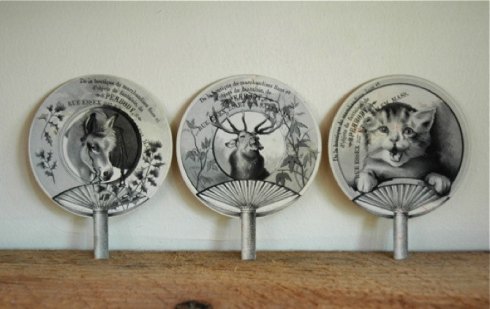
And finally, some amazing pieces of advertising ephemera:  three advertising fans, in French, for the Peabody’s Dry and Fancy Goods Bazaar in downtown Salem.  Salem had a large and growing French-Canadian population in the first half of the nineteenth century, and I suppose this was the target audience for the fans, which feature a stag, a pony, and (of course), a kitten.


Calendar Girls

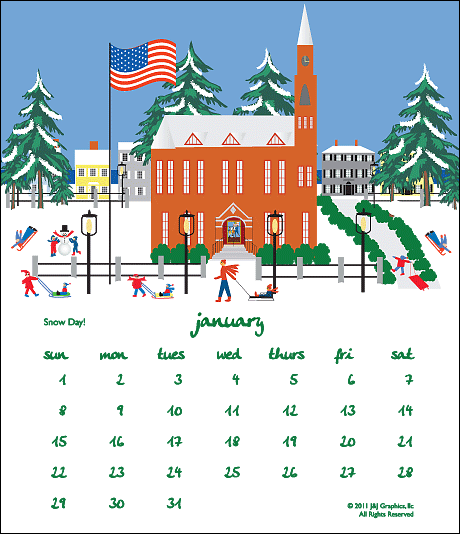
I’m a bit late for a calendar post, but then again I always buy my calendars after January 1st–sometimes well after January 1st.  While I’m not likely to engage in consistent sale-shopping or coupon-clipping, for some reason I get great pleasure from buying my annual calendars after they have gone on sale.  We usually purchase a “North Shore Folk Art” calendar from J & J Graphics at the Peabody Essex Museum shop for our refrigerator, and sometimes I even wait until they have their big January sale (this year it’s on the weekend of the 20th-22nd, definitely worth a visit if you’re in our area).  I’ll post January right here so I know what the date is until I get my own.

Upstairs in my office I generally pick something a bit more girly, whimsical, botanical, historical..whatever catches my eye.  Right now I’m liking this ethereal calendar from Irena Sophia, already on sale on Etsy!  I like the September and October girls–and Miss foxy February.

Calendars are an important form of ephemera that I haven’t featured on the blog yet, so why not now?  At the same time, they are among the timeliest and most artistic of genres.  And like all the pieces of paper we’ve examined over the last year–postcards, trade cards, book plates–they emerged as a mass-produced product in the later nineteenth century, coincidentally with the development of chromolithography.  I love the calendars from the “Penfield era”, from about 1890 to 1920, when the distinctive designs of illustrator Edward Penfield (1866-1925) graced the covers of magazines and the pages of the new poster calendars much more than those that came later with their Vargas-inspired pin-ups.  My “calendar girls” kept their clothes on!

Penfield calendars for 1897 and 1906 from the Library of Congress, above, and the work of some of his predecessors below (so you can see what an impression he made on turn-of-the-century graphic design):  an 1876 advertisement calendar for cigars and champagne, and two calendars by Boston-era publishers, also from the Library of Congress.

Calendars from Penfield’s fellow art nouveau illustrators  Louis Rhead (for Prang) and A.B. Wenzell for 1897 and 1899 are below, along with another rather less-artistic 1907 Boston calendar, for the beloved Necco wafers, all from the New York Public Library.


Wrapped in Wool

Getting all the Christmas stuff out of the house (which you should never do on New Year’s Day according to custom but always want to) leaves mantles and bookcases and other household surfaces looking bare.  I like the look of austerity after so much abundance in December, but still need to inject some warmth into my big old house.  I think I can get both with a few pieces of “cable knit ceramics”: pottery that looks like a sweater!  I’m late to this design trend (as usual) but it really appeals to me right now, in my post-Christmas, January mood. I can wrap myself in wool and my house too.

Here are some examples of what I’m looking at/for:

Cable-knit sweater bowls from Etsy seller reshapestudio.

“Knitware” collection tumblers and vases from Brooklyn potter Alyssa Ettinger.

“Knit Vases” from British artist Annette Bugansky.

“Wave” sweater vases from IlluStration.

If you want a soft sweater texture for your accessories rather than a faux surface one, you can buy wool-wrapped vases like the ones from Ferm Living pictured below, or easily make your own by wrapping, gluing, and/or sewing an old sweater sleeve around a cylindrical glass vase.  Pinterest can direct you to many sites with examples and instructions; I liked the ones below.

“Sweater vases” by Ferm Living at Velocity Art & Design; upcycled sweater-covered mason jars from DIY Crafts.

Now that we’re in the realm of textile arts, let’s move on from pedestrian vases into more exotic fare:  look at these amazing sweater-wrapped “domestic trophies” by Rachel Denny:

Red cable-knit deer head and blue cashmere “Clover” bunny at racheldenny.com

And finally, if you just want to sink into a cozy sweater yourself , how about this custom-made cable-knit slipcover?

Hand-knitted armchair slipcover by Etsy seller BiscuitScout.


House Plates

I picked up a desert plate at a flea market last week with an image of the Richard Derby House of Salem on it,  part of a series of 13 “Colonial Heritage” plates produced in 1976 by the Ridgewood Fine China Company in association with the Early America Society.  The artist Robert Franke was commissioned to paint a historic house for each of the 13 colonies in that bicentennial year, and the Derby House represented Massachusetts.  I have cabinets full of plates, even after selling off the transferware of my early collecting days, but this plate was cute, $7, and associated with Salem, so I did not hesitate very long.  Now that I have it, I’m thinking I need two more, as I always like to have three of everything, if possible.  I like Connecticut’s Webb House (center), and the Moffatt-Ladd House in Portsmouth, New Hampshire was quite important to me growing up nearby, so maybe I should have that too.

But then again, what would I do with these plates?  They are a bit cutesy/ye oldey; I better refrain and just stick with my one Salem plate.  Of course, this big decision got me thinking about houses on plates in general, and in history, as I remembered that most of my “romantic” transferware plates had houses on them, generally famous or fantasy houses, in bucolic settings, similar (but not nearly as nice) as these two examples from the collection of the Metropolitan Museum of Art.

Both plates were produced around 1830 by Job and John Jackson in the English Midlands for the American market:  nineteenth-century Americans loved  their house plates, if survivals are any indication.  I guess the English did too.  Below is a delftware plate made in Bristol in the 1760s and an early nineteenth-century French plate made for the British market, both clearly presenting houses, simple and grand.

Bristol delftware plate produced by Richard Frank and Creil pottery factory plate, both from the Victoria & Albert Museum.

Back to the present, some “modern toile” plates with houses by the great Scottish design firm Timorous Beasties, who make amazing wallpaper and fabrics, but also china.  Their “London Toile” pattern, while not exactly centered on a single house, certainly focuses on structures.  Somehow it reminds me more of the eighteenth-century delftware than the nineteenth-century toile-like transferware, as does the Juliska “Country Estate” charger below.

And here’s one last merging of architecture and ceramics, by Esther Coombs, a British illustrator who often uses vintage tableware for her canvases, always with charming results.


Salem Artisans on Etsy

By using the local search function on Etsy rather than merely searching for “Salem” items I can avoid all the witchcraft wares and get to the good stuff:  there are a lot of artists and artisans working in Salem and their creativity and productivity is impressive.  I haven’t done an Etsy post in a while and Christmas is right around the corner (apparently—so sad that we all seem to overlook Thanksgiving, one of my favorite holidays) so it seemed like  a good time.  Here’s a few of my recent Salem Etsy finds:  you can click on the image and go directly to the site.

Vintage recycled “Mr. Blandings Builds his Dream House” Journal/Sketchbook by Etsy Seller kissykissykatie.  This seller makes journals and sketchbooks out of old books and has a large selection on Etsy.  Mr. Blandings Builds his Dream House (Cary Grant and Myrna Loy!) just happens to be my favorite movie of all time, so this particular journal caught my eye.

“Fall Harvest” silver and gold stacking rings by Etsy Seller DangerousByDesign.  Beautiful minimalist jewelry in a mix of metals from this Etsy seller.

Spoon Busk Corded Corset by Etsy Seller JanesCorsets.  You’ve got to love a town that has a corset maker!

Red Lotus Medallion Little Girls Day Dress by Etsy Seller littlebirdsfly.  This seller produces dresses for little girls from really lovely not-so-little-girl fabrics.

“The Sweet Talk” knitted capelet by Etsy Seller Toil&Trouble.  I like the color combination of this “shoulder warmer” and it would come in handy in a house with 10-foot ceilings!

Soy candles in blood orange and absinthe by Etsy Seller WitchCityWicks.  Very distinct scents (anise, mead) as well as labels on these Salem-made candles.


Best Bats

Even though I don’t jump on the Halloween train here in Salem, I do decorate my house for the season.  I can’t help it; I am an habitual holiday decorator.  And I generally invite people over for Halloween night, not because I want to celebrate, but because I want them to hand out the bags of candy for the hours that it takes to appease the hordes of trick-or-treaters here in Salem while I hang out in the back.  So I like the house to look festive.  My fall decorating theme of the past few years—lots of owls everywhere—has become far too common so this year it’s all about bats.  Unlike most people, I don’t find bats even remotely scary or icky.  To me, they look cute and interesting and unique—a mammal that flies!  So I’m enjoying the various bats around the house; I may even keep them around until Christmas.

My decorating approach is both historically crafty  and acquisitive;  I look for historic images that I might be able do reproduce somehow—cards, garlands, decoupage–and I shop.  Since Etsy has been around I’ve done less and less crafting and more and more buying!  There are lots of digitized historic images of bats available, from the medieval bestiaries, early modern natural histories and nineteenth-century encyclopedias.  Here are some of my favorites, in chronological order.

Pierpont Morgan Library MSS 0081 (circa 1185) and 175 (circa 1500):  two hanging bats and a hybrid man (king?)-bat:

Seemingly very modern, but actually from the seventeenth century, is the Spanish artist Jusepe de Ribera’s Studies of Two Ears and a Bat from the collection of the Metropolitan Museum of Art.  Its motto:  Fulget Semper Virtus (Virtue Shines Forever).

But it’s in the next century that we get the best bats:  the bats of the Georges-Louis Leclerc, Comte de Buffon (1707-88.  Buffon’s pioneering and lavishly-illustrated (by French illustrator Jacques de Seve) 36-volume Natural History:  General and Particular (1749-88) contains illustrations of all sorts of bats, from long-eared to vampire (first named by Buffon), and as it was a reprinted frequently over the next century-and-a-half  it is a treasure trove for hunters of antique animal images.  Here are some of my favorite Buffon bats from the 1753-54 volumes of the Natural History, via the University of  Strasbourg:

A variety of bats from the 1799 edition of Buffon’s Natural History:


The Etsy seller antiqueprintstore has digitized images of bats from an 1831 edition of Buffon for sale; their postcard-sized prints can be used in a variety of ways.  I post them up on my parlor mirrors, along with the usual seasonal paraphernalia.

Tuesday Addendum:  I wanted to add this great 1919 Salem postcard, generously forwarded to me by the Salem native, author, collector, and researcher extraordinaire Nelson DionneI love it!


Out-of-Scale Squirrels

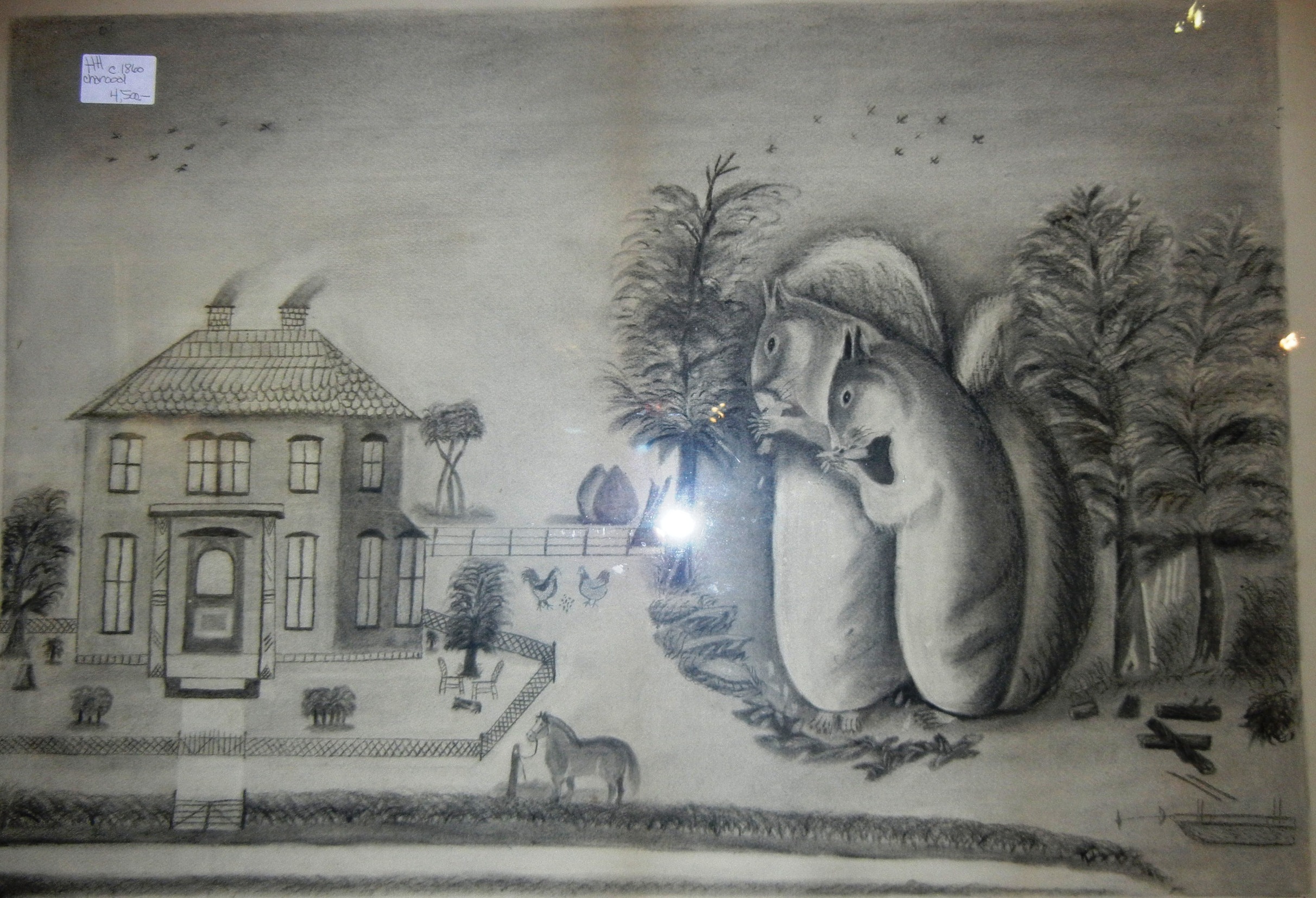
I saw this nineteenth-century charcoal drawing of GIANT squirrels at an antiques gallery in Maine a couple of weeks ago and haven’t been able to get it out of my mind.  Sorry for the quality of the photograph but my camera kept reflecting off the glass.  The dealer didn’t know anything about it, and it was priced at $4500, so this photograph is the only image I’ll ever have of these over-sized squirrels.

I find it charming in that nearly everything is out-of-scale: gigantic squirrels, big chickens, small house.  I’m not sure about the horse in the foreground as I can’t relate it to anything.  What does it mean?  Is the primeval forest encroaching on the tranquil homestead?  Or does the artist just like (or fear) squirrels?

While looking for more squirrel images I came across a few more with scale issues.  The first image is a late eighteenth-century print issued by the London publishers Laurie & Whittle entitled The Frail Sisters.  Obviously this is not great art (in fact, this post could be titled Bad Art at this point); the sisters are not particularly well done and they don’t look particularly frail.  On the knee of the sitting sister is a nearly unrecognizable too-tiny squirrel, which seems to be the center of attention despite its slightness.  The last off-scale squirrel is a deliberate photographic creation, and a much better image:  a man and a squirrel in Harvard Yard, taken by an anonymous photographer in the Spring of 1902.

A few images of more proportioned squirrels, made by artisans in the past and the present:  rabbits and a squirrel from William Vaughan’s Book containing such Beasts as are most useful for such as practice Drawing, Graveing, Painting, Chasing and for several other occasions (1664) and a very realistic-looking needle felted red squirrel by Etsy seller Daria Lvovsky.


Salem Etsy Picks for Summer

I haven’t done an Etsy post for a while, so I thought I would showcase some recent finds that are Salem-related or offered by Salem sellers. I was intrigued by my first item even before I realized it was set at the Salem train station (for lack of a better term); I have no idea what kind of search I was running, but it suddenly appeared!   The second item, an architectural print of the Colonial Revival “fireplace nook” in the dining room of the Caroline Emmerton House on Essex Street in Salem from the American Architect and Building News,  was featured in an earlier post entitled “Hand-drawn Houses” so it’s neat to see the Etsy listing. To fill my Salem basket I have added a Salem-made clock pendant, a pair of Daniel Low & Company vintage art nouveau butter knives, and a great old Essex Institute book on Salem ships.

11×14 Photographic print of Alternate Reality Train Station (8×10 also available) by Etsy seller remyphotographic.

Dining Room of Mrs. Emmerton, Salem, MA 1890 from Etsy seller stcroixarchitecture.

Antique Gold Steampunk Pendant by Etsy seller HeatherReidStudios.

Two Antique Sterling Butter SpreadersDaniel Low & Co. from Etsy seller RobertaGrove

1925 Old Time Ships of Salem from Etsy seller Frothingham Street