I’ve been working my way through all of the artists who were born or lived in Salem since I began this blog so many years ago, but one very notable and successful artist whom I have yet to cover is the sculptor John Rogers (1829-1904), chiefly because I don’t really care for his work. They have not aged well, but the “Rogers Groups” were important expressions of American material culture in the later nineteenth century: often Rogers is referred to as the Normal Rockwell of sculptors, and plaster castings of his best-selling works, depicting sentimental scenes of a young couple about to proclaim their marriage vows before a country parson and a convivial games of checkers “up at the farm,” sold thousands of copies for $15.00 each from 1860 to 1890. Even though Rogers studied in Paris like so many aspiring American artists, he firmly rejected the neoclassical sculptural style of his teachers—-and his time—in favor of a more accessible “vernacular” approach. He wanted to be a successful, popular artist more than an artist: he told his mother so, many times, in letters we can read at the New York Historical Society. The mother of John Rogers was Sarah Ellen Derby Rogers (1805-1877), and she is really my interest and my focus; but I can only get to her through him. And my interest in her started with a dress, the beautiful, ethereal, dress seemingly spun from air and mica (but really Indian muslin and silver) which she wore to her wedding reception in 1827.

 Indian Muslin and silver wedding reception dress of Sarah Ellen Derby Rogers, 1827, Peabody Essex Museum (Gift of Miss Jeannie Dupee, 1979).
This dress is in the stunning new Asian Export gallery of the Peabody Essex Museum. Since its opening about six weeks ago, I have snuck into see it (and several other things) about three or four times: I’m obsessed with it (and several other things)! The dress is beautiful, but I feel a connection to Sarah largely through her younger sister, Mary Jane Derby (Peabody), who was an artist and the author of a hand-written and -bound journal composed for her grandchildren which a lovely lady from Maine bought at a yard sale and sent to me: I know that I should turn this little book over to her family, or an archive, but I’ve held on to it simply because I cherish it. In the journal, Mary Jane writes about her wonderful childhood in the large mansion on Washington Street that she depicts in one her most alluring paintings. This is the mansion to which Sarah Ellen Derby Rogers would return after her marriage to John Rogers of Boston, and the birthplace of her son John Rogers (Jr.) in 1829.


Mary Ellen Derby, the Pickman-Derby Mansion at 70 Washington Street, c. 1825; Detroit Institute of Arts; a Moulton-Erickson Photograph from the 1880s, Cornell University Library—the house was demolished in 1914 for the present Masonic building; The Margaret, co-owned by Mary Jane’s and Sarah Ellen’s father John Derby, was one of the first American ships to reach Japan, in 1801, Old-time Ships of Salem, Essex Institute, 1917; The Rogers wedding announcement in the Salem Literary and Commercial Observer, June 9, 1827.
Mary Jane and Sarah Ellen Derby seem to have had a perfect Salem childhood growing up in this mansion during Salem’s most prosperous period, the granddaughters of Salem’s most prosperous merchant, Elias Hasket Derby, and the daughters of John Derby, Esq, part-owner of The Margaret, one of the first American ships (and THE first Salem ship) to dock in Japan. I’m so dazzled by her childhood (and her dress) that I make the cardinal historical mistake when I look at the post-marriage life of Sarah Ellen: I judge this life by my own standards and perspectives, rather than hers. By all accounts Sarah and her husband had a happy marriage (they had eight children, after all, of whom John Jr. was the second-eldest) but their lives together don’t seem to have been as comfortable as her Salem life. Despite his Harvard degree and Boston Brahmin pedigree, John Sr. was not a very good businessman: shortly after John Jr.’s birth in 1829 the young family was off to Cincinnati where Mr. Rogers attempted to establish a sawmill (and where Mary Jane met her husband, the Reverend Ephraim Peabody, while visiting her older sister) after this failed it was back to (western) Massachusetts for a silkworm enterprise, which also failed after a few years. There was a brief stint in New Hampshire, and then the (now much larger) Rogers family settled in Roxbury, with John Sr. taking up a post (a political appointment?) at the Boston Custom House which he held for the rest of his life. There was no Harvard for John Jr.: he was briefly established in a Boston apprenticeship before he ran off in pursuit of an artistic career. Perhaps this background explains his entrepreneurial attitude towards that career. All of this makes me feel sorry for Sarah: all those moves,, all those children! Did she have any help? Did she look back at her wedding reception dress and think: how did I get here? But I’m just projecting my own feelings on to her: she had a large and by all accounts happy family and a successful son who addressed all of his letters to that family to her, at its center, or heart (and it looks like despite all of those children, she still might have been able to fit into that dress).


Sarah Ellen Derby Rogers and her family, New York Historical Society Rogers Collection and the archived online exhibit John Rogers: American Stories where you can see more photographs, get more context, and read letters from John to Sarah; Checkers at the Farm—the second most popular work of Rogers—Smithsonian American Art Museum, Gift of John Rogers and Son; photograph of “Checkers”, Smithsonian via Essex Institute Lantern slide: E24240; Advertisement for “Checkers”, Harper’s Weekly 3 (March 18, 1876): 235.


 Fame AND Authority: Occasionally Mary Harrod Northend would present wistful Wallace Nutting-esque views, but mostly she was all about bringing antique material culture into the modern world; notices in Who’s Who in New England and the Architectural Record, citations in trade catalogs were common from 1915 on.

 Some of my Remond files; for some reason I’ve been keeping all of the genealogical information in a notebook I bought in Portugal.

 Signatures of Susan, Nancy, and Maritcha Remond on a petition to abolish the death penalty, 1850, Harvard Antislavery Petitions


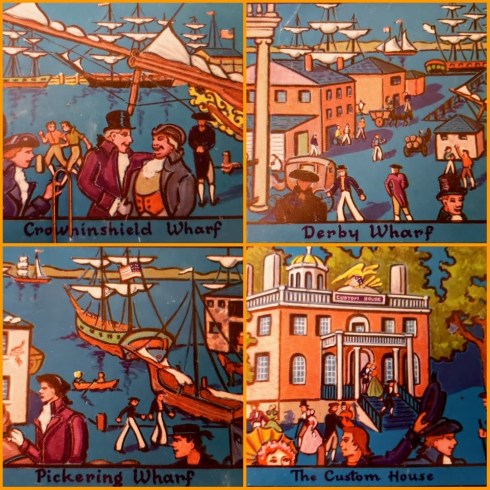


 The Hawthorne Hotel’s lobby and Main Brace cocktail lounge; Jonathan Butler, Harriet Shreve & John Pickering X in the Main Brace c. 1942 from Kenneth Turino’s and Stephen Schier’s Salem, Volume 2 (Arcadia Publishing, 1996); Larry O’Toole’s Salty Map of Cape Ann from


 A Treasure Trove of Silver in an old Salem house, from Walter Dyer’s Lure of the Antique (1910).

 Amazing photo of a lady (perhaps Mary Harrod Northend?) at the original location of the Hooper-Hathaway House (now on the House of the Seven Gables campus) inspecting some Old Salem wares in Dyer’s Lure of the Antique. The caption reads: “Don’t expect to buy these old treasures for a song. You are lucky to get them at all.” Once the Ward House was relocated and opened, it became the workshop of Sarah Symonds, who “perpetuated antiques” in the form of plaster-cast doorstops and mementos of famous Salem structures (Boston Herald, January 17, 1918). I think the days of buying antiques from guileless Salem homeowners were gone even by 1910, and in the next few decades the number of shops advertising in periodicals exploded.


 Salem Antique advertisement from the 1922 volume of the magazine Antiques, and from the collections of Historic New England.


 Atkinson’s Advertising, and her shop on the left-hand side of the Witch House, in photographs from the New Bedford and Cambridge Historical Societies, via Digital Commonwealth; Some items from the “Atkinson Collection” in Dyer: she was particularly known for her selection of Lowestoft.


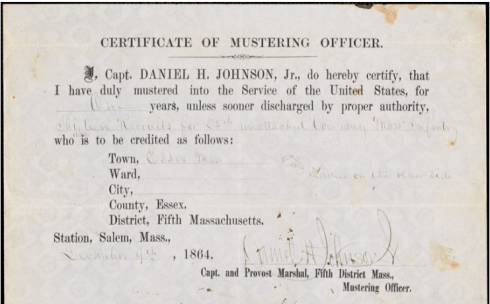 Recruiting posters from 1861-1863, New York Historical Society via New York Heritage; Town of Essex Civil War records, 1864 via Digital Commonwealth.

 Valentine’s Virginia vignettes, 1863-64, National Archives.


 Library Company of Philadelphia and Richard Frajola.

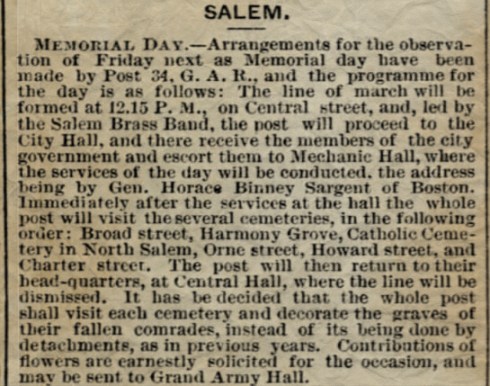

 The evolution of Memorial Day: C.H. Webber outfits participants for the occasion, Salem Register, May 19, 1870; Boston Globe May 1873, 1923, and 1944: the last GAR members in Massachusetts, including Thomas A. Corson of Salem, who died later that year at age 103.


 So interesting that this 1844 Polk Print (Library of Congress) mirrors the “Landsdowne” Portrait of George Washington from 1796: National Portrait Gallery, Smithsonian Institution.
 Two abolitionist “Moral Maps” which illustrate fears of the spread of slavery in the United States and North America, 1847-1854, Cornell and Yale University Libraries.
 Salem Register, July 5, 1847