Tag Archives: ephemera

Olympic Posters

It was nice to see and hear the traditional ringing of the bells in Britain yesterday, signalling the beginning of the London Summer Olympics. Nearly all of the British institutions that I regularly “visit” have their own take on the Olympics this summer:  the Museum of London has a general exhibit, while the British Museum focuses on medals and the British Library offers up Olympex 2012, an exhibition on collecting the Olympics. My favorite Olympic-themed presentation, thankfully very accessible on-line, is the Victoria & Albert Museum’s presentation, A Century of Olympic Posters . It’s so interesting to see how the posters reflected the times in which they were produced, while at the same time projected national images to the world which were carefully chosen by the host countries.

There was no official Olympics poster until the 1912 Stockholm Olympics, but it seems appropriate to begin with the program(me) cover for the first London Olympics, held in 1908 at the newly-constructed White City Stadium in Shepherd’s Bush.  This Olympiad was originally scheduled to be held in Rome, but the eruption of Mt. Vesuvius diverted it to London. It’s a nice nostalgic image, and you can see the White City in the background.

The first official Olympics poster, printed in 16 different languages and alternative formats, was the work of Swedish artist Olle Hjörtzberg,. The original design, featuring completely naked athletes in a reference to the ancient Olympics, was replaced by this version, with its strategically-placed streamers, but this was a bit controversial too.

After a long break due to World War One, the Olympics resumed in war-devastated Belgium for the 1920 Antwerp games. Maybe it’s just my own national bias, but that looks like a very prominent American flag on the poster:  perhaps an expression of gratitude for the timely entry of the US into the war?  The poster for the 1924 Paris Olympics by Jean Droit has become iconic, and we first see the five Olympic rings representing the continents of the world on the posters for both the 1928 Olympics:  summer (Amsterdam) and winter (St. Moritz).

The poster for the 1932 Los Angeles Olympics, the first to be held outside of Europe, looks a bit odd to me:  apparently the artist Julio Kilenyi sculpted the figure and then photographed it, and I’m not sure how the lettering was produced.  There’s very little sense of place here; it does not read Los Angeles or America to me, but it’s interesting that “California” had to be added.  I suppose that the City of Angels was not yet the international city that it would become.

Few images are as ominous as the official poster for the 1936 Berlin Olympics with its menacing Nazi symbolism and the Four Horsemen, which can only be seen as the Four Horsemen of the Apocalypse in historical perspective.  And then there are two very similar, one might say identical, posters from the canceled 1940 and 1952 Helsinki Olympics.  Clearly Finland–and perhaps the world–decided to pick up where they left off.

There is some semblance of place in the Helsinki posters, but I think that emphasis becomes pronounced in the post-war era, beginning with the image of the second British Olympics, the so-called “Austerity Olympics” of 1948. Jumping forward to the early 1960s, the sense of place seems to overwhelm the sheer athleticism of the earlier posters in the images from the 1960 and 1964 Olympics in Rome and Tokyo.

Of course, the images get more abstract and symbolic in the later 1960s:  the poster for the Mexico games represents the psychedelic age perfectly, as does one of the slightly-cynical images of the 1976 Montreal Olympics.

The posters for the more recent games just don’t seem as textured to me as those from the past, although I really like the official poster #1 from the 2000 Sydney games, “Peace Roo”, designed by David Lancashire. The trend seems to be for whole series of posters to be produced rather than just one, representing individual sports as opposed to the entire event. This was certainly the case for the Barcelona Olympics in 1992, which was represented by over 50 posters, and the organizers of the third London games commissioned posters from 12 eminent British artists. Pictured below is “For the Unknown Runner” by Chris Ofili, who used the vase outline to reference the Greek origins of the games.


Clapboard Castles

I know that the great American photographer Walker Evans (1903-75) liked Greek Revival houses, factories, main streets, roadside advertising, picture postcards, and people from all walks of life, but I think he really, really liked hotels. In the vast Walker Evans Archive at the Metropolitan Museum of Art, there are many images of hotels, large and small, and I’ve recently come into possession of a Fortune Magazine article from August 1949 in which he photographs and writes about some of the most famous New England resort hotels of the last century. In “Summer North of Boston”, Evans refers to one of these grand hotels, the Poland Springs House in South Poland, Maine, as “the nation’s uttermost dream of secular grandeur, this clapboard castle, turreted, porticoed, balustraded, oriflammed”. And when you see the photographs of this sprawling hotel (erected in 1876 and destroyed by fire in 1975), you know just what he means.

Scan from “Summer North of Boston” by Walker Evans, Fortune Magazine, August 1949 and original photograph and c. 1910 postcard of the Polar Springs House from the Walker Evans Archive, Metropolitan Museum of Art; 1894 menu from the Polar Springs House, New York Public Library Digital Gallery.

I really wish I had seen this amazing building before it burned to the ground in what all the accounts describe as a “spectacular” fire–a fate that it shared with most of the grand hotels in Evans’ article.  His “north of Boston” encompasses a triangular region between the North Shore towns surrounding Salem in the south, Bar Harbor, Maine in the north, and the White Mountains of New Hampshire in the west. Within this area were the New Ocean House in Swampscott (1884-1969), Oceanside in Magnolia (a village of Gloucester, Massachusetts:  1876-1958), Wentworth-by-the-Sea in New Castle, New Hampshire (built in 1874 and still standing, though some people think its recent “restoration” was more of a reconstruction), the Samoset in Rockland, Maine (1902-1972), and the Mount Washington Hotel in Bretton Woods, New Hampshire (built in 1902 and still majestically and miraculously intact).

The New Ocean House, Oceanside, Wentworth-by-the-Sea, and the Samoset by Walker Evans, and the Mount Washington Hotel at the time of the 1944 Bretton Woods International Economic Conference by Alfred Steiglitz, Time Life Pictures/Getty Images.

Of all these American castles it is the Wentworth with which I had the closest connection:  I grew up nearby and actually attended my senior prom at what was then almost a relic.  The building experienced a conspicuous decline in the later 1980s and 1990s, becoming the focus of the national preservationist movement, before it was rescued and rebuilt after 2000.  It has lost its hyphens and become the Marriott Wentworth by the Sea.

The Wentworth in 2000 and today; the BEST book for the architecture and culture of the grand resort hotels of coastal New England:  Bryant Tolles’ Summer by the Seaside.  The Architecture of New England Coastal Resort Hotels, 1820-1950 (2008)


Playing with Fire

Francis Bacon heralded the compass, printing, and gunpowder as the three European (really Chinese) inventions that changed the world, but he also had words of praise for another Renaissance (Chinese) innovation:  fireworks. Like gunpowder, fireworks represented the Promethean feat of his age:  stealing fire from heaven, and in both his Essays (1612; “On Masques”) and The New Atlantis (1627) he references the achievement:  we represent also ordinance and instruments of war, and engines of all kinds: and likewise new mixtures and compositions of gunpowder, wildfires burning in water, and unquenchable. Also fireworks of all variety both for pleasure and use.

I’m not sure what the recommended use of fireworks was besides pleasure, but I thought I’d indulge in a brief (and very Eurocentric) illustrated history of fireworks for the beginning of our July 4th week.  As always, when I compare the past and present, I’m struck by the artfulness of the former:  fireworks displays from the Renaissance through the nineteenth century seem to have been as much focused on a flagrant display of machines on the ground as light in the sky. As evidence, look at the elaborate seventeenth-century (Italian, of course) creation below, and an illustration from John Babington’s Pyrotechnia.

Engraving by Lodovico Ottavio Burnacini (1636-1707), courtesy Victoria & Albert Museum, London; John Babington, Pyrotechnia (1635), courtesy Folger Shakespeare Library.

Fireworks demonstrations in Europe are first recorded in the fifteenth century, so two centuries later they are not quite the marvel they once were and the “pyrotechnists” had to stage ever-more elaborate displays in order to impress at every royal and national event:  weddings, coronation, victories in battles and wars. Views of London fireworks celebrating the English victory at the Battle of Boyne in Ireland in 1690 and the Peace of Aix-la-Chapelle in April of 1749 are below;  the latter celebration definitely had its highs and lows. The high was the first performance of Handel’s Music for the Royal Fireworks, while the “low” was a firework-sparked fire which burned the central pavilion to the ground, accompanied by a swordfight between the pyrotechnist-architect of the performance, Giovanni Niccolo Servandoni, and the organizer of the event, the Duke of Montagu.

Night-time fireworks celebrating William III’s victory at the Battle of Boyne, 1690, British Museum; two views of the fireworks and fireworks pavilion celebrating the Peace of Aix-la-Chapelle, April 27, 1749, British Library and Victoria & Albert Museum.

In the nineteenth century, fireworks celebrations look a bit more recognizable (boring), so I’m going to shift to ephemera and fireworks-related items.  From either end of the century, some great British trade cards and a beautiful cover of Lippincott’s Magazine by Will Carqueville.

Trade cards from the British Museum and British Library; Lippincott’s cover from July 1895, Victoria & Albert Museum, London.

Back to the art of fireworks for the last century:  Eric Revilious’ amazing fireworks design for Wedgwood, commemorating the 1937 coronation of King George VI on a coffee cup, and a recent photograph by Sarah Anne Johnson.

Eric Revilious mug for Wedgwood, 1937, Victoria & Albert Museum, London; Chromogenic print with applied photospotting ink, acrylic ink, gouache, and india ink by Sarah Anne Johnson, New York Public Library Digital Gallery.


The Pied Piper

The Catholic liturgical calendar reveals that today is the day of the martyred saints John and Paul, the day on which (in 1284) several late medieval sources report that a man wearing a multicolored cloak strode into the small town of Hamelin (Hameln) in lower Saxony, and upon the request of the townspeople, took up his pipe and played a tune that lured all of their troublesome rats out of town and to their deaths. The piper returned for his payment, and when rebuffed, went away and then returned yet again, this time wearing the dark green cloak of a hunter.  He picked up his pipe again, and played a tune that lured Hamelin’s children–130 children in all–away, never to return.  And so the piper got his revenge, and a community lost its children for failing to pay its debt.

Engraving by Henry Marsh after John La Farge, 1868, Metropolitan Museum of Art, New York; 1930 Hameln postcard, Casas-Rodriguez Collection.

Such a dark story, and a source of puzzlement ever since its rediscovery and publication by the Grimm Brothers in the  nineteenth century.  Actually it never really disappeared; there seem to have been variant “rat-catcher” stories in circulation all over central Europe, and even in Scotland.  But the Grimms spread the tale far and wide, and Robert Browning’s 1844 poem made it even more popular.  Given the prominent role played by RATS in the narrative, it is an easy connection between the loss of the children and the momentous mortality of the Black Death, but the chronology doesn’t work:  the story dates to almost a century before the arrival of the plague in Europe.  In any case, the earliest references to the Pied Piper don’t even mention rats; they first appear in the sixteenth-century Zimmern Chronicle. The other references from that century, a time not only of periodic plague but also religious wars and witch hunts, seem to be transforming the piper into either the Devil or the grim reaper, leading the children in a “dance of death”.

The haunting Dance of Death at the end of Ingmar Bergman’s 1957 film The Seventh Seal.

Robert Browning’s poem, based on the version of the Pied Piper contained in Nicholas Wanley’s six-volume Wonders of  the Little World; or, A General History of Man (1677), somehow presents alighterversion of the story while still maintaining all the dismal details. I think this is because of all the colorful illustrations in the many Browning editions:  by Kate Greenaway (1888), Hope Dunlap (1910), and Margaret Tarrant (1912), among others.  Browning also has a similar “tribe” of people resurfacing in far-east Transylvania, a reference to Ostsiedlung, the eastward migration of the Germans in the high middle ages, a more likely basis for the Pied Piper tale.

As is always the case, folklore serves up useful metaphors to the present, for both social and political commentary. The first half of the twentieth century used the piper for a variety of messages: in two very timely (and different!)  American images, he is leading a pack of criminal and/or radical European immigrants across the sea and a group of children gardeners after World War I, while in Germany, he is a leftist devil, leading the fledgling German republic Into the Abyss.

Anti-immigration and US School Garden Army posters (1909 & 1919), Library of Congress, and “Into the Abyss” poster by Theo Matejko (1919), Victoria & Albert Museum, London.


The Queen Pitches

I must admit to indulging in a bit too much anniversaic history of late but the Anglophile in me cannot resist today’s anniversary of Queen Victoria’s accession (in 1837) especially as her successor just had such a big show. I’ve just discovered the most interesting Salem connection as well:  the Queen’s third cousin, Dr. Ernst Bruno de Gersdorff, left his native Germany shortly after his graduation from medical school and in the midst of the revolutions of 1848, and wound up here, where he began what looks like a very successful homeopathic medical practice and married the sister of one of the wealthiest and most prominent men in town, Judge Joseph Choate, who would later be appointed American ambassador to Great Britain!  A small world of connected people in the transatlantic Victorian Age.

It’s the Queen’s day, not the doctor’s, so I want to pull up some images from my teaching files, featuring the very commercial Victoria as pitchman to the world, at the very peak of the British Empire.  Here is the Queen/Empress of India/safeguard of the Constitution selling oats, soap, stoves, cloth, and cigarettes (produced by both British and American manufacturers) in the 1880s and 1890s.

Victorian advertising ephemera from the John Johnson Collection at the Bodleian Library, Oxford University, the British Library, the British Museum, Duke University’s Digital “Emergence of Advertising in America” Collection, and the New York Public Library Digital Collection.


Salem and the War of 1812

On this day 200 years ago President James Madison declared war on Great Britain, commencing the War of 1812, a conflict that must have meant very different things to different people.  I imagine that Canadians viewed the War as an attempted land grab by upstart Americans and I know that the British viewed it as an annoyance by pesky Americans occurring when the far greater threat, Napoleon, deserved all of their attention.  As an English historian, I never really gave the War of 1812 much consideration, but living here in Salem one can’t help but see its lasting impact.  The people of Salem in particular, and coastal New England in general, were bitterly opposed to the War, nearly to the point of secession.  They believed that it would spell the end of their commercial ascendancy, and they were right.

Salem and other ports up and down the Eastern seaboard had already suffered from the policies of the preceding Jefferson administration, most notably the Embargo Act of 1807, and Madison’s war was seen as a continuation of these anti-commercial (and anti-American?) policies.  One of the most often-cited causes of the War, the impressment of thousands of American seamen by the British Navy, apparently did not rally Salem to the cause, if this 1813 Salem Gazette article is any indication.

I’ve cropped a much larger document from the Library of Congress; it’s difficult to read from the scan, but this article consists of two comparative columns regarding the fates of “Impressed Seamen from Salem” (their parentheses, not mine):  the official story and then “the facts”, which seem to conclude that the seamen in question were simply deserters or otherwise unaccounted for.  This article is implicitly (explicitly?) accusing the US government of perpetuating a hoax on its citizenry in order to rationalize war with Britain, an accusation that doesn’t seem very extreme if you examine the words and deeds of Salem’s opposition Federalist party over the previous decade.  Salem’s leading Federalist was the eminent Timothy Pickering (1745-1829), former Secretary of State, Secretary of War, Senator and current Congressman, pictured below in a contemporary caricature of the Hartford Convention, comprising the New England opposition to the War. Kneeling before King George III in the center, Pickering is given the words:  I, strongly and most fervently pray for the success of this great leap which will change my vulgar name into that of my Lord of Essex. God Save the King.  No wonder that he and his associates were accused of being “Blue-Light Federalists”,  traitors who signalled to British ships with blue lights from the New England shores.  The Federalist Party would never recover from that accusation, in Salem or elsewhere.

Besides political opposition, the other major role played by Salemites during the War of 1812 was that of more proactive privateering.  Captain George Coggeshall’s History of the American Privateers and Letters-of-Marque during our War with England in the Years 1812, ’13, and ’14 (1844) is full of the exploits of Salem privateering vessels, including the Polly, the Snowbird, the Buckskin, the Montgomery, the John, the Revenge, the Dolphin, and the justly-famous Fame.  I particularly liked this passage about the Dolphin which Coggeshall culled from the Salem Gazette:  the privateer Dolphin, after a successful cruise of 20 days, returned to Salem on the 23rd of July.  The Dolphin has taken six prizes without receiving the smallest injury.  She was reportedly chased by the English at one time for 24 hours, but finally escaped. She has treated her prisoners with the greatest kindness. In rowing away from men-of-war, she found great aid from their voluntary assistance.  The prisoners said they had much rather go to America than return aboard a British man-of-war.”  The Fame had similar success before her shipwreck in 1814, and a reproduction Fame has been embarking on cruises around Salem Harbor for nearly a decade.  Her Captain, Michael Rutstein, has recently published an illustrated history of Salem privateers entitled The Privateering Stroke:  Salem’s Privateers in the War of 1812.

George Ropes, The Launching of the Ship Fame, 1802. Courtesy Peabody Essex Museum, Salem.

Ultimately what become known as the War of 1812 ended in a draw in 1814, with lessons learned on both sides.  For the Americans, I think the most important lesson was:  it’s not enough to just grow or sell things, we’ve got to MAKE things (like Great Britain).  So Salem’s commercial heyday was over, but its industrial era was just about to begin.

John Archibald Woodside, We Owe Allegiance to No Crown, 1814:  part of the current exhibition at the National Portrait Gallery:  1812A Nation Emerges.


Ever Eglantine

I’ve got roses on the brain, but not just any rose, eglantine roses, a wild, shrubby variety (otherwise known as sweetbriar or Rosa rubiginosa or eglanteria) at once very common but surprisingly elusive now.  I’ve been thinking about these roses for several reasons.  It is late May, and my roses are about to bloom, and I’ve come to the realization that I just don’t like several of them:  hyper-hybridized varieties that let me down every summer. Too pumped up and showy.  I want to go back to basics, and the eglantine rose is a very old rose, pared down and rambling, with a lovely scent. Chaucer wrote about this rose, as did Shakespeare, and Elizabeth I adopted it as her favorite symbol.

A beautiful sweetbriar rose in the Cloisters Garden.

So I have personal reasons for thinking about the eglantine rose, but also scholarly ones.  Summer classes start this week, and after an administrative semester, I’m back to teaching (gratefully): a course on “Shakespeare’s England” and one on Renaissance art, science and technology.  Content from both will probably appear in future posts, and the eglantine rose definitely ties in to the first, because “Shakespeare’s England” was largely Elizabethan England, and Elizabeth loved eglantine roses. The last Tudor had her family emblem, the Tudor Rose, and she used it often, but she adopted the more natural eglantine, symbolizing royalty and chastity, as a personal device, particularly after she had forsaken marriage in favor of “marrying England”.  The “Phoenix Jewel”, from about 1574, show Elizabeth surrounded by intertwined Tudor and eglantine roses (as the Virgin Queen, she preferred white), though in the more public “Phoenix portrait”, from about the same period, she is holding the Tudor Rose. Almost two decades later, William Rogers’ print “Rosa Electa” shows her with the Tudor Rose on one side (left) and the eglantine on another:  at this last phase in her long reign, she was widely associated with eglantine roses, even sometimes referred to as the Eglantine.

The Tudor Rose in BL MS Royal 11 E xi, ff. 2v-3 (a canon for Henry VIII); The “Phoenix Jewel”, circa 1574, British Museum; The “Phoenix Portrait”, attributed to Nicholas Hilliard, c. 1575, National Portrait Gallery, London (on loan to the Tate Museum since 1965).

More visual evidence of the first Elizabeth’s association with eglantine roses is her court painter Nicholas Hilliard’s miniature, Young Man among Roses (1585-95), in which a young courtier (often identified as Robert Devereux, the 2nd Earl of Essex) pays tribute to her simply by standing among eglantine roses (with his hand on his heart).  And then there is George Peele’s exhortation to his fellow Englishmen and -women to wear eglantine, and wreaths of roses red and white put on in honor of that day, for her Accession Day, November 17.

Nicholas Hilliard, Young Man among Roses (1585-95), Victoria & Albert Museum, London.


After Elizabeth, the eglantine rose continues to be admired, though perhaps not with the symbolism it had before. It’s a simple, country rose, contrasted with more extravagant varieties:  natural, wild.  Like all roses, it acquires all sorts of romantic associations in the eighteenth and nineteenth centuries, only to be turned into a tobacco brand in the twentieth!

“Rosa Eglanteria Zabeth” (Queen Elizabeth’s Eglantine Rose), Pierre-Joseph Redoutélater 18th century;  The “Wild Rose”, W.L. Ormsby lithograph, NYPL; a lithograph by Jane Elizabeth Giraud from “The Flowers of Milton”, 1846, NYPL; Tobacco Card, Duke University Emergence of Advertising Digital Collection.

The prettiest paper eglantine roses seem to be on paper:  William Morris chose the rose and its vine for one of his earliest, and most popular designs, “Trellis” (1864), and there is a lovely, simple pattern reproduced by Carter & Company Historic Wallpapers based on paper found in a house in Georgia that dates from the 1840s.  I love this company’s slogan:  History repeating itself….

“Trellis” wallpaper by William Morris, Victoria & Albert Museum, London; “Marietta Eglantine” wallpaper by Carter & Company Historic Wallpapers, LLC.


Chestnut Street Days

In 1926, the year of Salem’s tercentenary, the residents of Chestnut Street threw open their doors and some old clothes and welcomed the world into their stately homes, setting the precedent for four more “Chestnut Street Days” over the next half-century. This weekend the tradition will be revived with “May Day on Chestnut Street”, an event to benefit Hamilton Hall, during which ten homes on the street will be open to ticket-bearing guests.  In a departure from the original Chestnut Street Days and the other big Salem house tour, Christmas in Salem, this tour promises to be a more low-key affair, with an emphasis on history and architecture rather than dress or decoration.

Brochures for this weekend’s tour of Chestnut Street, and the second Chestnut Street Day, held in 1939, featuring Samuel Chamberlain’s etching “Springtime in Salem”.

I am fortunate to live on this storied street and it is a privilege (and pleasure) that I never tire of, even as the tourist trolleys stop outside my bedroom window every half hour.  I see Chestnut Street as an early (circa 1805) planned development, as Salem’s merchant princes sought to distance themselves from the busy wharves from which they conducted their business and live only amongst themselves, on a big broad street of boldly American (Federal) houses, filled with the wares (to varying degrees) that they brought home from the East.  It is fortunate that the street and its houses were built, as both kept old money and old families (never a bad thing!)  in Salem as the city experienced maritime decline and industrial growth and its accompanying dynamic change later in the nineteenth century.  By the end of the century, the street had become one of the symbols of “old Salem” and a succession of postcards, produced for a national market, reinforced that image, while at the same time freezing the street in time.

Images (mostly cards) of Chestnut Street in (somewhat) chronological order, 1890s-1980s.

The first picture above, which I included in one of my very first blog posts, shows the opening of Chestnut Street–looking west–about 1891. You can see Samuel McIntire’s amazing South Church on the right hand side, and the second photo shows the church in its entirety.  It burned down in 1903, to be replaced by the Gothic Revival structure that you see immediately above, which also burned down, in 1950.  Apparently it was recognized that the lot was cursed at that time, so it remains a church-less “McIntire Park”.

Detroit Publishing Company postcard of Chestnut Street looking west, 1906, in black-and-white and colored versions.  These were reissued for many years as far as I can tell.  The last card is a rarer western perspective, printed in Germany and published by A. Kagan of Boston, Massachusetts.  The personal note on the back is dated 1918, but I can’t imagine American publishers ordering German postcards in 1918, so it must have been around for awhile.

The eastern perspective–looking towards the harbor and the center of town–is more common.  Above are examples from the first two decades of the twentieth century.  The “car card” is always striking because of its head-on view, but also because Chestnut Street has been one-way in the other direction for decades.  The canopy of elms always makes me sad; I have no idea why chestnut Street was lined with elms rather than chestnut trees, other than the fact that all great American streets seem to have been planted with elms in the nineteenth century.  Much of this land was an orchard belonging to the Pickering Family before Chestnut  Street was laid out; maybe chestnuts reigned at that time.

A bit further up the street and a bit later, but still looking east. The middle card (courtesy of the Dionne Collection) appears to have been taken in the 1950s, while the last card is from the 1980s.  Only the cars change!

I can’t resist closing with my own reissue of Felicie Waldo Howell’s (Mixter, 1897-1968) vibrant painting of the first Chestnut Street Day:  Salem’s 300th Anniversary, Chestnut Street, June 1926.  Such a great image–and a reminder that streets are all about people as well as houses.


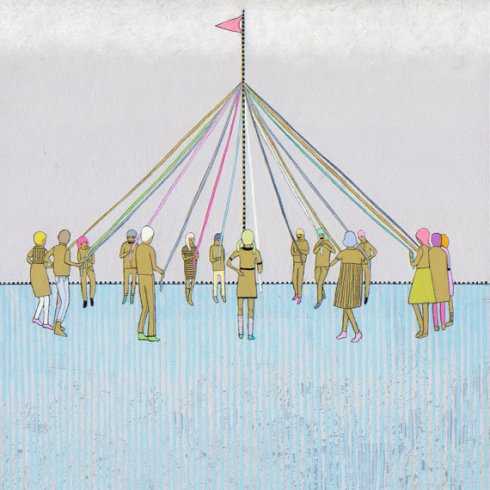
Maypoles

When I was a very little girl my family lived in a small village in central Vermont which had no preschool program, so my parents sent me to a private school the next town over.  My memories of this school are positively idyllic:  reading Peter Rabbit, singing, games, toast.  A singular memory, reinforced by a photograph of me looking like a little dark-haired Swiss girl in a dirndl, is of a Maypole, and going round and round it holding my ribbon.  Because of the Maypole, May Day was the most special holiday to me as a child, and I’ve tried to keep it up as an adult, with wreaths and May wine (made with sweet woodruff, a great spring plant) and a general spirit of merriment.  But I’ve yet to erect a Maypole in my backyard.

It is interesting to me that my experience with the Maypole happened in Vermont, the least puritanical of all the New England states. The Puritans hated Maypoles, and any ceremony or ritual or image that detracted from the word of God.  So dancing around the Maypole, a very popular custom in the medieval and Tudor eras, was prohibited during much of the very Puritan seventeenth century, both in old and New England.  There was definitely a revival in the eighteenth century, but it might have been too late for Massachusetts.  Thank goodness I had my Vermont childhood!

It’s hard to separate survival and revival in the history of the Maypole, but the custom seems to have been alive and well in the Elizabethan era, as illustrated by these amazing painted glass panels from the later sixteenth century depicting a Maypole and the various “Morris Dancers” who danced around it on May Day.  They are from Betley Hall in Staffordshire, and were somehow saved from Puritan iconoclasm and incorporated into a later house.  May Day celebrations seem to be part of every romantic history of the Elizabethan era, if only because the first Elizabeth makes a perfect May Queen.

Betley Hall glass panels, later sixteenth century, Victoria & Albert Museum, London; “May Day in the Reign of Queen Elizabeth”, Hodgson & Graves print, c. 1836, British Museum, London.

After the English Revolution, the maypoles of England reappeared, including a famously tall one in the Strand in London (to which, according to Walter Thornbury’s “St Mary-le-Strand and the Maypole” , Old and New London, Volume 3 (1878), Sir Isaac Newton attached his telescope) and in the center of the weeks-long “May Fair” in the Mayfair neighborhood.  The Great Fire and the great rebuilding of the later seventeenth and and eighteenth centuries removed maypoles from the streets of London but the custom apparently continued, as they appear in print and paintings as symbols of “Merry Old England”.  This particular symbolism seems to intensify in the nineteenth century, an age of dynamic change which threatened to sweep everything away that was both merry and old.  There is a definite revival of the Maypole motif in the later nineteenth and early twentieth century by the Arts and Crafts movement; as the old merrymaking custom endures, so too will traditional craftsmanship in the midst of mass production.

Country Dances Round a Maypole, Francis Hayman, c. 1741-42 (Supper Box Decoration at Vauxhall Gardens), Victoria & Albert Museum, London.

Edward Henry Corbould, May Day, 1873, British Museum, London; Kate Elinor Lambert, Woodcut device for the Stanton Press, 1921-22.

Another later nineteenth-century trend–the politicization of everything–also affected the maypole, which was appropriated primarily by the left side of the political spectrum, coincidentally with the association of May Day with workers’ movements.  Below are two illustrations of  a more modern Maypole:  around which monopolists and workers dance.

Frederick Barr Opper, the Monopolists’ May-pole (including lots of Vanderbilts), Puck Magazine, 1885 and Walter Crane, The Workers’ May-pole”, 1894, Library of Congress.

Back to basics:  of course, the survival (or revival) of the Maypole, in the nineteenth century and today, might simply be due to the fact that it provides entertainment for children, who probably see no greater meaning in its form than the focus of a simple dance in celebration of spring!  That’s my memory.

May Day in Central Park, c. 1905, Detroit Publishing Company, Library of Congress; May Pole by Jennifer Davis, Etsy.


Plant People

The chalkboard-painted backsplash in my kitchen( (which is really not a backsplash at all, a topic for another day), in a color called “peapod”, compelled me to find a few more spring green, pea pod accents for the room.  A simple search uncovered one of John Derian’s decoupaged mini-trays, featuring two people dressed in pea pods, an item that I’d seen before but never really took note of.  My curiosity about the source of the image led me to the blog of the New York Historical Society, which offered up more of Jerome B. Rice’s trade cards from 1885:  not only anthropomorphic peas, but a beet, onion, and potato as well!  Interesting that there is a Mr. Potato-body rather than a Mr. Potato Head, one of my favorite childhood games.

Jerome B. Rice Trade Cards from the Bella Landauer Collection at the New York Historical Society.

So now of course I forgot all about my kitchen and went off on a quest for anthropomorphic plant images.  It wasn’t a difficult quest, as I knew where to begin:  with the mystical medieval mandrake, a plant with a decidedly human root system which has long been the stuff of legend.  There are biblical references to it, as well as Shakespearean ones, and in between all the medieval herbals refer to the plant that shrieks or groans when it is pulled from the ground, a sound that is absolutely fatal to those who hear it, necessitating a dog-pulling technique if one wants to be bold enough to try.  All sorts of secret virtues, both magical and medicinal, are attributed to the plant, from the ancient era to Harry Potter.

Three views of the Mandrake:  Harley Manuscript 5294  (12th century) and Sloane Manuscript 4016 (15th century), British Library, and Hieronymous Brunschwig, Kleines Distillierbuch  (1500), Smithsonian Institution.

Now it is time for a distinguished late Renaissance plant person:  Rudolf II, Holy Roman Emperor from 1576 until 1612  (and avid cultural patron), depicted as Vertumnus, the Roman God of the seasons, by Giuseppe Arcimboldo.  You would think that Arcimboldo was on dangerous ground with this “portrait” but apparently Rudolf admired it–I’m sure that the latter knew what he was getting as this painting is very representative of Arcimboldo’s rather whimsical (strange?) works.  This is an image that never fails to amuse (repulse?) my students; it captures their attention at the very least!

Giuseppe Arcimboldo, Vertumnus (Rudolf II), 1590.  Note the pea pod eyelids!

Fast forward to the Victorian era and its obsession with flowers and their essence and meaning, very well expressed by J.J. Grandvilles Les Fleurs Animées (1847) in which a virtual army of flowers begs their commander Flower Fairy for permission to transform themselves:  “We are tired of this flowerlife. We wish for permission to assume the human form, and to judge, for ourselves, whether that which they say above, of our character, is agreeable to truth.”  They receive permission to join the human world, but the 54 etched and hand-colored plates that chart this evolution (devolution?) present them as beautiful but hybridized versions of humanity.

As far as I can tell, the  Grandville illustrations were issued as postcards in the 1870s and again around 1900, along with a veritable flood of flower people postcards on the market:  sugary sweet floral children and young maidens, which make Grandville’s flower girls look quite sophisticated and artistic.  Below is Miss Periwinkle, from a card dated 1900.

There are so many flower people out there from this era that I have to admit that I’m more interested in the rarer fruit and vegetable people, like the Rice pea pods that started my quest. Rice’s trade cards apparently initiated or reflected a trend of anthropomorphic crop images, as illustrated by the “cabbage girl” below (although what Dutch cabbage had to do with the flavoring this Baltimore company was offering I do not know), and a group of radishes from a British nursery in the 1890s.

The postcard manufacturers of the new industry’s golden age could clearly not resist the potential that “cantaloupe” (with or without an e) offered for plays on words, so we have several examples from the first decade of the twentieth century:  for a romantic attachment, and against:  we are too young, dear, we cantaloupe.

This last cantaloupe card is part of a series entitled “Garden Patch”, illustrated by E. Curtis for the prolific postcard publishers Raphael Tuck & Sons of New York City in 1907 and 1908. All of the cards in the series can be viewed here , including my favorites:  featuring a [water]melon, lettuce (be married), and a turnip (your nose is a little turn [ed]ip).  The latter is a bit of a stretch, but at least it gives us a full basket of vegetables.