Tag Archives: ephemera

The Power of the Printed Image

Most of the courses that I teach focus on the period in which printing technology first emerges, so I am constantly assessing the influence of print on the Renaissance, the Reformation, and nearly every aspect of early modern society and culture. Consequently I have a particular and professional appreciation for the Smithsonian Institution Libraries’ digital exhibition Picturing Words:  the Power of Book Illustration, which began its life as a “real”exhibition at the Smithsonian and on the road and then evolved into a virtual one. Ironically, I think most exhibitions that feature texts work better online than in rooms, and I bet this one does too:  you can get closer to the images, for longer, and come to appreciate the influence they must have had in their own time, and their continuing power in ours. The images in the exhibition are organized into three categories, inspiration, information, and influence, with an additional section of pictures which illustrate the process of printing illustrations from Gutenberg’s time to ours. I think that all the images are well-chosen, but for the purposes of this post I am limiting myself to just five illustrations, with a few more for context.

First up, from the Information column, a work I refer to often in all of my classes: the pioneering anatomical treatise by the Flemish physician Andreas Vesalius, De humani corporis fabrica libri septem, or “The Seven Books on the Structure of the Human Body” (1543).  In the Fabrica, Vesalius took on authoritative Galenism with the help of draftsmen from Titian’s workshop:  the result was a triumph for empiricism and a great example of the often-close relationship between art and science in the Renaissance. Several images are in the Picturing Words exhibition, but you can “turn the pages” of the entire text at the National Library of Medicine.  I love the title page, with Vesalius conducting a theatrical dissection, his face turned to us, the audience and readers, as well as the artfully placed skeletons and body parts.

As I am essentially materialistic at heart, the images from the exhibition that appeal to me the most are from the Influence category, as in influencing design and attracting consumers.  Asher Benjamin’s Practical House Carpenter has always been a favorite source for architectural images, and even though I’m about a century late for these particular products, I am quite drawn to these stoves and shoes. It’s important to remember in this digital age that print was at least as important to the Consumer Revolution as it was to the Scientific Revolution.

Columns, stoves and shoes:  images from Asher Benjamin’s The Architect; or, Practical House Carpenter, Boston: B.B. Mussey, 1853; Oriental and American Stove Works, Perry & Co., New York: The Van Benthuysen Printing House, 1874; Queen Quality Smart Shoes, Thomas Plant Co., Boston, 1910.

My last image is from the Inspiration section, but I have bypassed the medieval religious texts in favor of a page from David Pelletier’s The Graphic Alphabet (1996).  The link between the two is through the use of letterforms as illustration, an interesting feature of the exhibition:  ornamented capitals in the past, letters as ornaments in the present.

David Pelletier, The Graphic Alphabet.  New York: Orchard, c. 1996.


Pendleton Prints

I have long been fascinated with printing in all its forms, and became acquainted with the work of the Pendleton Brothers of Boston when I was researching a long-lost Derby house here in Salem.  The daughter of the house, Mary Jane Derby, entrusted her beautiful painting of it to William and John Pendleton, and they produced an equally beautiful lithograph with their cutting-edge process. This print led me to other prints, and explorations in the vast collections of the Boston Public Library and Boston Athenaeum.  There is something about the Pendleton’s work, particularly their images of buildings, that I find really captivating:  it’s almost photographic, but not quite; it is both realistic and romantic at the same time.  Here is the Derby House, now the site of the Masonic building on busy Washington Street, along with several other lost Salem houses, preserved forever by the Pendletons.

These prints of famous Salem houses, all from the collection of the Boston Athenaeum and all gone, were produced by the Pendleton shop in the 1830s, early days in the history of lithography.  The Derby house was taken down around 1915, after its Washington Street neighborhood had transitioned from residential to commercial. In the center, the Benjamin Pickman house was built around 1748 and taken down at the beginning of World War II, when it was in a dilapidated state.  The  “Lafayette Coffee House”, built after 1796 as a residence for the famous Salem merchant William “Billy” Gray, lasted until the 1970s, though it was unrecognizable at the end. The perennially-unsuccessful East India Mall/Museum Place/parking garage was built on its site.  This post isn’t really about these houses or their unfortunate destruction, but I can’t resist showing images of their later incarnations, strong contrasts to the Pendletons’ pristine structures.

Two Frank Cousins photographs of the Derby and Gray (Lafayette Coffee House & later the Essex House, a hotel) houses, Duke University Library, and in the  center, a HABS photograph from 1940 of the rear of the Pickman House, Library of Congress.

The Pendleton Studio in Boston was not in operation for very long (1825-1836) but nevertheless it seems to have been quite influential, both in terms of technology and the fostering of a community of artists, most prominently Fitz Hugh Lane.  Their images of Boston–individual buildings, wharves, streetscapes–demand a dedicated post, but I’ve got to sneak this lithograph of the Jonathan Morse house in Boston in here, because it is so charming, beautiful, Bulfinch, and sadly, long gone.

Jonathan Mason House:  Mt. Vernon and Walnut Streets, Boston. House built 1802, razed 1827.  C. Bulfinch, arch. Boston Public Library.

The Pendleton brothers were businessmen, and they didn’t just produce single-commission images of the region’s notable houses. Their oeuvre includes advertisements, song sheets, portraits of the well-known and the well-heeled, and curiosities, for lack of a better word. But they were not job printers, by any means. Two more humanistic examples of their work (well, in a way), and images that they themselves submitted to the Library of Congress are a phrenological chart based on the popular theories of Dr. Johann Spurzheim, founder of the phrenology craze that spread across America in the nineteenth century, and a print of Rembrandt Peale’s portrait of George Washington.

Pendleton’s Lithography prints from the Library of Congress, 1832 and 1827.


Election Day and Night

I am so very grateful that Election Day is finally upon us. I’ve been living in a world of division over the past many months:  divided family, divided household, divided department, divided circle of friends. Facebook has been absolutely unbearable in the last month or so–even more so than normal. Hopefully we can all move on no matter what the outcomes. All this early voting confuses and upsets me:  I think it’s adding to the divisiveness. Why can’t we just have one day, Election Day, when we all exercise our civic obligation and privilege at the same time?  If it’s a matter of access and opportunity, I would certainly support an Election Day holiday, but I think we should all vote on the same day and then celebrate our ability to vote on Election Night.

I’m very curious about the experience of voting in the past, and the speed by which news of the results reached the electorate. Few of my Americanist colleagues could give me any satisfactory insights into this, and my own knowledge of early modern Europe–and age when kings and queens ruled–is not much help.  I imagine that the experience of voting was very different in the cities and the countryside, and that it took weeks, if not months, to know the results before the telegraph and telephone. One colleague suggested we search through a database of early American newspapers to see when the election results reached Salem, and our findings were both predictable and surprising:  predictable in the sense that it clearly took several weeks to confirm the election of a president through most of the nineteenth century, surprising in the way they voted–over several days.  So there goes my criticism of the supposed “innovation” of early voting.  The logistics of democracy are often complicated, then and now.

My research into the mechanics of voting did turn up some great election materials, from a succession of campaigns and elections past, beginning with a lovely banner from one of the most contested elections of all time:  the 1800 race between Thomas Jefferson and John Adams. I love this banner from the Smithsonian, and wonder where it was displayed.

My election images are a mixture of materials:  from campaigns and periodicals primarily.  I would have liked to get inside the polling place, or on the streets just outside, but that was seldom possible. And I’m not even getting close to the present:  too divisive.  The past is safer.

Two very popular prints:  Election Day outside Independence Hall, Philadelphia, 1816, by Alexander Lawson, and James Polk trying to prove he is not pro-Catholic, 1844, both Library of Congress.

The telegraph delivers the results of the 1856 election & a Charles Maurand print of the celebrations following the election of Abraham Lincoln in the streets of New York, 1860, Harper’s Weekly; a metamorphic trade card for the presidential contest of 1876 between Tilden and Grant, Duke University Library Special Collections.

Inside the Polling Place:  voting in New York City, 1898 and a Jacob Riis photograph of a mock election, 1890, Museum of the City of New York.

The emergence of public opinion:  campaign cards for William Howard Taft and William Jennings Bryan from the 1908 election–before women could vote, of course, and a nation divided between Roosevelt, Wilson and Taft in 1912, Library of Congress.


The Spider and the Fly

A little tweet from one of my favorite history bloggers brought me to a charming web illustration in the collection of the Library of Congress and then I was off–there is nothing better than a parable, especially one as universal and flexible as the spider and the fly. There have been all sorts of illustrative variants on this age-old story over the centuries, and I must begin with my very favorite, John Heywood’s 1556 illustrated poem, The Spider and the Flie. I understand that literary scholars have little love for this poem, but it is a very illuminating historical source, and a window into a very contentious time.  Heywood was a passionate Catholic in a time of surging Protestantism:  he envisions this religious conflict as a war between devious Protestant spiders and stalwart Catholic flies, with insect allies on both sides. The Catholic Queen Mary (“Bloody Mary” to the Protestants) is portrayed as a housemaid, squishing spiders and sweeping England clean.

The inspiration:  a couple caught up in a web of romance on the sheet music cover of the 1901 song, “The Spider and the Fly”, J.D. Cress, Library of Congress.

More serious matters at stake:  illustrations from John Heywood’s Spider and the Flie (LondonThomas Colwell, 1556).  Heywood looks on as a Catholic fly gets caught in a web with a Protestant spider army approaching, and then as the maid/queen Mary rids England of the spider.

An emblem engraving from the later sixteenth century: print made by Johann Theodor de Bry, Frankfurt, 1592 (British Museum).

The satirical and metaphorical use of the Spider and the Fly parable only intensifies in the nineteenth and twentieth centuries, with new printing and printmaking technologies and the publication of Mary Howitt’s famous poem in 1829, with its leading line:  will you walk into my parlor?  But even before Howitt, the device was used by British caricaturist Thomas Rowlandson (1756-1827) to depict the central figure of his age, Napoleon:  pictured below surrounded by an army of European flies. After Howitt, cunning spiders armed with webs were everywhere, luring naive young me into taverns and the big city.

Thomas Rowlandson, “The Corsican Spider in his Web”, 1808, Metropolitan Museum of Art; a London temperance poster from the 1820s, Wellcome Library, London; a 1916 New York cartoon, New York Public Library Digital Gallery.

You can always count on Puck magazine for this type of anthropomorphic visual satire, and I found two “Spider and the Fly” illustrations among its archive of covers:  I’m afraid that the precise issue regarding the Interstate Commerce Commission escapes me in the first (1907) image, but the second one, from 1913, looks pretty timely.


Which Witch House?

One reason that I’ve been an ardent preservationist for most of my life is my belief that buildings hold extraordinary power–even more power, I think, than unbuilt spaces, no matter how beautiful. I can’t imagine a better example than Salem’s “Witch House” (more formally and accurately known as the Jonathan Corwin House), a structure that represents both the most tangible connection to the Witch Trials of 1692 as well as a symbol (and vessel) of Salem’s modern transformation into the “Witch City”. The Witch House seems to reflect the evolving aspirations and perceptions of the city that surrounds it:  for much of the nineteenth century, it was referred to as the “Roger Williams House”, a designation that tied it to the seventeenth-century minister who left intolerant Salem for free Rhode Island rather than the witch-trial Judge Corwin from a generation later. Freedom of conscience versus irrational jurisprudence.

The Witch House today and in an 1886 card by Edwin Whitefield, author/illustrator of Homes of our Forefathers.  Whitefield’s images seems to be based on that of Samuel Bartoll’s 1819 painting, in the collection of the Peabody Essex Museum.

The early architectural history of the Witch House is a bit mysterious (a study has been commissioned by the city, but I haven’t seen the results yet), but most experts believe that it dates from much later in the seventeenth century than Roger Williams’ time in Salem. All of the above images, those from the nineteenth century and just yesterday, might be idealized images of this fabled house. We do know that Jonathan Corwin acquired a structure in this location in 1675, and that he served on the Court of Oyer and Terminer which tried the accused “witches” of 1692. That fact alone seems sufficient for the house’s transformation into the “Witch House” much later, after it left the possession of the Corwin family in the mid-nineteenth century. More than anyone, the person responsible for this identification was George Farrington, an entrepreneurial Salem apothecary who definitely emphasized the witchcraft (rather than Williams) associations of his new place of business:  Farrington grafted a box-like shop onto the house and sold medicines in bottles with a flying witch insignia, anticipating the marketing strategies of Daniel Low decades later and many Salem businesses today. He also published images of  the “old witch house”, effectively establishing that identity.

The Witch House in the mid-nineteenth century:  very influential photographs by Frank Cousins of the front and rear of the house just prior to Farrington’s purchase in 1856 (the house had acquired a gambrel roof in the mid-eighteenth century), a Deloss Barnum photograph from the 1860s, after Farrington’s pharmacy had been attached to the house, an “Old Witch House” stereoview published by Farrington, and a Farrington medicine bottle from the 1880s as pictured in a recent ebay auction.  All photographs from the Robert Dennis Collection, New York Public Library.

For nearly a century, the Witch House was configured as a strange (maybe not for Salem) combination of business and tourist attraction and thousands (maybe more) of postcards were issued, fixing and broadcasting its identity. In the decades before and after World War I, when Daniel Low was marketing its witch spoon and other witch wares nationally, there seems to have been a marked increase in the number and variety of Witch House cards. There are also some interesting private photographs of the house from this era, confirming its conspicuous place in Salem’s urban streetscape.

Two photographs of the Witch House in the 1890s from the Schlesinger Library at Harvard, and postcards from 1900, 1901, 1906, 1908, 1911 & 1922.  Just a random sampling of many on the market!

The 1940s was a decade of transformation for the Witch House, when it came to represent preservation–but also profits: change and continuity. With the planned widening of North Street, a main thoroughfare in and out of Salem, the house was threatened, and its survival (along with that of the adjacent Bowditch House) became the rallying cry for the formation of  Historic Salem, Incorporated and its subsequent restoration under the direction of Boston architect Gordon Robb (who had worked on Colonial Williamsburg as well as another famous Salem seventeenth-century structure, the Pickering House). Moved to a more secure northwestern position on its lot, its shop detached and gables rebuilt, the Witch House was opened to the public in 1948 by the City of Salem, and it has been doing steady business ever since.

The Witch House in 1940 (HABS photograph by Frank Branzetti, Library of Congress), 1945 & 1948.

For more on the evolving perception, and structural history of the Witch House, see Salem’s Witch House:  a Touchstone to Antiquity (The History Press, 2012) by Salem architectural historian John Goff.


October Century

To set the tone for October, always a month of highs (my birthday, beautiful weather and scenery, baseball) and lows (Salem’s transformation into full-blown Witch City, baseball) for me, I am starting off with some lovely images from Century Magazine, the popular successor to Scribner’s which was distinguished by the quality of its illustrations and its emphasis on popular history (lots of Civil War memoirs, and Napoleon) and serialized fiction by the most renown authors of the day. It was published from 1881 to 1930, an era which was clearly a golden age of graphic design. Collaborations between notable authors and artists distinguished Century prior to World War I; one of my favorites was that of Julian Hawthorne, son of Nathaniel, and Harry Fenn on an article from 1884 entitled “The Salem of Hawthorne”. Fenn’s Custom House is below.

Another eminent Century author was Theodore Roosevelt, who penned several articles on the West in the later 1880s (with illustrations by Frederic Remington) and one on the heroism of the New York City Police Department after he had become its commissioner!

Most of Century covers are pretty sedate: more money, and emphasis, was invested in what was between the covers, and on advertising posters to sell each issue:  “coming attractions” for the literary world, a century ago.

Century cover and posters from the 1890s and 1910s, New York Public Library Digital Gallery.


Another Cartophilic Collection

I’ve posted on trade cards several times, and they remain a form of ephemera that I casually collect. It seems to me that these early business cards are among the least ephemeral of ephemera–so many survive.  And most of them are the standardized children/animals/flowers variety.  So I’m pretty picky:  my collection is full of Salem items, cards with unusual shapes, cards that advertise Sarsaparilla (for some reason, a new interest of mine; when sold as a medicinal tonic at the end of the nineteenth century it contained something like 18% alcohol) and apothecaries in general, and those put out by the home furnishings trades. Occasionally odd images catch my fancy, and I don’t care what they are selling. I really prefer the earliest trade cards, issued in western Europe in the seventeenth and eighteenth centuries, but I could never afford them and most of them are in rare book libraries anyway. It’s been a while since I featured any trade cards, so I thought that I’d showcase my most recent finds.

First, some Salem cards. Frank Cousins was an amazing photographer/entrepreneur who did much to capture and sell Salem a century ago:  the cards for his Essex Street shop, the Bee-Hive, were often issued in interesting shapes.  I always go for any view of the wharves and great examples of typography, and I love the font on Mr. Goodwillie’s card. The last card, presenting a western image of Chinese workers, is extremely interesting:  “others”, particularly Chinese, often appear on late nineteenth-century trade cards, and almost always in a stereotypical, racist and/or jingoistic way.  I’m not sure what’s going on with this card, issued by a Salem pharmacist; most likely it is part of a series.

As you can see, A.A. Smith is offering “petroleum remedies”:  even more unusual is the”magnetized food” on sale at a Brooklyn pharmacy.  I’ve included the back of the card so you can see the pitch:  using children to appeal to their mothers, obviously an age-old practice.  And then there are two cards issued by the Charles I. Hood Company of Lowell, Massachusetts, the leading manufacturer of the equally healthy Sarsaparilla.

Magnetized Food” trade card from the Library Company of Philadelphia Digital Exhibit: Nineteenth-Century Pharmacists’ Trade Cards from the William H. Helfand Collection.

I thought I was familiar with all the digital databases of works on paper but just recently I found the online collection of the Rothschild family’s Waddesdon Manor, which includes over 700 trade cards from the seventeenth and eighteenth centuries. This is an amazing resource for all sorts of things. The Rothschilds were probably the greatest collectors of the nineteenth century, and I was surprised to see so many humble trade cards among their more luxurious acquisitions, but apparently Ferdinand von Rothschild, the builder of Waddesdon, was interested in every aspect of French life and culture in the eighteenth century. Here are three late-seventeenth-century cards from his collection, with which urban outfitters offered their services and wares:  the first one is from a hat-maker, the second from a vestment-maker, and the last one from a furrier. Mere slips of paper that survived all these many years.


Eternal Elizabeth

Today is the birthday (in 1533) of Queen Elizabeth I, a fact that would have been well-known in her own time.  The coincidence of Elizabeth’s birthday with the eve of the nativity of the Virgin Mary was not lost on her subjects, and obviously enhanced her public reputation as the Virgin Queen. In a Protestant England shed of its saints, Elizabeth must have offered some consolation. There is so much to say about Elizabeth, but too much to say in a blog post and little that has not been said before. In addition to her rather remarkable lifetime, the thing that has always impressed me about Elizabeth is her durability; even though she was a mortal person who died in 1603 she never really seems to go away. Every generation has had its Elizabeth:  the seventeenth century brought her back as a stark orderly contrast to Civil War-strife, there were lots of comparisons between Elizabeth and the equally-long-reigning Victoria in the nineteenth century, and we have certainly had our share of Elizabeths–from Bette Davis to Cate Blanchett to Judy Dench and Helen Mirren–in the last century.

Images of Elizabeth:  her lifetime.  Except where noted, all portraits are from the collection of the National Portrait Gallery, London.

The “Clopton Portrait”, 1560, one of my favorites:  a portrait of the young queen before she became the subject of sophisticated royal iconography. Private Collection.

The “Pelican Portrait”, c. 1575, often attributed to Nicholas Hilliard.  Here we have a highly stylized Elizabeth and all sort of symbolism.  This mask-like face will be the template for some time.  The pelican brooch on her bodice is a reference to self-sacrifice:  a long-held legend told of pelicans feeding their children with their own blood.  At around this time, it was clear that Elizabeth would not marry, therefore she had sacrificed her personal desires for the English people. Walker Art Gallery, Liverpool.

One of several official Armada portraits, this painting by George Gower marks the wondrous victory over the “invincible” Spanish Armada in 1588.  Elizabeth is now well on her way to becoming larger than life.

Elizabeth does not age in her portraits in the 1590s, even though she is in her sixties.  Her waistline gets smaller and smaller, and she wears increasingly fantastical clothing.  Commissioned by Bess of Hardwick in 1592, this painting is still at Hardwick Hall.  It has been copied many times, and the amazing skirt has served as the inspiration for wallpaper and textiles in the twentieth century. The drawing, from the collection of the British Library, is dated 1775.

Elizabeth Ever After:

Line engraving by Crispijn de Passe the Elder, after Isaac Oliver, 1603.  A very influential image, disseminated widely in the seventeenth century, and influencing images of Elizabeth to the present.  As an example, look at Alix Stone’s costume design for Elizabeth in a production  of Benjamin Britten’s Gloriana, 1966.  Victoria and Albert Museum, London.

In a 1868 lithograph, a Vision of Queen Elizabeth tries to rouse Queen Victoria from her prolonged mourning following Prince Albert’s death:  snap out of it!

Modern Elizabeths:  Bette Davis, one of my favorite Elizabeths, in The Private Lives of Elizabeth and Essex (1939), and Cate Blanchett in the poster for Elizabeth (1998).  I love the poster (which is based on the “Coronation Portrait” of Elizabeth in the center–the original portrait, attributed to Nicholas Hilliard, was destroyed by fire and this is an early seventeenth-century copy), and Cate Blanchett, but the movie is a historical hot mess!

Appendix:  the best book on representations of Elizabeth:  Sir Roy Strong’s Cult of Elizabeth.  Elizabethan Portraiture and Pageantry.


Old Sloops in Salem Harbor

I returned to Salem and the coast in time for the Antique & Classic Boat Festival at Brewer Hawthorne Cove Marina in Salem Harbor, a great event that was cancelled last year because of Hurricane Irene.  This year, the festival’s 30th, the weekend weather was perfect. It’s a nice event because it’s intimate:  there are perhaps 30 boats with their owners right there, very ready to talk about their vessels and even invite you on board (at least some of them).  Plastic is seldom in sight:  it’s all about wood. There are both sailboats and power boats on view from different eras; this particular year, there seemed to be a preponderance of boats from the 1930s.

Several Sloops:  The “Loon”, built in 1937 at Boothbay Harbor, Maine, and two Dutch-built sloops from 1951:  the last sloop, “Rum Shark”, is owned by a Salem artist friend of mine.

I learned all about catboat variations and inspected some beautiful cabins on old power cruisers, often the party boats, with quite a few people on board.  Again–lots of wood. These custom-built boats all dated from the 1930s:  I had no idea that boat commissions flourished during the Depression.

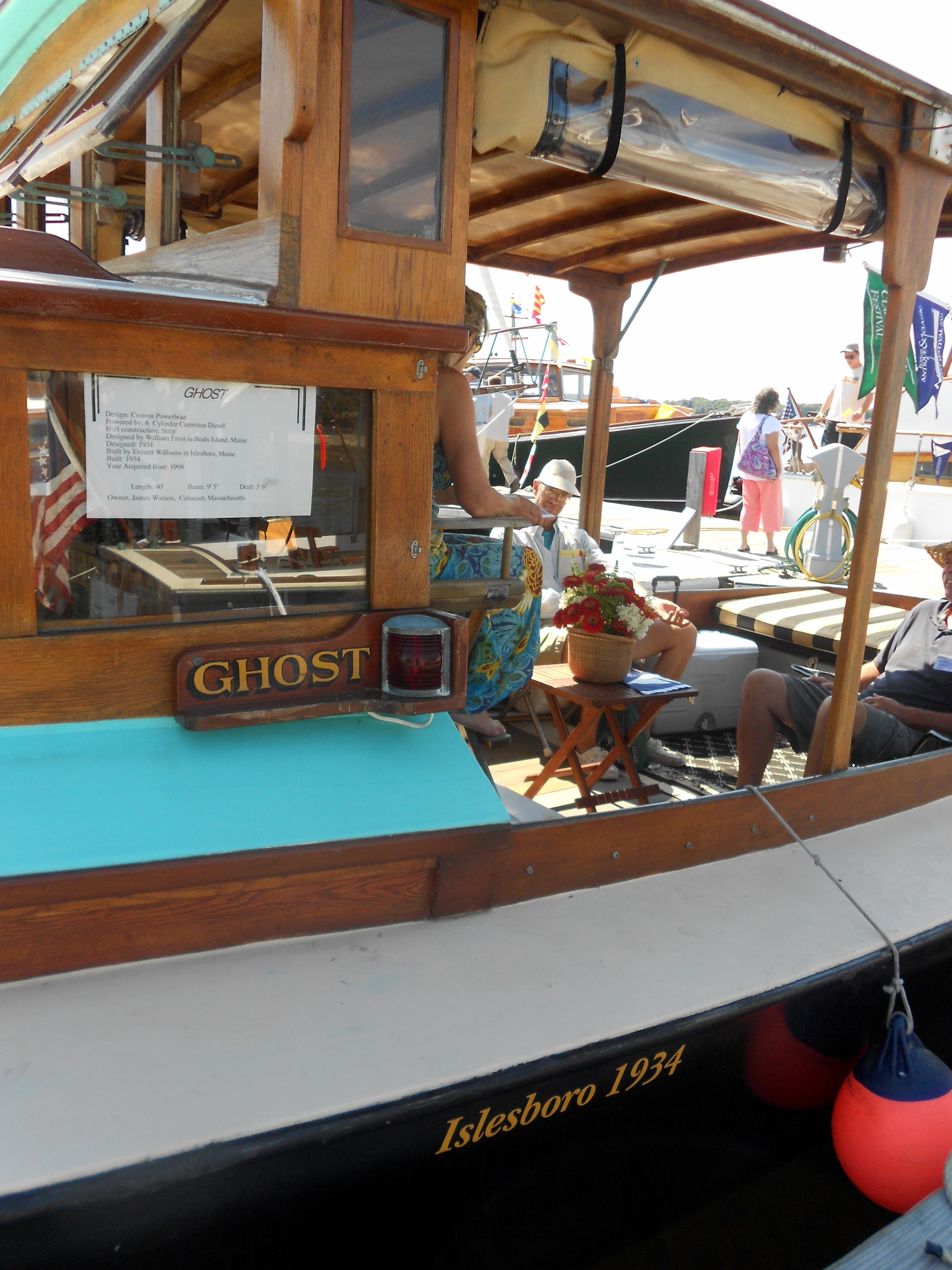
A few sailboats, including Victor, a Cape Cod Catboat dating from 1916, the oldest boat in the festival, and then the power cruisers, including Satin Doll from Salem and Ghost, built in Islesboro, Maine in 1934.

I searched in vain for my favorite boat from past festivals:  Chris-Craft speedboats from the early 1960s.  No luck this year, but the 1960 advertisement below brings them back.


Samuel McIntire in Texas

I knew that the charming 1793 summer house designed by Salem’s renown architect and woodcarver Samuel McIntire (1757-1811) had been moved (from its original location 4 miles away on Salem merchant king Elias Hasket Derby’s Peabody farm–successively the property of the Crowninshield and Osborn families), and copied (by Derby’s distant descendant Martha Codman for her Newport mansion Berkeley Villa, which you can read about here), but I had no idea until very recently that it was the inspiration for a Houston McMansion.

Here is a panorama of pictures taken yesterday of McIntire’s beautiful summer house, situated since 1901 on the Glen Magna estate in Danvers, Massachusetts.

And here, via my very favorite pinner on Pinterest, via the Cote de Texas blog, via Luxe magazine, are pictures of a house outside downtown Houston designed by John Ike of Ike Ligerman Barkley Architects of New York.

It is probably wrong of me to call this house a McMansion as it is only two rooms deep, but it does have white marble flours (versus the painted wood of the original).  I’m not sure what to think of this creation:  is imitation the sincerest form of flattery in this case?

Another view:  a Rudolf Ruzicka Christmas card for the Merrymount Press, 1940.