Tag Archives: ephemera

Gardening by Mail

Leaving aside our unnaturally warm March week, this is the first really springlike weekend, and a long one at that with the commemoration of Patriot’s Day here in Massachusetts on Monday.  Lots of things have popped up in the garden, though I suspect many plants never went to sleep during this warm winter.  I’m not sure what I’ve lost; there are some conspicuous holes but it’s still a bit early.  In any case, I always buy a few things in the spring and find places for them, often from some of my tried-and-true catalog sources.

The healthiest and hardiest plants in my garden come from Perennial Pleasures Nursery in East Hardwick, Vermont.  When I started the garden over a decade ago, I wanted to have only heirloom plants, and their little catalogs featured lots of varieties from the 17th through the 19th centuries, along with all the essential information about how to grow them.  I learned a lot from those catalogs, and I still have them, as well as all of the plants I purchased from them.  Now Perennial Pleasures only sells their specialty, phlox (of which they have many varieties that you cannot get anywhere else), by mail, along with a few other plants, but their plant guide (which you can download from their website) remains an essential reference for gardeners.  And if you’re in the Northeast Kingdom this summer, they have a Phlox Festival during the first two weeks of August.

After a couple of summers, I abandoned my “heirlooms only” rule because it was a little limiting, and there are lots of beautiful modern varietals out there that I wanted in my garden.  One particular summer, I became obsessed with alstroemeria, and the search for more varieties took me (virtually) to Digging Dog Nursery in northern California.  Since that time I’ve moved on from alstroemeria but not from Digging Dog, which supplies lots of healthy and well-established plants that you seldom see in regular nurseries.

Another online source of plants you don’t see anywhere and everywhere is Avant Gardens of Dartmouth, Massachusetts.  I generally drive down there as it’s not too far for me but I know they do a large mail-order business.  Lots of varieties of my favorite perennials, like the masterwort above, and unusual annuals as well.

Seeds have been a mail-order product for more than a century, and one of the oldest US suppliers is Comstock, Ferre & Co. of Wethersfield, Connecticut, a beautiful colonial town just outside Hartford.  Except for a little recent gap during which they were purchased by Missouri-based Baker Creek Heirloom Seeds, Comstock has been in the business of selling “hardy northern” seeds for 200 years. You can purchase their heirloom seeds online or at their retail location in Wethersfield, a charming cluster of buildings. Their seeds come in really lovely packets, another major attraction for me.  In fact, I am rather ashamed to admit that I have purchased seeds in the past (like the vegetable assortment from Monticello below) simply because I liked the packets they came in.

Now that I’ve shifted the focus of this post from plants to paper I might as well keep going!  Gardening by mail has a long history, and the Smithsonian Institutions Libraries have a great collection of  nursery catalogs from around the world and the last century or so.  Here are some of my favorites:  from a local seller in black and white, and nurseries in England and Maryland in vibrant chromolithographic color.  How different the last two catalogs are:  a rather restrained British offering of “golden” seeds and an exuberant display of Italian-American patriotism in the waning days of World War I.


Easter Weekend Witches

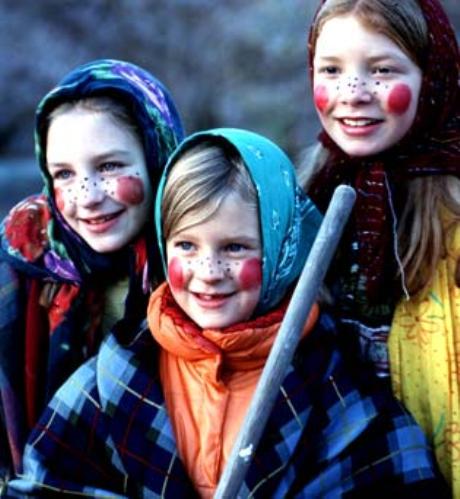
Given my city’s reputation, I think it is appropriate for a Salem-based blog to pay tribute to the Scandinavian tradition of påskkärringar: Easter witches.  According to this custom, most likely dating from a folklore “revival” in the nineteenth-century, Swedish children dress up as witches armed with broomsticks and copper kettles and go trick-or-treating on Maundy Thursday, the very day that their distant ancestors supposedly believed that “real” witches left on their journey to the faraway Blåkulla (Blue Mountain) to pay tribute to the Devil in a hedonistic sabbath.  These same witches returned from the mountain for Easter Sunday services (during which they would say their prayers backwards), if they could fit through the chimneys after several days of partying, or avoid the fires that were lit to keep them away.  Glad Påsk (Happy Easter) postcards from the first half of the century appear to feature the påskkärringar far more than they do eggs and chicks (or Jesus) and the tradition seems to be alive and well today.

It’s always interesting to trace modern customs and “traditions” as far back as you can go.  When you examine all the various details that make up the celebration of Easter in Sweden– flying witches, a far-off mountain, branches and bonfires, feasts–there definitely seem to be some pre-Christian elements, combined with pre-modern Christianity and modern commercialism.  At the very least, Blåkulla goes way back.  It is referenced in the key early modern source for Northern history and culture, the Historia de Gentibus Septentionalibus (History of the Northern Peoples) of Bishop Olaus Magnus, first published in 1555.  Magnus makes Blåkulla a bit more tangible by identifying it with a real island in the South Baltic, Blå Jungfrunwhich retains its mystical reputation.  He also describes, with a bit of skepticism that is later lost, the activities of witches and devils and other magical beliefs and entities.

The island of Blå Jungfrun, now a Swedish national park; devils and “weather witches” from Olaus Magnus’s Historia de Gentibus Septentrionalibus, Book Three.

Magnus was writing (and living) right on the precipice:  the period of 1560-1660 was one of intense religious conflict and witch-hunting in Europe.  Sweden managed to escape the former but not the latter, though it was a little delayed: the most intense series of witch trials in the north were the Mora and Torsåker Trials (1668-76), which resulted in the death of 85 people.  The testimony in these trials is characterized by 2 distinct themes:  references to Blåkulla, and the accusations of children, who claimed to have been abducted by witches to demonic sabbaths which took place there.  The reliance on child witnesses, who were allowed considerable time together to get their stories straight, is indeed remarkably similar to Salem.

Title page of Joseph Glanville’s popular Saducismus Triumphus:  or Full and Plain Evidence Concerning Witches and Apparitions(1682), which includes the Appendix: A True Account of What Happen’d in the Kingdom of Sweden in the Years 1669,1670, and Upwards.

Given the central role played by Swedish children in these late-seventeenth-century trials, it’s a big jarring to see them on Glad Påsk postcards from several centuries later, but this is only one more example of how something very serious (and scary) in the pre-modern past becomes benign in the near-present.  The Easter witches of the past century are so weighed down by kettles and cats, and the occasional chicken and egg, that they have no room for children on their trip to Blåkulla.

Glad Påsk postcards from the 1920s, 1930s and 1940s:  by the last decade, Easter Witches were taking planes to Blåkulla!


Clockwork and Cocktails

We had our big fundraiser for the Salem Athenaeum this weekend:  Clockwork and Cocktails:  A Steampunk Affair.  The event was the result of several months of planning and preparations and a last-minute frenzy of decorating.  And then it was over and it all came down, in about an hour: so much energy and effort, so ephemeral.  I have no pictures of the actual party because for the hour or so that I was there I was in a fog caused by a combination of cold medicine and gin, having come down with a bad cold the day before, but I trust that my friends and fellow committee members will send me some. Everyone was snapping away, as it was a very visual party.  I do remember:  quite a large crowd of 150 people, give or take 10 or 20, a broad spectrum of ages, 20s through 70s, almost all dressed in some steampunk fashion (which I did not expect; everyone seemed to take our theme very seriously), great musicians, a magnificent living statue who never blinked, and giant pink octopus tentacles descending upon the third-floor trustees’ room.  Salem has quite an active steampunk scene, and we were fortunate to find (actually they found us) MHS Hysteria, a merry band of actors/crafters who really made the party.

Fortunately I took pictures of our decorating session the day before the party so all the embellishments are documented:  they can live on in the digital world!  We had a great committee comprised of the most creative women in Salem, and their individual and collective efforts created a magical environment.  All the key steampunk details were there– clocks, gears, keys, hot-air balloons, Victoriana—elegantly executed and assembled.

Clocks:

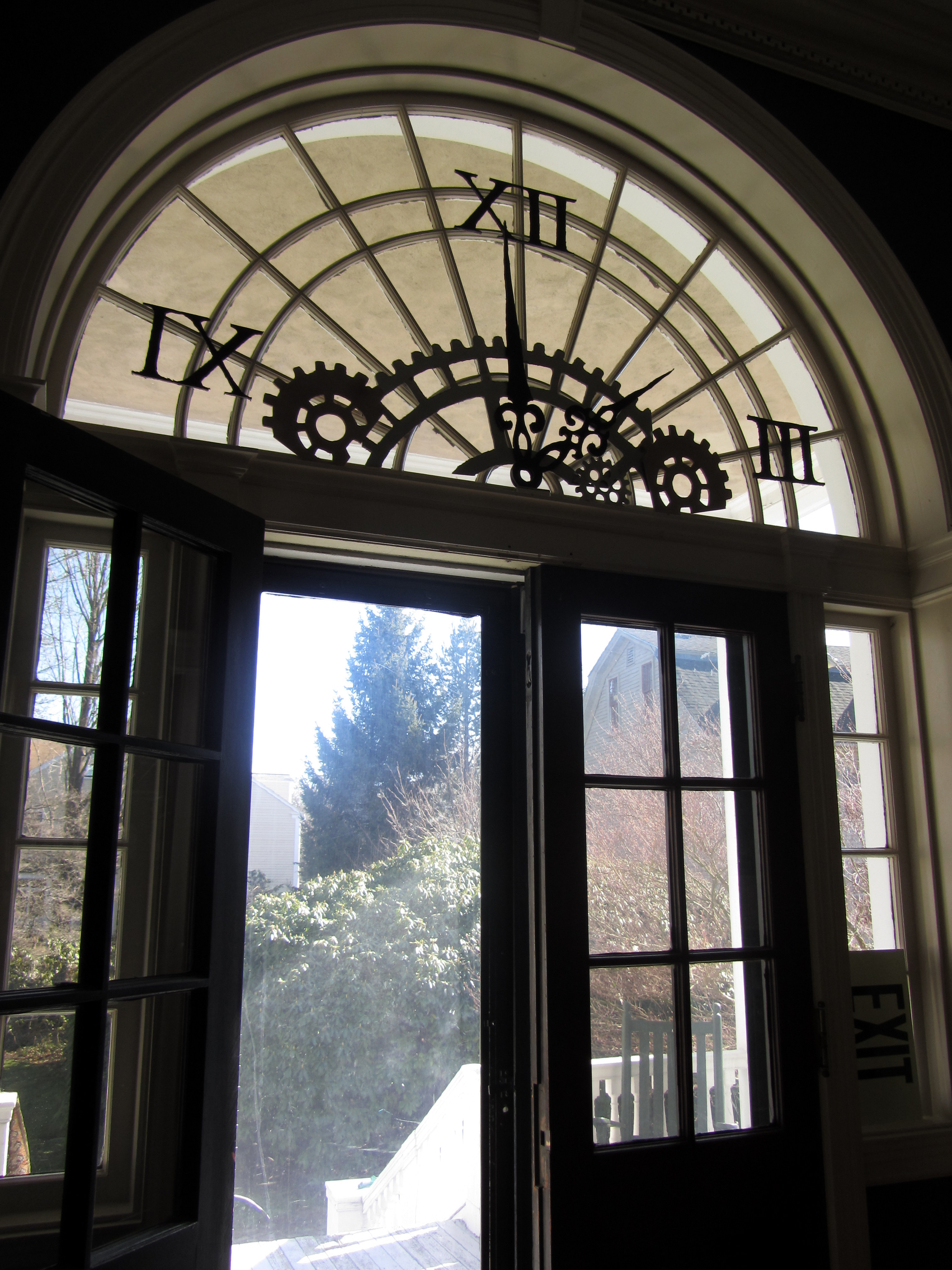
Adam from MHS Hysteria had the genius idea of transforming the Athenaeum’s demilune windows into Hugo-esque clocks, an amazing illustration of our theme as well as the Athenaeum’s architecture.  More clocks, just a few of many, including several sourced by Jane and a beautiful assemblage under glass by Suzie:

Balloons:

Part of the event included an exhibition of the literary sources of steampunk, which featured a lot of Jules Verne and other late nineteenth-century ballooning tales, so we wanted to carry that motif over into the party.  Katy made little balloon baskets (as well as mustaches- and goggles-on-sticks) and a late-afternoon balloon brigade put them all together.

Keys:

There were quite a few keys in the exhibition, which featured industrial ephemera as well as early science fiction.  Salem’s own Locke Regulator Company was one of the largest manufacturers of steam fittings in the country at the turn of the last century, so we had to include some of their materials, and where there is a lock there must be a key!  This motif was carried over into the party rooms, and even into the bathroom by Carol.  After I took the above picture, a pop-up Sherlock Holmes (complete with magnifying glass) somehow made his way in here; apparently he was the talk of the party.

Goggles, goggles everywhere:

There were goggles everywhere, both made and acquired.  Nathaniel Hawthorne wore his goggles-by-Carolyn (who also made the giant pink Octopus tentacles which I somehow failed to get a picture of) very well, I thought, as did this very dignified bust.

Miscellaneous objects of interest and beauty:

A very eclectic tableau on top of the card catalog (yes, the Athenaeum still has one), an automaton-esque old dress form (on which even the duct-tape shoulders look beautiful to me), and jewelry-insects under glass, just a sampling of the amazing decorative displays on view, and the energy and creativity of the event committee.  In addition to the aforementioned ladies, I’d also like to thank the rest of the committee:  my co-chair Sarah, master of logistics and the budget, Julie, Mary, Kristine, Penny, Stacia & Patti.  Cheers to you all!


March Hares

The “frisky” behavior exhibited by European hares in March, the beginning of their mating season, has determined that the allusions “mad as a March hare” and “harebrained” have been with us for a while, far longer than Alice in Wonderland. In the sixteenth century, there are so many references to this seasonal disorder among rabbits, including John Skelton’s “as merry as a March hare”  in Magnyfycence (1520) and John Heywood’s “as mad as a March hare” in the first edition of his Proverbs (1546) that it seems well-established in the English language and culture.  So now it’s March, almost mid-March, and it’s definitely time for some March hares.

My search for some real long-legged European hares brought me to a beautiful book by Christine Gregory, Brown Hares in the Derbyshire Dales (2010), which contains some stunning photographs of hares in their element, in every season. Gregory seems to pursue her subjects with a singular intensity, with riveting results.

A Hare in March by Christine Gregory, from Brown Hares in the Derbyshire Dales.

In the past, visual depictions of hares came in a variety of forms: different types of cards issued over the centuries, fables and stories, the decorative arts. They also seem to be among the most anthropomorphic of animals (especially March Hares). There are of course many images of hares in hunting scenes in the medieval and early modern eras, but almost as many in “turning the tables”/ world-turned-upside-down scenes in which hares are the hunters rather than the prey.  I could focus an entire post on just this sub-genre, but I’ll just include one such scene today: The Hunter Caught by the Hares, a Georg Penz print from a Hans Sachs broadside (circa 1534-35) in the collection of the Museum of Fine Arts, Boston.

Cartophilic hares appear in both the early modern and modern eras, beginning with this “nine of hares” card, from a deck of 72 round cards engraved by the “Master PW’ of Cologne around 1500.  Rather than hearts and spades, the deck is organized into suites of roses, columbines, carnations, parrots and hares. A more dandified hare appears on a cigarette card from many centuries later.

The Nine of Hares, Master PW of Cologne, circa 1500, Collection of the Victoria & Albert Museum, London. Cigarette card, 1920s, New York Public Library Digital Gallery.

Nineteenth- and early twentieth-century hares take all forms: both straightforward and anthropomorphic representations, political caricatures, decorative motifs, and from the second half of the nineteenth century onwards, a steady succession of illustrations from children’s’ books. The most acclaimed graphic designers and illustrators all have their hares, including Christopher Dresser, Hugh M. Eaton, and Walter Crane.

A European hare from Samuel Griswold’s Pictorial Geography of the World (1849), A “grotesque dado-rail, being formed of the hare, which is especially suited to a dining room” by Christopher Dresser (1876),NYPL Digital Gallery, a Chelsea tile by William Frend De Morgan, c. 1873-76, Victoria & Albert Museum, London, and the March cover of Frank Leslie’s Popular-Monthly.

Crane’s March Hare, who first appeared in the 1865 edition of Alice’s Adventures in Wonderland, is my favorite, and more natural (and Arts & Craftsish) hares appear in his 1887 edition of Aesops Fables. Jessie Wilcox Smith’s March Hare and Mat Hatter appear in a domestic scene in her 1915 edition.

Illustrations from Walter Crane (1865 & 1887) and Jessie Wilcox Smith (1915), NYPL Digital Gallery.

There is a large trace (or drove, there seem to be quite a few applicable collective nouns) of contemporary hares from which to choose, but I finally settled on the two below:  Bruce Gernand’s 2004 etching, Hare in Transit, an updated version of the Tortoise and the Hare, and Julia Cassels’  very vertical Mad March Hare.


Leaping Ladies

I don’t know about the supposedly “medieval” custom of ladies proposing to their fellows on Leap Days; it sounds like another example of what cultural historians call the invention of tradition to me.  As stated again and again (especially on the internet), the “Ladies’ Privilege” dates from either the future St. Patrick’s dialogue with the future St. Bridget in the fifth century, or a Scottish Act of Parliament in the thirteenth century.  In the Tudor-Stuart period that I study, I have found a few references to this odd day out, a day that doesn’t quite fit on the calendar, and one on which unusual things may occur, notably in the 1600 play The Maydes Metamorphosis, which contains the couplet Master be contented, this is leape year, Women wear breetches, petticoats are deare.

Actually there’s a long tradition of turning-the-tables in western culture:  lords of misrule, charivari, the “world turned upside down”, festivals.  Probably in other cultures too.  So I think the irregularity of leap day became equated with a day when women wore the pants, obviously an equally unnatural occurrence.  Not only do we have the Mayd’s Metamorphosis rhyme, but two images from several centuries later, both of which clearly express not-so-subtle political (King George IV wearing a dress) and social (bloomers!) sentiments.

George Cruikshank, A Leap Year Drawing Room, or the Pleasures of Petticoat Government, 1820. British Cartoon Prints Collection, Library of Congress.

Bloomers for Leap Year, Harper's New Monthly Magazine, 1852. New York Public Library Digital Gallery.

The cartoons above are critical caricatures, but women acting like men could also be entertainment, as very literally illustrated by this 1896 poster for the Forepaugh & Sells Brothers Combined Circus (from the Library of Congress), featuring “”the leap year ladies of laughter” and  “the only clown women who wear the comic crown”.

As far as I can tell, it is not until after the turn of the century, when we enter into a “golden age” for postcards, that we see the almost-exclusive association of Leap Year and the Ladies’ Privilege.  Rather than “new women” pushing the boundaries, we see desperate women chasing men pictured on penny postcards.  So many of these ephemeral items survived that they must have been manufactured by the ton, particularly in the leap years 1908 and 1912. After World War I, it was a different story.  There are some lovely, wistful women, but also a lot of unattractive and old maids, doing anything to catch a man on that special leap day.  Here is just a small selection of some random but (I think) representative samples, starting with some relatively mild examples from 1904 and then proceeding t0 the heady year of 1908 (popping ladies, man in a mousetrap).

And one postcard from 1912, another leap year that produced a mountain of cards portraying women in pursuit of men, and this one, which brings us back to who wears the pants.


Corset Culture

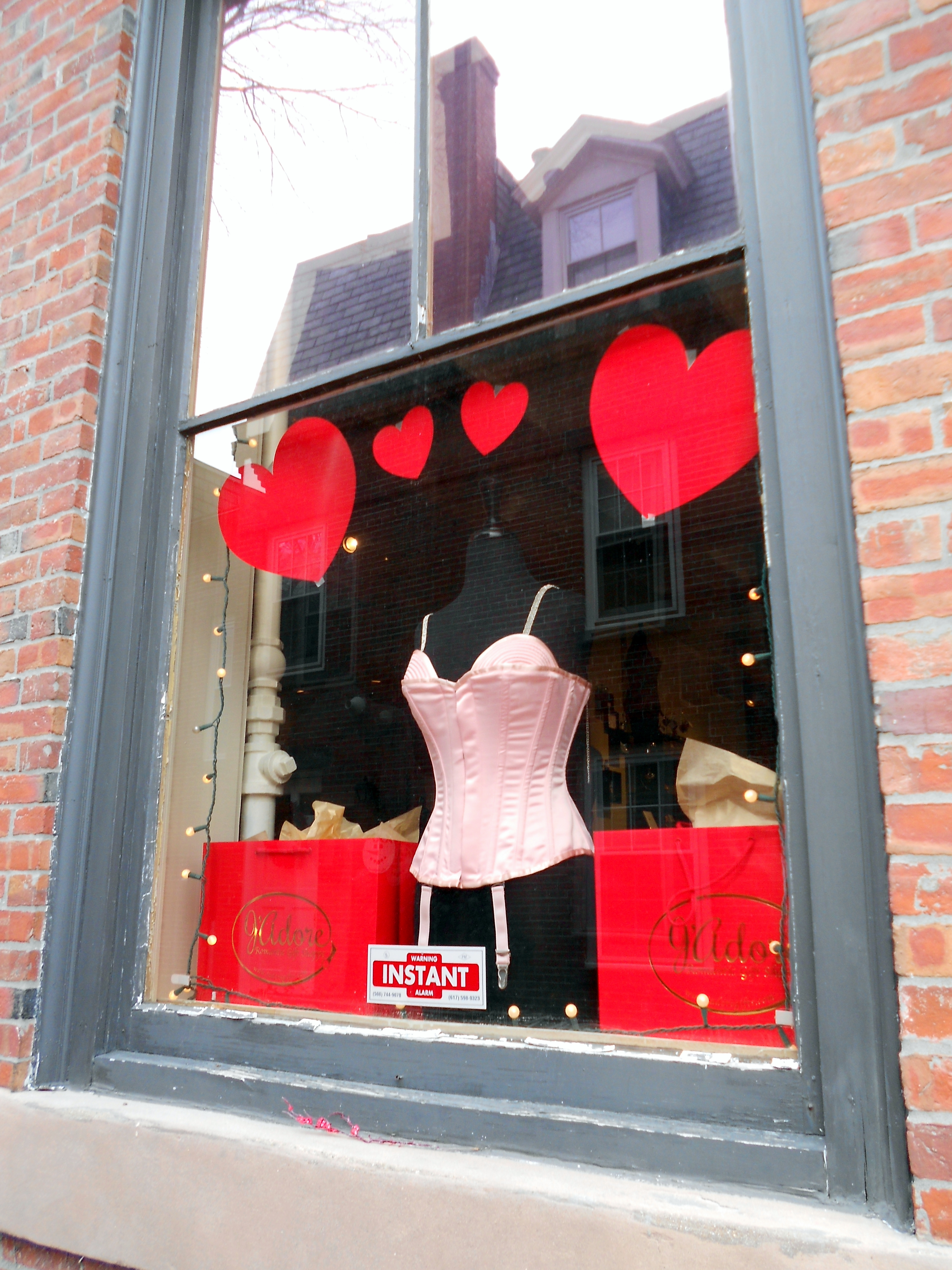
From my vantage point here in Salem, it appears that we’re in the midst of a corset comeback:  not only do we have our own corsetmaker who sells her creations online, but also a new bricks-and-mortar corset shop in Derby Square, right across from Old Town Hall.  A Beautiful Corset (10 Derby Street, Salem) offers made-to-order corsets by the British corset manufacturer Vollers, for which it is one of the few distributors in the United States. The owner explained to me that she has operated an online business for several years, but opening a real shop was a necessity, because with corsets, it’s all about the fit (and the fitting!)  Her expansive store is filled with “models” named after years, as Vollers still cuts their corsets from patterns made in 1899, and 1903, and so on, as well as a gift shop-within-a-shop called J’adore. 

The shop window at A Beautiful Corset/J’Adore, fabric choices for the corsets, a finished product in Chinese silk–with Salem’s Old Town Hall as backdrop.

My interest in corsets doesn’t come from a love of constraint, but rather of craftsmanship, and I always like to see a new shop open up in Salem, particularly one that doesn’t offer the same old (kitschy, witchy) things.  Corsets are both very old and very new, given that they morphed into girdles several generations ago, coincidentally with the invention of all sorts of synthetic and stretchable textiles, and essentially disappeared.  The reappearance of the hand-made corset is something to celebrate, just like letterpress printing.

The commercial revival of corsetry seems to be coincidental with a cultural one.  Several exhibitions featuring the corset have been mounted in the last few years, including the Victoria & Albert Museum’s touring exhibition Undressed:  350 Years of Underwear in Fashion and the Worcester Art Museum’s Bound by Fashionthe Corset in European Art.  It seems absolutely fitting that Worcester should have a big corset exhibition, as that city was the absolute center of corset manufacturing here in Massachusetts (with claims of being the largest corset manufacturer in the world) in the later nineteenth and twentieth centuries, when the Royal Worcester Corset Company (1861-1950) employed over 2000 workers (mostly women) at its state-of-the-art factory.

Pink silk corset, circa 1885-95, from the Collection of the Victoria & Albert Museum, London; Portrait of a Woman, 1556, by an anonymous painter of the Flemish school, Worcester Art Museum, Worcester, Massachusetts, and interior view of the Royal Worcester Corset Factory main stitching room, from Digital Treasures:  a Central and Western Massachusetts Library Project.

Worcester might have had claims to worldwide corset domination, but in terms of advertising claims, the company that seems to have led the industry in innovations was Warner Brothers, the founding corporation of the present-day Warnaco.  The company was founded by a pair of physician brothers, Lucien and Ira Van Der Warner, who founded their “reformed” corset company in Bridgeport , Connecticut in 1874 after several years of lecturing on the considerable dangers of whalebone- and steel-boned corsets.  Their new “healthy” corset was boned with more flexible coraline, an organic product made from the agave americana plant, and they must have spent a fortune on colorful chromolithographic advertising to showcase its natural benefits.  Two decades later, they had both retired as millionaires.

Warner Brothers Coraline Corset advertisement and trade cards, from Duke University Digital Collections and the Library of Congress.

The history of the corset is really essentially the history of women–women’s fashions, women’s health, women’s work–so obviously a short blog post can only scratch the surface.  Another major reason why corsets have been having a “moment” in the past few years is an amazing book:  Valerie Steel’s The Corset:  A Cultural History (2001), a work of intensive scholarship and immediate accessibility.  If you want the whole story of the corset, pick it up.

A 15-year-old corset worker in 1917:  Library of Congress.


Maps of the Human Heart

Heart-shaped maps are one thing, but maps of the human heart are quite another, and I’ve got both on this Valentine’s Day.  The charting of emotional territory, as opposed to physical space, has resulted in the production of several interesting maps from the seventeenth century to the near-present.  Below are the companion Map of the Open Country of a Woman’s Heart and Map of the Fortified Country of a Man’s Heart, ostensibly and anonymously drawn “by a lady” and published by the Kellogg Brothers of Hartford, Connecticut in the 1830s.  These heart maps, along with lots of other examples of the Kellogg’s impressive lithography, can be viewed at the online gallery of the Connecticut Historical Society and Museum.

I’ve brightened and cropped both maps so that you can better see the different regions that make up these human hearts. It’s very interesting that the woman’s heart is an “open” country while the man’s is a walled fort.  Money seems to take up a lot of territory in the man’s heart while outward appearances dominate the woman’s; romance and sentiment take up space but love is referenced only with power, ease, eating, dress and admiration!  Matrimony is very clearly outside of the man’s heart (whereas the “citadel of self-love” is inside).

These heart maps seem to be fusing together two cartographical trends from the early modern era:  the cordiform map, in which actual places are displayed in a heart-shaped map, and allegorical maps, which use map formats but dispense with the places altogether in order to put forth the message, often in caricature.  The most famous world map with a cordiform projection, the Nova, et Universi Orbis Descriptio of Oronce Fine, was published in a succession of early modern atlases after its initial appearance in 1531.

As for the allegorical, two very sentimental maps were published in the sixteenth and seventeenth centuries:  the carte de tendre, a road map to and through the country of “tenderness” first published in Madeleine de Scudery’s novel Clelie in 1654, and the “Empire of Love” map published by German typographer Johann Gottlob Immanuel Breitkopf in 1777.

The Carte de Tendre: beware of the “Lake of Indifference” and “Dangerous Sea”!

The Empire of Love:  proceeding from the “land of youth” at the bottom, northward to the “land of lust”, and then easterly to the “land of happy love” (hopefully).

Even after the turn of the twentieth century, emotional maps continued to be published in various formats.  I found a Brazilian postcard from 1904 in a collector’s forum along with a locally-made map of “Loveland”  in the collection of the Leventhal Map Center at the Boston Public Library (part of their ongoing exhibition of “unconventional maps”), and two heart maps that are clearly based on the Kellogg prints which were first published in McCall’s Magazine in 1960 and reprinted in the fascinating book by Katherine Harmon, You are Here:  Personal Geographies and Other Maps of the Imagination (Princeton Architectural Press, 2004).

A map of “Loveland” by Ernest Dudley Chase dating from 1943; it doesn’t scan very well, but a zoom feature is available at the BPL map site.  Lots of very 1940s-ish cartoon characters.

Geographical Guide to a Woman's Heart Emphasizing Points of Interest to the Romantic Traveler: illustration by Jo Lowrey for McCall' s Magazine, 1960

Geographical Guide to a Man's Heart with Obstacles and Entrances: illustration by Jo Lowrey for McCall's Magazine, 1960

Times and sentiments change; I think we’re about due for an updated map of the human heart.


Little Bits of Lincolniana

I hate Presidents’ Day; it obscures the achievements of those individual presidents which it claims to recognize.  We should celebrate, or at least remember, the birthdays of Abraham Lincoln and George Washington even if we do not have the day off from work. Today is Lincoln’s birthday, and for the occasion I’ve assembled some scraps of paper which bear witness to his personal life more than his presidential one (but ultimately they become inseparable).  There is a vast sea of Lincolniana, and this was just my way of navigating through it.

The clever little “business card” of young lawyer Lincoln, and the Cotillion Party for which he is listed as a “manager” (I suppose this is the equivalent of today’s “sponsor”), along with a certain Mr. Todd.  As that is his future wife’s maiden name, I like to think that he met Mary Todd at this party, though I could be wrong.  These items, as well as the four images below, come from the William E. Barton Lincoln Collection at the University of Chicago. Because they are quite charming, I’ve included some digitized exhibition labels from the Lincoln Centennial as well as the records.

The Marriage License of Abraham Lincoln and Mary Todd, the last bit of a letter from Abraham to Mary written while he was serving in Congress in Washington:  the majority of it is about money, indicating that Mary’s reputation as a spendthrift is well-deserved, and he closes with “kiss and love the dear rascals” referring to their boys.  A check for $5 to Tad, one of the rascals.

The items above are all from the Alfred Whital Stern Collection of Lincolniana at the Library of Congress:  a dance card from Lincoln’s first inaugural ball, a Union envelope from the Civil War, a Massachusetts Republican ticket for the election of 1864, and a mourning ribbon for Lincoln from later 1865.  All manner of ribbons survive, as everyone must have worn one; this is a particularly fancy one, I think.


Up, Up and Away

Today is Jules Verne’s birthday, and as I’ve been engaged in putting together a steampunk-themed exhibition and event at the Salem Athenaeum and have hot air balloons on the brain, I thought I’d share some of my favorite images of the balloon craze of the later nineteenth century.  Even though hot air balloons were invented in the later eighteenth century, they really picked up steam a century later due in large part to the enormous popularity of Verne’s “Voyages Extraordinaires”,  beginning with the publication of Cinq Semaines en Ballon (Five Weeks in a Balloon) in 1863.  The Balloon became the most accessible and emblematic of Verne’s fantastic wayfaring machines, and started to show up in all sorts of places.


Frontpieces to early Hetzel editions of Jules Verne’s collected Voyages Extraordinaires.

In addition to Verne’s texts, one of the very best places to look for early balloon images of all types is in the Tissandier collection at the Library of Congress.  Gaston and Albert Tissandier were balloon enthusiasts, collectors, and contemporaries of Jules Verne’s, and the Library of Congress purchased their 400+ item collection in the 1930s.  Here are the two balloonist brothers in the 1880s: as you can see, shortly after balloons captured the public’s imagination, airships of all kinds began to appear.  Anything was possible in the air.

A rather arbitrary sampling of the Tissandier collection is below:  Gaston and some journalist companions passed out due to lack of oxygen after their balloon Zénith reached a record height of 28,000 feet over Paris in April of 1875, an advertisement for balloon rides over Paris from the 1880s, and a photograph of several balloons within the newly-built Eiffel Tower at the Paris Exhibition of 1889.

In France, ballooning clearly became an art form, both the activity itself and its graphic depictions, as well as an expression of patriotism.  I love the print by Camille Grávis below, with a clockface balloon flying over the Eiffel Tower; it dates from the 1890s and exemplifies the time and place so well. Then we have a tricolor balloon and a fleet of balloons, all bearing the tricolor.

The next step was to remove the basket altogether and attach the balloon, or balloons, directly to a person, or to a horse, or to a person on a horse, or perhaps to a bicycle on its way to the moon.  Nothing was impossible; no place was unreachable–in the worlds of Jules Verne.

Throughout the western world, the motif of the hot air balloon infiltrates nearly every manifestation of popular culture  in the later nineteenth century:  advertising, entertainment, political satire, housewares, clothing, and ultimately moving pictures as well as still ones. I could post about balloon shows, women balloonists, politicians depicted as balloons (not a stretch for late nineteenth-century cartoonists), balloon wallpaper and fabric, balloon-view maps, and all the different types of balloon ephemera. Certainly the actual balloonists–the Montgolfiers in the eighteenth century, the Tissandiers in the nineteenth, and all of their followers–are responsible for this infiltration, but so too was Verne. It’s no accident that the pioneering 1902 Georges Méliès film Voyage dans la lune (of Hugo fame) was inspired by Verne’s earlier story From the Earth to the Moon.  At that point in time, Verne was nearing the end of his long and prolific life, and already recognized as a “prophet” of the new century.


The Gerry-Mander

This month marks the bicentennial anniversary of the first appearance of a monster that is still with us today:  the Gerry-Mander, first published in a Salem broadside in January of 1812. Very Scary.

                                       Library of Congress

The background for the appearance of the Gerry-Mander (a play on salamander) is the Massachusetts State Senate Election of 1812.  The two political parties at the time, the Jeffersonian Republicans and Federalists, were deeply divided:  politically, culturally, socially.  Here in Salem, members of the opposing parties didn’t even talk to each other, and they had erected separate assembly houses in the previous decade so they certainly didn’t dance with each other either.  The Jeffersonian Republicans pushed through the Massachusetts Legislature a bill creating electoral districts which gave them a distinct advantage in the upcoming election and Governor Gerry (somewhat reluctantly) signed the bill into law.  In protest, the Federalists hired engraver Elkanah Tisdale to create a caricature of the new Essex district, and thus the “Gerry-Mander” was born.  He (or she?) appeared in several Massachusetts newspapers (including the Boston Gazette) over the next few months, and reappeared regularly across the US–in different incarnations– over the next 200 years.  Governor Gerry went on to become James Madison’s Vice-President.

A cropped version, and one with the carved-out Essex County towns filled in.