Tag Archives: England

Christmas Casting

In the medieval era and slightly after, Christmas was often the time for making predictions for the coming year, rather than on New Year’s Day. Weather predictions were common, and also more varied prognostications, based on what day of the week Christmas fell. The predictions based on a Christmas Tuesday are not particularly cheery, I must admit, but then neither are they overwhelmingly optimistic for Christmases that fell on the other days of the week.  Here’s the Middle English verse from British Library Harley Manuscript 2252, the commonplace book (an often-miscellaneous journal of very random sayings and bits of information, kind of like a blog!), of London merchant John Colyns, from the late fifteenth or early sixteenth century, with my hasty translation. It’s been a while since I have tangled with Middle English so there may be some lapses here, but I think I got the gist of this verse.

Yf Crystemas day on Tuysday be, That yere shall dyen wemen plenté; And that wynter wex grete marvaylys; Shyppys shalbe in grete perylles; That yere shall kynges and lordes be slayne, And myche hothyr pepylle agayne heym. A drye somer that yere shalbe; Alle that be borne ther in many se, They shalbe stronge and covethowse. Yf thou stele awghte, thou lesyste thi lyfe; Thou shalte dye throwe swerde or knyfe; But and thow fall seke, sertayne, Thou shalte turne to lyfe agayne.

If Christmas Day be on a Tuesday, many women will die that year; and that winter will see great marvels; Ships shall be in great perils; That year kings and lords shall be slain, And many other people against them. That year will have a dry summer; All that are born in that year shall be strong and covetous. Whoever steals, shall lose his life by sword or knife; But if one falls sick, they shall become well.

Well at least it ends on a somewhat optimistic note!

STC 25949, title page

Ships and people in peril a century later:  The Wonders of this Windie Weather, London, 1613. STC 25949.


Fire over England

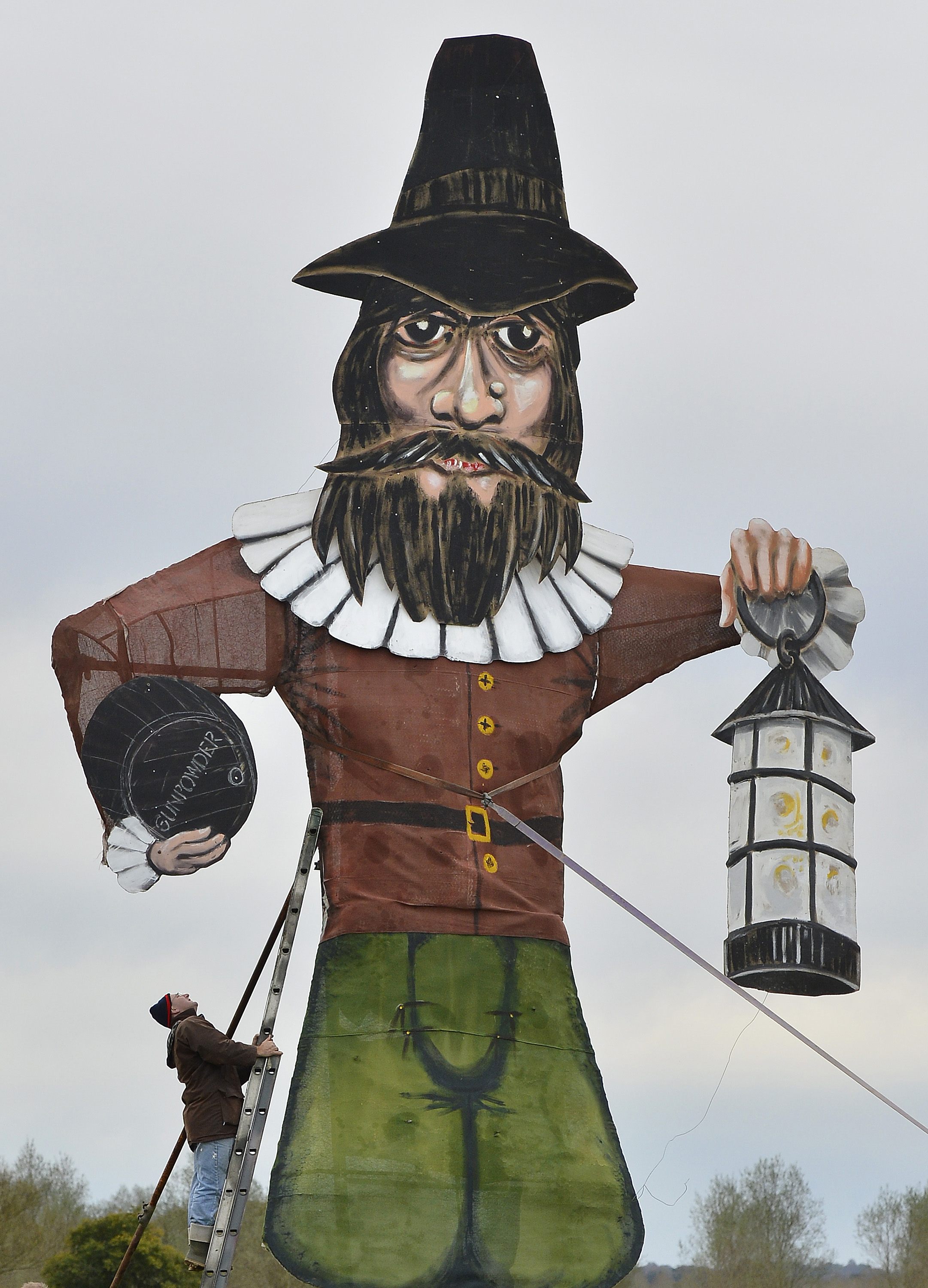
Tonight is Bonfire Night, the age-old celebration of the thwarting of the 1605 Gunpowder Plot, a native Catholic conspiracy to blow up the entire English government–King James I and VI and the royal family, attendant Lords and legislators–at the opening of Parliament. Plans of the plot leaked out, and Guido (or Guy) Fawkes, the man who has come to symbolize the Plot and recently so much more, was found in the basement of Parliament with 36 kegs of gunpowder. In the days that followed, he confessed to the Plot (both under torture and afterwards) and named the others involved. Not long after 1605, the relatively new art of fireworks was merged with the traditional celebratory British bonfire and burning Guy effigies to create a truly incendiary evening.  And the tradition has continued for over 400 years–it looks like they already started this weekend.

Celebrating the “wonderfull deliverance” in 1605 and last year.

The Plot and its aftermath have so many interesting dimensions:  historical, cultural, political.  I’m going to focus on just a few in this short blog post, but obviously books can and have been written. For teaching purposes, nothing demonstrates burgeoning popular anti-Catholicism in England better than the Plot and all of the diverse reactions and expressions that came after, as demonstrated particularly by the broadside below, which connects the attack of the Spanish Armada in 1588 with the Plot through a nefarious council jointly overseen by the Pope and the Devil. Religious propaganda in seventeenth century England was not subtle, but subtlety is not what you need to convey religious intensity, both negative and positive, to twenty-first century college students.

And then there is the culture of remembrance and the shaping of national identity. Modern historians have focused on this trend, particularly in relation to the Civil War in America and the First World War in Europe, but I think we can push it back into the early modern era. The Fifth of November was definitely and deliberately cultivated as a day of national deliverance and remembrance in England, and later in Great Britain, the Empire, and the Commonwealth. Here in New England, the 5th of November was celebrated as “Pope-Night” until the onset of the Revolution, and then it had to stop, or change, as it was just too British. Being British meant remembering the 5th of November, even if it was increasingly shed of its specific religious associations.

Illustrations from George Carleton‘s A Thankfull Remembrance of Gods Mercy, London, 1627, British Museum and from Extraordinary Verses on Pope-Night, Boston, 1769, Library of Congress.

Obviously it’s all about Guy Fawkes, then and now:  Bonfire Night is Guy Fawkes night.  As I wrote about in last year’s November 5th post, Fawkes has gone through an amazing transition, from terrorist to liberator, due to his central role in the graphic novel and film V for Vendetta and his adoption by the global Occupy movement. Guy miraculously became an advocate for freedom and an avatar for the 99%, with Shepard Fairey reworking his famous Hope poster with the mask of Fawkes replacing Obama. This transition seemed rather abrupt to me a year ago, but I’ve looked at Guy’s evolution over the centuries a bit and now I think I understand:  he has lost his context. Shed of the conspiratorial motivations and details, he became an increasingly iconic image, and also somewhat of a dashing cavalier.

Guy through the ages:  a Gunpowder Plot card from a deck of “Popish plot” cards, 1672, British Museum; an actor in character and costume as Guy, 1830s, Museum of London; cigarette cards from the 1920s and 1930s and a W.W. Denslow poster from the turn of the century, New York Public Library Digital Gallery; boys in Camden Town, London, with their Guy effigy, c. 1970, Museum of London; putting finishing touches on a Guy effigy this past weekend, Reuters.


Great Debates

I became a little restless during last night’s debate and started thinking about other debates, past debates, great debates.  While last night was occasionally (and surprisingly) informative, in general I think we’ve turned our political debates into forums over the past few decades and wish we could return to the days of back-and-forth dialogues in which both sides elucidate rather than just score points. When we think of great debates, we think of Nixon and Kennedy, Lincoln and Douglas, and Williams Jennings Bryan and Clarence Darrow in the Scopes Monkey Trial (or Frederic March and Spencer Tracy in Inherit the Wind), but I think I can dig deeper and go back further.

First, two interesting images of Richard Nixon, literally clashing with John Kennedy in the 1960 televised debate, and pointing at Nikita Krushchev in the “Kitchen Debate” of 1959.

Photography credits:  Thomas Dworzak/Magnum Photos; Elliott Erwitt/ARTstor Slide Gallery.

Both were apparently riveting debates, for different reasons.  The Kitchen Debate fascinates me:  a really big debate—communism versus capitalism–spontaneous, unmoderated, captured on film and and broadcast to the world!  And just a generation earlier, the very existence of capitalism, democracy and nearly every aspect of western culture was debated, as these WPA posters from the later 1930s illustrate. Perhaps the 1938 reenactment of the Lincoln-Douglas debates served as a reminder that this was not the only generation that was dealing with adversity.

WPA Posters from 1936-40, Library of Congress.

Think about all the amazing debates that happened in the decade or so before the Civil War:  over slavery and its extension, states’ rights, and the very survival of the United States.  Some erupted into violence; all were ultimately unsuccessful in bringing about a peaceful solution, despite all those Compromises.

An engraving of the Senate by Robert Whitechurch at the time of the Compromise of 1850:  Senator Henry Clay is addressing the senators, with Daniel Webster seated to the left of Clay and John C. Calhoun seated to the left of the Speaker’s Chair.  Library of Congress.  The Compromise did not hold: “Southern Chivalry” shows South Carolina Representative Preston Brooks caning Massachusetts Senator Charles Sumner in the Senate Chamber.

There were so many great debates held in the British Parliament over its long history it is difficult to choose just a few highlights:  debates over such seemingly insignificant issues as the adultery accusations leveled at Queen Caroline by George IV in 1820 and such major ones as the slave trade, suffrage, and many conflicts with the Crown. Of course there is a long history of debate outside the walls of Parliament as well, and while the arguments of the Radicals in the later eighteenth century are impressive, they were anticipated by those of the Levellers during the English Revolution. King Charles had been defeated by Parliament’s New Model Army, and there was an unprecedented opportunity for real political change, or at least the discussion of real political change. At the famous Putney Debates of 1647, Colonel Thomas Rainsborough of the New Model Army expressed a democratic argument that was way before its time: for really I think that the poorest he that is in England hath a life to live, as the greatest he; and therefore truly, Sir, I think its clear, that every man that is to live under a government ought first by his own consent to put himself under that government; and I do think that the poorest man in England is not bound in a strict sense to that government that he hath not had a voice to put himself under…”  Now this was the beginning of a truly great debate!

The House of Commons, 1793-94 by Karl Anton Hickel, National Portrait Gallery, London; woodcut illustration of the Putney Debates, 1647.


Peine forte et dure

Hard and severe Punishment, intended to compel an individual to enter a plea in a legal proceeding in which they had no confidence, or hope: the precedent in the English Common Law that entitled the Court of Oyer and Terminer to crush Giles Gorey to death under a pile of stones on September 19, 1692 for “standing mute”.  For those who take the remembrance and commemoration of the Salem Witch Trials seriously, the next few days are the dark crescendo of the hysteria, escalating toward the execution of the last eight victims on September 22. I wrote about these days in a series of posts last year, so I’m not going to repeat myself, but I did want to explore the history of peine forte et dure a bit more:  Corey’s miserable experience was a singular application of the precedent in American history, but it was a relatively rare infliction in English history as well.

Samuel Clarke,  A Generall Martyrologie (London, 1651).

Peine forte et dure is a late Medieval “innovation” in the English Common Law, first employed in the reign of Henry VI (1421-71).  English courts had always demanded that the accused enter a plea, but it was generally imprisonment and/or starvation that was used to compel submission. The first recorded use of the peine was on a woman, Juliana Quick, who was accused of High Treason because of her malicious slander of Henry–a king who did not command a great deal of respect among his subjects given his sporadic bouts of insanity.  Quick’s comments, ending with thou art a fool, and a known fool throughout the kingdom of England  must have stood out among the throng. Quick died in 1444, and by a century or so later the process was standardized:  the prisoner was stretched on his or her back, and stone or iron weights were placed on the body until the point of submission or death. The next recorded application of the peine also involved a woman, the “Martyr of York” Margeret Clitherow, who failed to enter a plea to protect her Catholic household in 1586. Queen Elizabeth personally apologized to the citizens of York for her torture and execution.

In the seventeenth century, Peine forte et dure was only applied in cases of murder, and more specifically in cases of the murder of family members. There were two very conspicuous cases, both of which were publicized in pamphlets:  William Calverley, a very troubled member of the Yorkshire gentry, was pressed to death in 1605 for failing to enter a plea after murdering his two young children and attempting to murder his wife and a third child, and Major George Strangways died under duress after refusing to plead on charges of murdering his brother-in-law in 1658.  Calverley’s case seems to have almost immediately caught the public’s attention and we have two competing narratives–that of a deranged madman and that of a man driven to extreme measures by the miseries of an enforced marriage.  The Calverley case might even be the source of A Yorkshire Tragedy, an early seventeenth-century play that was once attributed to Shakespeare but is now thought to be the work of Thomas Middleton.


Covers and illustration from three 17th century pamphlets inspired by the Calverley case:  Two most unnatural and bloody murders, The Miseries of enforced marriage, and A Yorkshire Tragedy. Note the cloven foot in the first pamphlet:  the devil made him do it.  As you can see, the tabloid press is not an invention of the twentieth century!

Colonel George Strangways was a more heroic character; he claimed to have been saving his sister from her up-to-no-good lawyer husband, who was attempting to steal her fortune.  One of his motivations for refusing to enter a plea was the fear that his family estate would be confiscated if found guilty of murder.  The judge ordered the application of peine forte et dure, and Strangways suffered for so long that the witnesses to his torture felt compelled to add their own weight and thus bring about a speedier, and more merciful, death. “Pain” was used as a threat over the next century, but applied in only a few cases, including, of course, Giles Corey in Salem and several notorious highwaymen in the early eighteenth century. In 1772, “the act being barbarous to Englishmen”, it was abolished.

The Unhappy Marksman, London, 1659.


Eternal Elizabeth

Today is the birthday (in 1533) of Queen Elizabeth I, a fact that would have been well-known in her own time.  The coincidence of Elizabeth’s birthday with the eve of the nativity of the Virgin Mary was not lost on her subjects, and obviously enhanced her public reputation as the Virgin Queen. In a Protestant England shed of its saints, Elizabeth must have offered some consolation. There is so much to say about Elizabeth, but too much to say in a blog post and little that has not been said before. In addition to her rather remarkable lifetime, the thing that has always impressed me about Elizabeth is her durability; even though she was a mortal person who died in 1603 she never really seems to go away. Every generation has had its Elizabeth:  the seventeenth century brought her back as a stark orderly contrast to Civil War-strife, there were lots of comparisons between Elizabeth and the equally-long-reigning Victoria in the nineteenth century, and we have certainly had our share of Elizabeths–from Bette Davis to Cate Blanchett to Judy Dench and Helen Mirren–in the last century.

Images of Elizabeth:  her lifetime.  Except where noted, all portraits are from the collection of the National Portrait Gallery, London.

The “Clopton Portrait”, 1560, one of my favorites:  a portrait of the young queen before she became the subject of sophisticated royal iconography. Private Collection.

The “Pelican Portrait”, c. 1575, often attributed to Nicholas Hilliard.  Here we have a highly stylized Elizabeth and all sort of symbolism.  This mask-like face will be the template for some time.  The pelican brooch on her bodice is a reference to self-sacrifice:  a long-held legend told of pelicans feeding their children with their own blood.  At around this time, it was clear that Elizabeth would not marry, therefore she had sacrificed her personal desires for the English people. Walker Art Gallery, Liverpool.

One of several official Armada portraits, this painting by George Gower marks the wondrous victory over the “invincible” Spanish Armada in 1588.  Elizabeth is now well on her way to becoming larger than life.

Elizabeth does not age in her portraits in the 1590s, even though she is in her sixties.  Her waistline gets smaller and smaller, and she wears increasingly fantastical clothing.  Commissioned by Bess of Hardwick in 1592, this painting is still at Hardwick Hall.  It has been copied many times, and the amazing skirt has served as the inspiration for wallpaper and textiles in the twentieth century. The drawing, from the collection of the British Library, is dated 1775.

Elizabeth Ever After:

Line engraving by Crispijn de Passe the Elder, after Isaac Oliver, 1603.  A very influential image, disseminated widely in the seventeenth century, and influencing images of Elizabeth to the present.  As an example, look at Alix Stone’s costume design for Elizabeth in a production  of Benjamin Britten’s Gloriana, 1966.  Victoria and Albert Museum, London.

In a 1868 lithograph, a Vision of Queen Elizabeth tries to rouse Queen Victoria from her prolonged mourning following Prince Albert’s death:  snap out of it!

Modern Elizabeths:  Bette Davis, one of my favorite Elizabeths, in The Private Lives of Elizabeth and Essex (1939), and Cate Blanchett in the poster for Elizabeth (1998).  I love the poster (which is based on the “Coronation Portrait” of Elizabeth in the center–the original portrait, attributed to Nicholas Hilliard, was destroyed by fire and this is an early seventeenth-century copy), and Cate Blanchett, but the movie is a historical hot mess!

Appendix:  the best book on representations of Elizabeth:  Sir Roy Strong’s Cult of Elizabeth.  Elizabethan Portraiture and Pageantry.


Ladies of Salem

Looking down upon the streets of Salem this summer are 12 “Ladies of Salem”, nautical figureheads created by local artists to commemorate Salem’s maritime past and highlight its present role as a “port of culture”.  The Lady of Salem festival, spearheaded by the city’s Beautification Committee, is the most recent of a succession of positive public arts initiatives designed to draw the attention of both residents and visitors away from the tacky exploitation of Salem’s witch-trial past, or at the very least to put the events of 1692 (and their “interpretation”) in context.  These ladies, affixed to lampposts on downtown streets adjacent to their sponsoring businesses, peer down at passers-by with their characteristic open gazes.  Here’s a sampling:  as the organizers of the festival are encouraging the public to vote for their favorites, I’m starting with mine, and then proceeding in no particular order.

Figurehead by Jeanne Pare, sponsored by Treasures over Time, Washington Street.

Figureheads by Mary Ellen Halliwell for the Salem Beautification Committee, Amberlynn Narvie for Beverly Cooperative Bank, and John Devine for the Palmer’s Cove Yacht Club on Essex Street.

Two more Essex Street ladies:  figureheads by Jade Mason for Body & Soul Massage/Collins Cove Appraisors and Sheila Billings for Cabot Money Management, Inc.

Figureheads were a prominent feature of ships built from the seventeenth century to the age of steam and were often, but not exclusively, female. The general consensus seems to hold that for very superstitious seamen, real women on board were bad luck, so this was the only way to have a feminine presence on seagoing vessels, which were, of course, also characterized as feminine.  At the same time, figureheads represented the “spirit” of their ships and offered protection on long, arduous voyages. The Peabody Essex Museum has a lovely collection of figureheads, many of which are very majestically displayed in East India Marine Hall, but the largest collection of figureheads from merchant ships can be found at the newly-restored Cutty Sark in Britain, part of Royal Museums Greenwich. I love this picture of them all together.

Figureheads in the East India Marine Hall of the Peabody Essex Museum, and one attributed to Samuel McIntire in the PEM’s collection; the Cutty Sark figureheads, collection of the Royal Museums Greenwich.

She’s not from Salem, but as most of us rarely have the vantage point of viewing a figurehead from above, I wanted to include this interesting photograph by Alan Villiers of the bow of the Herzogin Cecilie from 1928–the very last days of figureheads.


Hats Off to London

The Anglophile in me cannot resist one more post on London, but this one will not be about sports, but rather about hats.  And I will put a little Salem in here, because I am inspired.  As part of the Olympics celebration as well as the Mayor of London’s summer-long schedule of happenings called “Surprises”, twenty of the city’s most conspicuous statues have been topped with hats designed by eminent British milliners. For the next few days, Londoners will be amused (I hope) with very clever juxtapositions of hard and soft, traditional and fanciful.  The event is called “Hatwalk“, and here are some of my favorite pairings:

Queen Victoria wearing what appears to be an Olympic-flame hat, by Justin Smith, Esq.

Another flame: Admiral Nelson in a hat by James Lock & Co., Hatters.

General Sir Henry Havelock in a Philip Treacy “spectator”.

The Poet Robert Burns (A Red, Red Rose) wearing a hat by William Chambers Millinery.

General Sir Charles James Napier wearing a Sophie Beale hat.

King George IV and his horse, resplendent in Brighton pavilion-inspired hats by Stephen Jones.

Sir Arthur Sullivan and The Lady, wearing Gina Foster and Victoria Grant hats.

Franklin Delano Roosevelt and Winston Churchill on Bond Street, wearing hats by John Boyd and Herbert Johnson, respectively.

All photographs by Getty Images.

I love this installation (for lack of a better word–I’ve been struggling with what to call this happening) because it’s creative and historical at the same time–drawing attention to both design and the people, along with their eras and accomplishments, who are “modeling” the hats.  Several of these statues are in very prominent places like Trafalgar Square, but others might have been overlooked and forgotten.  Even before I became aware of Hatwalk, I had been thinking about several statues here in Salem and its environs which I pass by every day and never really look at, much less take the time to stop and read their plaques and inscriptions. If these statues had jaunty hats on their heads, perhaps I would!  One Salem statue in particular which needs more attention (or interpretation) is that of Roger Conant (1592-1679), who settled in Salem in 1626 and became its first governor, after brief stays in the Plymouth and Cape Ann colonies (he really disliked the Pilgrims).  The Conant statue was erected in 1913 after the Conant Family Association commissioned sculptor Henry H. Kitson (who had designed the famous “Minuteman Statue” and whose amazing home, Santarella, I featured in a previous post) for the design.  It is a commanding and majestic statue, but it suffers from its proximity to the dreadful Salem Witch Museum:  too many dim-witted tourists casually assume that Conant has something to do with the Witch Trials because of his seventeenth-century attire.  They never even bother to read the plaque–and the things I have heard them say as they have their pictures taken with poor Roger!  I think that Kitson did a good job with the hat, but perhaps the occasional placement of a slightly more Cavalier-esque one would help?  I hate to call on the Gunpowder Plotters for fashion advice, but I’ve always admired the depiction of their hats in the contemporary broadside below.


Archery Girls

Nearly every time I turned on the Olympics this past weekend archery was on, which was fine with me as I am an Olympics Conservative.  I like the traditional sports, played by amateurs:  no beach volleyball for me (especially in London, where it looks very silly).  Archery strikes me as very traditional, even though the bows and uniforms have been seriously updated.  A slim win for the Italian gentlemen, and yet another gold medal (the 7th in a row) for the South Korean ladies.  I read several funny tweets from British archery fans, who were disappointed by their archers, and wondered what would have happened at Agincourt if their forebears put in a similar performance:  no band of brothers today!

The gold-medal-winning Italian men and South Korean women archers, and their late medieval predecessors.  British Library MS Yates Thompson 29, c. 1500.

The South Korean ladies look a lot better than the Italian men, which is saying a lot, as the latter are Italian.  While the Olympians are, of course, exemplary, there is nothing new in their outward appearance:  archery seems to have given women opportunities to look stylishly sporty for at least a century.  I found a charming photograph of fledgling archers at the university (then college) where I teach:  these Salem State ladies, in their very neat uniforms, are on the field in the spring of 1965.

Salem State archers in 1965: Salem State Archives flickr.

The Salem girls were just the tip of the iceberg:  I found records and images of archery meets for women held from the late nineteenth century onwards, all over America.  Was archery the sport of liberation, I wonder?  And these ladies always looked good:  beautiful ensembles before World War I; more sporting attire afterwards.

Archery images from the Library of Congress, including images of a meet in Boston in 1900, and of the very serious archer Mary Brownell, c. 1910-15.

My last archery image is from a beautiful collection of very arts-and-craftsy illustrations in William Nicholson’s Almanac of Twelve Sports (1898):  this archery girl is perfect for the waning days of July.


Olympic Posters

It was nice to see and hear the traditional ringing of the bells in Britain yesterday, signalling the beginning of the London Summer Olympics. Nearly all of the British institutions that I regularly “visit” have their own take on the Olympics this summer:  the Museum of London has a general exhibit, while the British Museum focuses on medals and the British Library offers up Olympex 2012, an exhibition on collecting the Olympics. My favorite Olympic-themed presentation, thankfully very accessible on-line, is the Victoria & Albert Museum’s presentation, A Century of Olympic Posters . It’s so interesting to see how the posters reflected the times in which they were produced, while at the same time projected national images to the world which were carefully chosen by the host countries.

There was no official Olympics poster until the 1912 Stockholm Olympics, but it seems appropriate to begin with the program(me) cover for the first London Olympics, held in 1908 at the newly-constructed White City Stadium in Shepherd’s Bush.  This Olympiad was originally scheduled to be held in Rome, but the eruption of Mt. Vesuvius diverted it to London. It’s a nice nostalgic image, and you can see the White City in the background.

The first official Olympics poster, printed in 16 different languages and alternative formats, was the work of Swedish artist Olle Hjörtzberg,. The original design, featuring completely naked athletes in a reference to the ancient Olympics, was replaced by this version, with its strategically-placed streamers, but this was a bit controversial too.

After a long break due to World War One, the Olympics resumed in war-devastated Belgium for the 1920 Antwerp games. Maybe it’s just my own national bias, but that looks like a very prominent American flag on the poster:  perhaps an expression of gratitude for the timely entry of the US into the war?  The poster for the 1924 Paris Olympics by Jean Droit has become iconic, and we first see the five Olympic rings representing the continents of the world on the posters for both the 1928 Olympics:  summer (Amsterdam) and winter (St. Moritz).

The poster for the 1932 Los Angeles Olympics, the first to be held outside of Europe, looks a bit odd to me:  apparently the artist Julio Kilenyi sculpted the figure and then photographed it, and I’m not sure how the lettering was produced.  There’s very little sense of place here; it does not read Los Angeles or America to me, but it’s interesting that “California” had to be added.  I suppose that the City of Angels was not yet the international city that it would become.

Few images are as ominous as the official poster for the 1936 Berlin Olympics with its menacing Nazi symbolism and the Four Horsemen, which can only be seen as the Four Horsemen of the Apocalypse in historical perspective.  And then there are two very similar, one might say identical, posters from the canceled 1940 and 1952 Helsinki Olympics.  Clearly Finland–and perhaps the world–decided to pick up where they left off.

There is some semblance of place in the Helsinki posters, but I think that emphasis becomes pronounced in the post-war era, beginning with the image of the second British Olympics, the so-called “Austerity Olympics” of 1948. Jumping forward to the early 1960s, the sense of place seems to overwhelm the sheer athleticism of the earlier posters in the images from the 1960 and 1964 Olympics in Rome and Tokyo.

Of course, the images get more abstract and symbolic in the later 1960s:  the poster for the Mexico games represents the psychedelic age perfectly, as does one of the slightly-cynical images of the 1976 Montreal Olympics.

The posters for the more recent games just don’t seem as textured to me as those from the past, although I really like the official poster #1 from the 2000 Sydney games, “Peace Roo”, designed by David Lancashire. The trend seems to be for whole series of posters to be produced rather than just one, representing individual sports as opposed to the entire event. This was certainly the case for the Barcelona Olympics in 1992, which was represented by over 50 posters, and the organizers of the third London games commissioned posters from 12 eminent British artists. Pictured below is “For the Unknown Runner” by Chris Ofili, who used the vase outline to reference the Greek origins of the games.


Whistle Belly Vengeance

Flipping through one of a stack of old books I seem to be collecting on “ye olde” customs of New England, I found not only a recipe for a popular drink called “Flip”, but also one very much linked to my adopted city:  “A terrible drink is said to have been made popular in Salem – a drink with a terrible name – whistle-belly-vengeance. It consisted of sour household beer simmered in a kettle, sweetened with molasses, filled with brown-bread crumbs and drunk piping hot” (Alice Morse Earle, Customs and Fashions of Old New England, 1893).  I had seen that phrase before–in Old England–where it generally seemed to convey a truly awful drink, so it is odd to see it used as a name of a popular one:  the link must be the sour (spoiled) beer.  Our colonial forebears lived in an ever-perishable world which disdained waste of all kinds, so spoiled beer was turned into something sweet and hot to cover up its taste, and I suppose that the bread crumbs even added a bit of sustenance.  Many of the drinks referenced by Earle are similar in their combination of sweet and hot–and a few have proteins mixed in as well;  sillabub (hard cider, mixed with sugar, nutmeg and cream)and the afore-mentioned flip (strong beer, mixed with sugar, nutmeg, pumpkin and molasses, a shot of rum and a beaten egg, stirred with a hot fire poker) seem to have been the most substantive.  In general, possets were drinks which featured cream or milk, and fustians contained eggs.

Staffordshire posset pot, early 18th century, courtesy of Victoria & Albert Museum, London.

Beverige was a lighter, non-alcoholic drink generally made of water mixed with ginger and molasses, but when served to sailors it was strengthened by the addition of rum and vinegar, and became switchel. There were countless rum drinks, served hot and cold:  beer was mixed with rum (bogus), cider was mixed with rum (stone-wall), molasses was mixed with rum (black-strap).  New England was indeed awash in rum, perhaps fueled by rum, and therein, unfortunately, lies its major connection to slavery. My own house was built by a wealthy rum distiller, so I think about this connection quite a bit.

Eighteenth-century caricature from the George Arents Collection of Tobacciana in the New York Public Library (where there is smoking there is usually drinking); the Buckman Tavern in Lexington, Massachusetts, from A Revolutionary Pilgrimage (1917) by Ernest Clifford Peixotto.

Apparently a British brewery has revived Whistle Belly Vengeance:  a “ malty reddish ale”  produced by Summerskills Brewery of Devon is clearly not based on the original recipe, but it does seem to have attained the “frothiness” that was often aspired to way back when.