Tag Archives: England

Definitive Duels

Living right next to the Samuel McIntire-designed Hamilton Hall, a virtual memorial to Alexander Hamilton, I am always semi-conscious of the man, his life, and his death:  208 years ago today in a famous duel with Aaron Burr.  I wrote about the duel and its cultural impact in a post from last year, so for this particular anniversary I thought I would look at some of the more famous duels in Anglo-American history.

A romanticized view of the Burr-Hamilton duel, July 11, 1804, from an 1890 American history textbook.

I’m going to start with some early modern English duels and then work my way forward towards the nineteenth century and America.  Duels are interesting little events in European history because they represent the remnants of early medieval judicial combat, as well as a tradition that early modern kings were intent on ending in order to establish themselves as the ultimate defenders of the peace.  I’ve seen images from as early as the fourteenth century of kings “overseeing” duels between their noble subjects, thus projecting the message that the ritual had royal sanction. By the early modern era, one which witnessed a great expansion of royal authority, duels were made illegal and participants were subject to prosecution, especially if a death occurred.  A case in point was the duel fought between the Elizabethan playwright Ben Jonson and his actor colleague Gabriel Spencer on 22 September 1598 in the sprawling Hoxton Fields northwest of London.  Spencer was killed and Jonson was sentenced to hang for murder, but managed to escape this fate by pleading the ancient privilege of “benefit of clergy”.  Spencer’s death left no mark on Jonson, who went on to fame, fortune and celebrity as the recipient of lots of royal patronage.

Several decades later one of the most interesting men of his age, Sir Kenelm Digby (natural philosopher, cookbook author, courtier, swordfighting cavalier) killed a French nobleman who had insulted King Charles I in a 1641 Parisian duel from which he emerged unscathed.  Back home, the fact that he had defended the honor of the King of England did not mollify his fellow Englishmen, who remained affronted by his Catholicism on the eve of the English Civil War.

The romanticized image of the duel envisions a fight over a lady, but it seems to me that most duels were either about politics or petty insults.  One exception was the duel fought in 1668 between George Villiers, the 2nd Duke of Buckingham, and Francis Talbot, the 11th Earl of Shrewsbury, over Anna Maria Talbot, the Countess of Shrewsbury.  The Duke and the Countess were brazen lovers, and Talbot seems to have challenged Villiers to avenge his own honor more than that of his wife.  To no avail: he died from injuries sustained in the duel and his widow was promptly installed in Buckingham’s new country estate, Cliveden House.  The Duke’s career was not tarnished by this particular episode, but Samuel Pepys, the diarist of the age, did note that “this will make the world think that the king hath good councillors about him, when the Duke of Buckingham, the greatest man about him, is a fellow of no more sobriety than to fight about a whore.

Anna Maria (Brudenell) Talbot, the Countess of Shrewsbury, 1670 by Sir Peter Lely, National Portrait Gallery, London.

The later eighteenth and early nineteenth centuries was a golden age of duels, fought for more petty reasons than previously. It is almost as if the professionalization of war led to the trivialization of duels.  Before I jump the pond, let’s briefly examine the “royal duel” fought between the Richard Lennox, the (future) Duke of Richmond and Governor General of British North America and Frederick, Duke of York, second son of King George III.  When royals get involved, dueling becomes “fashionable”, but compared to the seventeenth-century duels, this one does indeed seem a bit trivial:  the Duke of York was said to have made a passing remark about Lennox’s cowardly disposition, to which the latter took offense, and they met at Wimbledon Common with pistols on May 26, 1789. Lennox’s shot merely grazed the Duke’s hair, and the Duke refused to fire, and so the matter was settled.

I could go on and on with British duels in this period:  duels involving future and serving Prime Ministers, Cabinet members and Members of Parliament, peers, military officers, journalists, and even ladies!  But I’m going to leave duel-happy Britain and cross the Atlantic to put the Burr-Hamilton duel in a bit more historical perspective.  Just two years after Hamilton’s death, another scandalous duel had a very decisive end:  the future seventh President of the United States, Andrew Jackson, fatally wounded Charles Dickinson in Kentucky on May 30, 1806.  Not being an American historian with the ability to recognize reliable primary sources from those prone to exaggeration, I must say that there are a variety of confusing accounts about this duel.  Here is what I understand, but I may be wrong:  Dickinson slandered his Nashville neighbor Jackson, then a country lawyer, over a bet on a horse race and threw in a slur on his previously married wife.  Jackson (who was apparently involved in anywhere from 13 to over 100 duels over his lifetime, depending on the source) took offense and challenged Dickinson, who accepted the challenge. When they met on the field of a Kentucky border town (because dueling was illegal in Tennessee), Jackson let Dickinson fire first, and received a bullet that would shatter two ribs next to his heart and remain with him for the rest of his life.  The wounded Jackson then fired straight at Dickinson, and his pistol either misfired or stopped half-cocked (depending on the source), so he fired again, and effectively killed him. Besides the bullet, nothing about this event hindered Jackson in any way:  he went on to become the “hero of New Orleans” and the President of the United States.

An illustration from the fictional author Major Jack Downing’s Life of Andrew Jackson (Boston, 1834); General Andrew Jackson, The Hero, the Sage and the Patriot, N. Currier lithograph, 1835 (Library of Congress).

My last duel has a Salem connection via Nathaniel Hawthorne.  As part of the notable Bowdoin College class of  1825, Maine Congressman Jonathan Cilley formed friendships with classmates Henry Wadsworth Longfellow and  Hawthorne, and the latter would memorialize him after his death from immediate injuries sustained in a duel with Kentucky Congressman William Jordan Graves in 1838. The cause of the duel was, again, politics, and the contentious Democrat (Cilley)-Whig (Graves) rivalry at the time; Graves, who is always described as an experienced “marksman” in the historical record, was standing in for the Whig New York publisher James Webb, whom Cilley had labelled biased and corrupt.  Months after the duel, Hawthorne published an earnest memorial/obituary in which the honor of New England is put forward as the greater cause of Cilley’s death, anticipating the larger conflict in years to come.

An 1838 broadside ballad, courtesy of Special Collections & Archives, Bowdoin College Library.


Silver Substitute

I spent the latter part of the long July Fourth week with family in southern Maine, engaging in some leisurely antiquing along Route One.  Our first stop was one of my long-time favorite shops, R. Jorgensen Antiques in Wells, which is always a lovely place to visit:  amazing furniture, beautiful grounds, friendly owners.  Usually I’m exclusively focused on the big pieces at Jorgensens, particularly tables:  I really can’t imagine a better place to buy an antique dining table.  But while I was gazing longingly at a pedestal table that seats eight but could be magically transformed into a Pembroke table that you could push against the wall, my eye fell on several smaller items: a “silver” tea set that was really pottery in disguise.

I thought I was familiar with lustreware but apparently not.  Many of my pearlware pieces have copper lustre bands, and you see the pink lustreware everywhere, but I had never seen pieces completely dipped in silver or platinum glaze, in such an alchemical and egalitarian way.  Silver for everyone!  This particular tea set is Edwardian, but looking around I found items from the early nineteenth century onwards.  Here are some of my favorites, all dating from the decades immediately following the invention of the glazing process in Staffordshire around 1805:  two lead-glazed earthenware coffeepots with platinum lustre decoration from about 1810-1820, and a two-handed cup, two decorated jugs, and an urn from the same period and region.  I also checked out auction results for similar items over the past few years and found that they are surprising affordable: could there be a new collection in my future?

Silver lustreware from the collection of the Victoria & Albert Museum, London, with the exception of the last two pieces:  decorated jug at Appleby Antiques and urn at the Metropolitan Museum of Art, New York.


Coney-Catching

Back to the reign of another long-reigning queen, Elizabeth I.  For my summer graduate course, I’ve been immersed in the pamphlet literature of the 1590s, including those relating the exploits of  London rogues, vagabonds, pickpockets, card-sharks and coney-catchers, to use the language of the day. In the contemporary vernacular, coneys (alternatively spelled conys, connys, connies) were domesticated rabbits (as opposed to wild hares), bred for the table and easy prey. Consequently coney-catchers were those who preyed on similarly-vulnerable human targets in the streets of London:  in today’s language, con-men.

The term seems to have been crafted by playwright, poet and pamphleteer Robert Greene (1560-1592), one of the “university wits” of late Elizabethan London, and an author who definitely wrote more for the public than the court.  Before his untimely death in 1592, Greene waged a war in print on those who had taken advantage of him while he was down and out, in the streets (quite a common state for him due to his profligate lifestyle).  The pamphlets were popular, and the term caught on. Its meaning, fool-taking or-making was easily grasped by everyone, and satirical responses kept the rabbits in print, as did Greene, by publishing under pseudonyms like “Cuthbert Conny-catcher”.

Greene’s conies between the covers.

All of these rabbits (coneys) remind me of those that magicians (conjurers) pull out of a hat:  there must be a connection. The John Derian decoupage tray on my mantle, called “the magician’s apprentice”, is making me think so too.


The Splashy Thames

Watching from afar, the highlight of this past weekend’s Diamond Jubilee celebration of Queen Elizabeth II’s long reign for me was the spectacular 1000-boat flotilla, floating theater on the Thames.  All the “color” commentary, on the television and in print, referred to the precedent of Charles II’s 1662 river pageant, organized to celebrate his marriage to the Portuguese royal princess Catherine of Braganza. The historical narratives of this particular pageant do indeed describe a spectacle.  The very detailed diarist John Evelyn wrote: “His Majesty and the Queen came in an antique-shaped open vessel, covered with a canopy of cloth of gold, made in the form of a cupola, supported by high Corinthian pillars, wreathed with flowers, festoons and garlands” and his contemporary Samuel Pepys observed that you could not see the water, as there were so many barges and boats.  But for visual inspiration, Canelleto’s panoramic painting The Thames on Lord Mayor’s Day (1746) cannot be beat.  It is in the permanent collection of the Lobkowicz Collection of the Czech Republic, and was loaned to the National Maritime Museum in Britain for its timely exhibition Royal River: Power, Pageantry and the Thames, on view until September. A mural was reproduced on the side of the London Bridge tube station to advertise the exhibition.

The Lord Mayor’s river pageants seem to precede those of royalty, but the Tudor and Stuart monarchs definitely used the river as the backdrop for their public displays of royal majesty, including coronations and funerals. They were experts at this sort of thing:  a procession, was great, but a floating procession, even better. Anne Boleyn had a coronation flotilla as well as one that accompanied her to her execution; river pageants also marked the beginning of her daughter Elizabeth’s reign in 1558 and its end in 1603. There was a three-day river pageant, including a staged fight by several ocean-going vessels, in May of 1610 to celebrate King James I’s proclamation of his eldest son Henry Frederick as the Prince of Wales. The pageant for King Charles II and his new queen Catherine in August of 1662 consisted of barges representing the twelve livery companies (guilds) of London as well as masques on the water; Catherine’s court painter, Dirk Stoop, captured the event for all posterity in an engraving entitled Aqua Triumphalis.

Dirk Stoop, Aqua Triumphalis, 1662. National Maritime Museum, Greenwich.

In the eighteenth and early nineteenth centuries, before the industrial revolution and intensive urbanization generated a “great stink” emanating from the river, the Thames continued to be the setting for municipal and national celebrations, while simultaneously serving as the “highway” that it had always been.  I think that the seventeenth-century map below illustrates this last function very well.  I couldn’t resist the pageantry of the Lord Mayor’s barge gliding by Windsor Castle in the 1813 aquatint, and then there is an image of perhaps the last national Thames pageant before the twentieth century, Lord Nelson’s grand maritime funeral procession in 1806, by Daniel Turner.

London. Part of the County of Middlesex, 1662 Lithograph, Crace Collection of Maps of London, British Library; The City of London State Barge Passing up the Thames by Windsor Castle, 1813 Aquatint, British Library; Daniel Turner, The Procession of Barges attending Lord Nelson’s Funeral, 1806, National Maritime Museum, Greenwich.

The last Diamond Jubilee, that of Queen Victoria in 1897, seems to have featured only a terra firma procession; perhaps the Thames was still too stinky, though it had been several decades since the installation of London’s sewage system. “Henry VIII” made an appearance on the river upon the occasion of the 500th anniversary of the beginning of his reign in 2009, and then there was the smiling Queen Elizabeth II on the water this past weekend.

Queen Victoria’s Diamond Jubilee procession passing over the Thames in 1897; “King Henry” in 2009; and the Spirit of Chartwell bearing the royal family down the river this past weekend.


Ever Eglantine

I’ve got roses on the brain, but not just any rose, eglantine roses, a wild, shrubby variety (otherwise known as sweetbriar or Rosa rubiginosa or eglanteria) at once very common but surprisingly elusive now.  I’ve been thinking about these roses for several reasons.  It is late May, and my roses are about to bloom, and I’ve come to the realization that I just don’t like several of them:  hyper-hybridized varieties that let me down every summer. Too pumped up and showy.  I want to go back to basics, and the eglantine rose is a very old rose, pared down and rambling, with a lovely scent. Chaucer wrote about this rose, as did Shakespeare, and Elizabeth I adopted it as her favorite symbol.

A beautiful sweetbriar rose in the Cloisters Garden.

So I have personal reasons for thinking about the eglantine rose, but also scholarly ones.  Summer classes start this week, and after an administrative semester, I’m back to teaching (gratefully): a course on “Shakespeare’s England” and one on Renaissance art, science and technology.  Content from both will probably appear in future posts, and the eglantine rose definitely ties in to the first, because “Shakespeare’s England” was largely Elizabethan England, and Elizabeth loved eglantine roses. The last Tudor had her family emblem, the Tudor Rose, and she used it often, but she adopted the more natural eglantine, symbolizing royalty and chastity, as a personal device, particularly after she had forsaken marriage in favor of “marrying England”.  The “Phoenix Jewel”, from about 1574, show Elizabeth surrounded by intertwined Tudor and eglantine roses (as the Virgin Queen, she preferred white), though in the more public “Phoenix portrait”, from about the same period, she is holding the Tudor Rose. Almost two decades later, William Rogers’ print “Rosa Electa” shows her with the Tudor Rose on one side (left) and the eglantine on another:  at this last phase in her long reign, she was widely associated with eglantine roses, even sometimes referred to as the Eglantine.

The Tudor Rose in BL MS Royal 11 E xi, ff. 2v-3 (a canon for Henry VIII); The “Phoenix Jewel”, circa 1574, British Museum; The “Phoenix Portrait”, attributed to Nicholas Hilliard, c. 1575, National Portrait Gallery, London (on loan to the Tate Museum since 1965).

More visual evidence of the first Elizabeth’s association with eglantine roses is her court painter Nicholas Hilliard’s miniature, Young Man among Roses (1585-95), in which a young courtier (often identified as Robert Devereux, the 2nd Earl of Essex) pays tribute to her simply by standing among eglantine roses (with his hand on his heart).  And then there is George Peele’s exhortation to his fellow Englishmen and -women to wear eglantine, and wreaths of roses red and white put on in honor of that day, for her Accession Day, November 17.

Nicholas Hilliard, Young Man among Roses (1585-95), Victoria & Albert Museum, London.


After Elizabeth, the eglantine rose continues to be admired, though perhaps not with the symbolism it had before. It’s a simple, country rose, contrasted with more extravagant varieties:  natural, wild.  Like all roses, it acquires all sorts of romantic associations in the eighteenth and nineteenth centuries, only to be turned into a tobacco brand in the twentieth!

“Rosa Eglanteria Zabeth” (Queen Elizabeth’s Eglantine Rose), Pierre-Joseph Redoutélater 18th century;  The “Wild Rose”, W.L. Ormsby lithograph, NYPL; a lithograph by Jane Elizabeth Giraud from “The Flowers of Milton”, 1846, NYPL; Tobacco Card, Duke University Emergence of Advertising Digital Collection.

The prettiest paper eglantine roses seem to be on paper:  William Morris chose the rose and its vine for one of his earliest, and most popular designs, “Trellis” (1864), and there is a lovely, simple pattern reproduced by Carter & Company Historic Wallpapers based on paper found in a house in Georgia that dates from the 1840s.  I love this company’s slogan:  History repeating itself….

“Trellis” wallpaper by William Morris, Victoria & Albert Museum, London; “Marietta Eglantine” wallpaper by Carter & Company Historic Wallpapers, LLC.


The Milkman Cometh

Today’s post is prompted by a great photograph of Salem milkmen about to go on their delivery routes given to me by my friend Nelson Dionne.  It was taken by the turn-of-the-(last)century commercial photographer Leland Tilford, who was really good at these “daily life” scenes.  Nelson acquired about 300 of the Tilford photographs and published many of them in an Arcadia book he co-authored with Jerome Curley called Salem: Then & Now (2009).  I just love this particular photograph:  the line of earnest milkmen and their horses about to go to work, the lone man leaning out of the second-story window, the banner drink buttermilk, live forever.  This is really another world, and only a mere century away!

On Sunday, I recovered from having hundreds of people file through my house for the May Day tour (they were all lovely, but it is still an exhausting experience) by lying on the couch and watching old movies from the 1950s and 1960s, all of which seemed to feature milkmen as minor, but still contributing, characters.  There was a time when the milkman was a regular presence in homes, but certainly no longer.  I’m old enough, and spent my childhood in a rural enough place, to remember deliveries of milk in glass bottles in general, and the cream on top in particular, but there is a dairy in Salem (Puleo‘s, established in 1928) that still delivers today.  New England, of course, is a dairy dreamland, and a couple of years ago Historic New England had a great traveling exhibition, which is still archived on their site, entitled From Dairy to Doorstep:  Milk Delivery in New England, 1860-1960.  It is so interesting to see the development and transformation of this important industry, from commercialization through mechanization and pasteurization, in a regional context.  But after viewing the exhibition in reality a couple of years ago, and digitally today, I was still thirsty for more.

Scenes from the expanding dairy industry in the northeastern US, 1910s-1950s:

8-year-old Jack in western Massachusetts gets ready for his milk deliveries on a “stone boat”, from a Lewis  Wickes Hine report on rural child labor in the Library of Congress, 1915; a milkman making deliveries in the New York suburbs, 1925, and H.P. Hood milkmen and trucks in the 1950s, University of Massachusetts Special Collections.

From at least the 1920s, there were escalating emphases on sterilization and specialization; here in New England, the Hood Company definitely showcased the former, while condensed and super-creamy “swiss milk” represented new milk markets.

Milk postcard (H.P. Hood & Sons, “the most sanitary milk depot in New England”) and posters from the 1920s, New York Public Library Digital Collection.

The production and distribution of milk, like most evolving industries, has an impact on gender:  the coming of the milkman means the disappearance of the milk maid, a very prominent figure in British print culture in the eighteenth and early nineteenth centuries, but much less so in America.  Looking through the print and caricature collections in the British Museum, I see that the milkmaid takes on a number of representative roles:  she is the picture (and bearer) of health in the countryside and the yoke-bearing female representative of the “lower orders” in the city, while in the satirical prints of Thomas Rowlandson and James Gillray she epitomizes a “loose” woman, spilling her milk as she winds up in a haystack with any man who wanders into her midst.  The best way to criticize a man at the end of the eighteenth century was to turn him into a woman, and poor King George III appears as a milkmaid several times, usually during bouts of his recurrent illness.

Milk maids of England:  in the city (1804), the country (1807) and at Windsor (George III, 1792), British Museum.


Anniversary History

Sometimes I think that all history in the public sphere is anniversaic, as if nothing in the past matters unless there’s a big anniversary involved, generally a centennial.  In the past few weeks, I’ve heard countless stories in the media about the sinking of the Titanic and the opening of Fenway Park, two very diverse events that happened in 1912 and thus share an anniversary in 2012.  On a more personal note, this is a big year for our family as my grandmother turns 100:  1912 was a very big year indeed.

As a professional historian, history-as-anniversary kind of bothers me: it is exclusively event-oriented, ignores more complex social, economic and cultural developments, and is so obviously subjective.  On the other hand, it does raise awareness about the past, which is always a good thing in my opinion, and it can be fun.  I thought I would sprint backwards through the last millennium and pick my own big events for the years 1812, 1712, 1612 and so on, thus demonstrating how very arbitrary such an exercise can be:  as someone trained in late medieval and early modern European history living in New England, my chosen events are going to be very different from those of, say, a modern African historian living on the West Coast.  So what is history?

I’m starting out here in Salem, a century ago, where crowds are in Town House Square, soon (April 29) to be the site of a campaign stop by former President Theodore Roosevelt, now a candidate for the Progressive (“Bull Moose”) party.  Roosevelt took the train up from Boston, gave a quick speech, and departed for the next town.

Moving backwards to 1812, my Salem perspective mandates that I pick the War of 1812 as my big event of the year (even though it certainly wasn’t over in 1812).  This war had a huge impact on Salem (and other eastern seaports), in effect ending its golden age.  This summer, there will be courses and exhibits at Salem State University and the Salem Athenaeum:  anniversary history.  I wonder if I was standing on Salem’s highest point, Legge’s Hill (now the site of a hulking YMCA, but offering the best view of Salem Harbor) could I have seen the engagement between the American Chesapeake and the British Shannon or the USS Constitution being chased by two British frigates?

The Constitution in 1803 by Salem artist Michele Felice Corne; the Capitol after burning by British Troops, 1814 (Drawing by George Munger, Library of Congress).

For the year 1712 I’m leaving Salem, no longer the center of the action, and crossing over to Britain. My big event for this year is the invention of the Newcomen Engine, the first machine to harness steam power for practical purposes–in this case, pumping out mines.  Thomas Newcomen’s steam engine might be less well-known than James Watt’s, which came later in the eighteenth century, but it was the first step of the Industrial Revolution.

The Newcomen Steam Engine, circa 1725.

I’m going to stay in Britain for the year 1612 and pick the Lancashire (Pendle) Witch Trials for my event of the year.  This was England’s largest witch hunt, small by continental comparison (12 accusations, 10 convictions on charges of murder by witchcraft, 10 executions) but one of the first trials in England which was focused on collective devil worship as opposed to individual maleficia.  It’s also an exceeding well-documented series of trials, and northern England seems to be gearing up for a Salem-esque 400th anniversary “commemoration”.

A 1612 chapbook about the Pendle Witches, and the 400th anniversary logo.

I’m heading to Italy for the year 1512: it’s the height of the Italian Renaissance and Michelangelo Buonarroti has completed the ceiling of the Sistine Chapel, which is summarily unveiled to the public by Pope Julius II.  I don’t think I need to say anything else.

God Dividing the Waters detail, Sistine Chapel.

You notice that I haven’t left Europe?  I’m going to remain there for 1412 and choose a birth for that year:  the birth, sometime in January, of the “Maid of Orléans”, Joan of Arc, the French national heroine who inspired the French victory in the Hundred Years War (1337-1453) and was martyred and canonized as a consequence.

Jeanne d’Arc in the company of saints, miniature circa 1485.

I am going to leave Europe and the west for my next big event:  1312 marks the beginning of the reign of arguably the greatest medieval African ruler, Mansa Musa (I) of the Mali Empire in west Africa.  Known for his great wealth, his cultural patronage (including the building of Timbuktu) and his pilgrimage to Mecca, Mansa Musa appears in European maps and texts long after his death.

Mansa Musa in the center of the Catalan Atlas, c. 1375.

North to Europe (sort of):  1212 was a big year in the history of the Spanish Reconquista, the centuries-long struggle on the part of Iberian Christians to recapture their peninsula from Muslim rulers.  At the Battle of Las Navas de Tolosa that year, King Alfonso VIII of Castile and his Christian allies (including many crusader knights) won a decisive victory, leading to the decline and fall of the Almohad Empire in Spain.

1112 might have been the year that Hildegard of Bingen, one of the most remarkable and accomplished women of the Middle Ages (mystic, author, artist, abbess, composer) was “enclosed” in the Church by her parents, commencing her spiritual and artistic journey.  In any case, it looks like 2012 will be the year that Hildegard finally receives her canonization, after a long campaign.

One last martyr.  2012 marks the millennial anniversary of the martyrdom of Aelfheagh (Alphege), the Archbishop of Canterbury, who was beaten to death by a mob of drunken Danish Vikings who had taken him prisoner on April 19, 1012.  The Danes who were occupying England at the time wanted “protection money” more than land or power, but the Archbishop refused to be ransomed, and so they killed him in frustration.  He was the first Archbishop of Canterbury to die a violent death (and subsequently be martyred and canonized):  Thomas à Becket apparently prayed to St. Alphege before he met his own death in Canterbury Cathedral.

British children as Vikings outside St. Alfege Church,  Greenwich, near the scene of the crime.  One view of St. Alphege Millennium observances held around Great Britain last week.

And that concludes my millennium of time-traveling (really hit-and-run) history!


Spring Cleaning: a Spotty History

In addition to dusting off my bicycle, I’ve also got to dust my house this spring, thought I must admit that my spring cleaning always gets delayed by the academic calendar:  I don’t really get to it until the semester is over in early May.  By that time, it’s a refreshing break from school, but the two pursuits–scholarship and housekeeping–are not entirely disconnected in my mind and life.  For the past few years, I’ve been slowly working on a book, tentatively titled The Practical Renaissance, about the practical applications of print and information culture in Elizabethan England.  My primary sources are popular “how-to” books which provided instructions for the improvement of health and household, several of which take on the brave new world of hygiene.

Standards of hygiene were obviously very different in the sixteenth century than they are today, but two concerns  really manifest themselves in my sources:  spot removal (and the care of textiles in general) and bugs.  One of the most versatile of my Elizabethan “practical” authors, Leonard Mascall, wrote about tree-grafting, fishing, animal husbandry and horticulture, as well as stain removal in his Profitable boke declaring dyuers approoved remedies to take out spottes and staines in Silkes, Velvets, Linnen and Woollen clothes.  Multiple editions of Mascall’s little book (which was a translation of  an earlier Dutch work) were published after 1583, testifying to its popularity.

Mascall and his fellow dispensers of household knowledge provided soap recipes (containing alum, egg whites, ashes, and various herbs) for “brightening” various fabrics, but one gets the sense that fumigating and perfuming were the main tasks of “cleaning” in Elizabethan households.  There are many recipes for “sweet bags” containing fragrant herbs that would be spread among the linen, a practice that would both “clean” household textiles and prevent their infestation by moths and other pests. Various herbs boiled down in a “perfuming pot” or cast into the fire would mask annoying household odors.  Instructions were also given for the delousing of both beds and bodies, which must have been a constant occupation.

Bed bugs in Hortus Sanitatis, 1536, and a page of very random recipes from John Partridge’s Widdowes Treasure, 1595.

In the seventeenth century, more comprehensive and detailed guides were published in multiple editions, becoming more authoritative in the process.  Two domestic bibles, seldom out of print, were Gervase Markham’s English House-Wife, first published in 1615, and Hannah Woolley’s Compleat Servant-Maid, or the Young Maidens Tutor (1677).  The books are longer but the recipes for cleanliness are still the same:  spot-cleaning of fabrics, sweet bags and sweet waters, perfumes and pomanders, musk balls and soap balls, shake the bedclothes to get the bed bugs out.  Unadulterated water is still a suspicious substance, with good reason.  You can see from the long title of Markham’s work that the seventeenth-century English housewife was supposed to possess a wealth of skills, encompassing everything from healing to distillation to maintaining the dairy.  Writing later in the seventeenth century, from a completely different perspective as both a woman and a former servant herself, Woolley’s very practical guide was geared towards prospective domestic servants who aspired to work in “great houses”.

The last two household compendiums to be published before the Industrial Revolution were Eliza Smith’s Compleat Housewife, or Accomplish’d Gentlewoman’s Companion (1727) and Hannah Glasse’s Servant’s Directory, Improved, or Housekeeper’s Companion (1762), with instructions on how to mix up paints and varnishes, whiten fabric, and, of course, banish bugs and vermin.  Glasse’s work also contains the following directions for cleaning wood floors, a “green” approach that sounds like it might work today:  “Take tansy, mint, and balm; first sweep the room, then strew the herbs on the floor, and with a long hard brush rub them well all over the boards, till you have scrubb’d the floor clean.  When the boards are quite dry, sweep off the greens, and with a dry rubbing brush dry-rub them well, and they will look like mahogany, of a fine brown, and never want any other washing, and give a sweet smell to the room”.  You can see Glasse’s instructions enacted by the curators of the Rhode Island Historical Society on April 21 when they scrub down the John Brown House in eighteenth-century style (and eighteenth-century clothing).

The title page of Hannah Woolley’s Compleat Housewife and a popular mid-18th-century print of “The Housewife”:  She claims you Praise, who keeps all sweet and clean:  for Tidy Housewife is no Title mean”.  Mezzotint after Gerrit Dou by Richard Purcell for Henry Parker, 1759-66.  British Museum.

Of course, in the nineteenth century, everything changes:  there is a revolution of soap…and detergent, disinfectants, and bug spray.  The housewife (or her maid) still has to do the work, but she doesn’t have to make the products anymore.  Given their domain over the household, housewives add a new role to ther varied tasks:  that of targeted consumers of the myriad of cleaning products on an ever-expanding market, all promising cleaner homes, in the spring time and all year round.


British advertisements for household soap from the 1870s and 1880s from the British Library; John Henry Vanderpoel poster for Armour’s Laundry Soap, 1890s, New York Public Library Digital Gallery.

“Spring Cleaning” acquires a metaphorical meaning in the modern era, first and foremost when applied to gender politics as in the two images below from just before World War I, and later more generally.  Finally, a scene of futuristic domestic liberation from Popular Mechanics in 1950.

Women’s Work (cleaning up the house) and Men’s Work (cleaning up the city) as a Suffragette confronts her husband in a Puck cartoon from 1912, Women’s Suffrage sweeping away the evils of prostitution, drinking and gambling in a 1914 cartoon, and the housewife of tomorrow (2000) doing her spring cleaning, 1950.  All, Library of Congress.


Globally-warmed Gardens

Unlike my students and nearly every one I run into, I’m not relishing this rare warm March weather.  I like warm (not hot) weather as much as the next person, but in season.  If there’s going to be a bright sun out there, I would prefer that there are leaves on the trees for shelter and shade.  Yesterday the temperature rose into the mid 80s which is just wrong for March in Massachusetts.  Last year was an amazing year for my garden, well-protected and -watered by a blanket of snow all winter long, but this year I am worried.  Looking around the web for some advice and reassurance, I instead became more alarmed when I came across the website for a campaign by the National Trust in Great Britain from 2010: A Plant in Time sought to raise environmental awareness by examining how climate change could end gardening as we know it.

The point, and the cause, is well-illustrated, literally, by three paintings by artist Rob Collins showing the effects of rising temperatures on the classic English garden—essentially it evolves into a Mediterranean one.

The end of the English garden is a dismal prospect indeed!  I look at my own (New) English garden, where blooms abound, and wonder if I’m going to see the same transformation:  the disappearance of the lawn, the roses, the delphiniums (actually, my delphiniums never come back anyway).  The National Wildlife Foundation’s Gardener’s Guide to Global Warming informs me that I’m still in my old 6B Plant Hardiness Zone, but also that at least one iconic Massachusetts plant, the mayflower, will disappear in the next few decades due to climate change.


The World of Work Boxes

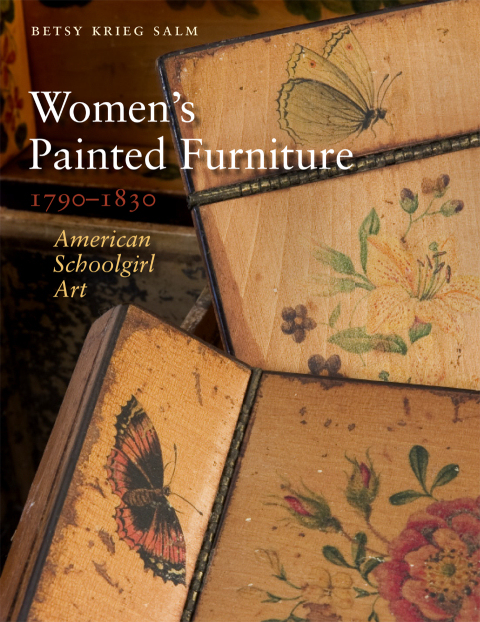
I was researching a post on painted “fancy chairs” from the Federal era and after when I got distracted by a great book and its subject matter: Betsy Krieg Salm’s Women’s Painted Furniture, 1790-1830 (University Press of New England, 2010) caught my eye in the library for numerous reasons (it’s a beautiful book, I love painted furniture, the era coincides with Salem’s golden age, so I knew I’d find some good stuff in it), but once I opened it I could not put it down. The result of three decades of research by the author (who is an ornamental artist herself), the book is art history, social history, education history, cultural history, world history all at the same time.

The subtitle, American Schoolgirl Art, is particularly appropriate as this book is about training, expectations, and influences as well as the motifs which decorate the furniture. I had never really considered the distinct genre of “schoolgirl art” and now I’m curious about its place in other eras and cultures. Lots of painted pieces are examined in Salm’s book, but my favorite by far are the work boxes produced by young women from relatively wealthy families, like Salem’s own Mary Derby Prince, the daughter of a Salem ship captain, with connections by blood and marriage to two of Salem’s most commercially aristocratic families, the Derbys and the Ropes. Another Salem box from the same era (and milieu) is that of Hannah Crowninshield, from the collection of the Peabody Essex Museum. Have I ever seen this before?  I don’t think so, but I could have walked right by it. I am familiar with samplers, of course, and the various types of wooden, decorated boxes produced for documents and other materials, but somehow I have never put the two together in the form of a work box, produced by young women as both an example of their work and for their work. Here are some of my favorites from the book:

Work Box by Ann Trask, Rowson Academy, Boston, circa 1810-20. Collection of Old Sturbridge Village.

Lid of Work Box by Hannah Bland, Massachusetts, circa 1810-30. Private Collection.

Detail of Lobstermen from Work Box of Fanny Barber, Gloucester, Massachusetts, 1821. Private Collection.

These boxes are so charming and so reflective of the environments in which these girls lived and worked, as well as the more general cultural influences to which they were exposed.  A little bit more context, for both American schoolgirl art and (transatlantic) work boxes in the first half of the nineteenth century:  a concise yet substantive article about the curriculum and culture at the Misses’ Martin’s School in Portland, Maine, and a few images of professionally-made work boxes from the British Empire. The first box is a particularly expensive example, with leather covering, silk lining, brass fittings, and custom-made sewing and needlework accessories, from the collection of the Victoria & Albert Museum in London.

Work Box, England, circa 1815. Collection of the Victoria & Albert Museum, London.

These last two “cottage” work boxes are both examples of Tunbridge ware, even though they were made in places thousands of miles apart:  southeast England and India. Tunbridge ware is the very intricate type of inlaid woodwork that emerged in the vicinity of Tunbridge Wells, Kent in the eighteenth century, characterized by the creation of mosaic patterns with different colored woods, and sometimes other materials. Tunbridge ware designs influenced American decoration and obviously Asian as well, as the second work box, made of wood veneered with ivory, was made in India around 1790-1800.

Tunbridge ware painted sewing box, early 19th century, Bleasdales Ltd.

Ivory-veneered Work Box, Vishakhapatnam, India, circa 1790-1800. Collection of the Victoria & Albert Museum, London.