Tag Archives: Christmas

Christmas Play

The invention of Christmas as not only a religious and social holiday but also as family time over the course of the nineteenth century meant that people had to find things to do while at home for stretches of time. Imagine what we now call “the Holidays” spent in the company of our extended families with no telephones, televisions, or computers and you can can quickly grasp the need for some form of distraction, occupation, or Christmas “merriment”: songs, tales, but above all, games. The Victorians were great entertainers and also avid consumers of board games, first for educational and later for entertainment purposes, so it only makes sense that they would develop parlor games which were specifically focused on their favorite holiday. The first Christmas game I found actually pre-dated Victoria herself:  Christmas circles : or amusement for the new year. A new game designed to entertain a numerous party, featuring a board of concentric circles consisting of Christmas objects and characters, dates from about 1825. There are tokens but no apparent rules, and in the center of the board said objects and characters are “staged”, suggesting a pantomime at home. This is a London-made game, and given the British propensity for pantomines at holiday time, a domestic version makes sense. Just a few decades later, Alfred Crowquil’s Pantomime (As it was, is, and will be…to be played at home) brought pantomimes into the parlor, though accessible illustrations of stock characters.

Christmas Circles VandA

Christmas Pantomines 1849

Pantomimes Harvard

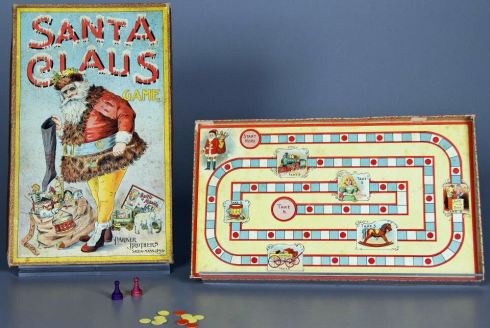
Christmas pantomimes never really caught on on this side of the Atlantic, and I don’t think a Christmas dinner party game called The Feast of Reason. A Christmas Dinner Party Puzzle did either, as I have been able to locate only two copies, one in the collection of the Boston Athenaeum and one which sold to a private buyer at auction a few years ago. Both were published by the Salem firm C. M Whipple and A.A. Smith in 1865, after a charming drawing by the artist William Emmerton (featuring marginalia that looks like a medieval manuscript) and lithography by the J.H. Bufford firm. There are multiple riddles for each course, and I have yet to figure out even one. Later in the century, another Salem producer, Parker Brothers, manufactured several games for Christmas time, including The Santa Claus Game and The Night before Christmas.

Feast of Reason BA

Feast of Reason 2p

Christmas Games Santa Claus Parker Brothers

Christmas Games Parker Brothers 1896 BGG

As the Parker Brothers’ games illustrate, by the twentieth century Christmas games seem to have evolved into children’s games primarily, rather than family or parlor games. There are a few exceptions, but there seems to be a holiday segregation of sorts, with the children preoccupied with gaming and gifts and the adults occupied elsewhere (purchasing, preparing, drinking?). At least everyone comes back together for the feast, followed by a little Crackers merriment, always over in Britain and increasingly over here.

Christmas Game 12 Days

Christmas Crackers V and A

Christmas games:  Christmas Circles, c. 1825, The Twelve Days of Christmas, c. 1950, and Batger’s Crackers, 1920s-30s, Victoria & Albert Museum Collection; Alfred Crowquil’s Pantomime, Harvard University; The Feast of Reason, c. 1865, Boston Athenaeum, Parker Brothers’ Santa Claus games, 1890s, National Museum of Play, ©The Strong.


Dancing towards Christmas

A week of events and grading: there is no why to make the latter look enticing or even interesting (though admittedly there is much less of it now that I’m chair, one of the few benefits of that position) so I’ll focus on the former. Over the past week we went to an “audience-driven” theatrical event at the Peabody Essex Museum‘s Gardner-Pingree House, the PEM’s monthly PM evening, themed as “Wassail” for December, and the annual Hamilton Hall Holiday (Christmas) Dance. The first event, All at Once upon a Time, was very special. I must admit that I signed up for it simply so I could spend an hour in the Gardner-Pingree, arguably Salem finest Federal house and Samuel McIntire’s masterpiece. It wasn’t every expensive: I would have been willing to spend much, much more simply to stare at those mantels and moldings for an hour. But the experience, for lack of a better word, carried me away from the material world, at least for a bit. The creation of Giselle Ty, a freelance opera and theater director based in London and New York, All at Once consisted of a small cast of seven or eight interacting with an “audience” of fifteen people, engaging in various activities, sketches and performances throughout the house–indeed on every floor. We were led through the house and enticed to listen, observe, read, write, dance, drum, and throughout it all, wonder. Ty is really after wonder, an increasingly rare commodity in this know-everything-instantly information age. The house looked magical, and because none of us were allowed to have phones or cameras I will entice you to click over to see some of John Andrews’ beautiful pictures at his Flikr photostream: he has allowed me to use a couple below but you should see more. Everyone’s experience is a bit different during this happening, so here’s mine:  I listened to a tale of trees in the front parlor, wrote a few lines of poetry in the dining room, unraveled and danced with a ballerina in a second-floor bedroom, and then watched a monkey and bear dance up on the third floor, after which we all danced with all of the cast. Then downstairs through the kitchen (with a Rumford Roaster!!!) to where we began. Later in the week, the PEM’s Wassail included traditional music (including the fifteenth-century Boars Head Carol) and dancing, and provided another opportunity to view the exhibition of  Native Fashion Now. The week was capped off by the Hamilton Hall Christmas (Holiday) Dance, preceded by a lovely pre-dinner party by one of the Dance’s patronesses at another one of Salem’s elegant Federal houses. I’m feeling very fortunate this morning, and still trying dust off some of the silver glitter in which I doused myself last night!

allonc022_copy1

Photo by John Andrews for Peabody Essex Museum

Photo by John Andrews for Peabody Essex Museum

Photo by John Andrews for Peabody Essex Museum

Photo by John Andrews for Peabody Essex Museum

Dancing 032

Dancing 049

Dancing 2 116

Dancing Hamilton Hall

Dancing 2 143

The Week’s Festivities: photographs of Gabrielle Ty’s All at Once Upon a Time at the Peabody Essex Museum’s Gardner-Pingree House courtesy of John Andrews of Creative Salem and Social Palates photography; Morris Dancers at PEM’s Wassail and formal attire from Native Fashion Now; fabulous skirt at a fabulous pre-Christmas Dance dinner party and the Christmas (Holiday) Dance at Hamilton Hall. I can never capture the actual dancing!


Seeing Red

It’s finals week and getting reading for Christmas week so please excuse a few short posts. My house is not quite ready yet, but the rest of Salem is draped in red. No white Christmas this year for sure–we’ve had several 60 degree days this month and the forecast looks brown, even green, as the warm weather has resulted in some startling regrowth out there–much of my garden looks like it is still alive! I know you’ve seen a thousand pictures of Hamilton Hall here, as it’s right next door and a site of constant activity and attraction for me, but I popped in to see it decorated for the Christmas Dance (now called the Holiday Dance but I’m still going to call it the Christmas Dance) this weekend. It looks lovely, better empty really though I do love the Dance.

Hamilton Hall 016

Hamilton Hall 021

Hamilton Hall 023

Hamilton Hall 028

Hamilton Hall 041

Hamilton Hall 043

Hamilton Hall 062

Hamilton Hall 050

Hamilton Hall 054

Hamilton Hall 088

Downtown: Santa getting ready to ride, beautiful red berries in the Derby House garden, red door on Mall Street; next door at Hamilton Hall, exterior and interior.


The Merry Boys of Christmas

One of the most dramatic examples of raucous Christmas revelry happened in Salem Village on Christmas Day, 1679 when four youths barged into the home of John Rowden and started singing loudly before the fire. After a few off-key tunes, they demanded compensation in the form of spirits: perry, in particular, as Rowden maintained a profitable pear orchard and was known to make a pleasing pear cider. According to the record of the subsequent trial: it was Christmas Day at night and they came to be merry and to drink perry, which was not to be had anywhere else but here, and perry they would have before they went”. Rowden and his wife were not pleased with the songs, or the demands, so they sent the young men away, but they quickly returned with a scrap of lead which they tried to pass off as coin to pay for their perry. The Rowdens rebuffed them again, and then all hell broke loose. According to Mr. Rowden’s testimony, The threw stones, bones, and other things against the house. They beat down much of the daubing in several places and continued to throw stones for an hour and a half with little intermission. They also broke down about a pole and a half of fence, being stone wall, and a cellar, without the house, distant about four or five rods, was broken open through the door, and five or six pecks of apples were stolen.”  This was a case of Christmas wassailing gone bad, very bad, recounted by Stephen Nissenbaum in his wonderful book The Battle for Christmas as “The Salem Wassail” and a great example of why Puritans on both side of the Atlantic abhorred Christmas. Their power in both Parliament and the Massachusetts Bay Colony resulted in the great Christmas ban of the mid-17th century: from 1651 to 1660 in England and 1659 to 1681 in Massachusetts.

Vindication of Christmas

The Vindication of Christmas, 1652, lamenting the prohibition of its “keeping” in England during the Interregnum.

There were three major reasons why the Puritans hated Christmas. Their insistence on scriptural authority cast doubt on its date, as nowhere in the Bible does it say that the Nativity occurred on December 25th. They could only conclude, very reasonably, that some ancient winter festival, the Roman Saturnalia or the Winter Solstice, had determined this date, and that the Christian Church had merely adopted and assimilated it: consequently Christmas was perceived as a pagan holiday with a Christian gloss. Given their mandate to purify the Church of all its non-scriptural “traditions” and Popish trappings, it became a conspicuous target. The third reason was primarily social: the Christmas that the Puritans targeted was “Old Christmas”, or “Merry Christmas”, which they saw principally as a prolonged season–Christmastide, which could stretch beyond the twelve days of Christmas to encompass all of December and January–of disorder, misrule, and excess. In Cotton Mather’s words, the “Feast of Christ’s Nativity is spent in Reveling, Dicing, Carding, Masking, and in all Licentious Liberty….by Mad Mirth, by long eating, by hard Drinking, by lewd Gaming, by rude Reveling…..”.  By the time Mather  wrote this, “Old Christmas” had returned to England with the Restoration of the Stuart monarchy. Salem seems a little behind the times in 1679 when those young men wassailed the Rowdens so crudely; indeed in that same year the government of Charles II begin requesting that the Massachusetts General Court repeal its anti-Christmas law. If the Rowden revelers had been a bit less rude (and much better singers) one wonders if they would have been let off as mere “merry boys of Christmas”, the subjects of a popular British ballad who cast off all constraints in their keeping of Christmas: these Holidays we’l briskly drink, all mirth we will devise, No Treason we will speak or think, then bring us brave mine’d Pies: Roast Beef and brave Plum-Porridge, our Loyal hearts to chear: Then prithee make no more ado, but bring us Christmas Beer!

Christmas oldp

Christmas Merry 2p

Christmas merryp

carols

Keeping “Old” Christmas and the “Merry Boys of Christmas” broadside woodcut illustrations from 1680s; Christmas Carols return to Old England at about this time, but New England will have to wait a bit longer.

Dedicated to my friends at the Salem Historical Society and Creative Salem, big supporters of history AND revelry.


The Eyes of Saint Lucia

The astronomical winter solstice will not occur for a week or so, but the shortest day on the Christian calendar is that associated with the Feast of Saint Lucia or Lucy, occurring on December 13. John Donne referenced this connection in his poem A Nocturnal upon Saint Lucy’s Day: ‘Tis the year’s midnight, and it is the day’s,/ Lucy’s, who scarce seven hours herself unmasks;/ The sun is spent, and now his flasks/ Send forth light squibs, no constant rays;/ The world’s whole sap is sunk;/ The general balm th’hydroptic earth hath drunk,/Whither, as to the bed’s feet, life is shrunk,/ Dead and interr’d; yet all these seem to laugh,/ Compar’d with me, who am their epitaph.

Lucia’s story is part late antique and part late medieval: the earliest accounts depict her as a young virgin martyr from Sicily who was put to death in the Diocletian persecution at the beginning of the fourth century. She had devoted herself to Christ following the miraculous recovery of her mother from chronic “bloody flux” (dysentery) and afterwards devoted herself to distributing her not-inconsiderable dowry to the poor of the island. Her spurned betrothed turned her over to the Roman authorities, and she was tortured and threatened with “fouling” in a brothel. Her virtue and virginity were maintained by another miraculous intervention which rendered her body immovable, but she was martyred by a sword to her throat (after burning also failed). Her veneration seems almost immediate, and by the sixth century Lucy’s story had spread through much of Europe. Her association with “light” (lux in Latin) seems to come principally from her name, but in the later medieval era she also became a patron saint to the blind and those with eye diseases: we increasingly see her with attributes of eyes (generally on a plate) from the fourteenth century on, and this depiction becomes standard with the Renaissance.

Lucy's Eyes BL

Lucy Francesco_del_Cossa

lucy-web3

British Library MS Additional 22310 (Venice, 1460-70); Francesco del Cossa, Saint Lucy, 1473-74, National Gallery of Art (and detail); Francisco de Zurbarán, Saint Lucy, 1625-30, National Gallery of Art, Washington.

Once Lucy became associated with both light and sight, the eyes appear in her depictions and then a story is constructed and grafted onto her hagiography–but it has variations: sometimes Lucy is punished for her vision of the end of Roman rule by the gouging out of her eyes before her martyrdom; in other accounts she gouges them out herself to repel her pagan fiance. Each tales develops its own embellishments: Lucy’s eye’s were so beautiful that both the emperor Maxentius (whose reign would soon end according to her “vision”) and her evil and equally pagan betrothed wanted them gone; Lucy’s faith was so strong that she sacrificed her most beautiful feature so that she could “see” in only that way.

The Martyrdom of Saint Lucy, Watercolor, n.d., Wellcome Library and Images, London.

The equation of “light” with “sight” in these ways, over time, is just one interesting aspect of Lucy’s veneration. Another is its durability–and its range: even after the Reformation she maintained her stature in Protestant Europe and even increased it in largely Lutheran Scandinavia. Lucy/Lucia is venerated in parts of Italy and eastern Europe too, but it’s the Scandinavian rituals that really interest me, because I can’t quite figure out whether they are a continuation or “invention” of tradition. As the first references to Lucia rituals are in the eighteenth century and the first national processions in the twentieth, I’m guessing the latter, but clearly they had a cultural basis that was rooted in both the Christian and pre-Christian past. On December 13, white-clad, red-sashed “Lucias” lead singing processions out onto the streets wearing head wreaths made of lit (by wax or battery) candles; in the home, the household Lucia serves her family a substantial breakfast of special saffron buns (lussekatter–with raisin “eyes”!) after the long winter’s night. These Lucias bring light into their world on the darkest day of the year, when there is none.

Lucia Christmas Morning 1923

st-lucia-saffron-buns-vertical

Photogravure of St. Lucia’s Day, 1898, Wellcome Library; The crowned Lucia at this year’s Festival of  St. Lucia at York Minster, sponsored by the York Anglo-Scandinavian Society (© Ian Forsyth/Getty Images); Carl Larsson’s Christmas Morning, published in “Lasst Licht Hinin”; St. Lucia’s Day Saffron Buns at Simply Recipes.


What I Want Now: King Penguins

Today I have an entry in my very occasional series of What I Want Now: things I am craving at this very minute. Generally these things fall into two categories: items that I have just discovered and want instantly and items that I have known about for a while but suddenly must have. Today I am thinking about collectible “King Penguin” books, an illustrated hardcover series that Penguin published between 1939 and 1959, including 76 titles. I have four and now want more. These are slim volumes with striking covers: like another series which I admire and collect, Britain in Pictures, it was the aesthetic quality of these books that first captured my attention rather than their content. They look great on a shelf, and in multiples, so I really need more, now. I bought my four volumes in a brick-and-mortar store that is no more, so I think I’ll have to expand my collection from online sources but I’m a bit hesitant as condition is everything with these books: not only do they have beautiful covers, they have lovely spines, and this is the part of the book that gets the most wear and tear. Yet despite my trepidation, I will press on, and if anyone out there reading this wants to help, I have Crown Jewels, Elizabethan Miniatures, Some British Moths, and Flowers of Marsh and Stream in my possession and really want Animals in Staffordshire Pottery, the two (edible and poisonous) mushroom books, both of which have amazing covers, A Book of Toys (with toy penguins on the cover), Spiders, The Bayeux Tapestry, The English Tradition in Design, A Book of Scripts, Tulipomania, and just for the season, Compliments of the Season.

King Penguin Elizabeth Miniatures

King Penguin Flowers Marsh and Stream

King Penguin Mushrooms Covers

King Penguin Toys Cover

King Penguin Spiders Cover

King Penguin Scripts Cover

King Penguin Ballet Illustration

King Penguin Military Uniforms Illustration

King Penguin Tulipomania Cover

King Penguin Compliments Cover

King Penguin titles I have and want, and illustrations from Janet Leeper’s English Ballet and James Laver’s British Military Uniforms. The best source for learning all about collectible Penguin titles is here. Oh, and this one too, please: for $92, I assume its spine its perfect.

King Penguin Life Cover


Christmas in Salem 2015

The venerable Christmas in Salem house tour, the major fundraiser of Historic Salem, Inc., returned to the McIntire District this year and featured homes and public buildings decorated around the theme of the “Twelve Days of Christmas”. There were some absolutely amazing houses open this year, and a huge turnout, due both to the perennial appeal of Chestnut and Federal Streets as well as the unseasonably warm weather–people didn’t seem to mind waiting in line. Unlike past years, I don’t have a lot of interior shots for you this year, as I was scolded very nearly every time I took my camera out: photographs are not allowed in the houses!  Having had several houses on this tour over the years, I can certainly understand the homeowners’ desire for privacy and security, but as official photographers and magazines and Salem Access Television were allowed to shoot, it does seem like a somewhat contradictory policy. In any case, I think you’ll get some sense of the spirit of the event from the exterior views, and I’ll tell you what you missed, in no particular order: 1) a dining room dressed up like a Tiffany box, complete with a Tiffany-ornamented tree; 2) TWO amazing conservatories, one which featured camellias, the particular favorite of Yankee bluebloods in the nineteenth century; 3) THREE period dollhouses: small, medium and large; 4) FOUR public buildings (the Phillips House, Hamilton Hall, the “Witch House”, and the Ropes Mansion–I was scolded here too, but there are plenty of pictures of these exteriors both here and elsewhere on the web; 5) I can’t make the numbers work anymore so I will simply say–a Rumford Roaster which I had never seen before! 6) the most beautiful study I have ever seen, with wooden swags adorning the windows; 7) a particularly clever, and aesthetically pleasing, device for hiding the television; 8) all different kinds of pantries; 9) lots of beautiful china patterns, including a nice collection of pink lustre which seemed to be the inspiration for an entire room; 10) many beautiful decorations tied to the theme of the tour–I especially liked the pears.

Christmas in Salem 2015 156

Christmas in Salem 2015 109

Nichols House Collage

Christmas in Salem 2015 099

Christmas in Salem 2015 118

Christmas in Salem 2015 142

Christmas in Salem 2 Chestnut

Christmas in Salem 2015 162

Our greeter at the Ropes Mansion and lots of decorated doors on Chestnut and Federal streets—sorry I can’t show you inside!  The doorway of #37 Chestnut, the Nichols-Shattuck House, was included in Frank Cousins’ Colonial Architecture, Volume I: Fifty Salem Doorways in 1912 and is often referred to as a “Coffin door”, because it has an extra panel that (supposedly) can be opened to accommodate coffins. All the architectural historians whom I consulted, however, say this is mythology. The rear of #37 shows the evolution of the house and the conservatory addition on the right. Exceptional “China coin” cast iron railing added to #2 Chestnut in the 1880s; lines and crowds on a 6o-degree day yesterday.

This has nothing to do with the tour, but I was out and about so much this past weekend that I also really noticed something that everyone in Salem has been talking about for the past month or so: the inescapable sight of our new HUGE trash and recycling barrels. A new trash pick-up regimen went into effect just after Halloween, and we were all given these large toters which are hefty and awkward–we’re all struggling with a place to put them–I know I am! So a lot of people are just leaving them on the street–or near it. Unfortunately, many of the streets of Salem are black and blue (plastic).

Christmas in Salem Trashcan Collage

I’ll link to interior shots as soon as they are up! 12/11/12 postcript: here’s the link to the official photographer’s interior images, which you can buy, of course: http://photo.vistaphotography.com/p384049441.


Krampus Cards

Krampus, that dark monstrous creature, cloven-hoofed, horned, hairy, and long-tongued, the antithesis of Saint Nicholas but also his companion, somehow did not make it across the pond with Old St. Nick’s descendant, Santa Claus–actually, he didn’t even make it across the English Channel. I’m not sure why not, except for the fact that he is a repulsive creature, who constrains mischievous children in his basket and carries them off to somewhere bad. So who wants him? Well apparently we do now, with the new Krampus film opening tonight and Krampusnacht festivals on the rise both in the old world (especially his native Austria, Switzerland and Germany) and the new on December 5th, the eve of the feast of St. Nicholas. He’s big in Los Angeles now, and Philadelphia, and also apparently Salem: can you imagine a better environment for Krampus than modern Salem?

Krampusnacht Austria

Saint Nicholas and Krampas

Krampus in the drawing room 1812-13

Krampuses getting reading for Krampusnacht in Stubaital, Austria, 2013, photograph by Sean Gallup/Getty Images; St. Nicholas bearing gifts and Krampus carting children away, two cards from the Christmas pictures by Raschka series by Raphael Kirchner, Museum of Fine Arts, Boston; Krampus sneaking into the drawing room behind St. Nicholas, from The Journal of Carl Baumann written 1813-25 by Franz Paumgarrten.

In his latest incarnation, Krampus seems a lot scarier now than he did a century or so ago, when he appeared regularly on Krampuscarten, holiday postcards issued in much of central and eastern Europe. He’s always been a beast, but he was a comical and/or polite one (almost knocking on the parlor door above!) at that time. His origins are somewhat obscure: his appearance mirrors the pagan or Neo-Pagan horned god but also the Christian devil. He seems like the embodiment of assimilated and dualistic Christianity to me, chained to remind everyone that as demonic as he may be, he is still under the command of God. According to all the “sources”, which cite one another but never the primary source, he becomes the companion of St. Nicholas at some point in the seventeenth century, and with the “invention of Christmas” and all of its “traditions” in the nineteenth century he assumes a major role in the festivities. Given his alpine origins, the most creative Krampuscarten are those created in Austria, in particular by the artists working for the Wiener Werkstätte before the First World War. These art nouveau Krampuses are a bit more stylized and whimsical than many of their more generic postcard counterparts, and they tangle with adults as well as children. Once men in Krampus masks begin to appear at the doors of their sweethearts on interwar cards, you know the Krampus has lost his sway.

Krampus and St. Nicholas WW 3

Krampus Koehler MFA

Krampuscarten by Wiener Werstätte artists Mela Koehler (1911), Arnold Nechanksy (1912) from the Neue Galerie and Josef Diveky (1909), Jutta Sika (1912) and Dora Suppantschitsch (1907), Metropolitan Museum of Art.

Appendix: A “Krampus versus Kringle” window at the Gulu-Gulu Cafe here in Salem snapped by my friend Lance Eaton—he’s going to put it on his own blog, but I’ve got it up first!

Krampus versus Kringle Eaton


Small Business Salem

After a beautiful warm Thanksgiving week it was rather depressing to wake up to a cold, dark, and rainy Small Business Saturday here in Salem. We were playing football in what seemed like 70-degree weather yesterday up in Maine! I’m a big advocate of shopping local and small, not just during the Holidays but all year round. I think small business owners are absolutely heroic, particularly retailers in this internet age. The day before Thanksgiving I found myself with lots of errands to do and lots of things to buy, even though I wasn’t even cooking: off I went to the tailor, the newest French bakery, the wine store, and the cheese shop, all on foot. I’m sure I could have saved myself time and money if I had just driven to Vinnin Square (where all the big stores are), but I wouldn’t have learned that the tailor’s mother-in-law grew up in the same French town as one of the purveyor of macaroons, I wouldn’t have been able to wish several friends Happy Thanksgiving, and I wouldn’t have garnered any praise for my recent letter-to-the-editor protesting Haunted Happenings’ toll on our ancient cemeteries. Today I went out in the rain just to see who was out and about: I prefer to do my own Christmas shopping just a few days before Christmas in a single day (or maybe two) with a long lunch break.

Salem Small Business 020

Salem Small Business 022

Caramel Macaroons

Salem Small Business 032

Salem Small Business 047

Salem Small Business 042

Salem Small Business 050

Salem Small Business 052

A very random sampling of Salem wares on Small Business Saturday: vintage Christmas ornaments (including those of a political nature) at Witch City Consignment; macaroons at Caramel; fish prints at Joes Fresh Fish Prints at Pickering Wharf, a selection of teas at the Jolie Tea Company, the new tea shop/room across from the Hawthorne Hotel, rainy window and manly items at The Marble Faun.

There were people downtown, so hopefully all of Salem’s merchants had good day. In the 20 years that I’ve lived here, the retail scene has definitely improved (particularly retailers of food and beverages) but it still looks a bit challenging to me. There are many visual and literary reminders of the “golden days” before the construction of the Northshore Mall in nearby Peabody when Essex Street was clearly bustling year round, and neither its transformation into a pedestrian mall in the 1970s or the commencement of Haunted Happenings in the 1980s has been able to bring back that dynamic customer base. It’s a different commercial era for sure, but if we want a vibrant downtown offering more than witch kitsch it’s our obligation to get out there and consume: it’s a Salem tradition.

Salem Bakery

Filene's 1856 Pavilion

Filene's 1880s

I just discovered several new archives of Salem photographs which really focus on business, so here’s some historical perspective and inspiration. Above: delivery carriages for Hyman B. Miller’s Bakery on May Street in 1913–these buildings would all be wiped out by the Salem Fire in the next year, but Miller rebuilt his business (Collections of the American Jewish Historical Society). Below, the original Salem Filene’s in 1856 and 1881: this is a business which grew to become one of the biggest regional American department stores in the twentieth century (AJHS Collections and Archives of the Credit Union National Association, Inc.).


All Wrapped Up

I think I spent more time on wrapping my Christmas gifts this year than purchasing them: I rationalized this by incorporating presentation into the cumulative “thought” that counts! I became rather enchanted with several images of seasonal, botanical anthropomorphism and they kind of took over my holiday: I made cards to affix to many of my gifts and even some custom wrapping paper via Spoonflower. Despite intensive searching online and off, I can’t find the creators of these images: the children transformed into Christmas trees, mistletoe, and plum puddings were issued as holiday cards by the Courtauld Gallery a few years ago, and the little holly sprites come from a vintage Christmas postcard in my possession, but I have no idea where they poinsettia lady comes from–she’s one of those random, unidentified, Tumblr images. If anyone has any information about these plant people, please forward so I can give proper credit!

All Wrapped Up 003p

All Wrapped Up 004

All Wrapped Up 007

Horsley_ChristmasCard

Holly Sprites Paper

Plant People for Christmas 2014.