Tag Archives: Boston

Remembering Dr. Warren

I have never been a formal student of memory and memorial culture, but the process, expressions, and artifacts of remembrance have fascinated me from the time that I was a little girl, growing up just down the street from the Justin Smith Morrill Homestead on the Justin Smith Morrill Memorial Highway (which we knew just as the road to South Strafford) in Strafford, Vermont and then moving to the equally past-focused town of York, Maine. Here in Salem, memorials are all around me, and some I take notice of on a regular basis while others escape my attention–why? I’ve been thinking about the distinction between individual and collective memorialization for some time: in the past, initiatives seem to have focused on the remembrance of individuals while we focus on the event, or the collective victims and/or participants related to that event. This seems like a basic divide between the nineteenth and twentieth centuries, and it was really driven home to me as I walked around Savannah last week. Savannah is a city of statues as much as it is of squares: these two distinguishing features go hand in hand. I did not take a precise inventory, but those statues erected to the memory of individuals definitely made a firmer impression on my memory, although sometimes (as in the notable case of Forsyth Park) you can see both, side by side.

Confederate and McLaws Statues Savannah

The Confederate War Memorial and Lafayette McLaws Statue in Forsyth Park, Savannah.

Today marks the anniversary of the Battle of Bunker Hill, at which over 350 men died, and many, many more were wounded: more British than American. It was truly a Pyrrhic victory for the British, and therefore ultimately inspirational for the Americans, as was the tragic death of Dr. Joseph Warren, prominent Son of Liberty, President of the Massachusetts Provincial Congress, the man who enlisted Paul Revere and William Dawes to put out the word that the British were indeed coming, and newly-commissioned Major General, who nonetheless engaged in the battle as a private soldier with a borrowed musket. Warren was shot in the face by his assailant and thrown in a mass grave by the British after the battle, but his body was recovered months later by Revere and his younger brother John, a Salem doctor, even after his martyrdom had been established by John Trumbull’s iconic painting, The Death of General Warren at the Battle of Bunker’s Hill, June 17, 1775. The Doctor Patriot has been memorialized in many ways: through the naming of towns across New England and the United States, streets (I’m not sure about Warren Street here in Salem), statutes and statues. The first Bunker Hill Memorial was a Warren Memorial, erected by his Masonic brothers; it was replaced by the 221-foot-high obelisk commemorating the entirety of the battle in 1843. But Dr. Warren did not retreat from the field entirely: an adjacent exhibit lodge was built in the late nineteenth century to house his statue, one of several in Boston. While I certainly would not want to displace the statue of Colonel William Prescott that stands before the Bunker Hill Monument, I would also like to see Dr. Warren there, outside, although maybe that would spoil that stark individual vs. collective aesthetic of the site.

Warren by Trumbull MFA

Warrens Death 1775

Warren Memorial Bunker Hill 1794

Bunker Hill Monument BPL 1920

Bunker Hill Monument and Prescott

Warren Statue by Dexter

Warren Statue Roxbury

Warren Tavern

John Trumbull’s Death of General Warren, Museum of Fine Arts, Boston; Frontispiece to the H.H. Brackenridge play The Battle of Bunkers-hill: a dramatic piece, of five acts, 1776, Library of Congress; Masonic Warren Memorial on Bunker Hill and present day Bunker Hill Monument in 1920, Leslie Jones, Boston Public Library, and today, with Colonel William Prescott “on guard”; Photograph of the Masonic Warren Statue by Henry Dexter, Southworth and Hawes, 1851, Museum of Fine Arts, Boston; The Warren Memorial Statue on Warren Street in his native Roxbury, before it was removed to West Roxbury by a street widening project (Roxbury wants it back), Leslie Jones, Boston Public Library; the Warren Tavern in Charlestown, built as a “memorial” of sorts to Warren in 1780.


Hatching Hostilities

Well this is not really a post that speaks to the spirit of Easter, but it does involve eggs…..I think I’ve written about all of the usual Easter topics over the years, including rabbits, the White House Easter Egg Roll, and Swedish Easter witches, but never war, until today. The minute I saw some egg-themed postcards from the Russo-Japanese War (1904-1905), I knew I had to write about them, and this seems like an (oddly) appropriate time. Even though it was a relatively short war, this cross-cultural conflict was nevertheless a major turning-point in Russian history, Japanese history, and world history, and it anticipated the truly global nature and coverage that would characterize World War I in the next decade. A good part of this coverage was pictorial: photographs, editorial images, and postcards–the latter was new media at the turn of the last century, and producers and artists in the west and the east embraced them as a multi-national form of war reportage. Cards produced for domestic audiences tend to be more propagandistic and jingoistic, obviously (you can see a sampling at MIT’s “Asia Rising” online exhibit), but those oriented towards an international market tend to be more symbolic, allegorical, and (above-all) humorous. Because of the universal symbolism of the egg and its all-too-apparent nature, these egg-themed cards, all from the vast Leonard A. Lauder Collection at the Museum of Fine Arts, Boston, are not too difficult to understand: an “Easter Egg of the War” is about to hatch hostilities in Manchuria, a Russian soldier cracks opens a “boiled egg” filled with his enemy, and the theater of war is played out in two postcards from the “Easter Eggs of the Mikado” series.

Japan Easter Egg of the War

Boiled Egg

Japan PC 1 MFA

Japanese PC 2 MFA

A.F. Delamarre, “The Easter Egg of War”, 1904-1905; Fernet, “Boiled Egg”, 1904-1905; and unidentified artist, “The Easter Eggs of the Mikado” series, 1904-1905, all from the Leonard A. Lauder Collection of Japanese Postcards, Museum of Fine Arts, Boston.

The meaning behind these next four postcards is even easier to grasp: an egg fight, in which eggs are broken, and scrambled (leaving behind a big mess!):

Egg Battle 1 Fact to Face

Egg Battle 2 Start the Fire

Egg Battle 3 Fire at Will

Egg Battle 4 Body to body

Egg Battle 5 After

Unidentified (Japanese?) artist, The Egg Battle series: face to face, start the fire, fire at will, body to body, after the battle, 1904-1905, Leonard A. Lauder Collection of Japanese Postcards, Museum of Fine Arts, Boston.


Koehler Christmas Cards

Looking around for inspiration for our family Christmas card, which I desperately would like to evolve from the traditional “here we are in front of some natural (maritime or snowy) backdrop”, I have become quite taken–like many before me, and no doubt after–with the whimsical illustrations of Mela Koehler (1885-1960). Koehler was a conspicuous member of the Wiener Werkstätte (Vienna Workshop), an artistic collaboration for artists, artisans, designers and architects inspired by the British Arts and Crafts movement. In the first three decades of the twentieth century, the Workshop became incredibly influential due to the fact that it emphasized both the artistic and the entrepreneurial: marketing was clearly a priority and the postcards produced by its members were the primary marketing tool. Mela Koehler created about 150 postcards for the Workshop: typically fantasy fashion images which served not as advertisements for actual clothes but as inspiration for women to experiment with their own attire. Add a tree or some holly, or a muff (clearly her favorite accessory), and you have a winter/Christmas postcard, offered up just at the moment that these merry missives were taking off. Original Koehler postcards are quite valuable, but most seem to have been acquired by Leonard Lauder as part of his massive collection (commenced when he was 6 years old), which has been generously donated to the Museum of Fine Arts, Boston. The MFA featured an exhibition of a sample of the Lauder postcards last year, and many have been digitized, fortunately for us and for posterity–because as artistic as these little cards are, they are still (or were), in essence, ephemera.

Christmas Koehler Card MFA

Christmas Mela Koehler MFA 1

Christmas Mela Koehler MFA 2

Christmas Mela Koehler MFA 3

Christmas Mela Koehler MFA 4

Christmas Mela Koehler MFA 5

Christmas Koehler Card MFA 3

Christmas Koehler Card MFA 2

Koehler Card 2

Mela Koehler Christmas postcards, circa 1912, from the Leonard Lauder Collection at the Museum of Fine Arts, Boston.


One, two, three, four, five……….

GABLES. Before I knew anything about historic architecture (and I still really don’t know all that much, to be honest), I always thought the gables (generally one, occasionally two or three) that seem to burst out of the roofs of mid-19th century houses were rather radical departures from the more straightforward colonial and Federal styles. Radical for American architecture, that is: obviously gables are a long-standing feature of European structures. But now I know they are just another revived element, derived not only from much older European elements but also 17th century “medieval” houses built in America (I know that term is widely used by architectural historians, but I find it awkward, as the 17th century is decidedly not medieval). Just the word gables in Salem is a reference to the House of the Seven Gables, which is more early nineteenth-century creation than seventeenth-century survival: when philanthropist Caroline O. Emmerton acquired the fabled mansion it had three gables rather than seven and she hired Boston architect Joseph Everett Chandler in 1909 to “restore” the “missing” gables and transform the house into Hawthorne’s inspiration. Chandler was more of Colonial Revival architect than a restoration architect, and he writes about the “development” of the House of the Seven Gables in his 1916 book The Colonial House, citing other first-period gabled structures in Salem and Boston as his inspiration. Hawthorne scholars believe that the author was also inspired by Boston gabled houses in his conception of the House of the Seven Gables, including Captain John Turner’s mansion on Beacon Street and the famous  “Old Feather Store” at Dock Square. Certainly there were gables aplenty to choose from in Hawthorne’s time, both new and old.

Gabled Julien House Boston-001

Gables 021

Gables 035

Gables 024

Gables 037

Gables 039

Gables 038

old feather store

Drawing of “Julien’s Restorator” in Boston, taken down in 1824, from James Henry Stark, Antique Views of Ye Towne of Boston, 1901, and center-gabled houses in Danvers and Salem; a two-gabled house in Danvers, and two adjacent three-gabled houses in Salem; The “Old Feather Store” in Boston, c. 1680-1860, shortly before it was taken down, Boston Public Library.


New Year’s Day

New Year’s Day is generally and literally about dismantling for me: taking down the elaborate holiday displays I assembled only weeks before on my eight fireplace mantels and all of the other decorations around the house. The tree is relatively easy compared to everything else, frankly, and as I write it’s out on the sidewalk awaiting its transport to Dead Horse Beach for the annual Christmas Tree bonfire this weekend. I’m an habitual seasonal decorator but now I’m wondering if I should reign in this instinct a bit….that’s certainly an attainable New Year’s resolution! In between bouts of dismantling I wasted copious amounts of time browsing the web for the perfect 2014 datebook because the one I bought at Target the other day is so devoid of any aesthetic whimsy that I fear I will not use it, and I need to: this is another area where my life has changed since becoming chair of my department–I now need to keep track of everyone’s dates and not just my own. As usual, I had Turner Classic Movies on in the background, and several movies distracted me from my dismantling mission as well, most notably the original (1968) Thomas Crown Affair. I had to figure out exactly where Steve McQueen lived on Beacon Hill in Boston (85 Mount Vernon Street–the 2nd Harrison Gray Otis house!!!) and examine each one of Faye Dunaway’s amazing outfits. And then, of course, I had to keep checking the weather reports as we have a big snowstorm bearing down on us: it looks like I will have several days inside to come up with some new displays for my mantels.

A day in the life: outside my bedroom window, the calm before the storm; a Christmas mantel before its dismantling; I love these little fabric trees from Quietude Quilts so I’m going to keep them up for a while; great Christmas presents: Wanderlust plates made in Rhode Island; Jessica Hische pocket planner; 85 Mount Vernon Street, Boston.

New Year 038

New Year 066

New Year 031

New Year 032

New Year 054

today-is-the-day-pocket-planner-570

OLYMPUS DIGITAL CAMERA


Waiting & Walking in Old Boston

I spent all of yesterday in Boston, in the realms of two of the city’s more venerable–and very different–institutions. At Massachusetts General Hospital, I kept my father company while we waited for news of my stepmother’s condition after surgery (she is fine, thank you). This particular institution has such a strong historic identity that you can’t escape it: sepia-toned photographs of firsts line the halls, a flyer for the “MGH History Trail” greets you in the waiting room, the original 1821 Bulfinch-designed building still sits in the center of its expansive campus, and a new Russell Museum of Medical History and Innovation opened its doors just last year. While waiting, I made my way to the Bulfinch Building, and ascended stone steps to the 4th floor surgical theater called the “Ether Dome”, the site of the first public surgery with anesthesia, performed in 1846 (there is a mummy up there too).

Boston 053

Boston 110

Boston 121

Boston 113

Boston 122

In the afternoon, I found myself in another venerable Boston institution: an “Old Boy’s Club”, except it wasn’t! Surviving bastions of the Brahmin past, Boston’s social clubs–most of which are located in the Back Bay–continue to function as social centers for their members but also offer rooms for short-term stays “in town”. My father’s club was closed for renovations, so they had placed him at the nearby Chilton Club, the only women’s club (clearly I cannot say “Old Women’s Club) among its brethren. Named for Mary Chilton, the first Mayflower passenger to leave Plymouth for Boston, the club occupies two adjacent brownstones on Commonwealth Avenue. Compared to the other Boston clubs I have seen, the decor of Chilton was indeed decidedly feminine, with needlepoint, lots of toile, a damask fabric-lined dining room, delicate fancy chairs scattered about, a pale yellow ballroom with mirrored “windows”, and a beautiful front-facing parlor called the “Dexter Room”. I asked the man at the reception desk if it was safe for my father to stay there, and he said they had admitted men a while ago (but they asked him to use the side entrance when he returned later that night).

Boston 098

Boston 081

Boston 076

Boston 089

Boston 097

Appendix:  in the Public Garden, a swan laid on her newly-lain eggs, in the biggest nest I have ever seen!

Boston 062


Streets of Boston

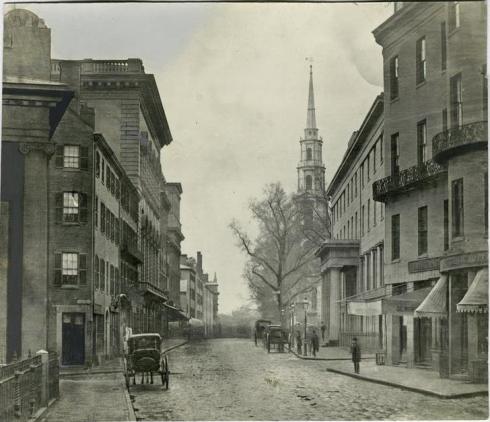
Like everyone else, I was thinking about Boston a lot yesterday and as it was a non-teaching day I was very vulnerable to the drip drip of media “updates” while at home. So I turned off everything and looked through some books about Boston:  its history, its architecture, its culture. Much better! Then I began assembling some of my favorite images and impressions of the city, and as that seemed like a somewhat productive enterprise I began to feel even better. So what I have today is a very random sample of my “collection”, including old favorites, new discoveries, and images of past and near-present. Boston is a dynamic city which has experienced a lot of change in the past few decades, but when I look at these images I still see a recognizable city, with the exception of the harbor views–visual reminders that Boston’s first and foremost identity for several centuries was that of a port. Paul Revere would draw on these prints a few decades later for his pre-revolutionary depiction of the occupation of Boston by British ships.

PicMonkey Collage with border

Two James Turner etchings of Boston’s wharves in the mid-eighteenth century from The American Magazine (Boston: Rogers and Fowle, 1743-46) and a hand-colored etching by John Carwitham of “A South East View of the Great Town of Boston in New England in America” (London: c. 1730-60), American Antiquarian Society, Worcester.

A century later, it’s more about the streets of Boston, the emerging “hub of the universe” and “Athens of America”. The mid- to late-nineteenth century were heady days for Boston, which of course had left Salem in the dust. During my hunt yesterday, I was particularly surprised to find that my favorite British pioneering photographer, Francis Frith, had included several images of Boston in his “Universal Series”. Artworks of varying mediums–watercolor, oil, another photograph–to depict other city scenes at around the same time.

Boston Francis Frith

Boston Frish State house

Boston Benjamin Champney 1851

Boston Railraod Jubilee on Boston Common William Sharp 1851

Boston Tremont Street 1860

Francis Frith photographs of Boston Common and the Massachusetts State House, 1850s, Victoria & Albert Museum, London; Benjamin Champney, Washington Street, Boston, 1850, Princeton University Graphic Arts Department; William Sharp, Railroad Jubilee on Boston Common, 1851, Museum of Fine Arts, Boston; Tremont Street, 1860, Halliday Historic Photograph Company, New York Public Library Digital Gallery.

And then there are the novel views of the city, created by creative and entrepreneurial publishers, cartographers, and balloonists! The nineteenth century loved the “big picture”.

Boston Balloon View 1860

Boston Birds Eye Triptych

James Black, Boston, as the Eagle and Wild Goose See It”, 1860, Metropolitan Museum of Art; a Birds Eye View of Boston Triptych, 1903, ArtHouseGraffiti.

Of the later nineteenth- and early twentieth-century “Boston painters’, I think Arthur Clifton Goodwin was particularly adept at capturing Boston streetscapes in his impressionistic way. There are lots of Goodwin paintings to choose from (in auction archives and the collection of the Museum of Fine Arts, Boston, which gave him his own posthumous show in the 1970s), but I went with Copley Square (1908). Of course I had to include a painting from his fellow Boston Impressionist, the more well-known Childe Hassam, so I went for Mount Vernon Street (1919) one of the most beautiful, and reproduced, streets of Boston. Jump forward thirty years, and you’re looking at “old” Beacon Hill with the financial district rising above it from across the Charles River in Cambridge in an amazing (oil!) painting by Thomas Adrian Fransioli. I love the “modern” look of this painting, although I believe that Fransioli is referencing the present, the past, and the future. Boston looks like the “shining city on the hill” that it has always been.

Boston Copley Square 1908 Arthur Clifton Goodwin MFA

Boston Mt Vernon Street Childe Hassam 1919 Christies

Boston Beadon Hill Fransioli 1947 MFA

Arthur Clifton Goodwin, Copley Square, London , 1908, Museum of Fine Arts, Boston; Childe Hassam, Mount Vernon Street, Christies; Thomas Adrian Fransioli, Beacon Hill, 1947, Museum of Fine Arts, Boston.


Selling the Psalms

There’s been a lot of discussion here in the Boston area over the last week or so about the decision of the Old South Church to sell one of their copies of the Bay Psalm Book, the first book to be printed in North America.  There are only eleven copies of this 1640 hymnal; each is precious (and worth about 10 million dollars, at the very least), and the Old South Church has two:  hence the decision to sell one to support its mission. I am certain that it was not an easy decision; deaccessioning an institutional legacy never is.  I’ve been on several boards of venerable institutions here in Salem which had to undertake similar considerations, and it was painful:  how do you honor the past while meet the demands of the present?

Bay Psalm Book LCp

The Library of Congress copy of the Bay Psalm Book (Cambridge, Massachusetts, 1640), more formally known The Whole Booke of Psalmes Faithfully Translated into English Metre. Whereunto is prefixed a discourse declaring not only the lawfullness, but also the necessity of the heavenly Ordinance of singing Scripture Psalmes in the Churches of God.

Everything about the Bay Psalm Book was imported:  paper, press, printer. The Puritans had brought several books of psalms with them, but their quest for the true word of God was essential and ongoing. The connection between printing and the Reformation was almost as well-known then as it is now, so the desire to have a press here in the New World must have been strong. The man with the plan was the Reverend Jose Glover, an English Puritan minister and shareholder in the Massachusetts Bay Company, who financed the purchase of the press (most likely Dutch, as was the type), the paper (most likely French), and the hiring of a “printer” named Stephen Daye in London. Glover died on the voyage to the New World, but his printer set up a press in Cambridge upon his arrival (with the aid of Glover’s widow, Elizabeth, who later married the first president of Harvard College, Stephen Dunster). There’s a lot of speculation about Daye; he was not a member of the Stationers’ Company, the printers’ and booksellers’ guild in London, rather he seems to have been trained as a locksmith and was barely literate. Nevertheless he is recognized as America’s first printer.

Bay Psalm Printing Press Stephen Daye

Bay Psalm First Printer restaurant

Daye’s Cambridge Press, Cambridge Historical Society; the First Printer restaurant at 15 Dunster Street, Cambridge, the site of Daye’s press.

The Bay Psalm Book went through several editions and remained in print through the seventeenth century. Even before the American Revolution, it was recognized as a foundational American text and included in the Prince Collection, the 2000 + rare texts collected by the Reverend Thomas Prince, the Pastor of the Old South Church in the 1740s and 1750s. These texts were stored in the steeple of the Church when it was transformed into a stable by the British during the Revolution (as I wrote about in an earlier post, the British stole Bradford’s Plymouth Plantation from the Church at this time but apparently felt the Bay Psalm Book was less valuable). In the later nineteenth century, the Church deposited the Prince Collection in the Boston Public Library for safekeeping. Of its two copies of the Bay Psalm Book, only one belongs to the Prince Collection so I assume that it’s the other that will go on the market, for the first time since 1947. All of the other 1640 copies (including one that was owned by Salem’s Federal-era chronicler, the Reverend William Bentley) are owned by institutions (you can see a great census here), so this is a rare opportunity for an individual to scoop one up.

Bay Psalm book title

Bay Psalm Book Singing Morgan

Title page of the Bay Psalm Book; Monks singing psalms in an earlier age: Pierpont Morgan Library MS M.193 fol. 277v (French, 13th century).