Tag Archives: Art

Hildegarde Hawthorne Hits Salem

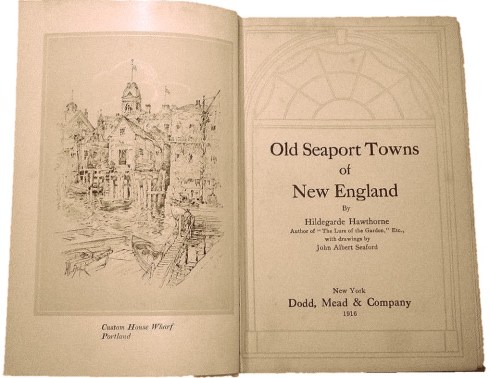
Nathaniel Hawthorne’s granddaughter Hildegarde (1871-1952), a prolific author of ghost stories, garden books, biographies and travel narratives as well as an ardent feminist and suffragist, returned to her ancestral city the year after its great fire (which she mistakenly dates to 1913 rather than 1914) so that she might gather material for her forthcoming book, Old Seaport Towns of New England. With “Sister” in tow, she disembarks into a bustling city which she clearly does not find as charming as Newburyport to the north or Newport to the south. The “insistent present” is bothersome in Salem, and she feels much closer to the spirit of her illustrious grandfather when she looks at the “tenements” of Union Street than the new House of the Seven Gables, “which used to belong to some relatives of ours”. She does, of course, love Chestnut Street.

hh-old-seaport-towns-of-ne

hh-chestnut-street

hh-old-seaport-towns-beverly-bridge-salem-side

Chestnut Street and the Beverly Bridge, Salem Side, by John Albert Seaford, from Old Seaport Towns of New England (1916)

And there’s lots more to see obviously, BUT (it seems like there is a but hanging over every sentence) new Salem or invented Salem seems to be intruding on old Salem too much:  You can easily spend a couple of days looking up the houses where famous men were born in this solid old city (for a feminist, she doesn’t seem to care about the house of famous Salem women). They seem to have had had an extraordinary hankering for the place. Not but what Salem must have been a particularly beautiful place in the days when these notable births were most common. It is now, in many spots, though it has lost much of its looks with advancing age.  For, oddly enough,as it becomes older it becomes younger, and the youth is not an improvement. After two days in town, Hildegarde left Salem at sunset, over the Beverly Bridge, vaguely disturbed by the conflicting impressions of her noisy, commercial present, that will not let you be, and the obstinate power of her past, equally insistent. It seems to me as if these last lines could have been written in 2016 as easily as 1916.

hh-collage

hh-1916

Two of Hildegarde’s other titles; Hildegarde, second from left, at the New York Womens’ Suffrage Parade, 1913, ©Paul Thompson, Getty Images.


Craftsman Confidence

As part of my recent immersion in early nineteenth-century design trends, I browsed through digital volumes of The Craftsman over its 1901-1916 run, every issue readily accessible at the University of Wisconsin’s wonderful Digital Library of the Decorative Arts and Material Culture. This was not a difficult task, as Stickley’s magazine is so interesting: such a heady mix of practicality, philosophy, and politics! How can you not enjoy a magazine with article titles like “Was Jesus a Carpenter?”, “The Century of Ugliness” (which was of course the 19th century from their point of view–when craftsmanship was compromised by industrialization), and “A Plea for True Democracy in the Domestic Architecture of America”?  In the end though, I came away feeling sad, as the editors and authors were so very hopeful for their new century, and their hopes were not fulfilled–the most anachronistic aspect of the magazine is its strident optimism. Everything can be reformed and everything is “civic”: not just education and urban planning, but also architecture and horticulture, even clothing. Birds are just as essential as bookcases, as the magazine espouses an integrated doctrine of conservation, craftsmanship, and community. The persistent quest for everything that is simple and “true” does get a bit pedantic as time goes on, even though I would like to live in their well-crafted and orderly world much more than in our disposable and disorderly one! But as soon as I saw Kaiser Wilhelm II depicted in a rather romantic fashion by the “new” German artist Arthur Kampf my browsing grew increasingly melancholy: I knew that the twentieth century would obliterate all opportunities for “Craftsman World”, and transform all those hand-crafted bungalows into cookie-cutter ranches.

crafstman1

craftsman-mark

craftsman06newyuoft_0530-entrance

stickley-house-1908

craftsman-living-room-c1901

craftsman11newyuoft_0302-dresses

craftsman-city-planning-1904

craftsman-collage

craftsman-roland-park-c1903

craftsman-cover-1914

craftsman-portrait-of-kaiser-arthur-kampf

Images from The Craftsman, 1901-1916, including the first cover and Stickley’s device, “Als Ik Kan” underneath a joiner’s compass, borrowed from Jan Van Eyck (Flemish for “All that I can do”), a Craftsman door and two-family house, “affording an opportunity for economy of construction without loss of architectural beauty”, living room, dresses “designed for comfort with a purpose in their ornamentation”, hexagonal urban planning, bookcases, urban villages, 1914 cover, and the foreboding Kaiser.


Conflagration Commemoration

Across the Atlantic, the year-long commemoration of the 350th anniversary of the Great London Fire of 1666 is peaking this weekend, today actually, with a contained conflagration: a 400-foot wooden replica of the seventeenth-century city will go up in flames on the Thames at 8:30 pm tonight. This is only one spectacular event amidst many creative ventures  organized by the arts production company Artichoke, which seeks to”transform people’s lives and change the world through extraordinary art” along with other institutional purveyors. The Artichoke events include illuminations, projections, lectures, interactive performances, pub crawls, a “fire food market” and “fire garden”, all offered under the umbrella of “London’s Burning”, while London’s more traditional institutions are offering a variety of thematic exhibitions and displays. It’s a very complete commemoration, befitting a transformative event in London’s–and Britain’s–history.

Fire of London St Pauls

Fire of London model Flames projected onto the dome of St. Paul’s Cathedral, the symbol of post-Fire London. Photograph: Chris J. Ratcliffe/Getty Images;  the David Best-designed wooden model to be set on fire tonight @artichoketrust.

Fire has played such a huge role in London’s history–not only in the seventeenth century, but also in the nineteenth and twentieth centuries, when another Great Fire of 1834 leveled much of Westminster and the Blitz destroyed much of the central City. The commemoration of tragedy in general, and fires in particular, must necessarily focus on loss and devastation but also on rebuilding–and how the process of rebuilding reflects on the particular society that is engaged in it. I think an incandescent commemoration of 1666 is appropriate because it will illuminate the loss at least as much as the rebuilding–which has always been the focus in remembrance of this particular Great Fire: Wren’s London. We don’t even know how many people died over those three burning days: we have precise knowledge of property damage but a woeful lack of comprehension about the human toll. When the Fire burnt itself out late in the day on September 5 it had consumed 13,200 houses, 87 churches, and St. Paul’s Cathedral and left up to 200,000 people homeless, but how many people?  Who knows: anywhere from hundreds to thousands (doubtless including anonymous souls who had survived the preceding plague year), yet we still seem to repeat the ridiculous number of only six verified deaths. Then as now, it seems that we can only begin to process the enormity of destruction in a visual and structural way.

Griffier I, Jan, c.1645-1718; The Great Fire of London, 1666

Fire of London print BM Griffier

Fire of London print BM after Griffier2 BM

The paintings of Dutch artist Jan Griffier I (c. 1645-1718), who came to London just after the Great Fire, seem to be particularly influential depictions: his view of the burning of Ludgate (Museum of London Collection) was reproduced in scores of prints over the next century and a half (Trustees of the British Museum).


Blaze of Glory

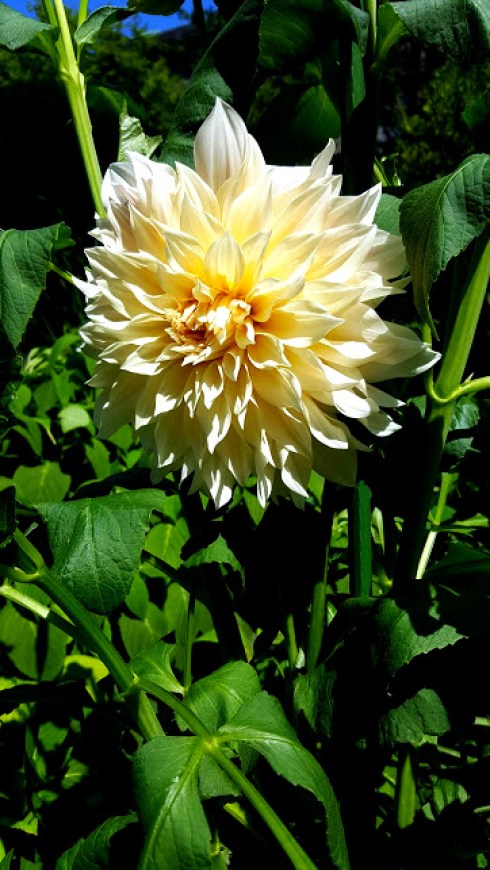
I know, Summer doesn’t really end until September 20, but I’ve lived and worked on an academic schedule for my entire life, so believe me when I say that Summer ends on Labor Day. This year I have mixed feelings: on the one hand, I worked all summer teaching and doing various administrative tasks (not, unfortunately, writing, except for here), so it seems like there never was a summer in academic terms. So who cares, bring Fall on. On the other hand, because I didn’t really have a summer (again–in academic terms: I know how privileged I am), these last few days are even more poignant. Whatever–it’s over–as I write this I am sitting in an empty classroom awaiting transfer registration. September is one of my favorite months (October would be too if I didn’t happen to live in WITCH CITY), and because the month is so beautiful, I always have this idea that I’m going to make my garden last through it rather than just giving up and ceasing all garden activities.My garden actually looks pretty good, as we are not under a water ban here unlike many towns in Essex County. I water sparingly, because I feel kind of guilty doing it, but it’s pretty green back there if lacking in color.Unfortunately I am not crazy about late summer/early fall flowers: dahlias are too showy, and sedum too………fibrous (succulents creep me out, for some reason). I found a few other plants to replenish my garden up at Pettingill Farm the other day, but it’s never going to look like the ultimate late-summer garden at the Ropes Mansion.

Last Days of Summer Pettingill Farm

Last Days of Summer 2PF

Last Days of Summer 3 pf

Late Summer Ropes

Late Summer flowers

Late Summer Dahlia Ropes

Late Summer flowers at Pettengill Farm in Salisbury and the Ropes Mansion, Salem. I had planned to go to the Tower Hill Botanic Garden in Boylston on Friday to see the amazing floral/architectural paper creations of Tiffanie Turner but now I see that they are not there! So disappointed. I might just start to like dahlias: hers look like floral armor for the challenges of Fall.

Tiffany Dahlia

A dahlia by Tiffanie Turner: more here.


The Lollipop Cemetery

Such an undignified name for such a solemn place: the Shaker cemetery in Harvard, Massachusetts, one remnant of the industrious community of Shaker non-genealogical families that resided in this beautiful Massachusetts town from 1769 until the First World War. But that’s what people call it. I had a hankering to see it the other day, and so I drove to Harvard and asked for directions, because it’s a bit off the beaten path (I never use my phone for navigational purposes on a road trip; that would defeat the whole point for me–it’s either wander or inquire): oh, the Lollipop Cemetery? Just drive towards Ayer and take a right on South Shaker Road. And so I did and there it was.

Shaker Cemetery Sign

Shaker Cemetery Stone

Shaker Cemetery markers crop

Shaker Cemetery Markers

The gate was locked, and I didn’t want to trespass on this sacred ground, but I think you can comprehend the lollipop characterization of these cast iron markers, which replaced the original stones from 1879. Here is a close-up of an individual marker from a wonderful site where you can research both the cemetery and its inhabitants, as well as a rather haunting photograph from Clara Endicott Sears’ Gleanings from Old Shaker Journals (1916). The Harvard Shaker community closed down in the following year, and the cemetery was deeded to the town of Harvard in 1945.

Shaker Marker

Shaker Cemetery gleaningsfromold00sear_0375

Boston patrician (with Salem roots) Clara Endicott Sears (1863-1960) became devoted to preserving the memory and material of the Harvard Shakers as their numbers dwindled to single digits. She had already established one of America’s first outdoor museums adjacent to her summer home on Prospect Hill a few miles down the road after she realized that a farmhouse on her property had been the site of Bronson Alcott’s short-lived Transcendentalist experiment when the few remaining Shakers in Harvard began selling their buildings.Clara bought the original 1794 office building and moved it to her hilltop museum, uniting Transcendentalist and Shaker visions (and later those of Native Americans and Hudson River Valley artists). Following this path, I drove over to the Fruitlands Museum, passing a few more Shaker structures along the way.

Shaker Old Stone Barn

Shaker Building Harvard Ruins of the Old Stone Barn and the South Family Building, Harvard Shaker Village.

The interpreters at Fruitlands emphasized “community” as the theme tying Transcendentalists and Shakers together rather than any Utopian dream, which seems appropriate to me, especially as the latter were entrepreneurial workers and the former were idealistic intellectuals. The relocated Shaker office is a testament to the aesthetic and industrious pursuits of the brothers and sisters; I came away overwhelmed by the sheer drive of young seedsman Elisha Myrick, who left the Harvard community, like many of his brethren, around the time of the Civil War. I just felt sorry for the Alcott children, who had to endure a cold and hungry 6 months in the farmhouse just down the road.

Shaker Boxes

Shaker Ads

Shaker Cloak

Shaker Industry

Fruitlands Farmhouse

Fruitlands Fruit

At Fruitlands: Shaker artistry and industry, the Alcott Farmhouse, and artist-in-residence Carolyn Wirth’s 3D take on Shaker gift drawings, installed in a grape arbor.

Driving out past the town common, I was waylaid by some beautiful houses: Harvard is really gorgeous, and calm. I drove back to Salem thinking (not for the first time) that perhaps it was a little too busy (and loud!). I hope I’m not turning into my great-great-great? grandfather, who sold everything (including a beautiful Tudor house), and left his family and friends in England for America, and the Shaker community of New Lebanon, New York.

Harvard Tavern

Harvard Colonial House

Harvard Brick House

Just a few Harvard houses: this first one was once a tavern, I presume.


Cabin in the Sky

The evening before last I was incredibly privileged to be able to attend a gathering in a ship’s cabin at the top of the Hawthorne Hotel. Not an actual cabin of course, but a rather convincing model, built for the Salem Marine Society in the 1920s as a condition of the sale of their building to the developers of the hotel. The Society, which was founded in 1766, had met continually at this location since 1830, and while its members do not seem to have been particularly attached to their Italianate Franklin Building (which replaced the earlier McIntire Archer Block, destroyed by fire in 1860), they were very attached to the site. And so the new hotel opened in 1925 featuring not only six stories and the latest accouterments, but also a rooftop cabin room, inspired by the actual captain’s cabin of one of the last great Salem East Indiamen, the barque Taria Topan. This cabin in the sky also represents the fruitful collaboration between the barque’s one-time commander, Captain Edward Trumbull, and the architect of the Hawthorne, Philip Horton Smith. It remains the private meeting room of the Salem Marine Society and their occasional guests, of which I was fortunate to be one.

Salem Marine Society Cabin HH

Cabin Room HH

SMS Cabin Interior

Hawthorne Hotel Buildings Collage

Cabin HH Exterior

Nathaniel Bowditch presides over the Salem Marine Society’s cabin at the top of the Hawthorne Hotel, the evolution of construction on the spot, from Samuel McIntire’s Archer Block (completed by 1810) to the Franklin Building (built after 1860) to the Hawthorne Hotel (built in 1925); X marks the spot of the rooftop cabin.

I was so excited to be in this space that I was a bit frenzied and not very good company, I’m afraid. I just wanted to see and capture everything. My skittishness was compounded by the fact that it was an absolutely beautiful early evening, and the ship’s cabin opens up onto an equally enticing (on such a day) ship’s deck, affording amazing views of Salem in every direction. Up in the air, surrounded by water on three sides, Salem’s original maritime orientation is all too apparent: the next time someone complains to me about how inaccessible is, I’m going to tell them to take a boat.

View of the Harbor from HH

View of Salem Common

View of Essex Street from Rooftop

But all those dashing sea captains were back inside, hanging from the teak-paneled walls in the form of portraits (alongside navigational instruments and paintings of ships) and encased in the Society’s registry of masters, a vast compendium of faces from 1766 to the present. I could have spent hours with this volume, gazing at all these drawings, paintings, silhouettes, and photographs of men and (finally!) women. There are so many ways you could use this source: it’s not just a record of maritime history, but also genealogy, social history, military history, even fashion history. Hats, no hats, hats, no hats.

Captain Abbot

Captain Fisk of Salem

Captain Collage

Captains Collage

Captain Fillebrownp.

Captains Abbot, Fiske, Chipman, Millet, Ward (clockwise), Tucker (right) and Webb, masters and members of the Salem Marine Society; a 20th century portrait of Captain John Fillebrown, who served in the War of 1812 and died a prisoner of war at Dartmoor Prison in England, along with 270 other Americans.

There were stories to be found in the cabin as well. The most apparent and dramatic one concerned the status of the Society’s very first honorary member, Matthew Fontaine Maury, Commander in the U.S. Navy and the first superintendent of the U.S. Naval Observatory. Despite his maritime magnificence, Maury was a Virginian and so not eligible for membership in the Society, but its membership honored his achievements by bestowing an honorary membership on him in 1859 and hanging his portrait on the wall of their original rooms.Two years later, after Maury resigned his commission and joined the Confederacy upon the start of the Civil War, the Salem mariners rescinded his membership, condemned him as a traitor, and placed his portrait head down and against the wall. This “reverse orientation” remains to this day, though a visiting delegation of the Mary Washington Branch of the Association for the Preservation of Virginia Antiquities gifted the Society with another image of Commander Maury in 2008, which hangs alongside the reversed portrait. And so now, in the words of the southern Commander, “All is Well”.

Salem Marine Society Cabin Interior

Sticken from our rolls


Preparing to Paint

Is there anything more engaging than an artist’s sketchbook? Or even a notebook with a few sketches in it? I suppose the end product doesn’t have to be visual, it’s the insight into that conception/creation/ working it out process that I’m interested in, but imagery tends to be far more accessible, of course. I use Leonardo’s notebooks extensively in my Renaissance, Scientific Revolution, and early modern courses, and students are immediately engaged, entranced even, far more than they are when I show them the finished product. It’s interesting to see the wanderings of a very fertile mind in his case, what inspired him and what he also had to work out: perspective, motion, hands. Most of Leonardo’s sketches never made it onto canvas; once a particular challenge was overcome he moved on to the next one, but the sketchbooks of more (focused, disciplined, on-task???? it’s hard to compare Leonardo negatively to anyone) artists illustrate the progress from page to paint: those of Claude Monet immediately comes to mind. But again, it doesn’t have to be about images. The sketchbooks of  Massachusetts artist Alvan Fisher (1792-1863), a pioneer in American landscape, genre, and “view” paintings, gives us insights into his preparation for one of the first views of Salem from “Gallows Hill”, a scene that would be imitated time and time again over the course of the nineteenth century. Fisher jotted down notes about the Salem Witch Trials in his sketchbook, indicating that his inspiration for the Salem painting was not just the view he saw before him, but the events that brought him to this particular place.

Fisher View of Salem from Gallows Hill

Fisher Sketchbook no 5 1824

Alvan Fisher’s View of Salem from Gallows Hill (1818), Collection of the Peabody Essex Museum, Salem, and Sketchbook no. 5, containing notes about the Salem Witch Trials, Museum of Fine Arts, Boston. With the recent validation of Proctor’s Ledge below rather than Gallows Hill above as the 1692 execution site, it occurs to me that the inspiration for this famous “view” is based on a falsehood! Indeed, I think that the figures in the foreground are sitting on THE ledge. But clearly a perspective from that point would not be as revealing of the city below.

From what I can see, most of the sketches in Fisher’s notebooks in the Museum of Fine Arts contain more conventional preparatory sketches: houses, hills, streams, animals. Creatures, particularly creatures in motion and even more particularly birds, seem to captivate artists for centuries, from Leonardo to Salem’s most famous artist, Frank Benson. Browsing around sketchbooks which have been digitized (especially those included in this archived exhibition at the Smithsonian’s Archives of American Art), I can’t tell which is more captivating to me: individual sketches or the entire sketchbook, the works themselves or the works in progress. 

Fisher Notebook 1

Benson Sketchbook 1882

Bird Collage

Sketchbook Rockport

Sketchbook Porter

Page from Alvan Fisher’s Sketchbook no. 1, Museum of Fine Arts, Boston; Autographed sketch by Frank Benson, 1882, Skinner Auctions; Leonardo’s sketches from the Codex on the Flight of Birds and one of Benson’s bird sketches, Northeast Auctions; Covers of sketchbooks of Harrison Cady (1943) and Fairfield Porter  (1950) from the Archives of American Art.


August Americana Picks

August is the season of Americana offerings at auctions and antique shows, and I have my eyes on a few lots in upcoming auctions at my favorite regional auctioneers.I really don’t “need” anything, but that has never stopped me from looking, pretty much everywhere I go, but especially through online auction catalogs and at previews and shows. What am I looking for? I’m always entranced by transferware, even though (or perhaps because) I sold off my own collection of pink a few years ago. Creamware, pearlware and mochaware. MAPS, especially schoolgirl maps. SIGNS, Salem especially, but not necessarily. Fancy chairs, always. Interesting paper. Anything with an unusual texture or history. In the past, Federal card tables: they are going for a song now but I simply have too many. So here is what is tempting me from sales coming up over the next week or so at Northeast and Skinner Auctions.

at Northeast:

August American TT

August Americana Colonial Cupboard Northeast

August Americana Ships Passage 1817

August Americana Salem Harbor Soup Plate

Copeland Spode’s Transferware Tissue Patterns; Colonial Cupboard made in Hudson Valley, New York;  Ship’s Passage for the Brig “Ceres” of Salem, signed by President James Monroe, 1817; English creamware soup bowl (one of a pair–the other features Nantucket Harbor) decorated with green enamel and black transfer print of Salem Harbor.

At Skinner:

August Americana 1 Skinner

Americana Auctions Metamorphosis Skinner

August Americana Eagle Print Skinner

August Americana Chairs

August Americana Desk Skinner

A polychrome transfer-decorated Liverpool Pottery creamware pitcher, bearing the name of Captain James Barr, a Salem Privateer whose house is still standing on Lynde Streeet; A Metamorphosis, America or England, 18th century, watercolor and ink on paper depicting Adam and Eve, and a lion changing into a griffin; Framed print of an eagle with an olive branch; Set of NINE fancy chairs with old green paint (it looks black to me, but the description says green); a nineteenth-century schoolmaster’s desk. This last item is a bit rustic for me, but for some reason I just love it. Maybe because it’s almost back-to-school time. Maybe I want to bring it back to school WITH me and carry it around from room to room to bolster my mastery!


The Two Mrs. Fenollosas

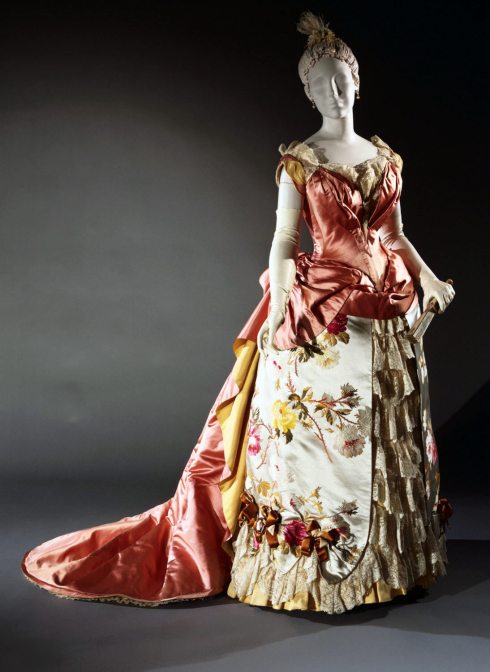
I came across a dress so beautiful the other day that I started thinking about its owner/wearer, Elizabeth Goodhue Millett Fenollosa, wife of the famous “Orientalist” and cultural ambassador Ernest Fenollosa, who happened to grow up in the house right next door to mine here in Salem. Actually “Lizzie” Fenollosa, who was also Salem-born and -raised, was Fenollosa’s first wife, who accompanied him to Japan, where he was eventually appointed Director of the Imperial Museum in Tokyo in 1888. Here is the Worth dress, which the curators of the Philadelphia Museum of Art believe might have been worn for her presentation at the Imperial Court coincidentally with her husband’s appointment. [Correction: please see comment below; Mr. Fenollosa was a professor of philosophy at Tokyo University and a curator at the Imperial Museum, but not its director.]
Fenollosa Dress

Women’s Evening Dress: Bodice and Skirt. Designed by Charles Frederick Worth, English (active Paris), 1825 – 1895. Worn by Mrs. Ernest Fenollosa, c. 1886-1887, Philadelphia Museum of Art. Gift of Mr. and Mrs. Owen Biddle, 1978.

I had never seen this stunning dress before but I was not surprised to see it in the collection of the Philadelphia museum, as the Fenollosas’ daughter Brenda was married into the prominent Biddle family of that city in 1913. Her son Owen Biddle and his wife donated the gown (along with another) to the museum, and she herself donated a lovely Meiji scroll from her father’s collection (and in his memory) in 1941. I was surprised to see another Fenollosa-related item in the museum’s collection, however: a photograph of her father’s second wife, Mary McNeil Fenollosa, by the photographer Eva Watson-Schütze, dated 1905. Obviously this item was not donated by the Biddle family, for the Fenollosa divorce was scandalous its day. I have no idea what Brenda’s feelings were, but her mother named Mary as a co-respondent in the 1895 proceedings.

Fenellosa Mary

Portrait of a Woman in Japanese Dress (Wife of Ernest Fenollosa), Eva Watson-Schütze, 1905. Philadelphia Museum of Art, 1905. Gift of Harvey S. Shipley Miller and J. Randall Plummer, 2004.

Ernest and Lizzie Fenollosa were childhood sweethearts in Salem; they were married right after his graduation from Harvard and then set off together for Japan, where he took up a position at the Imperial University at Tokyo and became fully immersed in traditional Japanese culture, eventually rising to his post at the Imperial Museum. He converted to Buddhism, but they did not appear to lead an ascetic lifestyle, if their house, their many western visitors (and her dress!) are any indication. During their time in Japan, Fenollosa also acquired a huge collection of traditional Japanese art, which he sold to Boston physician and philanthropist Charles Goddard Weld with the condition that it eventually be donated to the Museum of Fine Arts, Boston, where it now constitutes the Fenollosa-Weld Collection. The Fenollosas returned to Massachusetts in 1890, where he was appointed curator of the Department of Oriental Art at the MFA and organized several high-profile exhibitions. After he took up with Mary McNeil Scott, a twice-married southern secretary at the Museum, both his marriage and his curatorial career were over–although he continued in his scholarly activities. Lizzie and Brenda remained in the Boston area, but Ernest and Mary took off after their marriage: to New York, back to Japan (she had spent time there too, which explains much of their instant connection), to Mobile, Alabama (her hometown), and to London, where he died of a heart attack in 1908.
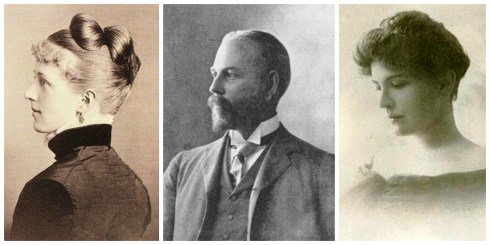
Fenollosa CollageElizabeth Goodhue Millett Fenollosa, Ernest Fenellosa, Mary McNeil Scott Fenollosa.

The two Mrs. Fenollosas were very different women bound together by one man, as well as their experiences in Japan, I suppose. Elizabeth Fenollosa seems to have been a private woman, although by all accounts she was a gracious hostess and certain details about her divorce did leak out to the papers…..Mary Fenollosa was much more public, writing popular novels under the pseudonym Sidney McCall, poems under her own name, and serving as an advocate for her husband’s work after his death. Truth Dexter, her first and most popular novel, tells the story of a southern wife (the title character) whose marriage is endangered by a brazen Boston socialite! That was too much for Lizzie, who told the New York Times that her intellectual ex-husband must have collaborated on the book as it contained too many little-known details of their lives together. I think that book, plus the fact that she’s a Salem girl, puts me on Team Lizzie, but both women certainly lived colorful lives that took them far from their places of origin.

Fenollosa House Buffum Street

Fenollosa House Japan Harvard Houghton

From Salem to Tokyo: Elizabeth Fenollosa’s childhood home on Buffum Street in Salem, and the Tokyo home she shared with Ernest, Fenollosa Papers, Houghton Library, Harvard University.

Midsummer Mallows

I like several varieties of plants in the large mallow (malvaceae) family, most particularly the older common varieties rather than the showy hollyhocks and hibiscus which are really too big for my garden. There are musk mallows and malva sylvestris at the front of one border, but in the back is my very favorite: marsh mallow, or althaea officinalis. This is an old, fabled plant which is tall and velvety, with soft pink flowers, appearing just about now. Like all plants which officinalis status, marsh mallow was an important medicinal plant in the ancient, medieval, and early modern eras, the basis of soothing syrups and balms for throats, stomachs, skin–even teeth. The marsh mallow plant had edible uses in the past too: its sap was extracted and mixed with nuts and honey (and later sugar and corn syrup) to make a confection, and its root was boiled for use in both sweets and “sallets”. Modern marshmallows have no marsh mallow in them, but several “organic” skin creams do. I looked in vain through my sixteenth-sources for a sweet marsh mallow recipe, but found it as a principal ingredient in one of the recipes to cure lovesickness in Jacques Ferrand’s classic seventeenth-century treatise. So there you are: a plant that is both utilitarian and beautiful.

Mallow 3

Mallow 9

Mallow 1

Above: my marsh mallows. Below, hollyhocks in the Ropes Mansion Garden–I’m showing you close-ups rather than the entire plants because they seem to be stricken with some sort of rusty disease. My other mallows have this too–not very attractive–but the marsh mallows seem immune! 

Mallow 7

Mallow 6

Mallow 5

marsh-mallow Fidelia Bridges Prang

Salem-born Fidelia Bridges’ Marsh Mallows, produced for Prang in the 1880s, New York Public Library Digital Gallery.