Tag Archives: Art

House Cards

I’m in the midst of cleaning, painting, and rearranging in advance of the Holidays, and yesterday I took a dusty and hastily-constructed collage of cards off the wall: the thank-you notes and invitations that I have received from my friends and neighbors over the years, delivered in the form of ivory cards with their houses emblazoned on the front. I’ve kept them, ostensibly “collecting” them, but they definitely deserve a more curatorial presentation–I really regret all those thumbtack holes. Many people in Salem are house-proud, and justifiably so: the stewardship of old houses is an engaging and continual preoccupation. When I look at my collection of houses cards–now reduced to an undignified stack–I don’t just think about architecture, I think about people: the people that gave me the card, the various artists who rendered these houses so distinctly, including a lovely gentleman, now deceased, who was often seen with his easel on the sidewalks of Salem. These cards also remind me of the illustrations in several of the Salem guidebooks published in the later nineteenth and early twentieth centuries–most particularly my favorite, Streets & Homes in Old Salem, which I think was last issues in 1953: time for a new edition?

house-card-collage

houses-12

houses-6

houses-7

houses-11

houses-13

houses-15

houses-9

houses-14

houses-8

houses-4 Some illustrations from Streets & Homes in Old Salem (1953) and a selection of my house cards, featuring homes on Chestnut, Summer, Flint, Essex, Federal, North and Broad Streets in the McIntire Historic District.


Imag(in)ing Authors

I don’t think that there is any doubt that we used to glorify authors much more in the past than in the present: while the written word is still alive and well (for now) its producers are not the focal points of our popular culture that Nathaniel Hawthorne, Mark Twain, and F. Scott Fitzgerald once were, except for those long-dead but seemingly eternal celebrity scribes like Will and Jane. There is so much material evidence of author adoration from a century and more ago : portraits, pilgrimages to literary “shrines”, biographies, the various Victorian “Authors” games–first produced right here in Salem— designed to develop literary familiarity and appreciation from an early age.But that is not the literary or the material culture that we live in now, so I was kind of surprised to encounter two “Odes to Authors” prints while I was browsing around the website of Anthropologie, of all places. These are the work of artist Valerie Suter, who is apparently a voracious reader of twentieth-century fiction.

authors

authors-2

Odes to Authors Virginia Woolf and Djuna Barnes by Valerie Suter, available here.

I went over to Suter’s website and found lots more authors: clearly they are her primary inspiration at this point in her life/career. She works in various mediums (including animation and clothing) and portrays her literary subjects in accessible and whimsical ways, occasionally doing something or in each other’s company, like the familiar subjects of A Moveable Feast  and Mark Twain playing pool, below. Lots of color, patterned backgrounds, interesting scale, and an almost complete absence of any formality or pretense bring these authors to life. I really want Josephine Tey, author of one of my very favorite books, The Daughter of Time (1951).

amoveablefeast

authors-john-steinbeck

authors-twain-and-paine

fullsizerender2

authors-joan-didion

authors-tey

daughter-of-time-penguin-classic

Paintings by Valerie Suter: Ernest Hemingway, Gertrude Stein, James Joyce and F. Scott Fitzgerald in A Moveable Feast; John Steinbeck among chrysanthemums, Mark Twain playing pool, E.B. White, Joan Didion & Josephine Tey; Penguin Classic cover of The Daughter of Time. 


The Woodcut Witch

Witchcraft and witch trials are by no means an academic focus for me, but any European historian who studies and teaches the early modern era must take these subjects on. Consequently I developed an undergraduate course called “Magic and Witchcraft in Early Modern Europe” just a few years after I came to Salem, in part because I also felt that I had a certain obligation, given the local unawareness of the fact that over 100,000 people were put on trial for witchcraft in the sixteenth and seventeenth centuries across Europe and the consequential belief that the 1692 trials were the largest/most important/consequential in world history. My course goals consequently included: 1) putting the Salem Trials in a wider geographical and chronological perspective and; 2) placing the European witch trials in a longer and larger intellectual tradition, hence the “magic”. The course title is partially a misnomer, as we spend half our time in the medieval era, laying essential theological and historical groundwork, and the last few times I taught it, I became somewhat stalled in the fifteenth century. I think this was a bit frustrating for my students, as the most intensive period of witch hunting was the century between 1560 and 1660 (can’t we get to the trials?), but the more I studied both the primary and secondary texts the more I came to realize that the fifteenth century was absolutely key to the intensification that was to come. This is true not only because of the publication of the famous Malleus Maleficarum, an incredibly accessible, even riveting, “how-to” manual of witch identification and prosecution which itself is a consequence of fifteenth-century trends regarding what was seen increasingly as a “pestilential heresy” on the Continent, but also because of the visualization of diabolical witchcraft, most prominently in Ulrich Molitor’s De lamiis et pythonicis mulieribus (‘On Witches and Female Soothsayers, 1489). A Professor of Law at the University of Constance, Molitor’s point of view is traditional in terms of his opinions on witchcraft, unlike the more radical authors of the Malleus, Heinrich Kramer and  Jacob Sprenger, whose perspectives were inquisitional rather than reasoned. In the course of a ten-chapter dialogue, Molitor ultimately concludes that witches are generally products of demonic illusion. So his words did not incite, but one could argue that his images did, as De lamiis was the first illustrated treatise on witchcraft, and a text with a remarkably long run: 43 editions were published between 1489–1669—more than the Malleus Maleficarum. Molitor’s insistence on the illusionary  powers of witches was definitely undercut by the inclusion of woodcut illustrations of middle-aged “witches” engaging in some of the things Kramer and Sprenger accused them of: stirring up storms, flying to the sabbat, frolicking with their demon lover. And so, in both words and woodcuts, stereotypes were created, and cemented over the next century.

molitor-title-page

molitor-archery-witch2

molitor-consorting-with-the-devil

molitor-flying-witches

molitor-feasting-witches

molitor-weather-witches

molitor-1544

Woodcut illustrations from the 1489, 1500, and 1544 (last one) editions of Ulrich Molitor’s De lamiis et phitonicis mulieribus. [first published in Reutlingen: Johann Otmar, not before 10 Jan. 1489]. University of Glasgow Sp Coll Ferguson An-y.34. For more and the later visualization of witches and witchcraft, see Charles Zika’s excellent The Appearance of Witchcraft: Print and Visual Culture in Sixteenth-century Europe.


Seasonal Spider (webs)

Well, Halloween is less than a week away so I suppose I should post on something seasonal: my October avoidance of downtown Salem has actually made me less aware of this holiday, although yesterday it dawned on me that I was not prepared for trick-or-treating and should start accumulating all of the candy I will need. It seems as if I always run out, no matter how much I buy. In my neighborhood there is a range of Halloween/Fall decorations:  some completely over the top, others more subtle. My favorite seasonal decoration preferences run more to the natural than the macabre: I’ve always thought that bats are wonderful, and I have developed a healthy appreciation for spiders over the last few years. There are quite a few spiders, with webs and without, around Salem these days, but today’s post is really more inspired by interior decoration than exterior embellishment, and specifically by a New York Times article from a few weeks ago about the restoration/redecoration of two historic “literary shrines”: the Connecticut houses of Mark Twain and Harriet Beecher Stowe. In the parlor of Twain’s house, workers are installing a reproduction 1880s wallpaper with spiderwebs designed by Candace Wheeler, an absolutely amazing artist who, along with her design colleagues in her firm Associated Artists, was primarily responsible for the original decoration of the house. Just one look at the wallpaper started me down both a Candace Wheeler path and a spider/web path–so here’s the latter, beginning with the Mark Twain’s parlor paper and proceeding back and forth through the ages and back to Salem.

spiderweb-wallpaper-candace-wheeler

spiderweb-wallpaper-collage

spider-textile-meiji-mfa

spiderweb-textile-mfa-2004

1985-52-31200b-pdp

spiderweb-medieval-bl-illuminated-ms

spider-in-salem

Candace Wheeler wallpaper, Metropolitan Museum of Art: Contemporary spiderweb wallpaper in two tones, Walls Republic; Japanese silk embroidered spiderweb textile, early Meijii era, William Sturgis Bigelow Collection, Museum of Fine Arts, Boston; English “Spider Print” Textile Length, 2004, Museum of Fine Arts, Boston; the best “natural” Halloween vignette ever: Bat and a Spider Web, 1782, Philadelphia Museum of Art; my favorite medieval spider, British Library MS Sloane 4016; a Salem spider.


Two Nights in Salem

As you might imagine, my teenage stepson is not at all sympathetic to my I don’t want to see tacky & exploitative witchcraft “attractions” attitude in October so we have ventured downtown for the last couple of nights.The weather has been warm but rainy so there weren’t that many people milling about but we did avoid the more commercial sites. I think I first took him to the Salem Witch “Museum” when he was six or seven and he thought it was ridiculous then; so he has no desire to return now, thankfully. On Thursday night we went to a few shops on the way to one of the Peabody Essex Museum’s monthly themed PEM/PM evenings, which are always great.This month’s theme was “Moon Landing”, in reference to their brand new exhibition “Lunar Attraction”, which is just the kind of multi-media, multi-genre, multi-era, and multi-perspective presentation that I always enjoy. We spent a lot of time watching the colorized version of Georges Méliès’ A Trip to the Moon (1902) that was playing continuously, but I found many of the exhibit items almost as captivating.

two-nights-pem

two-nights-to-the-moon

two-nights-melies

two-nights-vaca

two-nights-2-the-moon

two-nights-rabbit

two-nights-holyoke-eclipse

The Peabody Essex Museum on Thursday evening past: atrium and “Lunar Attraction” exhibits, including screen shots from A Trip to the Moon; Beth Hoeckel’s “Campground” collage from her ongoing series “Point of View”; Scott Listfield’s “To the Moon”, 2004, a Japanese moon rabit, and Edward Holyoke’s ink illustration of a solar eclipse, 1713.

On our way over to the Museum we stopped in at the Salem Arts Association, where there were works both timeless and ephemeral and seasonal-macabre, some more witty than others. I liked these little coffins in the window and a “Vampire Test”mirror; my stepson liked a map of the United States divided into regions which have Waffle Houses and regions which do not.That came home with us.

two-night-arts-2

two-nights-arts

On Friday night, before the deluge we had later and the PBS documentary on the making of Hamilton, we went to the House of the Seven Gables for one of their seasonal experiences, “Legend of the Hanging Judge”, in which actors play out different roles relating to the witch trials in the rooms of Nathaniel Hawthorne’s birthplace: the author himself was in residence, consumed with guilt, as his ancestor is the title character. The one good thing about Salem’s crass commercial Halloween tourism is that it gets tourists through the doors of real museums like the Gables, although I fear out-of-town sausage sellers make more money.

two-nights-gables-at-night

The Gables at Night. I can never get a good night shot–was trying for the contrast of garden and house and this is the best I could do!


Antique Apples

I was listening to the TED talk of biodiversity warrior Cory Fowler the other day when I suddenly became panicked about the dwindling variety of apples in our world. It must be the season, but immediately this issue resonated with me: we have apparently lost 86% of the varieties of apples we had a century ago: 86%! Of course I am very, very late to the party: Thoreau was wandering around the woods and fields of Massachusetts 150 years ago reveling in the sheer variety of pomological splendor before him while at that same time observing that “it is remarkable how closely the history of the apple-tree is with that of man” and “the era of the wild apple will soon be over”. He complains about the preponderance of Baldwins, now relatively rare, but it seems like all we have are boring McIntosh, Delicious, Gala, and Granny Smith apples in the grocery stores today. I looked through some agricultural books, journals, and catalogs from the middle of the nineteenth century, beginning with the several editions of Robert Manning’s Book of Fruits and proceeding through The Apple Culturist (1871), and came up with a list of about 150 apple varieties which were cultivated just in Massachusetts at that time, including the aforementioned Baldwin, along with Bellflower, Blue Permain, Canada Reinette, Duchess of Oldenberg, Early Joe, Fall Pippin, Fenouillet Jaune, Grimes’ Golden Pippin, Hawthorndean, Hubbardston’s Nonsuch (to which there is a monument dedicated in Wilmington, Massachusetts), Myers’s Nonpareil, Newtown Spitzenberg, Northern Spy, Pickman Pippin, Pick’s Pleasant, Pound Royal, Red Astrakhan, Rhode Island Greening, Roxbury Russet (very famous as “New England’s first pomological experiment”), and my very favorite, Westfield Seek-no-further. There are a few local growers still cultivating some of these varieties, but most of them are no more.

We can’t taste all of these antiquated apples (though some, it seems, we can!), be we can see them, thanks to a great visual source: the USDA Pomological Watercolor Collection, which contains over 7000 images of fruit from 1886 to 1942.We used to have over 7000 apples, and now we have pictures.

apples-collage

apple-early-joe

hubbardston-apple-arnold

apple-northern-spy

apples-roxbury-russet

roxbury-russetA Baldwin apple, 1915, by Mary Daisy Arnold; Early Joe, 1898, by Deborah Griscom Passmore; Hubbardston, 1928, Mary Daisy Arnold; Northern Spy, 1905, by Elsie Lower; Roxbury Russet, 1905, by  Amanda Almira Newton:  all U.S. Department of Agriculture Pomological Watercolor Collection. Rare and Special Collections, National Agricultural Library, Beltsville, MD 20705. A real Roxbury Russet from Clarkdale Fruit Farms in Deerfield, Massachusetts.


A Rare Emblematic Eagle

It is interesting to trace the adoption of the eternal eagle as a national symbol for the United States in the first fifty years of its existence, and its adaptation in Europe and Asia by entities eager to take advantage of the new American market. The eagle has been used in heraldry since time immemorial, so it took more than baldness to make it American (remember, Benjamin Franklin preferred the turkey for the national symbol, in part (I think!) because eagles were so universal). There’s a very informative essay on “Eagles after the American Revolution” at the Metropolitan Museum’s Heilbrunn Timeline of Art History (a resource I use often) which commences its analysis with Edward Savage’s Liberty, reproduced on reverse-pained glass in China for the American market around 1800. The image shows the former American emblem, a native goddess representing Liberty, passing her torch to the new not-very-bald American eagle.

eagle-savage

Chinese reverse-painted glass depiction of Edward Savage’s 1796 print “Liberty”, c. 1800, Metropolitan Museum of Art.

And after that, a veritable explosion of American eagles, appearing in all sorts of poses and forms before standardization occurs. There is a relatively rare eagle emblem from this era that seems so Salem to me: a triumphant seafaring bald eagle rides into a harbor on a shell boat, with shield and flag brazenly displayed. The harbor looks more romantic than federal, but still, the image seems to represent the commercial and maritime foundations of the American enterprise. This past weekend, I almost purchased a saucer bearing one of these “Eagle riding on/in a shell” images, but ultimately decided it was too dear. Manufactured by only one Staffordshire pottery firm, R. Hall & Son, in the 1820s and 1830s, it seems to be one of the few transferware patterns that has held its value over the past decade.

eagle-saucer-winterthur


eagle-riding-on-a-shell-saucer

eagle-riding-on-a-shell-skinner-auctions

eagle-riding-shell-blue-collage

eagle-riding-shell-rose-collage

eagle-and-shell-black

“Eagle Riding on a Shell” transfer-printed pottery in green, blue, rose and black made by the Ralph Hall Factory, Tunstall, Staffordshire, England, 1822-40, from the Collections of the Winterthur Museum, Skinner and Northeast Auctions–interspersed with some centennial textiles made by the American Print Works in Fall River, Massachusetts in the 1870s (another era of eagle creativity), collection of the Cooper Hewitt Museum


Face-based History

I am a longtime admirer of Simon Schama, as both historian and art historian, presenter and public intellectual. For me, his study of the Dutch Golden Age, The Embarrassment of Riches: An interpretation of Dutch culture in the Golden Age (1987) is a classic of cultural history, illustrating a masterful engagement of textual and material sources, almost Burckhardtian in its scope. I always have it close at hand. Even though Schama is not principally an English historian, I show bits and pieces of his History of Britain series in class, just because he is such a good communicator–and teacher. As any reader of this blog (or former student) knows, I’m always utilizing (I think of it as playing with, actually, as I am not trained) art in class, in large part due to Schama, even though I am far less knowledgeable and adept than he. Schama’s latest project focuses on British portraits in the National Portrait Gallery, probably my very favorite museum in the world: The Face of Britain is a multi-media history of Britain through its portraits, rather than a history of British portraits. Through an exhibition last year at the NPG, and an accompanying book and television series, Schama examines Britain’s relatively modern history (after all, the portrait is a Renaissance creation) through portraits of individuals which represent both precise historical moments and dynamic trends. A very representative, and compelling, vignette relates the creation of a famous (or infamous) portrait of Winston Churchill, commissioned for the Prime Minister’s 80th birthday by Parliament. There was quite a bit of push-and-pull between Churchill and the commissioned artist, Graham Sunderland, resulting in a portrait that is described by Schama as a “beautiful ruin” detested by the subject, the humiliation of the artist at its public unveiling in 1954, and its eventual  destruction by Lady Churchill or one of her delegates. All we have are studies and photographs of the painting that captured this particular historical moment.

NPG 5332; Winston Churchill by Graham Vivian Sutherland

Preparatory Study for Winston Churchill’s 1954 portrait by Graham Vivian Sunderland, National Portrait Gallery.

The making of Churchill’s portrait is a study in power dynamics, and Schama explores other kinds of relationships in his exhibition/presentation/narrative: “The Face of Power” is accompanied by “Faces of the People”, “The Face of Fame”, “The Look of Love”, and “The Face of the Mirror”. The essential relationship in all of these categories, however, is between the artist and the subject, and consequently it is a bit difficult to string along an entire collective history. I didn’t see the exhibition, but I heard from friends that it was confusing because of its conceptual-rather-than-chronological structure. I do have the book and I’ve seen several episodes of the series, and (once again) Schama’s superior communication skills do seem to carry us along, especially as we move among variant genres: “portable portraits”, miniatures, statues, engravings, photographs. I didn’t learn too much from his analysis of the Tudor and Stuart portraits–I’ve heard all that virgin and martyr stuff before–though I do appreciate the inclusion of Oliver Cromwell’s “warts and all” portrait and the “mourning portraits” Kenelm Digby commissioned of his beloved Venetia. I got a little lost in the later seventeenth century, but thought he made effective arguments for the representational value of portraits from the eighteenth century up through much of the twentieth, and I LOVED his “faces of the mirror”: I always though of self-portraits as being exclusively individualistic and not particularly dependent on context, but no longer! As is often the case with Schama, his transitions were subtle and his connections convincing, so in the end I found myself agreeing with his assertion that”portraits bring you into their company”.

Historical faces from Schama’s Face of Britain: Sir Francis Drake, whom Schama calls “the first genuine heroic famous Englishman”, principally because he is a “man of action”; Two very different portraits by William Hogarth: David Garrick as Richard III and the convicted murderess Sarah Malcolm in prison; Two earnest expressions of love by Thomas Gainsborough (for his daughters) and Dante Gabriel Rossetti (for Jane Morris, the wife of his William), and some amazing artists’ self-portraits, for which Schama provides plenty of context: Gerlach Flicke (cropped), an imprisoned sixteenth-century artist who painted the first English self-portrait so that his “dear friends….might have something by which to remember him after his death.”, Sir Joshua Reynolds, and William Orpen, “Ready to Start” fighing (?) in the Great War. Apparently Orpen later regretted his trivializing accouterments.

NPG 4032; Sir Francis Drake by Unknown artistSir Francis Drake by an unknown artist, c. 1580, ©National Portrait Gallery

british-faces-800_hogarth_davidgarrick_as_richardiii David Garrick as Richard III, William Hogarth, © Walker Art Gallery

british-faces-hogarth-sarah-malcolm-in-prison Sarah Malcolm by William Hogarth, Sarah Malcolm © Scottish National Gallery

british-faces-gainsborough-daughters-npgThe Painter’s Daughters chasing a Butterfly, Thomas Gainsborough ©National Gallery

Rossetti, Dante Gabriel, 1828-1882; Blue Silk Dress (Jane Morris)Blue Silk Dress (Jane Morris) by Dante Gabriel Rossetti, ©Society of Antiquaries of London

british-faces-gerlach_flicke_by_gerlach_flicke_crop Gerlach Flicke, ©National Portrait Gallery

British Faces Self-portrait_c.1747-9_by_Joshua_Reynolds_(2).jpgSir Joshua Reynolds, ©National Portrait Gallery

british-faces-498px-william_orpen-ready_to_start-1917 William Orpen, Ready to Start, ©Imperial War Museum


Drawing down the Moon

One artist whose work I have admired for quite a while but never really knew how to contextualize in a topical or thematic way is Samuel Palmer (1805-1881). He seems to be one of those people who was not of his time. I guess you would call him a Victorian artist, but he reacted against his dynamic age by creating rather romanticized, even primitivized (if that is a word) landscapes and pastoral scenes, in several mediums. I find much of his work–particularly his early work– very appealing yet hard to pin down: some of his paintings look and feel as if they could date from either the early seventeenth century or the late nineteenth. The monochromatic drawings which he called “blacks” (the first two images below) look strikingly modern to me, and deliberately designed to illustrate the effects of moonlight. I was looking and thinking about the Harvest Moon over the past few nights and suddenly one of these popped into my mind. So I looked up his works at the Tate, the Victoria and Albert Museum, and the Metropolitan Museum of Art, and a few other places, and found that my memory was correct: this was a man who could really draw (down) the full moon–and its crescent counterparts as well. The then-nineteen-year-old’s biblical inscription on the last drawing below is both timeless and timely: The / moon / also to / rule by night / for his mercy / endureth / for ever. Thou / crownest / the year / with thy / goodness.

The Harvest Moon: Drawing for 'A Pastoral Scene' c.1831-2 by Samuel Palmer 1805-1881

Samuel Palmer, The Harvest Moon: Drawing for ‘A Pastoral Scene’ c.1831. Tate Britain

palmer-evening-v-and-a

Samuel Palmer, Nocturnal Landscape with Full Moon and Deer, c. 1829-30. Victoria & Albert Museum


Coming from Evening Church 1830 by Samuel Palmer 1805-1881

Samuel Palmer, Coming from Evening Church,  1830. Tate Britain

palmer-cornfield

Samuel Palmer, A Cornfield by Moonlight with the Evening Star,1830.  British Museum

B1977.14.65

Samuel Palmer, Harvest Moon, 1833. Yale Center for British Art

17.55.2

Samuel Palmer,Christmas, or Folding the Last Sheep, 1850( Etching; second state of five). Metropolitan Museum of Art

palmer-harvest-moon-drawing-1824-v-and-a

Samuel Palmer, Harvest Celebration, c. 1824 (Leaf 20, ink drawing from a sketchbook). Victoria & Albert Museum


The Shots heard round the World

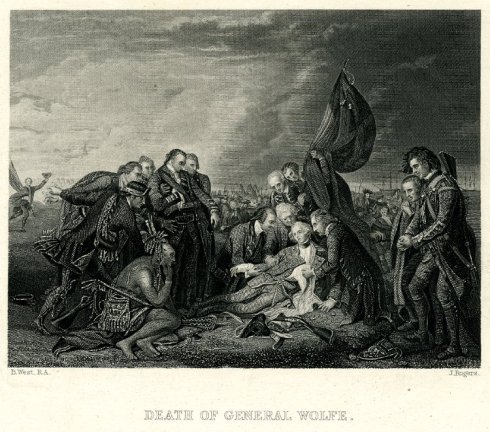
No, not that one, the (three) ones that came years before, which killed Major-General James Wolfe on this day at the decisive Seven Years’ War Battle of Quebec in 1759, a death that was disseminated around the world through the iconic 1770 painting by Benjamin West. The painting and its reproductions, in oil, print, tole, pottery and caricature, became a powerful symbol of the emerging British Empire, even though it was rather ironically the creation of an American-born artist. West broke with tradition by depicting the fallen hero in contemporary uniform rather than classical dress, thus intensifying the identification of his contemporaries, yet still portrayed an eternal, Christ-like figure. The painting was a sensation when it was first exhibited, and for quite a few years thereafter.

west-death-of-general-wolfe-1770

Benjamin West, Death of General West, 1770, National Gallery of Canada.

I’m hardly the first historian to pontificate on the importance of this painting: I’m leaning pretty heavily on the analysis of Simon Schama (albeit in “historical novella” form in Dead Certainties:  Unwarranted Speculations, 1991) and Linda Colley, more straightforwardly in her magisterial Britons. Forging the Nation, 1707-1837 (1992). Colley calls the painting a “splendid fraud” in that none of the onlookers were even there, most particularly the pensive Native American, who was of course fighting on the other side in what is referred to as the “French and Indian War” over here. Still, Colley observes that “The Death of Wolfe started a vogue for paintings of members of the British officer class defying the world, or directing it, or dying in battle at the moment of victory.”  I think this “vogue” was probably due as much to the prints of the painting as the painting itself (most after William Woollett’s engraving), because they were everywhere, in constant circulation  up until at least 1820 as far as I can tell: through the American and Napoleonic wars, when Britain needed its heroes. I suppose it was only the cult of Nelson that diminished that of Wolfe, somewhat.

death-of-general-wolfe-1776

death-of-general-wolfe-1820

death-of-general-wolfe-john-rogers-1830

west-tray-northeast-auctions

west-pitchers-christies

wolfe-gillray

Print made by William Woollett, 1776; Etching for John Young’s  ‘A Catalogue of Pictures at Grosvenor House’, 1820; Print by John Rogers , 1830, all Collection of the British Museum; Tole Tray, Northeast Auctions; Creamware Jugs, Christies Auctions; and The Death of the Great Wolf, a satire on the passing of the Treason and Sedition Bills, in 1795, James Gillray, British Museum.