
I was researching Salem’s struggle with/against urban renewal in the 1960s when I came across a massive collection of photographs from the career collection of Edmund Bacon, the famous Philadelphia city planner who is sometimes referred to as representing a “third way” between Robert Moses and Jane Jacobs. I honestly don’t know if Bacon was a critic or a fan of urban renewal: his work looks a little plaza-centric to me. Apparently he captured urban renewal funds for the rehabilitation of Society Hill in Philadelphia, however, and that is certainly to his credit. The landscape architect who worked on Society Hill was another Philadelphian, John F. Collins, and when Bacon was brought in to consult on Salem’s redevelopment after some (not all) of the planned destruction through “renewal” was thwarted, he recommended Collins to implement the new Heritage Plaza East Plan in the 1970s. Collins’ efforts reshaped downtown Salem over the decade, and you can read (and see) more about them here. But back to Bacon (father of Kevin, by the way): after his retirement he turned all of his papers and photographs over to the Fisher Fine Arts Library of the University of Pennsylvania, which is currently digitizing and crowdsource-cataloguing them through a project called the Ed Bacon Photo Project: the photographs are an amazing window into twentieth-century urban planning, and include several scenes of Salem’s little Dig.


During and after: Derby Square is such an important center for downtown Salem, although I wish the City was as dedicated to the maintenance of all the hardscape features incorporated by Collins as Philadelphia has been with Society Hill. The Cultural Landscape Foundation notes that “Collins’ details–richly patterned brick sidewalks and walls, granite curbs and backless benches, alleys, street trees, site-specific light standards and bollards – combined with small courtyards and pocket parks peppered throughout the 120-acre neighborhood, unite the unique blend of historic and modern buildings and landscape features.” The space has served as the site of grocers’ and farmers’ markets for decades–until last year when Covid mandated another location with more space for social distancing: I hope it can return this year. And on quite another note, I’m sure everyone will be thrilled to hear that one of Salem’s key businesses, Vampfangs®, is expanding into Derby Square with “Maison Vampyre,” an “elegant and uniquely themed private space, located in the heart of Salem at One Derby Square. Guests are invited to experience personal or group psychic readings from members of the local Vampire community.”

 The first Cabot house in Salem, built in John Cabot in 1708 at what is now 293 Essex Street; demolished in 1878: this is a great photo because you can see how commercial architecture imposed on Salem’s first great mansions on its main street.
 Moved to Danvers! No time to run over there and see if it is still standing right now, but will update when I know.
 Oh my goodness look at this Beverly jog! Built by second-generation Dr. John Cabot in 1739. Church Street was destroyed by urban renewal and is a shadow of its former self.
 A familiar corner at the 299 Essex Street and North Streets: this Cabot house was built in 1768 by Francis Cabot and later occupied by Jonathan Haraden.

 Survived! The Cabot-Endicott-Low House was built in 1744 by merchant Joseph Cabot and remains one of Salem’s most impressive houses. Its rear garden used to extend to Chestnut Street, and crowds would form every Spring to gaze upon it.




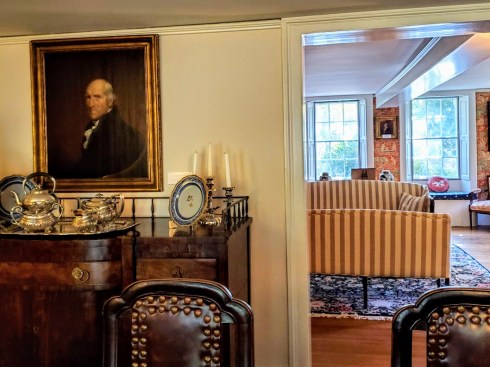

 Colonel Tim presiding over the Dining Room, Amanda Eddy showing us the evolution of the house; the Peacock Inn, UK National Archives.


 Western parlor with portrait of Mary Pickering Leavitt (1733-1805) and her daughter Sarah by Joseph Badger; Hessians!; wonderful portrait by Mary, restored by textile conservator Elizabeth Lahikainen in 2017; the Pickering family arms; from the curio cabinet; LOVE this china pattern but forgot to ask what it is—please inform, someone; family books and one of John VI’s essays.
 Photograph by Salem photographer and artist


 The “OLD Mansion” above is the Sewall House or Coventry Hall in York, Maine, my hometown: growing up in a large shingle house in the Harbor, this was always my touchstone for what a “proper” house should look like.
 Can anyone tell me about this house in Saco, Maine?
 WOW. This is (was) the “Dearborn House” in Grove Hall, in Boston. You can read more about this amazing house


 The Tufts House in Medford, an unknown (???) Boston house, and some exterior and interior details, including amazing “portable paneling”. Mr. Berry also went down south, but I am not going with him.


 News clips from Works Progress Administration Bulletins, 1936-39, Boston Public Library; National Youth Administration Photos and Records, NARA.


 HABS records, Library of Congress.


 The Patton Homestead, Hamilton


 Ipswich: the Whipple & Heard houses and just a few beautifully preserved Colonials—there are so many more!


 Newbury and Newburyport: one of my favorite houses in the County, on Newbury’s Lower Green, plus the Spencer-Pierce-Little


 Two works by Argentinian illustrator
 Design for a “Mannerist” house with a “catslide” roof in Kent by
  Alfred Hitchcock in his Villa Savoye bathroom by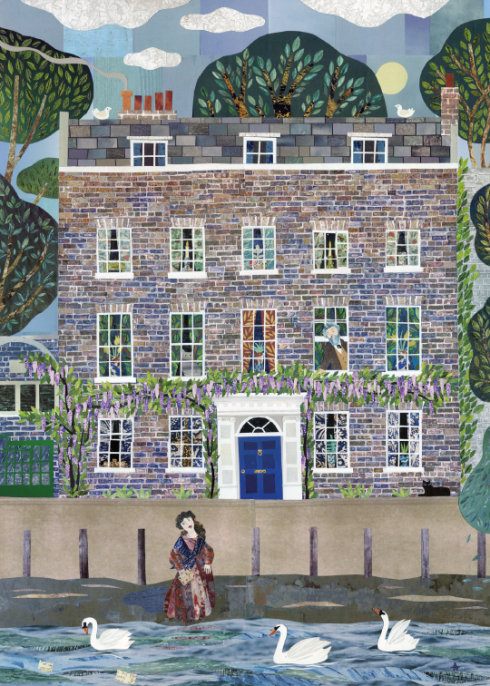
 William Morris at Kelmscott House and Dr. Johnson in London,
  Henry VIII at Hampton Court Palace by






