Tag Archives: Architecture

Misplaced McIntire Pieces?

My title is a bit provocative: I am sure art historians know where the various extant pieces of Samuel McIntire’s urns, swags, mantles, etc.. wound up after they were removed from structures that were burning or razed or mistakenly modernized. But I don’t. A case in point is the previous embellishment of the former stable of the John Robinson House on Summer Street. Just this past week I had a coincidental “happening” with this structure. I happened to run across an article in the March 1912 edition of Country Life in America about John Robinson’s garden (he was a famous horticulturist, author, and garden designer) entitled “A Little Garden in Old Salem” which features several photographs, including one of his stable, embellished with McIntire panels and urns taken from a Derby coach house and the South Church which had burned down nine years before. Then two days later, I happened to meet the charming artist who presently lives in the stable, which was converted to a residence many years ago (and separated from the Robinson House). As her house is no longer embellished with swags and urns, I asked her where they went. According to her sources (the stable’s previous owners, and the man who moved her into it), there was a fire, during which people in the neighborhood “saved” the McIntire pieces, but no one is quite sure where they all ended up. I confirmed the fire–which happened in 1950, just one year after the stable had been converted into a garage–but my photographic evidence dates from before this time, and after: obviously we have a present-day building which is quite transformed, as well as swag-less and urn-less.

McIntire Embellished Stable in Salem 1912

Robinson Stable HABS 2 LC

McIntire Collage

Robinson Stable HABS 3 West Elevation LC

Robinson Stable HABS LC

Summer Street Stable Salem

Photographs of the Robinson Stable/House over the years: from “A Little Garden in Old Salem” by Wilhelm Miller (photograph by Arthur G. Eldredge), Country Life in America volume 21 (1911-12): all outfitted with McIntire panels and urns; from the HABS inventory at the Library of Congress, 1940, with panels and no urns but drawings of all ornamentation; today–rebuilt after the 1950 fire with no ornamentation.

Regardless of the whereabouts of the McIntire elements, the 1912 and 1940 examinations of the Robinson stable are interesting comparisons of relative appreciation for the famed architect and woodcarver of Salem: the earlier article scarcely mentions him while the HABS report is all about him! But ultimately one wonders how all that ornamentation got on the stable and off it: I am imagining frenzied pilfering/saving, both on the night of the burning of the South Church next door and the stable 47 years later. And where are all these elements now? I’m just not sure. The Peabody Essex Museum has urns from the William Orne House (demolished 1882) in their collection, and The Visitor’s Guide (s) to Salem published by its predecessor, the Essex Institute, in 1908 and 1916 indicate that urns from the South Church as well as other architectural elements are among its collection. South Church elements are also featured in Volume 13 of the pictorial Pageant of America series, published for the nation’s sesquicentennial. Are these the same urns taken off the stable for the photo shoot–or others rescued on that terrible night in 1903? And where are all those swag and rosette panels that we see affixed to the stable in 1912 and 1940? What is missing and what is accounted for? As I write this I’m looking down Chestnut Street and thinking about all those basements–but sadly, there are only Victorian doors and shutters in my own, as well as lots of late twentieth-century junk.

McIntire Doorhead South Church

McIntire Urns South Church NYPL

South Church Details PEM

 McIntire doorhead and urns from the South Church, destroyed by fire in 1903, from Volume 13 of the Pageant of America Series: The American Spirit of Architecture by Talbot Faulkner Hamlin (1926), New York Public Library Digital Collections. Details of the South Church spire from the Peabody Essex Museum’s archived microsite for its exhibition Samuel McIntire: Carving an American Style.

Save

Save

Save

Save

Save


Tricorner Houses

There’s a particular type of New England colonial house that I’ve always admired: Georgian, with a hipped roof and two entrances, almost as if two houses had been joined together at a right angle. The profile is square but you generally see just three corners–which is why I refer to these houses as “tricorner” houses. I think I’m the only person that uses this term. My two favorite examples of this type of house are the Jeremiah Moulton house in my hometown of York, Maine, and the Thomas Ayres Homestead in Greenland, New Hampshire, and I happened to be driving by both of these houses yesterday so I took some pictures. I would have had to infringe of the privacy of the Moulton House’s owners to show you the perfect illustrative angle, but the Ayres house represents a tricorner house perfectly even though it has two additional entrances on the side rather than one. My rule (and again, it’s just mine) about these houses is that the length of the side structure has to be roughly equal to the front, and it cannot appear to be just a mere addition, but an integral part of the entire house.

Moulton House York

Tricorner House Thomas Ayres Homestead Greenland NH

Tricorner Ayres Greenland

Like tricorner hats, tricorner houses are eighteenth-century creations: most of the ones I have seen date from the 1730s through the 1760s. They all have two stories, and seem to be more characteristic of rural environments rather than urban ones–or maybe they have just survived in less-developed areas. There are quite a few in central Massachusets: if you browse through the digitized photographs of colonial houses taken by Harriette Merrifield Forbes at the American Antiquarian society you will come across several, especially taverns. Case in point: the Jones Tavern in Acton, Massachusetts, which acquired its tricorner shape between 1732 and 1750. I think tricornered houses (at least by my own conception) have to evolve rather than be built as such: high style examples like the Willard House at Old Deerfield and the Salem Towne House at Old Sturbridge Village have the requisite two sides/entrances but are not quite right–the corners are too sharp!

Jones-Tavern_early-20th-century

jones_montage_v4

My favorite “tricornered” houses: the Moulton House in York, Maine, the Ayres Homestead in Greenland, New Hampshire, and the Jones Tavern in Acton, Massachusetts. Please forward more examples!

Save


Silken Skirts and Open Houses

On at least five occasions over the last century, residents of Chestnut Street opened their wardrobes and their houses, donning period clothing while giving house tours on a succession of “Chestnut Street Days” celebrating the apparel, architecture, and culture of Salem’s golden age. The first Chestnut Street was in 1926, organized to recognize Salem’s Tercentenary, and the last was sometime in the 1970s: I’m not sure precisely when but I’m assuming it must have been around the Bicentennial? I’ve posted on these occasions before, but just the other day a very nice man sent me a photograph of the first Chestnut Street Day which I’d never seen before, so I thought I would do so again: we have lots of new residents on the street who are probably completely unaware of these happenings. I also delved into the press coverage a bit and was amazed by the number of headlines the 1939 and 1947 Chestnut Street Days generated: my title is derived from my favorite, “Heavy Silken Skirts Rustle Again at Salem’s Chestnut St.Day Preview”, from the May 27, 1947 edition of the Boston Globe.

Chestnut Street Day 1947 Boston Globep

This preview was followed up by no less than seven articles in the Globe over the next month, covering every little detail of the organization and occasion of the 1947 Chestnut Street Day:  Luncheon Waitresses Chosen for Chestnut Street Day in Salem (all Misses, for the luncheon at Hamilton Hall, the beneficiary of this particular Chestnut Street Day), Salem’s Beautiful Old Houses to be Open for Chestnut Street Day (30 that year!), It Took Two Months to Ripen the 4th of July Rum Punch in Salem (no aspect of the life of “Old-Time Sea Captains” was left uncovered by either the organizers of the Day or the press), and finally, on the eve of the big day:

Chestnut Street Day June 24 1947 Boston Globe Headline

There was definitely a big emphasis on the “garb”, for both men and women, some of which still resides on the street in storage at Hamilton Hall but most of which was sold a few years ago, as I recall. Historic New England also has some clothing in their collection–and films of Chestnut Street days–from the Phillips family. Every piece of evidence indicates that no detail was spared: clothing, food, furnishings carriages, games, house flags, flowers. These days were huge undertakings, apparently involving everyone of every age on the street: a real community effort and display of pride of place. Here are some images from a succession of Chestnut Street Days, beginning with the great family photo I just received and proceeding up to 1952. I don’t have any 1970s images: I wish someone would fill me in on that particular occasion and send photos!

Chestnut Street Days 1926 Trumball

Chestnut Street Day 1626 Tom Sanders

howell-painting-1926-chestnut-street-christies-2006-7200

Chestnut Street Day 1926: Family photograph courtesy of Jim Trumball;  Tom Sanders and his horses and carriage courtesy Martha Sanders; Felicie Ward Howell, “Salem’s 300th Anniversary, Chestnut Street, June, 1926”, Christie’s.

chestnut-street-days

Chestnut Streets Days 1939 carriage SSU

Chestnut Street Day 1939 Gibralter Lady SSU

1939: Flyer featuring Samuel Chamberlain’s “Springtime in Salem”; another carriage and team of horses; two ladies buying Salem’s famous Gibralters from Mrs. Mary E. Barker in period dress, Dionne Collections, Salem State University Archives and Special Collections.

Chestnut Street Day 1947 Press Coverage

Chestnut Street Day 1952 Ticket

1947 and 1952: One of MANY photographs and stories about the “famous” Chestnut Street Day in the Boston (and even New York) press, and a ticket to the 1952 Day, which featured 25 open houses.

Save

Save


Genealogical Houses

The practice and study of genealogy is supposed to be about people of course, but some of the genealogical tomes that I have consulted over the years seem to be almost as interested in houses, both family homesteads and the impressive residences of offspring. I’m not over-familiar with genealogical literature (I like a bit more context in my history), so I’m not sure whether this is a unique feature of Salem genealogies or not but many of the nineteenth-century histories of Salem’s venerable families feature plates of houses as well as portraits of the family members who lived in them. The best example, by far, is the weighty genealogy of the Pickering family and its many branches: The Pickering genealogy : being an account of the first three generations of the Pickering family of Salem, Mass., and of the descendants of John and Sarah (Burrill) Pickering, of the third generation by Harrison Ellery and Charles Pickering Bowditch, published in three volumes in 1897. The first volume is a veritable treasure trove of Pickering houses, most of which are still with us, others long gone. The second and third volumes follow the family through the nineteenth century and include lots of photographic portraits but few houses, as if to say we’ve built our houses for generations in true Yankee fashion–or perhaps we don’t like Victorian architecture. It seems to me as if the houses are presented as part of the foundation of the family, its very rootedness, as well as its thrift.

Pickering Houses no longer standing:

Diman House Pickering Genealogy

Haraden House Charter Street

Goodhue House

The James Diman House on Hardy Street, the Jonathan Haraden House on Charter Street, and the Benjamin Goodhue House at 403 Essex Street (I’m not sure of the dates of demolition of any of these houses, but I assume the Goodhue house was consumed by the Great Salem Fire of 1914).

Pickering Houses still standing, with the exception of the Phippen House, all in the vicinity of upper Essex and Chestnut Streets:

Clarke House Pickering Genealogy

Clarke House

Silsbee House Pickering Genealogy

Silsbee House

Cabot House Pickering Genealogy

Cabot House

Barnard House

Pickering Houses

Phippen House 1782

Phippen House

The Clarke, Silsbee, and Barnard Houses on Essex Street, the Pickering double house on Chestnut, and the Phippen House on Hardy and the grounds of the House of the Seven Gables Settlement Association.


A Galleon in Port

Our anniversary falls on Memorial Weekend so this past Friday we celebrated it with drinks and dinner in Newburyport, after which we walked around the foggy old town and came across a pirate ship, with a party on board. This was El Galeón, a Spanish reconstruction of a sixteenth-century galleon, which is apparently sailing up and down the eastern U.S. coast this summer. Somehow we didn’t know she was going to be in Newburyport, but there she was, and quite a sight to see. This is a ship from my period, so I was thrilled, and determined to make it back to see her in daylight. The weekend was busy, and so I didn’t manage this until late yesterday. In broad daylight El Galeón was still pretty impressive in its details, and bigger than I thought such a ship might be, but perhaps not quite as magical as she appeared on Friday: much less fog, no costumed party-goers on board, and I suppose alcohol might have colored my previous view a bit. But I had wanted to head north to Newbury and Newburyport anyway, to explore some Moses Little territory as a follow-up to my last post, and these towns are so packed with beautiful old houses they are always worth a trip, even on a busy holiday weekend.

Newbury cemetery

Newbury Short House Memorial Day Weekend

Newbury Short House Memorial Day Weekend2

Driving through Newbury, I always stop to admire the Knight-Short House (built c. 1723) with its brick sides.

Newburyport Galleon 4

Newburyport Galleon3

Newburyport Galleon2

Newburyport Galleon Night

Newburyport Galleon

Newburyport

El Galeón in port, day and night. Then I was off to see more houses.


What to do with my Stereoviews?

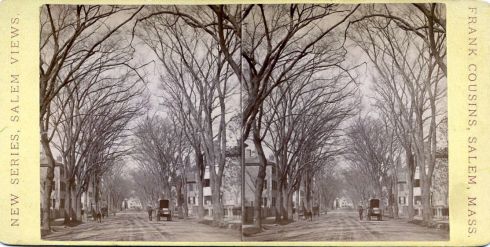
I’ve been a collector of sorts for much of my life but I never collected historic photographic images until I started this blog: I quickly realized their power to tell stories and provide context in this, our digital age. So I started buying some Salem images, mostly stereoviews, which were produced in vast quantities in the later nineteenth century. There were about six or seven major publishers of stereoviews here in Salem at that time, but I’ve focused almost all my collecting efforts on images associated with Frank Cousins, as either photographer or publisher. I just completed my collection of his sentimental “Salem in 1876” views, encompassing nearly every corner of central Salem. Now I’ve got a (shoe) box of stereoviews and I’m not quite sure what to do with them.

Stereoviews

Stereoviews 2

Steroview Chestnut Street Cousins

Frank Cousins published views taken both up and down Chestnut Street and all over the city, documenting “Salem in 1876”.

Stereoviews are relatively easy to acquire, especially of a city like Salem which has been selling its image, in one way or another, for quite some time. They turn up online very frequently and I always find them at the larger flea markets and paper shows. My collection is pretty focused on Cousins, but it also has a few views that I have never seen anywhere else, including a great (though completely unattributed and undated) view of Front Street from Washington Street and a rather unusual (forested!) view of the South Church that stood across Chestnut Street from my house for nearly a century. This McIntire masterpiece burned down in 1803: I’m trying to gather as many images of it so I can glean its impact from every possible perspective. My verdant view is contrasted with a more typical image of the church, from the best source for digitized stereoviews: the Robert N. Dennis Collection of Stereoscopic Views at the New York Public Library (where you can make “stereogranimators”).

Stereoview Front Street Salem

Stereoview Second Church Tilton

Stereo South Church Salem NYPL

(Stereo)view of Front Street, ?date, ?photographer); the South Church on Chestnut by Peabody & Tilton, c. 1875 and Guy & Brothers, c. 1884, Dennis Collection, New York Public Library.

Obviously I have a predilection for streetscapes but I like some (not all; some are creepy) of the more intimate, “up close and personal” stereoviews too. I’ve seen quite a few of people just standing outside their houses, being captured for posterity. A double dose of daily life. I love this image of a Salem Willows summer cottage with its residents, all ready for summer. This is not mine, unfortunately, but from another great source of stereoviews: the Center for Lowell History at the University of Massachusetts at Lowell Libraries.

Stereoview Juniper Point UMASS Lowell SP

“View at Juniper Point, Salem Neck, Mass.”, n.d., Center for Lowell History at the University of Massachusetts Lowell Libraries (the original Willows cottages were built for Lowell residents who wanted to summer on the coast).

So again, what to do with those stereoviews that I do possess? Ultimately I will leave them all to the Salem State University Library’s Archives and Special Collections, because what Salem needs is a Center for Salem History there, as the Peabody Essex Museum ceased its historical-society function long ago. But in the meantime, I’d like to find a more clever and creative way to preserve and display them. I’d like to get them out of the box! I guess I could frame them in some interesting combinations and create a gallery wall, but that’s about the extent of my creativity. Brass floating frames? Display them with a special “twinscope” at hand like this cool exhibit from just last year, Syracuse in 3-D (1860-1910)? I’m open to suggestions, because I do think there is something very engaging–both aesthetically and historically– about images in multiples. As evidence, I give you this beautiful invitation to the Pickering House’s annual garden party by Salem artist Racket Shreve, paired with Cousins’ stereoview, of course.

OLYMPUS DIGITAL CAMERA

Stereo Pickering

Stereoview Pickering House Cousins 1876

Scene from the interactive “Syracuse in 3-D” exhibit by Colleen Woolpert (+ more here); Racket Shreve’s quatre-Pickering House invitation; Frank Cousins’ “Salem in 1876” stereoview of the Pickering House.


Trees for Lafayette

This is not to complain–I know lots of good Salem people are working on this–but rather to offer some perspective: Salem’s grand boulevard Lafayette Street needs some trees (and some love). This is the route on which I walk to work nearly every day, and I crave the protective canopy it once had. I’m also tired of picking up trash, and hoping that the commitment to the future that tree plantings represent would also instill a bit more stewardship for this once-grand street. Lafayette Street was laid out a bit later than the rest of Salem: over the course of the nineteenth century following the erection of a bridge to Marblehead and the partition of the vast farm of Ezekiel Hersey Derby. The earliest photographs I have seen are from the 1870s: they show a boulevard of mansions, and trees: elms of course, but also other varieties. We have very precise dating for the planting of the elms of upper Lafayette Street from a wonderful book, John Robinson’s Our Trees. A Popular Account of the Trees in the Streets and Gardens of Salem, and of the Native Trees of Essex County, Massachusetts, with the Locations of Trees, and Historical and Botanical Notes (1891):  It has been said that the trees on the upper portion of Lafayette Street were planted within the line of the Derby estate, on account of some opposition to placing them in the street itself. The street was laid out in its present magnificent width at the suggestion of Mr. E. Hersey Derby in 1808. Mr. David Waters informs me that his father, but a short time before his death, while passing these trees, said that when a boy he was called by Mr. Derby to assist at planting them, holding the samplings while the workers filled the earth in about them. Mr. Waters, Senior, was born in 1796 and would have been twelve years of age when the street was laid out. The date of the planting of these elms, thus corroborated, may, therefore, safely be placed at 1808. In addition to a few images of the entire tree-lined street, we also have several photographs of the “wooded estates and pleasure gardens” (a phrase from an 1873 guidebook to greater Boston) of Lafayette Street before the Great Salem Fire of 1914. When you compare these lush images with those taken in the days after the Fire, it’s painful.

Lafayette_Street,_Salem,_MA 1910

Lafayette Street Cousins cropped 1891

Lafayette Street Cousins Derby Mansion 1891

Lafayette Houses Collage

Lafayette Church 1880s

Shades of pre-fire Lafayette Street: a very popular postcard c. 1910; Frank Cousins’ photographs of the very verdant street (1876) and the Old Derby Mansion (1891), demolished in 1898, Duke University Library; Gothic Revival and Victorian houses on upper Lafayette, still standing, while the McIntire-designed Josiah Dow House (built 1809) in the lower-right hand corner is gone (Smithsonian Institution collections and Cornell University Library); rendering for the Lafayette Street Methodist Church, American Architecture and Building News, 1884.

The Fire laid waste to half of the street (from Derby to Holly and Leach Streets), and later on many of the surviving mansions of the other half–rather massive Victorians, Queen Annes, and Italianates–became subdivided and commercialized. After the replacement of some of these structures by some truly terrible mid-century apartment buildings, the Lafayette Street Historic District was created in 1985. Trees will really help Lafayette Street, but other challenges remain: chiefly the constant traffic which seems to grow worse and worse with every passing year and the incremental though persistent expansion of Salem State University (my employer) at its upper end. Students and staff have turned this end of Lafayette into one big parking lot, a trend that has not been mediated by the construction of a large campus parking lot in my estimation. I think a new South Salem train stop would help with the parking, but I’m not sure about the traffic: I watch it every day on my way to and from work and the majority of it does not seem to be university-related: this is also the only route to Marblehead, after all.

Traffic is tough, but more trees will shield and shade Lafayette Streets residents…and walkers. And as I said at the top, there are plans for more trees, and better maintenance of existing trees, throughout Salem. Just last week the City Council formed the Leaf-oriented Resiliency and Arboricultural Expansion Taskforce with its associated acronym, LORAX, for just that purpose (yes, you read that correctly: LORAX). The plans for the major new development at the corner of Lafayette and Loring Streets also have lots of provisions for trees. I’m not really a fan of the new building (which will totally dominate the view from my office) but I’m really happy to see plans for all these new trees, including some disease-resistant elms (there is one Elm still alive on Lafayette–I think? See below!)

Lafayette Street 1908 Final

Lafayette today

Lafayette after the Fire pc

Lafayette 1917 SRCR Final

Lafayette Tree

Upper Lafayette in 1908 and today; the 1914 fire was so devastating, in so many ways, and all of the reports reference the lost trees almost as much as the lost buildings: the Rebuilding Commission Report specified many trees–some of which are visible in the 1917 photograph above: if trees were a priority then, they should be a priority now! Lafayette’s surviving Elm, near the corner of Fairfield Street.


Bridge Street Neck

Salem is a city of extremities in terms of its physical shape: two “necks” jut out into the Atlantic Ocean from a central peninsula. You can easily see that this was a settlement oriented towards the water rather than the land. Once transportation shifted towards the latter, traffic problems emerged for Salem, and they still present a major challenge to the city. One interesting Salem neighborhood which seems to represent the shifting impact of transportation very well is Bridge Street Neck, the first area to be settled by Europeans and the main gateway to the north. Its central corridor or “spine”, Bridge Street, first led to a ferry, and by the end of the eighteenth century the first bridge to Beverly was completed. From that time the area developed in typical mixed-use fashion, with commercial structures and residences rising up on Bridge Street, smaller houses on the side streets leading down to the water on both sides, and manufacturing sites interspersed: first maritime-related uses, later lead and gas works. There are all sorts of references (though I can never find images) to horticultural uses as well, from the first fields of the early “old Planters” to nineteenth-century greenhouses and pleasure gardens to today’s parks. In a few months Salem’s newest park will open at the very end of the Neck, dedicated to the work and memory of the Abolitionist Remond family.

Salem Map 1970 Osher Romantic Boston Bay Text

Salem Map 1903 cropped The North Shore coastline from Edwin Rowe Snow’s The Romance of Boston Bay, 1970; 1903 Map of Salem and surrounding places, Henry M. Meek Publishing Co., Leventhal Map Library, Boston Public Library.

Carriages, trains, trolleys, CARS: for too long Bridge Street Neck has simply been a place to get through.It’s never been a destination, unlike Salem’s other neck, home to the Willows. But over the past decade, a series of infrastructural changes have (perhaps) transformed this Neck’s functional status: a new bridge attached to a new bypass road which skirts the neighborhood rather than running through it, and a “revitalization plan” implemented by the city to address its aesthetic and economic challenges. I think this is a Salem neighborhood that is really primed for change, but in what direction? Its diverse building inventory–ranging from late eighteenth-century Georgians to post-war Capes–is protected by the recent designation as a National Register Historic District but not the more stringent review of a local historic district. And there is much to protect: there are some great old houses interspersed among the streets of Bridge Street Neck, better appreciated if you get out of your car and walk.

Bridge Street 4

Bridge Street 2

Bridge Street 1

LOVE this Gothic Revival cottage and its mansard-roofed neighbors on Arbella Street, named for the ship that brought John Winthrop to Salem in 1630.

Bridge Street 5

Bridge Street 6

Bridge Street Gwimm House

Bridge Street Thaddeus Gwinn House MACRIS

Bridge Street Neck Collage

Very pretty Victorian two-family; two early nineteenth-century houses: a Georgian (behind the addition) and the stunning c. 1805 Thaddeus Gwinn House, an unusual Salem two-story Federal (today and in the 1980s, courtesy MACRIS); two cute cottages on the North River side of Bridge Street.

Bridge Street 12

Bridge Street 8

Bridge Street 9

Bridge Street Neck Planters

The old and the new on Bridge Street including the Thomas Woodbridge House on the corner of March, and across from it: the future?


Ernest M.A. Machado, Salem Architect

I tend to romanticize architects and the practice of architecture. When I first went to the house of my now-husband, who is an architect, I expected it to be Monticello-like, with a study in which a drafting table took center stage, surrounded by lovely hand-drawn renderings on whitewashed walls. My vision was not realized, and of course he is generally bent over a computer rather than a drafting table. It’s impossible to romanticize his work now that I know much more about it, so while I maintain a wifely interest in his business and projects, I also tend to drift away, back, towards architects who lived in ages past, who can easily engage and distract me. Just yesterday I walked over to take a picture of a Salem house which was built and occupied by a very prominent horticulturist and landscape architect, Harlan P. Kelsey, about whom I wanted to write a post (it is spring after all, even if it is a frigid spring, and so time to turn to gardening). But the more time I spent looking at the house, the less I was interested in its occupant and the more I was interested in its architect. And so I forgot Kelsey (for now–I’ll come back to him because he is pretty amazing), and began to focus on Ernest M. A. Machado, the likely architect of One Pickering Street and a man who is very easy to romanticize because he died relatively young, very tragically, and with much apparent promise.

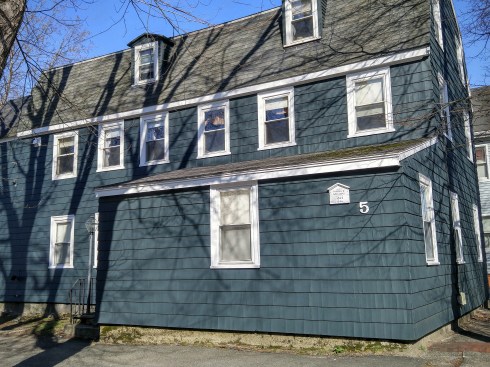
Fortunately Machado’s life his well-documented: he seems to come from a family that wanted him (and all of its members) to be remembered: there is a nice genealogy and some pictures here, and the family donated his own photographs of completed projects to his alma mater, MIT. Ernest Machado was born just up the coast in Manchester-by-the-Sea to a Cuban émigré father and a North Shore mother who was orphaned but nevertheless connected. Juan Francisco Machado and Elizabeth Frances Jones met and married in Massachusetts, returned to Cuba for a decade, and then settled in Massachusetts permanently to raise their large family, first in Manchester and later in Salem. The Machado house is one of my favorite in Salem: a stunning brick Federal on Carpenter Street. Ernest attended Salem schools and then the Massachusetts Institute of Technology, graduating from its pioneering architecture program in 1890. After working for at least two prestigious Boston architectural firms, he established his own practice in partnership with his future brother-in-law Ambrose Walker, with offices in Salem (on Church Street), Boston and Ottawa (where his brother was an established banker). In the later 1890s he seems to be working feverishly, with commissions in several Boston suburbs, Salem, and all along the North Shore. This pace continued in the new century, all the way up to his death by drowning in Lake Ossipee in New Hampshire in September of 1907: he was 39 years old and had just completed his most challenging commission: the 14,000 square foot brick mansion of Governor Charles B. Clarke on Portland’s Western Promenade.

Machado Kelsey House One Pickering Street Salem

Machado Carpenter Street Salem

The Kelsey House on Pickering Street & Machado family home at 5 Carpenter Street.

Machado’s mark on Salem is not hard to find. Besides the Kelsey house and a few other residences in the McIntire Historic District and the Phippen house on the Common, he supervised substantial renovations to the Salem Club and the Bulfinch Bank on Central Street. He rebuilt the Salem Lyceum on Church Street, and as a testament to his versatility, designed both a commercial building on Washington Street for the dry goods retailer Charles W. Webber and the Blake Memorial Chapel in Harmony Grove Cemetery. Yesterday I trudged over through driving rain to contemplate the chapel, and then walked up the hill to his grave, part of a family plot of elegant markers which apparently he also designed (and unfortunately very wet by the time I got there).

Machado 16 Beckford

Machado 4 Carpenter

_258185, 4/5/15, 9:41 AM,  8C, 4358x3223 (7538+1035), 150%, Custom, 1/160 s, R89.4, G34.6, B41.3

Machado Harmony Grove

Machado Chapel

Machado Graves

Machado Grave

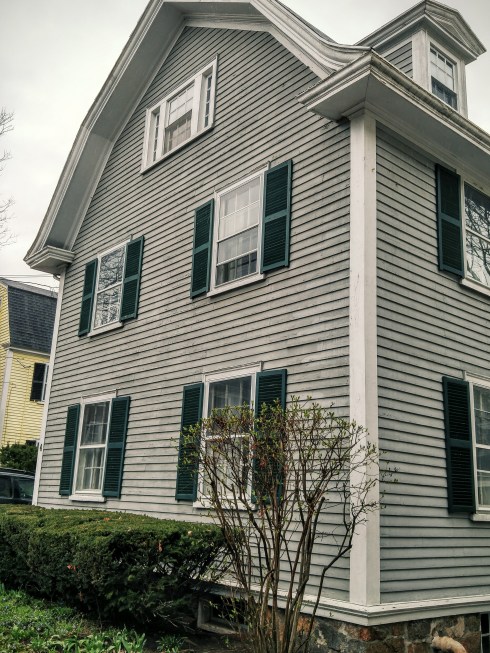
Machado in Salem: 16 Beckford Street and Four Carpenter Street; his own photograph of the Webber store on Washington Street, from the MIT Machado Archive; The Blake Memorial Chapel at Harmony Grove Cemetery and the (very wet) Machado grave(s) at Harmony Grove.

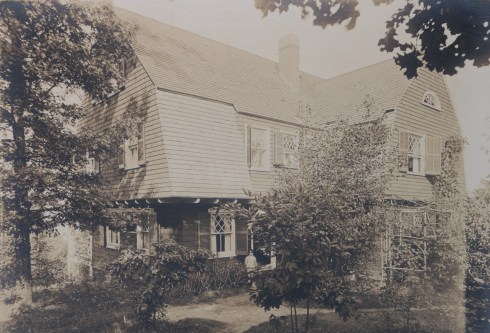
Looking at his Salem work as well as the portfolio of North Shore commissions (lots of residences and clubhouses for both the Salem Country Club and the Manchester Yacht Club) in the digital archive at MIT, it’s hard to discern a distinct Machado style: there are Colonial Revival houses in both the classical and Tudor traditions as well as lots of Shingle residences reflecting contemporary trends. But remember, he was a young architect, just establishing his practice and business and no doubt catering to the desires of his clients. Who knows what he would have achieved over the next thirty or so years of his working life? He could have maintained and expanded his practice as a Gold Coast residential architect, or he could have rebuilt Salem after the Great Salem Fire of 1914. Or both.

Machado Agge House MIT

Machado C.F. Allen House MIT Dome

Machado R. Wheatland House MIT

Machado Sanden House MIT

Machado House MIT Dome

Machado House MIT

Machado Lynn House AABN

Machado’s photographs of his own work at the Machado Archive at MIT: the Agge, Allen, R. Wheatland, and Sanden houses, and two unidentified houses (one of which looks just like a house in my hometown, York Harbor, Maine); a Tudor house in Lynn, from American Architect and Building News, 1906.

Appendix: you can stay in Machado’s recently-restored Clarke “Manor” (below) in Portland via airbnb; My Machado-obsessed day ended appropriately with a birthday party at one of his buildings: the Salem Lyceum, now Turner’s Seafood.

Machado Clark House Portland Zillow

Machado Lyceum.jpg


Salem on Screen: East meets West

There is quite a long list of films set in Salem, but the list of films that were actually filmed here is impressive as well–and much more impactful. David O. Russell apparently loves Salem, as he filmed scenes from two movies here (American Hustle, Joy) even though their plots did not necessitate this location, tours of Hocus Pocus locations remain ridiculously popular, and though not a film, we’ve decided to dedicate a very prominent city square to Samantha from Bewitched (and TV Land), just because a few episodes were filmed here. The very first production filmed in Salem, however, traded on its commercial reputation rather than its connection to witchcraft: this was the 1923 silent film Java Head, which shot scenes on Derby Wharf, Salem Common, and Chestnut Street.

Filmed in Salem Java Head Lobby Poster

Java Head was based on the novel of the same name by Joseph Hergesheimer, about the scion of an old Salem family who meets a “Manchu princess” in China, marries her to prevent her imminent death, and brings her home to his Yankee family and the girl he left behind. Apparently this love triangle drives the movie, along with lots of cross-cultural conflicts, but I’m basing my plot summary on the novel (and the 1934 “talkie” remake, which replaced Salem with Bristol, England) as the film has not made it to You Tube (and may indeed be lost, along with 75% of all silent films that were produced–the Library of Congress has catalogued the film but there are “no holdings” in its archive). The interior and “Chinese” scenes of Java Head were filmed at a studio in New York, but Derby Wharf (or a nearby stand-in) and several Salem structures were used as locations. In his 1989 memoir Highlight and Shadows, cameraman Charles Galloway Clarke recalls that We loved the good people of Salem for they were friendly and helpful and did everything to make our stay there pleasurable. After finishing the scenes around the recreated dock, for this was a film about the China Trade during the sailing days of Salem, we returned to Astoria for the interior scenes. The title “character” of the film is actually a Federal mansion, exemplifying the fortunes to be made in the China trade. Contemporary sources hint that the Forrester-Peabody Mansion (later the Salem Club and later still the Bertram Home) “played” Java Head, but I think a far more likely suspect is the Devereux-Hoffman-Simpson House on Chestnut Street.There are a few more details and images here, but what I’d really like to see is the film!.

Filmed in Salem Java Head Poster

Filmed in Salem Java Head article

Filmed in Salem Leatrice Joy

Filmed in Salem Java Head 1923

Filmed in Salem Bertram Home

Filmed in Salem Devereux Hoffman Simpson House Chestnut Street

Lobby Card for Java Head (1923) and article from Picture Play from the same year, showing lead actress Leatrice Joy’s transition “from occidental to oriental”; after the transition-a Swedish poster for the film; a still from the film showing the Salem mansion “Java Head” which some sources identify as the Bertram House at 29 Washington Square (with flag, above), but I think it was definitely 26 Chestnut Street (just above).