Tag Archives: Architecture

Ghostly Courtiers

I’ve just got a few more English posts before I get back to the actual streets of Salem: I just took so many great pictures over there if I do say so myself! I’m going back to Hampton Court today–the other side of Hampton Court, which if of course a bilateral palace, with a Tudor side and a Baroque/Georgian one, the cumulative work of Sir Christopher Wren and Sir John Vanbrugh who were commissioned by the last Stuarts and the first Georgians to remodel the entire castle in a more modern (and presumably comfortable) style. If completed, this modernization plan would have resulted in the complete demolition of the Tudor palace but lack of funds and the shifting preferences of monarchs determined that it was (fortunately) not. I far prefer the Tudor palace, inside and out, but I really enjoyed the furnishings, paintings, and overall interpretation of the “Secrets of the Royal Bedchamber” exhibit in the royal apartments on the other side, populated by courtiers all draped in white Tyvek.  Like any old place touched by tragedy, there are rumors of ghosts at Hampton Court Palace, and it as if you are walking among them in these rooms.

20160315_111841_Burst01~2[1]

London 735.jpg

London 724

London 726

London 728

London 727

London 725

London 731

London 730

London 732

Baroque facades–with the Tudor roofline peaking out behind, dining rooms and courtiers; Below, the “Grey Lady” ghost, Sybil Penn, wandering through the palace.

Grey-Lady-low-res


Hooked on Hawksmoor

Well, I am very late to this party but I became absolutely obsessed with the works of British Baroque architect Nicholas Hawksmoor (1661-1736) on my recent trip to London. Hawksmoor’s professional reputation was overshadowed in his own time–and long afterwards–by his association with two more prominent “gentlemen” architects, Christopher Wren and John Vanbrugh, but in the last few decades he seems to have emerged from their shadow. His oeuvre is impressive: under Wren he worked on St. Paul’s Cathedral, the naval buildings at Greenwich, several buildings at Oxford University, Hampton Court and Kensington Palaces and Westminster Abbey, the west towers of which were constructed according to his own design during his tenure as Surveyor General, and he collaborated with Vanbrugh on both Castle Howard and Blenheim Palace. I’ve been to all of these places, but I never associated any of them with Hawksmoor, or thought about Hawksmoor at all, until I saw his Christ Church, Spitalfields, early last week. From that point on the week belonged to Hawksmoor: I scouted out his six surviving London “Queen Anne” churches commissioned by the New Churches in London and Westminster Act of 1710, really looked at the Abbey’s west towers for the first time, and looked on the stately buildings of the Royal Naval College at Greenwich with a new appreciation.

Christ Church Spitalfields

Hawksmoor 1

Christ Church Spitalfields 1950s

Christ Church Spitalfields 1909

21. Christ Church, Spitalfields, London: by Nicholas Hawksmoor 1964 by John Piper 1903-1992

Christ Church, Spitalfields, shining like a beacon at the end of very busy Brushfield Street, afternoon and early evening (after its long restoration, completed in 2004), and in the 1950s and 1909; John Piper, Christ Church, Spitalfields, London: by Nicholas Hawksmoor, 1964, Presented by Curwen Studio through the Institute of Contemporary Prints, Tate Britain.

I just can’t stop looking at Christ Church! And I’m not alone: it has inspired scores of artists and photographers, and authors such as Iain Sinclair, Peter Ackroyd, and Alan Moore. In the poem Lud Heat (1975), which inspired Ackroyd’s (crime? suspense? mystery? not sure how to categorize it) novel Hawksmoor (1985), Sinclair envisions a “psychogeographical” alignment between all of the Hawksmoor churches, and later calls them “eternal” as opposed to the “shimmering trash” of the Docklands (in this great video). Sinclair is absolutely right; these churches do stand out, all of them, not just because of their stature and their distinctive spires but also because they present a rather odd combination of classical austerity and weight.You also have the sense that Hawksmoor was building temples rather than churches: these houses of worship don’t look precisely Christian! One of his six surviving London churches, St. George’s, Bloomsbury, is essentially a classical temple with a steeple on the side rather than the center, at the top of which is not Saint George but King George (I–in Roman dress, presumably he is the Saint), accompanied by a lion and a unicorn. It’s no wonder that our modern secular age admires Hawksmoor, the architect and the Freemason.

Hawksmoor St. Georges

Hawksmoor St. Georges 2.jpg

Hawksmoor St. Georges 3

Hawksmoor’s St. George’s Bloomsbury, completed in 1730; restoration completed in 2006.

Well, I do believe St. George’s was Hawksmoor’s last London church; his earlier ones do appear a bit more traditional/ecclesiastical but still display that distinctive Hawksmoor edge of composition and detail. Here are the rest of his churches, plus two more that he collaborated on with John James: St. Luke’s Old Street in Islington (which features an obelisk steeple!) and St. John’s Horsleydown in Bermondsey, which was demolished after sustaining bomb damage during World War II.

Hawksmoor St Alfrege

Hawksmoor St. Alfrege

Hawksmoor St. Alfrege 3

St. Annes Limehouse

St George in the East

St George in the East rendering BL

Hawksmoor St Mary Woolnoth City

450px-St_Lukes_Islington Hawksmoor

Hawksmoors lost church Bermondsey

St. Alfege Church, Greenwich, 1712-1714 (with window details); St. Anne’s Limehouse, 1714-27 (on the grounds of which there is a pyramid); St. George in the East, Wapping, 1714-1729 (I did not have time to make it out to Wapping, so I have “borrowed” a picture from here and a drawing of the facade from the George III topographical collection at the British Library. Next time!); St. Mary Woolnoth, 1716-27, right in the center of the City of London (very wide and narrow steeple); Two collaborations with John James, 1727-33: St. Luke’s, Old Street and St. John’s Horsleydown, demolished after World War II (from the Collections of the Metropolitan Archives of London). Similar fluted spires, but St. John’s had a comet on top!

So we have all sorts of classical elements, combined with more whimsical ones: columns, pyramids, obelisks, unicorns, comets. Mathematical precision and clocks. I don’t think this adds up to anything particularly pagan, much less sinister (somehow Hawksmoor acquired the moniker “the Devil’s Architect”–I’m not sure if this is a creation of his time or ours): I just think he was a man of his time, which was of course the Enlightenment. Quite a modern man, who ascended to the heights of a gentleman’s profession on his merits alone and worked primarily for institutions rather than patrons. He was impressive and his work remains impressive. I’m not precisely sure what his creative contributions were relative to those of his mentor, Christopher Wren, but I really felt Hawksmoor’s presence at Greenwich, almost as much as Christ Church, Spitalfields: maybe I’m getting a bit “psychogeographical” myself! Unfortunately we don’t seem to have this particular field of inquiry in the States: we’re just not that attached to our built environment to get that introspective about it.

Hawksmoor Greenwich

Hawksmoor Greenwich 2

So now I’m home, with only a few Hawksmoor books to sustain me. I need more: so now I’m going about collecting more texts, and some images that rival, or at least capture, the magnificence of Hawkmoor’s buildings. I really like the work of Andrew Ingamells, who has rendered several of Hawksmoor’s churches in aquatint etchings, and I would almost kill for Pablo Bronstein’s Four Alternate Designs for a Lighthouse in the Style of Nicholas Hawksmoor (Bronstein also designed and commissioned the construction of an actual Hawksmoor beach hut in the form of a lighthouse at  Folkestone, which you can see here).

Ingamells Hawksmoor Collage

Hawksmoor Collage2

Hawksmoor Pablo Bronstein

Hawksmoor books

Trinity and Hawksmoor

Aquatint etchings of Hawksmoor churches by Andrew Ingamells, from a selection here; Pablo Bronstein’s “Four Alternate Designs”, Herald Street Gallery;  Architectural and historical analysis from Owen Hopkins and Mohsen Mostafavi and beautiful black and white photographs by Hélène Binet; just finishing up Ackroyd’s engaging Hawksmoor this morning!


Tudor Texture in London

Besides far superior public transportation systems and many more public smokers, I think the thing that Americans notice the most when they travel to Europe is texture: a built environment that looks comparatively embellished, nuanced with symbolism, and venerable. Despite London’s dynamic growth over the past twenty years or so, there is still a lot of historic fabric in the city–but much of it is deceptively and relatively “modern”, i.e., Victorian. The Houses of Parliament are probably the best example, but scattered around the city are myriad buildings that “look” older than they really are: especially pubs! I was charged with finding Tudor sites in London on this trip: a task that was not as easy as you might think. The successive catastrophes of the Great Fire of London and the Blitz obliterated much of the city’s pre-modern fabric and in between there were those “improving” Victorians! So what remains of Tudor London? Lots of things, primarily to be found in the National Portrait Gallery, Tate Britain, The Victoria & Albert Museum, and the Museum of London. Several places, namely the Henry VII Chapel at Westminster Abbey, St. Margaret’s Church nearby, Lambeth Palace just across the river, and the Tower of London and the sister churches of St. Helen’s Bishopsgate and St. Andrew Undershaft in the City. There is also the Staple Inn of my last post, whose very Tudor appearance probably owes much to an early twentieth-century “restoration”, and St. Bartholomew’s Gatehouse and the oldest residence in London, located on the picturesque City street of Cloth Fair. To the west, Hampton Court Palace, and to the east, Sutton House in Hackney, which was one of the highlights of my recent tour. You can’t quite immerse yourself in the Tudor era in modern London–but you can come close, for an hour or two, if you find the right spot.

Tudor Texture windows

Tudor Texture Queen's

Tudor Texture Sutton Windows

Tudor Texture Sutton Window

Hampton Court 4

Windows into the Tudor era: exterior of the Chapel Royal at Hampton Court (where we attended a service!), featuring the Tudor emblems of the portcullis and rose; looking out from the Tower towards the Queen’s apartments, built c. 1530 for Anne Boleyn; windows at the Sutton House, c. 1535; one of many impressive oriel windows at Hampton Court Palace.

Henry VIII at Hampton Court

NPG 4618; Catherine Parr by Unknown artist

Tudor Texture tomb_margaretcountessof lennox

Tudor Texture Holme Family

Tudor People: Henry VIII at Hampton Court; my favorite of his wives, Katherine Parr at the National Portrait Gallery; the tomb of  his niece (and the grandmother of King James VI and I) Margaret, Countess of Lennox, in the Henry VII Chapel at Westminster Abbey; not quite Tudor-era people but I love this triptych portrait of the Holme family in the Victoria & Albert Museum, c. 1628.

Hampton Court

Hampton Court 2

Hampton Court 5

Sutton House

Sutton House 2

Sutton House 4

Gherkin and St. Andrews

Hampton Court courtyards and Sutton House and its central courtyards in Hackney; St. Andrew Undershaft in the City of London dwarfed by the Gherkin (my photograph didn’t turn out so well as the Gherkin wasn’t so textured; this is one credited to Duncan which I found here. It’s a pretty classic composition now, as you can imagine!)

So now finally for some real interior texture: the Tudors could not bear an unembellished surface and were particular fond of tapestries and wood paneling for their interiors. At Hampton Court, the private Tudor apartments were demolished to make way for the Baroque “restoration” of William and Mary’s reign, but the Great Hall of Henry VIII’s time remains, with its decorated hammer-beam roof and walls lined with The Story of Abraham tapestries. On the day that I was there last week, this room was full of English schoolgirls (in the best uniforms ever) drawing details from the tapestries in close consultation with their teachers, so it was hard for me to get a clear shot of the interior details (plus I was very taken with these uniforms–fortunately there are lots of pictures of the Great Hall online). Later in the week, at Sutton House, I walked around the house in complete isolation and marveled at each and every surface: it was like stepping back in time in some rooms, while in others the National Trust’s conservation/interpretation approach enabled one to look beyond the decorative facade into the bones of the house, which is a must-see for any Tudor fan.

Hampton Court Great Hall

Great Ware Bed.jpg

Sutton House Door

Sutton House doorway

Sutton House Linenfold Paneling

Sutton House plain paneling

Sutton House paneling

Sutton House Details

Sutton House upstairs

Schoolgirls in the Great Hall at Hampton Court; The very famous “Great Ware Bed”, c. 1590, at the Victoria & Albert Museum (this item could have a post of its own); The National Trust’s Sutton House in Hackney: front door, doorway, paneling, details from fireplace surround & hops woodcarving; upstairs drawing room.        


Londonopolis

I have returned from my whirlwind tour of London, which is itself a whirlwind, continuing and even intensifying the dynamic expansion (up and out) that I witnessed the last time I was over there, with no cessation in sight! There’s nothing new about this: the metropolis (Londinopolis, according to the title of James Howell’s 1647 survey Londinopolis an historicall discourse or perlustration of the city of London, the imperial chamber, and chief emporium of Great Britain: whereunto is added another of the city of Westminster, with the courts of justice, antiquities, and new buildings thereunto belonging) emerged in the later sixteenth century and just kept growing all the way up to the twentieth century, when wars stopped and then resuscitated its regular redevelopment. London remains the “chief emporium” of Great Britain, but also of the world. It was difficult to take a picture anywhere in the city without capturing a crane in the background: construction zones abound in every district. And even where there are no cranes there are constant contrasts between old and new–some quite shocking–and some more subtle. But London remains an amalgamation of neighborhoods, and I do wonder what its citizens think of the relentless development pressure. You hear complaints of “blackened” Belgravia, where wealthy foreigners have purchased flats in which they will never live, and “iceberg houses” with hugely built-out basements below ground, but what looks like folly architecture to me seems okay to Londoners. I purchased a book by Rowan Moore, the architecture critic for the Observer, to give some insights into London’s 21st-century building boom during the long flight home, but Slow Burn City was more about anecdotal building than perceptions of planning, for the most part.

I did complete my planned itinerary (including Botticelli Reimagined at the Victoria & Albert, which was ok, but from my perspective presented in backwards order; the Pepys exhibition at the National Maritime Museum, which adhered to its one man’s life and times format without fail, and the AMAZING sixteenth-century Sutton House in Hackney, which will get its own post), and took students to Hampton Court, Westminster, Greenwich, and the Tower of London. The rest of the time I spent in the east end–in Spitalfields and Shoreditch– exploring bustling neighborhoods that I didn’t know very well, inspired by the wonderful blog Spitalfields Life and steadfastly avoiding the Salem-like Jack the Ripper Museum, which was supposed to be about the lives of the female victims (and working-class women in general) but is somehow not. Spitalfields is surrounded by modern buildings but its core is eighteenth-century, and it has been a long-time refuge for immigrants: French Huguenots in the seventeenth and eighteenth centuries, Irish and Jews in the nineteenth, and Bangladeshi today. It is home to the Old Spitalfields Market, which is probably the best market in London, a city of great markets. I fell hard for an architect there, and I don’t mean my husband (who came along): one sight of Nicholas Hawksmoor’s Christ Church, Spitalfields and I was a goner–so he’s going to get his own post too.

Some of my favorite places and photographs: more focused posts to follow all week.

London Staple Inn

London Staple

London Liberty

London Busts

Real Tudor and Faux Tudor: Two of my favorite buildings in London: the Staple Inn in Holborn and Liberty of London; busts from Liberty, the National Maritime Museum in Greenwich, and the Victoria & Albert Museum.

London Trooping

London Tower View

London 483

London Tower

London Graffiti Collage

London V and A courtyard

London Greenwich.jpg

Troops trooping near Buckingham Palace; In the Tower yard; armour in the White Tower; “graffiti” on window frames in the Tower and at Hampton Court Palace; The view from the White Tower–fortress against modernity! In the garden at the Victoria & Albert; the view south across the Thames from the Royal Observatory, Greenwich.

London St Pancras

Pancras todayLondon Marleybone 2

London Marylebone

London Placques

The amazing St Pancras train station and adjoining hotel, saved from demolition by Poet Laureate John Betjeman, whose statue is prominently situated inside; Marylebone streets; a few blue placques.

London 455

London Spitalfields

London bags Spitalfields

IMG_20160313_215701[1]

IMG_20160320_155918[1].jpg

London Fournier

Very Vibrant Spitalfields: Nicholas Hawksmoor’s STUNNING Christ Church, Spitalfields (completed 1729) with which I am OBSESSED; the view from the Church: old and new buildings encasing the market; a few items from the market (thanks Carol!), the beautiful Fournier Street; an effigy of London Mayor Boris Johnson (or Donald Trump)?


Hawthorne’s Homes and Haunts

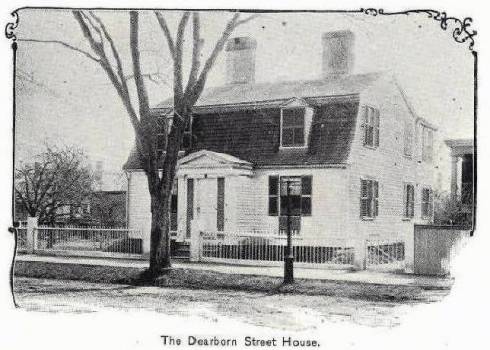
In the later nineteenth century there emerged a particular genre of topical nonfiction writing which focused on literary “shrines”, and Nathaniel Hawthorne received lots of attention from its practitioners. There were several periodical articles and books published with variant titles in the “Homes and Haunts of Hawthorne” realm, exploring the role of environment on his works with varying degrees of depth. As he was a native son, obviously Salem plays a central role in these analyses, generally as an urban and conversely puritanical place from which he wanted to escape to Concord and pastoral points west. No doubt all these authors were inspired by Hawthorne himself, not just his works but also his (quite self-conscious) words, written in 1840 about a garret room in his uncle’s house on Herbert Street where he spent quite a bit of time: Here I sit in my old accustomed chamber, where I used to sit in days gone by….Here I have written many tales–many that have been burned to ashes, many, doubtless, that deserved the same fate….If ever I should have a biographer, he ought to make mention of this chamber in my memoirs, because so much of my lonely youth was wasted here, and here my mind and character were formed.  All of the Hawthorne biographers did indeed make their way to the stark Herbert Street house (which Hawthorne later described as “Castle Dismal”) and it is interesting to see its comparative depictions. Winfield S. Nevins calls it a “severely plain”, common, though tidy, tenement house in his 1894 article in The New England Magazine, while Helen Archibald Clarke goes much more negative in her 1926 book, Hawthorne’s Country: It is now a tenement house, into which one does not care to intrude farther than the yard, so untidy that no amount of enthusiasm for shrines can blind one to it. When asking the way to the house, one is apt to be met by the reply: ‘I cannot speak English’. It is a comfort to remember that in Hawthorne’s day the district was not so closely built up [YES IT WAS],and was at least quiet and clean, and that however unlovely the lines of the house, the beach and boundless ocean were not far off.  Well, you can tell that she is going to prefer Concord to Salem!

Hawthorne Collage

Sepia drawings of Hawthorne’s birthplace, then on Union Street, now on the campus of the House of the Seven Gables, and the adjacent rear window of 10 Herbert Street from  W.B. Closson’s Homes and Haunts of the Poets, a series of etchings issued by Prang in 1886, and a photograph of the same buildings from Winfield S. Nevins’ “Homes and Haunts of Hawthorne” from New England Magazine (15) 1894.

Both authors include lots of illustrations in their works, including drawings, prints and photographs, but Nevins wants to portray a past Salem for the most part, devoid of people, while Clarke lets us see some 1926 inhabitants in the Witch City: children are prominently placed on Gallows Hill, even though it is not exactly clear what this site has to do with Hawthorne. The time span between the two texts affords us to see the restoration (or creation) of the House of the Seven Gables, never the home of Hawthorne but perpetually his most conspicuous Salem “haunt”.

Homes and Haunts Dearborn

Hawthorne Homes and Haunts Chestnut

Hawthorne Houses Mall Street

Hawthorne Homes and Haunts Custom House Clarke

Hawthorne Homes and Haunts Main

hawthornescountr00claruoft_0133p

Gables collage

Hawthorne Homes and Haunts Gables2

Photographs of Hawthorne’s Dearborn and Chestnut Street residences, along with the Turner-Ingersoll House before its transformation into the House of the Seven Gables (on the left above) from Winfield S. Nevins’ 1894 article, “The Homes and Haunts of Hawthorne”; photographs of the Mall Street house, the Customs House, a view towards Washington Square, the “Sockets” of Gallows Hill, and the House of the Seven Gables from Helen Archibald Clarke’s Hawthorne’s Country (1926).


Salem Film Fest 2016

CATS, architecture, the Renaissance (or pseudo-Renaissance)…all my favorite topics are featured in documentary films screening at this year’s Salem Film Fest, which opened last night with Curious Worlds: the Art & Imagination of [miniaturist] David Beck. The festival is now a Salem tradition, in its ninth year, and of course a welcome addition to the non-witchy/kitschy calendar. I usually go to one or two films, and regret not seeing more. Even though the slogan of the festival is Come to Salem, See the World, its organizers always include some local productions, so the entire experience has a “glocal” feel to it, which seems appropriate for our city, our time, and this particular medium. This evening we will see Concrete Lovethe Böhm Family, which purportedly “paints an intimate and pointed portrait of the complexity and inseparability of life, love, faith and architecture” through its examination of the life and work of German architect Gottfried Böhm, the patriarch of an architectural dynasty which includes his three sons. This weekend, I’ve got my eye on Projections of America, featuring 26 short propaganda films about America: the people produced for European audiences following the liberation of France in 1944, Kedi, all about the hundreds of thousands of cats that roam the streets of Istanbul, American Renaissance, a short on Renaissance-faire culture (I can’t miss this, as hopefully it will give me all sorts of insights into my students), and The Million Dollar Duck, (not to be confused with the 1971 Disney film of the same name) about the fierce competition among six artists to win the Federal Duck Stamp Contest, the only juried art competition sponsored by the U.S. government. I feel honor-bound to see this last movie, as one of Salem’s most illustrious artists, Frank Benson, was actually one of the competition’s first victors!

Salem Film Fest Concrete Love Poster

Salem Film Fest Poster_Projections_of_America

Salem Film Fest Kedi Still

Salem Film Fest Kedi Cat

Salem Film Fest AMERICANRENAISSANCE_web_1

Salem Film Fest Million Dollar Duck

Duck Stamp

German poster for Concrete Love: the Böhm Family; Projections of America poster;  character cats in Kedi; a “Renaissance” plague doctor in American Renaissance, poster for The Million Dollar Duck, and Frank Benson’s winning design from 1935.


High Street

Generally the “High Street” of a city or town is a main street but this is not the case with Salem’s High Street which was named, I think, because it was literally a relatively high street which looked down towards Salem Harbor. It’s a short cut-through street today, and offers an instructive perspective on Salem’s architectural developments as seventeenth, eighteenth, nineteenth and twentieth-century structures line its sidewalks. There are several really nice Georgian houses, a few Federal houses, and the first-period Gedney House, which is maintained by Historic New England as a study house. High Street was spared the obliteration by development of its neighboring street to the north, Gedney, and the obliteration by fire of its parallel street to the south, Endicott, though you can definitely see that the Great Salem Fire of 1914 cut a swath through its eastern end. Most of the street is remarkably preserved, even though in some cases it is through the fortification of asbestos siding. Unfortunately I only have a shallow understanding of the social history of High Street, but enough to know that it was the center of Salem’s African-American community in the earlier part of the nineteenth century and part of its Italian-American neighborhood a century later. That chatty diarist of the earlier era, the Reverend William Bentley, recalled an 1816 visit to “the square laying between Mill Street, High St., the Pickering Hill burying ground & the Mill Pond vulg[arly] called Roast Meat Hill. It was a mere pasture when I came to Salem. There is now a Twine factory & about 100 huts and houses for Blacks from the most decent to the most humble appearance.” (Bentley, vol 4, pp. 382-383). Less than a century later Salem’s Italian-American community built their own Catholic Church at the foot of High Street, St. Mary’s, which was closed by the Archdiocese of Boston in 2003 (you can see some of its beautiful interior here).

High Street looking up

High Street 1874 Atlas

High Street 10

Looking “up” High Street, the neighborhood in the 1874 Salem Atlas, #10, one of three Georgian Colonial houses on the street.

There are several interesting houses on High Street but I suppose the most “notable” are the aforementioned Gedney House (1665), the neighboring Benjamin Cox House (1775), and the William Fabens House (1804). If you check out the Gedney materials at the Historic New England website (which includes the 1912 photograph of the house below) you can see a gallery of wallpaper samples taken from the house, including a fragment of my favorite “tumbling blocks”. The Cox House was acquired at the same time (1967) as the Gedney by Historic New England (then SPNEA) for use as an overseer’s house and extended to the rear for that purpose. The Fabens house is one of the most unusual in Salem: it has brick sides, each with its own entrance, and a stuccoed front facade—I’m assuming the latter is a legacy of the Great Salem Fire, which passed so close to the street.Not so renown, but impressive nonetheless, is the circa 1820 house at #16, which has been stripped of its Victorian embellishments to reveal a more streamlined Federal facade.

High Street Gedney Facade

High Street Pan

Gedney House 1912 Historic New England

High Street Cox House

High Street Cox House Side View

High Street Fabens

High Street plaque

High Street no 16 collage

Historic New England’s Gedney and Cox Houses; one of the side entrances of the William Fabens House; No. 16 High Street in the 1970s and today.


Colonial and Colonial Revival

Over the years I have encountered people who were opposed to historic districts for a variety of reasons, prominently property rights and the sense that such building restrictions created homogeneous “museum neighborhoods”. I appreciate both arguments: I’m a bit of a libertarian myself and I have lived in historic districts since my 20s primarily because I like to look out the window when I get up every morning and look at historic buildings. But when I walk around Salem’s historic districts, I don’t see homogeneity, I see diversity: of building materials, of size, and even of style. Though Salem is renowned for its Federal architecture, there are many buildings in the downtown historic districts that pre-date and post-date this era, and I am always struck by how many houses were built in the later nineteenth century in styles that are far from “Victorian”: these are Colonial Revival structures melding into the streetscape, for the most part. You definitely notice the differences when you view “Colonial” and “Colonial Revival” side by side–and there are many opportunities to do this in Salem. Everything is a little bigger and bolder in the later houses: windows, window panes, dormers, especially entrances. Of course, the Colonial Revival era is long (most authorities seem to date if from 1880 to 1955) and encompasses several sub-styles (Classical Revival, Georgian Revival, Dutch Colonial), but one particular feature I notice in several of Salem’s more prominent houses built in the last decade of the nineteenth century are semi-circular projecting bays on the front facade–these houses are literally bursting out of line–but still complementary to the older structures surrounding them.

Colonial and Colonial Revival 014

Colonial and Colonial Revival 016

Colonial and Colonial Revival 029

Colonial and Colonial Revival 017

ABOVE: On upper Essex Street in Salem, the Clarence Clark House (built 1894) stands side by side the Captain Nehemiah Buffington House (built 1785) and across the street, the David P. Ives House features a very detailed Colonial Revival facade adhered to a much older (c. 1764) building.

BELOW: just a little further down (or up) Essex Street, I think the Emery P. Johnson house was the inspiration for all these bow fronts! It was built slightly earlier (1853) and thus is more Italianate than Colonial Revival, and was raised up on its mound in the early 20th century. It contrasts quite a bit with its colonial neighbors, but in a good way, I think.

Colonial and Colonial Revival 028

Colonial and Colonial Revival 026

Beckford Street below: the section of Beckford Street between Federal and Essex is a real mash-up of Colonial and Colonial Revival! I love the juxtaposition of the very old and charming Joseph Cook House (c. 1700-1733) with the very high-style Georgian Revival William Jelly House (c. 1905) right behind it–and then the George Beckford House (c. 1764) next to the Jelly House. And there was a cat in a window, too.

Colonial and Colonial Revival 031

Colonial and Colonial Revival 035

Colonial and Colonial Revival 040

And at the end of Chestnut Street, my favorite contrast of Colonial and Colonial Revival:  William Rantoul’s Colonial Revival adaptation of the Georgian Richard Derby House on Derby Street and the Kimball-Fogg House on Flint.

Colonial and Colonial Revival 047

What I difference a year makes! It was a warm day yesterday, nearly 60 degrees when I was taking these pictures. By sharp contrast, this is the same Chestnut-Flint Street corner a year ago:

frozen-february-014


Ever in Transition

The tensions between public and private interests, commercial and residential concerns, and historic preservation and economic growth are nothing new to Salem, which has always been a dynamic city proud of its past and poised for the future. Some eras are more dynamic than others, however, and I think we’re in a particularly dynamic period now, but any city or town or settlement is always in transition, of course. When I hunt for historic photographs I’m always on the lookout for the mix of “ancient” and “modern”, residential and industrial, small-scale and larger, dirt roads and railroad tracks. My very favorite visual chronicler of Salem, Frank Cousins, who was himself living through a very dynamic age, was clearly attracted to that mix as well, as one of the photographs that he submitted as part of Salem’s exhibition at the 1893 Columbian Exposition was that of a divided Derby Street doorway labelled “modern” and “colonial” (A subtle distinction for our modern eyes).

In Transition Cousins 1892 Columbian Exposition

Frank Cousins photograph of a Derby Street doorway, c. 1892, courtesy of Duke University’s digital Urban Landscape collection.

More illustrative of the city in transition, as opposed to a co-joined household, are the many pictures of Town House Square that date from the 1880s to about 1910. There you see predominantly brick multi-story commercial buildings, but if you look closer, there are still some surviving wooden residential structures (although they are probably serving a multitude of uses). For several years, I have had in my possession a stereoview of a building labeled “Ward-Goldthwaite & Co. Salem” which I thought might be one of these structures, only to realize that I had made a rookie historian’s mistake (not questioning a label): the Ward-Goldthwaite Company was located in Chicago, not Salem (even though it was published by the Moulton firm of Salem). Nevertheless, it’s a great image of a city in transition: you know that house isn’t going to last long.

In Transition Cousins Town House Square 1892 LOC

In Transition 1906 LOC

Stereoview Ward Golthwaite Co Salem

Town House Square at the intersection of Essex and Washington Streets, Salem, (Library of Congress) and a stereoview of the Ward Goldthwaite & Company in Chicago published by J.W. and J.S. Moulton of Salem as part of their “American Views” series.

The idea of zoning starts to catch on in Salem after 1900, and it was definitely accelerated by the Great Salem Fire of 1914. But before this momentous event, factories and residences co-existed in close proximity in the Point, Blubber Hollow and even the more residential North Salem, where the large Locke Regulator Company bordered the North River and a line of colonial houses on North Street. Some of the houses are still there, serving mixed uses as they did a century ago, while the Locke factory has been replaced by a junkyard and a car wash. The streets along Salem Harbor have always been among the most densely settled in Salem, but the 1903 photograph seems to show structures which are primarily residential–I’m not sure of the precise vantage point, but I’m assuming these buildings were all swept away by the Fire. The last photograph, from the PEM’s Phillips Library, shows fire bystanders watching the conflagration on Lafayette Street from the roof of a building on Highland Avenue: a view of mixed-used zoning with the new High School, the factory, and residences all in close proximity to one another. Highland Avenue became a preferred location for commercial development over the twentieth century, but as this photograph indicates, residences were built along it as well–and a few older structures, drastically transformed–still stand among the big box stores.

In Transition North Bridge 1890s

Salem 1903 Locomotive's Journal

phillipslibrarycollections.pem.org

Looking north along North Street from the old bridge, 1890s, Boston Public Library; A Perspective on Salem Harbor, 1903, Brotherhood of Locomotive Engineers Monthly Journal, September 1903; Watching the Great Salem Fire from Highland Avenue, 1914, Phillips Library, Peabody Essex Museum


A Bigger Picture for Bridge Street

I have been watching and listening to the public hearings over the proposed redevelopment of the former Universal Steel and Trading Corporation site on Bridge Street with great interest and concern. The site is located adjacent to a distinctive late nineteenth-century factory building owned by the F.W. Webb Company, a large distributor of plumbing supplies, which seeks to abandon this same building and build a new (far less distinctive) showroom and sales facility next door. Objections to the proposed building could be based on its rendering alone–it’s the typical glass and faux-brick generic building that we’re seeing everywhere and anywhere–but there are several other key factors which make this project troubling and controversial. The site is also located adjacent to the northern boundaries of the McIntire Historic District, in close proximity to the well-preserved colonial and Federal houses of Federal and River Streets. The owners of these houses do not want a large commercial building (the actual elevation of the proposed structure is a matter of debate) casting a shadow over their streets, and the intensity of their opposition has been fueled by the fact that they believed that the long planning process resulting in the creation of the “North River Canal Corridor” a decade ago ensured that more creative uses for this area would be pursued. The second factor is the contamination of the site and the costs and consequences of cleaning it up. The property was transferred to the city of Salem after Universal Steel ceased operations, and the city requested aid from both the EPA and the Massachusetts DEP to conduct a partial clean-up, which involved the removal of over 4,000 tons of contaminated soil. After this process, the city paved over the site to create a temporary parking lot while the new MBTA garage was being built. Once that project was completed the city sought a more profitable use for this parcel–and F.W. Webb put forward the only proposal. The new construction will require a more comprehensive clean-up, and the costs and potential health threats of such an invasive process are a matter of concern to everybody, but especially those in the adjacent neighborhood. A third major factor is the transfer of an “ancient way” from public ownership and use to Webb: Beckford Way, in existence from the seventeenth century, which will be transformed from public pedestrian path to private truck access and loading dock. Opponents of the Webb proposal ask (quite logically I think): if the Company is going to abandon its present building altogether, why doesn’t it relocate to a section of Salem that is dedicated exclusively to commercial uses and leave our neighborhood–and our way–intact?

Big Picture Bridge Street

UniversalSteelTradingCorpSite EPA

Bridge Street Salem January

Beckford Way

Aerial view of the site of the proposed new F.W. Webb building, marked by the X; the initial clean-up in 2012, with River Street houses in the background, EPA; these same houses last month (before our recent snow) looking over the temporary parking lot and reflected in the North River; Beckford Way.

You can read a more detailed summary of the project here, and also peruse project documents. The narrative presents a decidedly pro perspective, but you can easily discern the debate in the FAQ section. We’re in the midst of the process: already the City Council has held two public hearings on the project and there are more to come. As I intimated above, I’m very sympathetic to the concerns of my McIntire District neighbors (and believe the present Webb building would make fabulous housing given its proximity to the train station) but am also striving to widen–or elevate–my perspective, inspired by both a phrase I heard repeatedly at the first public meeting—“spot zoning”—as well as one of the more thoughtful observations of the night, expressed by an earnest River Street resident: Salem’s fabulous history and outstanding architecture is constantly at risk from unsound planning. These words resonated with me immediately as I feel that way all the time: our city’s piecemeal planning has led to undistinguished architecture, unlimited accommodations, and unceasing divisiveness, and it will continue to do so until we can all look at a bigger picture. Salem is hardly the only historic city facing myriad redevelopment challenges and opportunities at the moment: why can’t have a more comprehensive and proactive plan rather just reacting, reacting, reacting? Look at the example of our neighboring seaport to the north, Portsmouth, NH, which is pursuing “character-based zoning” (which must surely be the antithesis of “spot zoning”) by plotting out its development goals and proposals in “textured” 3D models that are available to the public on a web portal, so that everyone can see what proposed buildings will look like, in context and as part of a whole. We don’t even seem to know the actual height of the proposed Webb building on Bridge Street, much less how it will look in relation to its neighboring buildings (but I’m thinking, not good).

3DPortsmouthLead_920_557

3DPortsmouth1

Webb building

Plan Portsmouth 3D Model/Developed by Tangram 3DS;  our only view of the proposed Webb building.