Tag Archives: Antiques and Collectibles

American Girls

Countless cards were inserted in countless packs of cigarettes for decades starting in the later nineteenth century, for product (to avoid crushing the cigarettes inside), advertising, and revenue purposes (encouraging the formation of collections) and consequently cigarette cards form a huge category of ephemera. This is not really my category, but I do find some of the collections to be really interesting expressions of their era. A case in point are the several series of “State Girls” or “State Belles” offered by various publishers in the first decade of the twentieth century: the girls (or young women) are portrayed in a way that supposedly characterized their state, accompanied by other state symbols, and sometimes situated in representative settings. I became acquainted with these particular cards, which I have seen in both cigarette and postcard forms, through a flea market discovery of a Massachusetts girl, wearing academic dress while standing out on some North Shore rocky coast. This find occurred just several days after I received my Ph.D., and so this girl had a particular appeal to me: here I am, I thought, Scholar Girl, a Bay State Belle!

MA Girls Collage

As you can see, not all Massachusetts girls walked around in academic gowns, books in hand. The Raphael Tuck (on the rocks), Langsdorf (schoolmarmish) and National Art Company (sans glasses) girls do, but not those on the Platinachrome Company’s “alphabet” cards, which focus more on the letter and the state seal and flower, or the Fatima Turkish Cigarettes cards, which are all about the elaborate hats which adorn the heads of rather indistinct state girls. The ladies from all 45-48 states (depending on when these cards were published, and sometimes including the District of Columbia) get more detailed characterizations on some cards while on others they are simply idealized lovely-but-generic belles. Miss Pennsylvania is portrayed in colonial dress, armed with a musket and adorned with a tricorner hat, on the National Art Co. and Langsdorf cards below, while the “Keystone Belle” stands before the bustling factories of what I presume is Pittsburgh on the Tuck Card: the past and the present. Not yet quite a golden girl, Miss California is identified with her steamship and her oranges. The “Lone Star Girl” of Texas has her bluebonnets, and the “Opera Belle” of New York comes equipped with a skyscraper. There are girls equipped with fishing poles (Wisconsin, Washington, Oregon and Maine), swords (Maryland), paddles (Virginia), riding crops (New Jersey) and locomotives (Illinois), but the majority of young women are pictured with farming equipment or produce, a reflection of our then still-agrarian nation. A 21st century update on these cartophilic characterizations would be quite interesting.

PA State Girl Collage

State Girls CA collage

State Girls TX Collage

State Girls NY Collage

(Just click on the collages to enlarge)


Desperately seeking Distractions

A difficult week: we had to put our beautiful calico cat Moneypenny down after she suffered some sort of stroke, and then Charleston. Too awful for words, and I just walked past that church last week. We’ve had some lovely late spring early summer days, which seem almost cruel in my morose mood. My garden looks beautiful from far away, but up close it is full of weeds that I’ve been too busy to yank out. So that’s my plan–I shall tend to my garden and pursue the other distractions that have always been helpful in tough times: shopping (for everything from clothing to vintage lawn games), old movies (life is always good when Doris Day is on, submarine movies always plunge me into another world, and I’m currently obsessed with George Sanders), history (not only my profession but also my daily preoccupation–the perfect perspective corrective), and drinking (another great perspective corrective, in moderation of course). I need a new bicycle too: that will help. I do have some nice pictures that belie my dark mood: the garden–from afar so you can’t see the weeds! The lilac and variegated dogwood trees are particularly beautiful this year. Chestnut Street Park across the street, with the remains of a lovely neighborhood party last night, a thoughtful offering from my friend Pamela, and the gardens and antiques at the Massachusetts Horticulture Society’s Elm Bank last weekend, when all was well with the world.

Distractions 022

Park 001

Distractions 1

Distractions 3

Distractions 2

Distractions 4

Distractions 5

Distractions 9

Distractions 6

Distractions 8

Distractions 7

Very impressed with this lady’s bedstraw–must get some.


The ABCs of Slavery

I’ve always been a hunter and gatherer of old stuff, and the first “collection” I assembled while still in my early 20s was of nineteenth-century pearlware children’s plates, primarily ABC and nursery plates intended for instruction and edification: I had quite a few of Franklin’s Maxims, a few domestic scenes, animals, and lots of Robinson Crusoe: I still have the latter, one elephant plate, and a fortune-telling scene, but I sold off the rest a decade or so, along with all of my transferware. When I was hunting around for these little plates, I remember seeing some that were a bit political, and wondering: why would children care about free trade? But slavery was a far more passionate and accessible topic, and quite a few abolitionist ABC plates appeared in the mid nineteenth-century, especially after the production of Uncle Tom’s Cabin. These plates were produced primarily in Britain for the northern American market, and the Staffordshire potteries had the dual motivation of meeting (and perhaps creating) demand in America while presenting themselves as morally superior to their cousins across the Atlantic: there is an amazing transfer-printed jug in the collection of the Winterthur Museum which advertises all the available patterns along with one scene in which showing “Britannia Protecting the Africans”. The British were so very clever at catering to both sides in the struggle over slavery in America: preaching to the North while buying cotton from the South! The Winterthur collection also contains an anti-slavery ABC plate based on the work of Mary Belson Elliot, “blending sound Christian principles with cheerful cultivation”, and a popular children’s mug first sold at the 1846 Philadelphia Anti-Slavery Fair, along with the wonderful Anti-Slavery Alphabet produced by the Townsend sisters.

Anti-slavery plate Winterthur Collection

Anti-slavery Mug Winterthur Collection

anti-slavery alphabet primer 1846 Letters A and B

anti-slavery alphabet primer 1846 Letters M and N

From the Winterthur Museum Collections:  Staffordshire pearlware jug made by Christopher Whitehead, c. 1817-1819, ABC plate, c. 1800-1830, and child’s mug, c. 1795-1865; Pages from the Anti-Slavery Alphabet of Philadelphia sisters Hannah and Mary Townsend, 1846.

The particular plate that returned my attention to ABC plates in general and anti-slavery ABC products in particular is a lot in the upcoming Memorial Day Auction at Northeast Auctions: “Gathering Cotton”. This is a Staffordshire plate as well, but produced later than the Winterthur pieces (between 1850 and 1865) and its meaning/purpose is far less straightforward:  I can’t tell if it’s for or against slavery! With children front and center, I assume it is anti-, but it projects a far less strident message than other plates that were produced at this time, primarily based on  Uncle Tom’s Cabin, with scenes such as “The Buyer and Seller of the Human Article” and  “Uncle Tom Whipped to Death” depicted. Once the Civil War began, the messaging of ABC plates became even more straightforward, with simple depictions of Union generals produced, of course, in Great Britain.

ABC Plate Gathering Cotton

ABC Plate Human Article

ABC Uncle Tom plate

General McClellan Plate Cowan's Auctions

“Gathering Cotton” and other mid-nineteenth century Staffordshire ABC plates, from the Harriet Beecher Stowe Center and the University of Wisconsin-Madison Decorative Arts Database, referenced in two great articles: Louise L. Stevenson’s “Virtue Displayed: the Tie-Ins of Uncle Tom’s Cabin” (available here), and Jill Weitzman Fenichell’s “Fragile Lessons: Ceramic and Porcelain Representations of Uncle Tom’s Cabin” (available here). “The Arrival of General McClellan” Staffordshire ABC plate, Cowan’s Auctions.


The Historiscope

I’m fascinated by a visual device produced by Milton Bradley in the later nineteenth century called “The Historiscope:  A Panorama and History of America”. Swann Auction Galleries has one for sale in their upcoming auction. Here’s the description and an image: Printed hand-colored box, 5 1/4 inches tall, 8 1/4 inches wide, 2 1/4 inches deep, with long paper scroll on two spindles within, and mounted on a later(?) painted board; lacking wooden crank pieces and rear cover with caption information, otherwise moderate wear to exterior. The scroll is difficult to turn and has not been examined in full; sold as is. (MRS) [Springfield, MA?]: [Milton Bradley & Co.], circa 1870.

Historiscope Swann Auctions April 14

What fascinates me about this panorama is the early attempt to introduce some interaction into history instruction, although Jennifer Lynn Peterson (in “The Historiscope and the Milton Bradley Company:  Art and Commerce in Nineteenth-century Aesthetic Education, Getty Research Journal, No. 6 (2014): 175-184) informs me that each box came with a script, an “eight-page dramatic description of all the images in the moving panorama, characterized by a lively tone and filled with numerous attempts at humor”. So maybe it was a rather one-way “show”. The other thing that interests me is what the selective/reflective nature of this lens: any historiscope much necessarily reflect the society which produces it rather than the “history” which it purports to reveal. If we could turn the scroll of this Swann lot, we would see 25 iconic images of early American history, including the landing of Columbus in the West Indies, Pocahontas and John Smith, the Pilgrims’ arrival in Massachusetts, and Cornwallis’s surrender at Yorktown. (Another contemporary Milton Bradley product, the Myriopticon, focuses solely on scenes from the Civil War, or “Rebellion”). Would the same scenes have been chosen in 1920, or 1950, or 2000, or now? I’m fairly certain that Columbus would not make it into our 2015 historiscope, at least not in his circa 1870 characterization.

Historiscope Cover Yale

Historiscope Native AMericans Getty

Historiscope Christopher Columbus

Box cover and scenes (Native Americans in full regalia before the arrival of Columbus and the man himself) from Milton Bradley’s Historiscope, c. 1870, Beinecke Library, Yale University and Getty Museum.

So I guess the theatre-guise of the Milton Bradley Historiscope is appropriate: it projects as well as reflects. Even modern historiscopes function this way, literally: my case in point is the Historoscope de Saint-Laurent project in Montreal, which utilizes architectural projection to tell the story of a neighborhood. I love it, and I think it’s probably the best we can do with this genre while we wait (forever) for the development of a real historiscope, a time-traveling telescope which can reveal the past rather than just scroll or screen it.

P.S. Another Milton Bradley Historiscope is available here, mounted on cute little legs!


Valentines from the Great War

Oddly enough, love and war often do go together and we all know that absence often makes the heart grow fonder, so it’s only natural that the burgeoning greetings card industry would flourish during World War I. In the west, domestic producers had to replace that large part of the market that was previously produced by Germany, and “WWI silks”, embroidered greetings produced in France and Belgium, constituted one of the most important cottage industries of the war. It can be a little jarring to see military themes on cards that were supposed to foster sentiment, but it was a competitive market, and I’m sure that manufacturers wanted to seem current, and relevant. And you really can’t beat the sentiment when you see my ammunition, you’ll surrender your position, which was evidently quite popular as it was issued with a variety of images. So in celebration of St. Valentine’s Day and commemoration of the Great War, here is a selection of valentines from 1914-1919: from Great Britain, the United States, France, and (the most intimate of all, handmade on the Front) Australia.

Valentine Ambulance Bod Lib

Valentine Ambulance Interior Bod Lib

Valentine Nurse Bodleian Lib

Valentine LOC 1918 Over There

WWW Valentine LOC 1919

WWW Valentine LOC 1919 2

Valentine 1918 LOC

PicMonkey Collage

Cupid_Arrow_Heart

Valentine slogan WWI

Picture1

Valentine 1917 French Hearts

Love Letter Australian War Memorial 1918

Sources: Nancy Rosin Collection; Bodleian Library, Oxford University; Library of Congress; Ebay; Etsy; The Old Print Shop; Australian War Memorial.


Super Bowls

I must admit that I stole the title of this post from the online shelter magazine Lonny:  I couldn’t resist, but it is so obvious you would think I could have come up with it myself! In terms of content, however: my bowls are very different from theirs. Not being a big fan of either football in general or the Super Bowl in particular, I have to seek alternative activities for this weekend and shopping for or merely seeking material objects always works for me. As bowls are probably the most utilitarian object around–perhaps even more so than plates–there was a big sea to navigate but nevertheless I came up with a top ten list pretty quickly. My preferences run to antique with glazed or embellished finishes–I am currently obsessed with silver lustreware–but a touch of subtle iridescence or whimsy on a bowl of any vintage will always catch my eye.

Bowl 1

Antique Silver Resist Lustre Punch Bowl, $265

Bowl 3

Antique creamware salad bowl, price upon request

??????????

An Amazing Mochaware punch bowl with swags! $3200

Okay, let’s get a big more realistic: I might be able to swing for the silver lustreware bowl but certainly not the mochaware one. I have a pantry full of Mason Cash bowls, so I certainly don’t need any more, but I like basic yellow ware bowls, both old and new, particularly the white-banded variety. Many modern potters seem to produce updated creamware bowls, in a variety of interesting shapes and glazes.

bowl Yellow Ware

Late 19th-early 20th century Yellow Ware Bowl, $68

Laura_De_Benedetti_s1211

Creamware bowl by Laura De Benedetti, £25

kevin-millward-medium-hand-thrown-creamware-bowl-

 Kevin Milward Creamware Bowl, £60

Bowl Fairmont and Main

Fairmont & Main Creamware Vegetable Bowl, £13.59

Two cute cereal bowls: buttons and Dali.

Green Button Soup Bowl

Bowl Dali

Green Button soup or cereal bowl by Rebecca Lowery, $22;

Salvador Dali “Surreal” cereal bowl, $17

And finally, the best bowl haircut of all time: on the heroic, short-lived King Henry V (1387-1422): as depicted in a portrait by an unknown artist in the late Tudor era–an age which fixed his image for all time.

NPG 545; King Henry V by Unknown artist

Henry V, © National Portrait Gallery, London


Pursuing Punch and Mr. Cassell

Now (almost) fully in holiday entertaining mode, having (almost) left the semester behind me, I have been perusing old cookbooks in pursuit of a famous punch traditionally served at Hamilton Hall’s annual Christmas Dance. It’s a particularly potent rum punch, which led to a few horrible hangovers in my youth. Now I know how to handle it and have no fears of this weekend’s dance! I had my own little party a few days ago and hoped to serve it myself, but I didn’t find quite the right recipe, despite consulting the most obvious source, the 1947 Hamilton Hall Cook Book. I like this slim volume for several reasons: the shortness of its recipes, which are limited primarily to ingredients and very few processes, the odd names and ingredients (“Shrimp Wiggle”, “Maggi Essence”, “Veal Bewitched”, “Forced Meat Balls”, “Old Election Cake”), historical information embedded in the recipes, and the various topical features, primarily those on the Hall’s Rumford Roaster (which I wrote about in an earlier post) and one of its most famous resident caterers, Edward P. Cassell. The most amazing image in the little book is a portrait of Cassell in front of the Peirce-Nichols House, basket of “coveted invitations to an Assembly, a debutante ball or a wedding at which he was to be major-domo” in hand, taken by Salem photographer E.G. Merrill in 1907. It’s an iconic image of an iconic man: at this time, the cookbook proclaims, Cassell had been “a Salem institution for nearly half a century and Salem [was] justly proud of him.”

Cook Book

Edward Cassell 1907 Merrill

I wish I could find the correct rum punch recipe and I wish I knew more about Mr. Cassell. He was the second African-American resident to cater to the crowds at Hamilton Hall, succeeding John Remond, the patriarch of the well-known Abolitionist family and quite the entrepreneur himself. Despite his more recent vintage, Cassell seems much more mysterious than Remond, although I haven’t really taken the time to dig into his life and work. The long history of service provided by African-Americans to the denizens of Salem, in and around Hamilton Hall, needs more attention, I think, along with the cumulative experience of African-Americans in Salem. I do know that at the commemorative exercises held in recognition of the 250th anniversary of John Endecott’s landing in Salem in 1878, the tables were laid by Mr. Edward Cassell, the well-known caterer, and were handsomely decorated with a choice display of flowers, arranged beautifully in large bouquets, and a small one at each plate, with a neatly designed carte de menu, memento of the celebration and that the lunch embraced more than a score of dishes, substantial and elegant”, that he was famous for his ice-cream figures (mostly animals) and savory salads, that his Ropes Street home burned to the ground in the Great Salem Fire of 1914, and that he died in the following year. But that’s about it. As to the punch: no rum variety in the Hamilton Hall Cook Book, but there is an interesting recipe for “1858 Mulled Wine” involving lots of boiled wine thickened with egg yolks and topped with frothy egg whites which looks to me far older than 1858. This is the forerunner of egg nog, called caudell in the medieval era and caudle later. This popular drink, like its cousin posset, was enjoyed at Christmas and all winter long, and inspired the creation of bowls, spoons, and cups for just that purpose–like the charming late 17th century cup made by John Coney, which later came into the possession of Oliver Wendell Holmes and the collection of Boston’s Museum of Fine Arts.

Caudle Cup MFA 1690


Monopoly Pieces

I have quicksilver materialistic urges: what I want now are Monopoly pieces, or rather artistically-enhanced versions thereof. There is a Salem source of this desire, and it is a timely one: Parker Brothers of Salem acquired one of the key patents they needed  to produce their version of Monopoly on this day in 1935, and it was an immediate blockbuster, perhaps (or in spite of) the ongoing Depression. Parker Brothers’ long residency in Salem (1883-1991) is no doubt due in large part to the success of this ultra-American game. It was apparently rushed into production even though Parker Brothers president George Parker had low expectations: a series of boxes from 1935 bear the inscriptions “patent applied for” and “patent pending”. Inside are wooden houses and hotels and the original dark-iron tokens: the iron, racing car, thimble, shoe, top hat and battleship (the Scottie dog and wheelbarrow were added in the early 1950s).

Monopoly Box Patent Pending 1935

1935 Patent Pending Monopoly Box: Source.

And that’s the other reason why I’m craving Monopoly pieces now:  my favorite token was always the iron, and it has recently been cast out of the game, replaced by a cat. I’m a cat lover as well, but the new token just doesn’t have the texture of that old iron: thankfully my Monopoly game is pretty vintage, and thus iron-clad. And when a little tiny metal token just won’t do, several artists have been inspired enough by the game–and its iconic pieces–to create bigger and bolder versions. I want all of these creations by Stuart Whitton, which are hand-drawn on vintage postcards, but I think they’re long gone.

Monopoly Iron Whitton

Monopoly Racing Car Whitton PC

Monopoly Racing Car 2 Whitton

Monopoly Shoe Whitton PC

Monopoly Whitton dog PC

Stuart Whitton’s drawings of “infamous” Monopoly pieces at Behance and stuartwhitton.co.uk.

Since I’m particularly fond of the retired iron, I did find a more attainable object: a pewteresque replica: not very subtle, and far less artistic, but BIG. But where to put it? It screams doorstop to me, but when I went in search of a place, I found not one, not two, but THREE old 19th century irons propped up against doors on my third floor. I don’t think I need one more, even if it has an air of Monopoly about it.

Monopoly Iron Doorstop


Willow Ware Redux

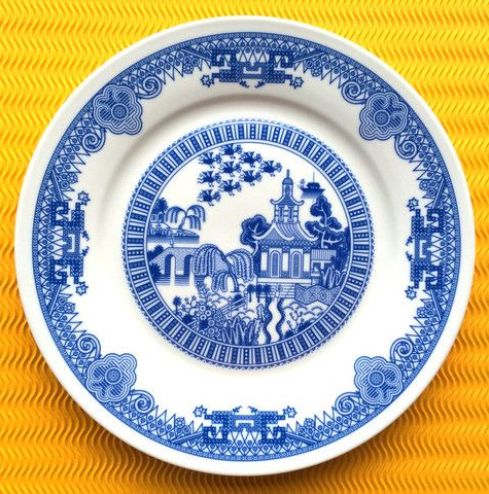
I am not fond of blue-and-white china (or anything blue, to tell you the truth), nor do I particularly like the Willow pattern, one of the most popular and replicated in the western world for several centuries. But I do love both the idea and the act of updating something that is classically familiar—even overly familiar–in a clever and creative way. So when I saw a little story about Calamityware, in which flying monkeys and flying saucers, along with robots and Renaissance sea creatures, are right there on the plate along with the traditional “Chinese” structures, figures, and landscapes, I went right to the source: artist Don Moyer’s site, on which his earlier drawings are coming to life (or pottery) on a Kickstarter-funded production line. So many things about these plates appeal to me (despite their color): they are blatantly anachronistic, purely whimsical, and perfect examples of my favorite fusion of past and present, traditional and modern, new and old. The flying monkeys were first off the line, and we may see kings and oligarchs later, though surely they won’t be as scary.

Calamityware

New Willow Ware Calamity 2

New Willow Ware Calamity 3

Calamityware is not the first variation on the Blue Willow pattern; in fact it was inspirational almost from its inception–and wildly popular. I’ve got a bowl full of Willow shards uncovered in my back yard when I was digging out my herb garden. Willow ware was first produced in the late eighteenth century by Thomas Minton, an English potter who adapted designs featured on Chinese export porcelain for domestic production. There was no patent protection, and his competitors–Wedgwood, Royal Worcester, Spode–began producing their own Blue Willow, and continued to do so for the next two centuries. In an early stroke of advertising genius, a story was composed to sell the dishes: when a powerful Chinese lord discovers that his daughter has fallen in love with his lowly clerk, he locks her up in a secluded pagoda behind a fence and betrothes her to a rich and elderly duke. The young couple flee before the wedding, but are hunted down and killed (there are different versions of their deaths). True love prevails, however, as the gods transform the lovers into a pair of lovebirds which remain together forever, hovering above the willow tree that once shaded their clandestine meetings. The story expanded the reach of Blue Willow–beyond the pottery business and into popular culture: poems, books, textiles, and pictures told the Blue Willow love story over and over again in the Victorian era, and after.

Willow ware Spode V & A-001

New Willow Wares Mercer-001

Spode Blue Willow plate, c. 1800-1820, Victoria & Albert Museum; Joyce Mercer (1896-1965) illustration, 1920s.

And now, Willow ware seems to be having a moment, once again. In fact, this “moment” seems to encompass the past decade or so, or perhaps the pattern, in all of its variations (and colors–I could go for the red), is always having a moment. And that, of course, is the definition of classic. In 2005 ceramicist Robert Dawson digitally-designed a line of “After Willow” dishes for Wedgwood, and more recently we have Pokemon Willow by Olly Moss (note the lovebirds, still flying above!) and there are more calamities to come.

Willow Ware Dawson V and A-001

pokemonwillow


Stumped by Shamrocks

I was going to do a rather straightforward post on the shamrock for St. Patrick’s Day, but it turns out that there is nothing straightforward about this plant, but rather an age-old confusion about what it actually is/was. The history of the shamrock and its association with Ireland is misty and murky: if indeed St. Patrick plucked a tender three-leaved (trefoil) sprig of some sprawling plant to illustrate the Holy Trinity we don’t know what that plant was, nor do we know precisely what plants Elizabethan authors like Edmund Campion and Edmund Spenser were referring to when they referenced the “wild” Irish eating shamrocks. The general consensus is that the word is derived from the gaelic seamróg, a diminutive form of seamair, meaning “clover”, but there is no botanical consensus that the shamrock is a clover variety: opinion seems to have been divided between various varieties of clover (trifolium) or wood sorrel (oxalis) for quite some time, with a weed called medic (medicago) mentioned occasionally as another candidate for the shamrock label. If you look at illustrations of the first two plants in one of the most lavishly illustrated medieval herbals, the Tractatus De Herbis (British Library MS Egerton 747), you can understand the confusion between these two look-alike, supposedly sacred plants.

Shamrock Egerton 747 Clover-001

Shamrock Egerton 747 Wood Sorrel-001

Clover (also called “Trinitas”) on the lower right and Wood Sorrel (also called “Alleluia”) on the upper left in BL MS. Egerton 747, c. 1280-1310.

The other source of confusion, much more modern and almost-exclusively American, I think, is between the shamrock (whatever it is) and the four-leaf clover. Both might be clovers, but if you embrace the trinitarian nature of the former, you can’t also have the secular charm of the latter–or can you? Americans seem to want it both ways, and consequently they fashion a St. Patrick’s Day holiday that combines a bit of faith and fortune, and much, much, much more fortification.

Shamrocks PC 1-001

Shamrocks PC 2-001

Shamrocks PC 3-001

St. Patrick’s Day postcards c. 1906-11 from the New York Public Library’s collection: a trefoil shamrock, four-leaf clovers, and both on one card.

There is much less confusion about how the shamrock (whatever it is) became inextricably identified with Ireland: this was much more a Victorian development than a medieval or early modern one. In the visual culture of the Great Britain, the Irish shamrock looms large, along with the English rose and the Scottish thistle (and occasionally the Welsh leek). These symbols appear together on all sorts of items–textiles, pottery, wallpapers–as both official “Arms” of the United Kingdom, decorations for royal palaces and personas, and patriotic embellishment.

The Rose, Thistle and Shamrock. The Floral Badges of England, Scotland and Ireland

Shamrock Curtain Border 1850s-001

Shamrock Garland Voysey-001

James King design for the National Arms of Great Britain, c. 1890; Norris & Company silk curtain border design for Windsor Castle, 1850s; C.F.A. Voysey textile design with garland of Tudor roses, thistles and shamrocks, c. 1915, Victoria & Albert Museum Collections.

These integrative designs are interesting aesthetically and politically, but you can’t beat a single shamrock (whatever it is), especially if it is made up of diamonds! Paired, perhaps, with a companion four-leaf clover brooch for extra luck. But even if there are no sparkling stones, a bright green shamrock (like the holiday it has come to represent) represents hopefulness and gaiety in the often murky month of March.

PicMonkey Collage

March Calendar Postcard with Little Girl Wearing Stole and Muff. 1906, March Calendar Postcard with Little Girl Wearing Stole and Muff

Diamond shamrock brooch, c. 1890, Victoria & Albert Museum; Art Deco platinum, diamond and jadeite clover brooch, c. 1935, Skinner Auctions; Ullman Manufacturing Co. calendar page for March, 1906.