Christmas at Home and Away

Our Christmas was Covid-impacted like everyone else’s, but it ended up being just lovely, with most of our time spent with my brother and brother-in-law in Salem eating, drinking, playing bad board games and watching movies. We went up to York Harbor for Boxing Day with my parents, but we’re not going down to New Jersey to see my husband’s family, so this is a rare holiday season without long-distance travel for me (with the exception of last year, of course), and I’m enjoying lounging around. Because we knew we would be primarily stationary on Christmas weekend, we snuck in a quick trip down to Newport to see the decorated mansions (the Elms, Marble House, and the Breakers) as well as the streets and streets of colonial houses of every color. So all in all, a convivial, colorful, and (so-far) Covid-free holiday! I feel very fortunate.

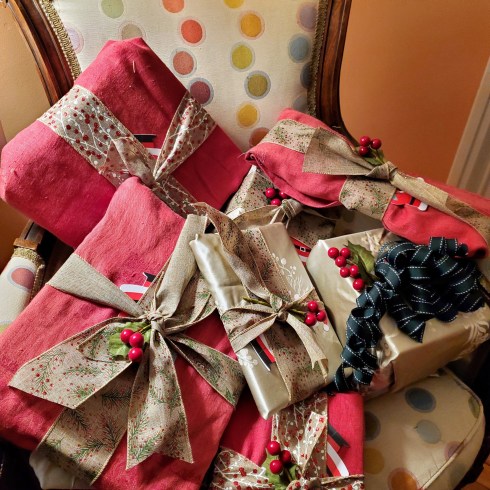
Christmas at Home (with swans this year—and lots of cats, our Trinity & Tuck, and my brother’s Clementine).

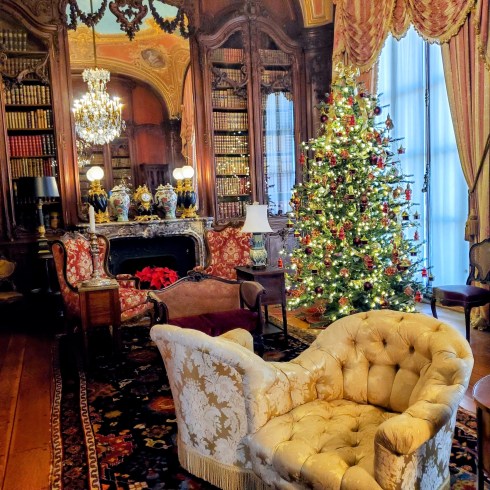
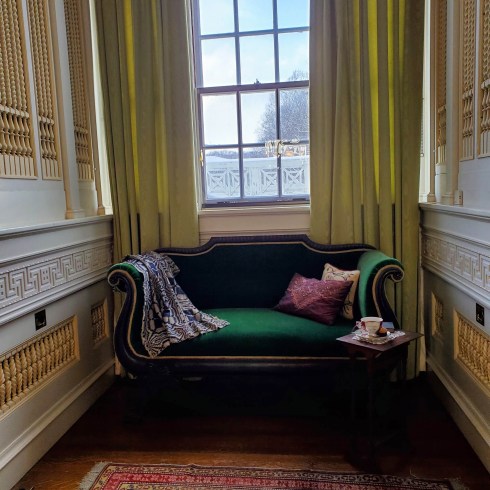
Newport! I really prefer the smaller colonial houses, but when you’re in Newport you’ve got to see some mansions, especially at Christmas time. We had a lovely dinner at the White Horse tavern, and just walked by and through so many houses. Perfect little break. I think I have the many, many Christmas trees and mantles in order of their location—-first The Elms, then Marble House, then the Breakers—but there were just so MANY I might have mixed some up.

The Elms, 1901.

Marble House, 1888-1892.

The Breakers, 1895.

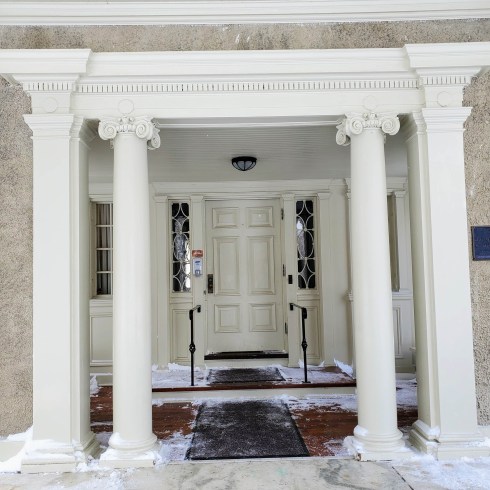
As glittering as they are at this time of year in particular, these mansions are a bit over the top, so I’m ending with the simple themed trees in the basement kitchen of the Breakers (hedgehogs & mushrooms! I’ve been wanting to do those Christmas themes myself) above and my very favorite Newport house and the First Parish Church in my hometown of York, below. Happiest of holidays to everyone.


Books for Christmas/Break

Classes have just ended and after grading I will attack the big pile of books by my bedside: I’ve already dipped into one or two but I have a full month with very few obligations ahead of me to really indulge. As I’ve been consumed with writing my own book (out in February) over the past few years, along with teaching and everything else, I haven’t had much time to read generally and broadly, so I’m really looking forward to the next few weeks. My list below is about as general and broad as I get: when I don’t have to read history for scholarship or teaching I tend to read histories of periods and places which I do not write or teach about. I’d love to read more fiction over the next month, but nothing has caught my attention except for the sole work of historical fiction below—and only because it’s related tangentially to my next project.

So here we go, beginning with two books that fall into the category of personal history:

Mr. Atkinson’s Rum Contract is an amazing personal history of Richard Atkinson’s own family, including his namesake forebear, a British merchant with considerable interests in the West Indies in the late 18th century who acquired the lucrative contract to supply the British army in North America with rum and other essentials during the American Revolution. This is a “warts and all” family history, as the family fortune was based as much on slavery as it was on sugar and land, of course, and one told in a truly captivating manner. Lotharingia is the last of Simon Winder’s surveys of central European travelogue history, following Germania and Danubia. I liked both of these books: they are rather breezy but still engaging and it’s easy to skip over the occasional boring bits. Lotharingia is the “land in between” established by the terms of the Treaty of Verdun in 843, which divided Charlemagne’s empire between his three grandsons: younger brothers Louis the German and Charles the Bald received lands east of the Rhone River and West Francia, respectively, while the eldest brother Lothar received the imperial title and “Francia Media”, a long strip of territory encompassing the Low Countries, parts of modern Germany and France, Switzerland, and much of northern Italy. A place of shifting boundaries and perspectives, for sure.

Since we are back in the early middle ages, I must admit that I have to do some work over the break: I’m teaching our early world civilization survey for the first time in a decade or so, so I must delve into some global history: Silk Road scholar Valerie Hansen’s The Year 1000 will be very helpful, and I’m hoping that Gary Paul Nabhan’s Cumin, Camels and Caravans, written from a more personal and cultural perspective, will provide me with some great “spicy” anecdotes.

And speaking of spices, I also want to use this break between semesters to do some background reading on my next project: a history of saffron in medieval and early modern England. A storied spice, a wonder drug, used in medical and culinary recipes and as a dyestuff, saffron has many threads to follow—through economic, social, cultural and even political history. I’m going to start with its most obvious attribute, its color, and then expand into some textile history. I’m not sure whether or not Atlantic sericulture will have much bearing on my understanding of saffron cultivation, but I’ve met Ben Marsh so I want to read his magisterial book (and you might know him too, from his family’s viral pandemic rendition of “One Day More”—he’s a Renaissance Man!) And then there is A Net for Small Fishes, Lucy Rago’s fictional account of the “Overbury Affair” in which Mrs. Anne Turner, she of the conspicuous yellow ruff, was implicated in the murder by poisoning of courtier Thomas Overbury and executed in 1615. There’s even a fictional Salem connection, as Nathaniel Hawthorne includes Anne Turner in The Scarlet Letter as a friend of suspected witch Mistress Hibbins, even teaching her how to color her ruffs yellow. Anne Somerset’s Unnatural Murder is a more straightforward account of the murder of Overbury set against the backdrop of poisonous Jacobean court culture.

I think I always include books about gardening on my lists, and this one is no exception. I like whimsical, personal books about gardening as an activity, but also cultural histories of evolving landscapes and horticulture: The Morville Hours is a perfect example of the former, and The Acadian Friends of the latter. It would be nice if someone would buy me the forthcoming Architects of the American Landscape and Nature and its Symbols, a reference book from Lucia Impelluso and the Getty Museum.

Finally, two texts focused on the interpretation of history for the general public, a constant concern and interest of mine. The United States is in the midst of a real reckoning (as opposed to a pandering PEM-esque reckoning) about its history and understanding of slavery, and Clint Smith’s bestselling How the Word is Passed is the very next book I want to read about this important process. Here in Salem, there’s very little reckoning; just an increasing amount of ghosts! All summer long, I was hearing ghost stories on the streets of Salem and I feel like I’m surrounded by their professional proponents. This fall, I went to a talk by a very prominent head of interpretation at a very prominent New England heritage organization and in the Q and A I asked him about ghost stories as history and he replied that ghost stories are history. While I understand and agree with that statement to a point, I’ve gone beyond my comfort level and so want to read up a bit more on dark or “paranormal tourism”: Haunted Heritage is about the scene in York, known as Great Britain’s most “haunted” city, so it should be just the ticket.


Salem Sustainability; or the Most Charming Memoir Ever

I came across a delightful short memoir quite by accident yesterday; it was so well-written and charming that I couldn’t stop thinking about it so I decided to write about it today to get it out of my head! It’s not about any BIG thing or event; in fact, it’s about a very little thing, what we might call an accessory today, and something we might not have thought much about at all before the pandemic: handkerchiefs in general, and “bundle handkerchiefs” in particular. “The Bundle Handkerchief ” was published in The New England Magazine in 1896 by Elisabeth Merritt Gosse, a Salem native and emerging newspaperwoman, who would go on to have a very successful career writing principally for the Boston Herald. It must have proved popular as it was issued as an illustrated pamphlet a few years later: I would love to get my hands on this! It’s such a simple story of how people wrapped up their purchases or possessions in the nineteenth-century, in handkerchief bundles of all cloths: gingham and calico sold at Mrs. Batchelder’s or Miss Ann Bray’s shops, the ‘finest white India silk” for ladies’ hats, lawn, linen or muslin for more intimate garments, Madras for new gowns as they made their way home from the dressmakers’, and “pale pink and blue gingham plaids” for shirts and spencers. Yet it is also revealing: of what people are doing and buying and wearing in very specific detail. l learned about all sorts of shops and customs of which I was previously completely unaware in its jam-packed three pages.

The bundle handkerchief as art: Alfred Denghausen, 1936, National Gallery of Art.

Apparently one could not even enter this world properly (or be introduced to it) without a bundle handkerchief! Is this where the stork with the bundled baby comes from? According to Elisabeth, No Salem infant, even without the requisite number of great-grandfathers and grandmothers, could be considered to have been properly introduced to society until it had dangled in a bundle handkerchief from a pair of steelyards, while its weight was recorded in the family Bible at the end of the family pedigree. She also included her own childhood memory of accompanying the family servants, armed with “two great bundle handkerchiefs of coarse blue and white checked gingham” to Mr. Hathaway’s bakery on Sunday mornings after church to retrieve the baked beans and brown bread which had been placed in his cavernous oven the day before. Salem women packed their soldiers’ trunks with prayer books from Mr. Wilde and medicine chests from Mr. (not Mrs.?) Pinkham, as well a selection of fine new bundle handkerchiefs, and three of these, of dark red silk, with the name embroidered in one corner, came home in one soldier’s trunk, brought by a guard of honor; for Salem gave the first of the Essex County heroes who laid down their lives for their country in the war of the Rebellion, as she did in the war of the Revolution. I wonder if she is referring to her own father here, Lt. Colonel Henry Merritt, who was killed at the Battle of New Bern in March of 1862.

Not blue and white, but the best I could do: a recipe card from the 1950s; Mr. Hathaway’s Bakery or the “Old Bakery” (now the Hooper Hathaway House on the campus of the House of the Seven Gables) in its original location at 21 Washington Street, Historic New England; Elisabeth Merritt Gosse in 1905, upon the occasion of the dedication of a boulder commemorating her father’s regiment near Salem Common.

Elisabeth Merritt Gosse recounts her last memory of a bundle handkerchief on the streets of Salem, wrapped around a book and carried by Mr. John Andrews in and out of the Salem Athenaeum, and observes that her title topic is as vivid a bit of color in Salem’s history as is Alice Flint’s silk hood, the frigate Essex, the North Bridge or even the House of the Seven Gables; and to speak of it calls up a long line of Salem’s sires and dames who took pride and pleasure and comfort in its use. [Another Salem memoirist, Harriet Bates or “Eleanor Putnam,” went even further: “The bundle handkerchief is as essential a figure in Salem history as the witches themselves.”] The bundle handkerchief’s time had passed in 1896, however, replaced by paper and string, prosaic, rustling, tearable, and to be quickly thrown aside and thrown away. This is not a good development in Elisabeth Merritt Gosse’s estimation, but as she died at the venerable age of 86 in 1936, we can at least be glad that she didn’t live long enough to see plastic.

Elisabeth Merritt Gosse was referencing the OLD Salem Athenaeum, now one of the Peabody Essex Museum’s empty buildings further up on Essex Street, but as I happened to be walking by the present one today, I snapped this photograph.


A Mysterious Matron and other Salem Cookbooks

Salem has a brand new cookbook out just in time for the holiday season: Salem’s Cookin‘, the Official Chamber of Commerce Cookbook. I kind of wish it had more historical recipes, as Salem has quite a few culinary claims to fame, but I’m sure I’m the only person with this wish as it features a range of recipes for dishes served at the city’s most popular restaurants and offerings from other establishments and individuals which seem surprisingly doable. It’s a very practical cookbook as well a showcase of Salem’s culinary landscape. Still, I’d rather read about food than attempt to make it so I thought I would mark the occasion with a survey of Salem cookbooks, beginning with the serious and mysterious The American Matron; or Practical and Scientific Cookery published in 1851 by an anonymous “housekeeper” who lived in Salem. This housekeeper was quite the cook, quite the chemist really, and quite the writer, and I’ve been trying to find out who she was for quite some time, with no success.

As its title implies, The American Matron is a very practical cookbook as well, so practical that it often seems as concerned with preventing food spoilage and consequential poisoning as offering up recipes that are easy to make and pleasant to eat. The instructions for pickle storage below are very representative of its author’s tone throughout: warning her readers not to keep their pickles in pottery or metal containers due to arsenic and acid, she concludes that One may not be instantly poisoned after eating pickles prepared or kept in such vessels; but if constantly used, a deleterious influence must be operated on the health from this cause, even when lest suspected. This is a text which begins with the proper storage of water and reads more like a public health manual than a cookbook in places, but it also includes scores of recipes for both traditional New England dishes as well as more exotic concoctions featuring ingredients from around the globe, highlighting Salem’s continuous seaport status. There are a lot of interesting seafood recipes in particular, all stressing the necessity of using just-off-the-boat ingredients. It is also a manual for housekeeping, containing instructions for dyes, cleaning agents, and pest control that one might see in the more random printed recipe collections of the early modern era: my favorite is her very nineteenth-century prescription for  how to remove the black Dye left on the skin from wearing mourning in hot weather. That’s a predicament I never considered before reading this book!

I can’t find any Salem cookbooks from the later nineteenth century, so I guess that brings us to a collection of historical recipes gathered together under the title What Salem Dames Cooked and published as a fundraiser for the Esther Mack Industrial School in 1910. Like many Salem creations of this particular time, this little volume expresses a Colonial Revival view of the past with its ye olde type and terms, and it was reissued about a decade ago in a glossy reprint so it is widely available. Moving forward another half century, the Hamilton Hall Cook Book was published by the Chestnut Street Associates as a fundraiser for Hamilton Hall just after World War II. Its recipes are quite minimalist, but as it contains both the iconic 1907 photo of Hall caterer Edward Cassell and a lovely illustration of the Hall’s Rumford Roaster I think it must be my favorite Salem cookbook. Old copies turn up on ebay rather regularly but I think Hamilton Hall should reprint it!

A Mary Harrod Northend photograph of the students at the Esther C. Mack School, Historic New England; Mr. Cassell making his deliveries in front of the Peirce-Nichols House.

I am sure there must be more later twentieth-century Salem cookbooks: perhaps issued by ladies’ committees of a church or the Hospital? But the only one I have in my possession is Served in Salem, published in 1981 by the Ladies Committee of the Essex Institute. Both the Hamilton Hall Cook Book and Served in Salem feature lots of recipes with ready-made, canned and frozen ingredients, in stark contrast to The American Matron: twentieth-century cooks didn’t have to worry about preservation and were apparently interested in as many shortcuts as possible. Served in Salem emphasizes entertaining: there are many “party” dishes and featured table settings which showcase the Essex Institute’s collections. Like its Chestnut Street predecessor, however, Served in Salem also features several nods to the past, including a letter from Sally Ropes Orne to her brother Nathaniel which reveals in great detail the Christmas dinner she served to her guests in the family mansion in 1848. It’s so great, and brings us back to the time of of The American Matron, though Sally writes from the perspective of a gracious hostess rather than a practical housekeeper. The dinner began with a toast with sherry, Maderia and hock (which she disdains as too expensive for the taste), then came in the oyster soup, followed by boiled chickens and a ham with caper sauce, mashed potatoes and squash. The next course featured a “noble turkey” accompanied by gravy and liver sauce and more mashed potatoes, this time “browned on top and marked off in diamonds,” which was followed by deserts: plum pudding with hard sauce, mince pies, and cream pudding. Everything was then removed, including the white tablecloth, and the meal was completed with Baldwin apples, grapes, nuts and raisins, along with more sherry. She concludes that “every article was charmingly cooked” and assures her brother that the day went off finely.

Christmas Dinner Service in the Ropes Mansion, from Served in Salem (1981).


Thanksgiving Tradition and Transition

For many years my family spent the long Thanksgiving weekend at the grand old Equinox Hotel in Manchester Village, Vermont, the generous gift of my grandmother. We established several traditions there that ended with her death five years ago, after which none of us wanted to return, until this past Thanksgiving. So we came from Maine, Massachusetts and New York to Vermont, where the golden November weather shifted to white winter on Thanksgiving night. We woke up, and it was like a switch had been flipped! We’ve never been crazy about the Equinox restaurants, so we went to the Dorset Inn for a Thanksgiving dinner, as we had in the past. The night after Thanksgiving always began with a dram of Scotch at the tavern at the 1811 House across the way (where nothing else was served except popcorn) but that has been absorbed by the Equinox and I’m not entirely sure what they’re doing with it (although I looked in the window and the bar doesn’t seem to have been changed a bit, thank goodness). Manchester’s role as a center of outlet shopping seems a bit diminished by the pandemic, but we weren’t very interested in shopping anyway (except at the Vermont Country Store a half hour away in Weston). I trudged around in the snow quite a bit but certainly didn’t make it up, or even near, Mount Equinox, though others ascended.

Thanksgiving and the day after at the Equinox and vicinity, the Dorset Inn, and the Vermont Country Store.

On Saturday I trudged all the way to Hildene, the summer home of Robert Todd Lincoln and his family for many years. This is just a great site, encompassing a stately Georgian Revival house and several other adjacent structures, well-preserved and interpreted (and a very nice museum shop, which reinvigorated my shopping impulse). The house looks imposing from outside but seems intimate inside, especially as an organ was diffusing early twentieth-century music through pipes which seem to run throughout. After a spectacular sunset and a great schnitzel for Saturday dinner, we drove down south and home, out of the white and back to the brown (and all of our responsibilities!)

Exteriors and Interiors at Hildene.


A Peaceful Thanksgiving from Plymouth

In full disclosure, as I write this, I am not in Plymouth: I’m actually in New Jersey, soon to go back to Massachusetts for a spell and then to Vermont for Thanksgiving. But last weekend I was in Plymouth, which was getting everything ready for the 400th anniversary of the very first Thanksgiving, in 1621. The weather was beautiful and my husband and I visited all the spots: the newly-renamed Plimoth Patuxet Museums, the Plimoth Grist Mill, and the Mayflower of course. We walked by Plymouth Rock with a passing glance which is pretty much all it deserves, but there was a small crowd gathered round, as usual. Even though Plymouth was getting ready, it was still calm and peaceful, and a welcome refuge from Salem which has been anything but for months. When we took a break for lunch we first tried a relatively new and seemingly hip place down on the water, but it was so noisy and crowded we walked right back out; I said to myself (or maybe out loud, I can’t remember): that’s like a Salem restaurant. We ended up in local sports bar, perfectly happy. Everything was just so easy in Plymouth. There were fewer reenactors at Plimoth Patuxet than I had ever seen before, but for me, this just heightened the starkness and impression of the landscape, a reproduced one for sure, but still quite effective in transporting one back.

In downtown Plymouth, the reproductions (the Grist Mill, the Mayflower) are merely small parts of an authentic, living town with old and new structures, going about its business, a town where you can actually buy basic necessities like socks and shoes (along with violins!) from shops that are open all year round. There’s a real history museum and a historical society. As you can tell, I just can’t help but compare Salem and Plymouth: I’ve done it before and I’m doing it now. They are both old Massachusetts settlements which have become tourist towns with claims to fame based on holidays: but Plymouth clearly seeks to set its holiday in a comprehensive historical context while also preserving daily livability for its residents, while Salem, after reducing and contorting its own history to fit its chosen holiday, seems focused only on throwing an escalating party. And as we all know, parties are more fun for the guests than the hosts (or at least that’s my experience).

Happy Thanksgiving from Plymouth!

Update: Heather Wilkinson Rojo is your source for all things Mayflower in general and Mayflower 400th commemoration in particular: see all of her lovely links here: https://nutfieldgenealogy.blogspot.com/p/mayflower-400th.html?spref=tw


In Which I Try to Understand the Peabody Essex Museum’s Current Exhibition on the Salem Witch Trials

The Peabody Essex Museum (PEM), located here in Salem, deserves considerable credit for engaging in and with the history of the city’s trademark event, the Salem Witch Trials, in a series of exhibitions featuring authentic documents and objects beginning last year and continuing this year with The Salem Witch Trials: Reckoning and Reclaiming. For several decades prior, the PEM ignored the trials, and by association, the flocks of tourists who converged upon Salem because of their escalating exploitation. During this time, I always hoped that the PEM would offer some sort of exhibition to counter the commodified interpretations of the trials (or some essence thereof) which reign in Salem, and it has. Last year’s exhibition, The Salem Witch Trials 1692, was a little spare, but the authenticity of its items and the straightforward manner in which the story was told was striking, especially in the context of schlocky October Salem. But this year’s exhibition is……much more murky: I simply don’t understand what I’m supposed to take away from it, both in terms of “reckoning” and “reclaiming,” especially the former. Connecting the past to the present is a complex task, or maybe I’m just missing the links made, so I thought I would “write it out”.

Judge Jonathan Corwin’s Trunk: Corwin was a justice on the Court of Oyer and Terminer, which presided over the Salem Witch Trials, and his Salem house is now known as the “Witch House”.

I briefly visited this exhibition shortly after it opened in September, and returned yesterday with several students in my freshman seminar on the Trials: they are going to be writing reviews for our class, so we’ll see if they have grasped it better than I! There are three parts to Reckoning and Reclaiming. You enter into the world of seventeenth-century Salem, armed only with a map and a very brief panel introduction to the trials, and represented by objects or “material manifestations” belonging to people swept up in the trials: Judge Corwin’s trunk (above), victim John Proctor’s sundial, a loom belonging to one of the members of the accusing Putnam family, embellished with symbols of counter-magic, as well as documents related to the legal process of the Trials. The second part/room takes you, via a timeline on the wall and more primary-source documents, through the more focused prosecution of victim Elizabeth Howe of Ipswich and into the present, represented by a glittery black dress from her descendant Alexander McQueen’s Autumn/Winter 2007 collection entitled “In the Memory Of Elizabeth How, Salem 1692.” Still in the present, you (we) move on to the last part of the exhibition: photographs of modern witches by Frances F. Denny, who is also a descendant of a Trial participant, Judge Samuel Sewall, as well as a woman prosecuted for witchcraft in Boston in 1674, from her series Major Arcana: Portraits of Witches in America.

Edward Payson’s Testimony on behalf of Elizabeth How(e).

All the constituent parts of this exhibition are interesting and well worth your time, but how are they connected? And who is doing the reckoning and the reclaiming? The exhibition, or us? I discern responses on the part of descendants McQueen and Denny but I always though reckoning and reclaiming were a bit more intensive activities. I looked up both words in the Oxford English Dictionary in order to get some guidance.

Reckoning: The action or an act of giving or being required to give an account of something, esp. one’s conduct or actions; an account or statement so given. Also: an occasion of giving or being required to give such a statement; a calling to account. A calling to account! That’s it: so who is being called to account in this exhibition? The afflicted girls, the judges, the people of Salem? Nope, no reckoning on their parts is in evidence. Survivor Philip English’s 1710 statement “What a great Sufferer I have been in my Estate by reason of the Severe prosecution of me & my wife in that Dark Time”, as well as the 1712 petition for compensation by the daughters of victim Elizabeth Howe are included in the exhibition, but not the apologies issued by accuser Ann Putnam, members of the jury, and Judge Samuel Sewall. We can read the poignant testimonies of those who spoke up for the accused (and these are my favorite objects of the exhibition) but the swift, even jarring, movement into the present makes it seem as if redemption is not possible in the past. Before I saw this exhibition, the use of the word “reckoning” in its title was enticing to me as I thought we were going to be presented with an historical view of how people who lived through the Salem Witch Trials wrestled with what they had experienced in its aftermath, but we are not presented with a full accounting.

Reclaiming:  Wow, this is a word that has many meanings and forms! Everything from falconry to recycling. I think the meaning that is relevant here is this one: To reassert a relationship or connection with, or a moral right to; (now frequently) to re-evaluate or reinterpret (a term, concept, etc., esp. one relating to one’s own demographic group) in a more positive or suitable way; to reappropriate. Clearly the exhibition is emphasizing the reappropriation of the word “witch” in our time through the creations of Alexander McQueen and the photographs of Frances F. Denny (along with the words of Denny’s subjects, who are all very expressive and assertive). But what does this reappropriation have to do with the victims of 1692 who were not, of course, witches? Again, the shift from past to present seems jarring, and the connective thread very thin, essentially McQueen’s and Denny’s lineage (and there about a million descendants of Witch Trial victims out there). Denny’s portraits are compelling for sure, so much so that they seem to constitute another, separate exhibition, tied to the first only through a word (and a dress?).

The Salem Witch Trials: Reckoning and Reclaiming is on view at the Peabody Essex Museum until March 20.


A Samuel McIntire Sofa

There is an extraordinary auction coming up in a few weeks at Skinner featuring the art and antiques of a Beacon Hill couple. Among the maritime and China Trade paintings and colonial furniture is an amazing c. 1805 mahogany sofa attributed to Salem’s Samuel McIntire, described as carved with a “crest with rectangular panel and shaped flanking panels, all with punchwork ground, the center panel with basket of fruit, the shaped panels with flowers and scrolls, above leaf-carved arms and turned waterleaf-carved supports, all on turned tapering legs” and listed with an opening bid of $15,000 and an estimate between $30,000-$50,000. So this is obviously well beyond my reach, but I still love it, even its upholstery (which I know is not supposed to matter but still).

I had been focused singularly on sofas for much of this year, having made the decision to replace the two settees in my front parlor with one larger couch. I wanted a Sheraton sofa, perhaps not a period piece but some later reproduction, with the (less-embellished) straight lines and legs of the McIntire sofa above. If they’re not attributed to McIntire, they are actually affordable! But I lost out on a few auction bids and then changed direction: my husband wanted something comfortable in that room after sitting on settees for so long, and I had to admit to myself that I really wanted to be able to take a nap in this room, which gets lovely light in the late afternoon. So we ended up with a couch from the 1990s (I think): its straight lines seemed to accommodate any adjacent style and its down cushion is really comfortable and nap-able. I’m pleased with my choice but the sight of this McIntire sofa sent me back into Sheraton musing. I rounded up some more McIntire sofas for fun: not a difficult task as everyone who has one wants the world to know it. There are McIntire sofas in many of the major American museums, in the White House, in the Texas Governor’s Mansion, and of course in the Peabody Essex Museum here in Salem. I’m not sure what the market is for one of these precious pieces now, but a decade ago the very similar Silsbee family sofa sold for over $111,000 in a Christie’s auction, so it will be interesting to see what this Skinner lot fetches.

Sofas attributed to Samuel McIntire of Salem in the Metropolitan Museum of Art (2), the Museum of Fine Arts, Boston, the Clark Museum, the Philadelphia Museum of Art, Winterthur, the White House (the central hall in 1963, photograph from the White House Historical Association) and the Texas Governor’s Mansion. And below: my new/old very Non-McIntirish couch: you can see I went in a very different direction!


The Spectre Ship of Salem

Despite the Salem marketing memo, Halloween is the time for ghosts, not witches, who already have their Walpurgis eve. I don’t think any ghost story could be more appropriate for a Salem Halloween than that of the legendary “Spectre Ship of Salem” which was supposedly reported by Cotton Mather in his Magnalia Christi Americana, according to all the internet “sources” and their sources. I can’t find the original reference, however, only one nineteenth-century gothic tale which asserts that it is embellishing Mather and indeed provides its readers with all sorts of romantic detail: a young couple bound for Old England set sail from Salem sometime in the later seventeenth century aboard the Noah’s Dove only to be presumably shipwrecked and perpetually cast adrift, their ship (and themselves) appearing periodically as an “apparition in the air” to the startled souls of Old Salem (always just before sunset, of course). The story of the “Spectre-Ship of Salem” first appears in print in Blackwoods Magazine in the spring of 1830, is transformed into one of the poetic Legends of New England by John Greenleaf Whittier, and then reappears in prose form in American periodicals over the next twenty years or so: with its repeated references to the elusive Mather, it is actually a ghost story about a ghost story! Mather does write about a ghost ship in his grand New England history, and cites a near-contemporary letter as evidence, but it is a ship out of New Haven rather than Salem, wrecked in 1647 and “perpetually sailing against the wind” thereafter.

Cotton Mather (including map embellished by me, 1702), John Greenleaf Whittier (1831) and Gleason’s Pictorial Drawing-Room Companion (1851).

Although his poem was penned early in his career, I suspect Whittier is responsible for the periodical popularity of the Salem spectre ship “legend” in the mid-nineteenth century, along with the fact that it could be linked to another spectral story increasing in appearances at the time, that of the Salem “witches”. It’s also so Hawthornesque. George Francis Dow commissioned the printing of a stand-alone edition of the Whittier poem in 1907, an act that was definitely in keeping with his other efforts to preserve/showcase/create colonial traditions. Ghost ships are the most global of eternal apparitions, so why shouldn’t Salem have one?

The Dow edition of the Spectre Ship of Salem, published in Salem in 1907; J. Flora illustration of a ghost ship from A Red Skelton in Your Closet: Ghost Stories Gay and Grim (1965).


Teaching with Holbein

A new exhibition featuring the works of Hans Holbein the Younger opened at the J. Paul Getty Museum this week, and it will be traveling to the Morgan Library and Museum after the new year. It happens that this very week Holbein was very much on my mind: various of his works had popped up, as they always do, in several of my classes, and he appears in reference and image in the proofs for my forthcoming book as well. I have always depended on Holbein: his images have enabled me to illustrate so many aspects and avenues of my teaching fields, from the Renaissance to the Reformation to the Scientific Revolution and everything in between. His 1533 masterpiece The Ambassadors is a visual key to all three topics, and I generally devote an entire class to it.

National Gallery, London.

I’m not that special: anyone armed with the essential knowledge of the era’s cultural history could turn The Ambassadors into a class: there’s just so much in it and to it! This particular painting is not included in the Getty exhibition, but each and every Holbein painting has a tale to tell, even if it’s just a singular portrait with (deceptively) little embellishment. I suppose Holbein is best known for his paintings of the Tudor Court, and the exhibition includes the portraits of Thomas Cromwell and Richard Southwell as well as one of my favorites, that of Mary, Lady Guildford, the wife of Henry VIII’s comptroller, Sir Henry Guildford. Holbein was a great painter of women in general, and “capturing their character” (the subtitle of the exhibition) in particular, but I do wonder why he chose the stern Lady Guildford rather than the more amused one captured in one of the studies for the portrait. In either case, you can easily see that both Lady Guildfords are far from the serene Renaissance ladies we generally see: they are feisty and fun.

Frick Collection, St. Louis Art Museum and Kunstmuseum Basel; The Getty Exhibition.

Of course, students love the gossipy history of Henry VIII and his six wives, of which at least two were painted by Holbein. Students love anecdotes, and Holbein allows you to illustrate them. But you’ve got to be careful: an anecdote can be a dangerous thing, remembered better than the larger issue/trend/event it is designed to illustrate. A case in point is the “story” behind Holbein’s portrait of Anne of Cleves, painted when he was dispatched to Germany to render a likeness as Henry was considering the Protestant princess for his fourth bride in 1539. The story goes that Holbein was so charmed by Anne that he made her more attractive than she really was, thereby convincing Henry to go along with the marriage by proxy only to declare “I like her not!” and seek an annulment the moment he laid eyes on her in England. I don’t think Holbein had time to be charmed by Anne, and we can see that he lavished more attention on her dress than her face in the portrait. In any case, Thomas Cromwell the courtier, diplomat, and by now manifest Protestant had far more influence over the German marriage, and he lost his head over it in the next year.

Jane Seymour (Kunsthistorisches Museum Wien), Anne of Cleves (The Louvre), and (perhaps) Katherine Howard (Royal Collection Trust).

The royal portraits are not included in the Getty exhibition, but there are several striking portraits of Tudor courtiers that I’m looking forward to seeing in person, including that of Southwell and an anonymous falconer or Portrait of a Gentleman with a Hawk. I also love Holbein’s portraits of merchants, who characterize his era in so many ways, and there are several in the exhibition though not my favorite, the Portrait of Georg Giese. It’s all in the details: Holbein enables us to grasp the practice of various endeavors with his little slips of papers, instruments and objects. He amplified the importance of literacy in his age as well as the ars nova of printing by including so many words in his paintings (so perfectly rendered: see Bonifacius Amerbach in the exhibition), engaging in printmaking himself, and designing printers’ devices and ornamental title pages. With Holbein we can also explore the roles of the Renaissance public intellectuals like Thomas More and Erasmus of Rotterdam, the latter represented in the exhibition by both Holbein’s portrait and the title page engraving by Albrecht Dürer based on it. All of this is fairly straightforward stuff: I haven’t even delved into the next layer of Renaissance symbolism, in lavish display in many of Holbein’s works. Layers and layers of images, words, and meanings.

Portrait of a Gentleman with a Hawk, Mauritshuis; Portrait of Georg Giese, Gemäldegalerie, Staatliche Museen zu Berlin; Bonifacius Amerbach and device of printer Johannes Froben, Kunstmuseum Basel; the exhibition catalog, Holbein: Capturing Character, edited by Anne T. Woollett.