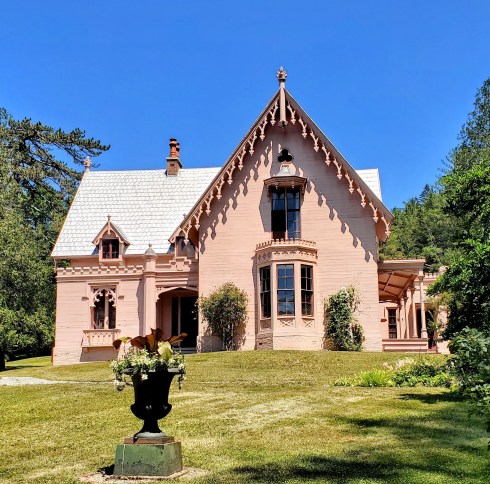
One hot morning last week I was looking at some paintings by the American Impressionist artist Matilda Browne (1869-1947) when I realized I wanted to see more. It was apparent that the best place to do that was the Florence Griswold Museum in Old Lyme, Connecticut, so I hopped in the car and drove down there, arriving in the early afternoon. I was supposed to be doing lots of other things but I ran (drove) away instead: I’m a firm believer in doing that from time to time and have always been grateful that I have the ways and means to do so. Old Lyme is a beautiful town: I’ve been there quite a few times but never to the Griswold Museum, and it was a real feast for the senses, especially at this time of the year, when the Colonial Revival garden in back of Miss Griswold’s mansion was at midsummer peak. There is the 1817 mansion, embellished with the art of Miss Griswold’s artist-boarders who established the Old Lyme Art Colony at the beginning of the twentieth century, the garden and grounds with trails along the Lieutenant River, the modern gallery with cafe and gift shop, and several studio-outbuildings which give the impression of an artistic community past and present. It was a perfect place to spend an afternoon in July, as everything was bathed in that golden midsummer glow, much like the painting by once-resident Edward Simmons of the same title. And I saw lots of Matilda Brown’s paintings too.


Edward Simmons’ July Afternoon, Old Lyme (1906) and the house, garden and grounds of the Florence Griswold Museum.
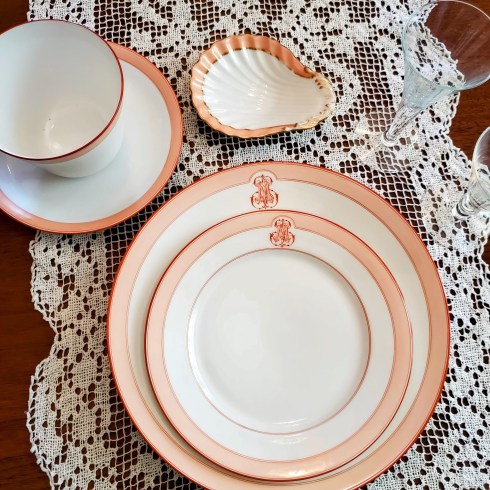
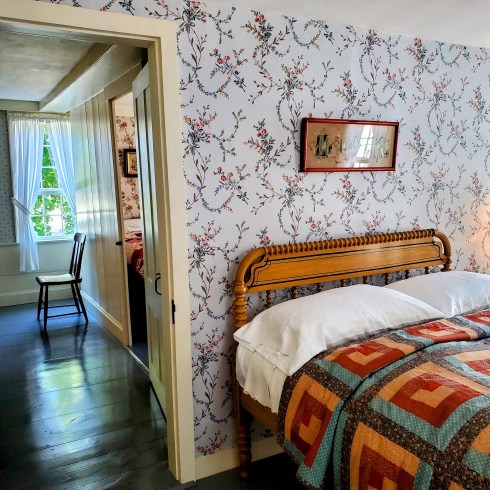
Florence Griswold’s life (1850-1937) was in some ways common, in other ways not. She was born into a wealthy family, exemplified by the grand 1817 mansion on Old Lyme’s main street, whose money was increasingly diminished to just the house and grounds with no means to keep both. After the death of her father in the 1870s, the house was transformed into a school for genteel ladies, and after the death of her mother in the 1890s, into a boarding house by Florence and her sister. The artist Henry Ward Ranger came to stay in 1899, and convinced other artists to follow suit in the years to come, and the house evolved into an artistic community with Miss Griswold very much in its center and her house the foundation of an emerging art colony in Old Lyme. Apparently extending patronage (in the form of credit) to artists became a higher priority than holding on to the family home, and she lost it before her death in 1937, but over the next decade the Florence Griswold Association was able to purchase it and establish the museum. The first floor of the house is maintained much as it was in her time, while the second floor has galleries devoted to the work produced there, including paintings of the house itself, illustrating her role as “the keeper of the artists.” Resident artists, including Matilda Browne, also painted the house itself, most prominently its door and mantle panels, leaving their mark in more ways than one. While the Old Lyme Art Colony is associated most prominent with American Impressionism because of the residency of Childe Hassam and others, you can also see works representative of the less well-known (at least to me!) school of Tonalism associated with Ranger. And there are also some very impressive cows.


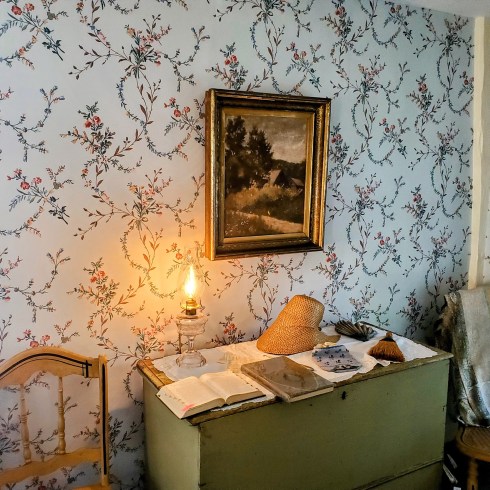
ABOVE: Matilda Brown, Miss Florence’s; Charles P. Gruppe, The Griswold House at Old Lyme; Woodhull Adams, Miss Florence’s Parlor (1912); painted panels in the Griswold dining room. BELOW: Front hall and parlor of the Griswold House, Miss Griswold’s bedroom and a guest bedroom.


It was quite a shift to move from the mellow tones and painterly animals ensconced in the old Griswold House to the museum’s modern galleries, which are currently showcasing a retrospective of artist Dana Sherwood’s more whimsical work, including an installed Bedroom Bestiary (2021) below. Very charming images, but I wanted to stay in the past, as usual, and in the garden, which was lush, lush, lush. So back to Miss Griswold’s environment I went: to the realm of her boarders and borders. It was Matilda Browne who lured me to coastal Connecticut after all.


Works by Dana Sherwood in the 2002 Krieble Gallery; Matilda Browne’s Clark Voorhees House (1905) and Saltbox by Moonlight; William Henry Howe’s Repose, September Days in Normandy (1888-89); back in the garden—somehow I never thought of using sage as a border plant like this.


 So, much of this seems fine, certainly the themes are great (more on them below), and the criteria professional. I’m having some difficulty envisioning the logistics of the vetting process, but will leave that to the experts. What does concern me, however, is the disassociation of “site” and “building” as referenced in #3 on. As you see in my graphic above, the Salem Witch Museum, the most profitable of the for-profits, is referred to as the former East Church, which is presumably how it made the cut. Why the East Church is deemed “historic” is beyond me, aside from its imposing Gothic Revival style: certainly it is no more historic than the nearby houses of ultra-philanthropist George Peabody and Supreme Court Justice Joseph Story, or the birthplace of the illustrious Benson brothers across the Common. When I asked why and how the Salem Witch Dungeon Museum, also located in a former church (built by the Christian Scientists and not the East Church parishioners), was included on the trail, I got this response from the Executive Director of Destination Salem: The Witch Dungeon Museum and Lynde Street are the site of early fortifications. English settlers knew that their presence in Salem immersed them in a web of global conflicts. Fearing reprisals from the indigenous people they were displacing and attacks from other colonial powers, the colony of Massachusetts erected a fort near this spot in 1629. Samuel Sharpe came from London with cannons to assume command of the militia. The first fort was probably made of tall wooden palisades, with extensions jutting out to prevent flanking. In the following decades, further fortifications were built along the Salem coast and a palisade was built along the western end of town. The early, feared attacks never happened. The East Church built a chapel on Lynde Street in 1897 and The Witch Dungeon Museum opened in the building in 1979. Visitors can watch a live-action reenactment of a witch trial and tour a recreation of the grim prison where the accused were kept. So basically: because a long-gone fort was once on the site of the Salem Witch Dungeon Museum, it qualifies for the trail? I don’t think I need to spend too long discussing the implications of this “standard.” In a city as old as Salem, every structure downtown was built on the site of something else: there are layers and layers and layers. The Witch Dungeon Museum’s storefront sister “museum” on venerable Essex Street, the Salem Witch History Museum, could claim that it sits on the site of Salem’s first printing house or any number of historic structures and thus qualify for the new Heritage Trail. Perhaps the cumulative criteria above could mitigate against this, but it does not appear to have done so with the Salem Witch Dungeon Museum: I think we need to be honest about where we are leading people—and why.
 Mannequin City: mid-20th century interpretive “technology” reigns in Salem’s for-profit witch “museums” which have no incentive to innovate, as the City delivers visitors right to their doors; Witch Dungeon Museum hanging mannequins.


 Salem tourism brochures from the 1950s through the 1980s: not until the last decade was the Heritage Trail restricted to downtown and the “story” increasingly restricted to witches. Love the sentiment of “traveling through history in Salem.”
 Higginson Square, 1893, Nelson Dionne History Collection, Salem State Archives and Special Collections. A big flatiron to highlight Asheville’s Flatiron building. It begs the question: no Parker Brothers site for Salem’s new Heritage Trail?