Recovering Salem’s Hispanic Heritage: a Revolutionary View

September 15 commenced Hispanic Heritage Month here in Salem; as I walked by the flag-raising in Riley Square the other day I wondered, what now? How are we going to recognize Hispanic Heritage Month? And given that Salem has an increasing population of Latino Americans, how are we going to expand “Salem history” to include their stories going forward? If I could offer a suggestion (which I am prone to do), why don’t we take advantage of two dynamic historiographical trends connecting Salem and the Iberian world in the eighteenth-century: the renewed focus on the codfish trade which generated so much wealth (and so many connections) on the North Shore in the eighteenth century and new perspectives on Spain’s role in the American Revolution? The importance of the codfish trade between New England and southern Europe has been emphasized by academics for quite some time (this particular study has been very influential) but I don’t think it has trickled down (or out) to a more general audience. My department co-sponsored an afternoon symposium along with the Salem Maritime National Historic Site, the Marblehead Museum, and Historic Beverly in 2019 entitled Salt Cod for Silver: Yankees, Basques, and the North Shore’s Forgotten Trade organized by the independent scholar Donald Carlton, but I think the trade remains relatively “forgotten,” and overshadowed by the China Trade which flourished after the Revolution. Actually I think the codfish trade is paradoxically both forgotten and taken for granted: the symbolism of the cod is everywhere in late eighteenth century Massachusetts and if not for this lucrative and expansive trade how else could both Salem and Marblehead appear on the list of the ten most populous American towns in the first census of 1790? To its credit, Salem Maritime has been stressing the importance of the pre-revolutionary fish trade almost since its founding, and in myriad ways: the map below is from its Spring 1940 Regional Review (I know it’s a bit hard to read, but Bilbao is definitely in the center of the world) and the “flying fish” from the site’s 2017 virtual reality “exhibition” (experience?) The Augmented Landscape

But neither fish or trade are particularly “sexy” or accessible topics of historical interpretation, especially historic interpretation for a general audience. Believe me, I know, I’ve been teaching pre-modern world history, which is very much about cross-cultural trade, for years: I’ve seen my students’ eyes glaze over many, many times even as I’ve tried all sorts of tricks to keep their attention. You need people, particularly individual stories, and you need a war (or some sort of conflict). So that’s why I’d like to see an interpretive focus on the relationships that were fostered by and through this long and lucrative trade and their eventful revolutionary impact. Material manifestations are helpful too: these are a major hook of the China Trade are they not? I’m not sure that the Iberian Peninsula can compete in this realm, but there was certainly a range of goods with the label “Bilboa” (the 18th century spelling) attached to them which were in demand in the later eighteenth century: most importantly Bilbao handkerchiefs, Bilbao yarn and caps, and Bilbao mirrors, which might or might not have been manufactured on the Iberian Peninsula.

A very typical 1770s shipping report in the Essex Gazette; of course the destinations listed point to the intersection of the fish and slave trades in the Atlantic system; Advertisements from the Salem Gazette, and a “Bilbao Mirror” from Bonhams Skinner. I should say that the only references that I found for “Bilbao caps” in the pre-revolutionary newspapers were in runaway slave advertisements.

The stories of the Salem men (sorry, they were all men when it comes to the maritime trade; manufacturing, processing and retail by-products I just don’t know) who dominated this trade can all be found in the papers of the Peabody Essex Museum’s Phillips Library in Rowley: Samuel Browne early in the eighteenth century, the Derbys, the Ornes, the Cabots, and others later (and there are very helpful appendices to the finding aids for these papers along with a recently-digitized collection of logbooks). These later men, like their counterparts in nearby Marblehead, Beverly, Gloucester, and other New England ports, dealt with Diego de Gardoqui Y Arribuibar, the head of an eminent family merchant house in Bilbao, Joseph Gardoqui & Sons. The Gardoqui firm had been importing salted codfish from the British American colonies since 1763, and because of stiff competition with other Iberian ports, its increasing focus in commercial relations was on the merchants of the North Shore of Boston. Diego de Gardoqui developed relationships with the Marblehead merchants Jeremiah Lee and Eldridge Gerry, and also with members of the Cabot family based in Beverly and Salem and the Derbys of Salem. When the Revolution began, these connections resulted in the Gardoqui firm suppling the Americans with arms, gunpowder and other supplies even before Spain entered the war on the side of America and France in 1779; the first foreign rifles supplied to the colonists were sent from Bilbao to Massachusetts in 1775. Gardoqui committed to the Colonies personally and then officially, assuming the role of a Spanish government official tasked with overseeing military aid during the Revolution and Spain’s first Ambassador to the United States afterwards. He was present at the inauguration of George Washington in 1789. Diego de Gardoqui appears like an Iberian Lafayette to me, and I am not the only one: recent historiography and initiatives (like these sponsored by global utility company Iberdrola, which actually built our new power plant in Salem and recently emerged victorious from a major lawsuit brought by its owner/developer) seek to re-center Spain in the history of the American Revolution, right alongside France. Salem and its region are part of that re-centering story, and could look eastward for inspiration as it approaches the anniversaries of both its founding and the Revolution in 2026. In an interview explaining the Iberdrola project and its mission, the historian José Manual Guerrero Acosta asserted that “I believe that millions of Hispanic people living today in the US are entitled to recognition of the fact that the Hispanic world and its forebears, which made up part of the Spanish crown territories in America, were present in a significant way at the birth of their country.”

Two recent titles, including a stirring study of the namesake of Galveston, Texas, Bernardo de Gálvez; Diego de Gardoqui, Ca 1785. Courtesy Family Cano Gardoqui.

Bilbao was a bit of a free port in the eighteenth century, owing to its customary fueros granting exemption from Spanish taxes and its role as a haven for privateers, including those from Salem. Just offshore in June of 1780, Captain Jonathan Haraden, the “bravest of the brave” and “Salem Salamander,” fought his most spectacular engagement with the British privateer Achilles, ostensibly to cheering crowds in port. The Gardoqui firm reported Haraden’s exploits to Benjamin Franklin, then Minister Plenipotentiary, and Franklin replied on July 4: “Captain Haraden–whose bravery in taking and retaking the Privateer gave me great pleasure.” Haraden is such a hero in nineteenth-century naval histories and twentieth-century boys’ magazines, and currently in Eric Jay Dolan’s Rebels at Sea. Privateering in the American Revolution, but in Salem both he and his profession seem truly forgotten. Cape Cod pirates, some real, some not, rule while Salem’s very real privateers languish in the dusty recesses of Salem’s ever-dimming historical consciousness. We seldom hear of them, despite the facts that 158 privateering vessels originated from Salem during the Revolution, capturing 458 prizes, the largest prize tonnage of any single American port. Perhaps a revolutionary re-focus, inspired by the need to expand our city’s history to include as many of our residents as possible, might also forge a reaquaintenance (and/or re-evaluation) with some previously-aclaimed dead white men too! There’s a lot of ground–or should I say ocean—for exploration, inspiration, and revelation.

Top: Nowland Van Powell’s depiction of Captain Haraden’s engagement with the Achilles, which had stolen his prize, the Golden Eagle, off Bilbao, Eldred’s Auctions.

APPENDIX: Those of you who are familiar with my blog know that I’m not exactly a fan of Salem’s “heritage management,” so I can’t resist this comparison of two Bilbao-connected plaques: one featuring Diego de Gardoqui prominently placed in front of the Jeremiah Lee Mansion in Marblehead and another marking Jonathan Haraden’s very public victory over the Achilles, which is located inside a Korean barbeque restaurant on Essex Street in Salem. Seriously! BonChon, the restaurant in question, was one of my major pandemic take-out spots (it still is actually, as I adore their fried rice) so I became quite familiar with Haraden’s plaque during that time. The plaque was installed by the Sons of the American Revolution in 1909 on a house where Haraden once lived which was later demolished. I seem to recall that its replacement structure had the plaque on the exterior, but when that building was demolished and another built in its place a few years ago it ended up inside—not exactly sure why, but very Salem.


Open House in Essex County

It occurred to me the other day that during the long life of this blog I have never spotlighted Trails and Sails, a calendar of dedicated events and openings throughout Essex County in September organized by the Essex National Heritage Area. I feel remiss; I have friends and former students who work for Essex Heritage, and I myself am a commissioner! These folks know what heritage is and are able to discern it from tourism, and so they connect and cast light on institutions and areas which represent this region’s cultural and material legacy in meaningful ways. Trails and Sails is a 10-day extravaganza of free events throughout our region, beginning next weekend. I’ve picked my events, and my participation will pretty much revolve around visiting old buildings, but don’t let my game plan (mis-) inform yours: there are plenty of events that involve much more outside action like walking, paddling, biking, apple-picking, cider-making, birding, and even “forest bathing” (whatever that is) right here in Salem. So go to the website, or download the digital guide, and chart your course. Note that many (but not all) events and openings are recurring and some require reservations.

Saturday, September 17I’ve got to get into the glorious Grand Army of the Republic Hall in Lynn, so that will be my first stop. I’ve wanted to see this hall for about five years. From Lynn, I’ll drive over to Danvers to tour the 1670 Judge Samuel Holten House, another building which I’ve long admired and never been inside. Same with the Platts-Bradstreet House in Rowley, so that’s next, then back to Salem for a walking tour of Charlotte’s (Forten) Salem by History Alive, Inc.

Lynn’s GAR Hall, two seventeenth-century houses, and Charlotte Forten about to lead us around Salem!

Sunday, September 18: I know that I will have to do some lecture and presentation prep on this day but I am still going to the Open House at the Rocks Village Handtub Building and Toll House Museum on the Merrimack as I love that building and (again) have never been inside. I might as well go to the Brocklebank Museum on Georgetown as it’s on the way home.

Rocks Village,Georgetown, and the Jackman-Willet House in Newbury.

The following week, unfortunately, is super busy and I have my own presentation on Saturday the 24th, so that leaves Sunday the 25th, when I’ll go up to Newbury and see the seventeenth-century Jackman-Willet House and anything else that is happening in that part of the county. I feel like I’m missing out on some great events, particularly Fletcher Steele and Frederick Law Olmsted tours and a view of Gloucester from its grandiose city hall. But there’s always next year: Trails and Sails is an established tradition. As I was looking at the schedule, thinking about where I would like to go, and reflecting upon my past summer, it was just houses, houses, houses! I love visiting old open houses, but I think I must be an outlier among heritage tourists today. I’ve been talking to a few museum professionals over the summer, and they all tell me that house museums just aren’t as popular as they used to be. This might explain why so many in Salem are closed, including all of the Peabody Essex Museum’s houses save the Ropes Mansion and Salem Maritime’s Derby House (well, save the ell). But everywhere I have gone this summer—in New York, and all the New England states—there have been good-sized parties touring houses with me so it makes me feel like there are still some old-house afficionados out there! An anecdotal view, I know, but a hopeful one. Perhaps I should finally admit, however, that my essential childhood bedside book, Samuel Chamberlain’s Open House in New England, might have been a bit odd.


Dickinson Domicile

I drove “out west” to the recently-reopened Emily Dickinson Museum last week thinking it would just be a pleasant last road trip of the summer during which I would learn a bit more about the poet, take some photographs of her house and the surrounding Pioneer Valley, and then return home to dash off a quick post and then turn to my syllabus prep as the new semester starts TOMORROW. But that’s not how it worked out: I couldn’t dismiss Emily or the rest of the Dickinsons that quickly or easily. The “Homestead” was striking and the tour substantive, but I left with fewer pictures and more questions than I intended to have. Emily remains enigmatic, but I found myself more interested in her living conditions than her work: the physical space of the house and its surrounding land, which was much larger and more pastoral in her time, her dashing brother Austin and very close sister-in-law Susan next door, the constant companionship of her younger sister Lavinia, and what can only be called the LOOMING presence of her brother’s pushy mistress and the first editor of her work, Mabel Loomis Todd. Emily managed never to meet Mabel (which I find particularly impressive) but nevertheless she was there. It was just all too much for me, so I wondered how Emily persevered/flourished in such a space! So when I got home, I couldn’t possibly post before I read three books about Emily and her family, all when I should have been working on my syllabi! This beast was the best: I could not put it down for two days, an amazing work of scholarship.

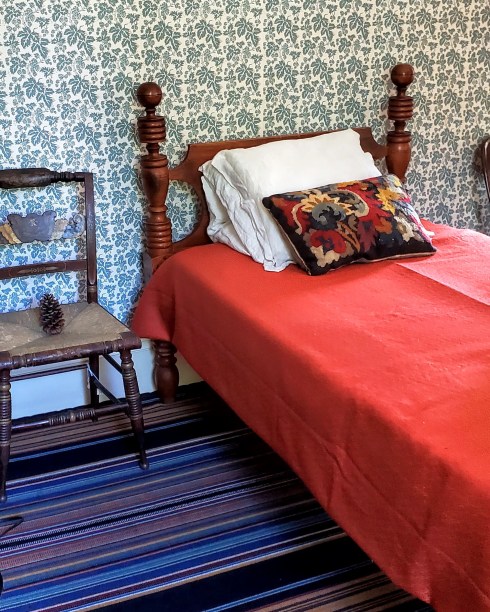
The Dickinson “Homestead,” members of the family, the library and conservatory. The Museum places pinecones on period seating which it does not want you to sit on, but also provides period seating in green!

So much LOVE and DEATH! Emily’s parents die–her mother after a long incapacitation in the bedroom next to Emily’s, and then her beloved young nephew. His father, her brother Austin, begins his passionate and long affair with Mabel, wife of a young Amherst College astronomer, and Emily has to pussyfoot around her own house, the Homestead, to get to her conservatory off the library while they are having liasons! Next door at the Evergreens, the social center of Amherst it seems, her very best friend and “sister over the hedge,” Sue Dickinson, is in distress over her husband’s open adultery. Emily herself commences a passionate-yet-platonic (I think?) relationship with an old friend of her father’s, Judge Otis Phillips Lord from SALEM. She refers to him as “My Lovely Salem” in her letters and he visited her often before his death in 1884. Emily died two years later and then Mabel the Mistress takes over, with the approval, at first, of Lavinia. The Poet is established, but conflict between all of the surviving insiders ensues, resulting in many Dickinson possessions and Emily’s papers going to Harvard. The recently-restored Homestead contains period copies of everything and so you really feel the Dickinson presence (or at least I did) but Harvard’s Houghton Library is the major Dickinson repository.

The amazingly colorful double parlor: somewhat subdued walls and brightly-patterned floors seems to be the theme. The lovely runner and second-floor landing floorcover by Thistle Hill Weavers; Emily’s bedroom and stand-in “desk”—a Federal work table. The real desk in the Dickinson Room at the Houghton Library.

But displaced possessions don’t matter, believe me, the house is THE HOUSE, and it is so colorful and full of texture, it feels alive! I loved it: the curation of the interiors seemed to echo the “meticulous care” Emily took with her own life. There are period pieces, both authentic and reproduction papers and textiles, and also some donations from the recently-concluded Dickinson series. The Homestead is a palimpest house: built in 1813 in a more austere Federal style, it was expanded and embellished by Emily’s father, and interpreted as her family house. I think I responded to it so much because it reminded me of my own house, built in 1827 and “italianaticized” in the 1850s, but my double parlor is nowhere near as colorful as Emily’s! You’ve got to go; you’ll have your own response, believe me.

A fragment of period wallpaper in Emily’s room, and an utilitarian white dress representative of what she preferred; her mother’s room next door, furnished with a bed from Dickinson the television series; the only surviving tree from the Dickinson era: an oak which survived the Hurricane of 1938. The Evergreens, Austin’s and Sue’s house, which is closed now but apparently still perfectly Italianate inside.


The Wentworth-Gardner House

We were in York Harbor all last week with family and friends, several of whom had never been to this region of New England before. So I was a bit of a tour guide, in my fashion. On a morning tour of Portsmouth, we passed by my favorite house in town, the Tobias Lear House, as well as its more famous neighbor, the Wentworth-Gardner House, one of the most famous Georgian structures in the country. I’m very familiar with this house, but for some reason I’ve never been inside, and the door was open with a flag out front, so in I went, forgetting all about my companions. They followed me, but I really gave them no choice in the matter! We had a lovely tour with a very knowledgeable guide, and the house was ever more stunning than I imagined. I’m kind of glad that I had never been in before, as this house is probably the best example of the entrepreneurial antiquarian Wallace Nutting’s material and cultural impact in New England and I’ve come to appreciate him only recently. Nutting purchased the house in 1915 and added it to his collection of “Colonial Pictorial Houses” after his restoration, and thus it became one of the more influential representatives of the “olden time” in his time and the Colonial Revival in ours. Images of Nutting’s wispy colonial ladies in its midst are scattered throughout and a room is devoted entirely to his work.

The Wentworth-Gardner House in Portsmouth, New Hampshire: present and before Wallace Nutting’s purchase in 1915; the amazing center hall with a stairway re-installed by Nutting, and one of his colonial ladies descending (from a large collection of Nutting images at Historic New England).

The houses was built by Mark Hunking and Elizabeth Rindge Wentworth in 1760 as a wedding gift for their son Thomas, who lived in it until his death in 1768. It was owned and occupied by Major William Gardner from 1793 to 1833, and thereafter by his widow. In the later nineteenth century the grand mansion became a rooming house as its South End neighborhood declined, and then Nutting came to its rescue! As you can see, his most extensive restoration was to its exterior, but the reinstallation of the stairway was a major undertaking as well. I know that the pineapple was a customary colonial symbol of hospitality, but I can’t help but wonder if Nutting was inspired by Salem’s “Pineapple House.”

Nutting’s restored doorway (Historic New England) and Salem doorheads from the 1895 Visitors’ Guide.

Nutting sold the house to the Metropolitan Museum of Art just after the close of World War I, initiating the threat of removal to New York City that was itself removed by the onset of the Depression. After a brief stint of stewardship by the Preservation of New England Antiquities, the Wentworth-Gardner (and adjoining Lear house) House was acquired by a group of local preservationists who eventually became known as the Wentworth-Gardner Historic House Associates in 1940. It’s just a great place to visit: so many wonderful structural and decorative details, including the wonderfully carved mantel in the front left parlor (another one of Nutting’s reinstallations), the newly-installed reproduction eighteenth-century flocked wallpaper, the very Colonial Revival kitchen with its steep steps leading to upstairs, several great bedchambers (I couldn’t call them simply bedrooms), the Wallace Nutting room, and a very nice exhibition on historic preservation in Portsmouth. I remain so impressed by this small city with all of its historic houses, in wonderful condition and all open to the public. It’s a great example of community commitment to material heritage and the importance of having several institutional stewards thereof, rather than just one or two.

Georgian and Colonial Revival styles/worlds merge in the Wentworth-Gardner House, Portsmouth, New Hampshire.


Massachusetts Route 57

I have taken a lot of road trips this summer: west, south, north. On my way to any place in the first two directions, I’ve tried to explore a territory I call “middle Massachusetts” between the greater Boston area (which I tend to extend to Worcester) and the Berkshires. The latter has a very strong identiy as you can see from the map I found in a shop in Great Barrington, below, as does greater Boston, the North and South Shores, and Cape Cod. But I’m just not sure about the middle: part of it could be called the Connecticut and/or Pioneer valley, but other parts seem not exactly mysterious to me, but rather amorphous. My attempts to discover and characterize Middle Massachusetts has taken me down some small old roads, and so far my favorite route has been Massachusetts Route 57, which extends from just south of Springfield almost to Great Barrington, just north of the Connecticut border. This route is perfect: not one chain store, lots of old houses, general stores, taverns, rolling hills, rivers, state forests, and a lake or two. I’m not sure why it’s not referenced on maps of nineteenth-century Massachusetts turnpikes, as it was clearly a major route from Springfield to the Berkshires from quite early on judging by the structures that line its path.

From the Berkshire perspective above, Route 57 includes several western Massachusetts towns, but I don’t know, Sandisfield doesn’t feel very Berkshirey to me although it is formally in that county. My favorite town on Route 57, Granville, is definitely not a Berkshire town, nor is neighboring Tolland, and then you drive through the New Boston village of Sandisfield, Sandisfield proper, New Marlborough, Monterey, and then finally Great Barrington. Route 57 merges with Route 23, another nice old route but not quite as pristine and rural. Great houses line the road, some a little shabby, some very shiny. Soon I was in New York State, and I returned home on a series of other lesser-known east-west routes, in northern “Middle Massachusetts.” It’s just too easy to take the Mass Pike.

Structures in Granville, West Granville (for some reason I didn’t snap a picture of the very much open Granville General Store—which has great cheese—but I did capture the very closed West Granville Store) New Boston, Sandisfield and New Marlborough along Route 57.


Hooked on Kinderhook

I made a very quick trip out to the Hudson River Valley at the beginning of last week to visit my brother and brother-in-law, and despite its brevity I still made some discoveries, including the delightful Columbia County town of Kinderhook. I always try to find new places when I’m out there, so on the way home I headed north from Rhinebeck, where they live, before turning east towards Massachusetts. It was supposed to be an hour-long diversion to see the Martin Van Buren National Historic Site before I headed home, but there was so much to see in Kinderhook I lingered, and did not get to Salem until well after dark. The President’s house did not disappoint, but downtown Kinderhook blew me away: beautiful houses and gardens, so much history, a stunning art gallery. The picture-perfect historytown: well worth a weekend trip if you’re within driving distance (or a longer one if you’re not). For some reason, I expected Lindenwald, which Martin Van Buren purchased after his presidential term was over, to be a bit dull and dowdy but it was on my list: when I got there I found it neither. I’ve been on a Gothic Revival kick all summer long, but this house is more than that: it’s a late Georgian mansion house transformed into a Gothic Revival mansion with an Italianate tower! Quite a melange: and Zuber & Cie wallpaper inside. The house was built by Judge Peter Van Ness in 1797, and inherited by his son William, who was Aaron Burr’s second in the 1804 duel which fatally wounded Alexander Hamilton. After Van Buren was defeated (on a Whig ticket) in the 1840 presidential election he retreated to Lindenwald, but following another defeat in the election of 1848 (on the Free Soil Party ticket) he was ensconced there for the remainder of his life. In 1849 he hired architect Richard Upjohn (who must have been THE Gothic Revival architect as he designed my two favorite houses in that style: the Rotch House in New Bedford and Kingscote in Newport) to expand and transform it.

Exterior and interior views of Lindenwald, including the tower stairwell and first-floor parlors. The entire center of the house is one big dining hall with the restored Zuber paper: for some reason it was difficult for me to photograph so refer to the site’s website! Not sure what this little house was for but it is cute.

This was the last day of a week-long heat wave so I really wanted to stay in my car, but once I got into downtown Kinderhook I had to get out of it. There were so many beautifuly houses, I would just stop, run out and take a photograph, and run right back into the air conditioning. But this was happening so often and the houses were in such close proximity to one another that it was getting a bit comical, so I finally stopped and took a walk. There was a strong presence of history: I had the image in my mind of the Continental Army marching down the main street victoriously after the (Second) Battle of Saratoga in the fall of 1777, especially as I passed the house where the captive General Burgoyne was entertained which was very close to the house where the wounded Benedict Arnold was taken. Earlier in the war, General Henry Knox passed through Kinderhook on his heroic quest to deliver cannon from Ticonderoga to General Washington in Boston. There are all these beautiful brick houses—both Dutch and English. There were details on the wooden houses I had never seen before. I was a puddle after my walk through Kinderhook but it was worth it!

The Luykas Van Alen House, 1747, which is owned and operated by the Columbia County Historical Society, as is the James Vanderpoel “House of History,” built in 1810. (The Van Alen house had several front porches with these built-in benches you see on Dutch Colonial houses built in the 20th century). Some houses which caught my eye in Kinderhook Village–I could have included many more. House where General Burgoyne was entertained and Major General (Turncoat) Arnold was attended to.

It was so hot in the Van Buren house that our guide passed out these cool fans! Perfect keepsake and advertisement for all this region has to offer. New York State takes its history very seriously: there are markers everywhere (maybe even TOO many–a big statement from marker afficionado me), every town has an official historian, and no opportunity goes unutilized to showcase it.


Are Hollyhocks Colonial or Colonial Revival?

And now for a really important question, but about all I can take on during these dog days of summer: are hollyhocks Colonial or Colonial Revival? The hollyhocks were simply beautiful and characteristically statuesque at the Saint Gaudens National Historic Site when we stopped by on the way back from Vermont a few weeks ago and I started thinking about them. Hollyhocks don’t look like a particularly useful plant but they are on the cover of so many books on “Colonial” gardens published at the beginning of the twentieth centuy: they seem to be the very symbol of the Colonial Revival garden (along with the sundial and the arbor). So what’s the story, Colonial or Colonial Revival?

Hollyhocks in Cornish, NH and on the cover of early 20th centuy gardening books: Shelton (1906); Ely (1903); Bennett (1919); McCauley (1911); “Colonial” woman and hollyhocks in font of the John Ward House, Salem in a c. 1911 photo by Mary Harrod Northend; layout for a Colonial Garden from Colonial gardens; the landscape architecture of George Washington’s time (1932).

So as you can see, hollyhocks were a mainstay in the “old-fashioned” gardens of the Colonial Revival era, but were they actually revived? Were they also present in gardens from centuries prior? I think that the answer is a qualified yes: hollyhocks were both Colonial and Colonial Revival, but the hollyhocks of the earlier era were a bit different than that of the latter. When horticultural authors in the early modern England referenced hollyhocks (which they spelled in many different ways, believe me), they meant Althea officinalis or what we call Marsh Mallow today. Marsh Mallow is a great old plant that I used to have in my garden but it disappeared last year. All mallows were utilized for their soothing effects, and John Winthrop included them in his order for “garden seeds” dispatched to London in 1631. The hollyhock in particular seems to have been an Asian variety brought west in the wake of the Crusades, and while it is often said that the naturalist William Turner fashioned the name hollyhock (or holyoke) in his 1551 Newe Herball, it dates from the fourteenth century at the very least. Turner’s Herball contained woodcut illustrations copied directly from the lovely colored engravings of Leonhard Fuch’s De Historia Stirpium (1543), and he also followed Fuchs in giving hollyhocks the scientific name Malva hortensis. The Fuchs illustration is below: as you can see, it is definitely a familiar hollyhock, but noticeably smaller than our modern variety. And that’s what happened to the Hollyhock: it was improved through hybridization in the nineteenth century. Malva hortensis became Althea Rosea and ultimately Alcea Rosea. The Boston nurseryman John Breck, author of the influential The Flower Garden or Breck’s Flowers (1851), disdained the popular dahlia and promoted the humble hollyhock, as a great improvement has been made in this old-fashioned, ordinary flower, within a few years, that has brought it before the public under a new phase; and it now bids fair to become as popular as many other flowers have been when taken in hand by the florist. Breck was referring to the cross-breeding success of his colleague across the Atlantic, Saffron Walden nurseryman William Chater, who had produced double hollyhocks with large flowers, “of better form, more substance in the petal, and more decided in colour.” And thus the hollyhook took off, its success limited only by the onset of a rusty disease that is still with us, unfortunately.

Sixteenth- and nineteenth-century hollyhocks: Wellcome Images; George Baxter’s print of Valentine Bartholomew’s Hollyhocks (1857), Victoria & Albert Museum.

Another major factor in the increasing popularity of the hollyhock must have been the many artistic depictions appearing on both side of the Atlantic from the 1870s: painters of all artistic schools, from impressionism to realism, painted stunning and soaring hollyhocks, often in the company of women. I could include hundreds of such paintings in this post, but I’ve limited myself to just a few of my favorite works. I’ve started out with Ross Sterling Turner’s Hollyhocks from 1876 because he is a Salem artist, but it’s not as representative as a painting fom the very same year by another New England artist, Eastman Johnson. Girls and hollyhocks just go together! It’s no wonder that the garden writers of the next decades, among them so many women, favored them. Hollyhocks were also a framing device, as Childe Hassam demonstrated in his many depictions of his friend Celia Thaxter’s garden on the Isle of Shoals in the 1890s (reproduced in An Island Garden in 1894): they could define an entrance, a view, or even the gardener herself. My favorite depiction of hollyhocks is in Abbot Fuller Graves’ painting Portsmouth Doorway (1910) at the Peabody Essex Museum, but everybody else’s impressionist over-the-top hollyhocks with a woman-in-white work seems to be Frederick Carl Friesek’s Hollyhocks from the following year.

Ross Sterling Turner, Hollyhocks (1876), LA County Museum of Art; Eastman Johnson, Hollyhocks (1876), New Britain Museum of American Art; Childe Hassam, In the Garden (Celia Thaxter in her Garden) (1892); Smithsonian Museum of American Art; Abbot Fuller Graves, Portsmouth Doorway (1910), Peabody Essex Museum; Frederick Carl Frieseke, Hollyhocks (1911), National Academy of Design.


A July Afternoon, Old Lyme

One hot morning last week I was looking at some paintings by the American Impressionist artist Matilda Browne (1869-1947) when I realized I wanted to see more. It was apparent that the best place to do that was the Florence Griswold Museum in Old Lyme, Connecticut, so I hopped in the car and drove down there, arriving in the early afternoon. I was supposed to be doing lots of other things but I ran (drove) away instead: I’m a firm believer in doing that from time to time and have always been grateful that I have the ways and means to do so. Old Lyme is a beautiful town: I’ve been there quite a few times but never to the Griswold Museum, and it was a real feast for the senses, especially at this time of the year, when the Colonial Revival garden in back of Miss Griswold’s mansion was at midsummer peak. There is the 1817 mansion, embellished with the art of Miss Griswold’s artist-boarders who established the Old Lyme Art Colony at the beginning of the twentieth century, the garden and grounds with trails along the Lieutenant River, the modern gallery with cafe and gift shop, and several studio-outbuildings which give the impression of an artistic community past and present. It was a perfect place to spend an afternoon in July, as everything was bathed in that golden midsummer glow, much like the painting by once-resident Edward Simmons of the same title. And I saw lots of Matilda Brown’s paintings too.

Edward Simmons’ July Afternoon, Old Lyme (1906) and the house, garden and grounds of the Florence Griswold Museum.

Florence Griswold’s life (1850-1937) was in some ways common, in other ways not. She was born into a wealthy family, exemplified by the grand 1817 mansion on Old Lyme’s main street, whose money was increasingly diminished to just the house and grounds with no means to keep both. After the death of her father in the 1870s, the house was transformed into a school for genteel ladies, and after the death of her mother in the 1890s, into a boarding house by Florence and her sister. The artist Henry Ward Ranger came to stay in 1899, and convinced other artists to follow suit in the years to come, and the house evolved into an artistic community with Miss Griswold very much in its center and her house the foundation of an emerging art colony in Old Lyme. Apparently extending patronage (in the form of credit) to artists became a higher priority than holding on to the family home, and she lost it before her death in 1937, but over the next decade the Florence Griswold Association was able to purchase it and establish the museum. The first floor of the house is maintained much as it was in her time, while the second floor has galleries devoted to the work produced there, including paintings of the house itself, illustrating her role as “the keeper of the artists.” Resident artists, including Matilda Browne, also painted the house itself, most prominently its door and mantle panels, leaving their mark in more ways than one. While the Old Lyme Art Colony is associated most prominent with American Impressionism because of the residency of Childe Hassam and others, you can also see works representative of the less well-known (at least to me!) school of Tonalism associated with Ranger. And there are also some very impressive cows.

ABOVE: Matilda Brown, Miss Florence’s; Charles P. Gruppe, The Griswold House at Old Lyme; Woodhull Adams, Miss Florence’s Parlor (1912); painted panels in the Griswold dining room. BELOW: Front hall and parlor of the Griswold House, Miss Griswold’s bedroom and a guest bedroom.

It was quite a shift to move from the mellow tones and painterly animals ensconced in the old Griswold House to the museum’s modern galleries, which are currently showcasing a retrospective of artist Dana Sherwood’s more whimsical work, including an installed Bedroom Bestiary (2021) below. Very charming images, but I wanted to stay in the past, as usual, and in the garden, which was lush, lush, lush. So back to Miss Griswold’s environment I went: to the realm of her boarders and borders. It was Matilda Browne who lured me to coastal Connecticut after all.

Works by Dana Sherwood in the 2002 Krieble Gallery; Matilda Browne’s Clark Voorhees House (1905) and Saltbox by Moonlight; William Henry Howe’s Repose, September Days in Normandy (1888-89); back in the garden—somehow I never thought of using sage as a border plant like this.


An Enigmatic Etcher

I wanted to share some examples of the work of the Salem artist George F. White, Jr., better known as George Merwanjee White (1849-1915), but I wish I could also share more details about his life. He’s a bit mysterious, particularly his chosen middle name, Merwanjee, a notable Parsi name. He was the proverbial “son of a Salem ship captain” whose most well-known works are quite local in focus, yet there is evidence that he also traveled widely, in both Europe and India. White’s father, George F. White Sr., made many voyages to the Indian Ocean for shipowners from Salem, Boston, and even New York, so perhaps his son might have accompanied him and was thus exposed to Indian influences, but this is complete conjecture on my part. In any case, by the time White Jr. married at the age of 27 he had shed the “F.” and acquired the “Merwanjee” and that is how he was known throughout his life. George M. White is recognized as part of an “Etching Revival” in Boston and Salem,, a movement which began in the last two decades of the nineteenth century in the latter city, exemplified by the little-known artists Harriet Frances Osborne and White and the more well-known Frank Benson. In addition to his etchings, White produced oil and watercolor paintings and was also recognized as a gifted producer of bookplates, but architectural etchings and drawings seem to be his preferred genre. There is a beautiful portfolio of his images of old Salem houses published by subsciption in 1886 entitled Etchings of Old Houses and Places of Interest in and about Salem which has been digitized for the “Peabody Essex Museum Publications” at the Internet Archive, and below are some of my favorite views. First, the process of production, followed by what was then generally known as the “Roger Williams House” and now the “Witch House,” the Philip English Mansion, the “Old Bakery” on St. Peter Street, later to be moved and renamed the John Ward House at the Essex Institute, the seventeenth-century survivor Narbonne and Pickering Houses, the lost Lewis Hunt and Richard Prince Houses, and Nathaniel Hawthorne’s birthplace in its original location on Union Street.


White’s images are of both old Salem houses—emerging landmarks—which had survived the dynamic nineteenth century (or most of it) as well as fabled houses which had not, thus expressing the beginnings of a preservation conciousness which is also evident in the similar sketches of Edwin Whitefield’s Homes of our Forefathers series, which was published just about the same time. Whitefield is a bit more romantic; White a bit more realistic. White wants to show and tell us what was special about the English, Hunt, and Prince Houses, and he’s wistful about the “picturesque” past: this is a word he applies to both the lost Prince House and the “living” Pickering House, the exterior of which was “fashioned” in the picturesque style of a bygone age in the 1840s. You can’t help but feel that modernity is encroaching.

Heliotype prints from George Merwanjee White’s Etchings of Old Houses and Places of Interest in and about Salem, Limited Edition, 1886.


The Golden Goose

Last week Salem’s new Heritage Trail, or at least the foundation thereof, was revealed with a report to the Salem Redevelopment Authority (SRA) and the launch of a new website. The outgoing “Red Line” has long been the object of derision, as it was a play-to-play route which made no meaningful distinction between the Salem Maritime National Historical Site and the Salem Witch Dungeon Museum. Concerns about the sign pollution which plagues downtown Salem and the now-common understanding that “redlining” refers to housing segregation apparently inspired the city’s tourism agency, Destination Salem, to put together a working group comprised of “stakeholders” representing Salem’s organizations, institutions, businesses and local government (but not, notably, neighborhood groups) to reconfigure the existing trail as something “new.” The end result will be a gold line running through downtown Salem, and very nice signs which will mark the stops along the way, including……………….the Salem Maritime National Historic Site and the Salem Witch Dungeon Museum.

Believe me, I’m pretty tired of screaming into the void about how Salem values (or doesn’t) its long and notable history. I also realize that the people who have transformed a small subsection of this history into a valuable commodity have clearly won the day, as many of Salem’s heritage organizations, including Historic Salem, Inc., the Salem Historical Society, the Essex Heritage National Commission, and even the Salem Maritime National Historic Site had representative members in this working group, so are clearly supportive of this new trail. But this is a really important time for Salem, with its 400th anniversary only a few years away and so many of its historic houses shuttered, including the entire Essex Street Block campus of the Peabody Essex Museum. So I have a few things to say, of course! I’ll try to be as succinct and straightforward as possible: after some consternation I have limited and organized my thoughts (which might take the form of pleas) into three main points:

      1. Forprofit sites cannot be heritage. Salem’s heritage is a public good, not a private commodity. Packaging an historical event into a dramatic presentation creates an “attraction,” not a museum. Packaging a tragic historical event into an attraction is troubling if not enacted with great care, and the dated figures employed by the The Salem Witch Dungeon Museum and the Salem Witch Museum evoke more mockery than empathy. These attractions have no place on an officially-sanctioned “Heritage Trail”; I don’t think any for-profit site does. Call the trail something else: my friend Joe suggested the “Tourism Trail.” I would have no problem with that: it’s the equivalency of an actual historic site like the House of the Seven Gables or the Charter Street Cemetery or the East India Marine Hall (all sites on the trail) with a manufactured attraction that troubles me, especially as the latter are so obviously exploitative. The creators and consultants of the new Heritage Trail realize that there is an issue here, so they have come up with criteria that Salem sites which hope to be listed on the trail as it expands must meet. Here they are, included as Appendix B in the “Salem Heritage Trail Recommendation and Project Recap” report prepared by the consultant company MuseumTastic for Destination Salem and presented to the SRA:So, much of this seems fine, certainly the themes are great (more on them below), and the criteria professional. I’m having some difficulty envisioning the logistics of the vetting process, but will leave that to the experts. What does concern me, however, is the disassociation of “site” and “building” as referenced in #3 on. As you see in my graphic above, the Salem Witch Museum, the most profitable of the for-profits, is referred to as the former East Church, which is presumably how it made the cut. Why the East Church is deemed “historic” is beyond me, aside from its imposing Gothic Revival style: certainly it is no more historic than the nearby houses of ultra-philanthropist George Peabody and Supreme Court Justice Joseph Story, or the birthplace of the illustrious Benson brothers across the Common. When I asked why and how the Salem Witch Dungeon Museum, also located in a former church (built by the Christian Scientists and not the East Church parishioners), was included on the trail, I got this response from the Executive Director of Destination Salem: The Witch Dungeon Museum and Lynde Street are the site of early fortifications. English settlers knew that their presence in Salem immersed them in a web of global conflicts. Fearing reprisals from the indigenous people they were displacing and attacks from other colonial powers, the colony of Massachusetts erected a fort near this spot in 1629. Samuel Sharpe came from London with cannons to assume command of the militia. The first fort was probably made of tall wooden palisades, with extensions jutting out to prevent flanking. In the following decades, further fortifications were built along the Salem coast and a palisade was built along the western end of town. The early, feared attacks never happened. The East Church built a chapel on Lynde Street in 1897 and The Witch Dungeon Museum opened in the building in 1979. Visitors can watch a live-action reenactment of a witch trial and tour a recreation of the grim prison where the accused were kept. So basically: because a long-gone fort was once on the site of the Salem Witch Dungeon Museum, it qualifies for the trail? I don’t think I need to spend too long discussing the implications of this “standard.” In a city as old as Salem, every structure downtown was built on the site of something else: there are layers and layers and layers. The Witch Dungeon Museum’s storefront sister “museum” on venerable Essex Street, the Salem Witch History Museum, could claim that it sits on the site of Salem’s first printing house or any number of historic structures and thus qualify for the new Heritage Trail. Perhaps the cumulative criteria above could mitigate against this, but it does not appear to have done so with the Salem Witch Dungeon Museum: I think we need to be honest about where we are leading people—and why.

        Mannequin City: mid-20th century interpretive “technology” reigns in Salem’s for-profit witch “museums” which have no incentive to innovate, as the City delivers visitors right to their doors; Witch Dungeon Museum hanging mannequins.

      2. The Trail is too restricted geographically. Salem has been a tourist destination for over a century, and there are previous incarnations of the Red Line, which was stamped on the City in the 1980s. (People seem to think that the big turning point in Salem’s tourism history is the filming of the television show Bewitched in 1970s, or at least that’s the story the rationalizes the placement of the Samantha statue in Salem’s most historic town square. But that’s clearly not true: it was the Haunted Happenings festival, initiated by the Salem Witch Museum in the early 1980s, that created our modern Witch City). All the pre-1980 trails were much longer, and included more Salem neighborhods and sites, including the entire McIntire District showcasing architecture, South Salem showcasing Pioneer Village and many more sites in the Downtown and Derby Street districts. If it really is going to tell Salem’s story in a comprehensive and authentic way (and accomodate all those themes!) the Trail has to branch out considerably. One of the reasons I find it so objectionable to direct people to a witch business on the basis of a seventeenth-century fort that is no longer there is the fact that Salem has a seventeenth-century fort that has been left to rot on Winter Island.
      3.  Salem tourism brochures from the 1950s through the 1980s: not until the last decade was the Heritage Trail restricted to downtown and the “story” increasingly restricted to witches. Love the sentiment of “traveling through history in Salem.”
      1. 3. A Plea for Authenticity & Creativity: I don’t really have enough to go on to speak to technology or  interpretive issues, but from what I can read I am struck by the relative conservatism in terms of the conceptualization of the entire trail: I expect more from a process of “strategic revisioning;” I don’t see any revisioning at all actually. Maybe that’s coming? This trail could have been recast as a “walking museum” as some cities have done (Memphis!), and thus accomodate both heritage and for-profit sites (in a pop culture category: the history of witchcraft tourism in Salem IS part of our heritage unfortunately) as well as the Peabody Essex Museum’s shuttered sites which are outfitted with “PEM Walks” interpretive audio “postcards“: why not integrate this ready-made interpretation into the Trail? Salem doesn’t have a history museum so a thoughtfully-constructed walking museum could really compensate for this deficiency: this approach could also add some chonological development to the trail, which is completely missing. Authenticity is everything in this digital, virtual age, which is why it is imperative to emphasize the unique geography and history of Salem with real places rather than artifical ones: besides the for-profit sites, I am also troubled by the selection of the new Charlotte Forten Park on Derby Street as a location to highlight Salem’s African-American history: African-Americans (including Charlotte Forten) did not live or work anywhere near it! And as I’ve written about before, the park has been “colonized” effectively by the Real Pirates Museum, which tells the story of pirates (some real, some not) from Cape Cod. More appropriate places to tell the stories of Salem’s African-Americans are Derby Square (which is on the Trail) where a variety of vibrant black businesses were located, and Hamilton Hall, where Salem’s Remond family lived and worked. Actually, a wonderful interpretive location for interpreting African-American history would be Higginson Square, which runs parallel to Derby Square: to tell the truth, the Remonds spent at least as much time at 5 Higginson Square as Hamilton Hall, and Charlotte spent considerable time there too. There could be some kind of creative installation there, which brings to my last point/question: why is Salem’s very dynamic creative community so absent from this revisioning project? My very favorite urban heritage trail is actually that of Asheville, NC, in which stories of the city’s past residents, both well-noted and not-so well-known, are woven together through public art, including commissioned sculptures and pre-existing artifacts. Lke all the best heritage trails, Asheville’s was a process of considerable community engagement: it is a work in process that is still engaging the community. That could happen here too, but only with the realization that all of Salem’s residents are “stakeholders” in our city’s Heritage Trail.
      2.  Higginson Square, 1893, Nelson Dionne History Collection, Salem State Archives and Special Collections. A big flatiron to highlight Asheville’s Flatiron building. It begs the question: no Parker Brothers site for Salem’s new Heritage Trail?

So those are my three main points but I do want to say a bit about the “future” of Salem’s heritage, which is kind of a funny phrase: isn’t heritage about the past and how can it have a future? Well, heritage has a past, a present and a future: we’re dealing with the present now. After the Executive Director of Destination Salem gave her presentation to the SRA last week, there were a few questions from the board (which only has authority over signage downtown, not content, so I was suprised to see this engagement), including, “why so much witch stuff?” (I am paraphrasing). She answered: (I’m still paraphrasing but this is very close) “well, 85% or our visitors come for the witch trials so we have to give them what they want.” I have no doubt that this is true, because we don’t have a heritage trail that showcases our Samuel McIntire mansions or our Revolutionary resistance or our 445 Revolutionary privateers or our industrious inventors or our treasure- (and history-) hunting Mormons or our dashing Civil War officers or our zealous abolitionists and suffragists or our amazing artists and craftsmen or our brave warriors on both the battle and home fronts or any of our immigrant communities as far as I can see. Maybe all that is coming, but it is clear to me that witchcraft-based tourism is only going to become even more pervasive in Salem if some sort of structural change does not occur because it is self-perpetuating. Destination Salem has always been a thoroughly professional, accessible and effective tourism office, but I’ve never understood how it came to be in charge of heritage, because for me, tourism and heritage are not necessarily the same thing. But in Salem, I guess they are. I suspect that the same old scenario which governed the creation of the first Heritage Trail was present here: the City did not invest enough effort or money, and so left it to the business owners, who quite logically advanced their own interests. So let’s just call it the Tourist Trail, or take advantage of this (golden) opportunity to do something more—and better.