A Salem Slaver

It’s beautiful here in Salem and I had a very colorful post all lined up for you: gardens, the arts festival, blue trees, doors of many colors, cats, my lady’s slippers, simple pleasures. But no, I had to read a letter from a son in a distant port to his mother back in Salem informing her of his father’s and her husband’s death during a slave revolt. I’ve even read this letter before, I’ve seen it quoted in undergraduate papers, I’ve been aware of its existence for years: but for some reason when I read it last night I knew I had to write about it, to exorcise it. I have been thinking about Jeremiah Lee of Marblehead and his wealth for several days, ever since I visited his beautiful house last week. I was curious about whether or not his wealth had been expanded through enslavement, and so I consulted the Massachusetts Slave Census of 1754, which has been digitized and made searchable by a very useful website entitled Primary Research: unfortunately, there was no return for Marblehead, but there was for Salem (83 enslaved persons) and since I was there I looked for some other Salem sources and then I found the letter. I thought, “I should read this again” and so I did and since then I’ve been unable to think of much else. It’s a terrible letter, but a very, very important one.

Transcript of the Fairfield/Felicity letter from Primary Research: it is also available in several collections and studies, and was first printed in the Essex Institute Historical Collections in 1888 (Volume XXV) where it is called a “strange epistle”. The original is in the Phillips Library. Crop of John Cary’s New Map of Africa, from the Latest Authorities (1805); A very complete description of Cape Mount several decades later is in Théodore Canot’s Captain Canot or Twenty Years of an American Slaver (1854): Canot was apprenticed in Salem, which he calls a “seafaring emporium” in the 1820s.

Here we have an early typed transcript of the letter of April 23, 1789 in which William Fairfield Jr. recounts a “very bad accident” which happened aboard the ship captained by his father William Fairfield, Sr., the schooner Felicity of Salem, while engaged in an illegal triangular trade: the legal institution of slavery had been outlawed in the Commonwealth of Massachusetts in 1783 and the slave trade in 1787. Bound for Cayenne, the capital of French Guiana and a major slave market, with a cargo of 35 enslaved persons on board, the “slaves rised above us” on March 26, killed Captain Fairfield and held the ship for a while, before young William and his confederates regained control. It sounds like William was incapacitated for a while as a result of being “scalt with hot chocolate” so I suppose it was the Felicity‘s crew who repossessed the ship without his help. After recounting the death and burial of his father, William adds that “we have sold part of the slaves [in Cayenne] and I hope to be home soon.” He’s so callous, so matter-of-fact, talk about the banality of evil: I scalded myself with hot chocolate but am otherwise in good health and we sold part of the slaves—I hope to see you soon! He is writing to his mother, of course, but this is a man who sounds as if he fears no consequences, and I couldn’t find any consequences for him or the crew of the Felicity. Young William continued his maritime career, often sailing on ships belonging to one of the Felicity’s owner Joseph White, who would be murdered in his bed in one of Salem’s most scandalous crimes in 1830. There is no mention of how he died in Captain Fairfield’s brief death notice in the Salem Mercury. 

The only person who seems to cast judgement on the Fairfields, or Mr. White, is (of course) the Reverend William Bentley, our constant commentator, who criticized all the vague trips to an unspecified “Africa” during the 1780s and 1790s in general and Captain Fairfield’s voyage in particular. In the Fall of 1788, he wrote: Captain William Fairfield, Felicity, Sch. sailed, according to clearance for Cape Verde Islands. It is supposed from the cargo, this latter carried and the character of the owner, that the vessel is intended for the slave trade. The owner confesses that he has no reluctance in selling any part of the human race. The even in its probably consequences gives great pain to thinking men, and in consideration of the owner’s easy circumstances, is supposed to betray signs of the greatest moral depravity. It is a daring presumption to dictate to divine wisdom, but when God’s judgements are abroad in the earth, sinners will tremble. The positive law of this Commonwealth is against the Slave Trade which it is to be hoped will be seriously noticed [Diary, Volume I, 104]. Well obviously Bentley spared no words regarding Mr. White, but does not opine on the death of Captain Fairfield, noting only that he was “killed by negroes” in the following June. And I don’t seem to be able to find any “serious notice” taken of this particular voyage or the sixteen other slave voyages from Salem before 1860 listed in the Transatlantic Slave Trade Database [another extremely valuable source]. Perhaps that’s why there was a slave ship sitting in Salem Harbor on the eve of the Civil War.


The Jeremiah Lee Mansion

There are two structures which made an impression on me early in my childhood and sort of set the standard for historic grandeur in my mind: Dartmouth Hall at Dartmouth College, where my father began his career, and The Lady Pepperrell House in Kittery, Maine, close to my hometown of York where we moved when he moved on to the University of New Hampshire. Of course, Dartmouth Hall is a Colonial Revival reproduction of an earlier building, though apparently a very faithful one. I didn’t know that when I stared up at it when I was five or so, and a decade later when I first became concious of the Lady Pepperrell House it evoked that memory. To me, both were New England Georgian exemplars. And yesterday I visited another Georgian exemplar, the Jeremiah Lee Mansion in nearby Marblehead. It was the opening day of its season, and I knew that the charming Rick, one of the most knowledgeable people around about all aspects of local architectural history (just follow his instagram account and you will learn something every day, sometimes every hour) was on docent duty, so I made my reservation and ran over there. It was a cold and gloomy June 1 (especially after a warm Memorial Day weekend), but the house seemed warm and cheerful to me despite its size: this is a grand mansion in every sense of both words.

The Mansion is made entirely of wood, but designed to give the appearance of an ashlar stone facade.

A bit of history and then I’ll show you some of my interior shots—the gloom outside really highlighted the color inside and I got some great views, if I do say so myself! The mansion was built by 1768 by Colonel Jeremiah Lee (1721-1775), a wealthy “merchant prince” of Marblehead, who was just as engaged in the civic and political life of this bustling maritime community as he was in his brilliant shipping career. Lee was the wealthiest merchant in Massachusetts acccording to tax records from 1771, and he might have been America’s largest pre-revolutionary shipowner with full shares in over twenty vessels. For someone who clearly had so much at stake within the commercial context of the Atlantic world and the British Empire, it’s quite remarkable to see how Lee risked all by becoming a committed Patriot, and even though he did not die in battle, he contracted pneumonia by sleeping in a chilly and wet cornfield on the outskirts of Lexington and Concord on the eve of those battles in April of 1775, certainly a martyr to the cause. So Lee only lived in his trophy house for seven years, and his widow Martha Swett Lee for another decade. We have to dwell in the past a bit longer to understand the sheer scale of this mansion: it seems almost oversized for Old Town Marblehead now, but Marblehead in 1770 was the second largest settlement in Massachusetts, while Salem was the fourth! After the Revolution, Salem commenced its economic and demographic boom, but while the first US census of 1790 reported Salem as the 7th largest city in the new nation (with a population of nearly 8000), Marblehead was still in the pack in 10th place (with a population of 5661). So this mansion represents not only the wealth and cosmopolitan taste of Jeremiah Lee, but also of pre-revolutionary Marblehead. That said, this structure is so very conspicuous and grand, that I understand the words of Miss Hannah Tutt, historian of the Marblead Historical Society, which acquired and restored it after 1909:  Fashioned as it was, after the homes of his ancestors, it needed but the hawthorne and the hedgerows to transport one to old England, and indeed the very timbers, of which it was framed, were grown in the mother country. Built at a cost of over ten thousand pounds, it could hardly be rivaled throughout the whole province of Massachusetts Bay—and overshadowing, with its grandeur, the humble home of the fisher folk, no wonder it became to them the “Mansion,” and the “Lee Mansion” it has always been, the pride of the whole town (The Lee Mansion. What it Was and What it is, 1911). Ok, context completed, let’s go inside: first floor first.

Through the front door, you step into this amazing 16-foot-wide entrance hall which extends to the back of house, and it’s all about the central staircase and the handpainted English wallpaper panels, which extend up to the second floor. The house served as the Marblehead Bank for about a century after it left the possession of the Lee family and before it came under the stewardship of the Marblehead Historical Society, so the back and upper stories were closed off. According to Rick, visitors could strip of pieces of this wallpaper as souvenirs in the front part of the first-floor hall, so reproduction paper replaced those parts, but the most of the wallpaper is original and glorious. There is a grain-painted “banquet hall” to the left, and a parlor/drawing room to the right.

There are actually very few items related to Jeremiah Lee in the house; most of the decorative accessories derive from the period but not the family. One feels the presence of Jeremiah and Martha (especially as you pass the copies of their full-length portraits painted by John Singleton Copley on the way to the second floor; the originals are in the Wadsworth Athenaeum), but you feel like you are visiting an eighteenth-century house rather than their house. A very grand eighteenth-century American house. I really appreciated the curation: the Marblehead Historical Society/Museum has been the recipient of a steady succession of decorative donations over the century since it has acquired the Lee Mansion, but the decorative accessories on display were chosen clearly to highlight and complement rather than overwhelm. Nothing competes with the architecture (well, I don’t think anything really could.) On to the second floor.

Second-floor Chambers: the two front rooms are still of considerable size, but things get a bit cozier in the back. The blue-trimmed chamber is a suite of connected small rooms including one with odd proportions and amazing wallpaper! The room with all the yellow damask—a guest room according to Rick—is simply stunning. And you can see that the furniture is top-notch and very complementary.

Beautiful rooms on the second floor, as you can see, but what I am not really showing you is the view. Remember, Marblehead was a busy seaport when this mansion was built: it was not, and is not, a rural estate. Now its grounds are a bit deceptive: there’s a nice side garden but the original lot was quite shallow and a large parcel of land in the back was a later acquisition by the Museum (there is a very interesting article by Narcissa Chamberlain, the wife of photographer Samuel Chamberlain who lived just one street over, about its original boundaries in the April 1969 issue of the Essex Institute Historical Collections). The large windows of the mansion frame the street views out front and the very green views out back, but all I could see was yellow inside, because there is a lot of yellow, but also because I’m working on my new book, a study of saffron, and so I see it everywhere. On to the third floor.

More saffron and more chambers on the third floor: I need these “bed chairs” or whatever you call them! Writing in bed is one of my favorite activities but it takes a toll on one’s back. These third-floor bedchambers were precious. I love this portrait of Miss Selman, the hatboxes, these curvy fancy chairs and settee. Two other rooms on the third floor were a catch-all room with a random collection of museum items (including sea chests with their charts still inside!) and a parlor/playroom/servant’s room in the rear, also filled with wonderful items. I’m not really focusing on the portraits in this post, but there are many interesting ones to see.

And down another side staircase (I seem to remember that there are four staircases in the house) to the first-floor kitchen and a small dining/breakfast room where one of Colonel Lee’s logbooks rests on a table and his contemporary Elbridge Gerry looks on. I starting writing as soon as I got home so I wouldn’t forget all the detailed information which Rick imparted to me, but of course everything was just too much to take in so I’m going to have to go back again. I can think of so many sub-stories: the people in the portraits, a Dartmoor Massacre drawing, the wallpapers and printed tiles, those bedchairs, the contributions of my favorite preservationist, Louise du Pont Crowninshield, a summer Marblehead resident. The Marblehead Museum purchased the adjacent property, the site of the Mansion’s brick kitchen and slave quarters, just last year and archeological investigations into the histories of slavery and service in this corner of Marblehead are commencing this very summer. So while there is a lot to see in this majestic mansion, it is not a static site but rather a dynamic one, engaged in an evolving process of discovery and reinterpretation.

The Jeremiah Lee Mansion & Garden: more information and reservations here.


Tattered Flags

The Civil War began with the lowering of a tattered 33-star flag from Fort Sumter in 1861 after which tattered flags defined, symbolized and memorialized the bravery, sacrifices and experiences of its participants on both sides for at least a half century—and likely much longer. There is no more powerful symbol of both commitment and conflict, and no more inspirational object. After surrenduring the Fort on April 12, Major Robert Anderson brought the Sumter storm flag with him to New York City, where it became the focus of a patriotic rally just a week later and then was put on a tour of northern cities to raise funds and rally troops. Almost exactly four years later and after the Confederate surrender of the fort, then Brevet Major-General Anderson returned to Charleston to raise the flag in a momentous ceremony that was overshadowed unfortunately by the assassination of President Lincoln. And in the interim, many flags were reduced to tatters and fragments.

Flag fallout: Edwin Francis Church painted several different versions of Our Banner in the Sky (Fine Art Museums of San Franciso, above), inspired by the tattered flag of Ft. Sumter. Commercial adaptations were printed, along with other Remember Fort Sumter! ephemeral images. Library of Congress.

Ever since I first saw the striking photograph of Sgt. William Carney of the Massachusetts 54th bearing the standard he rescued from the bloody battle of Fort Wagner in 1863 in Luis Emilio’s Brave Black Regiment I have been struck by the visual poignancy of the tattered flag. He just wouldn’t let that flag go, and consequently he became the first African-American recipient of the Medal of Honor in 1900. Just a few years later, Sargeant Samuel Hendrickson Smith bore the colors of the storied 8th Massachusetts in a Salem parade: he suffered permanent damage to his sight, hearing, and speech during the War but lived until 1910.

Newspaper drawing of Sergeant Carney holding the American flag during the battle at Fort Wagner: from an article in the Boston Journal, “Hero of Fort Wagner: Tale of Color Bearer William H. Carney,” published on December 29, 1898; Sgt. Samuel Hendrickson Smith of Salem and the 8th and 19th Massachusetts Regiments, 1905.

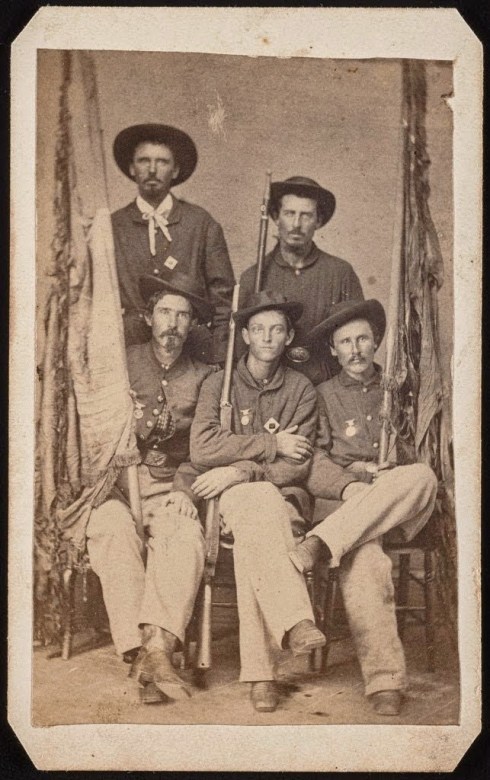
It’s easy to grasp the symbolic importance of the tattered flag image, during the Civil War and all wars really, but I never realized it was a distinct photographic genre until fairly recently. The enormous popularity of the carte de visite, the new photographic technology of the mid 19th century, accounts for many images of flags and flag bearers. Louis-Désiré Blanquart-Evrard had invented albumen printing, in which a negative photograph was printed on paper coated with egg whites (albumen) and mounted on thick cardstock, in the 1850s, resulting in a new mass media with expanded access to  photographic images. The Fort Sumter flag tour could be expanded by degrees, and remembrance of individual, regimental, state and national service and sacrifice recorded for posterity. Tattered flags became “relics” of the war, both in the hands of their bearers and simply standing there in their distressed state. Here are a few of my favorite images among the collection of “Tattered Flag CDVs” (actually the their preferred term is “battle-torn”) at the Library of Congress:

19th Massachusetts; 7th Connecticut; 4th New Hampshire; 44th New York; 30th Ohio; 21st Mississippi, Library of Congress.

The images above were public: I’m wondering if war-torn flags confiscated during battles were also made so. The American Civil War Museum has a large collection of confederate flags captured by Union soldiers and the National Archives has an inventory entitled “Records of Rebel Flags Captured by Union Troops after April 19, 1861” (RG 94). Every state historical society or museum or state house has a collection of war-torn flags, “brought home” during or after (sometimes well after) the war. Sometimes there is just an assemblage of scraps and threads, or perhaps just a material outline of what is sometimes referred to as a “ghost” flag: and like any ghost, it is haunting.

Flag of an unidentified unit. Captured at the battle of the Wilderness, Virginia, May 12, 1864 by Lt. Benjamin Y. Draper, 1st Delaware Infantry and scraps of a confederate flag confiscated (and divided) during the occupation of Richmond by troops from Springfield, Massachuesetts, American Civil War Museum. Remnants of the 95th Pennsylvania and 1st Massachusetts flags, Cowan’s Auctions and Morphy Auctions.

Can’t We Copy Concord?

The Concord Museum has been one of my favorite local history museums for some time, but I haven’t been there since the completion of a major expansion and reinterpretation initiative during the Covid years. Late last week I found myself with some free time and so off to Concord I went. I was impressed with the update, but just like the last time I visited, I could only really see the Concord Museum through the prism of a missing Salem Museum: I walked through the exhibits, which manage to be both chronological and thematic, sweeping yet very focused, thinking: Concord had this, but Salem had more of this, and also that! Salem did that first! OMG I can imagine a perfect Salem exhibit just like this Concord one, just change the names. And ultimately: can’t Salem just copy Concord? Why can’t Salem have a Concord Museum?  This is really not fair to the Concord Museum, which should be viewed on its own merits rather than comparatively, but lately (well, not so lately) I’ve become obsessed with the idea of a comprehensive Salem Museum which lays out ALL of Salem’s history in a chronological yet thematic, sweeping yet focused way: from the seventeenth through the twenty-first century, first encounters to Covid. It should be accessible and inclusive in every way, downtown of course, and it must be a collaboration between the City and the Peabody Essex Museum, because the latter possesses the greater part of Salem’s history in textual and material form. Really lately, I’ve come to think of Salem as experiencing an invasion of the body snatchers scenario, in which all of its authentic history has been detached to another town, only to be replaced by stories that are not its own: real pirates from Cape Cod, vampires who could be from anywhere and everywhere. Can’t we tell the real story, and the whole story?

So, with apologies to the Concord Museum, I’m turning it into a sort of template while also (I hope!) presenting its exhibits in some interpretive and topical detail. The museum lays out an essentially chronological view of Concord’s history, while first identifying Concord’s most prominent historical role, as a center of the emerging American Revolution, and both acknowledging and examining its regional indigenous history. Then we stroll though Concord’s history, which is told through both texts and objects, and lots of visual clues asking us to look closely.

Indigenous regions & English plantations: the Concord Museum explores the land negotiations in detail.[Salem also posseses a 17th century land-transfer document, held at City Hall. The 1686 “Original Indian Deed” of Frank Cousin’s photograph below features many more signature marks of Native Americans, testifying to a more complicated negotiation? I don’t really know: it’s not part of Salem’s public history.]

“Original Indian Deed” at Salem City Hall, c. 1890, Frank Cousins Collection at the Phillips Library of the Peabody Essex Museum via Digital Commonwealth.

You walk through the Concord Museum viewing exhibits in chronological order, but there are necessary tangents, and the biggest stand-alone exhibit is devoted to the events of one day: April 19, 1775. This is a new permanent exhibit, and it utilizes all the latest technology of visual storytelling while at same time focusing on the personal experiences of those involved. The famous Doolittle images, rendered dynamic, rim the perimeter of the exhibition room and a large digital map illustrates the events of the day. There’s a lot of movement in this room! We also hear from some of the participants and see the texts and objects which highlight their experience. How does one get ready for a Revolution? How does war affect daily life?

[Obviously, in a Salem Museum, one permanent exhibit would have to be devoted to the Witch Trials: interpreted not only as a story but as a collective and contextual experience. Apart from 1692, Salem should be paying a lot more attention to its Revolutionary role(s): not just Leslie’s Retreat, but also its brief role as a provincial capital and those of all of its privateers! Real Salem privateers.]

There is a continuous emphasis on how individuals experienced and shaped their world in the Museum’s exhibits, encompassing both big events, pressing issues, and daily life. We learn about the African-American experience in Concord through both official documents and the lives of two black families in town: the Garrisons and the Dugans, whose members were acquainted with both enslavement and freedom. Thomas Dugan’s probate inventory is posted, alongside a display of the possessions listed thereon. Concord’s dynamic abolitionist movement is another window into the institution of slavery, but it is not the only one. As would certainly be the case with a Salem presentation, abolition provides an opportunity to showcase female agency, and the Museum’s exhibits do not disappoint. But again, all I could think of was: Salem’s Female Anti-Slavery Society predates Concord’s Ladies’ Anti-Slavery Society by several years, AND it was desegregated because it was an extension of the first female abolitionist society in Salem, which was founded by African-American women.

The Museum’s exhibits on slavery and abolition: Mary Merrick Brooks was a particularly active member of the Ladies’ Anti-Slavery Society, and because her husband did not support its efforts, she sold her own tea cakes; “potholder quilts” were made up of squares like this one, which were also sold at Ladies’ Anti-Slavery Fairs in Concord (as well as Salem).

[The Histories of Slavery and Abolition illustrate the Salem problem really well, as there has been lots of research into both over the past few years by several institutions, including the Salem Maritime National Historic Site, the Peabody Essex Museum, and Hamilton Hall. But their efforts are all SILOED, and this prevents the diffusion of a comprehensive history of both to residents and visitors alike. Salem Maritime has developed walking tours and a research guide into African-American history in Essex County, the PEM is currently exhibiting an examination of school desegregation in Salem, and Hamilton Hall has had lots of materials and texts pertaining to the Remond Family on its website for several years, but are all these resources really getting out there? A common space and place for historical collaboration and exhibition would amplify all of these efforts considerably. We have so much information, from Salem’s 1754 Slave Census entry (below), to the recently-rediscovered 1810 Census for Salem, to the digitized records of the Salem Female Anti-Slavery Society (credit to the PEM’s Phillips Library for getting both the Census and the SFASS records out there), to the abolition petitions digitized by Harvard: but it’s not being used to tell a cohesive and comprehensive story! The Concord Museum has an Uncle Tom statue which once belong to Henry David Thoreau, but the Salem Museum could display an Uncle Tom’s Cabin card game manufactured by the Ives Brothers in 1852.]

There were 83 enslaved persons in Salem in 1754 according to the Massachusetts Slave Census of that year.

Like Salem, Concord has many heritage sites, so I imagine the Concord Museum serves as an orientation center from which people can go on to visit the Alcott’s Orchard House, Minute Man National Historical Park, or Walden Pond (among other places!) The Museum has reproduced Ralph Waldo Emerson’s parlor—while the actual room is just across the way–and utilized digital technology to enhance its interpretation. There’s also a great exhibit on Henry David Thoreau, but Louisa May Alcott and Nathaniel Hawthorne seem a bit short-changed—maybe there’s an evolving emphasis? A Salem Museum would have a host of public intellectuals to juggle as well. Lots of material objects “made in Concord” or purchased in Concord and we also get to learn about the town’s conspicuous visitors—some of whom stayed at the famous Old Middlesex Hotel. [it would be so much fun to research an exhibition on who stayed at Salem’s equally famous Essex House.]

Details from the Concord Museum’s Emerson and Thoreau rooms—the star is one of several placed by Concord antiquarian Cummings E. Davis, whose collection is essentially the foundation of the Museum, along a trail in Walden Woods to lead people to Thoreau’s cabin. Loved this image of the Old Middlesex Hotel which seems to have played a hospitality role similar to that of the Essex House in Salem, below (an 1880 photograph).

I’m skipping over a lot, as there was a lot to see, so you’ll have to go to the Museum yourself, but I did want to mention its engagement with Concord’s storied history as well as the documented past. Concord is a famous place, just like Salem, and so there is an obligation not only to present the past but also to address how the past has been presented, to take on “Paul Revere’s Ride” as well as April 19th. I really liked how the Museum presented the process of commemorating the Battles of Lexington and Concord a hundred years later, chiefly through the commission of Daniel Chester French’s Minute Man statue. A photograph of a group of disenfranchised Concord women surrounding the statue at its unveiling on April 19, 1875 makes a big statement, especially as Louisa May Alcott, present on that day, later noted that women could not march in the grand parade unescorted or even sit in the stands to listen to speeches of the day (maybe this was a blessing).


Lilac Days

Lilacs are so ubiquitous in New England in May that you tend to overlook them, but over the past pleasant days I have been seeking them out in some of my favorite spots. I’m always so conflicted during this month, as my academic responsiblities conflict with my desire to immerse myself in all things horticultural. Over the last few weeks, I missed both Lilac Sunday at the Arnold Arboretum, as well as the peak spring blooming at the Stevens-Coolidge garden in North Andover. But I finished my grading over the weekend, and found myself going to and from my family’s house in York Harbor, Maine on my own wayward routes, chasing lilacs along the way. I saw lilacs by the sea, lilacs in town, lilacs in the country, lilacs by front doors, back doors, bulkheads, gates, and many many fences.

Starting out in York Harbor yesterday (where it seems to me that there were many more lilacs in the past; I guess childhood memories are always like that!), then on to Portsmouth, where lilacs peaking through garden gates and alongside foundations lured me into Strawberry Banke. I really loved the garden at the Nutter House, the boyhood home of author Thomas Bailey Aldrich–this last lilac bush is in the garden his wife designed for him later and it is at least a century old. More on this garden later in the summer!

From Portsmouth, I drove to North Andover, as I decided to visit the Stevens-Coolidge garden even though I knew the tulips would be a bit past their peak: it’s still a lovely garden! Not many lilacs though: just a couple of tall hedges, which were waving constantly on this very breezy day. North Andover is an old town, so I knew I’d find some lilacs peaking out from any number of places, and I was not disappointed: they enclose several venerable house lots, the Parson Barnard House included.

From North Andover I headed home on the old Salem Road that takes you through Middleton and Danvers: bound for the beautiful Glen Magna garden in the latter town. I ended the day in a purple haze, but also with lots of gratitude and appreciation for the North Andover, Topsfield and Danvers Historical Societies, which maintain all these properties in such beautiful condition. From my jaded Salem perspective, the absence of cash-cow commodification of heritage sites is so welcome and refreshing. I visit the Glen Magna garden all summer long, and view it much in the same way that its founder and his successors, the Salem merchant Joseph Peabody and several generations of the Endicott family, must have: as a retreat from bustling Salem. Of course I can’t set myself up in the house like they did, but I’m very grateful for the open garden! The last Endicott to summer at Glen Magna, William Crowninshield Endicott, Jr., brought the 1794 summer house designed by Samuel McIntire for the Derby farm on Lowell Street in Peabody to Glen Magna in 1901. This amazing structure is worth a visit at any time of the year—it looks just as strking in the midst of winter as it does in the midst of all this green, and purple.

Lilacs against the Parson Capen House’s barn, and the gardens at Glen Magna.


Selling Seeds

A rather fluffy post on seed packets for this week: it’s grading time! This combination of gardening + paper, two of my favorite things, is irresistable to me at all times, but I have also noticed a trend over the last decade or so. I was thinking about my 2007 wedding the other day, as our anniversary coming up at the end of the month. The reception was held outside under a fairytale tent at the House of the Seven Gables, and so there was not much decoration, just some beautiful simple arrangements to complement the colonial revival garden. With that theme in mind, I made my own seed packets with custom labels for favors, as it was next to impossible to find decorative packets at the time. Now there are many sources for packets with striking graphics, with or without seeds! I seldom sow seeds, but whenever I have, I’ve always purchased the most decorative packets I could find: Renee’s Garden Seeds and Monticello were my go-to purveyors, and the Hudson Valley Seed Company, which has always had the most creative packets. These are still great sources, but there seem to be many more now; this particular post was inspired by some gorgeous packets designed for the Italian seed company Piccolo by the London-based studio Here Design. These packets look like little Penguin books, another obsession of mine! Once I saw them, I knew I was not up to date in the dynamic development of seed packets, so I dug in and looked for more.

Hudson Valley Seed Co. and Monticello seed packets; Piccolo packets by Here Design, London; Floret’s Flower Farm Seeds by illustrator Nina Sajeske, with design by Nicole A. Yang; Row 7 vegetable seeds; Baker Creek Heirloom Seeds; Lesley Goren’s packets for Artemesia Nursery in California; Anellabees Pollinator Seed Blends at Terrain; Kew Gardens seed packets, which are beautiful but unfortunately not available in the US.

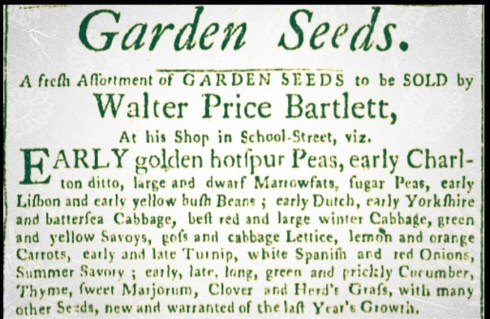
Going back a bit: because of course I’ve got to delve into the history of the seed packet, which seems to be an eighteenth-century innovation here in the United States. It is tied to, and illustrative of, the emergence and development of a commercial retail market for gardening supplies. Usually the D. Landreth Seed Company, founded in 1784 in Philadelphia by brothers David and Cuthbert Landreth and still very much in business, is given credit for the first seed packets, but a few years ago some packets were found in the eaves of the eighteenth-century Woodlands Mansion just up the river from the famous Bartram’s Garden in Philadelphia (clearly a horticultural nexus): whether they were for storage or sale is unclear. There were several seed shops in Salem in the mid and later 18th century, like Mr. Bartlett’s below, but I have no idea how they sold their seeds: perhaps people just came in and grabbed a handful? In any case, moving forward into the nineteenth century, there is no doubt that the entrepreneurial Shaker colonies were pioneers in the mail-order seed trade, to which many plain “papers,” or packets testify.

Essex Gazette 27 April 1773; Shaker, Landreth & Woodlands seed packets.


An Array of Amazing Caterer-Abolitionists!

I’m starting to work on the proposal for a book on Salem history to be published for the city’s 400th anniversary in 2026. This would be a joint enterprise: I have a colleague (and collegial) co-editor, Brad Austin, and we hope to have contributions from as many members of Salem State’s History Department as possible. Brad came up with the tentative title, Salem’s Centuries: 400 Years of Culture, Conflict, and Contributions, and we already have chapter proposals on topics ranging from the material culture of witchcraft in the seventeenth century to Catholic women in the nineteenth century to initiatives in support of Jewish refugees in the twentieth. As usual, I’m kind of in an odd spot: I’m not an American historian and my academic expertise is winding down just when Salem’s history is beginning! But I do think I have learned some things here, and so I’ve committed to chapters on the Remond family in the nineteenth century and urban development/preservation in the twentieth. I’m going to trust my co-editor and my colleagues who have more authority in these eras to prevent me from embarassing myself! For the Remond chapter, I want to use the family’s hospitality and provisioning roles as avenues into civic life in Salem during the early Republic. I’m fascinated with the idea that John and Nancy Remond, in particular, were catering events for institutions which excluded them. I always thought they were exemplary (and I still do, in many ways), but it turns out that there were actually many African-American caterers working up and down the Atlantic seaboard under similar conditions, pursuing their professional careers in civic settings while at the same time working to advance their civil rights. Despite the identification of African-American caterers in Philadelphia as “as remarkable a trade guild as ever ruled in a medieval city… [who] took complete leadership of the bewildered group of Negroes, and led them steadily to a degree of affluence, culture and respect such as has probably never been surpassed in the history of the Negro in America” by no less than W.E.B. Du Bois in his Negro in Philadelphia: A Social Study (1899), I know very little about these powerful purveyors. This is a perfect exemple of the potential pitfalls I am confronting with this project: I know a lot about the Remonds and their Salem world, but very little about the national context in which they lived and worked.

The Remond menu for the 200th Anniversary of the Settlement of Salem Dinner at Hamilton Hall in September of 1828 (I’m not sure why this was not held in 1826?), Phillips Library, Peabody Essex Museum.

Clearly I’ve got to up my game, but this effort will not be a hardship if I get to learn about people like these amazing caterer-abolitionists:

Joshua Bowen Smith (1813-1879): a Pennsylvania native who became a prominent Boston caterer and abolitionist, and later a Massachusetts state senator. Smith catered for Harvard University and many prominent Boston families including that of Robert Gould Shaw, with whom he was reportedly quite close. He was also a close friend of Massachusetts Senator Senator Charles Sumner (along with George T. Downing, below). Smith employed African-American refugees from the South in his business, and aided them in numerous ways through his membership in Boston’s Vigilance Committee, his participation in the Underground Railroad, and his foundation of the New England Freedom Association. Neither his abolitionist activism or his connections aided him when he was stiffed by his fellow abolitionist Governor John Andrew, who refused to pay a $40,000 bill submitted for catering services for the 12th Massachusetts Regiment of Volunteers. Andrew claimed that the legislature had not appropriated the funds, but managed to pay other provisioners without appropriations. Smith was consequently in a financially-vulnerable situation for the rest of his career, but this did not stop his public service.

Joshua Bowen Smith, Massachusetts Historical Society; Bill of Fare for the 75th Anniversary of the American Revolution Dinner for the Boston City Council, 1851. Boston Athenaeum Digital Collections.

Thomas Downing (1791-1866): I think I’ve called John Remond an “oyster king” a few times, and he certainly earned that title in Salem, but his contemporary Thomas Downing was the original Oyster King of a bigger kingdom: New York City. Downing was a native of Chincoteague Island off Virginia (one of my favorite places as a child because of my love for Marguerite Henry’s Misty of Chincoteague: my pony’s name was Chinka), the son of enslaved and then freed parents. He made his way north as a young man, spending some time in that foodie mecca Philadelphia, and then came to New York where his skills as both an oysterman and an entrepreneur enabled him to open the ultimate oyster establishment in 1825. By all accounts, Thomas Downing’s Oyster House was a cut (or several) above all the other oyster “cellars” in New York City, and so it attracted a more genteel, monied, and political crowd. Downing expanded the scale of both his establishment and his business over the next decade, filling mail orders for an international clientele (including Queen Victoria!). Just like John Remond in Salem and Joshua Bowen Smith in Boston, he was also very active in several abolitionist efforts: he founded the Anti-Slavery Society of New York as well as the refuge aid Committee of Thirteen, and worked for both school and transportation desegregation. I’m sure he and John Remond would have heard OF each other, but I’m really curious if they knew each other: they seem to be moving forward on tandem tracks. Downing was definitely the king of PICKLED oysters, which Remond also offered, but I don’t think the New Yorker moved into the latter’s lobster territory.

A stoneware pickled oyster jar from Thomas Downing’s Oyster House (New York City Historical Society) and a handbill for John Remond’s pickled oysters (Phillips Library, Peabody Essex Museum).

George T. Downing (1813-1903): followed in his father’s footsteps in both his profession and his activism, though primarily in a different setting: Newport, Rhode Island. It’s difficult to discern the difference between a restauranteur and a caterer in this period, but Downing Jr. seems to have operated as both with his establishments in Newport and his role as manager of the Members’ Dining Room at the U.S. House of Representatives in Washington from 1865 to 1877. This position was preceded by a long struggle to desegregate the Newport schools: the Remonds had removed to Newport during their own struggle for school desegregation in Salem in the later 1830s, so I’m pretty certain there is a connection here. Both before and after the Civil War, Downing Jr. was active in all of the abolitionist and equal rights organizations which his father and circle supported, always striving for more equality, more access, and more opportunities for African-Americans.

George Thomas Downing and his family, Rhode Island Black Heritage Society. What I would give for a photograph of all of the Remonds!

Robert Bogle (1774-1848): the first of the emerging Philadelphia African-American “caterers’ guild” referred to by Du Bois above; in fact, Bogle is often credited as not just the first African-American caterer but the first caterer, period (although the term was not used until after his death). He merged the professions of caterer and funeral director in Philadelphia for several decades, inspiring Nicholas Biddle to pay tribute to Boggle in 1830 as one whose “reign extends oe’r nature’s wide domain begins before our earliest breath nor ceases with the hour of death.” Bogle’s Blue Bell Tavern opened in 1813, and soon became famous for its meat pies and terrapin creations as well as a gathering place for Philadelphia’s political leaders: this is the hospitality entrée that accomplished caterers of any color could obtain, but perhaps one of the few avenues of access for African-Americans in the nineteenth century. Indeed, the wonderful digital exhibition on the life and work of an enslaved Charleston cook presented by the Lowcountry Digital History Initiative at the College of Charleston observes that the multi-faceted role of caterer was “one of the few, and most lucrative, prominent public positions that could be acceptably filled by an African American during slavery.”

Nat Fuller (1812-1866): It must have been difficult enough to be an African-American caterer in the North during this period, just imagine what that role would entail in the south! Fortunately we don’t have to imagine because we have this great digital exhibition: Nat Fuller’s Feast: the Life and Legacy of an Enslaved Cook in Charleston. As an enslaved teenager in Charleston in the 1820s, Nat Fuller was apprenticed to a remarkable free African-American couple who seem to be playing the same culinary and catering roles in Charleston that John and Nancy Remond were occupying in Salem, at the exact same time: John and Eliza Seymour Lee. Charleston John was the event manager for several venues; his wife Eliza the famous cook and pastry chef. After Nat Fuller completed his culinary training under Eliza, he worked as an enslaved cook for his slaveholder William C. Gatewood, an ambitious man who entertained frequently, for the next three decades under “evolving” conditions: in 1852 Gatewood agreed to let Fuller live outside of his household with his wife Diana (another famous pastry chef) under the so-called “self-hire” system. The Fullers began to operate independent provisioning and catering businesses in Charleston, paying Gatewood a percentage of their profits. By the later 1850s, though still enslaved, Fuller was Charleston’s “well known” and go-to caterer, staging elaborate events like the Jubilee of Southern Union dinner celebrating the completion of a railway between Memphis and Charleston in May of 1857 for 600 guests. In the fall of 1860, though still enslaved, Fuller opened his famous restaurant, the Bachelor’s Retreat, operating it throughout the war except for a few periods of illness and relocation, and at which, as a newly-free man, he hosted a dinner celebrating the end of the war and slavery in the spring of 1865. Abby Louisa Porcher, a white Charleston lady, documented this momentous event in a letter soon afterwards: “Nat Fuller, a Negro caterer, provided munificently for a miscegenation dinner, at which blacks and whites sat on an equality and gave toasts and sang songs for Lincoln and freedom.” Perhaps Fuller could not operate as a caterer-abolitionist like his colleagues in the North, but he emerged as an advocate for racial equality as soon as he was enabled. He died in the next year.


Appendix: you can read all about the “reenactment” of Nat Fuller’s Feast on the occasion of its 150th anniversary in 2015 here; Invitation below. Another prominent southern African-American caterer, John Dabney of Richmond, was born into slavery, is the subject of a beautiful documentary, The Hail-Storm. John Dabney in Virginia, which you can watch here.


Skirting Witches and Pirates in Salem

Walking is my preferred form of transportation in Salem, but I tread carefully: I want my path to be lined with beautiful old houses, colorful shops and lovely green (or white) spaces. Attractions exploiting the terrible tragedy of 1692 and out-of-town-yet-territorial pirates cloud my view and dampen my day. I’m happy to meet real witches and pirates on my walkabouts, but kitschy parodies annoy me. If you are of like mind, there are many routes you can take in Salem on which you will not cross paths with anything remotely touristy, but if you are venturing downtown you must tread carefully too. Avoid the red line at all costs and follow my route below, which I have superimposed on an old map of the so-called “Heritage Trail”: I’m starting at my house on lower Chestnut Street and making a witch-less circle.

Across from my house is Chestnut Street Park: this is not a public park but a private space, owned by all the homeowners of Chestnut Street. It was once the site of two churches in succession: a majestic Samuel McIntire creation which lasted for almost exactly a century and was destroyed by fire in 1903 and a stone replacement which was rather less majestic and lasted about half as long. The gate is usually open to everyone, but not for reseeding time as you can see by the sign. I walk down Cambridge Street by the park and across Essex into the Ropes Mansion Garden, not looking great now but an amazing high summer garden. Then I walk down Federal Court and across Federal Street to the Peirce-Nichols House which is owned, like the Ropes Mansion, by the Peabody Essex Museum. Unlike the Ropes, I can’t remember when the Peirce-Nichols was last opened to the public: it’s been decades. It has a lovely garden in back which was always open, and my favorite place to go at this time of year because of its preponderance of Bleeding Hearts. The gate to the back of the house has been closed for a couple of years now, but it is latched and not locked, so I entered and went into the rear courtyard, passing the memorial stone dedicated to the memory of Anne Farnam, the last director of the Essex Institute before it was absorbed into the Peabody Essex Museum on my right. I never knew Anne but I’ve learned a lot from her articles in the Essex Institute Historical Collections so I always pay tribute. The gate to the garden in back was latched and locked, so I presume the museum does not want us to venture in there. I hope it was ok to go that far! While I am grateful for these pem.org/walks recordings I’m always wondering why these houses are never open.

Continue down Federal Street past the courthouses: you must avoid Lynde Street and Essex Street where witch “attractions” abound. I take a left after Washington street onto a street that no longer exists: Rust Street. I like the juxtaposition of the newish condominiums and the old Church and Bessie Monroe’s brick house on Ash Street on the right: a symbol of the opposition to urban renewal in Salem. Then it’s on to St. Peter Street, past the Old Jail and the Jailkeepers’s House (below), right on Bridge, and then right again, onto Winter Street.

Winter Street

As you approach Salem Common, you must bear left and head for the east side, as the west side is the territory of the Salem Witch “Museum.” There are some side streets with wonderful houses between the Common and Bridge Street which might be a bit more pleasant to traverse than the latter but you will be cutting close to the “Museum”: that’s why I always go with Winter. Once there, go straight by the Common on Washington Square East : you will pass the newly-renovated Silsbee Mansion, which long served as the party palace Knights of Columbus and has been converted into residential units with a substantive addtion and exterior restoration, and one of my favorite houses on the Common, the Baldwin Lyman House.

On Washington Square East.

Washington Square East will take you right to Essex Street: cross and go down the walkway adjacent to the first-period Narbonne House into the Salem Maritime National Historic Site. No witches or pirates here: you’re safe! I love the garden behind the Derby House: I think it is probably at its best in June when the peonies are popping but it’s a great place to go all spring and summer and even in the fall. On Derby Street, you can turn left and go down to the House of the Seven Gables or go straight down Derby Wharf: I went to the end of the wharf on this particular walk. The Salem Arts Association is right here too, but beware: there is a particularly ugly witch on its right so shade your view lest your zen walk be disturbed.

Salem Maritime National Historic Site and the Salem Arts Association.

Back on Derby. Adjacent to the Custom House is a wonderful institution: the Brookhouse Home for Women, established in 1861! The Home is located in the former Benjamin Crowninshield Mansion, and it is very generous with its lovely grounds, which provide my favorite view of Derby Wharf. I always stop in here, and then I work my way back up to Essex Street on one side street or another. Essex Street east and west are wonderful places to walk, but the pedestrian-mall center is witch-central: a particularly dangerous corner is Essex and Hawthorne Boulevard, where the Peabody Essex’s historic houses face some of the ugliest signs in town. It’s a real aesthetic clash: gaze at the beautiful Gardner-Pingree House, but don’t turn around! If you want to go to the main PEM buildings or the Visitors’ Center further down Essex, approach from Charter Street north on another “street” that no longer exists: Liberty Street.

From the Brookhouse Home to the PEM’s row of historic houses on Essex Street. Memorial stone in the Brookwood garden: Miss Amy Nurse, RN, an Army Nurse (1916-2013).

Charter Street is the location of Salem’s oldest cemetery, the Old Burying Point, recently restored and equipped with an orientation center located in the first-period Pickman House, which overlooks the Witch Trials Memorial. So this is a wonderful, meaningful place to visit, but beware: just beyond is the “Haunted Neighborhood” or “Haunted Witch Village” (whatever it is called)  situated on the southern end of the former Liberty Street, abutting the cemetery. This is a cruel juxtaposition during Haunted Happenings, when you literally have a party right next to sacred places, but not too noticeable during the rest of the year, because for the most part witchcraft “attractions” create dead zones. But the tacky signage can still spoil your walk so avert your gaze as much as possible. Charter Street feeds into Front Street, Salem’s main shopping street, and from there you can find the path of least (traffic) resistance back to the McIntire Historic District, which is very safe territory. Broad, Chestnut, upper Essex and Federal Streets are lined with beautiful buildings, as are their connecting side streets, so take your pick. I usually just walk around until I get in my 10,000 steps: on this particular walk I ended up on Essex.

Charter, Front & upper Essex Streets.


The Eminent Antiquarian

I have been meaning to post on the most eminent of Salem’s antiquarians, Henry FitzGilbert Waters (1833-1913) for a while, but I kept finding more information about him and thought I’d wait until I had the total picture: but clearly he is one of those people for whom references will always appear and it will be impossible to draw the total picture unless one is doing so in the form of a longer piece or even a book. His papers are at the Phillips Library in Rowley, so that might be an interesting project for someone, as genealogy is so popular right now and he is clearly one of its pioneering professional practicioners. But for (or from) me, just a little introduction. Salem produced a succession of eminent antiquarians—-Joseph B. Felt, Sidney Perley, George Francis Dow—so calling Henry F. Waters the most eminent is a big statement, but I think he was: his combinantion of intense genealogical research and incessant collecting gave him a very public status in the later years of his life, and after. And he was the New England Historical and Genealogical Society’s first “foreign agent!” In the obituary written by his friend and Harvard classmate James Kendall Hosmer for the January 1914 issue of the NEHGS’s Register, Hosmer calls Waters “the most eminent antiquarian of his time, perhaps of all times,” so I am just following suit.

Waters in his uniform at the beginning of the Civil War (he served with Co. F, 23rd Regiment, Massachusetts Volunteers until he came down with rheumatic fever followed by yellow fever and then in hospitals after his recovery) and in the facing pages of his publications; portrait by Salem artist Isaac Caliga in the bottom right corner.

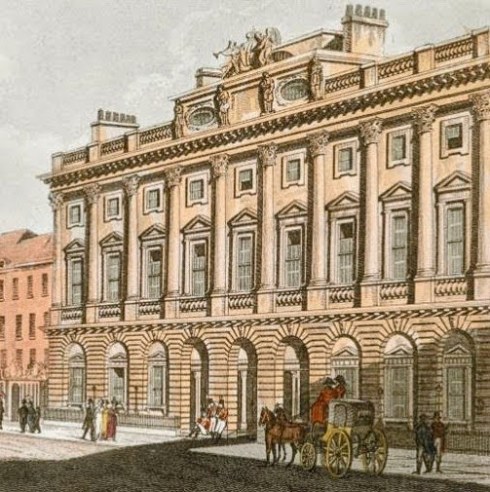
Waters grew up in Salem and went on to Harvard and service during the Civil War, after which he returned to his native city and dabbled according to Hosmer: he “was engaged not earnestly in educational work, collected old furniture, and pored over old documents.” He lived with his parents and unmarried brothers at 80 Washington Square, a c. 1795 McIntire mansion on Salem Common which belonged to his mother’s family (the Townends—who seem to be the reason for his ability to dabble, though his father was a judge). This house was obviously very important to him, as it was his primary residence for his entire long life, but I believe that another “house” was even more important to him: Somerset House in London, a grand classical building on the Strand which is now an arts center, but was the principle probate records repository during Waters’ lifetime—and long after. Waters went to London for the first time in 1879 with his friend Dr. James A. Emmerton (a medical doctor who also preferred to dabble) and they dove into these and other records, looking for anything and everything that might pad the pedigrees of New England families. They were very successful, and published genealogical “gleanings” in both the Historical Collections of the Essex Institute and the Register. Requests for more research were forwarded to both institutions, and in 1883 Waters returned to London as the first salaried “agent” of the New England Historical and Genealogical Society. He remained there (with occasional trips back home) for the next 17 years, during which he traced the lineages of just about every Salem mercantile family and established a national reputation through the continual publication of his genealogical research in journals and books as well as his detailed ancestries of John Harvard, Roger Williams, and George Washington.

80 Washington Square in the 1890s, Frank Cousins Collection at the Phillips Library via Digital Commonwealth; Somerset House in London, Rudolph Ackermann, 1809, British Library; An Examination of the English Ancestry of George Washington: Setting Forth the Evidence to Connect Him with the Washingtons of Sulgrave and Brington (1889).

Waters is credited by his contemporaries with “historical” discoveries as well as genealogical ones: I’m always a bit suspect of archival “discoveries” as that word slights the efforts of archivists, something I am always reluctant to do! But Waters brought several seventeenth-century maps to light, at least over here, including what became known as the “Winthrop-Waters Map” of the coast of Massachusetts c. 1630 and a colored map of Boston Harbor in 1694 which he had copied, as well as Samuel Maverick’s Briefe discription of New England and the severall townes therein: together with the present government thereof (1661) which had been purchased by the British Library several years before his arrival in London. I really think we should term these American discoveries, but they are very much in keeping with Water’s role as a retriever of textual and material heritage.

Copy of “A Draught of Boston Harbor: By Capt. Cyprian Southake, made by Augustine Fitzhugh, Anno 1694;” made for H. F. Waters, Esq., from the original in the British Library, copyright New England Historical and Genealogical Society.

On to the material. Waters’ lifetime closely coincides with the rise of Colonial Revival culture in New England, although he had a headstart on collecting: Hosmer and other observers state that he was able to get the good stuff before antiquing became fashionable and New England became picked over. The authors of the first books on American antiques all referred to him, and Dr. Irving Lyon, the author of the popular and influential The Colonial Furniture of New England is positively deferential, showcasing seventeenth-century chests, a desk and a chair, and other items from the “Waters Collection.” It was clearly all about the seventeenth century for him; I presume he believed that Salem’s Federal-era furniture was appreciated sufficiently in his day.
Furniture from the “Waters Collection” in Irving Lyon’s Colonial Furniture of New England; Essex County cabinet, c. 1670-1710, from the collection of “noted” antiquarian Henry F. Walters, Yale University Art Gallery; An English chair brought to America in the 1630s from Walters’ collection, Museum of Fine Arts, Boston.

This was a man who was appreciated during his lifetime, and after, but I think there is still more to discover and emphasize about him. We could embellish his role as Colonial Revival “influencer”: former Peabody Essex Museum curator Dean Lahikainen emphasized this role in relation to Salem artist Frank Weston Benson in the PEM’s 2000 Benson exhibition. Waters had tutored Benson and his brothers who grew up nearby on Salem Common and several of Benson’s paintings featuring interiors included items from the Waters collection or inspired by it. I think that Waters’ educational roles are a bit underemphasized: he was a gentleman tutor for sure: but he also held formal teaching positions at different times in his life and served on the Salem School Committee. His family is very interesting: he proudly served in the Massachusetts Massachusetts 23rd and in the medical corps, but several of his Waters cousins owned and operated plantations in the south—in Georgia and Louisiana (The Waters Family papers at the Phillips Library in Rowley will yield many “discoveries”, I am certain). And there is also more to say about his genealogical methodology, which I think would be of interest to contemporary genealogists. Salem is projecting a strong and rather stodgy heritage profile during the dynamic Gilded Era, and Mr. Waters was one of its most prominent exemplars.


Salem as Historyland

For the most part, this blog has been an academic release for me rather than academic engagement: I consider most of the history I’ve offered up here more pop-up than professional. But there is one academic field with which I have been engaging (mostly in the form of learning) continuously: the history of tourism. This is a relatively new field, emerging in the 1990s, but also a very interdisciplinary and important one, involving social, cultural, and economic factors interacting at local, regional, and global levels. There’s a Journal of Tourism History, several academic book series, and an emerging taxonomy: the general category of Heritage Tourism, for example, can be broken down into more specialized endeavors: literary tourism, thanatourism (also called Dark Tourism, focused on visitation to sites of death and suffering), legacy (genealogical) tourism. Salem became a tourist designation in the later nineteenth century, and from that time its projections have included all of these pursuits. With the bicentennial of the Salem Witch Trials in 1892, witches started appearing everywhere, but Nathaniel Hawthorne represented stiff competition in the opening decades of the twentieth century, particularly after the centennial commemoration of his birth in 1904 and the opening of the House of the Seven Gables in 1910. Over the twentieth century Hawthorne waned and the witches ultimately triumphed, but at mid-century there was a relatively brief span when Salem and its history were both perceived and presented more broadly, as an essential “historyland” which one must visit in order to understand the foundations of American civilization. The major periodicals of the 1940s and 1950s, including Time, Life, American Heritage and National Geographic, presented Salem not only as a Puritan settlement, but also as an “incubator” of both democracy and capitalism with the events of 1692 subsumed by those larger themes.

I think I need to explain and qualify my use of the term “historyland” before I continue, as I’m not using it in the perjorative way that it has come to be used in recent decades: idealized history theme park where one can escape the present and have fun! The “American Way of History” in the words of David Lowenthal. Its meaning evolves, but I am using it first (more later) as it was initially applied: to a region in which much happened and much remained as material legacy to what happened. It emerges in the 1930s as a very specific reference to the area encompassing Jamestown and Colonial Williamsburg in Virginia: I believe a section of Virginia’s Route 3 is still called the “Historyland Highway.” Virginia was so great at marketing itself as Historyland (an example is upper left in the above graphic—some chutzpah to claim that the “nation was preserved” in Virginia!) that other states, like nearby Maryland and North Carolina, started using the term as well. I’m sure that every state on the eastern seaboard was jealous, and the term was extended geographically, chronologically, and conceptually when a Historyland living history park focused on the logging industry opened in Wisconsin in 1954. In the next decade, National Geographic started using the term more generally in reference to national landmarks, in the succession volumes to its popular Wonderlands guides. I don’t want to romanticize the word or its meaning too much: the history that characterized these historylands was overwhelmingly European, narrative, and a bit too focused on colonial costumes for my taste, but at least it was place-based. I can imagine that the civic authorities would have been just a bit wary about the impact of for-profit attractions peddling a story that was not Salem’s in the 1950s and 1960s, especially with the presence of so many non-profit local history museums like the Essex Institute, the Peabody Museum, Pioneer Village, and the Salem Maritime National Historic Site. Clearly that is not a concern now. In characteristic fashion, National Geographic focused on the site-specific aspects of Salem’s past and present in its September 1945 issue, focused on the Northeast. Its industrial base has created some “drabness,” but “this prosaic, utilitarian present is more than matched by an extraordinarily insistent and romantic past. Salem is literally a treasure house of early American landmarks, relics, articles, and documents of historic interest, all easily accessible and within a small area. The little city is fairly haunted by these still-visible evidences of its illustrious position, first as progenitor of the great Massachusetts Bay Colony, and later as a mistress of the seas. Unlike some larger cities of venerable age, in which population grew apace, it was unnecessary for Salem to tear down and rebuild: thus a larger proportion of memorable objects remains undisturbed.” Wow: a city which retains its treasures, was focused on preservation, and haunted by its still visible-past rather than made-up ghosts! What we have lost.

Photographs of Salem from the September 1945 issue of National Geographic, obove, and from America’s Historylands: Landmarks of Liberty (1962) below: the Witch House, secret staircase at the House of the Seven Gables, and Pioneer Village.

This total package, “treasure house” characterization continued to define Salem’s representation in national periodicals over the next two decades, during which Life, Time, and even Ladies Home Journal came to the city to take it all in: the Custom House and Derby Wharf, the House of the Seven Gables, Pioneer Village, the Essex Institute and the Peabody Museum, the Court House with its pins, the YMCA with its small Alexander Graham Bell display (see above), the recently-restored Witch House, and Chestnut Street. (And everything was open all the time! Peirce-Nichols, Derby, all those houses we can seldom enter today).  But change was coming, to they ways and means by which we interpreted the past as well as to Salem. From the late 1960s, the meaning of “historyland” took on a more negative meaning and associated “living history” attractions began to fall out of fashion, a trend that culminated with Disney’s disastrous Virginia pitch in the early 1990s. And then Samantha and her Bewitched crew came to Salem, allegedly showing it the way forward: tell one story rather than many and focus on private profits rather than civic pride. The Salem Witch Museum demonstrated that that path could be very successful, and so everybody else jumped on board: the public sanction of “Haunted Happenings” eventually transformed Salem into a full-time Witch City and undermined those institutions which were trying to tell other, or more complicated stories. Many of Salem’s textual treasures have been transferred to Rowley, but I guess we are compensated by the real pirate’s treasure from the Whydah? In recent years, the city’s tourism agency, Destination Salem, has attempted to broaden its appeal by taking advantage of the popularity of genealogical research/travel with its Ancestry Days (next week: see schedule of events here) but I wonder how far that initiative can go when most of Salem’s genealogical assets are in Rowley. Perhaps no structure represents Salem’s transition into a modern historyland, with all of its current connotations, better than the Peabody Essex Museum’s Ropes Mansion, once merely an “early home on an old street” and now the Hocus Pocus house. If I were a true historian of tourism, I could explain this transition in social, cultural, and economic terms, but I’m not there yet. Nevertheless, Salem is the perfect subject for this dynamic field: we’ve already seen some great studies, and I’m sure we’ll see more.

The Ropes Mansion in the May 16, 1958 issue of Life Magazine, and October 2021.