Anniversary History: Local Edition 2023

Looking ahead to the new year from a local history perspective, there are commemorative moments for at least six events: five European settlements and a tea party, the 250th Anniversary of the Boston Tea Party, to be precise. A century and a half earlier, there were settlements at Gloucester, Massachusetts and Portsmouth, Rye (the Pannaway Plantation) and Dover (the Cocheco Plantation), New Hampshire. The ill-prepared and -fated Wessagusset Colony was established in Weymouth, Massachusetts in 1622 but its demise came the following year after the brutal Wessagusett “Incident,” more appropriately referred to as a massacre. Commemorative history should acknowledge both the good and the bad, the heroic and the tragic, the kind and the cruel, and so the Wessagusett Massacre of March 1623, a veritable “red wedding” which harmed relations between Native Americans and English settlers for years to come, demands a spotlight. Like the first Gloucester settlement by the Dorchester Company, Wessagusett was decidedly not a plantation in the seventeenth-century sense, but rather a fishing and trading station of 60+ men financed by London merchant Thomas Weston. “Weston’s Men” were completely unprepared for the New World and by the winter of 1622-1623 they were starving, and altogether dependent on both Plymouth and the Native Americans in the region. But foodstuffs were scarce for everyone that winter, and everyone was anxious. Rumors of an impending Native American raid on both settlements drove the Wessagusett men to seek aid from Plymouth, and militia leader Myles Standish and eight men sailed a shallop to the northern settlement and issued an invitation to Massachusett tribal leaders Pecksuot, Wituwamat, and others to attend a summit during which commenced a slaughter just as they all sat down to dinner. I’m going to let Charles Francis Adams tell the tale, as he presented it in his anniversary address on the occasion of the 250th anniversary of Weymouth: the savages were taken by surprise, but they fought hard, making little noise but catching at their weapons and struggling until they were cut almost to pieces. Finally Pecksuot, Wituwamat and a third Indian were killed; while a fourth, a youth of eighteen, was overpowered and secured; him, Standish subsequently hung. The massacre, for such in historic justice it must be called, seeing that they killed every man they could lay their hands on, then began. There were eight warriors in the stockade at the time,—Standish and his party had killed three and secured one; they suddenly killed another while the Weston people despatched two more. Only one escaped to give the alarm, which spread rapidly through the Indian villages. Interesting language for 1873: savages is employed, but Adams does not refrain from calling this slaughter a “massacre” unlike many of his contemporaries who labeled it a pre-emptive strike. Several Wessagusset men also died during the massacre, and the rest opted to abandon the settlement; Standish returned to Plymouth with the head of Wituwamat on a pike in ancient English warrior fashion, “to ornament the Plymouth block-house as a terror to all evil-disposed savages” in the words of Adams. This massacre seems worthy of a bit more commemorative reflection, at least a fraction of what the Boston Massacre receives continuously.
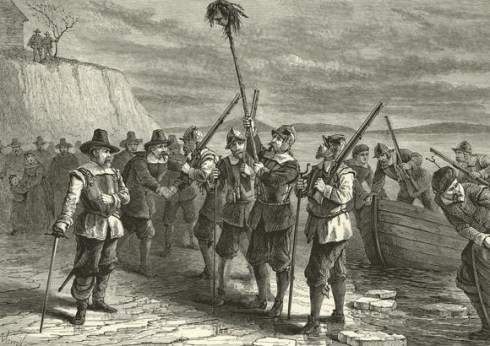
“The Return of Myles Standish from Wessagusset,” from Pioneers in the settlement of America: from Florida in 1510 to California in 1849 by William August Crafts, 1876. Ironically, nearly 300 years later (299!) Myles Standish lost his head when the Standish monument in Duxbury was struck by lightning: according to this post by Carolyn Ravenscroft, archivist of the Duxbury Rural and Historical Society, his replacement head was too heavy for the damaged “body,” so an entirely new Standish was created by Boston sculptor John Horrigon, pictured here in 1930.

I’m not sure what the plans for the commemoration of the Wessagusset Massacre are but all the early settlements have been planning their 400th anniversaries for quite some time, particularly Gloucester, which has assembled a multi-layered calendar of commemorative initiatives and offerings focused overwhelmingly on the city’s social history. I’ve been so impressed with the “400 Stories” project, which aims to collect, present and preserve stories from 400 of Gloucester’s residents from 1623 to 2023, thus connecting the past to the present. There are books, an artistic competition for a new commemorative medal, walking tours, festivals, and a gala: the evolving celebratory schedule is at Gloucester 400.

Portsmouth is all geared up too, although its big reveal party is on January 6 so I don’t know all the details. The PortsmouthNH400 site is here, and so far its signature product is a lovely bookA History of Portsmouth NH in 101 Objects, to which both my Salem State History colleague Tad Baker and alum Alyssa Conary have contributed. There’s an ongoing speakers’ series and exhibition based on the book, and on January 6 Portsmouth’s Memorial Bridge will be illuminated in blue, PortsmouthNH400th’s commemorative color. Like Gloucester, Portsmouth is also collecting stories (of 400 words) from its residents, to be compiled in a commemorative book designed to update its 350th anniversary history. Rye and Dover also have their 400th anniversary committees and calendars, derived from considerable public participation: the mission of Dover400 is “to honor our past, celebrate our present, and to inspire our future through meaningful and creative community engagement.”

The 250th anniversary of the Boston Tea Party is going to be big: after all, from the Boston perspective, it was “the single most important event leading up to the American Revolution.” I’m excited about all of the offerings by Revolutionary Spaces at the Old South Meeting House and the Old State House, including an exhibition on the power of petitions, an “immersive theatrical experience,” and various programs on the nature and expression of protest. Of course the Boston Tea Party Ships & Museum has plans as well, and is already counting down to the big reenactment on December 16, 1773. And there will be merch, including lots of commemorative tea.

Teas from Elmwood Inn & Oliver Pluff & Co.


A Big end-of-year Book Post

I always do a book post at this time of year for several reasons: it’s fun to go through the mental process of compiling “best of” lists, I like to offer gift suggestions, and the time between semesters is always one of intense reading for me. This year, I’m a little late for gift suggestions, but the two other inspirations apply: I read some great books over the past summer and I have my usual stack of unread books right by my bedside, all ready for December 26. This was the year that I published my own book, so I had more time for reading, but now I’ve just finished proposals for two new books, so the next year might not be so free (hopefully). I want to take advantage of the time that I have to read as much as I can, and I’m driven to learn more about: 1) Ukraine (because war); 2) commodities and trade in the pre-modern world (because saffron, the subject of one of my proposed books; 3) information dispersion, broadly defined (because academic+general interest); 4) the history of science (because academic+general interest); 5) early American history (because Salem, the subject of the other proposed book); and anything to do with design (just because). No fiction recommendations here, sorry: I  like fiction, I try to read fiction, but I just don’t seem to be able to finish novels at this point in my life. I put them down because I get curious about something: there are dog-eared spine-cracked books all over the house! So here goes: this is a “best of” list of what I’ve read or was on my radar in 2022 rather than what was published this year, and it’s pretty academic, but there are some fun and beautiful books here too.

Ukraine: I read Yale historian Marci Shore’s The Ukrainian Night: An Intimate History of the Revolution this past summer (and into September—it took me a while): I really learned a lot. My Ph.D. is in European comparative history, but boy, this book made me realize how little I know about Eastern Europe—and the twentieth century. The Ukrainian Night places the Crimean crisis of 2014 in historical context and thus also provides the context for the current crisis, and it is very much a personal, “intimate” history rather than an academic tome. I picked up Polish journalist Pawel Pieniazek’s Greetings from Novorossiya (2017) for more personal history of the ongoing conflict in eastern Ukraine and Timothy Snyder’s introduction: the latter (also at Yale) is my guide to everything Ukraine on Twitter (still). I imagine we’ll get “first-draft” histories of the Russian assault and Ukrainian response soon.

The demand, supply, consumption, and exchange of a range of commodities in the late medieval and early modern world are all academic and personal interests of mine, and 2022 was a banner year for books on all sorts of economic history. Any former student of mine will tell you that I believe that the Black Death was the most consequential event ever, for a variety of reasons, so I have been waiting for Belich’s book forever. It’s brilliant, and ties together all the trends and themes I have been teaching for years. I wanted to assign it to my undergrads this past semester, but I thought it would be a bit much for them. Future grad students, however, are duly “warned.” In terms of economic dominance in the world the plague made, it’s increasingly all about the Dutch, so Pioneers of Capitalism. The Netherlands 1000-1800 is a welcome book too. I like its long time span: too often the Dutch “Golden Age” seems to spring from a rather shallow pool. Anne Gerritsen’s The City of Blue and White has been by my bedside for a year or so, but I recently moved it to the top of the stack.

The City of Blue and White is definitely calling me, but it will probably have to wait until I have finished Pamela H. Smith’s latest book From Lived Experience to the Written Word. Reconstructing Practical Knowledge in the Early Modern World as I’m reviewing it for an academic journal. I wish I had read this book before I wrote my own, but Smith is a prolific and active scholar so I had the benefit of her prior publications. She teaches at Columbia, where she is also the Director of the Center for Science and Society and its Making and Knowing Project, which “explores the intersections between artistic making and scientific knowing.” There’s nothing new about “maker culture” and it was far more robust and fluid in the early modern era, when making became knowing. Jumping up a century or so and into the realm of visual information dissemination, I am obsessed with the new book series from San Francisco’s Visionary Press : Information Graphic Visionaries, edited by RJ Andrews, who told Print magazine’s Steven Heller that he is “obsessed with craft. To me, the most fascinating thing is to understand the story behind how something came to be.” That’s just how I feel, so I wish I had put these three books on my Christmas list. I’ll just have to buy them myself, beginning with volume on Emma Willard’s history maps (the “Temple of Time,” above, is just one) which are just fascinating in so many ways.

Speaking of ambitious and confident Victorians who believed in progress passionately, Iwan Rhys Morus’s How the Victorians Took Us to The Moon is a survey of nineteenth-century British innovators as well as the innovative “spirit” of their era. It’s a bit biographical for me but that approach definitely increases its accessibility. The other history of science, broadly and brilliantly focused, which I purchased this year is Lorraine Daston’s Rules: A Short History of What We Live By. I thought it would be a good aid for teaching, but I just devoured it, and find myself picking it up often: reference and readability: you can’t beat that!

My Salem State colleagues and I are collaborating on a book of essays for Salem’s 400th anniversary in 2026 and I’m going to have to do a deep dive into several periods of American history for my contributions. Since I’m not an American historian, I need some foundations, and I really like the “American Beginnings” series from the University of Chicago. Three series books are above: the first two explore a topic that my colleague Dane Morrison has been working on for a while: how trade to the East in particular and maritime history in general contributed to the formation of American identity. Dane has a book out this year too: Eastward of Good Hope. Early America in a Dangerous World. Salem was absolutely central to this expansive trade and thus to America’s emerging identify, and this is the broad context that we want for our book.

I’m just realizing that this is a very serious list so let’s lighten it up a bit! I’m not sure it’s an actual genre, but my favorite books to read for pleasure are “house stories” focused on houses and their evolution over time, along with, and because of, the people who lived in them. Here are three examples I picked up this year:

I absolutely hated the recent Netflix series on Anne Boleyn, Blood, Sex & Royality: it is that same weird hybrid documentary drama approach last seen in The Last Czars, which remains the most appalling historical “thing” I have ever seen. It’s so odd to see the main characters, actual historical people, engaging in intimacies followed by the commentary of a talking head. Anyway, one of the talking heads in Anne’s story, Owen Emerson, is one of the authors of The Boleyns of Hever Castle, which I absolutely love. I bought the book after I viewed the program, just to get all the horribly imagery of the latter out of my head, and it did. Clive Aslet’s The Story of the Country House is just wonderful, and I think Ruth Dalton’s Living in Houses. A Personal History of English Domestic Architecture (over four centuries) is going to be great too: I do hope I have time to read it. As you can see, I really need some stories of houses outside of Britain, so please send recommendations! Merry Christmas to all, and to all: try to reserve the week between Christmas and New Year’s for yourself: for reading (or whatever else you like to do).


Christmas Shopping in Salem: the Macabre and the Merry

I try to shop local whenever possible: compared to decades past, it’s not difficult as Salem seems to have become as much of a shopping destination as a dining one. But you’ve got to pick a side: goth or gleeful? dark or bright? macabre or merry? Krampus or Santa Claus? Because of the ever-increasing exploitation of the tragedy of 1692 and its contrived connection to Halloween, “witchy” shops, an aesthetic very broadly defined in Salem, have proliferated over the past few years, reaching the level of self-sustaining demand. This article asserts that Salem has become an “alt fashion hotspot” for those seeking gothic garb, and explains the supply and the demand far better than I can! Maybe you can have it both ways—there are certainly some Salem shops that manage to merge the macabre and the merry quite creatively—but with a list consisting of babies and mostly middle-aged people, I’m squarely in the Merry Christmas camp.

It’s difficult to take photographs of shop windows in the daytime, but Witch City Consignment’s windows represent Salem Christmas shopping well: all is bright but there are looming monsters!

So let’s take a walk down Essex Street from the Witch House to the Hawthorne Hotel and I’ll point out some of my favorite shops along the way and on the side streets. Remember my “merry” bias: this is not an all-inclusive tour! I’m so down on witch-kitschiness that I’ve sworn not to patronize businesses that even have “Witch City” in the name, but I have to make occasional exceptions. I can’t resist Witch City Consignment: there’s so much to see and buy there, though generally I end up buying more things for myself rather than friends or family. I can’t resist the Salem stuff and right now I’m into “apothecariana” or whatever you call it: I love these turn-of-century gold-lablel pharmacy bottles and they are on sale! Witch City Wicks across the way has great candles: I’ve been buying them from the pre-brick-and-mortar days. This section of Essex Street is pretty gothy with the looming Vampfangs and the new Blackcraft, a southern California company which transformed a Colonial Revival bank building into an all-black emporium with a red witch descending from the center ceiling medallion. I skipped the former and went into the latter, for a very brief spell. There’s a lot of black in the store, but very little craft: strictly made in China as far as I could tell. On to Town House Square past the Christmas Tree in Lappin Park.

Witch City Consignment wares; nice to see the cheery windows of the Gulu-Gulu Cafe after I left Blackcraft.

I craved more craft and more merry after Blackcraft, so I headed right for a trio of shops on the corner of Washington and Front Streets owned by a very creative and entrepreneurial couple: the brand new Spruce Home, Oak+Moss, and Roost & Company. Much shopping ensued: these shops have something for everyone, and their wares are unique yet usable, tactile and textural, both decorative and utilitarian. I scooped up napkin rings and onesies, managed to resist all manner of cocktail culture, but had to have my very own merry & bright banner!

Spruce Home and Oak+Moss.

There is great shopping on Front Street (particularly at J.Mode for women’s clothing) which runs paralell to Essex on either side of Derby Square, but I did so well at the Spruce/Oak/Roost triumvirate that I headed straight for Emporium 32 on Central, before getting back on Essex. Here we have the curation of yet another creative couple, who have packed their tin-ceilinged shop with more whimsical wares, including nostalgic Christmas decorations, jewelry, prints, very visual books, barware and outerware. It’s a great accessory shop, and also a wonderful place to shop for men with hats, gloves, and shaving stuff galore. Plus it’s just a merry place, which always cheers you up, no matter the season (and they always have the best windows, in every season). At this point, I have to admit that I had my husband with me and we had nearly reached his shopping capacity, so it was time to break for lunch at the tavern at the Hawthorne Hotel (and drinks, of course: I had this delicious blood orange & bourbon cocktail, below). 1925, the latest venture from the Emporium entrepreneurs, will be opening in the corner shop of the Hotel in the new year.

Shopping at Emporium 32 and drinks (+ food and a pointsettia Christmas tree) at the Hawthorne Hotel.

With sustenance, my husband declared he could do two more shops and no more, so we set off for the Peabody Essex Museum shop and DiehlMarcus & Company, a lovely store located in a Bulfinch building almost across from Emporium 32 on Central Street. Even when I was furious with the PEM for removing the Phillips Library to Rowley (five years ago!) I still shopped in its lovely shop: its buyers have always found the best things. This particular year, the PEM shop seems to have embraced all things Salem, commissioning little wooden replicas of all of its buildings from The Cat’s Meow. I want them all and I couldn’t possibly choose, so I “settled” for some Ropes Mansion placemats, among other items. There’s no question that more damage would have been done if my husband wasn’t with me, and I will have to return to do some actual shopping for others. It does seem a bit odd to me to be featuring all these buildings that are not presently open to the public, particularly the empty Plummer Hall, long home to the Phillips Library, and its adjoining and also-dark Daland House: maybe these little houses are a sign of future openings?

All the PEM houses! The Museum even installed a ye olde Salem Christmas neighborhood in the windows of one of its empty storefronts on Essex Street.

After DiehlMarcus, my husband dropped out and I was on my own in the shops of Church Street and at Pickering Wharf: the former is a sparkling street of signs while the latter is looking a bit shopworn, I must admit (no fault of the shopowners but rather of their landlord, of course). But I always like to buy a few things at the Marble Faun at the Wharf, a book and gift shop for anglophiles and Hawthorne-philes (more books at the PEM shop and Wicked Good Books on Essex Street), and I knew that Joe’s Fish Prints had some cute coffee cups which would work for everyone on my list except the babies.

Candles (+ great tea and soap and lots of other things) at Diehl-Marcus, fish impressions at Pickering Wharf, very pretty hand-crafted jewelry at Jenni Stuart Fine Jewelry and more apothecary bottles at Hive and Forge/Red Antler Pharmacy. This combined and eclectic shop also features a lot of taxidermy, so be forewarned if that’s not your thing, but also the crafts of 30+ makers.

I realize that my shopping guide is a bit late and long, but I’d like to mention a few online local makers and sellers as well: please add more in the comments!

Kamillascrochet for cute hats, made very speedily.

JandJGraphicsLLC for merry and bright calendars with local scenes.

EVArtandDesign for merry and bright “windows of Salem” digital illustrations.

Chloesgoodstuff for cat drawings.

WidowsWeedsAntiques for interesting ephemera.


Christmas Trim

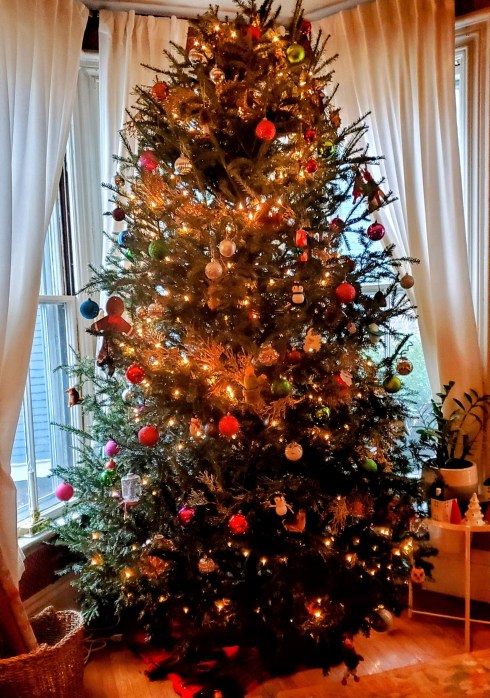
It’s going to be a super busy December, so I got a jump start on decorating my own house: we have eight fireplaces with mantles plus several other surfaces which “require” adornment so there’s a lot of sorting out and arranging to do. I have two rules, or should I say practices, which I observe for holiday decorating: I don’t bring greenery in until just before Christmas and I always choose a creature theme. Down in my basement, there’s a little room with shelves full of creatures of Christmases past: swans from last year, and then bears, foxes, sheep, hedgehogs, rabbits, mice, cats and lots of deer, of course. This year is all about pheasants, as I found some Royal Copley ones that I really liked this fall and wanted to keep them out: I’ve glitzed them up a bit and added some gilded companions. I love natural greenery but I can’t stand to see it fade, so usually I wait until the last possible moment to mix it in with my other decorations. This year I hedged on the rule, and added a few greens because I wanted some warmth and contrast, but more is coming! Someday I might go for simpler decorations but my holiday aesthetic is still pretty much all about abundance. The exception to the greenery rule has always been the Christmas Tree, but over the last few years we’ve had trees die on us before Christmas, so now we’re going to wait for that too. There’s nothing more depressing than a crispy Christmas tree, in my opinion.

Downstairs mantles, the “mantle” in the kitchen, measuring-cup creatures from Anthropologie and my pantry. The glittery squirrels always come out: they’re in the library. By the time I got to the second floor, I was running out of pheasants, so substituted a lowly duck. (There’s a few peacocks mixed in with the pheasants downstairs too, because peacocks). Last year’s swans on the shelf in the basement.

This past weekend was the Christmas in Salem tour, the major fundraiser for Salem’s historic preservation organization, Historic Salem Inc. It’s in a different neighborhood every year, and this year was all about North Salem, encompassing Buffum and Dearborn Streets, on either side of North Street, and a few homes off Dearborn. It was not at all a “colonial” tour, rather it had a bit of a retro feel to me despite the presence of many later nineteenth-century homes, including the gorgeous Queen Anne Ropes House. There was also a stunning 1915 bungalow on the tour, an unusual style for Salem. Gratitude and congratulations to all the homeowners: it’s quite an effort to open your home to 1000 people (believe me, I’ve done it twice). Christmas in Salem always puts me in the holiday mood: it’s such a lavish display of generosity and creativity and cheer: hopefully I’ve captures some semblance of these things in the pictures!

At the Ropes House: love, love, love the button garlands!!! Below: my friend Bradley guiding us through the kitchen in his Princess Diana black sheep sweater and everyone’s favorite “simple” decoration: red branches and floating candles.

Below: lots of textures and nooks and crannies on this tour! These are the details that gave me the retro feel.

What we want to see: table settings, a wreath, and a Christmas tree.

I hope all these homeowners are having a drink just about now (Sunday @5pm)!


Deerfield Thanksgiving

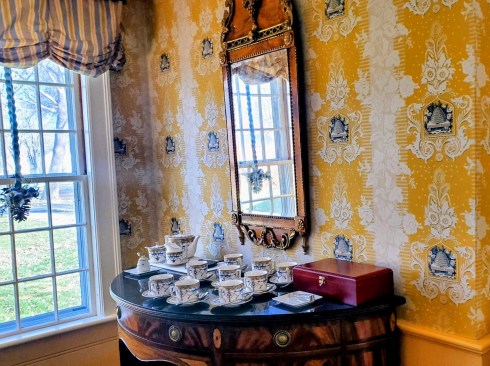
I know that it was a back-to-big-family-Thanksgiving for many people, but because of health and almost-conflicting family events my husband and I found ourselves alone this year. We made a last-minute decision to head to Historic Deerfield, where we stayed at the Inn for two nights and had a lovely Thanksgiving dinner at the Inn at Boltwood (previously the Lord Jeffrey Inn) in Amherst. We ran into old Salem friends and made new Pennsylvania friends at the Deerfield bar, walked around and in as many of those magnificent houses as we could, and “played” in the attic of the Flynt Center for Early American Life. I have under-appreciated this experience on past visits: there was something about this particular visit that made the “visible storage” of all sorts of items from Historic Deerfield’s collections—everything from ceramics to muskets to wrought iron, in multiples—so very engaging. Maybe it’s because we had this “attic” to ourselves. My husband and I have very different tastes, but he could be over there in the realm of metal-working tools while I was lingering in mocha ware, both of us content. We left the attic only because the weather was so beautiful: clear and sunny and bright, casting all those Connecticut River Valley doorways in stark relief.

Historic Deerfield has always been an exploration of maker/craft culture as much as architecture so a focus on objects on this particular visit seemed correct: I’ve always been too dazzled by the houses to take in the Deerfield-made baskets, famous blue-and-white embroidery pieces and pottery to take proper note of them in situ. Before there was Historic Deerfield, there was Arts and Crafts Deerfield, a haven and destination for traditional crafts and preservation at the turn of the last century, and before then there was of course colonial Deerfield: you can see and feel the layers as you walk down Old Main Street. We had the neighborhood to ourselves as we took a long walk on Thanksgiving morning, so we looked in a lot of windows and hung out in back amongst the barns.

A walk down Old Main Street from South to North and then back towards the Inn: village map with house names and dates.

A recent addition to Old Main Street are the Witness Stone markers laid before every house in which an enslaved person live and worked: these were installed just last month in partnership with the Connecticut-based Witness Stones Project. So there’s another layer uncovered and exposed. Museum neighborhoods can feel a bit static and fixed in time, but I’ve never felt that way about Historic Deerfield: rather it has always seems like an engaging mix of past and present or a cumulative work in progress to me. At the same time, time moves slower there: just turn off Route 5 for an hour or a day or two and catch your breath, take a walk, or rummage around in an attic.

Witness (to slavery) stones, a work in progress, and a signpost right in the midst of Deerfield Academy.


Daniel Low and the Art of Advertising

Very often, one of Salem’s longest-running and best-known businesses, Daniel Low & Company, is reduced to a pioneering seller of witch wares with their souvenir witch spoons and other “memorabilia” issued before, during and well after the very important Bicentennial of the Witch Trials in 1892. It all started with a spoon, say the proponents of witchcraft tourism, long ago: we didn’t start it! And they are not wrong: the Company certainly sold its share of witch spoons, plates, dishes, thimbles, scissors, and more unusual items like “penwipers”. But Daniel Low & Co was also a Salem institution for over a century: evolving from its jewelry and silver foundations to a major purveyor of all manner of decorative accessories for the home over its long history (1867-1994). It “sold Salem” in more ways than one: if you visited its landmark store, situated in Salem’s most historic square in the former site of its First Church, you would see not only floors of display cases but also “unique antique rooms” featuring reproductions of Salem’s more traditional products; if you ordered from the annual Daniel Low year book you would receive a receipt bearing an illustration of an historic Salem structure as well as a copy of the company pamphlet The Salem Pilgrim. 

You could write a book entirely on Daniel Low’s advertising methods and campaigns: there’s just so much information and copy. The company advertised both locally and nationally: to support both its wondrous store and its annual year book, issued from the 1890s into the 1960s (I think—I can’t find the end date). But it’s not just the means by which Daniel Low reached out and reached in to homes across America, it’s the messaging. The store’s advertising philosophy was expressed in a number of speeches and articles by Robert R. Updegraff, its manager of publicity, from the teens into the thirties. Everything I read by Updegraff, who seems to have been a pioneering practicioner of the new “art” of advertising, reminded me of Don Draper’s Kodak carousel pitch in Mad Men: aim for the heart, and treat your customers like neighbors. Only a year into his job, Mr. Updegraff summarized his pitch and his profession in a serialized article entitled “The Story of the Year”:  One thing is sure, the advertising man who is to be the real power in the future will be the man who stops thinking in terms of type and borders and magazines and billboards and street car cards and printing presses and halftones. He will think in terms of neighborliness and life. He will write simple, sincere, friendly messages to these neighbors of his. He will think and write in terms of ideas, emotions, experiences, merely using words as vehicles to convey his message and printing presses to multiply it. He will use illustrations only when they tell the story better than the same amount of space used in words. His advertisements will be efficient because they are sincere and have the beauty of truth. And they will be effective. [Macleans magazine, September 1913]. Updegraff believed that Salem’s past could be utilized to emphasize sincerity and exemplify the “beauty of truth”: not its witch-trial past but rather a more hopeful, gilded, and gentle “old Salem.” In a 1914 article in Printers’ Ink he elaborates on how the imagery of truly Colonial Salem conveyed an atmospheric sincerity in the Daniel Low Year Books which began offering “glimpses of old Salem” from that time until the 1950s.

A half-century of Daniel Low & Co. Year Books: from Historic New England, Salem State University Archives and Special Collections Flickr photostream, Harvard University Digital Collections and my own collection.

Glimpses of Old Salem was a constant, but not Daniel Low’s exclusive pitch: it aimed to be a traditional-yet-modern “Treasure House” too, a phrase that was adopted by the Essex Institute and applied to all of Salem from the mid-century: before Witch City crowded out all other messaging at its close.


A Cooper’s Shop for Sale

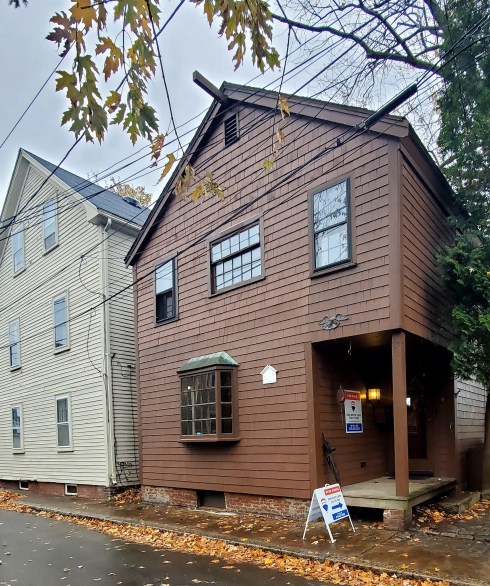
Wow, I don’t think I’ve posted on Salem real estate for quite some time! I’ve just been so serious, but actually there’s not much point: generally as soon as something comes on the market it is snapped right up. I’m sure that will be the case with this little house too, but I’ve also admired it, so I ran over this weekend for the open house. It’s a little two-story shop on Kosciusko Street, overlooking Derby Wharf and the entire Salem Maritime National Historic Site. Two stories, open-floor plan on both floors with a little bedroom and bathroom carved out of the second floor (as well as a “galley” full bathroom on the first), no parking, not much yard: very simple and very atmospheric.

As you can see, there’s been quite a few twentieth-century alterations to this building, especially its fenestration. The plaque report by Historic Salem, Inc. asserts that it is an eighteenth-century structure moved to this site about 1870. The MACRIS inventory calls it “colonial inspired!” Both reports also suggest that it might be an ell that was previously attached to the adjacent building at 159 Derby Street. I’m not sure how this precise 1701 date, so proudly proclaimed, came about. A photograph from the 1930s features an exterior that looks quite different: this can be found at the amazing house history of 159 Derby, now the home of the Salem Arts Association, researched by art historian Franny Zawadski. I was thrilled to learn that both houses were owned by the Salem chapter of the Ukrainian Workingmen’s Association, an organization about which I intend to find out a lot more.

The Shop on the far right above, and on the 1874 Salem Atlas.

I think there’s a bit of Colonial Revivalish embellishment here but it’s fine with me: someone wanted this little old building to look like a ye old cooper shop and it does! It also looks like minimal maintenance to me: a condo alternative with a very tight basement (the advantage of being moved to this spot, I imagine). Since I haven’t written a real estate post in some time, I think I should address the location a bit more. Anyone moving to greater downtown Salem at this point has to consider the impact of tourism, as our City seems hell-bent on driving that engine as much and as far as possible. If you complain about tourism now, you’re going to get a “well, you moved to Salem so you knew what you were getting” sentiment, which I don’t think is fair if you located here twenty years or more ago when Haunted Happenings was much less intense in terms of length and traffic volume of both feet and vehicles. But if you move to Salem now, you better know what you will face (especially if you don’t have a parking place). I think this location has the benefit of being in the zone but protected by the expanse of the Salem Maritime park: I was in this vicinity during the most crowded weekends last month and there were far fewer people here than in the center of the city. I just don’t think the majority of Salem tourists are interested in “history” and this cooper’s shop is in the thick of it.

First and second floors looking out on the Custom House and Derby Wharf (it was kind of dreary outside yesterday but I think the weather just enhanced the coziness).


Remembering the Revolution: Two Caleb Footes

For this Veterans Day 2022 the stories of two Salem men named Caleb Foote: grandfather (1750-1787) and grandson (1803-1894). But there’s a shadow of another man in this post too, a young lieutenant named Benjamin West, the sole Salem casualty of the Battle of Bunker Hill. The younger Caleb Foote is the link between the other two men: a prominent newspaper editor and publisher, he also dedicated himself to the remembrance of both his grandfather, a privateer and prisoner of war who left behind quite a revolutionary record, as well as his great uncle, who did not. Their conjoined histories are a great reminder of both the sacrifices made by the first American veterans and the commitments that their descendants made to their memories.

Fortunately members of the Foote family were meticulous writers and archivists of their own family papers. Caleb Foote the Patriot was a wonderful letter writer and journal keeper, both on land and on sea. So we know his Revolutionary story well, and his grandson amplified it by compiling and publishing his records in the Historical Collections of the Essex Institute in 1889. Several of the original texts are preserved among the papers of Divinity Professor Henry Wilder Foote (grandson of Caleb Foote III) at Harvard. According to a letter to his wife Mary, Foote was with General Washington at Cambridge in the fall of 1775, but returned home to Salem after the new year. He then took to the sea as yet another of Salem’s many daring privateers: his vessel, the Massachusetts brigantine Gates, was captured by the British off Canada in July of 1778, after which he was taken to England and imprisoned in Forton Prison near Portsmouth for the next two years. In Spring of 1779, he wrote to Mary back in Salem: I am sorry to inform you that you need not look for me till December or March next altho it may be my good fortune to be at home sooner. Please to remember me to all friends….Capt. Smith, Mr. Hines, Mr. Campton, Mr. Foster, Jacob Tucker, John Shaw, and Jonathan Tarent are in the prison with myself (as Salem served as a major privateer port, so many of its sailors ended up in Forton or Mill Prisons as prisoners of war). Foote grew increasingly exasperated with his imprisonment over his next letters, and with Mary as well, who did not seem to be writing him return letters (oddly he refers to her as “most affectionate friend” in his early letters and “dear beloved wife” in the later ones!) In the summer of 1780 he sounds bereft: my welfare…is very poor at present for here we lie in prison, in a languishing condition and upon very short allowance, surrounded by tyrants, and with no expectation of being redeemed at present, for we seem to be cast out, and forsaken by our country, and no one to grant us any relief in our distress; and many of our noble countrymen are sick and languishing for the want of things to support nature in this low estate of health; and many of they have gave to the shades of darkness. Some others have entered on board His Majesty’s ships to get clothes to cover their nakedness, which is to the shame of America.” This was the low point, after which Foote and several of his fellow prisoners managed to escape and find their way to Amsterdam, where they signed on as crew of the recently-commissioned Privateer South Carolina, which eventually brought them home. Foote kept the log along the way, and was discharged from service in January of 1782, near the end of the Revolution. Five years later he was dead at the age of 37, having never really recovered from his long and difficult service, and leaving Mary and their children in rather desperate straits according to the successive applications for aid sent to various Federal offices on her behalf by august Salem dignitories like Timothy Pickering and Nathaniel Silsbee.

Mary Foote survived her husband by nearly 40 years, during which time she saw her eldest son, namesake Caleb, die at sea, several years after his wife, leaving their sole child, five-year-old Caleb III, an orphan in 1810. His mother belonged to the large West family in Salem, and he was raised by them, chiefly his grandmother, who was the widow of Samuel West, bother of the Benjamin West who was killed at Bunker Hill. The Wests must have discouraged a seaman’s career for young Caleb, because he began an apprenticeship at the Salem Gazette and essentially never left: rising to editor, co-owner, and publisher. He was also a civil servant and the model of nineteenth-century civic engagement, serving as postmaster, school committee member, state representative, and Whig party chairman, as well as on every single infrastructure committee I could find and on the boards of nearly every Salem insitution. He was a temperate Mason. Caleb Foote spoke about his grandfather and namesake at public events regularly, but it wasn’t until towards the end of his life that he began taking up the cause of his great uncle Benjamin, who was for some reason left off the list of names on the Bunker Hill Memorial. Joseph Felt asserted that Benjamin West died “in the trenches” in his 1827 Annals of Salem, but he was unheralded in Boston until the venerable Foote took up his cause in the 1880s, perhaps inspired by his compilation work on his grandfather’s papers. And so we have some charming remembrances, first from Foote himself, who testified that this great-uncle of mine had some taste and talent for portrait painting, and a life-sized bust portrait of him in his lieutenant’s uniform, painted by himself hung in the house [of his grandmother West] , and its history was often mentioned to visitors. A copy of it is now in the possession of the Essex Institute, in Salem, and another in the family…..Another reminiscence was entered into the record that is even more poignant: a column from the late Henry Derby of Salem, whose grandmother was nine years old in 1775 and a neighbor of the Wests. She told her grandson that she remembered that morning of June 17 very clearly, when the young lieutenant came through her mother’s door exhibiting his insignia of office (a feather in his hat) to bid her goodbye. To the question, “Are you going, Benjamin?” “Yes—right away,” was his quick reply and off he went, never to return. Mrs. Derby remembered his artistic skills too. He had a shop downtown with a beautiful and much-admired sign of himself in the process of painting a carriage: a perfect advertisement for his sign-painting business. After his death and the disposal of his effects, this very sign became the lining of an outside cellar door of his family house, his last earthly residence, and there gratified the eyes of children and passers-by whenever these doors were thrown open, till time and exposure erased the picture of this young patriot and martyr to liberty.”

Salem Printer Ezekiel Russell’s Elegiac Poem on the Bloody Battle at Bunker-Hill, Massachusetts Historical Society; West Reminiscences in William Whitmore Story’s A memorial of the American patriots who fell at the Battle of Bunker Hill, June 17, 1775 : with an account of the dedication of memorial tablets on Winthrop Square, Charlestown, June 17, 1889, and an appendix containing illustrative papers (Boston, 1889); Caleb Foote’s 1894 New York Times, obituary, also dated June 17!

A few notes on imagesafter I read about the self-portrait trade sign on the cellar door above, I spent hours trying to find some semblance. No luck: honestly, the close I could come is Norman Rockwell’s Colonial Sign Painter from 1936! As charming as Norman Rockwell can be, this is not what I was looking for. Much more interesting is the story of the West self-portrait at the Essex Institute, which turns out not to have been a self-portrait, but rather a portrait by his cousin Benjamin Blyth. All this is explained in an article on Benjamin Blyth by Professor Henry Wilder Foote, grandson of Caleb Foote III: what a coincidence! I couldn’t find an image anywhere, which is often the case with portraits which are referenced as deposited with the Essex Institute in nineteenth- and early twentieth-century catalogs and periodicals: I presume it’s up at the Peabody Essex Museum’s storage facility in Rowley. In any case, I love the inscription on the back as noted by Foote: The Gentleman The Patriot The Soldier The Hero.

Norman Rockwell, The New Tavern Sign (Colonial Sign Painter), 1936, Norman Rockwell Museum.


The Skeletons of Lagrange Street

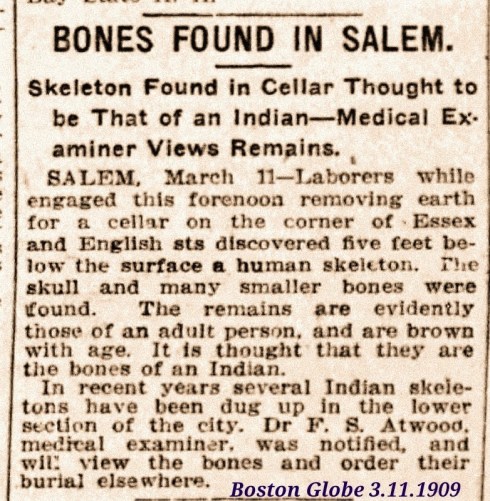
Salem is a place where everybody always says that the “past is present” or something to that effect; one discerns the ongoing presence of the past in the old structures and streets and cemeteries. That used to ring true for me, but not so much anymore. I still have a sense of Salem as a palimpest city, though: with layers and layers of history beneath my feet, reinforced when I walk by one of the seldom-ceasing infrastructure projects downtown and see all the cobblestones that lie beneath. I often think of Salem in the nineteenth century, when there was so much new but also so much more old all around, as a time when people must really have been aware of the past in a material way because of the contrast: the factories were so big and noisy and the surviving relics of the “olden time” so decayed, rather than perfectly preserved (if they survive) today. And it seems as if every time one of those relics was demolished for new construction, more relics were found underground, sometimes human remains. Nathaniel Hawthorne has a story in one of his notebooks of a skeleton that was found, in parts, underneath High Streeet, identified by one of the older residents of the neighborhood as a Frenchmen who came to town. It was a notable, but not a shocking, discovery: I perused nineteenth-century Salem and Boston newspapers and regular reports of skeletons uncovered in Essex Country appeared fairly regularly, generally presumed to be Native Americans. Even early in the century, Salem’s great diarist, the Reverend William Bentley, ran over as soon as remains and “curiosities” emerged from the soil: to Winter Island, to Northfields, and to Southfields. Over time, the majority of the reported skeletons of Salem seem to have surfaced in a pretty specific area: in South Salem, along Palmer’s Cove, on a street that was called Lagrange in the 19th century and is now Leavitt. Here is the unfolding tale of their uncovering:

So, some awareness that there might have been an Indian Burial Ground in what was then Southfields as early as the 1850s, and a succession of extractions from 1809 on with no apparent effort to protect the site. Of course not, this follows in the tradition of founding father Thomas Jefferson, who conducted an archaelogical dig adjacent to Monticello even as he noted local Native Americans making “sorrowful” visitations, and Surgeon General Joseph K. Barnes, who directed U.S. Army medical officers to collect the skulls of Native Americans in 1868, so that the craniological collection of the Army Medical Museum could facilitate “the progress of anthropological science by obtaining measurements of a large number of skulls of the aboriginal races of North America.” Later in the nineteenth century, the pseudo “race sciences” of phrenology and eugenics continued to justify this competitive collecting. The reference above to the Essex Insitute’s possession of an infant skeleton is not surprising, given that one of its founding institutions was the Essex County Natural History Society. It’s my only clue as to where any of these skeletons might have wound up (so far), but it is leading me nowhere: the Peabody Essex Museum’s 2018 completed inventory of human remains and associated funerary objects (in compliance with the Native American Graves Protection and Repatriation Act or NAGPRA of 1990) does not reference remains from the Lagrange area specifically. The inventory includes “the physical remains of 45 individuals of Native American ancestry” taken from sites in Salisbury, Newbury, Ipswich, Gloucester, Marblehead, Revere and Salem. The Salem remains were taken from an “old cistern in Front Cellar in 1993” (????) and south Salem, so this could be Lagrange Street: the cranial fragments unearthed from this site apparently belonged to a teenager. It looks like one skeleton (in the 1892 clip) simply dissolved in the open air, but I am curious about how the rest of the remains were treated, and what became of them. My only remaining thread is intrepid medical examiner Frank S. Atwood, who seems to be taking the remains into professional custody, at the very least. Called to the scene of yet another discovery at the corner of English and Essex Streets in 1909, it is reported that he ordered their burial elsewhere. In just the past year or so, several unmarked graves of African-Americans have been identified and restored, and I’m wondering if that is within the realm of partial possibility for these earlier, displaced, settlers of Salem.

Lagrange Street on the 1911 Salem Atlas: in three years all this would be swept away by the great Salem Fire, and then rebuilding, again.


A Salem Ghost Story

Even though I recognize no connection between Halloween in general and the Salem Witch Trials (because #theywerenotwitches) and for that reason don’t particularly care for Salem Halloweens, I do like the holiday itself, especially its All Hallows Eve foundations. I like ghosts too, and ghost stories, especially if they are crafted elegantly and not just made up by Salem tour guides. For these reasons, I am always looking for a good Salem ghost story and last week I found one! It’s a humorous ghost story rather than a scary tale, written by Brander Matthews (1859-1929), the very prolific and pioneering professor of dramatic literature at Columbia University. “The Rival Ghosts” was first published in Harper’s Magazine in 1884 and then in Matthews’ Tales of Fantasy and Fact in 1896. Its plot features a Salem house haunted by two ghosts who duke it out before they enter into a spectral marriage, bringing peace to both the house and its owner, a Mr. Eliphalet Duncan, on the eve of his own marriage. Eliphalet Duncan is a young New York lawyer, of Scotch and Yankee stock, as his father had come over from Scotland and married a girl from an old Salem family, dating back to the days of the Witch Trials of course. Both his parents died when Eliphalet was quite young, leaving him two legacies: a haunted Salem house and (eventually) a Scottish title. The Salem house is described as “little” and dates back to the seventeenth century, so I’m picturing it as either the Narbonne House or the John Ward House, both of which I gothicized a bit. The Crowninshield-Bentley House might be a bit late but I’ll throw it in there too: “The Rival Ghosts” is not illustrated in either of its editions, but it seems to be calling out for some imagery!

The Narbonne House of the Salem Maritime National Historic Site; John Ward and Crowninshield-Bently Houses, Peabody Essex Museum.
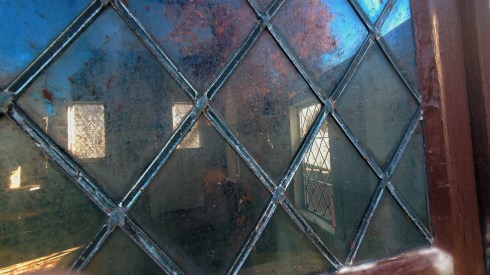
The Salem ghost never appears to the master of the house, but visitors would see and hear its presence on the second day of their stay, when it became determined to drive them away. So Eliphalet was a bit isolated in his little old Salem house, which became even more unwelcoming after he received word that his Scottish cousin had died, leaving him with the family title. Apparently the title came with a ghost, who was to attend his lord at all times and places, and so the Scottish Ghost was suddenly in Salem. Neither ghost was threatening to the new Lord Duncan, but they clearly hated each other, and caused quite a ruckus in his little house: wailing, rapping, throwing things, and playing a variety of musical instruments. He was determined to find out more about them in order to get rid of them, so that he might have peace and visitors in Salem. Towards that aim he invited an old friend to the house, a very brave friend with whom he had fought in the Civil War: his comrade left on day three of what was supposed to be a week’s stay, driven away by the the cacaphony of the rival ghosts. A very frustrated Eliphalet fled as well, to the White Mountains, accompanied by the personal Scottish Ghost and leaving the House Ghost in Salem: “spooks can’t quarrel when they are a hundred miles apart any more than men can,” our narrator observes.

Window of Quaker Meeting House, Salem, Peabody Essex Museum.

On the top of Mount Washington (I guess the cog railway had been built), Eliphalet met the love of his life, the sister of a former classmate who was he immediately determined to marry: Miss Kitty Sutton. A long courtship and engagement ensued, during which he told her about the ghosts. She expressed great interest in his family house, but wanted it cleared of spectres, so Eliphalet returned to Salem on a mission. He pleaded with the ghosts to vacate and managed to enter into a dialogue with them, during which it was revealed that the House Ghost was a woman! She had been murdered by her husband back in seventeenth-century Salem and had lingered ever since. Eliphalet suggested a spectral marriage to give them all some domestic peace, but the ghosts protested that there was too much of an age difference (the House Ghost was about 200 years old, while the Scottish Ghost claimed to be 450 years old) before finally consenting. There followed a double wedding, of ghosts and humans, and off the former went, leaving the little old Salem house to the new Mr. and Mrs. (Lord and Lady) Duncan. While it’s not entirely clear how their marriage led the ghosts to vacate, it’s a nice ending to a charming tale, full of spirited negotiations! Another discovery this past week: the old house interiors paintings of the Russian-American artist Morris Kantor (1896-1974), painted in 1930-31 after a summer tour of visiting historic houses. Maybe it was just the timing of these twin discoveries, but they seem like perfect atmostpheric illustrations for “The Rival Ghosts,” particularly this first one: The Haunted House. 

Morris Kantor, The Haunted House (1930), Art Institute of Chicago; Still Life (1931), Artemis Gallery; Interior (1931), Smithsonian American Art Museum.