Category Archives: Salem

Postal Perspectives, Salem Edition

I was enthralled this week with news of the new technology which has unlocked “letterlocked” letters from the sixteenth and seventeenth centuries: before the onset of the envelope in the nineteenth century there were often-intricate practices of folding, cutting, creasing and sealing letters to secure their contents, making it impossible for modern scholars to pry them apart without causing considerable damage to invaluable sources. With every discovery of a locked letter, or a cache of locked letters, the pressure mounted to discovery another way to reveal the writing inside, and this very week, a team of scientists announced their process of “Unlocking history through automated virtual unfolding of sealed documents imaged by X-ray microtomography.” This is BIG news: the letters are scanned and “virtually unfolded,” rendering their physical integrity intact. Secrets are revealed! I just can’t think of anything more exciting.

I’ve worked with seventeenth- and eighteenth-century letters before but they had already been opened up: hopefully they weren’t quite as “locked” as some examples and no harm ensued. It’s so interesting that envelopes became common so late in western history: really only from the 1830s. With the completion of my manuscript (and before readers’ comments come in) I had the time to indulge my curiosity a bit this week, the first opportunity in over a year, so I engaged in one of my favorite pastimes, putting a Salem spin on a much larger and more global topic. I haven’t engaged in “ephemeral history ” for a while so it was also nice to look at some pieces of paper. Both epistolary and postal history can reveal all sorts of interesting things, even on the surface, and two great sources for all things philatelic are the Stamp Auction Network in general and Daniel F. Kelleher Auctions in particular: all the letters below come from the latter source unless otherwise noted. First up, some folded 18th-century Salem letters from the Kelleher archive: addressed to Mrs. Hannah Pickering, Widow from 1725, and the nephews of John Hancock, Thomas and John, from 1796 (via the Salem “packet”).

Once envelopes arrive, they become increasingly elaborate, especially with the coming of the Civil War. The Phillips Library has a large collection of Civil War Covers which I hope to see one day but the one below is from Kelleher: as you can see, it contrasts quite strikingly with the simple letter addressed to Mr. Robert Manning, Nathaniel Hawthorne’s uncle. The Salem printer-publisher J.E. Tilton specialized in embellished envelopes: here is one showcasing John C. Frémont’s western expeditions in support of his presidential campaign in 1856. In the next decade Tilton moved his business to Boston, but other Salem printers took up the patriotic paper trade. The envelope illustrations seem to get larger and more colorful over the second half of the nineteenth century, leaving little space for the address—illustrated by the Spanish-American War cover from 1898.

In addition to patriotic purposes, envelopes were great means for advertising and commemoration: all sorts of engines start to appear from the 1870s on, along with a variety of other industrial (and agricultural) goods and of course, the company headquarters. Salem’s famous hotel, the Essex House, appeared on numerous envelopes in the later and early twentieth centuries. Clothing and shoe manufacturers took full advantage of their stationery (the 1895 letter to the Naumkeag Clothing Co. in Salem is from Downeast Stamps), and before the stamp became the chief expression of commemoration, it was all about the envelope.


Who’s Counting?

I am right on the verge of completing my manuscript for submission to the publisher, but I had to stop because something is bothering me and I need to “write it out”. That process describes quite a few of my blog posts, actually. Last week the Phillips Library of the Peabody Essex Museum posted some pages of the 1810 census for Salem on Instagram, illustrating very well the segregated columns of the census-taker, and the less-detailed entries of African-American households. The post pointed out that census records were “key” for conducting #BlackHistoryResearch and also included a tag for #genealogy. At first impression I was glad to see this post: Salem records for African-American history are limited and largely unavailable to the general public (with the great exception of the Salem Female Anti-Slavery Society records which are also held by the Phillips, and have been digitized by the Congregational Library) so anything newly revealed is great! But then I started to get annoyed: this is serious business, and the Phillips holds so much of Salem’s history, can’t we have more than an Instagram post? I think I’m speaking not only for myself but for many educators when I express my deep appreciation for the digital resources that many institutions have provided during this pandemic, actually facilitating, or even enabling, us to do our jobs. I have been very dependent on the digital resources and modules of the Newberry Library and the British Library, in particular, but it’s not just those large and well-endowed institutions that have stepped up, much smaller, local institutions have as well: the very day the Phillips posted its census pages, I checked out a great an amazing source-based digital exhibition created by King’s Chapel in Boston for Black History Month and Historic Beverly’s Set at Liberty exhibition has been up for a year. So these three census pages, as interesting and important as they are, did not really satisfy greedy me (but it is always thrilling to see John Remond’s name, and the size of his household in 1810).

The more I thought about this post, the more concerned I became, and it isn’t just because I think the Phillips should be stepping up its education game. I realized that there was an issue with the census itself, and the issue is: the National Archives doesn’t think that a census survey for Salem in 1810 exists. The people whose names you see above, both black and white, are not “represented” beyond the walls of the Phillips Library in Rowley. The National Archives has digitized its census records (Record Group 29: Records of the Bureau of the Census, 1790-2007) in partnership with Ancestry, FamilySearch, and other genealogical sites, and if you are a subscriber you can search by state, county, and township: I did so and could not find any Salem data for 1810. Maybe it’s just me: I really am a terrible genealogist. Perhaps those of you out there looking for your ancestors living in Salem in 1810 have had better luck. Let me know! When we were trying to stop the relocation of the Phillips Library to Rowley a few years ago, I though it was the public records that would keep it in Salem: I made lists of all their city and state records and sent them to influential people with high hopes. But I never thought that the Library might be the sole repository of federal records, so this surprised me, and of course, now I’m wondering what else is in there.

Update: I wanted to add an update because there is a lot of interest in this census! It does look like the Phillips might have the only copy, although Heather Wilkinson Rojo, genealogist extraordinaire of Nutfield Genealogy, found a microfilm reference at the National Archives (M252-18) but it is certainly not digitized. I notified Dan Lipcan, the head librarian and Pingree Director of the Library, and he is on the case.


Cabot Constructions: Salem’s Lost Georgians

I am of two minds when it comes to genealogy: the professional historian in me thinks it is a bit antiquarian and lacking in context, but the local historian in me is very grateful to genealogists past, especially those who produced major family histories around the turn of the twentieth century, complete with lots of photographs of the old manses built by first, second and third generations. The other day I was looking for something other than the sources missing from my almost-completed manuscript’s endnotes, in other words, procrastinating, and somehow I found myself in the midst of the very comprehensive Cabot family genealogy: History and genealogy of the Cabot family, 14751927 by L. Vernon Briggs. The Cabots are a famous Yankee family, primarily associated with Boston now I think, but like so many Brahmin families—they started out in Salem. Some branches stayed, but most left: for Beverly, for Brookline, and for Boston. Everywhere they went they built great houses, and some of their best houses were right here in Salem. Unfortunately, only one survives: the Cabot-Endicott-Low House on Essex Street. I had read about the others, but never seen them, and in this great old genealogy, there they were! The Cabots had it all: ships and land and great country and city houses, but I only had eyes for these Salem Georgians.

The first Cabot house in Salem, built in John Cabot in 1708 at what is now 293 Essex Street; demolished in 1878: this is a great photo because you can see how commercial architecture imposed on Salem’s first great mansions on its main street.

Moved to Danvers! No time to run over there and see if it is still standing right now, but will update when I know.

Oh my goodness look at this Beverly jog! Built by second-generation Dr. John Cabot in 1739. Church Street was destroyed by urban renewal and is a shadow of its former self.

A familiar corner at the 299 Essex Street and North Streets: this Cabot house was built in 1768 by Francis Cabot and later occupied by Jonathan Haraden.

Survived! The Cabot-Endicott-Low House was built in 1744 by merchant Joseph Cabot and remains one of Salem’s most impressive houses. Its rear garden used to extend to Chestnut Street, and crowds would form every Spring to gaze upon it.


Stripped and Razed

I’m in the intense period of writing my book with a March 1 deadline looming, so posts are going to be very spotty over the next few weeks, but today, I needed a break from my ploughmen and practitioners. There’s a lost building in Salem with which I remain fascinated, one of several really. If I ever do write my Salem book, which I have titled “Dead History” in my mind, it will have one whole chapter on structures that were stripped of their amazing interior and exterior architectural detail, but remained standing for decades afterwards, often converted into unrecognizable commercial establishments which bore no resemblance to their glorious past. Then they were put out of their misery at some point in the twentieth century, that great century of destruction. Most, but not all, of these structures were on Essex Street, Salem’s main street from the seventeenth century, including the building I am spotlighting today, the Philip Saunders House, built in the mid-eighteenth century and demolished in 1965. Here’s a photograph of it from the early twentieth century—after it had been altered somewhat, with a lot more to come.

Sorry—I can’t attribute this photograph. I bought it on ebay several months ago, an unusual act for me (not buying on ebay, buying Salem photographs on ebay). Generally old Salem photographs for sale are just reprints of those freely available from their repositories, but the minute I saw this photograph I knew I hadn’t seen it before: this is 260 Essex Street, the Philip Saunders House. The two shops on its ground floor, The Salem Trimming Store and Mary E. Hayes, Hairdresser, were located there up until about 1920, and after that, a succession of shops until it was taken down by the City of Salem in 1965. In between, whoever was sourcing antiques for the Kennedy family purchased its spiral staircase and Georgian paneling, and transferred it to the main house of the Kennedy Compound in Hyannis Port just before the second World War. This happened to Salem houses constantly from about 1890 to 1950. The Saunders House was a unique three-story pre-revolutionary brick building, and there was resistance to its demolition from Historic Salem, Inc. and other organizations and individuals, but not enough, apparently. The preservationists of Salem had been putting our fires for some time in the 1960s, and it was about to get worse with the onslaught of urban renewal. You can almost hear the exhaustion in Elizabeth Reardon’s voice in the newspaper article below, and believe me, she was game.

Both Mrs. Reardon and other preservationists compared the Saunders House in Salem to the Ebenezer Hancock House in Boston, which was also threatened at the time, I think. But it survived: and when you look at it today you can’t help but think of what might have been in Salem.

The Ebenezer Hancock House (1767): in the mid 1970s, from a Boston Landmarks Commission Structures Report, and today.


Caroline Remond Putnam

Faithful readers of this blog will know that I am captivated by the Remonds, an African-American family of ten who lead exemplary lives of advocacy, activism and entrepreneurialism in Salem in the nineteenth-century, often centered around Hamilton Hall, the Federal reception hall right next door to my house. I feel very connected to them and I’m interested in everything they did. The parents, John and Nancy, clearly raised their children to be independent and assertive, and were both independent and assertive themselves. The most public, and therefore most well-known, Remonds were the abolitionist speakers Charles Lenox and Sarah Parker, and while I have the utmost admiration for them they have their historians, while their siblings do not. There are also no photographs (in the public realm anyway) of the other Remonds, so we don’t “see” them. So I’ve been collecting as much information as possible about the “invisible” Remonds, and I thought I would cap off my year of #salemsuffragesaturdays with a spotlight on the amazing life of the youngest member of this distinguished family, Caroline Remond Putnam (1826-1908).  She’s one of the most impressive women I have ever encountered. The closest I can get to her is her signature, sadly: on a petition against capital punishment signed when she was a teenager, on a letter addressed to Wendell Phillips sent from London (both from the digital collections of Harvard), on her passport application in 1865.

Even without an archive of personal papers to elucidate her life, it’s easy to see that Caroline was a very engaged woman: the advertisements for her businesses fill the pages of the Salem Register; her efforts towards abolition are referenced in successive issues of The Liberator. As the youngest Remond child, she had several examples to follow as every family member was busy: in business and in reform causes, or both. Her parents managed to enroll her older sister Sarah and Caroline in the Salem public schools, from which they were expelled for no cause other than their race, prompting the relocation of the family to Newport, Rhode Island. The Remonds returned to Salem when the girls’ schooling was complete, and to their several businesses. Caroline began working in hairdressing in partnership with several of her sisters, and on her own, and in the late 1840s she married Joseph H. Putnam of Boston, whose family was part of the African-American network of entrepreneur activists which extended to Philadelphia. Caroline never stopped working: as a personal hairstylist, as the owner of a Salem salon and wig factory called the Ladies Hair Work Salon with her sisters, and as the manufacturer of the popular “Mrs. Putnam’s Medicated Hair Tonic” for hair loss. She and Joseph had two children, Edmund and Victoria, but tragedy struck in 1859 when Caroline lost both her husband and her baby daughter within three months. Her reaction was to leave: she booked passage for Britain for herself and her young son Edmund to join her sister Sarah, and there are no indications that she planned to come back to the United States. But she did: back and forth across the Atlantic she went over the next 20 years or so, sometimes with a sister, often with Edmund. She came back because she had a lot to do: she had her businesses, and had assumed major leadership roles, chiefly in the realm of fundraising, for the American and Massachusetts Anti-Slavery Societies. After the Civil War she shifted her efforts towards the suffrage movement and the American, New England, and Massachusetts Woman Suffrage Associations, and was always recognized as a “well-known advocate” of the cause. Caroline clearly had many obligations in the United States, but she returned to Europe several times in the 1870s and eventually joined her sister Sarah in Italy (where she managed a hotel in Rome!) in the mid-1880s and then made a permanent move to England, where she died in 1908.

Abolition, Suffrage AND Pacifism: Caroline had big goals, and that characteristic Remond mix of activism and pragmatism regarding business matters.

It’s rather sad to see someone work so hard for the greater good in a country, and be so eager to leave it: after Frederick Douglass visited the Remond sisters (Caroline and Sarah, plus Maritcha) in Rome he reported that “they detest prejudice of color and say they would not live in the U. States, if you could or would give them America!” These sentiments were grounded in experience. Caroline experienced at least three cases of very public discrimination: she was with Sarah at the Howard Athenaeum in Boston in 1853 when they were ejected from their seats, on her first Atlantic crossing in 1859 she and her young son were barred from the first-class cabins in the Cunard liner Europa for which she had purchased tickets, and on a trip to New York City in 1870 her reservations for rooms at the Metropolitan Hotel were not honored. I’m sure these were just three public instances out of many more private ones. But still she pressed on, always trying to create a better world for herself, her family, her gender, her race, and pretty much everyone else.


The Disposition of a Directress

Well I have to admit that I’m feeling pleased with myself this week as I have finished a challenging on-line semester of four courses while writing a book, my blog has reached its 10th anniversary, and I’m wrapping up my #SalemSuffrage Saturdays! Pardon my boasting, but sometimes you must indulge yourself. I’m really proud of the blog: I think that there is a lot here; I’ve certainly learned a lot while writing it, and that was my primary reason for starting it in the first place. Salem’s history is so deep; I don’t know if anyone can really scratch the bottom, and it is also wide-ranging, consisting of much, much more than the Witch Trials and the China Trade. Certainly this year’s focus on women’s lives has underscored that point, with its artists and authors, abolitionists and suffragists, physicians and shopkeepers, students and teachers. It’s been a bit challenging trying to draw out the details of some of these women’s lives in this particular year, but I’ve learned to be creative as Salem’s primary historical repository has been out-of-town and off-line for most of this blog’s life. Nevertheless there are holes and gaps and lots of work to be done to put together a cohesive and comprehensive history of Salem women’s lives. Before I end this year’s deep dive, I wanted to offer up something about women’s charitable roles in Salem: this is a topic with great continuity, as Salem women continue to be extremely active in charitable institutions, some of which are still extant after decades, or as in the case of the Salem Female Charitable Society, centuries. This is also a HUGE topic: the roles which Salem women played in institutions such as the Salem Children’s Friend Society, the Seaman’s Widows and Orphan Association, the Woman’s Friend Society (still with us), and the Salem Woman’s Club, just to name a few, were a really important part of civic life in Salem. For the most part, it’s only possible to write about this form of women’s work on very general terms, but we can get a bit more personal about the founder of Salem’s first woman’s charity, the Salem Female Charitable Society (SFCS), because of the remarkable obituary written by her friend, Mrs. James King. I’ve NEVER read so long an obituary of a woman in this era, much less written by a woman. Lucretia Ward Osgood must have been an extraordinary woman.

I love this, particularly the line she had the happy faculty, while she derived pleasure from the company and converse of others, to make them unusually pleased with her, and happy in themselves. Who doesn’t want that faculty? Yes, she was a good mother and Christian but we get some insights into her personality as well, which was obviously charming. These antebellum charitable societies get criticized later on for not lifting the poor up very far—essentially for training servants—but this is not the time nor the place to get into that. Lucretia and her fellow society ladies put themselves out there, got organized, dispensed charity, and impressed contemporaries like the Reverend Thomas Barnard, who spoke at their first anniversary in 1803: Ye, my female friends, feel her Spirit! In all the forms of society ye make your publick appearance: With your Directresses, Managers, and Members: With your Governess, and the Children of your affectionate charge! When ye first formed, I will confess to you, I, with many others whose judgement I respected, felt averse to your society. We thought Charity might be better ordered. But upon a deliberate view of your Constitution, I change my opinion. In the following year, the Salem Female Charitable Society was formally incorporated by Massachusetts law, and it remains so.


Dress UP Salem

Maybe you’ve seen this week’s New Yorker cover: a woman in her apartment on her computer, presumably in a Zoom meeting. She’s wearing a lovely blouse, earrings, and lipstick and her hair looks great, so all “above” is perfect. But below, out of sight of the computer screen, is another matter: she is wearing gym shorts and slippers, there is scattered paper everywhere, along with Amazon boxes, drinking vessels, and two cats. And she’s drinking a cocktail. That, dear readers, is me in the fall of 2020, teaching four courses while writing a book, with a new kitten running all around. Next week classes will end and I’m just about finished with a particularly difficult chapter: then I’m going to put on a skirt and tights and real shoes. This sad state of sartorial affairs has depressed me, as generally in December I’m thinking about what I’m going to wear to the Hamilton Hall Christmas Dance and other holiday events: obviously not happening this year. We’re also fortunate in Salem to see attendees of the Commonwealth Vintage Dancer’s Fezziwig’s Ball walking through the streets to Old Town Hall: again, not this year. So I’ve mustered up some historic Salem dresses and some new-old dresses in historic Salem settings to get myself in the holiday mood, material girl that I am.

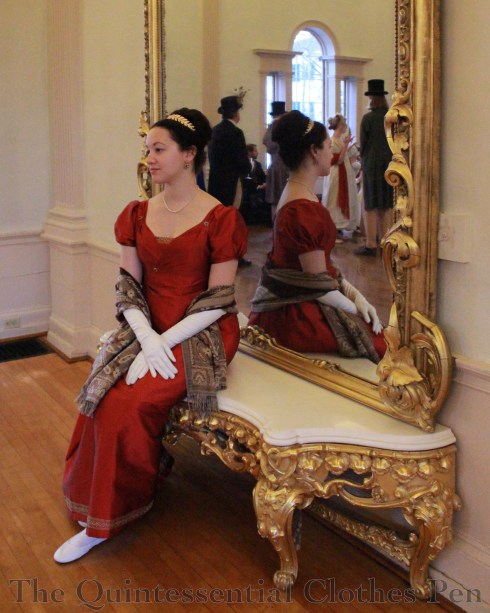
My favorite Salem dress ever is Sarah Ellen Derby Roger’s wedding dress, in the collection of the Peabody Essex Museum. I looked for something similar with Salem provenance, and found this lovely pale pink gown with amazing sleeves. I also found the wonderful blog of historical clothing maker Quinn Burgess, The Quintessential Clothes Pen. Since Quinn has attended several events in Salem wearing her own creations, I thought you would like to see some period clothes in situ, at Hamilton Hall and Old Town Hall. Her dresses below are designs from 1812-1813, about a decade earlier than Sarah’s wedding dress and its more muted cousin.

Sarah Ellen Derby Roger’s Wedding Dress, made in Salem from materials from India,1827, Peabody Essex Museum (Gift of Jeannie Dupee, 1979); Pale pink silk gown, Charles A. Whitaker Auctions. Quinn Burgess at Hamilton Hall and with her friends at Fezziwig’s Ball in Old Town Hall–an annual event sponsored by the Commonwealth Vintage Dancers. Photo credits: L. Stern (white and red dresses at Hamilton Hall) and James Sabino (The Festive Ladies at Old Town Hall).

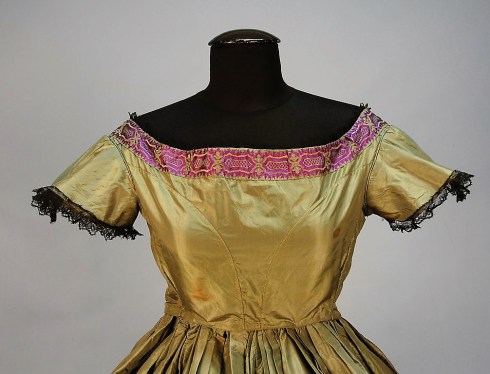
Let’s go forward a bit to the middle of the nineteenth century, not really my favorite period for design, but the ladies below make it look good! I came across this Civil War photograph of Marianne Cabot Devereaux Silsbee, author of A Half Century in Salem (1886) in her photograph album at the Phillips Library in Rowley. Despite the volume, I imagine this must be a day dress, but I found a very colorful chartreuse and purple ballgown from a Salem family in the archives of Whitaker’s auctions in Philadelphia. I always thought I liked that color combination, but now I’m not so sure: I think I prefer Quinn’s more subtle gown—hardly a “little” black dress–indeed Quinn tells me it is blue!

Marianne C.D. Silsbee, Phillips Library PHA 58; Civil War Era silk ballgown from a Salem family, Charles A. Whitaker Auctions; Quinn Burgess in a navy c. 1860 dress at Hamilton Hall (photographer credit: Emma Forrest).

And speaking of little black dresses, I’m going to jump forward a century to show you one from a Salem purveyor: a Mollie Parnis dress from the Mayflower Vintage shop on Etsy. Gorgeous. I’m not sure I’d wear this to the Christmas Dance, as I prefer more of a ballgown for that occasion, but (if I could fit into it), I’d find someplace to wear it. I’m looking forward to the moment when I can even think about what dress I might wear, where.

Mollie Parnis dress from Mayflower Vintage.


Highlights from Charles A. Whitaker Auctions.

More of Quinn Burgess’s work can be found at: The Quintessential Clothes Pen; www.quinnmburgess.com; Twitter (@thequinnpen) and Instagram (@thequinnpen).

You can see more period dances and dancers at vintagedancers.org +upcoming events.


The Dance Will Go On!

There is no contest for me: my favorite Salem event has always been the Christmas Dance at Hamilton Hall: I have never missed it in all the years I’ve lived in Salem, even in the one year I had to go alone. Last year I was in terrible pain from sciatica, but I still hobbled over there and stayed for as long as possible. It’s just that important to me. Anything related to Hamilton Hall is a women’s history topic, very appropriate for my #SalemSuffrageSaturday posts, as women have worked in the Hall, danced in the Hall, held fairs and other fundraising events in the Hall for a variety of causes, and supported the Hall in myriad ways for its two+ centuries. Women continue to support the Hall through two major fundraising events which date to the period right after World War II, when the Hall was in dire need of repairs: the annual Christmas (now Holiday) Dance and Lecture Series, traditionally held on Thursday mornings in February and March. I served as President of the Hall for six years, and on its board before and after, so I know how very, very important the funds from these events are: when we received the checks from the Dance Committee (all ladies) and the Ladies’ Committee which runs the Lecture Series, we breathed a sign of relief. The Hall was built by subscription, and incorporated only in 1986: at that time it had a very small endowment, and it still does: events have always supported it, making an event-less 2020 a very precarious time. But as always has been the case, the ladies rose to the occasion: the Lecture Series will be virtual, increasing accessibility for many people as it always sold out in a week or so, as will the Holiday “Dance”, with some very special patronesses.

I’m so happy about this invitation and event! It combines two endeavors which are very important to me: the preservation of the Hall and its traditions and the showcasing of some remarkable women of Salem who have not received the attention they deserve. There’s a long tradition of naming patronesses for dances at the Hall; these hostesses ensured the success of everything from military balls to debutante assemblies. When the Christmas Dance began, patronesses (and now patrons) became as integral to its popularity as the famous bourbon punch (which I am now realizing that I’ve referred to as rum punch in posts past. What can I say? It always knocked me out). I was a patroness about ten years ago and it was not only an honor but also great fun: waiters with silver trays of champagne kept coming over and people bow and curtsy to you—what could be better? When the chair of the Dance Committee notified me that this year’s dance would go on virtually with patronesses from the past , I was thrilled: what a perfect way to recognize the Suffrage Centennial in this challenging year! I was happy to put forth some candidates, but the ladies of the Dance Committee made their choices, and it was all their idea. I’m just thrilled to see Margery, Mary, Elizabeth, Sarah (Symonds), Nancy, Louise, Clarissa and Sarah (Sherman) get their Salem due! Especially Nancy, whom I think of whenever I step inside the Hall, toiling away in the hot downstairs kitchen on the Rumford Roaster, while everyone was dancing in the ballroom upstairs.

Post-war Patronesses in a photo belonging to my friend Becky Putnam: staring directly into the camera, while in a perfect curtsy, third from the left, is her lovely mother Rosamond Putnam; Debutantes in 1969 in curtsy—-sorry for the quality but I wanted you to see the extended-front-leg curtsy which I found difficult to do when I was a patroness—they do too, although they really had to go low! My two favorite Hamilton Hall dresses: left is vintage Ceil Chapman from the late 1950s which I wore in 2004; right is from 2017. For some reason I cannot find a photo of myself as a patroness–if anyone has one, let me know! Even though there will be no dance IN the Hall this year, it is still as dressed up for Historic Salem’s virtual Christmas in Salem tour. Here is Jetsan, who belongs to current Hall president Michael Selbst, exhausted from his decorating efforts. 

Hamilton Hall Holiday Dance link: a video will be uploaded for ticket-holders on December 19 featuring the patronesses and dance history. To the Ladies!


Mother Harriet Maxwell

This entire year of posts exploring the experiences and achievements of Salem women on #SalemSuffrageSaturdays has not featured a single immigrant: a big slight given the important role of immigration in our nation’s, and city’s history. It certainly wasn’t deliberate: I’ve been working with the sources available to me and so far no émigré has emerged from them. But today, finally, I am spotlighting an amazing woman of Irish origin and, at the same time, opening up a window into turn-of-the century race relations: what one life, or even one episode in one life, can tell us! Mrs. Harriet Maxwell was born in Ireland in 1849 and lived in England for a decade or so following her marriage to James R. Maxwell, a sergeant in the Scots Fusilier Guards. After her husband’s death in service she emigrated to the United States in 1879, and to Salem: I’m not sure what the precise draw was. In 1886 she graduated from the Salem Hospital’s training school for nurses, and she worked in private service and at the hospital until the spring of 1898, when the call went out for nurses for the quarantine camps established during and after the Spanish-American War, the first war in which the U.S. Army relied on contract nurses in addition to those from the Red Cross and religious orders. Mrs. Maxwell immediately resigned her position at Salem Hospital and signed up: she was sent to the “city of tents” at Montauk, Long Island: Camp Wickoff, where over 21,000 soldiers were sent for quarantine to lessen the spread of yellow fever and malaria in the wake of the war.

Scenes from Camp Wikoff, Long Island, August and September 1898: the arrival of the 24th infantry, the “city of tents”, men of the 71st infantry regiment,Teddy Roosevelt in camp, camp “street” and nurses, Theodore Roosevelt Collection, Harvard Libraries and  Library of Congress.

Far more soldiers died from disease, principally yellow fever, malaria, and typhoid, than combat during and after the Spanish American War, including Salem’s own William Huntingdon Sanders. The American military seemed unprepared for the biological threat, both during and after the war. Camp Wikoff, named for the first American casualty of the war, was hastily constructed and insufficiently prepared or “manned”, in terms of medical staff, for the onslaught of troops which began arriving in August of 1898, including Theodore Roosevelt and his Rough Riders. Following a succession of deaths (there would be 340 in all), and the outbreak of fever in the camp and surrounding community, Wikoff became the focus of sharp criticism in the national newspapers: the finger was pointed at Secretary of War Russell Alger in particular, and by extension, President William McKinley, who visited the camp in September. Julian Hawthorne, Nathaniel’s son and father of John, a soldier in the 71st Infantry whom he and his wife found emaciated when they visited the camp, expressed an opinion that seems to have been shared by many in the early fall of 1898:

From the great portfolio of contemporary Camp Wikoff texts and images by Jeff Heatley at Art and Architecture Quarterly.

So this is the situation Harriet Maxwell of Salem found herself in when she arrived at Camp Wikoff in August. She was not assigned to nurse the famous Rough Riders but rather one of the “colored” regiments in residence in the camp, in segregated quarters of course: the 10th U.S. Cavalry which had fought right alongside Roosevelt’s troops at the Battle of San Juan Hill. Many of its members were fevered when they arrived at Wikoff, and Mrs. Maxwell nursed them continually, forming the close relationships that were captured in an article first published in the Boston Globe and then in regional newspapers: the story of how she became a “mother” to these troops, a lasting designation that also ended up in her 1931 obituary in the Globe: 

The Boston Globe, 4 December 1898; the 10th U.S. Cavalry at Camp Wikoff, US National Archives.

It’s an endearing story, if a bit “matriarchal” and all too illustrative of the perceived boundaries of the time. Mrs. Maxwell’s time at Wikoff was brief but impactful, as everyone’s seems to have been. She went off to another fever hotspot, Ft. Monroe in Virginian, and then back to Salem, where she continued her practice and became a highly-respected member of the U.S. Spanish-American Veterans group and the namesake of its auxiliary. Mrs. Maxwell died in September of 1931, and her obituary (September 22 Boston Globe) notes that her two grandfathers were at the Battle of Waterloo. Two uncles were fatally wounded at the Crimean War. Again, what a life-span.


Abigail, Abigail & Susan

I was hopefully thinking about transitions and inaugurations and first ladies and somehow I ended up admiring Abigail Adams’ yellow kid slippers in the Smithsonian. I can’t really retrace my steps as I was kind of in an election coverage daze. But here are the slippers, which were donated by Miss Susan Elizabeth Osgood of Salem. They prompted a #SalemSuffrageSaturday post, as I’m trying to look at Salem women’s history with the widest possible lens, as well as every possible filter. It’s been clear to me for some time that the collection (in both its active and preservation meanings) and curation of Americana is an important Salem topic, and one in which women played many key roles.

Abigail Adams’ Slippers!

The First Ladies collection at the Smithsonian was conceived by two Washington society ladies, Cassie Mason Myers Julian-James and Rose Governeur Hoes, a great-granddaughter of President James Monroe, in 1912-1913; their gallery of items collected from presidential families opened to the public on February 1, 1914. Their emphasis was on “costume” but the collection expanded in scope and scale over the next century and is one of the Smithsonian’s most popular exhibits. An absolutely great source, the successive Reports on the Progress and Condition of the U.S. National Museum for 1913-1914, gave me the Salem story: in the latter year, the Report reported that “Mrs. Julian James and Mrs. R.R. Hoes continued, with their customary zeal, their self-appointed task of securing materials for the period costume collection, and during most of the year they were closely occupied in arranging the interesting fabrics and other articles which had been received. The results of their labors, successful and most brilliant in effect, have already been described, and there only remains to be accounted for in this connection the many and valuable contributions of the year. Of costumes of ladies of the White House, forming the central and most prominent feature of the exhibition and including some accessories, six were received, [including] a dress, kid slippers, and fan and pearl beads, worn by Mrs. John Adams, received from Miss Susan E. Osgood, of Salem, Mass.”

The items which once belonged to Abigail Adams which were donated to the Smithsonian Institution in 1913 by Salem’s Susan Elizabeth Osgood: the dress is navy blue, and shown by itself and in “company” (far right); the “pearl beads” are actually glass—so Mrs. Adams was well ahead of Jackie Kennedy and Barbara Bush with her faux pearls!

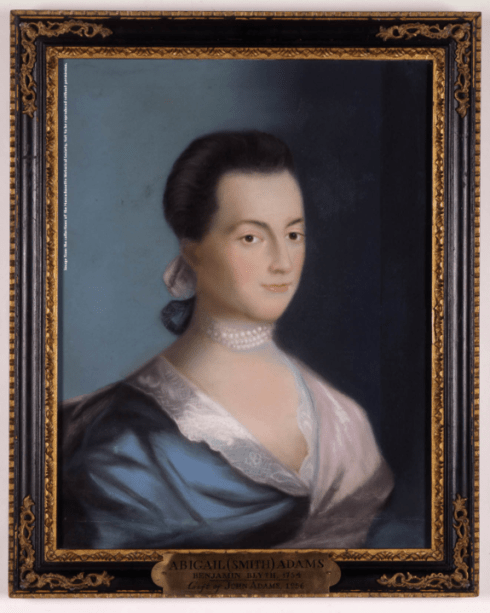
It took me a while to figure out how Susan Osgood came to be in the possession of these items: there was no readily apparent connection to Abigail Adams and I am no genealogical researcher! Miss Osgood was one of those maiden ladies from established Salem families who seldom shows up in the newspapers: the rule was birth, marriage and death only and since she was unmarried that left a large gap (especially as she lived a long life, from 1832-1920). The only time she really “appears” in public is in reference to her famous garden at 314 Essex Street. I chased down a few family connections and finally found the link: her uncle, the Salem historian Joseph Felt, was married to Abigail Adams’ niece, Abigail Adams Shaw, the daughter of her younger sister, Elizabeth Shaw Peabody. As Mr. and Mrs. Felt had no children, I’m guessing that the Adams items were passed down to their niece, Susan, after their respective deaths and were stored in Susan’s Salem house until the Mrs. Julian-James and Hoes put the word out. There are a few references to Salem sculptress Louise Lander playing an intermediary role in this story, but I couldn’t really substantiate them: she was living in Washington at the time, however. If my explanation of the Abigail-Abigail-Susan connection is accurate, that means that Mrs. Adams is connected to Salem through both of her sisters. Her older sister, Mary Smith Cranch, and her husband Richard lived in Salem for a time, during which both Abigail and John Adams visited occasionally. I presume (again) that the Adamses were introduced to the work of Salem artist Benjamin Blythe on one of those occasions, and commissioned their famous pastel portraits from him.

Abigail Adams by Benajmin Blyth, circa 1766. Massachusetts Historical Society.