Category Archives: Salem

MIT and Salem: little details and big plans

I knew that students in the pioneering professional architectural program at the Massachusetts Institute of Technology came to Salem to measure and draw interior and exterior details of notable Salem houses in the 1890s and after, but I did not know that the “Salem as laboratory” role extended well into the twentieth century for both architecture and urban planning students at MIT: recently I browsed through an archive of MIT Masters’ theses and saw several Salem studies among them as graduate students considered the waterfront, how to integrate historic and modern architecture (a perennial problem), public art, and the logistics of tourism, among other spatial topics. These were interesting to read as we seldom have debates about public spaces in Salem that are intellectual or contextual or even public: projects are simply announced and implemented. The most interesting thesis for me was one of the oldest, entitled “A new Peabody Museum for Salem, Massachusetts,” written by M.Arch candidate Donald H. Panushka in 1951. The thesis of Mr. Panushka’s thesis was that the Peabody Museum of Salem, especially its beautiful East India Marine Hall, was both detached from the waterfront and crowded in by commercial development on Essex Street, so that it should be removed to the Derby Wharf campus of the Salem Maritime National Historic Site (SMNHS). As you can on his map below, several other waterfront sites were considered, but ultimately he chose the large lot adjacent to the wharf in what was solely an academic exercise: I don’t think Mr. Panushka even consulted the SMNHS, but he did include some striking photographs and renderings to make his case. So it’s an interesting “what if” scenario, visually presented. I’m not sure the mid-century buildings placed alongside the relocated Hall would have weathered well, but knowing what we know about the development of Witch City in the later twentieth and twenty-first centuries, it’s tempting to think about how a more robust interpretation of Salem’s maritime heritage might have countered that trend—-and we could have had a ship decades before the Friendship. But again, it was all academic.

The first generations of architectural students at MIT were a bit more focused on architectural practice than planning: several “summer schools” in the 1890s produced measured drawings of Salem houses that were published in the the American Architect and Building News and later the successive volume of the Georgian Period published by William Rotch Ware. Details, details: including those of several Salem houses which, unfortunately, no longer exist in a material sense as well as those which fortunately do.


A Salem Shipwright

Salem’s Federal-era shipwrights Retire Becket and Enos Briggs are justly famous, but the men who crafted ships both before and after the so-called Golden Age are a bit more obscure. A case in point is Edward F. Miller, who maintained a productive and prosperous shipyard (at the site of Briggs’ yard) in South Salem in the middle of the nineteenth century producing ships for Salem, Boston and New York merchants before he shifted his attention and skills to erecting structures for land: I first learned about Miller when I visited Stonehurst in Waltham, which he built for the architect Henry Hobhouse Richardson and his client Robert Treat Paine, but there is little mention of him in Salem. His shipyard built La Plata (bark, 1850); Dictator (schooner, 1853); Delight (bark, 1855); Mary Wilkins (brig, 1855); Arabia (bark, 1857); Guide (bark, 1857); Jacinta (schooner, 1860), Glide (bark, 1861); Jersey (bark 1869); and Taria Topan (bark, 1870, and the latter served as the model for the cabin headquarters of the Salem Marine Society on the top of the Hawthorne Hotel.

William Pierce Stubbs, Bark Taria Topan of Salem, 1881, Bourgeault-Horan Antiquarians; The Salem Marine Society Room at the top of the Hawthorne Hotel, The Bark Glide of Salem.

Miller had a dynamic nineteenth-century life: learning his trade at shipyards in his native Nova Scotia, East Boston, and Charlestown (where he worked on the Constitution), going to sea and to California at the time of the Gold Rush, returning to Massachusetts and investing his new fortune into shipyards in Marblehead and then Salem, and building ships for two decades until he moved to Newton, Massachusetts in 1878 and starting building houses (apparently he also had a third career in maritime publishing). In Salem Vessels and their Voyages, George Granville Putnam presents Miller’s ships as worthy successors of those of Becket and Briggs: “No vessel so large as the Grand Turk of 1791—which was allways spoken of in its day as ‘the Great Ship’—was built in Salem for nearly 80 years until the bark Jersey of 599 tons was built in South Salem by E.F. Miller for Captain John Bertram in 1868; the barks Guide and Glide each of 495 tons had preceded it and there followed in 1870 the bark Taria Topan, 631 tons, also built by E.F. Miller, the last large square-rigged vessel built in Salem.” At the beginning of every project and the occasion of every launch, the Salem papers heralded Miller’s activity, reminding us all that Salem’s “ebbing” maritime culture, so vividly depicted by Nathaniel Hawthorne, was still quite lively in the decades before and after the Civil War. And of course the Stonehurst connection is Mcintire-esque: when I first stepped inside its massive entry hall, I remember thinking, “this is like a ship’s cabin” and indeed it was.

Miller notices: Salem Gazette, 1.17.1856; Salem Observer, 7.16 1864, Salem Observer, 9.22.1860; Salem Register, 1.12. 1857; The cabin-like Great Hall at Stonehurst, built by Miller.


Envisioning Salem, 1962

Salem is currently in the midst of implementing another urban renewal plan under the supervision of the Salem Redevelopment Authority (SRA), the board that was created by the city’s first urban renewal plan in the 1960s. The story of the implementation of that plan is a pretty established narrative: over-ambitious SRA orders destruction of much of downtown and advocates for the construction of a highway into central Salem to increase access for shoppers lured away by the North Shore Shopping Center in Peabody until concerned citizens’ protests and the New York Times architectural critic Ada Louise Huxtable’s extremely influential article brought national attention to the imminent destruction of Old Salem, shifting “renewal” towards redevelopment and preservation. Well, obviously I’m simplifying a much more complex process with many players: I’m starting to go through some of the sources which documented this process so I can understand it a bit better. I thought I would start with the early 1960s vision, as expressed by a series of reports issued by Blair and Stein Associates of Providence, RI, a planning firm hired by the City. Blair and Stein supposedly produced seven reports for the Salem Planning Board: I have found only three so far and the “Central Business District” report the most interesting: Salem, Massachusetts : central business district / prepared by Blair and Stein Associates in cooperation with the Salem Planning Board and the Massachusetts Department of Commerce (1962).

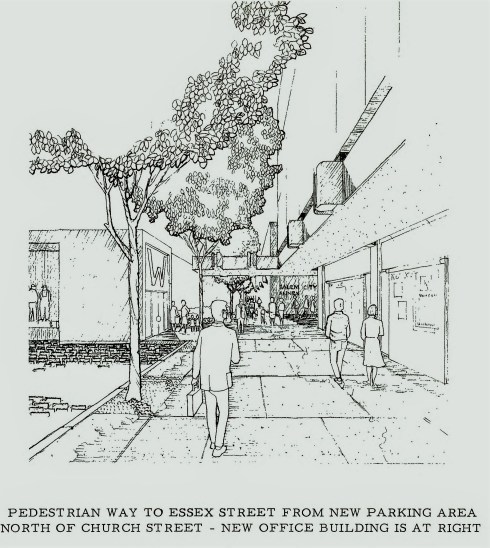
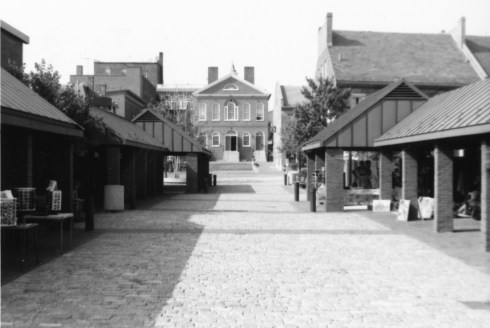
This study and its recommendations was not as focused on “tear it all down” as I expected: there are definitely recommendations for clearances, but also for preservation. Blair & Stein believed that the North Shore shopper, who is always referred to as “she,” could be lured back to downtown Salem if “blight” was cleared away and access improved. There are many references to urban blight, which was perceived as both decay and the reign of “inappropriate” facades and signs: after those were removed the state and fate of the stripped building should be considered. Because the emphasis is on renewing Salem’s shopping district above all, parking is very important, as is the overall design of pedestrian avenues around the downtown. Thus they gave us a pedestrian mall on Essex Street, Salem’s main street, but also on secondary routes leading into it. Salem would become an outdoor mall, with a mix of old restored buildings and new complementary structures: complementary not “imitative,” which is what I think most people would like to see now. It’s just annoying when advocates of sub-standard new construction accuse anyone who argues for higher standards of trying to turn Salem into a faux Federal city: I like the language below emphasizing scale, texture, character and “spirit” of new construction and did not expect to find it in a document of this nature and vintage.

Interesting spelling of “aesthetic” but these are goals I wish we were shooting for now!

Apart from the concerns about blight, parking and aesthetics, the major difference between this plan and the current one relates to housing: Blair and Stein envisioned a distinct shopping and cultural district and did not advocate for the expansion of residential buildings downtown, while that is a major planning goal at present. While they referenced tourism, they clearly saw it through a regional focus rather than a national one, and they don’t even mention Halloween. Salem would be a city of day trippers and day shoppers, returned to regional hub status.

Deed restrictions prevented all that planned Front Street parking, and inspired Artists’ Row, here pictured in 1978, Salem State University Archives and Special Collections.

The schematic sketches are just that, clean and orderly, and now I am seeking the specifics of how this rather vague plan turned into the scary plan of action recorded in the Boston Regional Office of HUD several years later: The Heritage Plaza East project advanced from the planning stage to the execution stage in February 1968. About 40 structures in the area will be rehabilitated, 140 will be razed, and 75 families will be relocated in the process of clearing the area. CLEARED OUT. The records of the SRA, which for some reason are deposited in the Phillips Library, will certainly shed light on the “progress” from planning to execution.

Appendix:  Historic Salem, Inc. has prepared a “Citizens Guide to the Downtown Renewal Plan” for those who wish to engage with its implementation, available here.


A Tory-Loving Town?

Salem has a bit of a reputation as a “Tory-loving town” due to the sentiments of some of its more conspicuous residents on the eve of the Revolution: prominent judges, merchants and lawyers could not reconcile their local and imperial loyalties and thus became exiles for the duration of the Revolution, or for the rest of their lives. The Banishment Act of the State of Massachusetts, issued in 1778 “to prevent the return to this state of certain persons therein named and others who have left this state or either of the United States, and joined the enemies thereof” named only four Salem Loyalists, William Browne, Benjamin Pickman, Samuel Porter and John Sargeant, but this is only a fraction of those who were identified as Tories by their own words or those of their contemporaries. The British archives, family genealogies, and contemporary newspapers point to a lot more: I did a very cursory search and came up with: Henry Gardner, merchant and shipowner, Captain Thomas Poynton, apothecary Nathaniel Danby, physician John Prince, Customs official Jonathan Dowse, merchant George Deblois, schoolmistress Mehitabel Higginson, John Fisher and Samuel Cottnam, as well as the well-known gentlemen Andrew Oliver, Samuel Curwin, the Honorable Benjamin Lynde, and William Pynchon, and I’m sure that this is not an exhaustive list. Most of these names are featured on the very warm address offered to General Gage upon his removal of the provincial capital from Boston to Salem in the late Spring of 1774, and I suspect the remaining signatories had similar sympathies.¹ Timothy Pickering’s father was a Tory! Despite the pretty dynamic historiography of New England Loyalists, and some very accessible accessible primary sources, I don’t think we know enough about Salem’s Tories and their stories.

Just a few monographs and primary sources for the further study of Salem’s Loyalists; Congratulations to General Gage.

Some of the more interesting Tory anecdotes focus on houses. In Sarah Orne Jewett’s The Tory Lover (1901) a character expresses her concern for the potential consequences of her friend’s entanglement: “I could not pass the great window on the stairs without looking out in fear that Madam’s house would be all ablaze…..There have been such dreadful things done against the Tories in Salem and Boston!” The “dreadful” acts against Salem Tories included a mob attack on the Ropes Mansion in March of 1774 while Judge Nathaniel Ropes lay inside dying (of smallpox) and the shattering of windows at William Pynchon’s Summer Street house. The cause of the mob attack on the Ropes house might have been the judge’s high judicial salary or contagious disease; nevertheless he died the day after it happened. Salem’s nineteenth-century historians recounted a “family tradition” that Thomas Poynton’s house, with its distinctive gilded pineapple over the doorway, was also attacked: he fled in 1775 and died in England in 1791. William Pynchon boarded up his windows and remained in Salem, documenting its revolutionary social life in his famous diary. Other Tories remained and appear to have suffered few consequences for their views (Andrew Oliver) while several were welcomed back after 1783 (Benjamin Pickman; Henry Gardner). Diaries and letters reveal some of their stories, but I think a more collective and integrative approach would yield more insights. It was all so very personal: there were obviously family and friendship connections among Salem’s Loyalists, but some families were divided by the Revolution as well. Salem has no Tory Row like Cambridge because the site of many Loyalist residences was the ever-evolving Essex Street, but a primitive (sorry! still working on my digital skills here; the book interrupted my progress) mapping can mark the Tory presence and/or absence.

Tory Houses: several survive but most are long gone. The Ropes Mansion in its original location, right on Essex Street (Old-Time New England, 1902); The Salem Chamber of Commerce is located in Dr. John Prince’s much-altered house on Essex Street, and Historic Salem, Inc. is located in the much-altered Curwen House, which used to be situated on Essex Street.

Only William Browne’s mansion, firmly and conspicuously located in the center of Salem, was confiscated: it would be replaced by the grand (but short-lived) Derby Mansion after the Revolution. The transition of power and influence from the Brownes to the Derbys seems rather revolutionary in many ways. When I look at the last Salem advertisements of two Tory shopkeepers, I wonder about all their stuff: for them, leaving was not just a matter of turning a key and leaving some associate (or their wives) to look after their property. (I also wonder if Nathaniel Dabney’s “Head of Hippocrates” sign was quite as big as depicted). Henry Gardner apparently paid taxes to the Town of Salem during his period of exile: perhaps that preserved whatever property he left behind. By contrast, Samuel Porter was clearly missing things upon his return. And what of Salem’s African-American residents, especially those who were enslaved: a 1777 petition by a “Great Number of Blackes” stated their case for freedom with revolutionary rhetoric, but were others enticed by British offers of liberty? Clearly there is lots to learn about Loyalists.

Essex Gazette, June, 1774; Salem Mercury, June 20, 1788.

¹James Stark, in his Loyalists of Massachusetts and the Other Side of the American Revolution (1910) states that “The importance of the following addressers is out of all proportion to their apparent significance. They are an indispensable genesis to the history of the Loyalists. For the next seven years the Addressers were held up to their countrymen as traitors and enemies to their country. In the arraignments, which soon began, the Loyalists were convicted not out of their mouths, but out of their addresses. The ink was hardly dry upon the parchment before the persecution begain against all those who would not recant, and throughout the long year of the war, the crime of an addresser grew in its enormity, and they were exposed to the perils of tarring and feathering, the horrors of Simbury mines, a gaol or a gallows.” but I think this is a bit of an overstatement.


Circa 1775

For Patriots Day, I endeavored to find Salem houses built in 1775, but it turned out to be a bit more involved task than I envisioned. I was just going to walk around and look at the Historic Salem, Inc. plaques, then I decided to consult the Massachusetts Historical Commission’s MACRIS database, which gave me a very workable list. The former overruled the latter for many of the houses I encountered however, so “circa 1775” is the best I can do. Salem houses are sometimes tricky to date just by apparent style: there is a conservatism that dominates the quarter century after the Revolution when it comes to you average dwelling (as contrasted to the Federal mansions which rose at the same time). Several “Georgian” cottages were built in 1806 or even 1826. So these houses are very “circa” for the most part, in the most flexible sense of the word, and I’m not really going to be able to answer the question behind this post: how many people in Salem were confident enough to build a house after five+ years of escalating conflict and tension over representation and sovereignty in British America?”

First up is the Wendt House on Crombie Street: this house has been the object of consternation for decades. First it was threatened my Holyoke Mutual Insurance Company, which threatened to demolish it for parking spaces, then it was saved by Historic Salem, Inc. (HSI), now it is threatened again (not so much its form but its LIGHT) by a large apartment building proposal. Below, Summer, Cambridge and Hight Street Houses: 51 Summer Street is dated 1771 by Historic Salem, followed 6 Cambridge Street and 8, 14 and 21r High Street.

And over on the other side of town: a Briggs Street house which MACRIS dates to c. 1775 but for which HSI has a more precise history, a Daniels Street House which is a great example of the “conservative” trend I spoke of above, and 19-21 Essex Street, which has been through many transformations. Such a cool house, and pretty substantial even without its later additions, indicating that even though the political times were turbulent, the economic future perhaps looked a bit more promising from the perspective of 1775.

19-21 Essex Street in 1985, MACRIS.


Mansard Mania!

So the developers of a large lot on Norman Street, a major artery in Salem which connects the downtown to one of the city’s major residential/historic districts and also serves as a primary gateway, have come up with their third schematic rendering for the site. We first saw a rather brutalist box, then an industrial-esque box, and now we have a mansard box. I wrote about their challenge here, and despite my lack of enthusiasm for their projections, I do believe that they have a very challenging site: Norman Street was once an absolutely charming street of residences and shops of diverse style and size, but it was ravaged by a perfect storm of an unleashing of all the infrastructural forces of the twentieth century. This is the design that will be presented to the Salem Redevelopment Authority this week:

Proposed design for 38 Norman Street, Salem.

This is a site that is not only very conspicuous, but also situated directly between two historic streets: Crombie and Chestnut (where I live), so both scale and historical context are issues for consideration. Frankly, based on its judgements over the past year or so, I don’t think the Salem Redevelopment Authority (SRA) is particularly concerned about either of those criteria, but the developers met virtually with several neighborhood groups and I’m sure they were notified of such concerns. So I think this mansard addition must be in response to these meetings, although I’m at a loss to explain how that particular roofing style fits into the streetscape. While it is known for its Federal architecture, Salem actually has some great mansard-roofed buildings, but they are overwhelmingly residential rather than commercial or institutional, and none are in the immediate vicinity of this lot. The original Salem Normal School building on Broad Street is the only mansard-roofed institutional building that comes to mind. I really, really hope that these developers were not inspired by the ghastly River Rock residences on Boston Street, but why wouldn’t they be? This project was approved, and thus serves as a practical precedent for aspiring Salem developers.

River Rock Residences.

Whatever the inspiration, this new rendering gave me an excuse to read all about mansard roofs, past and present. There was a lot to read: people really have a lot to say about mansard roofs, not so much the original early modern examples or even those revival mansard roofs from the third quarter of the nineteenth-century, but the “neo-mansard” trend of the 1960s and 1970s. There are blogs and opinion pieces galore explaining that phenomenon from a range of perspectives—but generally more horrified, sarcastic, and whimsical than complimentary. The original mansard was a tax-dodge tactic: in the seventeenth century French houses were appraised according to the number of floors below the roofline, and the mansard style thus enabled the addition of a non-taxable floor (I suspect space is the primary motive of the “historical” addition to the Norman Street proposed development as well.) The Second Empire of Napoleon III and the Hausmannization of Paris inspired the second wave of mansard mania, which swept across the United States in the 1860s and 1870s, despite the fact that wooden “French” roofs were blamed for turning the Great Boston Fire of 1872 into a conflagration: Henry Ward Beecher even called mansard roofs “conflagration caps.” I’m wondering if this is the reason I can’t find many larger mansard-roofed building in Salem.

I couldn’t find any mansard-roofed commercial buildings among the Frank Cousins’ photographs from the Phillips Library via Digital Commonwealth, but Salem has lots of cute mansard cottages from the post-Civil War era.

As you can tell from the detailed photos of the mansard roofs above, it’s all about the details: most modern mansard-roofed buildings lose something in the translation because they don’t attend to those details. A great example is the Hotel Commonwealth in Boston, built in the early 2000s to liven up Kenmore Square and link it to the Back Bay through its Second Empire style. The Boston Redevelopment Authority approved the renderings, but “when workers took the shroud off [in 2002] ….. officials and neighbors were aghast. To save money, the elegant building depicted in renderings had been replaced with one featuring a plastic-looking facade and garish two-dimensional window bays seemingly lifted off a B-movie set.” [Boston Globe, 27 October, 2014: “Framing the Proposal”] The developers were ordered to overhaul the building’s exterior before it even opened, and replaced the building’s value-engineered (and apparently bright yellow?) fiberglass panels with precast stone, as well as all “cosmetic” features, to the tune of $5 million. Even though I was right here in Salem, I don’t remember this episode at all, so I read about it in the Globe: both letters and articles typically used the words hideous and disastrous in reference to the Hotel, and one piece was entitled “Yellow Alert.”

Hotel Commonwealth rendering, Boston University, and in 2015, Boston Herald photo by Angela Rowlings.

That’s quite a spectacular rendering above and obviously the more humble proposed design of 38 Norman Street doesn’t set itself up for failure quite so conspicuously, but Salem appears to have developed a propensity for plastic so I’m wary, even still. The Hotel Commonwealth seems to be in the midst—or at the end?—of a third wave of mansard mania that was noted by the eminent architectural critic Ada Louise Huxtable, otherwise known as the “woman who saved Salem” due to her exposure of Salem’s cataclysmic urban renewal plan to a national audience in the 1960s. A decade later, she wrote about “Mansard Mania” in the New York Times, and was not complimentary: all is fake tops and false nostalgia, regardless of use, size or scale. I think she was referring to structures like those featured in all the “neo-mansard” blogs, an example of which is below, but still I wonder: why do we need mansard-style roofs or prairie-style roofs? Why can’t we have Salem roofs?

1970s mansard-roofed structure from The Neomansard: “trying to embrace the style without irony.” Just a great site.


The Privateer’s House

On this very day in 1776, the Continental Congress authorized private vessels commissioned with “Letters of Marque and Reprisal” to “make captures of British Vessels and Cargoes” and Salem’s shipowners and shipmasters responded enthusiastically: 158 privateering vessels originated from Salem during the Revolution, capturing 458 prizes and the largest prize tonnage of any single American port. It seems appropriate to feature what once was the home of a particular (and particularly active) privateer today: a structure that long stood on Lynde Street downtown and is now in the process of being “transformed” into a much enlarged building in a Georgian-esque style, complete with a built-in garage. I don’t know how much is left of the James Barr House, actually, but a brief history of its most celebrated occupant and record of its evolution are below.

James Barr was born several years before his father, also named James, built the family homestead at 25 Lynde Street, but he spent most of his childhood and adulthood in the house and died in it in 1848, at age 93. His was a full and long life, on sea and on land. Fortunately we have a wonderful and accessible source: his grandson James Barr Curwen published Barr’s “Reminiscences,” including his Revolutionary War commissions, in the Historical Collections of the Essex Institute in 1890 (Volume 27). Barr spent the war in service: on the Black Snake as First Lieutenant in 1777 and as Captain of the Oliver Cromwell, the Rover, and the Montgomery thereafter. He took prizes and was taken prisoner: he spent several months onboard the infamous British prison ship Jersey in New York Harbor and was also transported by the British to Barbados: nevertheless he always seemed to be able to extricate himself and find another ship. Unfortunately his grandson includes more details about the terms of his commissions than his escapes. After the war, Barr became a merchant mariner in partnership with his brother John: their copper-bottomed ship Hope was apparently one of the speediest Salem ships to the East Indies. Mr. Curwen assesses his grandfather’s retirement as “quiet”: “in early days he was a staunch Federalist and later a Whig, but he never took a conspicuous part in politics. He lived a strictly honest and conscientious life and died respected by all who know him at the age of ninety-three years, four months, twenty-one days.” James Barr’s “Reminiscences” also include a portrait commissioned in Leghorn for East India Hall and a very rare photograph of the old captain in the year before his death.  Photographs of Revolutionary-war veterans have been the subject of several studies over the past few years and I’m not sure this particular one is well-known: what a record!

In another town, a famous privateer’s house might be preserved and celebrated: but that’s not the Salem way. The Barr house, built on the storied site of Salem’s first fort in 1759, left the family’s possession in the early twentieth century and its downtown location rendered it vulnerable to commercial and multi-residential use. Much of Salem’s downtown is under the jurisdiction of the Salem Redevelopment Authority (SRA) rather than the Salem Historical Commission: those identifying adjectives are apt. Here is the visual evolution of the house over more than a century: from Curwen ownership in the 1890s (captured in Frank Cousins photographs from the Phillips Library and Digital Commonwealth) to a MACRIS photograph from 2016, to the day it lost its gambrel roof last week, to this morning, and a rendering of its completed form encompassing however many condominiums were approved by the SRA.

And here’s the description from the Massachusetts Historical Commission’s 2016 MACRIS inventory by Neil Larson and Walter R. Wheeler: The Barr house is one of a diminishing number of mid-18th century vernacular wood frame dwellings in Salem. Although it has experienced minor alterations and significant additions over time, the original outline of the dwelling remains clearly readable; it retains its original form, feeling and materials, and continues to embody the distinctive characteristics of a mid-18th century side passage gambrel-roofed dwelling. 


The Howard Street Church

The Howard Street Church was a short-lived institution, but it had an enormous impact on Salem’s nineteenth-century social and political life, far beyond the brevity of its existence or size of its membership. It is also a great example of how Salem’s history has been distorted by the exploitation and commodification of the Witch Trials: today the Church is little-known, and the adjacent Howard Street Cemetery is significant primarily as the place where accused victim Giles Corey was pressed to death upon his plea of “standing mute” and the imposition of peine forte et dure.

The Howard Street Cemetery in 1949 by Life photographer Nina Leen: it looks much the same now and the vantage point is approximately the location of the Howard Street Church.

The Church was founded out of a schism, and it too experienced schisms during its brief existence, from 1803-1864: both it pastors and its membership were active and engaged citizens, often to the extreme. As its last pastor, the Reverend C.C. Beaman, concluded in his 1861 history (Essex Institute Historical Collections, Vol. 3): “the Church has been likened in reference to its trials to the bush that was in the fire and yet not consumed. On the slavery question and on temperance it has been a marked church, having early spoken boldly upon them;—and if the being cast into prison is a proof of regular descent from the apostles, this church has a strong claim, inasmuch as one of its ministers died in prison and another was confined there.” The men in question were the Reverends Charles T. Torrey and George Barrell Cheever. The latter was a passionate proponent of temperance, who targeted one of the wealthiest and most powerful men in town, John Stone, Deacon of the First Church and simultaneously Salem’s largest distiller (who also built my house), in The Dream, or, The True History of Deacon Giles’ Distillery and Deacon Jones’ Brewery: Reported for the Benefit of Posterity, which was first published in Salem in 1835 and later in New York City for national distribution. After its publication, Cheever was accosted in the streets, horse-whipped, and sued, convicted, and imprisoned for slander, but his campaign for temperance, waged from the pulpit as well as in print, did not cease. I wrote about this story way back in 2011, and now we have a distillery named after Deacon Giles (a perfect Salem story).

One of Deacon Giles’ Distillery’s great illustrations, from an edition at Boston Rare Maps.

So the Howard Street was a center of a temperance storm in the 1830s, but it was the center of Salem’s abolitionist activities from its foundation to its end. Its first pastor, the Reverend Joshua Spalding (sometimes spelled Spaulding) had welcomed African-Americans into his new congregation from the beginning, after his dismissal and his flock’s “separation” from the Tabernacle Church in 1802, and with each successive pastor the commitment to abolition became stronger. Spalding was an early advocate of public education for Salem’s African-American children, and he appointed an African-American man, Israel Freeman, as one of his new church’s deacons. A short-lived successor of Cheever, Charles Turner Torrey clearly could not stand to just talk about the evils of slavery in somewhat-enlightened Salem: he went south and became a conductor on the Underground Railroad, dying in a Baltimore jail of consumption after facilitating the freedom of some 400 enslaved persons. In jail, he wrote his memoirs to support his family back in Massachusetts: Home or The Pilgrims’ Faith Revived was first published in Salem in 1845; following his death in the following year, Torrey “returned” to Massachusetts and was buried in Mount Auburn Cemetery with considerable ceremony. One of Salem’s most eminent educators and abolitionists, William B. Dodge, was a long-time member and Elder of the Howard Street Church: he first taught Salem’s African-American students in its vestry, where the Salem Female Anti-Slavery Society (among whose founding members were Dodge’s wife Sarah Dole Dodge and daughters Lydia and Lucia) also met frequently. The whole congregation, and indeed the city, was summoned to the Howard Street Church on occasions for prayer services for the end of slavery, as was the case in June of 1835.

There is ample evidence that the Howard Street Church served as a hub for abolitionist activities in Salem over the first half of the nineteenth century, but it’s hard to pay tribute to a site that is no longer there. I can’t even come up with a photograph (well, there is a semblance, see below), which is really frustrating as the Church was the creation of Samuel McIntire! It had a tower, and a very famous bell, which might have ended up the adjacent Central Baptist Church on St. Peter Street after the Howard Street congregation was dissolved (but the City of Salem had a claim, so I’m not sure). The Church was almost in constant flux: it started out as the Branch Street Church, named for the lane that connected Brown and Bridge Streets, later called Howard, and assumed the name Howard Street Church in 1828. Its denomination changed too: from Congregational to Presbyterian and back to Congregational. It’s the individuals that stand out in the history of this church, though: Spalding, Cheever, Torrey, Dodge and more, It seemed to draw men and women of great conviction. And if Howard Street’s abolitionist history was not illustrious enough, there is the role that the Church played in one of the most deadly battles in pre-20th century naval history: the defeat of the USS Chesapeake by the HMS Shannon on June 1, 1813. The former ship’s crew was annihilated in the 12-minute battle, which was watched by North Shore residents from atop Legg’s Hill. The Chesapeake‘s captain, James Lawrence of “Don’t Give up the Ship” fame, died shortly after that famous plea, along with several of his officers. The Chesapeake was sailed to Nova Scotia by the British with its dead and wounded aboard, and Salem’s George Crowninshield retrieved the remains of Captain Lawrence and Lieutenant August Ludlow from Halifax at his own expense and returned them to Salem for a formal funeral at the “Rev. Mr. Spauldings Meeting-house” in late August 1813. And thus the Howard Street Church became the center of national attention.

Massachusetts State Library; Newburyport Reporter and Country Gazette, August 24,1813.

The Howard Street congregation began to dissolve in 1864 and the end of the material church (in Salem) came in 1867 when everything was auctioned off. The McIntire Church building was removed, not destroyed: it was floated (I assume) over to Beverly, where it became the new Avenue Methodist Episcopal Church in 1869, with some adjustments and alterations at that time, and more in the 1880s, so I don’t think that the photograph below represents what the Howard Street Church looked like—though perhaps some semblance. Its former location became the site of a new Salem public school, the Prescott School, but not for long: the growing Polish Catholic community represented by the Church of St. John the Baptist purchased the closed Central Baptist Church in the first decade of the twentieth century, and expanded its property to Howard Street in the 1960s. The history of Salem’s churches is indeed quite dynamic!

Salem Gazette; 1874 Salem Atlas @State Library of Massachusetts; photograph of the Avenue Methodist Episcopal Church, Historic Beverly. The displaced congregation of St. Alphonse began worshipping in this Church after the Great Salem Fire of 1914, and it was destroyed by arson in 1963.


Renaissance and Reign of Terror

1904 was a big year in Salem’s commemorative history: it was the centennial of Nathaniel Hawthorne’s birth, and his birthplace received both regional and national attention. This was squarely in the midst of the time when Witch City and Hawthorne/Colonial City were duking it out to see which one would define Salem’s identify going forward: the former won, of course. Hawthorne was born on July 4, so in the midsummer there were lots of stories on Salem in the Boston papers, with a notable focus on material culture: his houses, other storied Salem houses, Salem gardens, Salem streets. As Hawthorne was so often focused on the past, so too was his commemoration.

Homes and Gardens in Salem, Boston Daily Globe, July-August 1904.

Salem was also featured in a book on American architecture published in 1904: American Renaissance. A Review of Domestic Architecture by Joy Wheeler Dow, Architect. This first caught my attention because I assumed “Joy” was a woman architect, but it turns out that Joseph Wheeler Dow preferred to be called Joy. He was a prolific writer and critic around this time, publishing in several “shelter” periodicals, and had a very forthright style. I like opinionated authors, and even though Dow was very snobby, concerned when anyone who lacked a Harvard education was in any position of authority and using the term “Anglo-Saxon” a bit too much for my taste, he’s still fun to read. His concept of the material “Renaissance” was strictly Victorian but he detested Victorian architecture: his division of American architecture centered on a Renaissance of craftsmanship and style in the colonial and first half of the nineteenth century and a “Reign of Terror” thereafter in which too much money and fashion (as opposed to style) created objectionable buildings. He loved Salem and placed its building firmly in the era and style of the American Renaissance.

Dow’s captions are great, so I included a few of them above: if you want atmosphere and plenty of it, go to Salem! (exclamation point mine, as that is how he writes). We’re so fortunate to have all of the houses above still standing, and they still provide a wonderful context and atmosphere. I don’t share Dow’s opinion of Victorian architecture, either residential or commercial, and I think buildings from that era—and after—add context and atmosphere as well. If I were to divide Salem’s built environment into periods I would have a long “Renaissance” era extending up to the twentieth century, perhaps even to the Great Salem Fire of 1914, then a rebuilding/accommodating the car era (not sure what I’d name it) and the “Reign of Terror” would begin in 2000 or so: we are clearly in a Reign of Terror now. It’s hard to characterize all of Salem’s new buildings: several appear to have tried for some context in the details but ended up as plastic pastiche, others could have been built everywhere and anywhere. I can’t explain the first building below, Salem’s new Hampton Inn: I really have no words. I’m not really sure what to think about the Brix, a new condominium development built on the site of the former District Courthouse: it’s a big boxy building but its downtown location can support that, even as the transition to a side street, Church Street, is rather abrupt. I guess it’s just the roofline that bothers me: why the overhanging eaves? This is the third or fourth new Salem building with similar roofs: has there been some secret pact to transform Salem into an exemplar of a revived Prairie Style? Maybe that’s the new “atmosphere” we’re going for but it seems odd given Salem’s illustrious architectural past. Away from the downtown, but not too far, are the new Halstead Apartments, which manage to represent a shadow of Salem’s vibrant industrial past in a rather reassuring, even atmospheric, way.

Salem’s new multi-colored Hampton Inn (+apartments) and multi-style River Rock development on Goodhue/Boston Streets; The new Brix condominium building on Washington and Church Streets; the Halstead Apartments on Flint Street.


Postal Perspectives, Salem Edition

I was enthralled this week with news of the new technology which has unlocked “letterlocked” letters from the sixteenth and seventeenth centuries: before the onset of the envelope in the nineteenth century there were often-intricate practices of folding, cutting, creasing and sealing letters to secure their contents, making it impossible for modern scholars to pry them apart without causing considerable damage to invaluable sources. With every discovery of a locked letter, or a cache of locked letters, the pressure mounted to discovery another way to reveal the writing inside, and this very week, a team of scientists announced their process of “Unlocking history through automated virtual unfolding of sealed documents imaged by X-ray microtomography.” This is BIG news: the letters are scanned and “virtually unfolded,” rendering their physical integrity intact. Secrets are revealed! I just can’t think of anything more exciting.

I’ve worked with seventeenth- and eighteenth-century letters before but they had already been opened up: hopefully they weren’t quite as “locked” as some examples and no harm ensued. It’s so interesting that envelopes became common so late in western history: really only from the 1830s. With the completion of my manuscript (and before readers’ comments come in) I had the time to indulge my curiosity a bit this week, the first opportunity in over a year, so I engaged in one of my favorite pastimes, putting a Salem spin on a much larger and more global topic. I haven’t engaged in “ephemeral history ” for a while so it was also nice to look at some pieces of paper. Both epistolary and postal history can reveal all sorts of interesting things, even on the surface, and two great sources for all things philatelic are the Stamp Auction Network in general and Daniel F. Kelleher Auctions in particular: all the letters below come from the latter source unless otherwise noted. First up, some folded 18th-century Salem letters from the Kelleher archive: addressed to Mrs. Hannah Pickering, Widow from 1725, and the nephews of John Hancock, Thomas and John, from 1796 (via the Salem “packet”).

Once envelopes arrive, they become increasingly elaborate, especially with the coming of the Civil War. The Phillips Library has a large collection of Civil War Covers which I hope to see one day but the one below is from Kelleher: as you can see, it contrasts quite strikingly with the simple letter addressed to Mr. Robert Manning, Nathaniel Hawthorne’s uncle. The Salem printer-publisher J.E. Tilton specialized in embellished envelopes: here is one showcasing John C. Frémont’s western expeditions in support of his presidential campaign in 1856. In the next decade Tilton moved his business to Boston, but other Salem printers took up the patriotic paper trade. The envelope illustrations seem to get larger and more colorful over the second half of the nineteenth century, leaving little space for the address—illustrated by the Spanish-American War cover from 1898.

In addition to patriotic purposes, envelopes were great means for advertising and commemoration: all sorts of engines start to appear from the 1870s on, along with a variety of other industrial (and agricultural) goods and of course, the company headquarters. Salem’s famous hotel, the Essex House, appeared on numerous envelopes in the later and early twentieth centuries. Clothing and shoe manufacturers took full advantage of their stationery (the 1895 letter to the Naumkeag Clothing Co. in Salem is from Downeast Stamps), and before the stamp became the chief expression of commemoration, it was all about the envelope.