Category Archives: History

Twelfth Night

The Twelve Days of Christmas (finally) conclude this weekend with Epiphany, or “Twelfth Night”, marking the arrival of the Three Kings from the East in Jerusalem so that they might adore the baby Jesus. Once again, however, biblical traditions merge with earlier ethnic ones, creating hybrid celebrations and customs. In western Christian culture, Twelfth Night was a big party night before the nineteenth century, the peak of the Christmas season rather than the afterthought that it is today. I’m wondering if that is changing, however: there have always been Epiphany services in churches in our area but this particular year I’ve been invited to three Twelfth Night parties. Maybe people are getting fed up with the sheer consumerism of Christmas Day and refocusing on the social and festive aspects of the holiday season through Twelfth Night.

Hans_Memling_-_Adoration_of_the_Magi_-_WGA14816

Twelfth Night Magi MS

Two Renaissance views of the Adoration of the Magi:  by Hans Memling (c. 1470, Museo del Prado, Madrid) and British Library Egerton MS 2125, Ghent, early sixteenth century.

Twelfth Night traditions vary from place to place and time to time, but there are some constants:  there is always feasting, there are always cakes, and there is generally some sort of performance that involves role-playing, often world-turned-upside-down role playing, such as Shakespeare’s cross-dressing Viola of Twelfth Night; or, What You Will, which was first performed in 1602 as part of the festivities. This particular play survives because it was included in the 1623 First Folio, but it is just one of many Twelfth Night masques that were staged in the sixteenth and seventeenth centuries for both elite and popular audiences.

Twelfth Night Viola

Twelfth Night Masque 1607 costume

Viola’s duel with Sir Andrew Ague Cheek, 1788 print by H.W. Bunbury, Victoria & Albert Museum, London; printed edition of a masque performed for King James VI on Twelfth Night,1607.

Twelfth Night celebrations also have to include a cake, but there seem to be many recipe variations:  spiced cakes, fruit cakes, sugared “Kings’ Cakes” with multicolored icing or little crowns on top, “rich cakes”,Martha Washington’s “Great Cake”.  I particularly like the recipes from Colonial Williamsburg and the Folger Shakespeare Library:  these cakes are rather dense, alternatively brandy-soaked, and to be really authentic they should be baked with surprises inside that relate to the Twelfth Night festivities: a bean, a coin or a trinket representing the baby Jesus, perhaps a slip of paper to be safe. At parties in the past, the guest who found the prize in his/her slice became the king or queen of Twelfth Night. Some old recipes refer to the insertion of both a bean (for the king) and a pea (for the queen), so two “sovereigns” can rule over the festivities. Again, the world is turned upside down–for a night. And of course, as the last image illustrates, everybody wants to be King, even if it was just “King of the Bean”.

twelfth-night-the-king-drinks-by-david-teniers-the-younger-1339626083_b

Twelfth Night Cake 1841 BM

David Teniers the Younger, Twelfth Night (the King Drinks), 1634-40, Museo del Prado, Madrid; 1841 editorial cartoon, British Museum.


Best Bedside Books 2012

Well, it’s the time of year for lists, lots of lists:  best and worst, most important, so on and so forth, lists of ten things that characterize the passing year in one way or another. I’ll do my part with a best books list, with a qualification:  these are titles that were published in 2012 which I consider to be essential for bedtime reading, or bedtime reference, to be more precise. I do like to read in bed before I sleep, but I drop off quite rapidly, so I need a quick hit of compelling information, and/or some visual stimulation, before I’m gone. I’ve given up fiction altogether for this purpose, and I never read any sort of academic history later at night:  my bedside books need to be “dippable”; I will pick up one or the other from the stack–too tall for the bedside table–and dip into it every other night or so, in order to see or learn something before I fall asleep (books that do not perform these services leave the stack rather quickly). Several amazing natural histories were published this year which are perfect for this purpose, so I’ll start with them.

Natural Histories cover

Natural Histories. Extraordinary Selections from the Rare Book Archive of the American Museum of Natural History Library. Edited by Tom Baione.  Sterling Signature, 2012.

Nothing fascinates me more than the merger of art and science and this first book illustrates that historical merger in an extraordinary way. It is the ultimate gift and coffee table book, as it comprises a collection of historical sources relating to every branch of natural history from anthropology to zoology, succinct yet substantive contextual essays, and lots of images, as well as frame-ready prints, but it is also incredibly informative and inspirational. Similar in its historical range and the compelling nature of its images is the National Library of Medicine’s Hidden Treasure, and rather more whimsical (yet still empirical) is Caspar Henderson’s The Book of Barely Imagined Beings.  A 21st Century Bestiary. These books are just visual feasts, and I also learn something every time I pick them up.

Hidden Treasure

the-book-of-barely-imagined-beings-a-21st-century-bestiary

Hidden Treasure:  the National Library of Medicine.  Edited by Michael Sappol.  Blast Books, 2012; The Book of Barely Imagined Beings by Caspar Henderson.  Granta Books, 2012.

I’ve been interested in folklore for quite some time, and an amazing new edition of Grimm’s Fairy Tales was published this year: this bicentennial edition of The Annotated Brothers Grimm was edited and annotated by Maria Tatar, Chair of the Program in Mythology and Culture at Harvard.  It really is a definitive edition, and also includes many classic illustrations.  There’s nothing better than reading Grimm fairy tales before you fall asleep:  food for dreams!

9780393088861_custom-4b83bd148becf10073c6395f14fbda06c18a1daf-s6-c10

The Bicentennial Edition of the Annotated Brothers Grimm. Edited by Maria Tatar.  W.W. Norton, 2012.

I always have architecture and design books in my bedside stack, also good for dreaming, and the ones I purchased this year are American Decoration by Thomas Jayne and London Hidden Interiors by Phillip Davies.  Their titles are self-explanatory. I love Jayne’s traditional style, and with its 180 properties and 1200 photographs, Hidden Interiors is positively encyclopedic.

Book Jayne

philip-davies-london-hidden-interiors1

American Decoration:  A Sense of Place, by Thomas Jayne. Monacelli Press, 2012. London Hidden Interiors, Phillip Davies. An English Heritage Book, Atlantic Publishing, Ltd., 2012.

Both art history and history texts seldom function well as bedside books, as they require a bit more sustained concentration. If they are far removed from my academic interests, sometimes I can make them work out of sheer ignorance/ interest and curiosity (or if they have relatively short chapters!)  Right now I have two books in these categories by my bed, both very recently published:  Eleanor Jones Harvey’s The Civil War and American Art, which is the companion volume to the exhibition that’s on right now at the Smithsonian Museum of American Art, and Todd Andrlik’s Reporting the Revolutionary War, which presents a narrative of the American Revolution through contemporary newspaper reports, including several from the Salem Gazette.

CivilWar_500

Reporting

Eleanor Jones Harvey, The Civil War and American Art. Yale University Press, 2012; Todd Andrlik, Reporting the Revolutionary War. Before it was History, it was News.  Sourcebooks, 2012.

Salem is a “walkable city”, and I think more places in car-obsessed America should be walkable cities, which is why I purchased urban planner Jeff Speck’s Walkable City. How Downtown can Save America, One Step at a Time. I’m learning a lot from this book, but I do think it is better read in the daytime rather than just before bed. And last but not least, a perfect bedside book that my brother just gave me for Christmas:  Simon Garfield’s Just My Type. A Book about Fonts. This was actually published in 2010, but I also have another Garfield book that was published this year, On the Map: A Mind-Expanding Exploration of the Way the World Looks, (Gotham) so together they can fill out my top ten list.  Typography and cartography: two very interesting, yet contained topics.  Perfect for end-of-day reading.

Walkable City

Just-My-Type

Jeff Speck, Walkable City. How Downtown can Save America, One Step at a Time. Farrar, Straus and Giroux, 2012; Simon Garfield, Just my Type. A Book about Fonts. Gotham reprint, 2012.


Christmas Casting

In the medieval era and slightly after, Christmas was often the time for making predictions for the coming year, rather than on New Year’s Day. Weather predictions were common, and also more varied prognostications, based on what day of the week Christmas fell. The predictions based on a Christmas Tuesday are not particularly cheery, I must admit, but then neither are they overwhelmingly optimistic for Christmases that fell on the other days of the week.  Here’s the Middle English verse from British Library Harley Manuscript 2252, the commonplace book (an often-miscellaneous journal of very random sayings and bits of information, kind of like a blog!), of London merchant John Colyns, from the late fifteenth or early sixteenth century, with my hasty translation. It’s been a while since I have tangled with Middle English so there may be some lapses here, but I think I got the gist of this verse.

Yf Crystemas day on Tuysday be, That yere shall dyen wemen plenté; And that wynter wex grete marvaylys; Shyppys shalbe in grete perylles; That yere shall kynges and lordes be slayne, And myche hothyr pepylle agayne heym. A drye somer that yere shalbe; Alle that be borne ther in many se, They shalbe stronge and covethowse. Yf thou stele awghte, thou lesyste thi lyfe; Thou shalte dye throwe swerde or knyfe; But and thow fall seke, sertayne, Thou shalte turne to lyfe agayne.

If Christmas Day be on a Tuesday, many women will die that year; and that winter will see great marvels; Ships shall be in great perils; That year kings and lords shall be slain, And many other people against them. That year will have a dry summer; All that are born in that year shall be strong and covetous. Whoever steals, shall lose his life by sword or knife; But if one falls sick, they shall become well.

Well at least it ends on a somewhat optimistic note!

STC 25949, title page

Ships and people in peril a century later:  The Wonders of this Windie Weather, London, 1613. STC 25949.


Winter Solstice

Today is the Winter Solstice (in the Northern Hemisphere), marking the shortest day and the longest night of the year, when the sun appears at its lowest point in the sky. The Latin word refers to the “stoppage” of the sun, as it appears to hover at this low point for several days, and certainly this was recognized as an important time, both before and after the coming of Christianity. Indeed, the solstice often appears on medieval calendars as a “red-letter day”, so important that it was written in red ink. As you can see on this December psalter calendar, the only two red-letter days are those when the sun moves into Capricorn and the winter solstice.  Even the nativity–Christmas Day–is written in black ink.

Solstice 1030

This calendar also illustrates another convention of medieval Christianity:  the overlay of Christian holidays (holy days) on pagan ritual days. The Winter Solstice is recognized as the winter solstice, but also as the day of St. Thomas the Apostle, one of the 12 apostles of Jesus, who first doubted the resurrection of Christ and later compensated for this doubt by spreading the good news far and white, certainly outside the Roman Empire, perhaps as far as India. My casual survey of a sampling of psalters from the twelfth century on revealed that St. Thomas gradually replaced the solstice as a red-letter day, but medieval scribes still recognized the importance of the waxing, waning, and “hovering” sun in other ways and texts. The sun seems to get more vivid with the centuries, and even becomes quite humanistic with the Renaissance!

Solstice BL MS Arundel

Solstice Royal MS

Solstice Morgan ms

Solstice Sloane

British Library MSS Arundel 60 (after 1073) and Royal 17 E VII (14th century:  God creating the sun and the moon); Here come the sun:  Pierpont Morgan Library MS M. 14 (late 15th century) and BL MS Sloane 1171 (sixteenth century).

The Winter Solstice returns to modern calendars, sometimes with St. Thomas and sometimes not, and achieves recognition as a natural day in the seasonal year.  There’s something both reverent and hopeful about the day, as we know that the trend towards more darkness will be gradually reversed in the coming days and months.

Solstice Kate Greenaway 1891

Winter Solstice 1971 by Dame Barbara Hepworth 1903-1975

In typical traditional fashion, Kate Greenaway sticks with St. Thomas’s Day in her 1892 Almanac (NYPL Digital Gallery), while British modern artist Barbara Hepworth depicts the Winter Solstice in a more graphic way (Tate Museum, 1971).


Wassail and Shrub

I’m making two traditional drinks for the holidays this year:  wassail for a gathering and shrub for gifts. Both drinks go way back, how far no one really knows. Wassail was both a drink and an activity, first referenced in the cider-producing parts of England where harvest revelers would dance about sprinkling the trees with a particularly potent vintage so that the next year’s harvest would be abundant: Robert Herrick wrote Wassaile the trees that they may beare / You many a plum and many a peare/For more or lesse fruits they will bring / As you do give them Wassailing in the seventeenth century. At some point, Wassail and Wassailing also came to refer to a more general custom of a drink/drinking to one’s health (the Middle English waes hael roughly translates to “be hale” or “be well”), and more specifically to Christmas cheer and well-wishing:  wassailing seems to merge with caroling to create a custom of extending celebratory hospitality to one’s friends and neighbors during the holiday season. The great revival (or creation?) of Christmas traditions in the Victorian era brought forth not only trees but also wassailing; the “traditional” Here We Come a-Wassailing carol that we are all so familiar with actually dates from the mid-nineteenth century.

wassail bowl V and A

Christmas Spirits

An English wassail bowl from the later seventeenth century, Victoria & Albert Museum, and a “Merry Christmas” image from the major illustrator of Dickens’ works, Hablot Knight Brown (also know as “Phiz”). Father Christmas holds the wassail cup among other Christmas traditions of “merrie olde England”:  plum pudding, roast beef, mistletoe. I’m not sure why so many spirits (“bogies” and the snapdragon) are in the picture, nor do I know what “twelfth cake” is–yet!) British Museum, c. 1860.

It was a bit difficult to narrow down the variant recipes for the wassail drink; they seem to fall into spiced ale, spiced cider, and spiced wine categories with rum even appearing in a few.  The most traditional recipes feature stewed and mottled apples and/or eggs to create a thick  frothiness that makes the drink resemble “lambswool”, its early designation. I’m not going that route, as I find that texture (and eggs in general) rather repellant. I think I’m going to go for a simple wine and fruit juice recipe from the Williamsburg Cookbook.  And sadly, I do not have one of those multi-handled wassail bowls like the one from the V & A above; a simple punchbowl will have to do.

Shrub is probably even more ancient than wassail drinks; it derives from the necessity of preserving fruit long after the harvest over. Fruit is combined first with sugar and then with vinegar to create a syrup that can last indefinitely and mix with anything.  My hunch is that shrub was one of those things discovered (or rediscovered) by Europeans as a result of their encounters during and after the Crusades, as its name derives from the Arabic sharab (syrup; drink) and sugar was introduced into the European diet (and consciousness!) at that time too. Refrigeration did away with shrub, but I think it is currently experiencing a revival: there are several commercial manufacturers, including Tait Farm, from which I bought my first bottle.  But it’s easy enough to make, and there are 2 major processes:  hot and cold.  Using heat, you macerate whatever fruit you prefer (berries are best), add sugar and a bit of water, and boil up a syrup.  Once it has cooled, you add vinegar–whatever kind you like (I generally use apple cider or some type of flavored vinegar rather than white).  Leave it for a while, then strain, and then you have a fermented concoction which you can add to seltzer, lemonade, or alcohol (gin,vodka, and rum all work well with shrub). Without heat, the fruit and sugar combine to create a syrup-like mixture anyway, which you then add to the cider. Shrub is both tart and sweet, and you can keep it in the refrigerator for quite a while. A very pleasant way to drink your vinegar!

Tait-Shrub-Group-PS-Fullsized-2

Shrub Bottle Ticket Elizabeth Morley V and A

Shrub Bottle Ticket Enameled Copper 1770 V and A

Tait Farm shrubs, and two shrub bottle tickets from the Victoria & Albert Museum, London: the silver ticket was made by Elizabeth Morley in London around 1794-95, and the enameled copper ticket dates from 1770.


Colonial Chocolate

Salem can lay claim to at least one candy title–Ye Olde Pepper Candy Companie, established in 1806, claims to be “America’s oldest candy company” and is still manufacturing the gibralters and black jacks that established its reputation. But the other day I came across a trade card in a digital archive which I thought could lead to another title for our fair city:  oldest commercial chocolate manufacturer.  The card (which gets no bigger, sorry) advertises the business of Gideon Foster, Chocolate Manufacturer, and dates from 1780–the same year that the famous Walter Baker & Co., Ltd. chocolate company was founded in Dorchester Lower Mills.  Perhaps Foster beat out Baker by a few months!

Chocolate 1780

Chocolate Bakers factor

Chocolate Baker 1929

Bakers Christmas

Advertising Chocolate, 1780-1829. Baker images courtesy The Dorchester Atheneum.

Alas, I don’t think Salem can claim the chocolate title, for two reasons.  The Baker Company can be dated even earlier than 1780, to when Walter Baker, a Boston physician, established a partnership in 1765 with English chocolatier John Hannon. When Hannon departed for Europe in 1780, never to return, Baker continued to run the company under his sole ownership, and it expanded dramatically through the nineteenth century under his heirs and the twentieth century under the successive ownership of  General and Kraft Foods (leaving Foster’s little company in the dust!)  The other reason is that while Gideon Foster is associating himself with the commercial mecca of Salem,on his trade card, his chocolate mill was actually located in the nearby village of South Danvers, now Peabody; in fact, Foster’s well-preserved Federal house serves as the headquarters of the Peabody Historical Society.

That matter settled, I still have my questions. Why were these two prominent men so focused on the production of chocolate during the Revolutionary War?  Wasn’t chocolate a rather trivial pursuit at this particular time? Foster was General Gideon Foster, hero of the Battles of Lexington and Concord, later at Bunker Hill and the siege of Boston, but back in Peabody making chocolate by 1780:  was chocolate manufacture a matter of national necessity?  Probably not, but it was definitely a substantive commodity in the eighteenth century, viewed as nutritional, medicinal, and sustaining–almost like food. But it was also a beverage (we are generally talking about drinking chocolate at this time; candy bars come later) that some thought had the potential to replace the almighty tea. Thomas Jefferson certainly thought so; in a 1785 letter to John Adams he predicted that “Chocolate. … By getting it good in quality, and cheap in price, the superiority of the article both for health and nourishment will soon give it the same preference over tea and coffee in America…”

Here in Salem, and in the present, my favorite source for chocolate is the decades-old Harbor Sweets, where I started my Christmas shopping today (with less than two weeks to go–classes complete, papers and final exams to grade!)  Even if you don’t have chocolate on your list, this is a great place to go for its Santa’s workshop ambiance, as well as the free samples.

Chocolate Harbor Sweets


Arctic Animals

I had an arctic weekend. It wasn’t particularly cold here in Salem (rather the opposite), but since I was in a Santa Claus frame of mind, I thought I’d follow up my St. Nicholas post with a historical look at the North Pole, and that led to full immersion in the Arctic. This northern orientation (and two great books: Robert McGhee’s Imagining the Arctic:  the Human History of the Arctic World; Francis Spufford’s I May Be Some Time:  Ice and the English Imagination) gave me new insights into lots of things, but for the sake of imagery, I’m going to go for arctic animals:  great white beasts of the frozen north.

Before they set out to explore all the unknown corners of the world in the fifteenth and sixteenth centuries, Europeans had lots of ideas about the North which had been passed down from ancient geographical writers like Pytheas, Strabo and Pliny the Elder. The typical Renaissance endeavor involved the engagement, verification and/or dismissal of classical knowledge and for the Arctic, nothing was more influential than the posthumous publication of Gerhard Mercator’s world map, which portrayed the North Pole as a magnetic black rock surrounded by a clearly-marked Northwest Passage. In England, this inspired the erection of “arctic poles” all over the country and Martin Frobisher’s three voyages, from 1576-78, to Meta Incognito (the “unknown limits”; really southern Baffin Island, though Frobisher claimed the entire Arctic for England).

arctic1595

Gerhard Mercator, “Septentrionalium Terrarum descriptio”, from his posthumously published atlas, Atlantis pars altera. Enlarged fascimile, Historic Collection, Princeton University: part of a Princeton digital exhibition, Of Maps and Men.  In Pursuit of a Northwest Passage.

Imagine the surprise (or perhaps the expectation) when Frobisher’s men found a unicorn washed up on a Baffin Island beach, or rather a “Sea Unicorn”, as they referred to the creature. This fabled creature seemed to confirm that they were somewhere special, and previously elusive. From this first discovery, northern fish and fauna were always described and depicted as especially monstrous, especially large, especially white.  From narwhals to polar bears, from foxes to hares, these were almost-otherworldly creatures.  The Frobisher “Sea Unicorn” is pictured below, from George Best’s account of the second voyage, followed by two relatively modern caricatures of really large Arctic creatures.

Arctic Sea Unicorn

Arctic Hare 1890s Smithsonian

AMICO_PHILADELPHIA_103883058

Anonymous drawing of a BIG arctic hare, c. 1890, Smithsonian Institution, and Charles Sidney Raleigh, “Chilly Observation”, 1889, Philadelphia Museum of Art

The Arctic Hare (Lepus articus) is the largest North American rabbit, but it’s not that big! And of course it’s the same for the polar bear:  these images convey a sense of the (literal) diminution of man in the vast, frozen Arctic.  I’m quite taken with the hare, so much so that I even “adopted” one through the World Wildlife Fund (I figured that polar bears have more advocates). They are grey in the summer, but apparently turn into white fuzzy balls in the arctic winter.

Arctic Hare

Arctic Hair Greenpeace Ad

Arctic hares in their natural habitat; South African Greenpeace “white is the new green” ad, 2010.

For an Arctic animal in scale, there is no better image than William Bradford’s An Arctic Summer:  Boring through the Pack in Melville Bay (1871) with what looks like an arctic fox walking along the ice undisturbed or unaware of the nearby ship. Yet man is still humbled–isn’t that a piece of a wreck on the shore?  Bradford was a Massachusetts artist whose work, based on his own observations while on an 1869 polar expedition, figured heavily in the Peabody Essex exhibit Journey to the Ends of the Earth:  Painting the Polar Landscape a couple of years ago. More of Bradford’s paintings, as well as amazing photographs from his illustrated book, The Arctic Region:  Illustrated with Photographs taken on an Expedition to Greenland can be found at the Clark Art Institute.

Arctic Bradford

Arctic Fox

William Bradford, An Arctic Summer:  Boring through the Pack in Melville Bay, 1871, Metropolitan Museum of Art; cast earthenware Arctic fox, Hornsea Pottery Co., 1956, Victoria & Albert Museum, London.


Saint Nicholas

Today is the Feast Day of Saint Nicholas, (270-343) who evolved, through the centuries, into Santa Claus, because of his legendary roles as a protector of children and secret gift-giver. This was quite an evolution, in more ways than one! Nicholas is known alternatively as Nicholas of Myra, as he served as Bishop of that southern Turkish city (now called Demre) for much of his life, and Nicholas of Bari, as his relics were removed to southern Italy in the eleventh century. The Italians who confiscated the relics of the revered Saint claimed that were acting in the name of “security”, as Myra was increasingly vulnerable to Muslim attacks, but one could certainly ascertain that it was a case of simple theft. There are many stories associated with Nicholas’s holy works, so many that he is also referred to as Nicholas “the wonder-worker”, but the most popular relates a rather dark tale in which Nicholas visited an inn during a regional famine, and quickly discerned that the innkeeper had chopped up three boys and encased them in brine to sell them as pickled pork.  Nicholas brought the innocents back to life, and evolved into the savior of children who found themselves “in a pickle”.

Nicholas of Bari Stowe Breviary BL

Nicholas BM Dutch

Nicholas BM Flemish

British Library MS Stowe 12, “The Stowe Breviary”, 1322-25; Dutch woodcut print, 1480-1490, and hand-colored engraving from a Flemish prayer-book by the “Monogrammist M”, 1500-1525, both British Museum.

Images of Nicholas with the resuscitated boys (in their pickle barrel) can be found in all manner of religious texts from the medieval and early modern eras, as illustrated by those above, and were also the single focus of a succession of paintings and prints from the Renaissance and after. When Nicholas is not in the company of the boys, he is often pictured with the young women whom he saved from lives of prostitution by secretly gifting their father with gold for their dowries, another work of wonder that solidified his connection with the young (and vulnerable).

Nicholas Met Boys

Nicholas Met Dowry

Two altarpiece panels representing the holy deeds of Saint Nicholas by Bicci di Lorenzo, 1433-35:  Saint Nicholas Resuscitating Three Youths and Saint Nicholas Providing Dowries, Metropolitan Museum of Art.

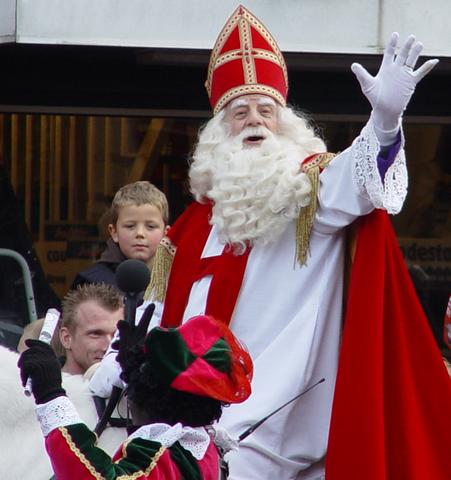
The religious history of Saint Nicholas is pretty easy to reconstruct, but when hagiography meets folklore it gets a bit more confusing. One thing is certain: the transformation of the saint into the jolly dispenser of gifts is much more a phenomenon of western Christian culture than it is of the Orthodox Church, which still recognizes Saint Basil of Caesarea as the benevolent gift-giver (on his feast day of January 1).  The other factor that seems pretty clear is the role of the Reformation. The modern Santa Claus seems to be an amalgamation of the Dutch and Flemish Sinterklaas, the English “Father Christmas” and a secularized Saint Nicholas. While the Dutch Sinterklaas still arrives on the eve of St. Nicholas, wearing a Bishop’s hat and bearing a staff, the Protestant prohibition of his veneration gradually transformed him into a secular figure. Across the English Channel, a similarly-dressed (and aged), “Father Christmas” reemerges only after the Reformation and Revolution, when the Restoration ushers in a return to the “merry old England” of memory. And when these figures cross the Atlantic, the melting pot of American culture (and Coca Cola) gradually transforms them into our very own Santa Claus.

Nicholas Print 1604p

Nicholas Sinterklaas

Nicholas Father Christmas 1890 Vand Ap

Engraving of Saint Nicholas by Antonius Wierix, 1604, British Museum; Sinterklaas celebration in Amsterdam, 2011, and a Father Christmas card, c. 1890, Victoria & Albert Museum.


Selling the Psalms

There’s been a lot of discussion here in the Boston area over the last week or so about the decision of the Old South Church to sell one of their copies of the Bay Psalm Book, the first book to be printed in North America.  There are only eleven copies of this 1640 hymnal; each is precious (and worth about 10 million dollars, at the very least), and the Old South Church has two:  hence the decision to sell one to support its mission. I am certain that it was not an easy decision; deaccessioning an institutional legacy never is.  I’ve been on several boards of venerable institutions here in Salem which had to undertake similar considerations, and it was painful:  how do you honor the past while meet the demands of the present?

Bay Psalm Book LCp

The Library of Congress copy of the Bay Psalm Book (Cambridge, Massachusetts, 1640), more formally known The Whole Booke of Psalmes Faithfully Translated into English Metre. Whereunto is prefixed a discourse declaring not only the lawfullness, but also the necessity of the heavenly Ordinance of singing Scripture Psalmes in the Churches of God.

Everything about the Bay Psalm Book was imported:  paper, press, printer. The Puritans had brought several books of psalms with them, but their quest for the true word of God was essential and ongoing. The connection between printing and the Reformation was almost as well-known then as it is now, so the desire to have a press here in the New World must have been strong. The man with the plan was the Reverend Jose Glover, an English Puritan minister and shareholder in the Massachusetts Bay Company, who financed the purchase of the press (most likely Dutch, as was the type), the paper (most likely French), and the hiring of a “printer” named Stephen Daye in London. Glover died on the voyage to the New World, but his printer set up a press in Cambridge upon his arrival (with the aid of Glover’s widow, Elizabeth, who later married the first president of Harvard College, Stephen Dunster). There’s a lot of speculation about Daye; he was not a member of the Stationers’ Company, the printers’ and booksellers’ guild in London, rather he seems to have been trained as a locksmith and was barely literate. Nevertheless he is recognized as America’s first printer.

Bay Psalm Printing Press Stephen Daye

Bay Psalm First Printer restaurant

Daye’s Cambridge Press, Cambridge Historical Society; the First Printer restaurant at 15 Dunster Street, Cambridge, the site of Daye’s press.

The Bay Psalm Book went through several editions and remained in print through the seventeenth century. Even before the American Revolution, it was recognized as a foundational American text and included in the Prince Collection, the 2000 + rare texts collected by the Reverend Thomas Prince, the Pastor of the Old South Church in the 1740s and 1750s. These texts were stored in the steeple of the Church when it was transformed into a stable by the British during the Revolution (as I wrote about in an earlier post, the British stole Bradford’s Plymouth Plantation from the Church at this time but apparently felt the Bay Psalm Book was less valuable). In the later nineteenth century, the Church deposited the Prince Collection in the Boston Public Library for safekeeping. Of its two copies of the Bay Psalm Book, only one belongs to the Prince Collection so I assume that it’s the other that will go on the market, for the first time since 1947. All of the other 1640 copies (including one that was owned by Salem’s Federal-era chronicler, the Reverend William Bentley) are owned by institutions (you can see a great census here), so this is a rare opportunity for an individual to scoop one up.

Bay Psalm book title

Bay Psalm Book Singing Morgan

Title page of the Bay Psalm Book; Monks singing psalms in an earlier age: Pierpont Morgan Library MS M.193 fol. 277v (French, 13th century).


Picturing Louisa

Today is the birthday (in 1832) of Louisa May Alcott, who I have always thought of as a real Massachusetts girl, with her Transcendentalist upbringing, her independent spirit, and her lifelong reformist tendencies. Sometimes it’s hard to separate her from Jo in Little Women, but she was a real person who served as a Civil War nurse (briefly) rather than waiting at home in Concord, who had many menial jobs, who wrote sensationalistic penny dreadfuls under a pseudonym as well as her classic bestsellers, and who was a lifelong abolitionist and suffragette. She never married, and died at 55 from what some people say was lupus, others mercury poisoning, and she herself thought might be meningitis. I know Louisa had her own life, but I can’t help associating her with Jo, primarily because of the movies rather than the book.  When I picture Louisa, I generally think of Katherine Hepburn playing Jo in the 1933 version of Little Women, rather than June Allyson in the 1949 version or Winona Ryder in the 1994 film; I think June and Winona did well, but Kate is seared in my memory.  If I had not seen any of these films, perhaps I could separate Louisa and Jo; but I have (and there you see my main teaching challenge:  many of my students have learned their “history” from films).

Stacy Tolman drawing of Louisa, reproduced in Lilian Whiting’s Boston Days (1902); a 1933 publicity pamphlet for George Cukor’s 1933 Little Women.

Back to the book.  I have several editions of Little Women, but my most prized one is an 1880 copy published by Roberts Brothers in Boston and illustrated by Frank Thayer Merrill. I’ve looked at other editions, but I like my Merrill best, and since I’ve made the Louisa/Jo connection, this is how I picture the Louisa and her world as well.

The last way I picture Louisa is in Concord, at Orchard House and its environs.  And when I think of her there, I wonder about her and her family’s relationship with Nathaniel Hawthorne, who purchased the Alcott’s first Concord house after he fled Salem.  He renamed their “Hillside” the Wayside, and it is just down the road from Orchard House:  apparently the Alcotts even became the Hawthorne’s tenants while their house was undergoing renovations.  Nevertheless, the relationship does not appear to have been a close one, and I wonder why. A recent book by Eva LaPlante, Marmee & Louisa: The Untold Story of Louisa May Alcott and Her Mother, explores the relationship between Louisa and her mother, Abigail May Alcott, who was a descendant of the Salem Witch Trials judge Samuel Sewall.  Of course, we know that Nathaniel Hawthorne was a descendant of another Witch Trials judge, John Hathorne. You would think that Louisa and Nathaniel could have bonded over these shared skeletons in their closets, but perhaps not.