Category Archives: History

Queen Anne and Napoleon III

We spent Thanksgiving in Saratoga Springs, New York, a city that on first impressions is as “Victorian” as Salem is “Federal”. I wasn’t able to spend the entire long holiday weekend there (and I was sick most of the time I was there), so I didn’t go on a long architectural/photographic walking tour as is my typical inclination, but I did dash down North Broadway, which is lined with Gilded Era mansions, as well as a few downtown side streets. I’m going back for more soon. Even before the quick trip to Saratoga, I had been thinking about Victorian houses here in Salem, and how I’ve never really done justice to this broad category of architecture. There are so many subcategories and styles!  I’ve always been a bit confused about two in particular:  Queen Anne and Second Empire. Not the styles of these houses, which are easily recognizable with their towers, turrets, and mansard roofs, but the names:  how did these thoroughly American houses get named for the last Stuart monarch, who reigned in Britain a full 150 years before a “Queen Anne” house was built across the Atlantic, and the French Second Empire ruled by Napoleon III (which was at least contemporary with Second Empire houses here in America)?  These names seem to imply a cultural imperialism that is incompatible with the assertive American spirit of the later nineteenth century, but then again, I’m neither an American historian or an architectural one, so my impression could be incorrect.

Queen Anne (r. 1702-1714) in 1705 by Michael Dahl, and an carte-de-visite of Napoleon III (r. 1852-70), National Portrait Gallery, London.

I can understand the use of the term “Victorian” for nineteenth-century houses on both sides of the Atlantic, as Queen Victoria really dominated her long era, but Napoleon III was no Queen Victoria! I suppose the rebuilding of Paris–the cultural center of the world–in Second Empire style during his reign provides the general explanation for the use of that term over here. The use of “Queen Anne” remains a mystery to me, but here are a couple of Queen Anne houses:  the first one in Saratoga, the second in Salem. There are several great Queen Anne houses in Salem, mostly outside the city center, but this more compact example is just a few steps from the Common:  it seems to feature all the characteristic details of the style in a much smaller footprint than the grand Saratoga house. This is a house that even a Federal fan such as myself could love.

The Second Empire style was forged by the Haussman Plan, a comprehensive urban planning initiative in Paris commissioned by Napoleon III and administered by Georges-Eugène Haussmann between 1853 and 1870. Much of central “old” Paris was swept away and replaced by grand boulevards and squares lined with mansard-roofed and embellished multi-story buildings made of “sanitary” stone. The “haussmannization of Paris” was projected to the world via serial publications and French paintings, creating an international style.

Images of the new boulevards of Paris, 1850s-1870s, Victoria & Albert Museum, London.

When I walk down the streets of Salem, I see structures, small and large,  that seem to be inspired by the Second Empire style:  American translations in a “colonial” context. Lafayette Street gives off a “French” impression in more ways than one, and not far from the Queen Anne house, just off the Common, is a multi-family painted-brick house that comes close to the French standard, at least to my untrained eye. The Salem house that really reads Second Empire to me, however, is over on my side of town, on upper Essex Street.  Even though Bryant Tolles (in Architecture in Salem:  an Illustrated Guide,1983) refers to it as reflecting “French Academic and High Victorian Italianate” influences, the Putnam-Balch House, which was built at the height of the Second Empire style, always reads “Paris, 1870s” to me. This majestic mansion, somehow all the more extravagant because it is built of wood, really dominates the streetscape with its sheer presence:  it once served as an American Legion post and has recently been restored.


Cranberry Picking

“…as why are Strawberries sweet and Cranberries sowre, there is no reason but the wonderfull worke of God that made them so…”.  John Eliot, the Puritan “Apostle to the Indians”, used the “American” name rather than the preferred English fenberry (variantly bear-berry and mosse-berry) in his 1647 treatise The Day-Breaking if not the Sun-Rising of the Gospell with the Indians in New-England, one of several seventeenth-century references to the sour little berry that was so common in Massachusetts. Along with corn, this was one native American crop that captured the attention of  the English early on–though most of their efforts seem to have been directed at transforming cranberries into something sweeter:  syrups, tarts, sauces.  They could not ignore a berry that ripened in the winter!

One last Thanksgiving weekend post on a fruit that remains one of Massachusetts’ few commercial crops, although we are no longer the country’s leading producer:  that title is now claimed by Wisconsin.  Still, there’s a major harvest every year starting in late September, and it’s a beautiful sight to see.  I just couldn’t make it down to the southeastern part of the state this busy semester, but here’s a great recent photograph of a bog at the A.D. Makepeace Company in Wareham, one of the state’s oldest producers.

Photo credit:  Charlie Mahoney for the Boston Globe; 1907 Makepeace Co. cranberry sign,Etsy.

The conditions of cranberry picking have changed a lot over the last century, for the better. Documentary photographers like Lewis Wickes Hine focused on the industrial exploitation of child and migrant labor in the early nineteenth century, and contemporary photographs of very small children, native Americans, and newly-arrived Europeans (in the case of southeastern Massachusetts, primarily Portuguese “bravas” from New Bedford, led by bog bosses called padrones) abound.

Portuguese cranberry pickers at the Eldridge Bog in Rochester, Massachusetts, and the “tenement” that housed them, September 1911, and a boy “scooper” at the Makepeace Bog. The caption of the last photograph reads: Gordon Peter, using scoop with metal teeth not covered. Said 10 years old. One of the smallest scoopers that we found. Usually scooping is done by adults. Been picking 3 years. Location: Makepeace near Wareham, Massachusetts. Lewis Wickes Hine, Library of Congress.

The pictures above contrast sharply with the recent photograph of the cranberry harvest at Makepeace, but also with artistic representations of cranberry picking in the nineteenth and twentieth centuries. Two paintings that fall on either side of Hine’s photographs are Eastman Johnson’s Cranberry Pickers, Island of Nantucket (1880) and Provincetown artist Ross Moffett’s circa 1930 Cranberry Pickers. Moffett’s modernistic representation of the workers in their spare Cape Cod context is a lot bleaker than Johnson’s more romantic image, but both artists seem to focus on the landscape at least as much as on the pickers.

Eastman Johnson, Cranberry Harvest, Island of Nantucket, 1880, Timken Museum of Art, San Diego; Ross Moffett, Cranberry Pickers, c. 1927-30, Smithsonian American Art Museum.


The Spoils of War and Thanksgiving

I’m going to bypass any politically correct discussion of Thanksgiving this week and return to the source:  William Bradford’s Of Plymouth Plantation.  Bradford was the second governor of the Plymouth Colony, and his personal history of the spiritual and literal journeys of his fellow Separatists out of England and to the New World is one of the earliest and most important sources of British American history. Bradford began writing the book in 1630, and it covers the formation of the Plymouth colony up to 1647, including that first legendary “Thanksgiving”, which did not become an official holiday until two centuries later. Ironically, one factor which rather inadvertently led to the establishment of Thanksgiving as the quintessential American holiday was the theft of the source which first referenced it.

A paragraph from Plymouth Plantation; Paul Manship’s idealistic image of the first Thanksgiving, 1930s, Smithsonian institution.

Bradford’s book was known and referenced by colonial American historians in the seventeenth and eighteenth centuries, but it remained in manuscript form. After the siege of Boston, when the British occupied downtown, troops ransacked the Old South Church (and turned it into a riding school, of all things) and found Bradford’s Plymouth Plantation lodged in the steeple. One (or several–who knows?) soldier took it as a spoil of war, and it made its way to Canada and later to Great Britain where it somehow (again–who knows?) found  its way into the Library of Fulham Palace, the official residence of the Bishop of London.  There it was used and referenced by several British historians of early America, bringing it to the attention of American scholars–who had apparently forgot all about it?  I know; there are a lot of question marks in this story! In any case, the sole copy of this very important American source  was in England and a movement to get it back began organizing in the 1840s. It took a while–a half-century to be precise– but the British “borrowers” did consent to have the text printed while it was in their possession.  It was published in 1856, under the auspices of the Massachusetts Historical Society, and it clearly revived interest in the history of the “Pilgrim Fathers”.

Old South Church, Boston, apparently threatened after surviving the great Boston fire of 1872, and in 1898, Boston Public Library; Fulham Palace in the later nineteenth century.

The publication of Plymouth Plantation came at a time when the United States was increasingly divided over the issue and expansion of slavery, and the text seems to have stimulated interest not only in the Pilgrims but in the Northern settlement at Plymouth, to counterbalance the earlier Southern settlement at Jamestown. After the Civil War broke out, President Lincoln responded to the continued lobbying of the influential author and editor Mrs. Sarah Josepha Hale, a strong advocate for the extension of New England values to the rest of the country as a way towards national unity, and proclaimed Thanksgiving a national holiday in 1863. George Washington had issued a similar proclamation, but Lincoln formalized the custom and standardized the date, in the spirit of both thanksgiving and union in the midst of war.

Two Winslow Homer views of Thanksgiving Day, 1865 from Frank Leslie’s Illustrated:  Hanging up the Musket and The Church Porch, Smithsonian Institution.

And what of Bradford’s manuscript?  It remained at Fulham Palace for nearly the rest of the nineteenth century, despite some high-ranking diplomatic deliberations. Trades were attempted, and some papers of King James I were sent over to Great Britain, with the hope of receiving Plymouth Plantation back.  To no avail:  the Bishop of London had to consult with the Archbishop of Canterbury, who had to confer with the Prince of Wales.  It all took some time:  not until 1897 was the manuscript returned to Massachusetts, where it remains, in the State Library.

Two pages from the Bradford manuscript at the State Library:  the title page and a list of Mayflower passengers.  Note the IT NOW BELONGS TO THE BISHOP OF LONDON’S LIBRARY AT FULHAM note on the former.


Calligraphic Cats

I was watching a mash-up rebroadcast of Antiques Roadshow the other night when a pair of Victorian calligraphic drawings suddenly appeared, including one very charming cat. You can see the appraisal–with appraiser Carl Crossman stating that he and his colleagues have seen plenty of calligraphic deer and eagles but few cats–here. Crossman loved the cat (and valued it at around $3500-$4000) and so do I, so of course I had to find one for myself. Calligraphy has always been a more integral feature of Islamic and East Asian art than that of the West, and I found some nice Asian BIG cats, but domestic calligraphic cats from Europe and America were indeed difficult to track down.

Calligraphic Tigers from Japan (18th century) and Pakistan (19th century), Victoria & Albert Museum, London.

In the west, calligraphic drawings seem to emerge first in the general instructional workbooks of eighteenth- and nineteenth-century tutors and their students. The owl and the pussycat below, which come closest to capturing the charm of my beloved Antiques Roadshow cat, were drawn by Dutch instructor Jacob Labotz for his students to copy and thus perfect their hands. So I started my search through the available instructional texts, starting with the later seventeenth century and working my way up to the later 1800s, when “flourishing” offhand calligraphy, combining writing and drawing, flourished. Mr. Crossman was correct: I found lots of birds (more doves than eagles), and no cats.

“Mary Serjant her book scholler to Eliz Bean Mrs. in the art of writing and arithmetick”, 1688, Beineke Rare Book and Manuscript Library, Yale University.

I expanded my search to include museum collections, antique-shop inventories, and auction archives and could only find more calligraphic birds, in addition to a few horses and donkeys, rabbits, the occasional dragon, and this wonderful elephant, produced in Ohio in the mid-to-late nineteenth century. I would have snapped it right up if it was not already sold.

This elusive elephant inspired me to dig deeper and reminded me of an image that I do have:  a calligraphic deer in the form of a John Derian tray:  perhaps the source could lead me to a similarly drawn cat? Fortunately the Real PenWork. Self-Instructor in Penmanship (Pittsfield, MA: Knowles & Maxim, 1881) is available online:  there I found my deer, along with flourished and fanciful birds of all feathers, fish, horses, and a big cat.

I’m going to keep looking for the perfect Spencerian calligraphic cat drawing, but in the mean time I think I’ll settle for yet another John Derian plate (I’m embarrassed to count how many I have), because this one comes very close to my feverishly-sought-after feline.


Aid and Comfort

My family does not have a long list of veterans in its present or past, so Veterans Day has always been a bit abstract for me, or just the tail end of another long weekend.  I’m as patriotic as the next person, so I always try to think about war, service, and loss on the actual day, but my thoughts are not particularly personal, and consequently, not very heartfelt. I must admit that several Veterans Days have been “observed” by watching marathons of war films on Turner Classic Movies, or, even worse, going shopping!  This year, however, I am more thoughtful, because I am focused, finally, on my grandfather’s service during World War II.

My paternal grandfather, who died in 1996, was a physician who served as a lieutenant in the  U.S. Navy Medical Corps from 1943-45.  He was the medical officer on board the USS Taluga, which was hit by a kamikaze suicide plane attack in April of 1945, and also worked in a field hospital on the island of Okinawa. I don’t remember him talking about these experiences at great length; his identity was always more physician (and patriarch) than it was veteran.  And sadly, I don’t think I really every questioned him about it, in any detail.  We recently celebrated the 100th birthday of his wife, my grandmother, and while putting together a photographic presentation of her life, I came across several pictures of Pops in uniform, and finally started to focus on his service.  Too little, too late; Nana can answer some questions, and there are letters, but I really wish I had had conversations with my veteran while he was still alive.

Since I don’t have the particulars, I’ll be more general; it occurred to me that medical advances are one of the very few positive outcomes of war, both in the past and the present. Not only did physicians, nurses, and medics provide essential aid and comfort in the midst of war, what they learned about the treatment of battlefield injuries contributed cumulatively to the advance of medicine after the war. War and medicine have been inextricably linked, through the centuries, and most intensively in last century of  total war weaponry and tactics. So my focus for this Veterans Day is on those who healed those who fought.

We don’t have any pictures of my grandfather doing his work during the war, and he wasn’t a surgeon, but I think the picture of a wartime surgery in the Pacific theater is particularly poignant, as is the following one of nurses on their way home, for quite different reasons.

Two pictures from the National Archives:  “In an underground surgery room, behind the front lines on Bougainville, an American Army doctor operates on a U.S. soldier wounded by a Japanese sniper.” December 13, 1943; and   “Nurses of a field hospital who arrived in France via England and Egypt after three years service.” Parker, August 12, 1944. The 9th Field Hospital at Okinawa, 1944, National Library of Medicine.

I can’t imagine how the medical corps of World War I dealt with military innovations of this “great war”, the gas, machine guns and trench warfare for which they had no reference.  And then the aftermath:  the legions of amputees, disfigured, and disabled veterans who would require treatment, rehabilitation, and aid long after the war was over.  The interwar era saw unprecedented advances in medicine due to the military medical professionals who rose to these challenges. Military medicine came to benefit not only those who served, but also society as a whole.

Scenes from World War I and after, from the National Library of Medicinean American ambulance corps at work in France, typhoid vaccinations, and “above knee amputation with peg legs reconstruction class”, 1917-1919.

I could show you picture after picture of injured and mutilated veterans of World War I; their sacrifices were documented by the medical corps for the greater good.  Clearly the nature of the injuries sustained in the Great War was unprecedented but the inclination to learn from such suffering was not:  Civil War injuries were documented as well, by battlefield physicians who were no doubt overwhelmed by the circumstances they found themselves in, and after, by their colleagues who were attempting to learn from the recent past–and probably prepare for the future.

U.S. Sanitary Commission Hospital at Gettysburg, 1863, New York Public Library Digital Gallery; page from The Medical and Surgical History of the War of the Rebellion, 1861–65, United States Surgeon General’s Office, 1870-88:  from the Smithsonian Institution Libraries’ Digital Exhibition “Picturing Words:  the Power of Book Illustration”.

The history of military medicine certainly doesn’t begin with the Civil War; I could trace battlefield physicians back to the Renaissance and certainly there were countless, anonymous nurses on the sidelines over the ages.  But the futility of their efforts in the face of war is important to note:  more soldiers died of disease and battlefield surgeries than combat injuries until World War I. So I’m going to end with a physician who offered even more than his professional skills and expertise in service to his country:  Boston’s own Dr. Joseph Warren, who died fighting in the Battle of Bunker (Breed’s) Hill, galvanizing the will of his fellow patriots.

An illustration from Heisters Surgery (1768), National Library of Medicine; John Trumbull, The Death of General Warren at the Battle of Bunker Hill, 1786, Museum of Fine Arts, Boston.


Pendleton Prints

I have long been fascinated with printing in all its forms, and became acquainted with the work of the Pendleton Brothers of Boston when I was researching a long-lost Derby house here in Salem.  The daughter of the house, Mary Jane Derby, entrusted her beautiful painting of it to William and John Pendleton, and they produced an equally beautiful lithograph with their cutting-edge process. This print led me to other prints, and explorations in the vast collections of the Boston Public Library and Boston Athenaeum.  There is something about the Pendleton’s work, particularly their images of buildings, that I find really captivating:  it’s almost photographic, but not quite; it is both realistic and romantic at the same time.  Here is the Derby House, now the site of the Masonic building on busy Washington Street, along with several other lost Salem houses, preserved forever by the Pendletons.

These prints of famous Salem houses, all from the collection of the Boston Athenaeum and all gone, were produced by the Pendleton shop in the 1830s, early days in the history of lithography.  The Derby house was taken down around 1915, after its Washington Street neighborhood had transitioned from residential to commercial. In the center, the Benjamin Pickman house was built around 1748 and taken down at the beginning of World War II, when it was in a dilapidated state.  The  “Lafayette Coffee House”, built after 1796 as a residence for the famous Salem merchant William “Billy” Gray, lasted until the 1970s, though it was unrecognizable at the end. The perennially-unsuccessful East India Mall/Museum Place/parking garage was built on its site.  This post isn’t really about these houses or their unfortunate destruction, but I can’t resist showing images of their later incarnations, strong contrasts to the Pendletons’ pristine structures.

Two Frank Cousins photographs of the Derby and Gray (Lafayette Coffee House & later the Essex House, a hotel) houses, Duke University Library, and in the  center, a HABS photograph from 1940 of the rear of the Pickman House, Library of Congress.

The Pendleton Studio in Boston was not in operation for very long (1825-1836) but nevertheless it seems to have been quite influential, both in terms of technology and the fostering of a community of artists, most prominently Fitz Hugh Lane.  Their images of Boston–individual buildings, wharves, streetscapes–demand a dedicated post, but I’ve got to sneak this lithograph of the Jonathan Morse house in Boston in here, because it is so charming, beautiful, Bulfinch, and sadly, long gone.

Jonathan Mason House:  Mt. Vernon and Walnut Streets, Boston. House built 1802, razed 1827.  C. Bulfinch, arch. Boston Public Library.

The Pendleton brothers were businessmen, and they didn’t just produce single-commission images of the region’s notable houses. Their oeuvre includes advertisements, song sheets, portraits of the well-known and the well-heeled, and curiosities, for lack of a better word. But they were not job printers, by any means. Two more humanistic examples of their work (well, in a way), and images that they themselves submitted to the Library of Congress are a phrenological chart based on the popular theories of Dr. Johann Spurzheim, founder of the phrenology craze that spread across America in the nineteenth century, and a print of Rembrandt Peale’s portrait of George Washington.

Pendleton’s Lithography prints from the Library of Congress, 1832 and 1827.


Election Day and Night

I am so very grateful that Election Day is finally upon us. I’ve been living in a world of division over the past many months:  divided family, divided household, divided department, divided circle of friends. Facebook has been absolutely unbearable in the last month or so–even more so than normal. Hopefully we can all move on no matter what the outcomes. All this early voting confuses and upsets me:  I think it’s adding to the divisiveness. Why can’t we just have one day, Election Day, when we all exercise our civic obligation and privilege at the same time?  If it’s a matter of access and opportunity, I would certainly support an Election Day holiday, but I think we should all vote on the same day and then celebrate our ability to vote on Election Night.

I’m very curious about the experience of voting in the past, and the speed by which news of the results reached the electorate. Few of my Americanist colleagues could give me any satisfactory insights into this, and my own knowledge of early modern Europe–and age when kings and queens ruled–is not much help.  I imagine that the experience of voting was very different in the cities and the countryside, and that it took weeks, if not months, to know the results before the telegraph and telephone. One colleague suggested we search through a database of early American newspapers to see when the election results reached Salem, and our findings were both predictable and surprising:  predictable in the sense that it clearly took several weeks to confirm the election of a president through most of the nineteenth century, surprising in the way they voted–over several days.  So there goes my criticism of the supposed “innovation” of early voting.  The logistics of democracy are often complicated, then and now.

My research into the mechanics of voting did turn up some great election materials, from a succession of campaigns and elections past, beginning with a lovely banner from one of the most contested elections of all time:  the 1800 race between Thomas Jefferson and John Adams. I love this banner from the Smithsonian, and wonder where it was displayed.

My election images are a mixture of materials:  from campaigns and periodicals primarily.  I would have liked to get inside the polling place, or on the streets just outside, but that was seldom possible. And I’m not even getting close to the present:  too divisive.  The past is safer.

Two very popular prints:  Election Day outside Independence Hall, Philadelphia, 1816, by Alexander Lawson, and James Polk trying to prove he is not pro-Catholic, 1844, both Library of Congress.

The telegraph delivers the results of the 1856 election & a Charles Maurand print of the celebrations following the election of Abraham Lincoln in the streets of New York, 1860, Harper’s Weekly; a metamorphic trade card for the presidential contest of 1876 between Tilden and Grant, Duke University Library Special Collections.

Inside the Polling Place:  voting in New York City, 1898 and a Jacob Riis photograph of a mock election, 1890, Museum of the City of New York.

The emergence of public opinion:  campaign cards for William Howard Taft and William Jennings Bryan from the 1908 election–before women could vote, of course, and a nation divided between Roosevelt, Wilson and Taft in 1912, Library of Congress.


Fire over England

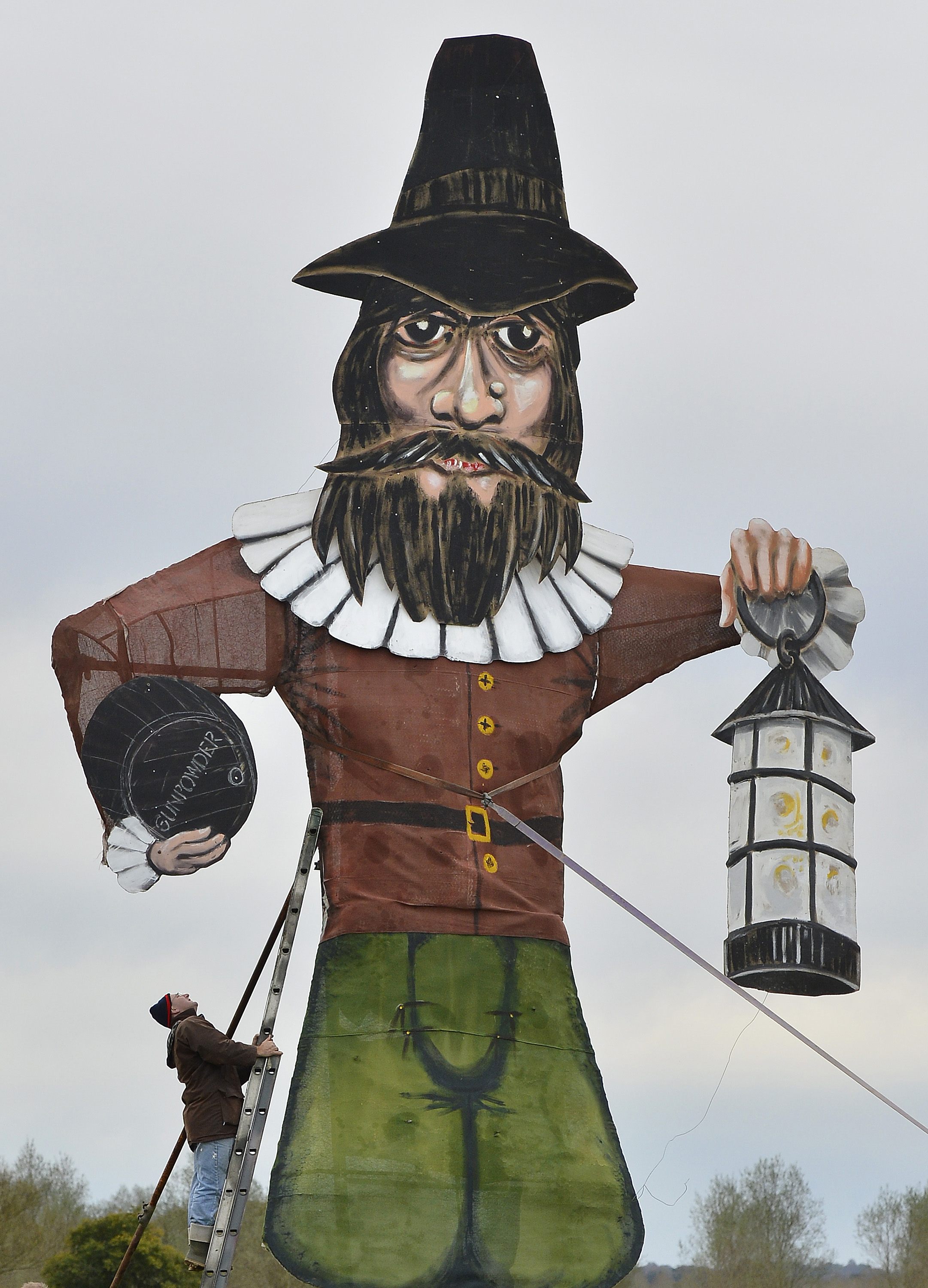
Tonight is Bonfire Night, the age-old celebration of the thwarting of the 1605 Gunpowder Plot, a native Catholic conspiracy to blow up the entire English government–King James I and VI and the royal family, attendant Lords and legislators–at the opening of Parliament. Plans of the plot leaked out, and Guido (or Guy) Fawkes, the man who has come to symbolize the Plot and recently so much more, was found in the basement of Parliament with 36 kegs of gunpowder. In the days that followed, he confessed to the Plot (both under torture and afterwards) and named the others involved. Not long after 1605, the relatively new art of fireworks was merged with the traditional celebratory British bonfire and burning Guy effigies to create a truly incendiary evening.  And the tradition has continued for over 400 years–it looks like they already started this weekend.

Celebrating the “wonderfull deliverance” in 1605 and last year.

The Plot and its aftermath have so many interesting dimensions:  historical, cultural, political.  I’m going to focus on just a few in this short blog post, but obviously books can and have been written. For teaching purposes, nothing demonstrates burgeoning popular anti-Catholicism in England better than the Plot and all of the diverse reactions and expressions that came after, as demonstrated particularly by the broadside below, which connects the attack of the Spanish Armada in 1588 with the Plot through a nefarious council jointly overseen by the Pope and the Devil. Religious propaganda in seventeenth century England was not subtle, but subtlety is not what you need to convey religious intensity, both negative and positive, to twenty-first century college students.

And then there is the culture of remembrance and the shaping of national identity. Modern historians have focused on this trend, particularly in relation to the Civil War in America and the First World War in Europe, but I think we can push it back into the early modern era. The Fifth of November was definitely and deliberately cultivated as a day of national deliverance and remembrance in England, and later in Great Britain, the Empire, and the Commonwealth. Here in New England, the 5th of November was celebrated as “Pope-Night” until the onset of the Revolution, and then it had to stop, or change, as it was just too British. Being British meant remembering the 5th of November, even if it was increasingly shed of its specific religious associations.

Illustrations from George Carleton‘s A Thankfull Remembrance of Gods Mercy, London, 1627, British Museum and from Extraordinary Verses on Pope-Night, Boston, 1769, Library of Congress.

Obviously it’s all about Guy Fawkes, then and now:  Bonfire Night is Guy Fawkes night.  As I wrote about in last year’s November 5th post, Fawkes has gone through an amazing transition, from terrorist to liberator, due to his central role in the graphic novel and film V for Vendetta and his adoption by the global Occupy movement. Guy miraculously became an advocate for freedom and an avatar for the 99%, with Shepard Fairey reworking his famous Hope poster with the mask of Fawkes replacing Obama. This transition seemed rather abrupt to me a year ago, but I’ve looked at Guy’s evolution over the centuries a bit and now I think I understand:  he has lost his context. Shed of the conspiratorial motivations and details, he became an increasingly iconic image, and also somewhat of a dashing cavalier.

Guy through the ages:  a Gunpowder Plot card from a deck of “Popish plot” cards, 1672, British Museum; an actor in character and costume as Guy, 1830s, Museum of London; cigarette cards from the 1920s and 1930s and a W.W. Denslow poster from the turn of the century, New York Public Library Digital Gallery; boys in Camden Town, London, with their Guy effigy, c. 1970, Museum of London; putting finishing touches on a Guy effigy this past weekend, Reuters.


Weather Witches

The witch trials in early modern Europe, which resulted in the execution of between 40,000 and 60,000 people and targeted double that figure, focused on devil worship more than anything else, but maleficia (harmful magic) was often the trigger, and the evidence, for the identification of conspiratorial witchcraft. And of the various types of harm that witches were accused of committing, nothing was more generic, and more harmful, than weather witchcraft. One of the earliest printed depiction of witches makes the connection concrete:  two hag witches are literally whipping up a storm in a cauldron.

Ulrich Molitor, (fl. 1470-1501), De lamiis et phitonicis mulieribus (Cologne, 1500).

Even if we can’t understand the fear of witchcraft in our rational era, we can understand the threat of weather witchcraft to a civilization that depended on the climate for food, and life. Our supposed mastery of nature leaves us a lot less vulnerable–at least we like to think so. But in the premodern past, a storm could bring hunger at best and starvation at worst. The source of evil is always a problem in Christianity, as it is in every culture:  why do bad things happen to good people?  The devil and his witches–the servants of Satan–provided an accessible explanation. And for these reasons, I think that the earliest disseminated images of the witch focused on weather witchery:  certainly those of the greatest printmakers of the day, Albrecht Dürer and his apprentice Hans Baldung (Grien) did: Dürer pictures a goat-riding witch attending by several putti and bringing forth rain, while Baldung’s more shapely weather witches are yielding their apple-capped flask to bring forth a storm with the aid of another demonic putto and of course, the demon-goat. This particular image is obviously a painting, but Baldung created several influential woodblock prints of witches depicted in an overtly sexual manner, intensifying interest in them even more in the early sixteenth century.

Albrecht Dürer, The Witch (1500-02), Metropolitan Museum of Art, New York; Hans Baldung Grien, The Weather Witches  (1523), oil on panel, Städel Museum, Frankfurt.

As I am writing this, I keep checking for updates on Hurricane Sandy, and I just read about the abandonment at sea of the Canadian replica tall ship HMS Bounty (made for the 1962 Marlon Brando film), and the loss of several members of her crew.  This was the particular witchcraft fear in Scandinavian cultures:  witches stirred up storms at sea and sank ships. You can see this fear illustrated in the Historia de Gentibus Septentrionalibus of Olaus Magnus (1555), a grand compendium of Nordic popular culture and folklore, as well as in King James I and VI’s pamphlet about the famous North Berwick trials:  Newes from Scotlanddeclaring the damnable life and death of Dr. John Fian (1591). Upon his engagement to Anne of Denmark, James spent time in Scandinavia and became exposed to continental witchcraft beliefs: the stormy voyage he endured on his return trip home combined with his belief that as “God’s lieutenant” he was the target of demonic conspiracies inspired him to be a particularly zealous witch-hunter both in Scotland and England.

Magnus’s Historia and Newes from Scotland woodcuts:  Ferguson Collection, University of Glasgow Library Special Collections.

The contemporary record of one of the largest witch hunts in European history, occurring at Trier in western Germany from 1581 to 1593 and resulting in the death of over 360 people, is illustrated with a composite picture of all the activities of witches, including storm-making with a broomstick. In central Europe, hail seems to have been the most commonly-identified form of magical weather and could definitely provoke accusations. Hail does seem kind of magical, if you think about it.

Title page of Peter Binsfeld, Tractatus de confessionibus maleficorum et sagarum (1592).

You can see from the title page of one of the pamphlets reporting the Lancashire (Pendle) trials of 1612, the largest trials in England, that weather witching was one of the accusations, along with riding the wind. I am not certain if any specific weather charges were leveled at the accused witches here in Salem, although I do know that the intense cold, and the hardship it brought to this community, has been considered among several contributing factors in the background of the 1692 trials. This follows the European historiography, which has been considering the impact of the “Little Ice Age” on witch-hunting for some time.

A goat-riding witch brings down a storm:  from  the Compendium Maleficarum of  Francesco Maria Guazzo (1628).


Salem Common

First off, it is Salem Common, not Salem Commons; the Common is not a suburban tract housing development. Those who refer to it as “Commons” are either not from Salem, or from New England (where commons are common), or are peddling something, such as the owners of the sausage stands and fried dough trucks who are allowed to set up residence on the Common during October.  I love commons (I’m using the plural here) and I think Salem has one of the prettiest in New England–but not in October.

Salem Common this October, and the same corner in an 1870s photograph by Salem photographers Peabody & Tilton (New York Public Library) and a turn-of-the-century postcard.

One of my favorite views of the Common is not a photograph, but a painting:  George Ropes’ Salem Common on Training Day (1808), which shows the local militia drilling on the green with townspeople looking on:  a window into the civic life of the new republic.  The Common has never been a pristine park but rather the center of varied activities: baseball, weddings, festivals, field days, concerts, ice-skating. A succession of playgrounds have been located on the Common, and now there’s a particularly nice one on the southeastern corner.  I think that most of the activities in the Common’s history, however, have benefited the public rather than private individuals. It is a common, after all.

George Ropes, Salem Common on Training Day (1808), Peabody Essex Museum; baseball on the Common in 1910, and the same perspective this past week.

I’ve seen other vehicles besides food trucks drive and park on the Common at this time of year, as if it were a parking lot. The sense of enclosed, protected, tranquil space in the midst of the city has been challenged for some time now, and not only in October, by the deteriorating condition of the circa 1850 cast iron fence.  The city is restoring the fence, in phases, but it’s an expensive undertaking. The Washington Arch is looking a little worse for wear too:  I’d like to think that the revenues from the food trucks are going towards these repairs in particular, and into a fund for the general maintenance of the Common in general.

Late nineteenth-century stereoviews show the Common with a more spare and formal look, no doubt, in part to the presence of Elm trees, always so striking in images from the past. Below are three images by the prolific Salem photographers Frank Cousins and G.K. Proctor (I’ve got an interesting post about the latter coming in the next few weeks) and an anonymous contemporary colleague.  The north side of the Common remains the most serene today; I imagine that this last photograph is also the last of our Fall color with this enormous storm bearing down on us.

Salem Common stereoviews by Frank Cousins, GK Proctor, and an anonymous photographer, New York Public Library Dennis Collection.