Category Archives: History

The First Weekend in June

It was a very busy weekend in Salem and Essex Country, encompassing the first seventeenth-century Saturday of the season, the Salem Arts Festival, Shakespeare on the common, open houses and garden tours, an ice cream social and a cider launch party, among other happenings. The weather was absolutely spectacular, sunny, dry, and in the low 80s, enticing “this is why we live in New England” comments everywhere I went. Salem was packed with tourists: I also heard many languages. I was outside all weekend and am paying for it this morning, with sunburn, itchy bug bites, and lots and lots of work to do–but I don’t care. After I plant the beautiful herbs that I purchased up in Salisbury in my garden, I’ll lock myself in my office!

June Weekend 016

June Weekend 012

June Weekend 008

June Weekend 027

June Weekend 047

June Weekend 058

June Weekend 061

June Weekend 064

June Weekend 068

Scenes from my first June weekend: hula hoop canopy and fish at the Salem Arts Festival, Derby House herb garden, something’s finally happening at the “Crotchet House”, launch party for Salem-made cider (really good–much dryer than other varieties of hard cider that I have had here in the U.S.), the Herb FARMacy in Salisbury, Massachusetts, and the Dole-Little House in nearby Newbury.


Tedious Details

Among the books up for “adoption” and restoration at the Salem Athenaeum this spring and summer is a first (1891) edition of Caroline Upham’s Salem Witchcraft in Outline, which has the outrageous subtitle the story without the tedious detail. It’s a beautiful little book, but I just can’t get past that subtitle, a knife to the heart of any historian: THE STORY WITHOUT THE TEDIOUS DETAIL. Caroline was the daughter-in-law of the first serious historian of the Salem Witch Trials, Charles W. Upham, whose Salem Witchcraft: with an account of Salem Village and a History of Opinions on Witchcraft and Kindred Subjects (1867) approached the event and topic with unprecedented context and detail. With her Outline, she admits that she is neither a brilliant essayist nor an historian, but offers her little book to the public as one would the photograph of a notable scene, not a great original painting. And if, as it must be, the rich coloring and delicate effects are missing in the reproduction, it is hoped the drawing may be found true, and no important lines set in awry. Having been desired by the heirs of the late Charles W. Upham to draw freely from the History, paragraphs from it have been woven into the sketch giving strength to the little story, and serving the reader better than a feminine pen I could do”.  Her “photograph” is certainly framed well, with a beautiful cover, amazing fonts, and lovely pen-and-ink illustrations of the seventeenth-century houses that “witnessed” the events of 1692. I also like the “signature page” featuring the names of some of the major participants in the trials: Governor Phips, several judges, the victim John Proctor: this represents Caroline’s approach and emphasis on personal stories, which actually anticipates the focus of witchcraft histories from a century later.

Upham 009

Upham 010

Upham 013

Upham 011-001

Upham 016

So there’s a lot to like about this little book, but again, there is also that objectionable subtitle: THE STORY WITHOUT THE TEDIOUS DETAIL. For me, it’s all about the details: the details make the “story”. I do want to give Caroline the benefit of the doubt, however: it’s clear to me that nineteenth-century Salemites were tired of their witchcraft past (Nathaniel Hawthorne being the best example); they couldn’t quite conceive yet (actually Daniel Low’s witch spoon would appear at just about the same time as Salem Witchcraft in Outline, for the 200th anniversary of the Trials) how to turn their dark past into commercial opportunities. They wanted to acknowledge, but move on. So a succinct outline, produced just in time for the big anniversary, might have seemed sufficiently reverential. And I also have to admit, as one who has delved in Victorian volumes quite a bit, that nineteenth-century history writing is a bit tedious, with its focus on great men, big battles, and past politics. I can appreciate the images below, even though the first one is every professor’s worst fear!

NPG D12938; William Smyth ('A petty-professor of modern-history, brought to light') by James Gillray, published by  Hannah Humphrey

Tedious Tissot

James Gillray, William Smyth (‘A petty-professor of modern-history, brought to light’), c. 1810, ©National Portrait Gallery, London; James Tissot, The Tedious Story, c. 1872, Private Collection


June is for Jousting

While searching my usual sources for characteristic images of the month of June, I was struck by how many epic battles occurred during the most green and golden of months: there are as many images of conflict as there are of pastoral fields and full-blown flowers. This is pretty understandable given that spring and summer constituted “campaign season” in the pre-modern past, but momentous battles continue into the modern era, presumably after nature has been conquered herself: Naseby, Louisburg, Bunker Hill, Waterloo, Custer’s Last Stand, D-Day. I don’t really want to go there, so I’ll think I’ll dwell in the more distant past, where not only serious battles occurred in the first month of summer, but also “play” ones, as a whole circuit of tournaments and festivals emerged in the late medieval and early modern eras, signalling the submission of the military aristocracy and the coincidental expansion of royal authority and centralized monarchies. As soon as a way of life gets ritualized, you know it’s on its way out!

Harley 4379 f.19v

June Jousting-001

clothgold

June Henri III-001

le_grand_carrousel_de_1662_copyright_rmn-74457-001

projet_de_costume_pour_le_carrousel_des_galants_maures_marechal_de_camp-85f57

Detail of miniature of a joust between Pierre de Courtenay and Sire de Clary, British Library MS Harley 4379, f. 19v; June calendar page from BL MS Additional 24098, Book of Hours, Use of Rome (the “Golf Book”, c. 1540); Kings Henry VIII of England and Francis I of France meet at the “Field of the Cloth of Gold”, 5 June, 1520; King Henri II is injured during a celebratory joust on 30 June, 1559, Franz Hogenberg, Bibliotheque Nationale, Paris (leading to a half-century of power struggles and warfare among the unleashed French nobility, divided and motivated by their religious differences); Louis XIV’s “Grand Carrousel”, 1662: the festival (after Henri de Gissey) and a participant in one of the elaborate “oriental” costumes designed for the event, Chateau de Versailles (certainly no self-respecting noble would put on this garb a century before!)


Willow Ware Redux

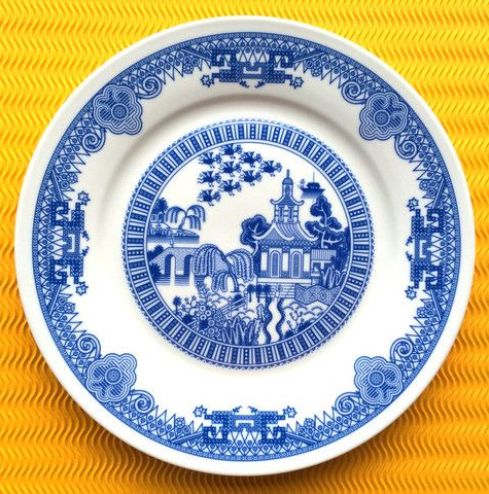
I am not fond of blue-and-white china (or anything blue, to tell you the truth), nor do I particularly like the Willow pattern, one of the most popular and replicated in the western world for several centuries. But I do love both the idea and the act of updating something that is classically familiar—even overly familiar–in a clever and creative way. So when I saw a little story about Calamityware, in which flying monkeys and flying saucers, along with robots and Renaissance sea creatures, are right there on the plate along with the traditional “Chinese” structures, figures, and landscapes, I went right to the source: artist Don Moyer’s site, on which his earlier drawings are coming to life (or pottery) on a Kickstarter-funded production line. So many things about these plates appeal to me (despite their color): they are blatantly anachronistic, purely whimsical, and perfect examples of my favorite fusion of past and present, traditional and modern, new and old. The flying monkeys were first off the line, and we may see kings and oligarchs later, though surely they won’t be as scary.

Calamityware

New Willow Ware Calamity 2

New Willow Ware Calamity 3

Calamityware is not the first variation on the Blue Willow pattern; in fact it was inspirational almost from its inception–and wildly popular. I’ve got a bowl full of Willow shards uncovered in my back yard when I was digging out my herb garden. Willow ware was first produced in the late eighteenth century by Thomas Minton, an English potter who adapted designs featured on Chinese export porcelain for domestic production. There was no patent protection, and his competitors–Wedgwood, Royal Worcester, Spode–began producing their own Blue Willow, and continued to do so for the next two centuries. In an early stroke of advertising genius, a story was composed to sell the dishes: when a powerful Chinese lord discovers that his daughter has fallen in love with his lowly clerk, he locks her up in a secluded pagoda behind a fence and betrothes her to a rich and elderly duke. The young couple flee before the wedding, but are hunted down and killed (there are different versions of their deaths). True love prevails, however, as the gods transform the lovers into a pair of lovebirds which remain together forever, hovering above the willow tree that once shaded their clandestine meetings. The story expanded the reach of Blue Willow–beyond the pottery business and into popular culture: poems, books, textiles, and pictures told the Blue Willow love story over and over again in the Victorian era, and after.

Willow ware Spode V & A-001

New Willow Wares Mercer-001

Spode Blue Willow plate, c. 1800-1820, Victoria & Albert Museum; Joyce Mercer (1896-1965) illustration, 1920s.

And now, Willow ware seems to be having a moment, once again. In fact, this “moment” seems to encompass the past decade or so, or perhaps the pattern, in all of its variations (and colors–I could go for the red), is always having a moment. And that, of course, is the definition of classic. In 2005 ceramicist Robert Dawson digitally-designed a line of “After Willow” dishes for Wedgwood, and more recently we have Pokemon Willow by Olly Moss (note the lovebirds, still flying above!) and there are more calamities to come.

Willow Ware Dawson V and A-001

pokemonwillow


A Decoration Day Divided

The holiday which we now commemorate as Memorial Day has its origins in the immediate years after the Civil War, when late-May rituals of remembrance and decoration of veterans’ graves emerged and evolved spontaneously and separately in both the North and the South. Given the prominent role played by the Grand Army of the Republic (G.A.R.) in the official adoption of the holiday in the North in the later 19th century, a rather divided commemoration continued all the way up to World War I, which united the nation in remembrance, and widened its circle to encompass American veterans of all conflicts. In 1971, Memorial Day was declared a national holiday by an act of Congress and placed on the last Month of May. And thus we have our national commemoration and commencement of summer (although weather-wise, the latter might apply only to the North). When tracing the earlier history of Decoration Day through paper, which is easy to do as it corresponds to the “golden age” of penny postcards and advertising inserts, the divided focus is readily apparent. The cards below are from a great archive of postcards produced by the famous British firm Raphael Tuck & Sons, which supplied both North and South with their commemorative cards.

Decoration Day Tuck North Flag

Decoration Day Tuck South Flag 1907

Raphael Tuck Grant 1911

Decoration Day Tuck Lee 1911

Decoration Day Tuck 1910

Decoration Day Tuck 1911 Blue and Gray

Decoration Day Tuck all wars

Flags unfurled, North and South, c. 1907; Remembering Generals Grant and Lee (with the U.S. flag sneaking into the latter scene), c. 1911; In a northern Attic, c. 1910; The Blue and the Gray come together just before the Great War; all veterans after (this last card is not a Tuck–you can probably see the difference in quality–and also unlike all the Tuck cards, it was not produced in then-hostile Germany).


One, two, three, four, five……….

GABLES. Before I knew anything about historic architecture (and I still really don’t know all that much, to be honest), I always thought the gables (generally one, occasionally two or three) that seem to burst out of the roofs of mid-19th century houses were rather radical departures from the more straightforward colonial and Federal styles. Radical for American architecture, that is: obviously gables are a long-standing feature of European structures. But now I know they are just another revived element, derived not only from much older European elements but also 17th century “medieval” houses built in America (I know that term is widely used by architectural historians, but I find it awkward, as the 17th century is decidedly not medieval). Just the word gables in Salem is a reference to the House of the Seven Gables, which is more early nineteenth-century creation than seventeenth-century survival: when philanthropist Caroline O. Emmerton acquired the fabled mansion it had three gables rather than seven and she hired Boston architect Joseph Everett Chandler in 1909 to “restore” the “missing” gables and transform the house into Hawthorne’s inspiration. Chandler was more of Colonial Revival architect than a restoration architect, and he writes about the “development” of the House of the Seven Gables in his 1916 book The Colonial House, citing other first-period gabled structures in Salem and Boston as his inspiration. Hawthorne scholars believe that the author was also inspired by Boston gabled houses in his conception of the House of the Seven Gables, including Captain John Turner’s mansion on Beacon Street and the famous  “Old Feather Store” at Dock Square. Certainly there were gables aplenty to choose from in Hawthorne’s time, both new and old.

Gabled Julien House Boston-001

Gables 021

Gables 035

Gables 024

Gables 037

Gables 039

Gables 038

old feather store

Drawing of “Julien’s Restorator” in Boston, taken down in 1824, from James Henry Stark, Antique Views of Ye Towne of Boston, 1901, and center-gabled houses in Danvers and Salem; a two-gabled house in Danvers, and two adjacent three-gabled houses in Salem; The “Old Feather Store” in Boston, c. 1680-1860, shortly before it was taken down, Boston Public Library.


Worts and All

When I first planted my garden, I was studying horticultural texts from the late medieval and early modern eras, and determined to have the same plants that I was reading about in my own backyard. In particular, I sought out plants that ended with the suffix wort, Old English and German for “plant” or “root”, believing that these ancient plants would connect me to the past–no matter what they looked like! And so, for the past decade or so, I’ve had some rather straggly plants in my garden just because of their heritage–or supposed heritage. Actually some “wort plants” are quite commonly used in modern gardens: varieties of stachys (woundwort), epimedium (barrenwort–containing an aphrodisiac essence), St. John’s Wort, pulmonaria (lungwort), the indestructible groundcover herniaria glabra (rupturewort, sometime called “burstwort”), saponaria (soapwort), astrantia major (masterwort). According to the Doctrine of Signatures and their appearance, the vernacular names of these plants reflect their uses. I have all of these plants in my garden still:  they survived our tough winter. However, it seems that some of my lesser-know wort plants did not: I seem to have lost my motherwort (leonurus cardiaca, of which Nicholas Culpepper commented in 1653, there is no better herb to take melancholy vapours from the heart … and make a merry, cheerful, blithe soul for mothers and everyone else), the variety of campanula that is called “throatwort” is gone, as are many of my ferns, including a maidenhair variety referred to as “spleenwort” in the medieval herbals. Actually the motherwort was much too big for my garden, so I don’t think I’m going to miss it, or the very common mugwort (artemesia) which seems to be gone as well.  I ripped out my spiderwort (tradescantia) long ago because it was so ungainly, and I’m not convinced it was even that old: from the 17th century on, the word wort seems to be rather liberally applied to plants of all kind, even those from the New World.

Wort Fuchs Bloodwort-001

Wort Fuchs Hazelwort-001

Worts 002

Worts 004

Worts 005

Bloodwort and Hazelwort from Leonhard Fuchs’ New Herbal of 1543 (all plates available here; a great resource!); my surviving soapwort, lungwort, and barrrenwort.


The Death of Nathaniel Hawthorne

150 years ago today Nathaniel Hawthorne died, far from either his native city of Salem or his adopted town of Concord, in the company not of his beloved family but that of his devoted friend, former President Franklin Pierce. Really he died alone (as Pierce reported), very peacefully, in his sleep. I don’t think there are any plans to mark this memorial here in Salem (remember, we are Witch City, not Hawthorne city, and Nathaniel doesn’t seem to have cared much for Salem anyway), but (as usual) there will be events in Concord. It appears that Hawthorne had been unhappy and unsettled for some time before his death (just shy of 60; his birthday is July 4): there were money worries, health issues, the separation from his family, and of course the war–he doesn’t seem to have been enough of an Abolitionist or enough of a Yankee for his friends and neighbors– but at least his passing was peaceful, very peaceful according to President Pierce. I did a quick search of newspaper front pages for the week after May 19–and Hawthorne’s death was on the front page of every single newspaper I scanned, even in the South, although generally it was just a line or two in the midst of all the war news. He was famous in his own time, and has become even more so with time. There are many compelling and contradictory things about the work and the character of Nathaniel Hawthorne–he was both intensely shy and so handsome that people would stop him in the street– but for me, he’s always been the ultimate New Englander, and that is how and why I am thinking about him today.

PicMonkey Collage

Hawthorne's birthplace-001

Hawthorne on the Move

ourworldsgreatb01drakgoog_0411-001

Hawthorne Plymouth

Manuscript copy of The Dolliver Romance, which Hawthorne was working on before his death, New York Public Library; Newspaper reports from The (Washington, D.C.) Evening Star and The Daily State Sentinel (Indianapolis), May 20, 1864, Library of Congress Historic Newspapers Collection; Hawthorne’s birthplace in its original location on Union Street in Salem and its journey to the House of the Seven Gables campus in 1958; Hawthorne’s Concord milieu, from Samuel Adams Drake, Our World’s Greatest Benefactors (1884); The Pemigewasset House in Plymouth, NH: where Hawthorne died on May 19, 1864, Library of Congress


Gothic Visions, Realized

I have posted on Salem’s Gothic Revival structures before, but I didn’t really delve into the sources or inspiration for this mid-19th century romantic style, other than to reference Andrew Jackson Downing. While Downing and other outside influences were no doubt important, it is now clear to me (thanks to two scholarly papers* by Arthur Krim) that Salem had its own Gothic promoter, Colonel Francis Peabody (1801-1867). The second son of Salem’s most illustrious merchant prince at the time, the Colonel’s life and work mark Salem’s transition from Federal city built on maritime trade to “Victorian” city sustained by industry: he even had a statue of Queen Victoria installed in the truly Gothic “Banqueting Room” of the family’s Essex Street mansion. But it is important to note that Peabody was an energetic entrepreneur and philanthropist, not just a dilettante dabbling in design. He was colonel of the 1st Regiment, 1st Brigade, 2nd Division of Massachusetts Militia, the founder of the Forest River Lead Company (the subject of my last post), and the first president of the Essex Institute. He clearly had two passions, which seem very different but perhaps are related: technology including all of its potential applications and the public awareness thereof, and the Gothic style, interpreted quite conservatively–and widely. The colonel seems to have craved a Gothic environment not only for himself (encompassing the interior of the family home on Essex Street and Kernwood, his “country” estate in North Salem) but for much of Salem: he was the driving force behind the design of the First Unitarian (North) Church on Essex Street in the Gothic style by Boston architect Gridley J.F. Bryant as well as the foundation structures of Salem’s picturesquely-planned cemetery, Harmony Grove, for which he designed the “rustic arch” himself in 1839. Certainly it was not an impartial publication, but the successive editions of the Essex Institute’s Visitor’s Guide to Salem in the later nineteenth century proclaim that Peabody’s love of the beautiful in architecture has left a good influence in Salem in many way. His two pursuits, technological innovation focusing on the future and a design aesthetic focused on the “medieval” past are not incompatible: in moments of dynamic change like mid-19th century Salem (or Britain), reverence for the past, especially the rural past, seems perfectly understandable to me.

Colonel Francis Peabody’s Gothic Salem:

Peabody House Cousins-001

Gothic Banqueting Hall Francis Peabody House 134 Essex 1850-1908

2004-21.17 001

PicMonkey Collage

Gothic 013

Gothic 011

Gothic funeral 1870

The Peabody House, 134-36 Essex Street Salem, c. 1890, and its “Banqueting Hall”: photographs by Frank Cousins, Duke University Urban Landscape digital collection (the house was taken down in 1908 and replaced by the Salem Armory headhouse); Photograph of Kernwood, Peabody’s North Salem estate built on 66 acres, by Walker Evans, c. 1931, Metropolitan Museum of Art; Harmony Grove Arch, designed by Peabody in 1839 and taken down in 1960, quatrefoil, and Kernwood Gate and Gatehouse, Frank Cousins photographs, c. 1890, via Krim (1992); Harmony Grove chapel door and Peabody Family Funeral Monument; The gathering for the Colonel’s funeral, Harper’s Weekly, February 1870.


* Arthur J. Krim, “An Early Rustic Arch in Salem”, Journal of the Society of Architectural Historians, Vol. 51, No. 3 ( 1992), pp. 315-317, and “Francis Peabody and Gothic Salem”, Essex Institute Historical Collections, Volume 130, no. 1 (1994), 18-35.


Deleaded

Like many northeastern cities, large and small, that flourished during the Industrial Revolution, Salem is still wearing the scars of its productive past: there are decaying tanneries, free-standing chimneys, and ramshackle warehouses in close proximity to more beautiful (and lively) places around town. I think these sites are simply part of the layered texture of the city, and of course a century or more ago their builders would never associate the word “scar” with these constructions: they were industrial palaces. I’ve been thinking about lead mills recently, as there is a large site on the Salem-Marblehead line that is the subject of a planning study right now. The buildings of the Forest River/ Chadwick Lead Mills sat on this site (originally known as “Throgmorton Cove”) for nearly 150 years, producing bullets for Union soldiers, and “pure” white lead for generations of painters. The company received authorization to fill in the Forest River in three separate occasions in the later nineteenth and early twentieth centuries, creating the landscape that had to be cleaned up a century later, after its almost-landmark building burned to the ground in 1968. An earlier–palatial and pastoral–incarnation of the company is represented by a F.F. Oakley chromolithograph in the collection of the Boston Athenaeum, along with a similar image of its competitor across town, the Salem Lead Works. I do think it is interesting how nineteenth-century printmakers portrayed industrial buildings not as encroaching on the landscape, but as part of it.

Deleaded Forest River

Deleaded Salem River

Boston Athenaeum chromolithographs:  F.F. Oakley Litho., 1860; Chas. H. Crosby & Co. Lith., 1872, both Boston.

Nothing survives of this second Lead works, which was situated on the North River along the train tracks–as you can see in the lithograph, except for little scraps of paper which advertised its products, which of course necessitated a century-long (and more) deleading process pursued not only by cities, but also individual property-owners.

Unleaded Forest River Logo

Unleaded ad Salem Directory 1886

Unleaded-001

Forest River Lead Company logos from a 1919 billhead; Salem Lead Company ad from the 1886 Salem Directory; 1930s Dutch Boy ad featuring “Salem White Lead”.