Category Archives: History

Stolen Identities

I hate tumblr. I link my posts to it, because it is automatic and they display beautifully, but I never go there. I know that pretty much all I will find is lifted: unsourced, uncredited, without any context whatsoever. Of course, the internet is an anarchical wild west, but tumblr is still the worst outlaw: thoroughly unaccountable. It’s clearly cool not to credit on tumblr, so I know that if I go there I will be very, very annoyed: I might find a beautiful picture, but I will never, never find its source. The other day I was searching for some more information about someone who lived in my house 150 years ago: Willard Peele Phillips. I check up on him occasionally, because he was a pretty active entrepreneur and abolitionist and new sources are digitized all the time. I wound up on tumblr, where I found a very familiar photograph, and some very, very familiar text on a blog entitled The Civil War Parlor, whose author claims that “every effort is taken to remember the men and women of the Union and Confederacy equally with dignity and respect”.

Below is the picture, lifted and lightened from my post Remembering the 54th Regiment. Instead of copying my accreditation, she copies my text above, almost word for word. “Her” text is first (in red!) followed by my original words, in bold.

 Three little known Salem men with the 54th Massachusetts Volunteer Regiment: Willard Peele Phillips, a prominent Salem businessman served on Governor Andrew’s recruiting committee for the regiment, Luis Fenollosa Emilio was a young captain in the Regiment, and later served as acting commander after he became the only officer to survive Fort Wagner, and Francis H. Fletcher, a clerk in a Salem printing office, enlisted in the Regiment and fought until the end of the war. Those are the bare facts, but the involvement of these three men runs deeper.  Phillips raised money, not only men, for the Regiment, Emilio later became the historian of the Regiment with the 1891 publication of The Brave Black Regiment.  The History of the 54th Massachusetts, 1863-65, and Fletcher protested the army’s unequal (or nonexistent!) pay system while still in service.

Less well-known, in varying degrees, is the involvement of three Salem men with the 54th Massachusetts Volunteer Regiment: Willard Peele Phillips, a prominent Salem businessman (who happened to live in my house at the time, or I live in his now) served on Governor Andrew’s recruiting committee for the regiment, Luis Fenollosa Emilio was a young captain in the Regiment, and later served as acting commander after he became the only officer to survive Fort Wagner, and Francis H. Fletcher, a clerk in a Salem printing office, enlisted in the Regiment and fought until the end of the war. Those are the bare facts, but the involvement of these three men runs deeper.  Phillips raised money, not only men, for the Regiment, Emilio later became the historian of the Regiment with the 1891 publication of The Brave Black Regiment.  The History of the 54th Massachusetts, 1863-65, and Fletcher protested the army’s unequal (or nonexistent!) pay system while still in service.

She not only left out the all-important first line (does this woman not know how to cut and paste?) and Francis Fletcher’s letter, but linked this text to the picture without my accreditation: Capts. Tomlinson and Emilio (center) with Lt. Speer, all of Company C of the Massachusetts 54th, May 1863, Library of Congress, Letter of Francis H. Fletcher to Jacob C. Safford, Gilder Lehrman Institute of American History. Consequently Captain Emilio, in the center, is the only proper identification in this picture: his fellow officers, Capt. Tomlinson on his right and Lieutenant Speer on his left, are literally left out of the picture by Miss Civil War Parlor, who, let me remind you, is dedicated to taking every effort to remember the men and women of the Union and Confederacy”.

tumblr_m9c2rfzyGG1rd3evlo1_500

AGAIN: Unknown Photographer, Second Lieutenant Ezekiel G. Tomlinson, Captain Luis F. Emilio, and Second Lieutenant Daniel Spear, October 12, 1863, tintype, 3 1/4 x 2 7/16 in. (8.6 x 6.5 cm.), Library of Congress, Prints and Photographs Division. All three survived the War, but only Emilio was from Salem: Tomlinson was from Radnor, Pennsylvania, and Spear was from Boston.


Here be Hedgehogs

Well, it’s actually Hedgehog Awareness Week, so I feel that I need to do my part. I always decorate with animals, and generally it’s a seasonal cycle of snails/foxes/deer/rabbits with a few individual oddities, but just recently I bought a cute ceramic hedgehog so I was thinking about about expanding my menagerie…..and then came Hedgehog Awareness Week! Interesting and historical images of hedgehogs are not difficult to find: medieval illustrators often inserted urcheons/urchins into the margins of their manuscripts and there are also several tales to inspire images: Aesop’s Fox and the Hedgehog ( a title that was adapted by Isaiah Berlin for his classic essay on types of thinkers, inspired by the observation of Archilochus that the fox knows many things, but the hedgehog knows one big thing), the Grimm brothers’ Hans-my-Hedgehog and The Hare and the Hedgehog, and a host of other hedgehog stories penned (and drawn) more recently. There are hedgehogs in Alice’s Adventures in Wonderland and Peter Rabbit: they are a cute and easy addition to any illustrated story. So it was difficult to narrow down my collection of hedgehog images, but here goes.

Medieval Urchins (hence Sea Urchins!):

Hedgehog BL 2-001

Hedgehog Egerton-001

Add. 39636, f. 13.

Hedgehog and Ape-001

British Library MS Harley 3244 f. 49v (13th c.); MS Egerton 1121 f. 44v (15th c.–the hedgehog mocks the goat admiring his reflection in a stream); MS Additional 39636, ff. 13  (15th c.–St. Benedict and a hedgehog); Royal 15 E IV f. 180 (15th c.)

Some early modern hedgehogs: because of his voracious appetite and hibernation habit, the hedgehog often represented gluttony, as on the flag below, and his round silhouette was made for mockery:

Hedgehog vices BM-001

Hedgehog and Hare BM-001

Hedgehog 1777 BM-001

British Museum engraving of the Vices by Heinrich Aldegrever, 1552; engraving after Marcus Gheeraerts’ illustrations of Aesop’s Fables, c. 1630; satirical print of “Miss Hedgehog” published by Matthew Daly, 1777

Whimsical and utilitarian hedgehogs, 19th-21st centuries:

V0049518 A crowned fairy king seated on a hedgehog drawn by a young g Hedgehog Bulb Pot Wedgwood V and A 1820-001

Hedgehog Pincushion-001

Hedgehog May-001

The King of the Fairies rides his hedgehog, 19th c., Wellcome Library Images; Bulb Pot by Josiah Wedgwood, 1820, Victoria & Albert Museum; Hedgehog pincushion (there’s a long tradition of these!), Tatjana Ceramics; Calendar Page for May, Catherine Bradbury,© Catherine Bradbury, Bridgeman Art Library / Private Collection


The Welsh Salem

There are actually several Welsh Salems, but the most iconic is both a place and a painting: of the interior of a small Baptist chapel in the village of Pentre Gwynfrun, near Llanbedr in North Wales, by Sydney Curnow Vosper (1866-1942).  The focus of the watercolor is an elderly (even ancient) woman in traditional Welsh dress, surrounded by several other members of the congregation, most deep in prayer. Salem was painted by Vosper in 1908, a time when local Welsh traditions appeared vulnerable, and the painting reads tradition, faith, calm in an increasingly industrialized world. It also became the most accessible of images when it was incorporated into an advertising campaign for Lever Brothers’ Sunlight Soap, the first packaged bars of soap in Britain: for £7 of soap, consumers were entitled to send in a voucher and receive a color print of Salem. Many did so, especially in Wales, and consequently it adorns many Welsh walls. The painting has been the focus of a book and a recent exhibition, and Salem Chapel has become the object of many a pilgrimage.

Salem 1908

Salem on Wall

Salem, Sydney Curnow Vosper, 1908, Lady Lever Art Gallery, Liverpool Museums; a framed color print, BBC Wales

I saw my first Salem print when I was around 20, in a Welsh bed and breakfast, appropriately. Within a week of my first sighting, I saw several more. I had no knowledge of traditional Welsh clothing at that time, so I thought that this Salem pictured a seventeenth-century Salem, Massachusetts church and that the woman depicted was an ancient accused witch, being cast out by her congregation. I heard “Salem” and thought Salem Witch Trials. Believe me, I was quickly corrected! There is, however, a vague diabolical connection here: many people see the devil in the folded sleeve of the woman’s shawl–on the right, near her bent elbow, and her bible–as well as a mysterious face in the window. I have to admit that these visions elude me, but clearly there is more to Salem than meets the eye.


Enchanted Gardens

I’m rather depressed about my garden: I think I lost a lot of perennials–including many dear old friends–over this past bitter winter. This is generally the week–or even earlier–that my favorite spring plants pop up, but so far all I see is trillium and pulmonaria in the “woodland garden” out back. Notably missing is my all-time favorite, the almost-magical Jack-in-the-pulpit (Arisaema triphyllum), which should definitely have popped up by now. I think my Jacks are dead, although several of my gardening friends tell me to not give up hope as we are as much as four weeks behind this year, but there is not a single little sprout to be found peeping through the mulch. I fear for my Lady Slippers, but they come up a bit later so I have not given into despair quite yet. The center perennial beds seem to be in better shape than the shady back, with the exception of the germander edging border that I’ve been slowly developing over the past few years: quite a few of the individual plants have been lost, breaking the uniformity of the border. I’m tempted to just rip them all out and start fresh with a hardier plant, and so I would really welcome suggestions for low-lying, traditional, hardy, front of the border alternatives.

So I am not spending these first precious days of May dancing around my lush, flowering garden (in a flowing white dress) because it is neither lush nor flowering: looking for inspiration (or escape) I am instead delving into the “Enchanted Garden” sub-sub-sub genre of paintings. Of course medieval-esque fantasy gardens are a favorite Pre-Raphaelite theme, but even before their Decameron-inspired images appeared in the nineteenth century, artists were inspired to amplify nature in rather seductive ways. In the later sixteenth century, the popular poem by the Italian poet Tarquinato Tasso, Gerusaleme Liberata (Jerusalem Liberated), inspired several paintings of enchanted gardens. The poem turns the Crusades into an epic fantasy, in which heroic Christian knights confront all sorts of obstacles in the Holy Land. One particular knight, Rinaldo, is enticed by the beautiful Saracen sorceress Armida to enter her lush garden, and there she keeps him occupied for quite some time, until he is rescued by his comrades. I like the painting by Flemish artist Jan Soens best among several illustrations of Rinaldo and Armida, because it seems to focus as much on the garden as on the sorceress.

Enchanted Garden 16th C

Jan Soens, Rinaldo and Armida in the Enchanted Garden, c. 1581-1611, The Walters Art Museum

Several centuries later, Giovanni Boccaccio’s Decameron inspired several pre-Raphaelite painters to depict one of its most popular stories (the 5th to be told on the 10th day): the tale of the besotted Ansaldo, who conjured up a magical May garden in the midwinter for his lady love, Dianora, who had promised him that she would leave her husband and run away with him if he completed this seemingly-impossible task. Ultimately Ansaldo releases Dianora from her promise, and the garden dissolves “like the morning dew”, but it seems to have been a collective aim of British romantic painters to recapture it and other enchanted gardens for posterity.

Enchanted Garden Stillman

(c) Lady Lever Art Gallery; Supplied by The Public Catalogue Foundation

Enchanted Garden Waterhouse tree-001

Marie Spartali Stillman, Messr. Ansaldo Showing Diavola His Enchanted Garden, 1889; John Waterhouse, The Enchanted Garden, 1917, Lady Lever Art Galler, and study for above, Victoria & Albert Museum Collections

Also romantic, in a more naive way, are the paintings of British artist Helen Fielding (1900-1979) who depicted her Lancashire environment in an ever-charming way, including a garden that seems enchanted in all seasons, here pictured, as vividly remembered, in the spring of 1908. I love the inscription on the back, from the Christie‘s catalog: The Enchanted Garden was very/beautiful in April, when Father thought it would be better to send Mother, George and I also the Aunts, Grandma and Miss/Carter (who wore pink) to Grandpa’s at Blackpool/to be safely out of the way of the Suffragettes/in Lees. We saw for the first time the/Wild Cherries in flower and small trees/covered in the palest pink blossoms/which Grandpa said was the Crab apple, George and I had never seen trees/with blossom which covered them like/snow, also in the Enchanted Garden was/the pond which would soon be full of frogs/and tadpoles and the year was 1908/Helen Layfield Bradley 1975. I know just what she means by “trees covered with blossoms like snow”, don’t you? Still waiting for that here.

Enchanted Garden Bradley

Helen Fielding, The Enchanted Garden, 1975


Looking for the House on the Corner

I was searching for springtime in Salem on canvas yesterday, as the real season has failed to arrive (not unusual for New England). Clicking around artnet, avoiding all the other things that I have to do during this busy time in the academic year, I found a new-to-me “Salem” artist: Sidney Raynes (1907-1968). I’m using the quotation marks because it is quite apparent that Raynes did not live in Salem, but she painted several very interesting Salem scenes in the 1930s or 1940s. A Massachusetts native who was trained at the Art Students’ League in New York, Raynes was part of the Rockport artists community on Cape Ann and a lifelong member of the Rockport and North Shore Art Associations. I looked for as many paintings of hers as I could find on the web, and from this small sample of her work it looks to me like she was more inspired by the streets and buildings of Gloucester and Rockport than the shore: this might explain the appeal of Salem. Both of the paintings below, Salem in Springtime and Salem Street Corner, are appealing to me, but I’ve become quite fixated on the latter simply because I dont know where it is.

Raynes Salem Springtime

Raynes Salem Street Corner 1930s

Sidney Raynes, Salem in Springtime and Salem Street Corner, oil on board and oil on masonite.

This house might be long gone–it looks like it is on its way out here. But I took a walk to see if I could find it, armed with the two major clues the painting provides: the pediment-topped doorway and the corner quoins (as well its corner location). Lots of houses in Salem have doorways like this, and many have quoins, but very few houses have BOTH and are located on a corner.The boarded-up first story with additional entries indicates that this house served some sort of commercial purpose in its past, eliminating houses in residential areas, although shops and residences were more closely connected in the past than they are now. I narrowed it down to two houses: the Captain John Hodges House (1788) and the Timothy Orne House (1761), both on Essex Street. I’ve featured both of these important houses several times on the blog and I know their general histories: I’m pretty sure the Hodges house never had a storefront. So that leaves us with the Orne house, which has gone through quite a few transformations in its long history. It has the corner quoins (hidden under siding in the 1970s Bowman’s Bakery photograph below) but the last photograph by Frank Cousins (c. 1900) shows a doorway that is decidedly not pedimental.

Corner 018

Corner 014

Corner Timothy Orne House

cousins-timothy-orne-house-266-essex

Captain John Hodges House and Timothy Orne house today, mid- and early 20th century.

So I’m stuck. If Sidney Raynes’ relic house on the corner still exists, I’m not sure where it is. Awaiting suggestions!


Beauty Sleep

As it happened I was watching the 1935 film version of Romeo and Juliet (starring Leslie Howard and Norma Shearer) while I was going through seed catalogs and doing some (late) garden planning. Just as Juliet went into her deep sleep, I came to the herbal sections of one catalog, and remembered that I always wanted some belladonna (Atropa Belladonna; Deadly Nightshade) for my garden–just because it’s one of the most storied poisonous plants in history. A decade or so ago, when I had given over most of my garden to herbs which served as either plague cures or poisons (for scholarship!), a student gave me some belladonna seeds–which I thought was very nice/cheeky of him–but the plant lasted only one season. So I’d like to try again. Juliet reminded me:  Shakespeare is not specific, but it must have been belladonna on his mind. His contemporary, John Gerarde, wrote that a small quantity could lead to madness, a moderate amount to a “dead sleep”, and too much to death in his Herball or General Historie of Plantes (1597). As Friar Laurance observes in the play,”within the infant rind of this small flower/poison hath residence and medicine power” and later instructs Juliet: Take thou this vial, being then in bed, / And this distilled liquor drink thou off; / When presently through all thy veins shall run / A cold and drowsy humour, for no pulse… And in this borrow’d likeness of shrunk death / Thou shalt continue two and forty hours.

Belladonna Juliet-001

L0058356 Glass bottle used for tincture of belladonna, England, 1880-

Juliet considering her options and holding a belladonna? tincture in an 1830 print by William Say (British Museum) and an apothecary bottle from 1880 (Wellcome Library Images).

Friar Laurence was right: belladonna has the virtues of both medicine and poison, but throughout history, its emphasized use has been on the latter (poison-tipped arrows, “inheritance powders”, magical ointments which enable witches to fly) with the exception of the cosmetic application which explains its vernacular name, “beautiful lady”. The Renaissance image of beauty encompassed not only a high forehead but also a certain wide-eyed (literally) look, and Atropa Belladonna contains a muscle-relaxant substance (atropine) that dilates the eyes for long periods of time. Presumably the fashionable Renaissance lady had to be quite knowledgeable about how to prepare her tincture, or have a reliable apothecary. I always thought the Raphael’s mistress Margheriti Luti was the perfect belladonna girl, and he certainly admired her. Perhaps the “spring beauty must-have”, Giorgio Armani’s Belladonna palette, can create a similar look (and I wonder if Mr. Armani knows that the name conjures up as many references to death and it does to beauty?)

466px-La_donna_velata_v2

Belladonna-Pallette

Belladonna BM-001

Raphael, Woman with a veil (La Donna Velata), 1516, Galleria Palatina, Florence, Italy; Giorgio Armani’s Belladonna palette for Spring 2014; Atropa Belladonna as depicted in one of Mary Delany’s beautiful collages , 1791, British Museum.


Brick Revival

A beautiful brick Colonial Revival house in Salem came on the market last week, so I stopped by to check it out on my way to school. Fairfield Street, its location, is just off Lafayette in the midst of the area that was completely devastated by the Salem Fire of 1914. Almost immediately after the Fire, its property owners committed to a plan of relatively rapid rebuilding and this strident street emerged as prime evidence of Salem’s renewal. This is certainly the theme of Salem author/photographer Mary Harrod Northend’s article in the Fall 1920 edition of The House Beautiful: “Worthwhile Houses Built in Salem since the Great Conflagration of 1914”, which features 11 Fairfield Street along with its neighboring structures–many built of solid, more flame-retardant materials like brick and stucco–built to last, with myriad details representative of their owners’ and architects’ appreciation of the “old-time architecture” of Salem. In the particular case of 11 Fairfield, the owner was George W. Hooper, owner of the Salem Laundry, and the architect was Robert. C. Boit of Boston: the house is dated 1914, so they must have made their contract while the embers of that June were still smoldering!

Fairfield 054

Fairfield Street Interior

PicMonkey Collage

Fairfield Street 1920-001

The George W. Hooper House, designed by Robert C. Boit, 1914, as featured in its present-day listing and in The House Beautiful, no. 49 (1920)–on the right.


Set in Salem (sort of)

I have heard so many dreadful things about the new WGN series Salem that I was desperate to see it: our cable provider does not carry that station but I was able to watch it online and I also checked out the series website. It is indeed horrible, in more ways than one. Its central premise, that there were witches in Salem who themselves initiated the 1692 trials in a devilish divide-and-conquer strategy against the voiceless Puritans, sustains that mythology and ignores decades of research, but of course it is fiction, so I suppose all is well. Or is it? One of the series’ executive producers, Adam Simon, maintains that the history is fantasy but the magic is real and that Salem reflects all the knowledge we now have about the reality of European witchcraft. His reality is a strange mishmash of witchcraft folklore from the Continent, England, and the New World, with no cursing crones: a very sexy head witch, empowered by her very sexual pact with the Devil and aided by the very sexy Tituba, stores her familiar frog in her bewitched/incapacitated husband and prepares to face off against a very sexy Reverend Cotton Mather, whose father Increase burned scores of witches back in Essex (England, I presume, though to my knowledge Increase never visited there; he is better represented by his iconic assertion that”It were better that Ten Suspected Witches should escape, than that one innocent Person should be condemned”.) Geography–a sense of place–is not a strength of this show, which is odd because it is named after a place. I get the feeling that the producers and writers don’t even know where Salem is (was): the big city is New York, not Boston, and the costume designer comments that In Salem they had more [sartorial] rules than the rest of Europe. I could go on with my critique, but I think you get the picture.

Set in Salem WGN

The Streets of “Salem”, according to WGN America

This “Salem” got me thinking about other screen “Salems”, and there are many. Salem on film is a huge topic, impossible to capture in one post. If you differentiate between films that are supposed to be set in Salem (lots of Scarlet Letters, The Maid of Salem (1937), The House of the Seven Gables (1940) and several Crucibles, and films that were filmed in the actual Salem (the more recent Hocus PocusBride Wars, and American Hustle), it is more manageable. I’m more interested in the former, and it basically comes down to “Puritan films”  in the earlier part of the twentieth century and “witchcraft films” thereafter, with notable exceptions and overlap. I haven’t seen all the Scarlet Letters (the first one dates to 1911!) but I prefer the 1973 Wim Wenders version (in which Portugal stands in for 17th century Salem) to the 1995 Demi Moore film, and The House of the Seven Gables (starring Vincent Price) has nothing at all do with Hawthorne’s novel: we need a real/reel “remake”! There are also several versions of The Crucible: a 1957 French film adapted by Jean-Paul Sartre, entitled Les Sorcières de Salem, and Arthur Miller’s own 1996 adaptation, which was filmed for the most part up the coast on Hog Island in Ipswich Bay.

PicMonkey Collage

Set in Salem 1973

Set in Salem 1937

MSDHOOF EC137

© Copyright 2010 CorbisCorporation

Set in Salem 1957 Crucible

Posters for the 1926 and 1934 versions of the Scarlet Letter, and a screen shot of the 1973 Wim Wenders film; Posters for the Maid of Salem (1937) and The House of the Seven Gables (1940), and a photograph of the latter’s Salem opening at the Paramount Theater on Essex Street; Poster for Jean-Paul Sartre’s Les Sorcières de Salem (1957).


A Scary Map of the World, with no London or Amsterdam or……Salem

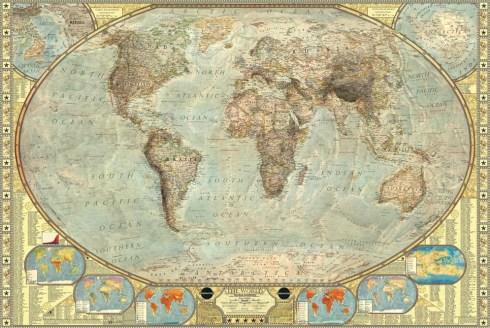
On this Earth Day, it seems appropriate to feature the scary but beautiful map of the world with unfrozen polar caps created by Slovakian student/graphic artist/cartographer Martin Vargic. At first glance, the map looks like a traditional nineteenth-century decorative map of the hemispheres, but then you look closer (just click on it) and see that many unshaded coastal areas are “missing” and that new seas and lakes have opened up in the midst of continental interiors: there is an Amazon Sea in the middle of South America and a new “Artesian Sea” in Australia. The map presents a rather radical vision with sea levels 260 feet higher than today (most scientists seem to project a 3 foot rise by 2100), and consequently all the coastal cities of the eastern seaboard in North America are gone (including Salem, of course), along with those of the Gulf Coast and what looks like the entire state of Florida. Across the Atlantic, London is gone, along with Amsterdam, and DenmarkVargic, whose work can also be found here, seems to have one-upped his earlier map of the internet, which went viral earlier this year.

climate1

Climate Vargic 1

Climate Vargic 2

Climate Vargic 3

Map Images © Martin Vargic @ Halcyon Maps

Appendix: Climate maps are nothing new, although predictive ones certainly are. Those from the 17th through the 19th centuries seem to be more of the recording or empirical nature, like the circular map of London’s annual temperature cycle below. Things get a little bit more subjective later in the nineteenth and the early twentieth centuries, when “scientific racism” (and environmental determinism) tried to assert “rational” explanations for the industrial progress (and supposed superiority) of the West. The 1924 map below seems to be doing just that.

L0027564 Luke Howard, The climate of London...

L0029476 Civilization and Climate, world map

Map from Luke Howard, The Climate of London, deduced from meteorological observations, made in the Metropolis, and at various places around it…(London, 1833),Wellcome Library; and map from Ellsworth Huntingdon, Civilization and Climate (London, 1924), Wellcome Library.


Remembrance, Recreation and Reenactment

The blogger part of my brain is whirling in anticipation of this long weekend of Patriots’ Day/Easter/Marathon Monday: what to write about? I think I’ve offered up enough Easter eggs, bunnies and witches, and Patriots’ Day, the Massachusetts (and Maine) holiday which commemorates the Battles of Lexington and Concord and the beginning of the American Revolution, coincides with Marathon Monday. I have always thought of my own personal ritual–a walk or run down the Battle Road on which the British retreated back to Boston–as sort of a combination of the two holidays, a form of patriotic athleticism. But last year I had a bad cold and stayed home and watched the Marathon on television, including the horrors that unfolded at its finish line in Boston. Now, after last year, the holiday seems different, darker. I am afraid that I am a bit numbed by the nonstop media coverage of the Marathon memorial that we have experienced in the Boston area (and perhaps nationally?) over these past few weeks, so I think I’ll go back to 1775, or at least our impression or “memory” of it. After classes yesterday I flew down to Concord to catch the first day of the new exhibition at the Concord Museum, timely titled The Shot Heard Round the World: April 19, 1776, and while I was there I poked around a bit, looking for Minutemen and Redcoats–or at least their shadows.

Remembrance 014

Remembrance 010

Remembrance 016

Remembrance 030

Remembrance 037

In Concord: the entrance to the exhibition, with a militia man inside, flints from the battlefield, a 1930 diorama, and across town, the Major John Buttrick House and adjacent monument.

Concord does commemoration very well, much better than we do here in Salem: of course they a good event to commemorate–the courageous shot heard round the world–and we have a bad one–the intolerant, irrational witch trials. But I would really like to replace the tacky, exploitative, and out-of-date Witch Museum–which is really just one BIG diorama dated circa 1971–with the tasteful and reflective Concord Museum, which seems just as concerned with Concord’s history as the making of Concord’s history. I long for an exhibition on the creation of “Witch City” but doubt I will ever see it.

Remembrance 022

Remembrance 023

There’s another exhibition I’m looking forward to further down the road (battle and otherwise): The Battle After the Battle: the Lexington-Concord Tug of War for Revolutionary Fame, opening at the Lexington Historical Society on May 3. I thought these two towns worked together in the spirit of collaborative commemoration, but apparently not! They’ve both been in the business for quite some time, to which the Boston Globe photographs from the 1920s and 1930s below attest. As I was heading back to Salem I spotted a few present-day reenactors outside the Concord Museum: I think they’re camping out tonight so they can be on the spot, rested and ready, for tomorrow’s battles.

Concord Bridge

Lexington Green

Remembrance 039

Reenactors in Concord (1928) and Lexington (early 1930s) © Leslie Jones, Boston Public Library, and yesterday, outside the Concord Museum.