Category Archives: History

A Coronation Primer

Time to put some of my day job perspectives out there: it’s not every day/year/decade/half-century that we get to see a British coronation! I’m kind of excited; I even dusted off some of my old grad school books about medieval monarchy and royal iconography last weekend. Over my career, I’ve taught about the interrelationships between spiritual and secular authorities pretty constantly in medieval and early modern courses, but I seldom have time to delve into all the expressions of these alliances and conflicts, and coronations are case studies in both symbolism and projection: in the distant past, the more recent past, and judging from all of the official imagery leading us to the coronation of King Charles III, even today.

Official Coronation “paper”: invitation by heraldic artist Andrew Jamieson, emblem by Sir Jony Ive KBE and his creative coalition LoveFrom, one of four thematic stamps produced from wood engravings produced by Andrew Davidson for Atelier Works.

I’ve always thought of King Charles III as a traditional man, primarily because of his preference for classical architecture, I think. The images above definitely reinforce this characterization for me, but they also reveal his interests in the natural world and diverse, hopefully harmonious communities. I love the tradition-embracing change aesthetic of these images, and I think the Coronation will have a similar tone. Coronations are absolutely traditional, but they are also flexible ceremonies which can embrace variant themes according to individual preferences: they evolved over time and reflect their historical contexts. Early medieval coronations seem to represent order, legitimacy, and the evolving sacred nature of kingship; later medieval coronations still embrace those themes but also a more independent divine authority of kings who were claiming unmediated mandates from God rather than through the Pope. This continues into the seventeenth century, but there were also increasing references to “the people” in both feudal fashion and a (slightly) more egalitarian manner. There were lots of changes in the 18th and 19th centuries: to accomodate and highlight the constitutional role of the monarchy and British and Imperial sovereignty. After the long reign of Queen Victoria, it was time for a “refresh,” but tradition sill reigned: this seems very similar to what we are experiencing now. Of course we enter the era of the intensifying power of both public opinion and public relations in the twentieth century, and the coronations of both Kings Edward VII in 1902 and George V in 1911 really reflect these developments. We get these great souvenir books (as well as a flood of material souvenirs) in the twentieth century too: one of my favorites, published by the Illustrated London News for the coronation of Edward III, features wonderful (though quite imaginary) images of previous coronations with Edwards past presented in color and gilt.

Images from The Coronation of King Edward VII, 1902, published by the Illustrated London News (cover against some great Queen Victoria wallpaper from the Victoria & Albert Museum.)

King Edward I, the Confessor’s role in coronation history derives principally from his commissioning of the Coronation Chair on which King Charles will be crowned, as well as the Crown itself, but I’m not sure that all of the other Edwardian coronations are singular, with the exception of that of King Edward II, in which he swore “to observe the future laws made by the community of the realm.” Those last three words constitute a very powerful phrase, and precedent. Most British historians assert that the first ceremonial coronation, or perhaps that which was recorded in detail, was that of Edgar “the Peaceful” at Bath Abbey in 973. This was orchestrated by the great Saint Dunstan and featured both an early version of the contractual oath and a coronation banquet (feasting is always associated with coronations). William the Conqueror was the first monarch to be crowned at Westminster Abbey, Tudor coronations featured a notable expansion of pomp and symbolism (particularly Arthurian symbolism) reflecting concerns of legitimacy after the Wars of the Roses and the new sovereignty over the English Church established by King Henry VIII, and Stuart coronations were more elaborate (and longer) still, particularly those after the Civil War. King Charles II’s coronation featured a mile-and-a-half-long procession and reconstituted regalia, as Oliver Cromwell had destroyed what he saw as profane objects. In the 18th century, King George I’s coronation oath replaced “Kingdom of England” with “Kingdom of Great Britain” after the Union with Scotland, and King George IV’s oath replaced “Great Britain” with “United Kingdom” in 1821. At the end of that decade King William IV seems to have desired to dispense with all the pomp and circumstance, bud did ride to Westminster Abbey in the 1762 Gold State Coach, establishing a “tradition” which continued thereafter. Queen Victoria “restored” everything in her coronation in 1838, which lasted for five hours and featured lots of mistakes, mandating rehearsals for the future.

Edgar the Peaceful among the Saints, c. 1050; Thomas More’s poem upon the occasion of the Coronation of Henry VIII and Katherine of Aragon, 1509; Depictions of Queen Victoria’s Coronation looking back, 1897, Illustrated London News, all British Library.

There is room for variation and innovation in the order and elements of the Coronation ceremony as well as its overall presentation: to me, it seems to have evolved from a Christian and feudal ceremony to a secular and constitutional one, but there’s still quite a bit of religious overtone to it obviously, and more majesty than anything else. King Charles will maintain the four essential elements of every twentieth-century coronation: 1) the Recognition, derived from the recognition of the monarch observed by the Witenagemot, the Anglo-Saxon predecessor of Parliament; 2) the Oath, representing the contract between the monarch and the people; 3) the Annoiting (or Unction), representing the monarch’s consecration by the Church of England; and 4) the Homage: a feudal survival in which the “Lords Spiritual and Temporal” pledge fealty to the monarch. The King is crowned between the Annoiting (with the Restoration-reconstituted St. Edward’s Crown) and the Homage, and this is supposed to happen around noon, British time of course. But in addition to all this “tradition,” there will be some key changes, some very detailed, others rather momentous. King Charles and Queen Camilla will ride to the Abbey in Queen Elizabeth’s Diamond Jubilee Coach, rather than the golden Georgian coach. A new “Greeting of the King,” which will precede the Recognition, in which two chorus boys will welcome the King (and the Queen) to the Abbey. The Annoiting of a monarch is a sacred ritual, not be broadcast in any way, so iconographer Aidan Hart and the Royal School of Needlework have produced a privacy screen featuring a tree design representing the 56 Commonwealth countries, but there is a new annointing oil recipe! The Homage will be much shorter than in coronations past, as the 1999 House of Lords Act curtailed the peerage (but not short enough for most Britons, I think). But most important of all, the Coronation service will feature prominent roles for Muslim, Hindu, Sikh, Buddhist and Jewish leaders, as well as prayers and readings in other British languages (Welsh and Scottish and Irish Gaelic), and a woman will present the Swords of State and Offering for the very first time.

From Old England:  A Pictorial Museum of Regal, Ecclesiastical, Municipal, Baronial, and Popular Antiquities, ed. by C. Knight (1860).


Connecticut Calm (Waters)

I’m generally anxious around this time of year, approaching the end of the semester, but this year I am particularly so: I seem to be uneasy in general and in Salem in particular. The nice weather has kicked off the tourist season earlier than ever, or maybe it never ended? This means large tour groups just outside my house as late as 10:00 at night, with guides speaking about the ancient “ankle breaker” stones along the sidewalk that my neighbors and I installed in the last decade or so. Run, run, to the back of the house, I tell myself, so I don’t have to hear any more, but sometimes I just don’t want to get off the couch—and one guy is so loud I can even hear him way out back. A change of scenery (and perspective) was definitely needed, so for the long Patriots Day weekend my husband and I took off for one of the prettiest towns in Connecticut (a state with many pretty towns): Essex, near the mouth of the Connecticut River. We stayed at the old Griswold Inn, in one of its newer suites, and ate and drank and looked at old houses and the river. It was very foggy, but there were daffodils everywhere, and I do feel a bit cheerier now that I’m back home (or in Salem).

Welcome to Essex, Connecticut!

I started decompressing as soon as we got on one of my favorite Connecticut small roads: Route 169. Well, before, really: right over the state line in Thompson, which has a great common surrounded by wonderful houses (including the resurrected Gothic Revival long neglected by the famous interior designer Mario Buatta). Route 169 leads you through Woodstock, and by Roseland Cottage, to Canterbury, where the amazing Prudence Crandall opened her school for African-American girls (what an amazing woman! I need to know much more about her), to Norwich, where we turned south and drove by the decaying buildings of the long-abandoned Norwich State Hospital which are such a sharp contrast to the shiny Mohegan Sun casino across the river.

The road to Essex: Thompson houses, Roseland Cottage (which I visited just last summer), Prudence Crandall’s school in Canterbury, and one of the derelict buildings of the former Norwich State Hospital (with a glimpse of Mohegan Sun across the river).

I think my husband thinks that Essex is a bit “Truman Show-esque” but it was just what I needed:  a lovely town with clean sidewalks that is proud of its history rather than seeking to sell it 24/7. The houses are pretty perfect, but they are not mansions. It’s really all about watercraft in Essex: this was a rather quiet time but its harbor will be full to brimming in a month or so. Essex built a famous warship for the Revolution named the Oliver Cromwell (which was renamed the Restoration when it was captured by the British in 1779!), it endured the burning of 27 of its privateering ships when the British raided the harbor in April of 1814, the storied schooner yacht Dauntless ended her career on the Essex waterfront at the turn of the last century, and famous steamships line the walls of the Griswold Inn. The wonderful Connecticut River Museum, housed in an old steamship warehouse, explores the layers of local maritime history through art, artifacts and narratives in such an engaging way that I really felt the connection of water to land over history and now I’m absolutely inspired to take another New England road trip: a longer one, up the entire length of the River from Saybrook to Canada.

An array of Essex houses (birdhouses are big in this town too); the Onrust, a replica of a Dutch colonial ship, is moored in front of the Connecticut River Museum (my husband John is looking for me, I think); the Turtle, a Revolutionary-era submarine, which was built just up the River. I love the caption of this c. 1860 painting of Captain and Mrs. Samuel L. Spencer: “Captain Spencer of Old Saybrook, shown with the most important females in his life: his wife and his ship. He was captain of Daniel Webster of the London Line of packets for more than twenty years.” The Connecticut River Museum’s exhibition of Watercraft at Work made even BARGES interesting, and among the items I found my very favorite ship name of all time: of the schooner “Tansy Bitters”.


The Golden Ball Tavern

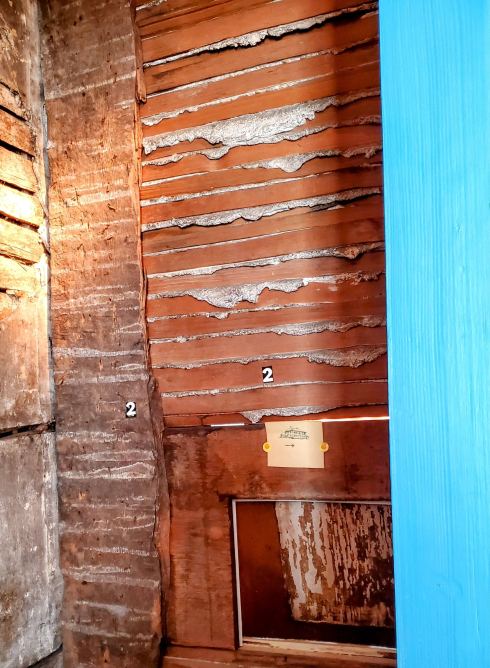
It’s spring break week and I’m slowly making my way down to “New Sweden” but as I write this I’m stuck in a snowstorm at my brother’s house in New York! I should be able to get out tomorrow and want to spend three or four days looking at old houses in Delaware, south Jersey, and Pennsylvania. This was supposed to be a Revolutionary tavern tour, but I think it’s going to be a bit more general: we’ll see! But because it was supposed to be a tavern tour, I did visit a tavern back in Massachusetts on Sunday: a sunny day which seems like it was weeks away rather than days away. I’ve driven by the Golden Ball Tavern Museum on the old Boston Post Road in Weston for years but never ventured inside before, and decided to take advanage of its monthly second Sunday open houses to take a tour. It was very interesting: a spacious eighteenth-century building left quite deliberately in a lived-in, layered condition. Weston is a very wealthy town, and I expected the house to be in mint restored condition but that is not the approach here: the ceilings were sloping in places, patchy plaster was everywhere, and I read a cautionary note on the central stairway: “original avocado paint—do not paint.” This house museum is an independent, self-sustaining operation which is staffed by enthusiastic docents who appeared to be discovering the house right alongside its visitors: it all felt very personal, like we were all just dropping in, or into a house built by tavern-keeper Isaac Jones in 1768 which sheltered six successive generations of his family. In the heated environment of the early 1770s, Jones gave shelter and sustenance (in the form of tea!) to British soldiers, prompting his neighbors to attack the tavern on March 28, 1774 in what later became known as the “Weston Tea Party.” He later came around to the right side, but the interpretive identity of the Tavern as museum seems to be focused on family history and Loyalist history. And layers, literally. If you’re into material textures, this tavern is the place for you: the historic paint, paper, and hardware was on full revelatory display.

The first floor of the Golden Ball Tavern: proceeding from the rear old kitchen, with many layers exposed, towards the tavern room in the front. LOVED this little Sheraton settee! Original paint and plaster in the central hallway and the right-side parlor and bedroom have been refinished.

Upstairs there are bedrooms, of course, but also a room which was used for more public purposes: and consequently it has one of the most interesting and practical architectural details I have ever seen. Doors that open up to the ceiling and are affixed to hooks! Hooks which are still there! And right across from this room is that in which poor Mrs. Jones was lying in bed with her newborn infant when her neighbors broke in in search of her Tory husband (these little notes are everwhere in the tavern, another aspect of its very personal presentation). I really loved all the colors and textures in this room, including the adjacent “office” and stairways upstairs and downstairs. So many details in this one space, just a corner of this one house.

Details, details, details! The door on the ceiling, hooks, paint, stairs, and a colonial filing system.


A Slave Trader in Salem

I’ve learned a lot about Salem’s African-American history while writing this blog; I don’t think I would look at the city the same way otherwise. I associate Chestnut Street, where I live, much more with the Remond family and their myriad activities centered on Hamilton Hall than with any particular Salem merchant or sea captain. When I walk to work down Lafayette Street, I pass a neighborhood of parallel streets on my right, beginning with Pond and ending with Cedar, on which numerous African-American families lived in the mid- and late nineteenth century: John Remond had a house on Pond, and his eldest daughter Nancy Shearman lived in the neighborhood with her family, along with his successor as caterer to Hamilton Hall, Edward Cassell. I don’t have the same place-association as I do with the Hall on Chestnut Street, as all the structures on these streets burned to the ground during the Great Salem Fire of 1914, but I think about the neighborhood that was there before. The city directories make it clear that this wasn’t an African-American neighborhood; it was rather an integrated neighborhood, just like the Salem public schools from 1844. This neighborhood was so diverse that it was even home to a notorious Virginian slave trader, who resided at 29 Cedar Street intermittently for a decade or so, from 1851 to the beginning of the Civil War, along with his common-law African-American wife and their four children. As they say, you can’t make it up.

Part of Salem’s Ward Five: Henry McIntyre / H. E. B. Taylor / Friend & Aub’s Lith., MAP OF THE CITY OF SALEM MASS. From an actual Survey By H. McINTYRE. Cl. Engr. H. E. B. TAYLOR, ASSISTANT. Philadelphia: Henry McIntyre, 1851.

The slave trader in question was named Bacon Tait and his common-law wife was named Courtney Fountain. Both came from interesting Virginia families. I certainly did not discover their stories: as much as the limited sources allow, Hank Trent pieced together what can be known about their lives in a slim well-sourced volume entitled The Secret Life of Bacon Tait. A White Slave Trader Married to a Free Woman of Color (LSU Press, 2017) and you can also read an excellent summary at the Encyclopedia Virginia. But I think we need more Salem context, and I have questions; actually, just one: how did a notorious domestic slave trader maintain a residence in which was supposedly such an abolitionist stronghold as Salem? Obviously there are two assumptions in that particular question: that Tait was notorious (or at the very least conspicuous) and that Salem was abolitionist. To support the first assumption, we’ve got to start in Richmond, the second-largest slave-trading market of the antebellum domestic slave trade (after New Orleans). When he traveled to the United States as secretary to the popular novelist William Makepeace Thackeray in 1852-1853, the artist Eyre Crowe took advantage of downtime in Richmond to walk several blocks from his fashionable hotel to the slave market to sketch the scenes he saw there (before he was asked to leave), publishing them in the Illustrated London News upon his return to Britain. These sketches were studies for two paintings which illustrated and publicized the process of slave-trading on both sides of the Atlantic: Slaves Waiting for Sale, Richmond, Virginia and After the Sale: Slaves Going South from Richmond.

Eyre Crowe, Slaves Waiting for Salem, Richmond, Virginia (1861), Heinz Collection, Washington D.C.; After the Sale: Slaves Going South from RIchmond (1853), Chicago History Museum.

Bacon Tait was a major player in this Richmond trade and in Richmond itself: the pages of the Richmond Enquirer, the Richmond Dispatch, the Richmond Daily Times and the Richmond Whig record his real estate transactions, his political successes, and his slave-trading activities from the 1820s to the Civil War, even after he had moved to Salem in 1851: he traveled back to conduct business and also employed surrogates. His trade is also documented in the Slave Ship Manifests at the National Archives (a chilling source that I had never consulted before: not my period, thank goodness!) Notices of his “holding” facilities are particularly lengthy, and the Visitor’s Guide to Richmond (1871) records that Tait was the original builder of the infamous “Lumpkin’s Jail” (otherwise known as the “Devil’s half-acre”) in 1825. An “under new management’ advertisement from several years later reveals the inhuman dimensions of this particular side of the business.

In Massachusetts, William Lloyd Garrison’s weekly abolitionist newspaper, The Liberator, printed excerpts from the Richmond papers frequently, with lengthy commentary and annotations. When Tait announced the opening of his new “private jail” in 1834, The Liberator reprinted the copy and commented upon it, and a certain “P.H.” took the liberty of rewriting it for its readers: the entire piece was featured prominently on the front page of the December 27, 1834 edition of the paper. Charles Lenox Remond was the agent of The Liberator in Salem at the time: it’s unlikely that this item escaped his notice.

Tait’s relationship with Courtney Fountain began in the early 1840s, while she might have been in his employ as a housekeeper. She was originally from Winchester, Virginia and part of a minority (10%) of free blacks in Richmond at the time, but members of her family resided in the North and were active in abolitionist circles in both New York State and Massachusetts. It’s not entirely clear from Trent’s book how they ended up here, but Courtney’s sister Ann and brother John resided in Salem, as well as several cousins. Tait and Courtney had four children in the 1840s: Celine, Constance, Bacon Jr. and Josephine, each two years apart. Salem’s schools were desegregated in 1844 (thanks to the efforts of the Remonds) and Massachusetts abolished its anti-miscegenation law the year before. You can certainly understand the lure of Salem for Courtney, but it’s hard to picture Tait as a doting family man, which seems to be the only incentive for his departure from Richmond in 1852. In any case, he purchased the Leach House at 29 Cedar Street in July of that year: it looks like it was a lovely property, located on a bluff at the end of the street overlooking Mill Pond.

Bacon Tait is listed in the Salem Directories of the 1850s as a “merchant” living at 29 Cedar Street and in the 1855 state and 1860 federal censuses as well: there are no indications that Salem residents were outraged by his residence in their town or even aware of his existence. Charles Lenox Remond was living on Pond Street during the 1850s, just three streets over, and just a few doors down Cedar Street lived Adeline Roberts, a Salem schoolteacher and long-time corresponding secretary of the Salem Female Anti-Slavery Society. Miss Roberts corresponded regularly with William Lloyd Garrison, Lucretia Mott, and other abolitionist leaders, and in the very year that Tait moved to Salem, she was organizing a series of seven lectures on the abolition movement to be held at the Salem Lyceum in the fall. Tait never appears in her letters, but she must have been aware of his residency. Were there whispers at the Lyceum before every lecture? Was Salem society gossiping behind closed doors? I just don’t know. Tait seems like a ghost in Salem, but he was still conducting his business in Richmond: I suspect a lot of family letter-burning later on. That’s the problem: we can’t see (or hear) whispers from the past or letters that have been destroyed, we can only speculate. I’m assuming that Courtney’s family was protecting her and her children (and by extension, him), and I’m also assuming he kept his head down and conducted his trade via post and travel. All census documents from Salem indicate that Courtney and Tait were married, but there is a difference between state and federal censuses in designation of race: the federal census indicates that the entire family was white while the Massachusetts censuses indicate that Courtney and her children were of mixed race. I’m not sure what this means in terms of their presentation or perception.

What happened when the war broke out? Tait seems to have returned to Richmond permanently, leaving his family in Salem. He instructed one of his daughters to sell the house on Cedar Street in 1864, yet they all appear on the Massachusetts census as living there in 1865. Both Courtney and Tait died in 1871: she in Salem, he in Richmond: their four children remained in Salem, residing at various addresses. Tait left several wills, and the most recent one, leaving his fortune “to his illegitimate children by a mulatto woman, who held to him the relation of housekeeper, he having no lawful wife” was contested by various partners and employees in Richmond. Many transactions dissolving his real estate ensued, but I have no idea where the money went. Courney’s death notice was printed in the Salem Register (as “Mrs. Courtney Tait, Richmond papers please copy,”) as was Tait’s, with no further identification or detail. She is buried in Harmony Grove Cemetery with a lovely epitaph from her children; he is buried at another Gothic Revival cemetery, Hollywood in Richmond, with no epitaph at all. As for his reception, or lack thereof, in Salem, I haven’t found the answer to my question, but maybe my presumption is wrong. Maybe Salem wasn’t an “abolitionist stronghold;” maybe it was home to only a small minority of very vocal abolitionists in the 1850s who invited William Lloyd Garrison to speak every other month, protested the Dredd Scott decision vehemently, organized August 1st Emancipation Day celebrations, and pushed for Charlotte Forten’s appointment as the first African-American teacher in the Salem public schools. We always want righteous causes to be more popular than they generally were. Or maybe Tait just maintained his privacy: this seems more possible at that time than today. As I think about the past and the present I am struck by how wide the gap was between Bacon Tait and many of his Salem neighbors: we tend to think of our own time as divisive, but our divisions seem relatively insignificant compared to theirs.

No stigma in Salem: Celine Tait Burding, Courtney and Tate’s eldest child, commissioned a Tait family plot in Harmony Grove Cemetery for her mother as well as her own family: she married Willard Burding in 1873, had four children, and died in Salem in 1886. Courtney’s gravestone in the center reads simply “Our Mother” and bears an inscription derived from Shall we Gather at the River, published only six years before: “on the March of the Beautiful River that flows by the Throne of God she waits for us.” In Virginia, Tait’s family is described in less reverential terms: Petersburg Progress-Index, June 21, 1871.


Anniversary History: Local Edition 2023

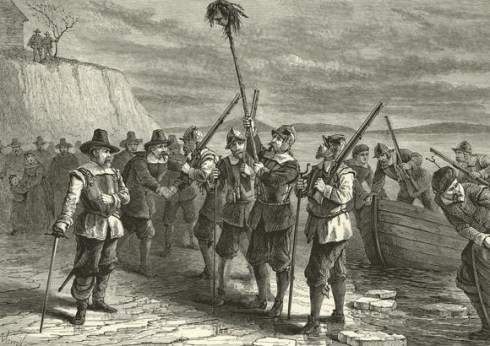
Looking ahead to the new year from a local history perspective, there are commemorative moments for at least six events: five European settlements and a tea party, the 250th Anniversary of the Boston Tea Party, to be precise. A century and a half earlier, there were settlements at Gloucester, Massachusetts and Portsmouth, Rye (the Pannaway Plantation) and Dover (the Cocheco Plantation), New Hampshire. The ill-prepared and -fated Wessagusset Colony was established in Weymouth, Massachusetts in 1622 but its demise came the following year after the brutal Wessagusett “Incident,” more appropriately referred to as a massacre. Commemorative history should acknowledge both the good and the bad, the heroic and the tragic, the kind and the cruel, and so the Wessagusett Massacre of March 1623, a veritable “red wedding” which harmed relations between Native Americans and English settlers for years to come, demands a spotlight. Like the first Gloucester settlement by the Dorchester Company, Wessagusett was decidedly not a plantation in the seventeenth-century sense, but rather a fishing and trading station of 60+ men financed by London merchant Thomas Weston. “Weston’s Men” were completely unprepared for the New World and by the winter of 1622-1623 they were starving, and altogether dependent on both Plymouth and the Native Americans in the region. But foodstuffs were scarce for everyone that winter, and everyone was anxious. Rumors of an impending Native American raid on both settlements drove the Wessagusett men to seek aid from Plymouth, and militia leader Myles Standish and eight men sailed a shallop to the northern settlement and issued an invitation to Massachusett tribal leaders Pecksuot, Wituwamat, and others to attend a summit during which commenced a slaughter just as they all sat down to dinner. I’m going to let Charles Francis Adams tell the tale, as he presented it in his anniversary address on the occasion of the 250th anniversary of Weymouth: the savages were taken by surprise, but they fought hard, making little noise but catching at their weapons and struggling until they were cut almost to pieces. Finally Pecksuot, Wituwamat and a third Indian were killed; while a fourth, a youth of eighteen, was overpowered and secured; him, Standish subsequently hung. The massacre, for such in historic justice it must be called, seeing that they killed every man they could lay their hands on, then began. There were eight warriors in the stockade at the time,—Standish and his party had killed three and secured one; they suddenly killed another while the Weston people despatched two more. Only one escaped to give the alarm, which spread rapidly through the Indian villages. Interesting language for 1873: savages is employed, but Adams does not refrain from calling this slaughter a “massacre” unlike many of his contemporaries who labeled it a pre-emptive strike. Several Wessagusset men also died during the massacre, and the rest opted to abandon the settlement; Standish returned to Plymouth with the head of Wituwamat on a pike in ancient English warrior fashion, “to ornament the Plymouth block-house as a terror to all evil-disposed savages” in the words of Adams. This massacre seems worthy of a bit more commemorative reflection, at least a fraction of what the Boston Massacre receives continuously.

“The Return of Myles Standish from Wessagusset,” from Pioneers in the settlement of America: from Florida in 1510 to California in 1849 by William August Crafts, 1876. Ironically, nearly 300 years later (299!) Myles Standish lost his head when the Standish monument in Duxbury was struck by lightning: according to this post by Carolyn Ravenscroft, archivist of the Duxbury Rural and Historical Society, his replacement head was too heavy for the damaged “body,” so an entirely new Standish was created by Boston sculptor John Horrigon, pictured here in 1930.

I’m not sure what the plans for the commemoration of the Wessagusset Massacre are but all the early settlements have been planning their 400th anniversaries for quite some time, particularly Gloucester, which has assembled a multi-layered calendar of commemorative initiatives and offerings focused overwhelmingly on the city’s social history. I’ve been so impressed with the “400 Stories” project, which aims to collect, present and preserve stories from 400 of Gloucester’s residents from 1623 to 2023, thus connecting the past to the present. There are books, an artistic competition for a new commemorative medal, walking tours, festivals, and a gala: the evolving celebratory schedule is at Gloucester 400.

Portsmouth is all geared up too, although its big reveal party is on January 6 so I don’t know all the details. The PortsmouthNH400 site is here, and so far its signature product is a lovely bookA History of Portsmouth NH in 101 Objects, to which both my Salem State History colleague Tad Baker and alum Alyssa Conary have contributed. There’s an ongoing speakers’ series and exhibition based on the book, and on January 6 Portsmouth’s Memorial Bridge will be illuminated in blue, PortsmouthNH400th’s commemorative color. Like Gloucester, Portsmouth is also collecting stories (of 400 words) from its residents, to be compiled in a commemorative book designed to update its 350th anniversary history. Rye and Dover also have their 400th anniversary committees and calendars, derived from considerable public participation: the mission of Dover400 is “to honor our past, celebrate our present, and to inspire our future through meaningful and creative community engagement.”

The 250th anniversary of the Boston Tea Party is going to be big: after all, from the Boston perspective, it was “the single most important event leading up to the American Revolution.” I’m excited about all of the offerings by Revolutionary Spaces at the Old South Meeting House and the Old State House, including an exhibition on the power of petitions, an “immersive theatrical experience,” and various programs on the nature and expression of protest. Of course the Boston Tea Party Ships & Museum has plans as well, and is already counting down to the big reenactment on December 16, 1773. And there will be merch, including lots of commemorative tea.

Teas from Elmwood Inn & Oliver Pluff & Co.


Remembering the Revolution: Two Caleb Footes

For this Veterans Day 2022 the stories of two Salem men named Caleb Foote: grandfather (1750-1787) and grandson (1803-1894). But there’s a shadow of another man in this post too, a young lieutenant named Benjamin West, the sole Salem casualty of the Battle of Bunker Hill. The younger Caleb Foote is the link between the other two men: a prominent newspaper editor and publisher, he also dedicated himself to the remembrance of both his grandfather, a privateer and prisoner of war who left behind quite a revolutionary record, as well as his great uncle, who did not. Their conjoined histories are a great reminder of both the sacrifices made by the first American veterans and the commitments that their descendants made to their memories.

Fortunately members of the Foote family were meticulous writers and archivists of their own family papers. Caleb Foote the Patriot was a wonderful letter writer and journal keeper, both on land and on sea. So we know his Revolutionary story well, and his grandson amplified it by compiling and publishing his records in the Historical Collections of the Essex Institute in 1889. Several of the original texts are preserved among the papers of Divinity Professor Henry Wilder Foote (grandson of Caleb Foote III) at Harvard. According to a letter to his wife Mary, Foote was with General Washington at Cambridge in the fall of 1775, but returned home to Salem after the new year. He then took to the sea as yet another of Salem’s many daring privateers: his vessel, the Massachusetts brigantine Gates, was captured by the British off Canada in July of 1778, after which he was taken to England and imprisoned in Forton Prison near Portsmouth for the next two years. In Spring of 1779, he wrote to Mary back in Salem: I am sorry to inform you that you need not look for me till December or March next altho it may be my good fortune to be at home sooner. Please to remember me to all friends….Capt. Smith, Mr. Hines, Mr. Campton, Mr. Foster, Jacob Tucker, John Shaw, and Jonathan Tarent are in the prison with myself (as Salem served as a major privateer port, so many of its sailors ended up in Forton or Mill Prisons as prisoners of war). Foote grew increasingly exasperated with his imprisonment over his next letters, and with Mary as well, who did not seem to be writing him return letters (oddly he refers to her as “most affectionate friend” in his early letters and “dear beloved wife” in the later ones!) In the summer of 1780 he sounds bereft: my welfare…is very poor at present for here we lie in prison, in a languishing condition and upon very short allowance, surrounded by tyrants, and with no expectation of being redeemed at present, for we seem to be cast out, and forsaken by our country, and no one to grant us any relief in our distress; and many of our noble countrymen are sick and languishing for the want of things to support nature in this low estate of health; and many of they have gave to the shades of darkness. Some others have entered on board His Majesty’s ships to get clothes to cover their nakedness, which is to the shame of America.” This was the low point, after which Foote and several of his fellow prisoners managed to escape and find their way to Amsterdam, where they signed on as crew of the recently-commissioned Privateer South Carolina, which eventually brought them home. Foote kept the log along the way, and was discharged from service in January of 1782, near the end of the Revolution. Five years later he was dead at the age of 37, having never really recovered from his long and difficult service, and leaving Mary and their children in rather desperate straits according to the successive applications for aid sent to various Federal offices on her behalf by august Salem dignitories like Timothy Pickering and Nathaniel Silsbee.

Mary Foote survived her husband by nearly 40 years, during which time she saw her eldest son, namesake Caleb, die at sea, several years after his wife, leaving their sole child, five-year-old Caleb III, an orphan in 1810. His mother belonged to the large West family in Salem, and he was raised by them, chiefly his grandmother, who was the widow of Samuel West, bother of the Benjamin West who was killed at Bunker Hill. The Wests must have discouraged a seaman’s career for young Caleb, because he began an apprenticeship at the Salem Gazette and essentially never left: rising to editor, co-owner, and publisher. He was also a civil servant and the model of nineteenth-century civic engagement, serving as postmaster, school committee member, state representative, and Whig party chairman, as well as on every single infrastructure committee I could find and on the boards of nearly every Salem insitution. He was a temperate Mason. Caleb Foote spoke about his grandfather and namesake at public events regularly, but it wasn’t until towards the end of his life that he began taking up the cause of his great uncle Benjamin, who was for some reason left off the list of names on the Bunker Hill Memorial. Joseph Felt asserted that Benjamin West died “in the trenches” in his 1827 Annals of Salem, but he was unheralded in Boston until the venerable Foote took up his cause in the 1880s, perhaps inspired by his compilation work on his grandfather’s papers. And so we have some charming remembrances, first from Foote himself, who testified that this great-uncle of mine had some taste and talent for portrait painting, and a life-sized bust portrait of him in his lieutenant’s uniform, painted by himself hung in the house [of his grandmother West] , and its history was often mentioned to visitors. A copy of it is now in the possession of the Essex Institute, in Salem, and another in the family…..Another reminiscence was entered into the record that is even more poignant: a column from the late Henry Derby of Salem, whose grandmother was nine years old in 1775 and a neighbor of the Wests. She told her grandson that she remembered that morning of June 17 very clearly, when the young lieutenant came through her mother’s door exhibiting his insignia of office (a feather in his hat) to bid her goodbye. To the question, “Are you going, Benjamin?” “Yes—right away,” was his quick reply and off he went, never to return. Mrs. Derby remembered his artistic skills too. He had a shop downtown with a beautiful and much-admired sign of himself in the process of painting a carriage: a perfect advertisement for his sign-painting business. After his death and the disposal of his effects, this very sign became the lining of an outside cellar door of his family house, his last earthly residence, and there gratified the eyes of children and passers-by whenever these doors were thrown open, till time and exposure erased the picture of this young patriot and martyr to liberty.”

Salem Printer Ezekiel Russell’s Elegiac Poem on the Bloody Battle at Bunker-Hill, Massachusetts Historical Society; West Reminiscences in William Whitmore Story’s A memorial of the American patriots who fell at the Battle of Bunker Hill, June 17, 1775 : with an account of the dedication of memorial tablets on Winthrop Square, Charlestown, June 17, 1889, and an appendix containing illustrative papers (Boston, 1889); Caleb Foote’s 1894 New York Times, obituary, also dated June 17!

A few notes on imagesafter I read about the self-portrait trade sign on the cellar door above, I spent hours trying to find some semblance. No luck: honestly, the close I could come is Norman Rockwell’s Colonial Sign Painter from 1936! As charming as Norman Rockwell can be, this is not what I was looking for. Much more interesting is the story of the West self-portrait at the Essex Institute, which turns out not to have been a self-portrait, but rather a portrait by his cousin Benjamin Blyth. All this is explained in an article on Benjamin Blyth by Professor Henry Wilder Foote, grandson of Caleb Foote III: what a coincidence! I couldn’t find an image anywhere, which is often the case with portraits which are referenced as deposited with the Essex Institute in nineteenth- and early twentieth-century catalogs and periodicals: I presume it’s up at the Peabody Essex Museum’s storage facility in Rowley. In any case, I love the inscription on the back as noted by Foote: The Gentleman The Patriot The Soldier The Hero.

Norman Rockwell, The New Tavern Sign (Colonial Sign Painter), 1936, Norman Rockwell Museum.


The Most Magical Plants

Well, October is upon us here in Salem, so that means I’m going to spend all my time inside or on the road. I’m just not a fan of Haunted Happenings, the City’s Halloween festival that starts earlier with each passing year: crowds are converging from at least mid-September now. On September 22, when eight convicted “witches” were hung at Proctor’s Ledge in 1692, you can see people dancing in the streets in Salem. Haunted Happenings is now in its 50th year and this is an anniversary worth celebrating for many, but for me, it’s just fifty years of turning tragedy into treasure. While I do not see or celebrate the connection between the tragedy of the Salem Witch Trials and Halloween, I still find the customs and traditions associated with the latter holiday very interesting, and as I’m teaching my “Magic and Witchcraft in early Modern Europe” course this semester, I find myself subsumed in the source and secondary literature of these complex topics. I haven’t taught this course in 5 years so it definitely needs a refresh! I have learned so much teaching this course over my career at Salem State: at the beginning I offered it simply as a corrective to what I saw (and still see) as a simplistic understanding of witch trials here in Salem, but every time I taught it I learned more about Christian theology and European folklore: after about a decade of teaching it I felt that I needed to undertake more serious study of the former and and contemplated going to Divinity School and now I feel like I need an advanced degree in folklore! It’s all so interwoven, and the focus on both magic and witchcraft over the medieval and early modern eras enables one to see how and why pre-Christian beliefs were assimilated into Christianity—and/or demonized. This coming week we are going to look at some important high and later-medieval herbals and the “magic” that was contained therein, so I decided to make a list of the top ten magical plants. This was a more difficult task than I though it would be as so many plants have protective/proactive virtues associated with them, but this is my list. I’m leaving out Mandrake because we all know that’s the most magical plant of them all, and as many plants were seen to be powerful in both facilitating and dispelling magic I’m going with the most efficacious, by reputation.

Vervainactually might be more powerful than mandrake. It was known as both an “enchanter’s plant” and an antidote against witchcraft. Gathering vervain seems to have been somewhat of a sacred ritual and there doesn’t seem to be anything that this plant could not do: protect, predict, heal, preserve chasteness and procure love. Snakes are often included in illustrations of vervain: both slithering varieties in the marginalia and more threatening serpents at center stage. Clearly it was percieved as an effective weapon against both.

British Library MSS Sloane 1975 and Egerton 747.

St. John’s Wort: a powerful demon-repellent as you can see by this retreating demon in the fifteenth-century Italian Tractatus de Herbis (British Library Codex Sloane 4016). Referred to as a “devil-chaser” on the Continent, St. John’s Wort was also worn as a protective amulet and used as decoration for doorways and windows on St. John’s Eve at midsummer, when its yellow flowers bloom. Its association with St. John the Baptist also bequeathed it medical virtues, and it was used to staunch bleeding, especially from the thrusts of poisoned weapons, and treat wounds.

British Library Codex Sloane 4016 and MS Egerton 747.

Rue: one of my very favorite herbs, and the sole survivor of my garden of plague cures from twenty years ago! The “herb of grace” was prized for its potency against the plague, infections, and also poison, signalled by its bitterness. It was also believed to be a preserver of eyesight, but it’s best to focus on the general rather than the particulars with this very efficacious herb, which could ward off witchcraft and was used in masses and exorcisms as well as an abortifacient. I just think its gray-green leaves are beautiful, and it adds structure to the garden all season long.

Plantae Utiliores; or Illustrations of useful plants, employed in the Arts and Medicine, M.A.Burnett,1842. 

Scabiosa: was far more interesting in the medieval period than its profile as a perfect cottage garden plant now. It was known as “Devil’s Bit” because of the appearance of its root, which looks like someone took a bite out of it. According to John Gerard, who was known to “borrow” information rather indiscriminately, “the great part of the root seems to be bitten away; old fantastic charmers do report that the Devil did bite it for envy, because it is an herb that has so many good virtues, and is so beneficial to mankind.” It was perceived as particularly beneficial to the skin, hence its name, a far cry from “pincushion flower.”

British Library MS Egerton 747; William Catto, 1915, Aberdeen Archives, Gallery & Museums.

Garlic: also has a devilish nickname, the “Devil’s Posy,” and cure-all connotations, so that it was also known as the “Poor Man’s Treacle.” (Treacle is an English sweet now, but in the late medieval and early modern eras it was an anglicization for “theriac,” the universal panacea.) There’s an interesting old tale that when Satan stepped out of the Garden of Eden after his great triumph, garlic sprang from the spot where his left foot lay, and onions from where he had placed his right foot. Like so much folklore, I’m not entirely sure what to do with this information. The key attribute of garlic was its pungent odor: like the bitter taste of rue, this signalled strength: enough to ward off witches, plague, and I guess vampires (though medieval people do not mention the latter).

Garlic (right) and a coiled snake, British Library MS Egerton 747.

Foxglove: a plant with more folkloric pseudonyms than any other! Foxglove: gloves for foxes or fairies or witches? Fairy fingers, ladies’ thimbles, rabbit flowers, throatwort, flapdock, cow-flop, lusmore, lionsmouth, Scotch mercury, dead man’s bells, witches’ gloves, witches’ bells: these are just some of its variant nicknames. Dead man’s bells indicates some knowledge of its potentially poisonous effects, but its cardiac attributes were not known until the eighteenth century. What a tangle with all these names! It’s so interesting to me that a plant can be associated with both witches and the Virgin Mary, as digitalis apparently was. Some of its names also testify to belief in the “doctrine of signatures” by which the appearance of herbs signals their use: foxglove flowers were said to look like an open mouth, and their freckles symbolic of inflamation of the throat: hence, throatwort.

Woodblock trial proof for textiles, 1790-1810, Cooper Hewitt Museum.

Hollywas perceived as very holy, of course. Very little nuance or contradiction with this plant, which Pliny, who seems very accepted by the medievals even though he was a Pagan, credited with the powers to protect and defend against withcraft, lightening, and poison. Its red berries became associated with the blood of Christ over the medieval era, along with its thorny leaves, which made it even more potent. Plant it close to the house, all the traditional authorities say (I feel fortunate that someone did that for my house long ago).

Elizabeth Blackwell’s Curious Herbal, 1737-39.

Moonwort: a little lesser known, but worthy of inclusion if only because it supposedly possesses the ability to open locks and guard silver, as well as unshoe any horses that happen to tread upon it or even near. Ben Jonson referred to it as one of the ingredients of “witches’ broth,” but by his time I think they were throwing everything into that brew. It’s a tiny, tight-fisted, flowering fern (Botrychium lunaria) that just looks like it must have magical qualities, but was also used to heal wounds.

George William Johnson, The British ferns popularly described, and illus. by engravings of every species (1857).

Henbane: is perhaps the most powerful of the bane plants, indicating death by poison, and another plant with both harming and healing virtues, demanding skillful use. It is always mentioned in reference to witchcraft in the late medieval and early modern eras, specifically as an ingredient in ointments (and salves which enabled witches to stick to their brooms!) This might be why it was referred to as the “Devil’s eye” in some regions. But it was also a powerful sedative, known to take away pain, and a hallucinogenic which could take away sense.

Henbane (on the right) in BL MS Egerton 747; Patrick Symons, Still Life with Henbane, 1960, Royal Academy.

Deadly Nightshade: related to henbane, but even more potent. Every bit of this plant was known to be poisonous, and early modern botanical authors urged their readers to banish it from their gardens. With knowledge and caution, henbane was a plant one could work with, but hands off deadly nightshade! Only the Devil tended it; in fact it was difficult to lure him away from this menacing crop of  “devil’s berries” and of course it was yet another ingredient in the strange brews of witches. Its botanical name, Atropa belladonna, indicates its use:  The eldest of the Three Fates of classical Greek mythology, the “inflexible” Atropos cut off the thread of life, and the “beautiful ladies” of Renaissance Venice used it in tincture form for wide-open, sparkling eyes. The English adopted the term belladonna in the later sixteenth century, but they also referred to deadly nightshade simply as “dwale,” a stupefying or soporific drink.

William Catto, Aberdeen Archives, Gallery & Museum.


The Wentworth-Gardner House

We were in York Harbor all last week with family and friends, several of whom had never been to this region of New England before. So I was a bit of a tour guide, in my fashion. On a morning tour of Portsmouth, we passed by my favorite house in town, the Tobias Lear House, as well as its more famous neighbor, the Wentworth-Gardner House, one of the most famous Georgian structures in the country. I’m very familiar with this house, but for some reason I’ve never been inside, and the door was open with a flag out front, so in I went, forgetting all about my companions. They followed me, but I really gave them no choice in the matter! We had a lovely tour with a very knowledgeable guide, and the house was ever more stunning than I imagined. I’m kind of glad that I had never been in before, as this house is probably the best example of the entrepreneurial antiquarian Wallace Nutting’s material and cultural impact in New England and I’ve come to appreciate him only recently. Nutting purchased the house in 1915 and added it to his collection of “Colonial Pictorial Houses” after his restoration, and thus it became one of the more influential representatives of the “olden time” in his time and the Colonial Revival in ours. Images of Nutting’s wispy colonial ladies in its midst are scattered throughout and a room is devoted entirely to his work.

The Wentworth-Gardner House in Portsmouth, New Hampshire: present and before Wallace Nutting’s purchase in 1915; the amazing center hall with a stairway re-installed by Nutting, and one of his colonial ladies descending (from a large collection of Nutting images at Historic New England).

The houses was built by Mark Hunking and Elizabeth Rindge Wentworth in 1760 as a wedding gift for their son Thomas, who lived in it until his death in 1768. It was owned and occupied by Major William Gardner from 1793 to 1833, and thereafter by his widow. In the later nineteenth century the grand mansion became a rooming house as its South End neighborhood declined, and then Nutting came to its rescue! As you can see, his most extensive restoration was to its exterior, but the reinstallation of the stairway was a major undertaking as well. I know that the pineapple was a customary colonial symbol of hospitality, but I can’t help but wonder if Nutting was inspired by Salem’s “Pineapple House.”

Nutting’s restored doorway (Historic New England) and Salem doorheads from the 1895 Visitors’ Guide.

Nutting sold the house to the Metropolitan Museum of Art just after the close of World War I, initiating the threat of removal to New York City that was itself removed by the onset of the Depression. After a brief stint of stewardship by the Preservation of New England Antiquities, the Wentworth-Gardner (and adjoining Lear house) House was acquired by a group of local preservationists who eventually became known as the Wentworth-Gardner Historic House Associates in 1940. It’s just a great place to visit: so many wonderful structural and decorative details, including the wonderfully carved mantel in the front left parlor (another one of Nutting’s reinstallations), the newly-installed reproduction eighteenth-century flocked wallpaper, the very Colonial Revival kitchen with its steep steps leading to upstairs, several great bedchambers (I couldn’t call them simply bedrooms), the Wallace Nutting room, and a very nice exhibition on historic preservation in Portsmouth. I remain so impressed by this small city with all of its historic houses, in wonderful condition and all open to the public. It’s a great example of community commitment to material heritage and the importance of having several institutional stewards thereof, rather than just one or two.

Georgian and Colonial Revival styles/worlds merge in the Wentworth-Gardner House, Portsmouth, New Hampshire.


Tattered Flags

The Civil War began with the lowering of a tattered 33-star flag from Fort Sumter in 1861 after which tattered flags defined, symbolized and memorialized the bravery, sacrifices and experiences of its participants on both sides for at least a half century—and likely much longer. There is no more powerful symbol of both commitment and conflict, and no more inspirational object. After surrenduring the Fort on April 12, Major Robert Anderson brought the Sumter storm flag with him to New York City, where it became the focus of a patriotic rally just a week later and then was put on a tour of northern cities to raise funds and rally troops. Almost exactly four years later and after the Confederate surrender of the fort, then Brevet Major-General Anderson returned to Charleston to raise the flag in a momentous ceremony that was overshadowed unfortunately by the assassination of President Lincoln. And in the interim, many flags were reduced to tatters and fragments.

Flag fallout: Edwin Francis Church painted several different versions of Our Banner in the Sky (Fine Art Museums of San Franciso, above), inspired by the tattered flag of Ft. Sumter. Commercial adaptations were printed, along with other Remember Fort Sumter! ephemeral images. Library of Congress.

Ever since I first saw the striking photograph of Sgt. William Carney of the Massachusetts 54th bearing the standard he rescued from the bloody battle of Fort Wagner in 1863 in Luis Emilio’s Brave Black Regiment I have been struck by the visual poignancy of the tattered flag. He just wouldn’t let that flag go, and consequently he became the first African-American recipient of the Medal of Honor in 1900. Just a few years later, Sargeant Samuel Hendrickson Smith bore the colors of the storied 8th Massachusetts in a Salem parade: he suffered permanent damage to his sight, hearing, and speech during the War but lived until 1910.

Newspaper drawing of Sergeant Carney holding the American flag during the battle at Fort Wagner: from an article in the Boston Journal, “Hero of Fort Wagner: Tale of Color Bearer William H. Carney,” published on December 29, 1898; Sgt. Samuel Hendrickson Smith of Salem and the 8th and 19th Massachusetts Regiments, 1905.

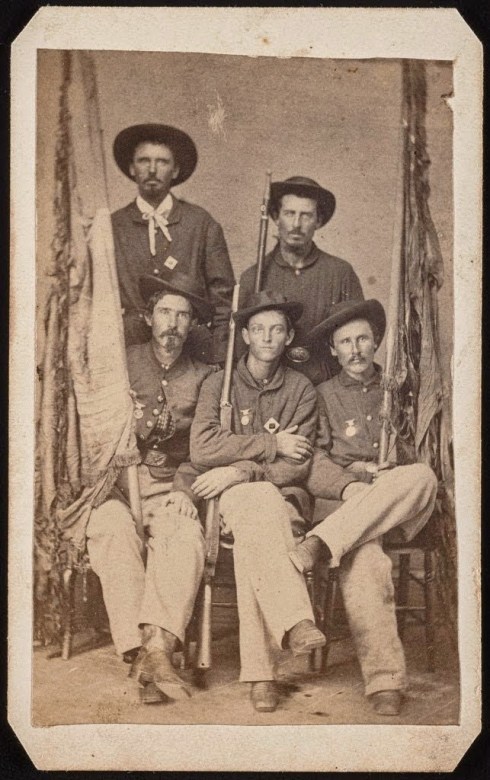
It’s easy to grasp the symbolic importance of the tattered flag image, during the Civil War and all wars really, but I never realized it was a distinct photographic genre until fairly recently. The enormous popularity of the carte de visite, the new photographic technology of the mid 19th century, accounts for many images of flags and flag bearers. Louis-Désiré Blanquart-Evrard had invented albumen printing, in which a negative photograph was printed on paper coated with egg whites (albumen) and mounted on thick cardstock, in the 1850s, resulting in a new mass media with expanded access to  photographic images. The Fort Sumter flag tour could be expanded by degrees, and remembrance of individual, regimental, state and national service and sacrifice recorded for posterity. Tattered flags became “relics” of the war, both in the hands of their bearers and simply standing there in their distressed state. Here are a few of my favorite images among the collection of “Tattered Flag CDVs” (actually the their preferred term is “battle-torn”) at the Library of Congress:

19th Massachusetts; 7th Connecticut; 4th New Hampshire; 44th New York; 30th Ohio; 21st Mississippi, Library of Congress.

The images above were public: I’m wondering if war-torn flags confiscated during battles were also made so. The American Civil War Museum has a large collection of confederate flags captured by Union soldiers and the National Archives has an inventory entitled “Records of Rebel Flags Captured by Union Troops after April 19, 1861” (RG 94). Every state historical society or museum or state house has a collection of war-torn flags, “brought home” during or after (sometimes well after) the war. Sometimes there is just an assemblage of scraps and threads, or perhaps just a material outline of what is sometimes referred to as a “ghost” flag: and like any ghost, it is haunting.

Flag of an unidentified unit. Captured at the battle of the Wilderness, Virginia, May 12, 1864 by Lt. Benjamin Y. Draper, 1st Delaware Infantry and scraps of a confederate flag confiscated (and divided) during the occupation of Richmond by troops from Springfield, Massachuesetts, American Civil War Museum. Remnants of the 95th Pennsylvania and 1st Massachusetts flags, Cowan’s Auctions and Morphy Auctions.

Can’t We Copy Concord?

The Concord Museum has been one of my favorite local history museums for some time, but I haven’t been there since the completion of a major expansion and reinterpretation initiative during the Covid years. Late last week I found myself with some free time and so off to Concord I went. I was impressed with the update, but just like the last time I visited, I could only really see the Concord Museum through the prism of a missing Salem Museum: I walked through the exhibits, which manage to be both chronological and thematic, sweeping yet very focused, thinking: Concord had this, but Salem had more of this, and also that! Salem did that first! OMG I can imagine a perfect Salem exhibit just like this Concord one, just change the names. And ultimately: can’t Salem just copy Concord? Why can’t Salem have a Concord Museum?  This is really not fair to the Concord Museum, which should be viewed on its own merits rather than comparatively, but lately (well, not so lately) I’ve become obsessed with the idea of a comprehensive Salem Museum which lays out ALL of Salem’s history in a chronological yet thematic, sweeping yet focused way: from the seventeenth through the twenty-first century, first encounters to Covid. It should be accessible and inclusive in every way, downtown of course, and it must be a collaboration between the City and the Peabody Essex Museum, because the latter possesses the greater part of Salem’s history in textual and material form. Really lately, I’ve come to think of Salem as experiencing an invasion of the body snatchers scenario, in which all of its authentic history has been detached to another town, only to be replaced by stories that are not its own: real pirates from Cape Cod, vampires who could be from anywhere and everywhere. Can’t we tell the real story, and the whole story?

So, with apologies to the Concord Museum, I’m turning it into a sort of template while also (I hope!) presenting its exhibits in some interpretive and topical detail. The museum lays out an essentially chronological view of Concord’s history, while first identifying Concord’s most prominent historical role, as a center of the emerging American Revolution, and both acknowledging and examining its regional indigenous history. Then we stroll though Concord’s history, which is told through both texts and objects, and lots of visual clues asking us to look closely.

Indigenous regions & English plantations: the Concord Museum explores the land negotiations in detail.[Salem also posseses a 17th century land-transfer document, held at City Hall. The 1686 “Original Indian Deed” of Frank Cousin’s photograph below features many more signature marks of Native Americans, testifying to a more complicated negotiation? I don’t really know: it’s not part of Salem’s public history.]

“Original Indian Deed” at Salem City Hall, c. 1890, Frank Cousins Collection at the Phillips Library of the Peabody Essex Museum via Digital Commonwealth.

You walk through the Concord Museum viewing exhibits in chronological order, but there are necessary tangents, and the biggest stand-alone exhibit is devoted to the events of one day: April 19, 1775. This is a new permanent exhibit, and it utilizes all the latest technology of visual storytelling while at same time focusing on the personal experiences of those involved. The famous Doolittle images, rendered dynamic, rim the perimeter of the exhibition room and a large digital map illustrates the events of the day. There’s a lot of movement in this room! We also hear from some of the participants and see the texts and objects which highlight their experience. How does one get ready for a Revolution? How does war affect daily life?

[Obviously, in a Salem Museum, one permanent exhibit would have to be devoted to the Witch Trials: interpreted not only as a story but as a collective and contextual experience. Apart from 1692, Salem should be paying a lot more attention to its Revolutionary role(s): not just Leslie’s Retreat, but also its brief role as a provincial capital and those of all of its privateers! Real Salem privateers.]

There is a continuous emphasis on how individuals experienced and shaped their world in the Museum’s exhibits, encompassing both big events, pressing issues, and daily life. We learn about the African-American experience in Concord through both official documents and the lives of two black families in town: the Garrisons and the Dugans, whose members were acquainted with both enslavement and freedom. Thomas Dugan’s probate inventory is posted, alongside a display of the possessions listed thereon. Concord’s dynamic abolitionist movement is another window into the institution of slavery, but it is not the only one. As would certainly be the case with a Salem presentation, abolition provides an opportunity to showcase female agency, and the Museum’s exhibits do not disappoint. But again, all I could think of was: Salem’s Female Anti-Slavery Society predates Concord’s Ladies’ Anti-Slavery Society by several years, AND it was desegregated because it was an extension of the first female abolitionist society in Salem, which was founded by African-American women.

The Museum’s exhibits on slavery and abolition: Mary Merrick Brooks was a particularly active member of the Ladies’ Anti-Slavery Society, and because her husband did not support its efforts, she sold her own tea cakes; “potholder quilts” were made up of squares like this one, which were also sold at Ladies’ Anti-Slavery Fairs in Concord (as well as Salem).

[The Histories of Slavery and Abolition illustrate the Salem problem really well, as there has been lots of research into both over the past few years by several institutions, including the Salem Maritime National Historic Site, the Peabody Essex Museum, and Hamilton Hall. But their efforts are all SILOED, and this prevents the diffusion of a comprehensive history of both to residents and visitors alike. Salem Maritime has developed walking tours and a research guide into African-American history in Essex County, the PEM is currently exhibiting an examination of school desegregation in Salem, and Hamilton Hall has had lots of materials and texts pertaining to the Remond Family on its website for several years, but are all these resources really getting out there? A common space and place for historical collaboration and exhibition would amplify all of these efforts considerably. We have so much information, from Salem’s 1754 Slave Census entry (below), to the recently-rediscovered 1810 Census for Salem, to the digitized records of the Salem Female Anti-Slavery Society (credit to the PEM’s Phillips Library for getting both the Census and the SFASS records out there), to the abolition petitions digitized by Harvard: but it’s not being used to tell a cohesive and comprehensive story! The Concord Museum has an Uncle Tom statue which once belong to Henry David Thoreau, but the Salem Museum could display an Uncle Tom’s Cabin card game manufactured by the Ives Brothers in 1852.]

There were 83 enslaved persons in Salem in 1754 according to the Massachusetts Slave Census of that year.

Like Salem, Concord has many heritage sites, so I imagine the Concord Museum serves as an orientation center from which people can go on to visit the Alcott’s Orchard House, Minute Man National Historical Park, or Walden Pond (among other places!) The Museum has reproduced Ralph Waldo Emerson’s parlor—while the actual room is just across the way–and utilized digital technology to enhance its interpretation. There’s also a great exhibit on Henry David Thoreau, but Louisa May Alcott and Nathaniel Hawthorne seem a bit short-changed—maybe there’s an evolving emphasis? A Salem Museum would have a host of public intellectuals to juggle as well. Lots of material objects “made in Concord” or purchased in Concord and we also get to learn about the town’s conspicuous visitors—some of whom stayed at the famous Old Middlesex Hotel. [it would be so much fun to research an exhibition on who stayed at Salem’s equally famous Essex House.]

Details from the Concord Museum’s Emerson and Thoreau rooms—the star is one of several placed by Concord antiquarian Cummings E. Davis, whose collection is essentially the foundation of the Museum, along a trail in Walden Woods to lead people to Thoreau’s cabin. Loved this image of the Old Middlesex Hotel which seems to have played a hospitality role similar to that of the Essex House in Salem, below (an 1880 photograph).

I’m skipping over a lot, as there was a lot to see, so you’ll have to go to the Museum yourself, but I did want to mention its engagement with Concord’s storied history as well as the documented past. Concord is a famous place, just like Salem, and so there is an obligation not only to present the past but also to address how the past has been presented, to take on “Paul Revere’s Ride” as well as April 19th. I really liked how the Museum presented the process of commemorating the Battles of Lexington and Concord a hundred years later, chiefly through the commission of Daniel Chester French’s Minute Man statue. A photograph of a group of disenfranchised Concord women surrounding the statue at its unveiling on April 19, 1875 makes a big statement, especially as Louisa May Alcott, present on that day, later noted that women could not march in the grand parade unescorted or even sit in the stands to listen to speeches of the day (maybe this was a blessing).