
Category Archives: History

Jacobean Style

Has anybody been watching Mary & George? So much texture! Dark and rich. I’m not sure what I think of the whole presentation in terms of its storyline and representations, but the ambiance and environment seem evocative to me, while also exaggerated: in the very first episode Julianne Moore’s Mary snares her second husband wearing a hat embellished by pheasant feathers and rabbit ears! Not being an art historian, I’m never sure whether or not the “Jacobean” style I admire is authentic or revived/amplified. But I like it. To me, it’s as if the early Stuarts ramped up everything Elizabethan—and then added their own more luxurious and whimsical touches. I love the very clever Anne of Denmark in this series: and she is the living, breathing clotheshorse I always thought she was. I’m not sure where the costume designer found her/his inspiration, but if I were charged with the task I would go right to a contemporary visual source: a portfolio of watercolor renderings of Royal, military and court costumes of the time of James I, “probably by an Italian artist.” I’ve been using these images in my classes for years, and while they certainly have a continental/Italian gaze, I still think they are representative of the age. Most of the experts seem to think that these images were made for a contemporary friendship album, called an album amicorum.

I assume these first three images are the King, the Queen, and their eldest son Henry Frederick, who died of typhoid in 1612—if they date from after that date, I guess that’s Prince Charles draped (like his mother) in fleur-de-lis, as the Stuarts were still claiming French sovereignty.

So many courtiers, or are these also the King and Queen? I can’t quite tell.I know those two never went riding around on one horse together, or cuddled under a tree by a big hat and a small castle.

These carriage scenes are great, but the most compelling images in this portfolio are those at the table—for meals and cards, or both. There’s just something about them: I love out-of-scale depictions and those are very BIG cards and wineglasses. The bright colors against the dark walls and the floor! The people somehow look both happy and wooden at the same time.

Julianne Moore is certainly not wooden in Mary & George and below she is in her big-eared hat: could it be a Jacobean variation on hearing all, as depicted by the more subtle (human) ears (and mouths and eyes) on Queen Elizabeth’s dress in her Rainbow Portrait and envisioned by a 21st century eye?


Queen Elizabeth, Julianne Moore, and Royal, military and court costumes of the time of James I, Folger Shakespeare Library.

Dorothy Talby

I’m starting out Women’s History Month with a Salem tragedy of the seventeenth century, and gratitude that this story popped into my mind at this time, better late than never. I wrote about Hugh Peter, the fourth pastor of Salem’s First Church and later Oliver Cromwell’s chaplain and thus a doomed regicide in England, for our forthcoming book and I tried to give him a comprehensive, current, and critical treatment even though my piece is one of our shorter “interludes.” I included his slave-holding, documented in Harvard’s recent Harvard & the Legacy of Slavery report, and did a deep dive into the recent historiography of the English Revolution. I thought I had Peter all buttoned up, but then I woke up in the middle of the night last week and thought “Dorothy Talby!” Dorothy became the first entry of a social media series on lesser-known women in Salem’s history on this past Friday and I researched her all weekend, so I could tell her story here and in my revised piece on Peter, once it comes back from peer review.

I don’t know what Dorothy Talby looked like: I’m making “silhouettes” from contemporary sources to depict the women I’m featuring on social media this month and I’m sure several will end up here. There’s a real picture problem with pre-modern women: either they are not pictured at all or they are pictured by romanticized images from the last century or so. I used one of Wenceslaus Hollar’s wonderful images from the collection at the University of Toronto for Dorothy’s “silhouette”.

Like everyone in Salem in the 1630s, Dorothy Talby was an emigré. She and her family arrived from Puritan-centric Lincolnshire in 1635, apparently following the popular pastor John Cotton. The Talbys (spelled Taulbee earlier and in variations in Massachusetts), including Dorothy, her husband John, and their five children, arrived in Salem at a rather anxious time, as several settlers—mostly women—were quite vocal in their support of the expelled Roger Williams and and critical of his replacement by Peter. And down in Boston, there was another woman stirring up schism: Anne Hutchinson and her Antimonian challenge. There’s a happy reference to Dorothy in October of 1636 when her sixth child, a daughter named Difficulty, was baptized, but after that it’s all trouble. She fell in and out of troublesome states when she was violent towards her husband, for which she received public admonishments, whipping, and eventually a sentence of being bound and tied to a stake on one of Salem’s main streets. Judge William Hathorne’s summary order used language a bit less condemning than that in his judgements against Salem’s Quakers several decades later:

Whereas Dorethy the wyfe of John Talbie not only broak that peach & love wch ought to have beene both betwixt them, but also hath violentlie broke the kings peace, by frequent Laying hands upon hir husband to the danger of his Life, & Contemned Authority, not coming before them upon command, It is therefore ordered that for her misdemeaner passed & for prvention of future evills that are feared wilbe committed by hir if shee be Lefte att hir Libertie. That she shall be bound & chained to some post where shee shall be restrained of hir libertye to goe abroad or comminge to hir husband till shee manefest some change of hir course….Only it is pmitted that she shall come to the place of gods worshipp, to enjoy his ordenances.

Dorothy’s course stilled for a spell or two, but it did not change: she strayed intently towards “future evils” as she seeemed to believe that it was her duty to remove her entire family from their earthly misery. In December of 1638, she strangled her youngest child, Difficulty, and confessed to the crime after being threatened with peine forte et dure. She was executed days later in Boston, requesting beheading but denied, stuffing the mask given to her into her collar, swinging her legs towards the ladder until she died. We don’t hear the word “revelation” from Dorothy herself, but we do from John Winthrop’s journel entry (a “revelation from heaven”) as well as from Peter, her pastor, who cautioned the attendees of her execution not to lean into “imaginery revelations”. Both men seem to be throwing Dorothy in with Anne Hutchinson and her immediate revelations, then threatening their church. Winthrop does use the m[elancholy] word; Peter does not. Melencholy was an ancient term, experiencing a revival in early modern health manuals and most especially Robert Burton’s popular Anatomy of Melancholy (1621), yet there was little effort to apply any of its old/new theories to Dorothy Talby; she was in the hands of God only in New England.

A more radical intervention of the age: itinerant surgeon extracting stones from a woman’s head; symbolising the removal of her ‘folly’ (insanity). Line engraving after N. Weydtmans after himself, 17th century. Wellcome Collection.

Centuries later, Dorothy Talby was a useful anecdote for those who wanted to shade the Puritan past, or recount “cruel and unusual punishments of bygone days.” Nathaniel Hawthorne, always ready to mine his family’s past for his own benefit, pictured Dorothy in his Main-Street:”chained to a post at the corner of Prison Lane, with the hot sun blazing on her matronly face, and all for no other offence than lifting her hand against her husband, while Oliver Wendell Holmes judged her “mad as Ophelia.” It’s so easy to diagnose the dead!


The Salem Tercentenary, 1926

As I’ve been finishing up the manuscript of our 4o0th anniversary volume, Salem’s Centuries, I’ve been writing and thinking about Salem’s 300th anniversary quite a bit. For some reason I thought that I had already posted about this big event on this unwieldly blog, but I haven’t. Quite a lot is out there—the archivists at the Salem State University Archives and Special Collections oversee an ever-larger collection of historical photographs of Salem, many of which they have uploaded to Flickr, and among them are some great Tercentenary views. This is really the best place to go for local history, including an array of blog posts which put their collections in context. So maybe, in my writing-and-teaching-brain-fog, I confused their output for mine? I don’t know, but there’s certainly no Tercentenary post here so I thought I’d pull one together. I’m quite impressed by the activity of the 1926 Tercentennial but it was certainly more celebration than reflection. This was not a moment to be at all critical about the city’s past; this was a party! Beginning on July 3, 1926 and commencing on the 10th, city residents were feted by parades, street parties, reunions, balloon ascensions, a big ball, a field day, a firemen’s muster, a bonfire, various illuminations, and concerts, concerts, and more concerts. Many people were involved in the planning, at least hundreds if not more. Starting in 1924 a general committee came together, followed by the appointment of chairs of the various subcommittees: the bonfire, music, fireworks, the horribles parade, sports, the military, civic, and historical parade, historical exercises, banquet, costume ball, floral parade, firemen’s muster, entertainment and publicity. Then the work began and there were some alterations: a “great” civic and military parade was severed from the floral and historical parade when it became apparent that the consolidated parade would be very, very long and that the guest of honor, Vice-President George Dawes, could be in Salem only for a short period of time. (President Coolidge was invited to the Tercentenary shortly after his election and I have no idea why he couldn’t turn up—it seems like a slight, as didn’t he summer in Swampscott?) The planning seemed to go smoothly but I have no real insights into subcommittee deliberations—I’m not sure where the meeting meeting minutes are, or if there were any. But they seem to have thought of everything, including a temporary “hospital” installed in the Phillips School overlooking Salem Common. The one big pre-celebration problem that surfaced was in relation to one of the big arches erected at the entrances to the city, specifically the arch at the Salem-Beverly Bridge. Once completed, a furor arose: it said “Greetings” rather than “Welcome” and on the wrong side! Greetings was simply not welcoming enough, and people leaving the city and crossing over to Beverly were being greeted! It cost the princely sum of $700 to fix this arch sign but it had to be fixed and so fixed it was.

I think that was it for the missteps, and then came July, and they were off! Here’s the schedule:

Sunday the 4th: Bells ring all over the city, followed by religious services, and then a huge band concert on the Common. Presumably this is what the brand new bandstand was built for, but as the band consisted of “300 pieces” I don’t think all those musicians could have fit in there. In the evening, a 100-foot bonfire was set ablaze (we are right in the midst of Salem’s big July 4th bonfire craze at this time).

Monday the 5th: The “Grotesque, Antiques & Horribles Parade” featuring Salem schoolchildren in costume competing for prizes (this is another Salem/North Shore July 4th tradition).

We are the Freaks Float, Nelson Dionne Salem History Collection, Salem State University Archives and Special Collections, Salem, Massachusetts.

Tuesday the 6th: Tours of old Salem homes open for the occasion, many, but not all, on Chestnut Street, and an exhibition of “treasures brought to Salem by the sea captains of old days.” In the evening, a balloon ascension at Salem Willows and an “illumination” of US Navy vessels in Salem Harbor.

Wednesday the 7th: the “Great” Parade, with Vice-President Dawes in attendance. This was followed by an historical address on Salem Common, another band concert, and fireworks.

Vice President Charles G. Dawes, Mayor George J. Bates, Governor Alvan T. Fuller, and Congressman William M. Butler; Nelson Dionne Salem History Collection, Salem State University Archives and Special Collections, Salem, Massachusetts.

Thursday the 8th: Family reunions for “Old Planter” families; I’m not sure about everyone else. The first Chestnut Street Day, which was quite the event, and a field day on the Common. The Tercentenary Ball was held that evening at Salem Armory.

Friday the 9th: The other parade, the “Floral and Historical Parade.” (I just love the idea of this– flowers and history!)

Floral Float No. 9, 1926 and Brig Leander Float, Leland O. Tilford photographs, Salem News Historic Photograph Collection, Salem State University Archives and Special Collections, Salem, Massachusetts.

Saturdy the 10th: A huge firemen’s muster on Salem Common, yet another parade and band concert, and fireworks on Gallow Hill.

Quite a success I think, and there were some cultural consequences too. One thing I’m curious about is Salem artist Phillip Little’s “huge” painting of Derby Wharf at the beginning of the nineteenth century: it was commissioned by the Naumkeag Steam Cotton Company for a big home exposition in the spring of 1926 and supposedly shown in Salem for the Tercentenary, but I’m not sure where or when. And where is it now? I want to see it! Since I have not seen it, I have to say that my favorite Salem Tercentenary painting remains Felicia Waldo’s impressionistic view of the first Chestnut Street Day.

Felicie Waldo Howell, Salem’s 300th Anniversary, 1926, Christies.

These civic celebrations can seem frivolous on the surface, but they also reveal a lot about the communities which are putting them on. Much of these activities would have been very familiar to Salem people in 1926: they were used to parades, and old home days, bonfires and annual field days, in which children from every neighborhood competed against each other in a variety of athletic activities on Salem Common. It’s a huge generalization which deserves much more documentation and explanation, but Salem seems much more focused on its residents than its visitors at this time, and for much of the twentieth century. The comments and the coverage from 1926 indicate that what was really new about the Tercentenary were the open historic houses throughout the City, and on Chestnut Street in particular. The national house and garden magazines went crazy with the coverage! Chestnut Street Day was so successful that it was repeated on four more occasions, with the last one occurring in 1976 (there are some great Samuel Chamberlain photographs of later Chestnut Street days from the Phillips Library at Digital Commonwealth and here). And there was nary a witch in sight in 1926, certainly not on the official Tercentenary medal.


Holiday Tables

If I’m hosting for Christmas or any other holiday, I spend more time thinking about the table than the menu: much more time. I love setting the table, and once I attain my “vision” we’re all relegated to eating in the kitchen, no matter how many days before the big meal. Here it is, December 22, and I am hosting Christmas dinner and the table is not set! I just finished my grading, however, so I’ll get it together. I have a different animal theme every year for Christmas decorating and some animals are easier than others. Obviously deer are super easy, and I’ve also done bears, foxes, sheep, swans, pheasants, mice and hedgehogs—and more. This year, I chose lions, and they have been challenging! But I do have these great lion placemats which are everything. I’m not quite ready, however, so here’s a succession of holiday tables from both sides of the Atlantic.  First we have some Scottish tables from my trip last month, and then a succession of tables from Strawbery Banke in Portsmouth, NH: every year they have a Candlelight Stroll among and within their historic houses, featuring a sweeping and colorful view of holidays past.

Scotland: first up are parlor, dining room, and kitchen tables in the Georgian House in Edinburgh’s New Town, owned and operated by the National Trust for Scotland, then a Georgian “everything” room in another National Trust House, Gladstone’s Land. You’re looking at a table, but a lot more is going on in this room–it reminded by of another Georgian room, just below, in the Concord Museum, which I just visited last week. Back in Edinburgh, nothing is more festive than a pub table, and the city is in the midst of major gin craze. The Jolly Botanist is a great gin bar that we really enjoyed.

Back Home (well in Portsmouuth): Strawbery Banke is a museum “neighborhood” of historic houses, some of which were located in the Puddle Dock area of Portsmouth, others which were moved there when the museum was founded in the 1960s. It’s always been a part of my life, as I grew up across the river in southern Maine. The annual Candlelight Stroll features decorated houses with reenactors, representing different periods and stratas of society. The opulent Goodwin Mansion, first up below, was built in 1811, but it is interpreted as an 1870s house. Below its dining room is that of the Chase House, a Georgian structure that is interpreted c. 1818, followed by that of the Rider-Wood House (1830s), the Shapiro House (1919) and the time-capsule 1950s kitchen of the Pridham House.

My table is not set yet but here are the lions, ready to go! Best wishes for a restorative and merry Christmas.


It Happened in Town House Square

I didn’t expect to be posting on Salem for a while as I’m on my way to Maine to escape the Halloween Hordes (haven’t quite broken away yet!) but I’m in the midst of writing the last chapter for Salem’s Centuries and I thought posting would help. It’s why I started this blog in the first place, so long ago, to indulge my curiosity about Salem’s lost history and free up my writing from its academic constraints! This last chapter is on the long history of Salem’s center, Town House Square, and I’m just kind of enraptured with everything that happened there, but also haven’t figured out the meaning of it all. I’m trying to use the chapter to summarize the book Salem’s Centuries and also Salem’s centuries by using the Square as kind of a “stage” (at least that’s the word I’m using now). So this will be kind of a sketchy post as it is a work in progress and I welcome all comments and corrections.

I’m happy with my opening paragraph:

A crowd filled Town House Square on a sunny day in June of 2005, cheering and jeering the unveiling of a bronze statue of the actress Elizabeth Montgomery in character as Samantha Stevens of the television series Bewitched. The rationale for the statue was the filming of a few episodes of the series in Salem in 1970, commencing a successful intensification of witchcraft-focused tourism in the view of those who cheered, while less-enthusiastic attendees noted the impropriety of installing a fictitious witch within view of the sites where the victims of 1692 were accused and tried. The Reverend Jeffrey Barz-Snell, 31st pastor of the First Church of Salem, which stood across the street for centuries, was among those who had urged the Salem Redevelopment Authority to reject the statue weeks before“in due deference to our history”and its location: “we must object to this statue being sponsored by the city of Salem, less than twenty yards away from site where we committed, arguably, one of the worst…..crimes in the history of this city.” This argument was countered by the majority opinion, expressed succinctly by Salem City Councilor Thomas Furey: “Salem is the Witch City. I think we all need to lighten up, take a breath, and let Salem have fun.” This moment in time and place is representative of the continuous significance of a small parcel of land, more of an intersection than a square, over Salem’s centuries. The crowd, the expression of civic identity, representations of church, state and commerce: all have had their role to play in Town House Square.

Then I go back to the seventeenth century and start with the English settlement of Salem from 1626, including a brief discussion of how the topography shaped the town and its center at the intersections of its two main thoroughfares, later called Essex and Washington Streets. This became known as Town House Square in the 18th century, and that’s still its place-name, although I wonder how many Salem residents (much less tourists) know it as such today. Then it’s all about meeting houses—-four on the same site: it really took a lot of time to figure out all that building history. First there was a small meeting house built in 1634 which was long thought to be the small building you can see in the rear of Plummer Hall on the Peabody Essex Museum’s campus, a larger though still quite simple structure built around 1670, the first “churchly” meeting house with a belfry, built in 1718, and finally the present building (1826) which long served as the Daniel Low & Co. store after the First Church departed to its present building further along Essex Street. Salem’s meeting houses are confusing, both before and after the First Church splits up into successor congregations: East, North, South and Tabernacle. Thank goodness I don’t have to go into the theological and factional disputes: I’m sticking to Town House Square.

So, once I set the stage, action will begin: here’s what happened in Town House Square, with an emphasis on the public. Obviously lots of other things happened in this vicinity over 400 years but why do some leave a mark or record and others not? And do the happenings in the Square reveal its public nature and role? Just questions I’m asking myself as I am writing.

  1. Lots of Quaker resistance: holding their own meetings right next to the First Church/Meeting House, wearing their hats into the latter, and then in 1662, Quaker Deborah Buffum Wilson, accompanied by her mother and half-sister, walked “naked for a sign” down Washington Street in imitation of an Old Testament episode (Isaiah 20.2-3) and in denunciation of the spiritual “nudity” of those who condemned them. Yes, a NAKED QUAKER walked down Washington Street. This resistance was met with an equal (or larger) measure of persecution, especially by the William Hathorne, who lived right on the Square.
  2. Anti-Royalist protests: by the same William Hathorne, who as Major of the Salem Militia, assembled his armed soldiers in Town House Square for his impassioned speech against the Royal Commissioners present in Massachusetts in 1664, after which he himself was summoned to England on the charge of refusing to submit to royal authority.
  3. The Salem Witch Trials: also happened in Town House Square once the judicial proceedings moved from Salem Village to Salem Town. Close quarters! Judge John Hathorne, son of William, lived right there, as did the Reverend Nicholas Noyes, and victim Bridget Bishop. The combined courthouse/schoolhouse at the northern end of the Square, made of the framing of the 1634 meeting house, separated the properties of Noyes and Bishop, and High Sheriff George Corwin resided at the southern end of the Square.
  4. Salem’s first July 4th: came before the Revolution! There was a huge party at the Town House (sometimes called the provincial Court House, sometimes even the State House—think of the old State House in Boston) to celebrate Sir William Pepperrell, the hero of the Siege of Louisbourg, in 1746. The cannons surounding the Town House were fired after every toast, and there were many.
  5. Big Town Meeting Protests: against British taxation, commencing with the Stamp Act (1765), at the Town House. (But less than 20 years earlier they were celebrating the hero of a war they were not willing to pay for–just a British historian’s perspective.)
  6. Salem’s “Tea Party”: a crate of tea from Boston is seized and burned in Town House Square on October 4, 1774, “in the presence of several hundred spectators.”
  7. Last meeting of the Massachusetts Provincial Assembly: against the orders of Governor Thomas Gage, electing delegates to the new Provincial Congress which met in Concord on October 7, 1774.
  8. Colonel Alexander Leslie and his regiment passed through Town House Square on their way to the North River to recover rumored cannon, and back again on their retreat, February 1775.
  9. Presidential Parades: George Washinton in 1789, and Theodore Roosevelt in 1912.
  10. Salem’s “big digs”: the first railroad tunnel built in 1839, and rebuilt in the later 1950s.
  11. Nathaniel Hawthorne’s romanticized view of colonial history set against Town House Square in two stories: A Rill from the Town Pump and Endicott and the Red Cross.
  12. Town House Square Transportation Hub: trains, trolleys, and later, buses.
  13. Daniel Low & Co. established in the former fourth meeting house of the First Church, 1867. A mail order innovator, the store also issued a catalog which projected both Salem and Town House Square to the entire country.
  14. War Bond Rallies: the Square was the center of  “community chest” and war bond events during both World War I and World War II, including one which featured  fake Germans attacking during the former!
  15. Restaurant action: I think this can take me from the second half of the twentieth century into the twenty-first, from the long-running Gerber’s “Little Town Hall” restaurant through various fast-food experiments to today.
  16. And then came Samantha……back where I started. I don’t really believe in historical objectivity, but I know that I can’t even try to write about that awful statue in a balanced way, so I better close with a reprise of Reverend Barz-Snell’s and Councillor Furey’s statements.

John Smibert’s portrait of Sir William Pepperrell, Peabody Essex Museum; the “Salem Tea Party” of October 4, 1774; there are great historic placques in Town House Square but I don’t think the tourists are really interested. Where can I Get a Car?, 1894; The Story of a Store, 1926. Boy, what a devolution of opponents: from King George to Burger King. Town House Square today, or yesterday: it’s Samantha’s neighborhood.


The Summer of Old Photographs

I worked all summer long on my chapters for Salem’s Centuries and a few other projects, researching and writing, researching and writing, researching and writing. Once I’m on the trail, I’m a pretty steady worker, but I do take breaks: I’ve learned from other writing projects that you have to pause to let your mind absorb and process information. Sometimes the break might be at night when you’re asleep—I got into the habit of leaving a notebook by my bedside when I was writing my dissertation and when I woke up in the morning sometimes I would see notations inside that I didn’t even remember writing! That must have been one of the benefits of a younger mind because it didn’t happen this summer, when all my breaks were conscious. Every time I went up to the Phillips Library in Rowley, I would dutifully call up boring municipal records but also collections which contained old photographs of Salem. I’d pore over them a bit and photograph them for later perusal, and by the end of the summer I had quite a collection. The Phillips has digitized two of its largest collections of Salem photographs: the Frank Cousins and Samuel Chamberlain collections, but there remain many seldom-seen images within collections. Fortunately there are great finding aids to locate such images, but also some very miscellaneous collections which yielded surprises, at least for me! I loved schoolteacher Grace Hood’s shots of the Salem and Massachusetts celebrations in 1926-1930 (PHA 67; including some completely new-to-me views of the opening day of Pioneer Village in 1930) and an unknown photographer’s depictions of a very gritty Salem encased in a large composite collection entitled Photographs of interiors and exteriors of Salem, Mass., circa 1890-1950 (PHA 151). And there’s much more.

Phillips Library PHA 67 & 151.

My favorite collection was the first one I accessed, back in May: a treasure trove of images contained in the scrapbooks of Francis Henry Lee of 14 Chestnut Street, mostly from the 1880s (Phillips Library MSS 128). Lee was the son-in-law of the woman who lived in my house, and a committed architectural antiquarian focused on documenting the history of every house on Chestnut and adjoining streets. He did not rely on hearsay, but sent queries to anyone who ever lived in the neighborhood, and his scrapbooks are filled with detailed responses, some written on black-trimmed stationery indicating that their authors were in mourning. I was familiar with his articles in the Historical Collections of the Essex Institute, but surprised to find his research materials accompanied by so many wonderful photographs.

Some of my favorites: (I filtered those that were really hazy or damaged).

Chestnut, Summer & Norman Streets from two perspectives. I’ll never get over how wonderful Norman Street was!

Riding and looking north on Summer Street, and then south (Samuel McIntire’s house is on the extreme left of the last photograph).

Broad Street, looking west.

Cambridge Street, looking north and south.

Work on Bott’s Court.

Hamilton Street, looking north.

Chestnut Street Houses—what’s going on with that figure at the third-floor level of the third photo above, which I think is #26?

Warren Street, looking towards the “Turnpike” (Highland Avenue).
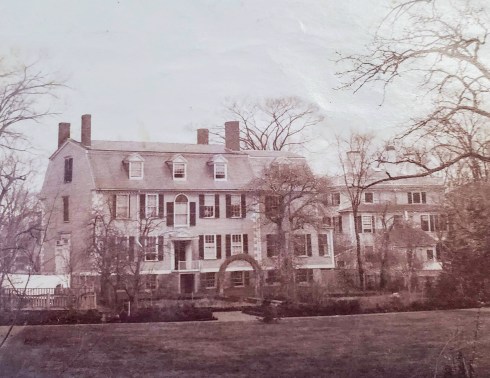
There were several photographs which were especially exciting to see among the Lee papers, including those which show the magnificent formal garden in the rear of the Cabot-Endicott-Low House on Essex Street, which extended to Chestnut before no. 30 Chestnut was built in 1896. This garden was quite famous: it was prominently featured in many horticultural publications and was by all accounts quite the tourist attraction, especially in the spring. A 1904 Boston Globe article on “Beautiful Old Gardens of Salem” reports that for many years the tulip bed was the greatest feature of this garden, and each spring, when these flowers were in perfection, and upper portion of the high fence on Chestnut was removed to enable the public to view the exhibit.

Even more exciting than this lost garden were two photographs of my own house that I had never seen before, including one sans the apartment that was added on in phases between 1890-1910. Our house is the right side of a double house built in 1827: both sides were identifical until the 1850s, when one of our owners expanded the house considerably in back and altered the interior to look more fashionable at the time—round mouldings rather than square ones! The big entrance alteration reflects the changes inside, but I did not know that this guy also put new mouldings over the windows, and disdained shutters as too colonial, I guess. Several owners later, there was a sequential addition on the side of the house: first as an office for a very well-know opthamologist who lived here, and then bedrooms were built above: this is our present-day 7 1/2, a really cute apartment with the best views of Chestnut Street. I assumed that it covered up windows which were on the side of our house, but it looks like there were none. As you can see from all of the other photos of the street, Chestnut was driveway-less in the nineteenth-century: the larger houses had carriage access on Warren or Essex: the property of our house actually wrapped around Hamilton Hall next door and so our carriage house—long- demolished—accessed Cambridge Street.


Olmsted Central

I have felt vulnerable all summer long, while working on my contributions for our Salem book: my chapters relate to academic fields for which I have no professional preparation, including African-American history (John Remond), art history (the Colonial Revival) and urban planning (Salem’s 20th-century development). I read widely and had support from my colleagues, and all the chapters will be peer-reviewed, so I don’t think I’ll embarass myself in the end, but I’m still a bit anxious. I’m co-writing the last referenced chapter, on Salem’s development from the Great Salem Fire of 1914 to the present, with my co-editor for the entire book, and after I plowed through rebuilding and urban renewal I simply dumped it on him, just done with it! It wasn’t fun to write and I needed some distance to reflect. So that’s what I have been doing for the last two weeks or so, trying to read histories of urban planning for pleasure. This is a field that intersects with the history of landscape design and garden history—and as the latter is more familiar to me I found a comfort zone. So I got some grounding and feel ready to go back into this chapter with some different perspectives and questions. I also realized I needed to cap off my weeks of reading with a visit to what must be the Mecca of landscape history: the Frederick Law Olmsted National Historic Site in Brookline, Massachusetts.

So Chestnut Hill, a beautiful section of Brookline which extends over into Newton, was my weekend destination. This is where Boston Brahmins established their country seats in the later nineteenth century, and because of these considerable investments in land the area still retains its pastoral feel despite its proximity to Boston. At the height of his pathfinding career in 1883, Frederick Law Olmsted purchased an early 19th century farmhouse and several acres of land from two elderly spinster sisters who were reluctant to move: he built them a house next door. Another neighbor was Isabella Stewart Gardner, whose “Green Hill” summer house was built by Salem ship captain Nathaniel Ingersoll earlier in the century. Olmsted did not intend for his new house, named Fairsted, to be a seasonal showplace: it became the center of his business and his practice, as well as a center for the emerging new discipline of landscape architecture. This is the focus of the site’s interpretation: on the practice rather than the personal. The farmhouse was expanded in all directions, most conpicuously in the office addition which served as the headquarters of the Olmstead Brothers after the Frederick Law’s retirement in 1895. The firm endured (as the Olmsted Associates) until 1980, the same year that the National Park Service acquired Fairsted. As you can see from the photographs above, the orginal farmhouse its garden addition are not in the best shape: a planned and funded restoration has stalled due to the quality of the workmanship, and is delayed until the next funding process (but private donations can be made here). The interior of the farmhouse is pristine, and (again) dedicated to telling the story of the Olmsted practice. The office addition is like a time capsule of a 1920s-1930s architecture firm: with a drafting room, a photography room, a blueprint-printing room, a shipping room, and a vault, where all the Olmsted plans are archived.

In the main house: very few personal items, it’s all about the firm. I was primarily interested in the urban planning inititatives of the Olmstead firm as my chapter on Salem’s 20th century development begins with Harlan Kelsey’s 1912 City Plans Commission report. Because the Olmsted projects are so extensive, both in sheer number and geographically, the firm’s archives are always in demand and consequently the NPS has completed a major digitization project and also furnished researchers with an invaluable research guide to the collections. I found five Salem projects, the most important of which is the subdivision of the famous Pickman/Loring farm c. 1900: this was Salem’s first planned neighborhood, and I didn’t include it in my draft chapter (but I’m certainly going to do so now)!

The Olmsted site offers two tours, both of which were given by enthusiastic and articulate interns: one on the cultural landscape, the other on the office and practice. In the first, we learned all about Olmsted’s design philosophy (naturalistic and anti-Victorian, not particulaly interested in PLANTS, “borrowed view”) and the second focused primarily on how the firm was run during the era of the Olmsted sons/brothers. I just loved the office tour: forget AI and digital “reality”: this was immersion!

The Olmsted office wing: photography library with project #s (all materials are preserved in the vault now), drafting room, planting specifications, blueprint-printing room (and a very strange blueprint drying machine), shipping room, little cubbyhole office outside the vault.


Lafayette, You are Here!

I’ll drive down to Newport, Rhode Island for any occasion, and Bastille Day seemed like a good one as French expeditionary forces landed there in 1780 as part of their formal and personal commitment to the American Revolution, a commitment that is honored today by the “French in Newport” festivities on the second weekend of July. From the Rhode Island perspective, the French “occupation” of Newport is the beginning of the end, the road to Yorktown and independence started there. A friend had lent me the Newport Historical Society’s Winter/Spring 2023 issue of its journal, Newport History, which is entirely focused on the French in Newport, so I was well prepared by articles on “The Washington Rochambeau Revolutional Route National Historic Trail,” (from Newport to Yorktown of course), “Forging the French Alliance in Newport,” and “A New Look at how Rochambeau Quartered his Army in Newport.” I arrived just in time for the comte de Rochambeaut’s proclamation, wandered about checking in on my favorite Newport houses and others in which the French were quartered, and then returned to Washington Square to hear the Marquis de Lafayette give an amazing little talk on how he was inspired to cross the Atlantic and join the American ranks. I was quite taken with the Marquis, and as he was speaking an extremely precocious boy yelled out of the window of a passing car “Lafayette, you are here!”

 Print depicting the arrivl of Rochaembeau’s troops in Newport in July 1780, Daniel Chodowiecki, The Society of the Cincinnati, Washington, DC.

Rochambeau and General Washington got on very well, and had lots of planning to do during that fateful year, so Washington was in Newport too for a bit, staying, I believe, at the Count’s headquarters at the William Vernon House. George Washington 2023 was not in Newport, but a replica of his field tent was, as part of the Museum of the American Revolution’s “First Oval Office” initiative. It was rather intimate to go in there—I’ve really got to go and see the real thing, the ultimate “relic” of the Revolution—in Philadelphia. While the French rank and file seemed to be on duty, the officers were relaxed and conversational, underneath their own tent on in the Colony House nearby, wearing light floral banyans when not in uniform. I had not been in the Colony House for a while and had forgotten how grand it is. Certainly worthy of Newport.

A cool (actually very hot) bakehouse on site with an enormous clay (???) oven in back from which you could buy a toasted slice of bread with salt pork butter………

The Colony House, a private home on Spring Street where Francois-Jean de Chastellux, the liasion officer between Washington’s and Rochambeau’s armies, lived while in Newport, one of my favorite Newport houses which must go into every Newport post, and the tricolore.


One Hero and 17 Rescinders

I am staying in my family’s house in York Harbor for the month of June, mostly writing with occasional breaks for gardening and sightseeing. But you know me: I can never really get away from Salem! On this past Saturday, a single word was uttered which provided me with a connecting link between my hometown and my principal place of residence: rescinders. This is not a word you come across often, but within a couple of days I did, quite by happenstance. I love it when that happens, so here’s the context and the connection, starting with yet another preservation challenge back in Massachusetts concerning a structure associated with Revolutionary War Brigadier General John Glover. Glover is associated with two standing structures, a landmark house not far from Marblehead Harbor and a “retirement” home located on the Marblehead/Swampscott/Salem line which had a long and varied history following his death in 1797. “Glover Farm” was most recently the “General Glover House,” a restaurant owned and operated by Anthony Athanas of Pier 4 fame, but the entire property, including the 1762 house in which John Glover lived and died, has been left to deteriorate following its closure in the 1990s. While various officials of the town of Swampscott have proclaimed the property “blighted,” the Swampscott Historical Commission (which seems to be 10x more proactive than its counterpart in Salem) voted to issue a demolition delay and is seeking ways and means to save it in collaboration with the Swampscott Historical Society and local preservationists and any- and everyone who is interested in material heritage.

Glover Farm as the General Glover Inn, part of Sunbeam Farm, 1920s-1930s, Swampscott Public Library. Anthony Athanas opened the General Glover House in 1957 and here are menu covers and ads from the 1950s, 1960s and 1970s from guidebooks of those eras. It looks like the perfect “ye olde” restaurant: I wish I had went!

General Glover was a true American hero, outfitting his own ships as privateers, ferrying General Washington across the Delaware on that fateful Christmas night in 1776 and serving at Saratoga, Newport, and the Hudson River highlands successively between bouts of ill health on his part and returns to Marblehead to attend to his ailing wife. He sought retirement at the close of the Revolution, and General Washington notified him of Congress’s approval in a letter dated July 30, 1782, closing with wishes for a restoration of health, attended with every happiness in your future walks of life. Apparently Glover found that happiness at the rural farm some distance from Marblehead’s busy docks, in a house that its still standing despite decades of active development all around it. I started digging into this particular Glover House when my friend and former colleague, Nancy Lusignan Schultz, brought it to my attention: as chair of the Swampscott Historical Commission, she is right at the center of the preservation efforts (which you can learn much more about in this podcast). But as soon as I realized who built the house, I was caught, or caught up: it was William Browne, Salem’s richest and most notorious Loyalist, whose considerable properties were confiscated after he fled to Britain in 1776, eventually ending up as the colonial Governor of Bermuda. Browne deserves much more scrutiny than I can give him here, but he was a powerful man in Salem and Massachusetts, whose fall from grace came when he became one of the 17 “Rescinders” who were described by John Adams as Wretches, without Sense or Sentiment after they voted to rescind the Massachusetts Circular Letter which had been drafted by the provincial Assembly in response to the Townshend Acts in 1768. The Letter called for resistance, and was sent to all of the other colonies, prompting the protest of Governor Francis Barnard on behalf of London. Bernard ordered the Assembly to rescind the letter, and the Assembly put the matter before a vote: 92 nays and 17 yeas, with Salem’s representatives Browne and Frye loudly voting YEA. This lead to one of the most important moments in Salem’s political history, a town meeting assembled to vote for replacements for Browne and Frye which exposed the deep divisions of the day, and about 30 Salem Loyalists. Browne and Frye and their 15 fellow wretches were “memorialized” by the ever-ready Paul Revere in his adaptation of a British broadside entitled The Scots Scourge issued under the title A Warm Place—[in]Hell and Boston merchant John Rowe noted the names in his diary, “for my own satisfaction.”

A Warm Place—Hell by Paul Revere, American Antiquarian Society.

How I love Rowe’s sentiment: I record the 17 yeas, that were so mean-spirited to vote away their Blessings as Englishmen, namely their Rights, Liberties and Properties and how lovely that one of Browne’s properties should go to such a self-sacrificing patriot as General John Glover. But this is not the end of my rescinder rap. I was so focused on Frye and Browne and Salem that I did not take note of all the names on Rowe’s list immediately. I drove up to York on Friday and went to an open house at our local Historic New England property on Saturday: the Jonathan Sayward House, where I interned in college. As soon as I stepped in the parlor, I remembered: he was a rescinder too, and there he is on Rowe’s list, just above Browne (Maine was of course part of Massachusetts until 1820). Sayward did not suffer as much loss as Browne, who I believe was a much bigger fish: no exile (just confinement to this very home), no confiscation, and reconciliation after it was all over. George Washington and King George III share wall space in the Sayward House today.

Portrait of Jonathan Sayward, Rescinder, in his family home, anonymous artist, and the right parlor, above. Below, our hero, Brigadier General John Glover: a study by John Trumbull drawn while Glover was living at his farm, 1794. Yale University Art Gallery.


A Neighborhood Besieged

A dynamic, healthy city is composed of neighborhoods: this is a time-honored, universal observation, so much so that I believe it is a truism. It follows that municipal leaders should prioritize the protection of neighborhoods, but too many times, far too many times in my opinion, the City of Salem has pitted residents against developmental entities which seek to alter the composition and character of neighboods in overwhelming ways. I’m really worried about a neighborhood located just south of where I live, through which I walk and/or drive pretty much every day, which seems to be facing a development of gargantuan proportions: three multi-storey buildings for shelter and senior housing along with adminstrative and retail facilities, to be built in and on a small area of narrow streets and small houses, the remainder of a storied section of our city. The neighborhood now goes by the name of “Greater Endicott” for the major street that runs through it, but in the past it was: a ship-building district at the head of the South River proximate to Mill Pond, “Roast Meat Hill,” Salem’s first African-American neighborhood, and Little Italy, a tight-knit neighborhood clustered around a community-built church.

A Stereoview of the Boston & Maine Depot, with Mill Pond in back and the Endicott Street neighborhood top right, from the Dionne Collection at Salem State University Archives and Special Collections, 1870s. Jen Ratliff of the Archives has recently published a post on Salem’s “Little Italy,” which you can find here, along with links to more photos and ephemera.

The development at issue has not been proposed formally to a City board yet, but its developers, two regional non-profits, Lifebridge Northshore and Harborlight Community Partners, have met with city councillors and the neighborhood association. Lifebridge operates a homeless shelter on part of the site on which they want to expand, and Harborlight is a community development nonprofit which has built and redeveloped many affordable housing projects on the North Shore. There is no question that both organizations are engaging in laudable and necessary work, but in this particular case I believe that their missions are in conflict with the viability of an historic Salem neighborhood. Their proposal is to demolish the current Lifebridge Shelter, once the parish hall for St. Mary’s Italian Church, as well as the church itself and adjacent buildings, to build two five-storey buildings along Margin Street, and an additional four-storey building for senior housing behind these two structures, on the existing playground along Pratt Street. Very little parking is specified: 12-15 spaces for three huge buildings, several of which will have considerable visitation and staffing needs. And there’s one odd little detail: because one of the buildings which will be demolished is the Christopher Columbus Society, which features a bar, Lifebridge has proposed relocating said bar in its dry shelter building! I believe that none of the new housing facilities are limited to Salem residents; both Lifebridge and Harborlight operate as regional organizations. As there is a state law mandating the replacement of playground facilities, a new playground will be built along Endicott Street. I have seen a rendering of this proposal, but I don’t really know where it came from or if it is accurate so I’m not going to publish it here: suffice it to say that it’s rather horrifying!  The buildings don’t look like anything else in the neighborhood—this could be the beginning of the Hampton Inn-ization of Salem as the project looks like it will mirror the new Hampton Inn across the way (the less stripey part), and I’m no architect or surveyor, but I don’t really see how everything will fit.

As there has been no formal proposal yet, my sources for this proposal are notes from several meetings of the Greater Endicott Neighborhood Association: with the developers and with the two candidates for Mayor in Salem’s recent special election. Sadly, both of these men sound a bit resigned about the development: their answers to the residents’ questions give the impression that resistance is futile! The relationship between Lifebridge and Harborlight and Salem’s municipal government seems very close: both organizations were collaborating “partners” in the creation of the Salem Housing Road Map for FY 2023-2027, and last fall Harborlight hosted a ‘Housing Institute‘ at Old Town Hall for city councillors and staff. Photographs of smiling Salem politicians at Lifebridge and Harborlight fundraisers and legislative breakfasts appear regularly: there doesn’t seem to be the same separation as is the case with private developers, or maybe I’m just being naive about the latter. The proposal is in serious conflict with the zoning for the neighborhood, but there are tools to overide these restrictions in Massachusetts: 40B and 40R statutes, which grant developers free reign if sufficient affordable housing is part of the proposal. Salem has already met (and exceeded) the 40B requirement of 10% affordable housing, but 40R is more of a “carrot” than a stick approach to urban development, aimed at creating “smart growth districts” in proximity to mass transit by “streamlining” the permittal process and incentivizing the host city/town with cash payments. This could happen here, but it would take a majority vote of the City Council. There’s no question that more housing is a drumbeat echoing out from City Hall, but I believe that our councillors care about neighborboods too: I’m not as pessimistic (yet!) as one commentor in the meeting notes who observed that “a group of 100 individuals is being privileged over a neighborhood, and by extension, a city.”

The Harborlight Homes Housing Institute at Old Town Hall, Salem, Sept. 22, 2022.

What came before, and what next? That’s about as much housing policy discussion as I can engage in. It’s more simple for me, really. When I think about this neighborbood faced with this looming development, my mind conjures up one question: hasn’t it suffered enough? Of all Salem’s historic neighborhoods, this one is the least protected and has withstood the most challenges: from economic dislocation in the 18th and 19th centuries, from the Great Salem Fire which singed its borders in the early 20th, to development in the 20th centuries. And now this. People in the nineteenth century were very conscious of its venerability and vulnerability in a way that people in the 21st century are not, because it had already lost so much. Salem’s first two custom houses were located in this neighborhood, the so-called “Port House” and “French House”: the latter survived into the nineteenth century and was verified as Salem’s old house by none other than the Reverend William Bentley, who found “1645” carved into a mantle. In the vicinity of High Street were myriad seventeenth-century houses, including the famous Palmer House drawn by Edwin Whitefield in the 1870s and the Pease and Price Bakery, captured by Frank Cousins in the 1890s. And then of course there is the 1665 Gedney House, certainly not as noted as these structures a century ago but now an illustrative study house owned by Historic New England, which has recently confirmed that it operated as a tavern operated by widow Mary Gedney during the Witch Trials. I think the development of a preservation mentality in Salem in the later nineteenth century was very much focused on this neighborhood, rather than more illustrious ones, because the progressive filling-in of the South River and Mill Pond and the coming of the railroad yards had transformed it into a marginal location over the century: “Knocker’s Hole,” named for the loud knocking of shipwrights’ mallets in the shipyards along the shore, was no more. In an “epitaph” for the recently-demolished Palmer House in the 1880s, a Salem antiquarian noted that the “old homestead” had been named for “the old pioneer ship-builder of Knocker’s Hole, Richard Palmer, who had grants among the first of those who wrought so lustily in the noisy shipyards about Creek Street.”

As the neighborhood became less central, it became more affordable of course, and so a succession of African-Americans who worked in the city’s many service industries took up residence there, from the 1820s into the 1870s: mariners gave way to cooks and hairdressers, chimney sweeps and cartmen. Clarissa Lawrence opened Salem’s first school for African-American children in the neighborhood as early as 1807, and letter settled at 8 High Street, which she passed down to her children. She founded the Colored Female Religious and Moral Society of Salem, which soon merged with the integrated Salem Female Anti-Slavery Society, for which she traveled to the third national convention of the Women’s Anti-Slavery Society in Philadelphia in 1839 (on a segregated train) to give her rousing speech about meeting the “monster prejudice everywhere.” In the 1840s, there were seventeen African-American households on High Street, and more on adjoining streets, including that of Mercy Morris, the sister of the pioneering Boston lawyer Robert Morris, on Creek Street. A decade later, the Fletcher family was living on nearby Pratt Street (likely the street to be most impacted negatively by this development), including Francis Fletcher, who advocated for the formation of an African-American Regiment during the opening years of the Civil War in correspondence to Massachusetts Governor John A. Andrew, and then joined the Massachusetts 54th himself.

Clarissa Lawrence’s (of High Street) big speech, and Francis Fletcher of Pratt Street. Pratt Street runs right by the High Street playground, which is a designated site for one of the multi-storey buildings, so everything you see on the left above will be a big building. No more tree-filtered sun for this neighborhood.

Salem’s City Directories reflect a change after the Civil War: not so many of the familar names of African American families in the nighborhood, replaced by a succession of Irish and then Italian names. Between 1880 and the restrictive immigration act of 1824, 4 million Italians came to the US, part of a larger “Great Migration” during which 17 million Italians left their country after unification, most from the still-agriarian South rather than the more urban, and industrializing North. Massachusetts was a major destination, and Salem then offered employment in thriving textile and shoe factories, but all the sources I consulted indicated that Italian-Americans in Salem didn’t break into that more lucrative work in great numbers until World War I and after: there was a lot of ditch-digging for instrastructure projects and employment in various service industries before. It’s hard not to come to the conclusion that a community of Italian-Americans in Salem formed around the foundation of a church: St. Mary’s Italian Church, built on Margin Street by this community in the 1920s and the center of this neighborhood until closed by the Archdiocese of Boston in 2003. Stripped and subjected to iconoclastic destruction between intervening periods of Lifebridge ownership thereafter, it’s almost painful to read about the great reverence that this community held for this Church before, expressed in material ways by everything from an embroidered altar cloth to the tower bell, cast on-site in the Italian tradition. You can see the bell today right next to the Christopher Columbus Society, and I wonder where it will end up if this proposal goes forward.

Salem’s Italian-American Community in the 1920s and the building and embellishment of St. Mary’s Italian Church & the former church today: the Lifebridge/Harborlight plan seems to call for either outright demolition or facadism. One immediate consequence of the foundation of this Italian-American parish/neighborhood was the recognition of Salem’s Italian-Americans as such: before they were Italians, then they were Americans, celebrating July 4th with one of their traditional arts! Postcard of St. Mary’s from the SSU Dionne Collection.

The Great Salem Fire of 1914 was capricious in this area, taking out some streets and leaving (High!) others alone: when you walk around you will see a lot of buildings dating from 1915-1916 as rebuilding and building went together in the neighborhood. More damaging were two major “developments” of the 1930s along its northern boundary: the building of the Salem Post Office on Margin Street and the Holyoke Building resulted in the razing of at least 50 buildings for the Post Office alone. Samuel McIntire’s house on Summer Street was demolished to make way for the Holyoke in 1935, and this decade of depression and rampant destruction was also when venerable Creek Street was eradicated altogether.

X marks the spot of the future Post Office and Holyoke Building, along with curving Creek Street: many of the structures in this photograph would be demolished in the 1930s, including Samuel McIntire’s house on Summer Street (yellow arrow). Another arrow marks St. Mary’s Italian Church, SSU Archives and Special Collections. The Post Office rising, also SSU and charming Creek Street by Frank Cousins, Phillips Library Digital Collections via Digital Commonwealth.

When I look at the aerial photograph above I see the housing density that the leaders of the City of Salem crave now; it was destroyed by those 1930s developments in the name of progress. And while the Lifebridge/Harborlight proposal is driven by a more humane mission, it will inevitably impact the remainder of this still densely-settled and heritage-rich neighborhood in a negative manner just because of its size and scale. And it doesn’t have to be that way: there are other sites in Salem, far more appropriate sites which could accomodate the proposal’s various programming needs much more effectively.  The City should work with the developers to find a suitable site rather than to impose this project on a neighborhood which has stood the test of time.


A sunny Memorial Day in the Greater Endicott Street Neighborhood.

