Category Archives: History

Remembering the Revolution: Two Caleb Footes

For this Veterans Day 2022 the stories of two Salem men named Caleb Foote: grandfather (1750-1787) and grandson (1803-1894). But there’s a shadow of another man in this post too, a young lieutenant named Benjamin West, the sole Salem casualty of the Battle of Bunker Hill. The younger Caleb Foote is the link between the other two men: a prominent newspaper editor and publisher, he also dedicated himself to the remembrance of both his grandfather, a privateer and prisoner of war who left behind quite a revolutionary record, as well as his great uncle, who did not. Their conjoined histories are a great reminder of both the sacrifices made by the first American veterans and the commitments that their descendants made to their memories.

Fortunately members of the Foote family were meticulous writers and archivists of their own family papers. Caleb Foote the Patriot was a wonderful letter writer and journal keeper, both on land and on sea. So we know his Revolutionary story well, and his grandson amplified it by compiling and publishing his records in the Historical Collections of the Essex Institute in 1889. Several of the original texts are preserved among the papers of Divinity Professor Henry Wilder Foote (grandson of Caleb Foote III) at Harvard. According to a letter to his wife Mary, Foote was with General Washington at Cambridge in the fall of 1775, but returned home to Salem after the new year. He then took to the sea as yet another of Salem’s many daring privateers: his vessel, the Massachusetts brigantine Gates, was captured by the British off Canada in July of 1778, after which he was taken to England and imprisoned in Forton Prison near Portsmouth for the next two years. In Spring of 1779, he wrote to Mary back in Salem: I am sorry to inform you that you need not look for me till December or March next altho it may be my good fortune to be at home sooner. Please to remember me to all friends….Capt. Smith, Mr. Hines, Mr. Campton, Mr. Foster, Jacob Tucker, John Shaw, and Jonathan Tarent are in the prison with myself (as Salem served as a major privateer port, so many of its sailors ended up in Forton or Mill Prisons as prisoners of war). Foote grew increasingly exasperated with his imprisonment over his next letters, and with Mary as well, who did not seem to be writing him return letters (oddly he refers to her as “most affectionate friend” in his early letters and “dear beloved wife” in the later ones!) In the summer of 1780 he sounds bereft: my welfare…is very poor at present for here we lie in prison, in a languishing condition and upon very short allowance, surrounded by tyrants, and with no expectation of being redeemed at present, for we seem to be cast out, and forsaken by our country, and no one to grant us any relief in our distress; and many of our noble countrymen are sick and languishing for the want of things to support nature in this low estate of health; and many of they have gave to the shades of darkness. Some others have entered on board His Majesty’s ships to get clothes to cover their nakedness, which is to the shame of America.” This was the low point, after which Foote and several of his fellow prisoners managed to escape and find their way to Amsterdam, where they signed on as crew of the recently-commissioned Privateer South Carolina, which eventually brought them home. Foote kept the log along the way, and was discharged from service in January of 1782, near the end of the Revolution. Five years later he was dead at the age of 37, having never really recovered from his long and difficult service, and leaving Mary and their children in rather desperate straits according to the successive applications for aid sent to various Federal offices on her behalf by august Salem dignitories like Timothy Pickering and Nathaniel Silsbee.

Mary Foote survived her husband by nearly 40 years, during which time she saw her eldest son, namesake Caleb, die at sea, several years after his wife, leaving their sole child, five-year-old Caleb III, an orphan in 1810. His mother belonged to the large West family in Salem, and he was raised by them, chiefly his grandmother, who was the widow of Samuel West, bother of the Benjamin West who was killed at Bunker Hill. The Wests must have discouraged a seaman’s career for young Caleb, because he began an apprenticeship at the Salem Gazette and essentially never left: rising to editor, co-owner, and publisher. He was also a civil servant and the model of nineteenth-century civic engagement, serving as postmaster, school committee member, state representative, and Whig party chairman, as well as on every single infrastructure committee I could find and on the boards of nearly every Salem insitution. He was a temperate Mason. Caleb Foote spoke about his grandfather and namesake at public events regularly, but it wasn’t until towards the end of his life that he began taking up the cause of his great uncle Benjamin, who was for some reason left off the list of names on the Bunker Hill Memorial. Joseph Felt asserted that Benjamin West died “in the trenches” in his 1827 Annals of Salem, but he was unheralded in Boston until the venerable Foote took up his cause in the 1880s, perhaps inspired by his compilation work on his grandfather’s papers. And so we have some charming remembrances, first from Foote himself, who testified that this great-uncle of mine had some taste and talent for portrait painting, and a life-sized bust portrait of him in his lieutenant’s uniform, painted by himself hung in the house [of his grandmother West] , and its history was often mentioned to visitors. A copy of it is now in the possession of the Essex Institute, in Salem, and another in the family…..Another reminiscence was entered into the record that is even more poignant: a column from the late Henry Derby of Salem, whose grandmother was nine years old in 1775 and a neighbor of the Wests. She told her grandson that she remembered that morning of June 17 very clearly, when the young lieutenant came through her mother’s door exhibiting his insignia of office (a feather in his hat) to bid her goodbye. To the question, “Are you going, Benjamin?” “Yes—right away,” was his quick reply and off he went, never to return. Mrs. Derby remembered his artistic skills too. He had a shop downtown with a beautiful and much-admired sign of himself in the process of painting a carriage: a perfect advertisement for his sign-painting business. After his death and the disposal of his effects, this very sign became the lining of an outside cellar door of his family house, his last earthly residence, and there gratified the eyes of children and passers-by whenever these doors were thrown open, till time and exposure erased the picture of this young patriot and martyr to liberty.”

Salem Printer Ezekiel Russell’s Elegiac Poem on the Bloody Battle at Bunker-Hill, Massachusetts Historical Society; West Reminiscences in William Whitmore Story’s A memorial of the American patriots who fell at the Battle of Bunker Hill, June 17, 1775 : with an account of the dedication of memorial tablets on Winthrop Square, Charlestown, June 17, 1889, and an appendix containing illustrative papers (Boston, 1889); Caleb Foote’s 1894 New York Times, obituary, also dated June 17!

A few notes on images: after I read about the self-portrait trade sign on the cellar door above, I spent hours trying to find some semblance. No luck: honestly, the close I could come is Norman Rockwell’s Colonial Sign Painter from 1936! As charming as Norman Rockwell can be, this is not what I was looking for. Much more interesting is the story of the West self-portrait at the Essex Institute, which turns out not to have been a self-portrait, but rather a portrait by his cousin Benjamin Blyth. All this is explained in an article on Benjamin Blyth by Professor Henry Wilder Foote, grandson of Caleb Foote III: what a coincidence! I couldn’t find an image anywhere, which is often the case with portraits which are referenced as deposited with the Essex Institute in nineteenth- and early twentieth-century catalogs and periodicals: I presume it’s up at the Peabody Essex Museum’s storage facility in Rowley. In any case, I love the inscription on the back as noted by Foote: The Gentleman The Patriot The Soldier The Hero.

Norman Rockwell, The New Tavern Sign (Colonial Sign Painter), 1936, Norman Rockwell Museum.


The Most Magical Plants

Well, October is upon us here in Salem, so that means I’m going to spend all my time inside or on the road. I’m just not a fan of Haunted Happenings, the City’s Halloween festival that starts earlier with each passing year: crowds are converging from at least mid-September now. On September 22, when eight convicted “witches” were hung at Proctor’s Ledge in 1692, you can see people dancing in the streets in Salem. Haunted Happenings is now in its 50th year and this is an anniversary worth celebrating for many, but for me, it’s just fifty years of turning tragedy into treasure. While I do not see or celebrate the connection between the tragedy of the Salem Witch Trials and Halloween, I still find the customs and traditions associated with the latter holiday very interesting, and as I’m teaching my “Magic and Witchcraft in early Modern Europe” course this semester, I find myself subsumed in the source and secondary literature of these complex topics. I haven’t taught this course in 5 years so it definitely needs a refresh! I have learned so much teaching this course over my career at Salem State: at the beginning I offered it simply as a corrective to what I saw (and still see) as a simplistic understanding of witch trials here in Salem, but every time I taught it I learned more about Christian theology and European folklore: after about a decade of teaching it I felt that I needed to undertake more serious study of the former and and contemplated going to Divinity School and now I feel like I need an advanced degree in folklore! It’s all so interwoven, and the focus on both magic and witchcraft over the medieval and early modern eras enables one to see how and why pre-Christian beliefs were assimilated into Christianity—and/or demonized. This coming week we are going to look at some important high and later-medieval herbals and the “magic” that was contained therein, so I decided to make a list of the top ten magical plants. This was a more difficult task than I though it would be as so many plants have protective/proactive virtues associated with them, but this is my list. I’m leaving out Mandrake because we all know that’s the most magical plant of them all, and as many plants were seen to be powerful in both facilitating and dispelling magic I’m going with the most efficacious, by reputation.

Vervain: actually might be more powerful than mandrake. It was known as both an “enchanter’s plant” and an antidote against witchcraft. Gathering vervain seems to have been somewhat of a sacred ritual and there doesn’t seem to be anything that this plant could not do: protect, predict, heal, preserve chasteness and procure love. Snakes are often included in illustrations of vervain: both slithering varieties in the marginalia and more threatening serpents at center stage. Clearly it was percieved as an effective weapon against both.

British Library MSS Sloane 1975 and Egerton 747.

St. John’s Wort: a powerful demon-repellent as you can see by this retreating demon in the fifteenth-century Italian Tractatus de Herbis (British Library Codex Sloane 4016). Referred to as a “devil-chaser” on the Continent, St. John’s Wort was also worn as a protective amulet and used as decoration for doorways and windows on St. John’s Eve at midsummer, when its yellow flowers bloom. Its association with St. John the Baptist also bequeathed it medical virtues, and it was used to staunch bleeding, especially from the thrusts of poisoned weapons, and treat wounds.

British Library Codex Sloane 4016 and MS Egerton 747.

Rue: one of my very favorite herbs, and the sole survivor of my garden of plague cures from twenty years ago! The “herb of grace” was prized for its potency against the plague, infections, and also poison, signalled by its bitterness. It was also believed to be a preserver of eyesight, but it’s best to focus on the general rather than the particulars with this very efficacious herb, which could ward off witchcraft and was used in masses and exorcisms as well as an abortifacient. I just think its gray-green leaves are beautiful, and it adds structure to the garden all season long.

Plantae Utiliores; or Illustrations of useful plants, employed in the Arts and Medicine, M.A.Burnett,1842. 

Scabiosa: was far more interesting in the medieval period than its profile as a perfect cottage garden plant now. It was known as “Devil’s Bit” because of the appearance of its root, which looks like someone took a bite out of it. According to John Gerard, who was known to “borrow” information rather indiscriminately, “the great part of the root seems to be bitten away; old fantastic charmers do report that the Devil did bite it for envy, because it is an herb that has so many good virtues, and is so beneficial to mankind.” It was perceived as particularly beneficial to the skin, hence its name, a far cry from “pincushion flower.”

British Library MS Egerton 747; William Catto, 1915, Aberdeen Archives, Gallery & Museums.

Garlic: also has a devilish nickname, the “Devil’s Posy,” and cure-all connotations, so that it was also known as the “Poor Man’s Treacle.” (Treacle is an English sweet now, but in the late medieval and early modern eras it was an anglicization for “theriac,” the universal panacea.) There’s an interesting old tale that when Satan stepped out of the Garden of Eden after his great triumph, garlic sprang from the spot where his left foot lay, and onions from where he had placed his right foot. Like so much folklore, I’m not entirely sure what to do with this information. The key attribute of garlic was its pungent odor: like the bitter taste of rue, this signalled strength: enough to ward off witches, plague, and I guess vampires (though medieval people do not mention the latter).

Garlic (right) and a coiled snake, British Library MS Egerton 747.

Foxglove: a plant with more folkloric pseudonyms than any other! Foxglove: gloves for foxes or fairies or witches? Fairy fingers, ladies’ thimbles, rabbit flowers, throatwort, flapdock, cow-flop, lusmore, lionsmouth, Scotch mercury, dead man’s bells, witches’ gloves, witches’ bells: these are just some of its variant nicknames. Dead man’s bells indicates some knowledge of its potentially poisonous effects, but its cardiac attributes were not known until the eighteenth century. What a tangle with all these names! It’s so interesting to me that a plant can be associated with both witches and the Virgin Mary, as digitalis apparently was. Some of its names also testify to belief in the “doctrine of signatures” by which the appearance of herbs signals their use: foxglove flowers were said to look like an open mouth, and their freckles symbolic of inflamation of the throat: hence, throatwort.

Woodblock trial proof for textiles, 1790-1810, Cooper Hewitt Museum.

Holly: was perceived as very holy, of course. Very little nuance or contradiction with this plant, which Pliny, who seems very accepted by the medievals even though he was a Pagan, credited with the powers to protect and defend against withcraft, lightening, and poison. Its red berries became associated with the blood of Christ over the medieval era, along with its thorny leaves, which made it even more potent. Plant it close to the house, all the traditional authorities say (I feel fortunate that someone did that for my house long ago).

Elizabeth Blackwell’s Curious Herbal, 1737-39.

Moonwort: a little lesser known, but worthy of inclusion if only because it supposedly possesses the ability to open locks and guard silver, as well as unshoe any horses that happen to tread upon it or even near. Ben Jonson referred to it as one of the ingredients of “witches’ broth,” but by his time I think they were throwing everything into that brew. It’s a tiny, tight-fisted, flowering fern (Botrychium lunaria) that just looks like it must have magical qualities, but was also used to heal wounds.

George William Johnson, The British ferns popularly described, and illus. by engravings of every species (1857).

Henbane: is perhaps the most powerful of the bane plants, indicating death by poison, and another plant with both harming and healing virtues, demanding skillful use. It is always mentioned in reference to witchcraft in the late medieval and early modern eras, specifically as an ingredient in ointments (and salves which enabled witches to stick to their brooms!) This might be why it was referred to as the “Devil’s eye” in some regions. But it was also a powerful sedative, known to take away pain, and a hallucinogenic which could take away sense.

Henbane (on the right) in BL MS Egerton 747; Patrick Symons, Still Life with Henbane, 1960, Royal Academy.

Deadly Nightshade: related to henbane, but even more potent. Every bit of this plant was known to be poisonous, and early modern botanical authors urged their readers to banish it from their gardens. With knowledge and caution, henbane was a plant one could work with, but hands off deadly nightshade! Only the Devil tended it; in fact it was difficult to lure him away from this menacing crop of  “devil’s berries” and of course it was yet another ingredient in the strange brews of witches. Its botanical name, Atropa belladonna, indicates its use:  The eldest of the Three Fates of classical Greek mythology, the “inflexible” Atropos cut off the thread of life, and the “beautiful ladies” of Renaissance Venice used it in tincture form for wide-open, sparkling eyes. The English adopted the term belladonna in the later sixteenth century, but they also referred to deadly nightshade simply as “dwale,” a stupefying or soporific drink.

William Catto, Aberdeen Archives, Gallery & Museum.


The Wentworth-Gardner House

We were in York Harbor all last week with family and friends, several of whom had never been to this region of New England before. So I was a bit of a tour guide, in my fashion. On a morning tour of Portsmouth, we passed by my favorite house in town, the Tobias Lear House, as well as its more famous neighbor, the Wentworth-Gardner House, one of the most famous Georgian structures in the country. I’m very familiar with this house, but for some reason I’ve never been inside, and the door was open with a flag out front, so in I went, forgetting all about my companions. They followed me, but I really gave them no choice in the matter! We had a lovely tour with a very knowledgeable guide, and the house was ever more stunning than I imagined. I’m kind of glad that I had never been in before, as this house is probably the best example of the entrepreneurial antiquarian Wallace Nutting’s material and cultural impact in New England and I’ve come to appreciate him only recently. Nutting purchased the house in 1915 and added it to his collection of “Colonial Pictorial Houses” after his restoration, and thus it became one of the more influential representatives of the “olden time” in his time and the Colonial Revival in ours. Images of Nutting’s wispy colonial ladies in its midst are scattered throughout and a room is devoted entirely to his work.

The Wentworth-Gardner House in Portsmouth, New Hampshire: present and before Wallace Nutting’s purchase in 1915; the amazing center hall with a stairway re-installed by Nutting, and one of his colonial ladies descending (from a large collection of Nutting images at Historic New England).

The houses was built by Mark Hunking and Elizabeth Rindge Wentworth in 1760 as a wedding gift for their son Thomas, who lived in it until his death in 1768. It was owned and occupied by Major William Gardner from 1793 to 1833, and thereafter by his widow. In the later nineteenth century the grand mansion became a rooming house as its South End neighborhood declined, and then Nutting came to its rescue! As you can see, his most extensive restoration was to its exterior, but the reinstallation of the stairway was a major undertaking as well. I know that the pineapple was a customary colonial symbol of hospitality, but I can’t help but wonder if Nutting was inspired by Salem’s “Pineapple House.”

Nutting’s restored doorway (Historic New England) and Salem doorheads from the 1895 Visitors’ Guide.

Nutting sold the house to the Metropolitan Museum of Art just after the close of World War I, initiating the threat of removal to New York City that was itself removed by the onset of the Depression. After a brief stint of stewardship by the Preservation of New England Antiquities, the Wentworth-Gardner (and adjoining Lear house) House was acquired by a group of local preservationists who eventually became known as the Wentworth-Gardner Historic House Associates in 1940. It’s just a great place to visit: so many wonderful structural and decorative details, including the wonderfully carved mantel in the front left parlor (another one of Nutting’s reinstallations), the newly-installed reproduction eighteenth-century flocked wallpaper, the very Colonial Revival kitchen with its steep steps leading to upstairs, several great bedchambers (I couldn’t call them simply bedrooms), the Wallace Nutting room, and a very nice exhibition on historic preservation in Portsmouth. I remain so impressed by this small city with all of its historic houses, in wonderful condition and all open to the public. It’s a great example of community commitment to material heritage and the importance of having several institutional stewards thereof, rather than just one or two.

Georgian and Colonial Revival styles/worlds merge in the Wentworth-Gardner House, Portsmouth, New Hampshire.


Tattered Flags

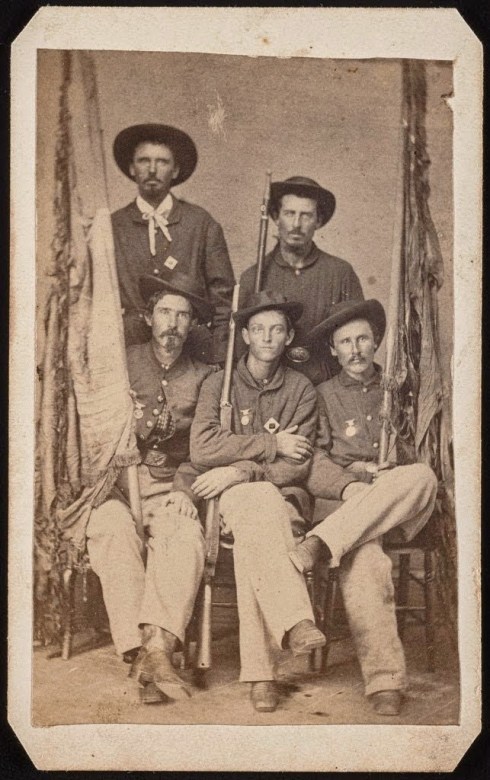
The Civil War began with the lowering of a tattered 33-star flag from Fort Sumter in 1861 after which tattered flags defined, symbolized and memorialized the bravery, sacrifices and experiences of its participants on both sides for at least a half century—and likely much longer. There is no more powerful symbol of both commitment and conflict, and no more inspirational object. After surrenduring the Fort on April 12, Major Robert Anderson brought the Sumter storm flag with him to New York City, where it became the focus of a patriotic rally just a week later and then was put on a tour of northern cities to raise funds and rally troops. Almost exactly four years later and after the Confederate surrender of the fort, then Brevet Major-General Anderson returned to Charleston to raise the flag in a momentous ceremony that was overshadowed unfortunately by the assassination of President Lincoln. And in the interim, many flags were reduced to tatters and fragments.

Flag fallout: Edwin Francis Church painted several different versions of Our Banner in the Sky (Fine Art Museums of San Franciso, above), inspired by the tattered flag of Ft. Sumter. Commercial adaptations were printed, along with other Remember Fort Sumter! ephemeral images. Library of Congress.

Ever since I first saw the striking photograph of Sgt. William Carney of the Massachusetts 54th bearing the standard he rescued from the bloody battle of Fort Wagner in 1863 in Luis Emilio’s Brave Black Regiment I have been struck by the visual poignancy of the tattered flag. He just wouldn’t let that flag go, and consequently he became the first African-American recipient of the Medal of Honor in 1900. Just a few years later, Sargeant Samuel Hendrickson Smith bore the colors of the storied 8th Massachusetts in a Salem parade: he suffered permanent damage to his sight, hearing, and speech during the War but lived until 1910.

Newspaper drawing of Sergeant Carney holding the American flag during the battle at Fort Wagner: from an article in the Boston Journal, “Hero of Fort Wagner: Tale of Color Bearer William H. Carney,” published on December 29, 1898; Sgt. Samuel Hendrickson Smith of Salem and the 8th and 19th Massachusetts Regiments, 1905.

It’s easy to grasp the symbolic importance of the tattered flag image, during the Civil War and all wars really, but I never realized it was a distinct photographic genre until fairly recently. The enormous popularity of the carte de visite, the new photographic technology of the mid 19th century, accounts for many images of flags and flag bearers. Louis-Désiré Blanquart-Evrard had invented albumen printing, in which a negative photograph was printed on paper coated with egg whites (albumen) and mounted on thick cardstock, in the 1850s, resulting in a new mass media with expanded access to  photographic images. The Fort Sumter flag tour could be expanded by degrees, and remembrance of individual, regimental, state and national service and sacrifice recorded for posterity. Tattered flags became “relics” of the war, both in the hands of their bearers and simply standing there in their distressed state. Here are a few of my favorite images among the collection of “Tattered Flag CDVs” (actually the their preferred term is “battle-torn”) at the Library of Congress:

19th Massachusetts; 7th Connecticut; 4th New Hampshire; 44th New York; 30th Ohio; 21st Mississippi, Library of Congress.

The images above were public: I’m wondering if war-torn flags confiscated during battles were also made so. The American Civil War Museum has a large collection of confederate flags captured by Union soldiers and the National Archives has an inventory entitled “Records of Rebel Flags Captured by Union Troops after April 19, 1861” (RG 94). Every state historical society or museum or state house has a collection of war-torn flags, “brought home” during or after (sometimes well after) the war. Sometimes there is just an assemblage of scraps and threads, or perhaps just a material outline of what is sometimes referred to as a “ghost” flag: and like any ghost, it is haunting.

Flag of an unidentified unit. Captured at the battle of the Wilderness, Virginia, May 12, 1864 by Lt. Benjamin Y. Draper, 1st Delaware Infantry and scraps of a confederate flag confiscated (and divided) during the occupation of Richmond by troops from Springfield, Massachuesetts, American Civil War Museum. Remnants of the 95th Pennsylvania and 1st Massachusetts flags, Cowan’s Auctions and Morphy Auctions.

Can’t We Copy Concord?

The Concord Museum has been one of my favorite local history museums for some time, but I haven’t been there since the completion of a major expansion and reinterpretation initiative during the Covid years. Late last week I found myself with some free time and so off to Concord I went. I was impressed with the update, but just like the last time I visited, I could only really see the Concord Museum through the prism of a missing Salem Museum: I walked through the exhibits, which manage to be both chronological and thematic, sweeping yet very focused, thinking: Concord had this, but Salem had more of this, and also that! Salem did that first! OMG I can imagine a perfect Salem exhibit just like this Concord one, just change the names. And ultimately: can’t Salem just copy Concord? Why can’t Salem have a Concord Museum?  This is really not fair to the Concord Museum, which should be viewed on its own merits rather than comparatively, but lately (well, not so lately) I’ve become obsessed with the idea of a comprehensive Salem Museum which lays out ALL of Salem’s history in a chronological yet thematic, sweeping yet focused way: from the seventeenth through the twenty-first century, first encounters to Covid. It should be accessible and inclusive in every way, downtown of course, and it must be a collaboration between the City and the Peabody Essex Museum, because the latter possesses the greater part of Salem’s history in textual and material form. Really lately, I’ve come to think of Salem as experiencing an invasion of the body snatchers scenario, in which all of its authentic history has been detached to another town, only to be replaced by stories that are not its own: real pirates from Cape Cod, vampires who could be from anywhere and everywhere. Can’t we tell the real story, and the whole story?

So, with apologies to the Concord Museum, I’m turning it into a sort of template while also (I hope!) presenting its exhibits in some interpretive and topical detail. The museum lays out an essentially chronological view of Concord’s history, while first identifying Concord’s most prominent historical role, as a center of the emerging American Revolution, and both acknowledging and examining its regional indigenous history. Then we stroll though Concord’s history, which is told through both texts and objects, and lots of visual clues asking us to look closely.

Indigenous regions & English plantations: the Concord Museum explores the land negotiations in detail.[Salem also posseses a 17th century land-transfer document, held at City Hall. The 1686 “Original Indian Deed” of Frank Cousin’s photograph below features many more signature marks of Native Americans, testifying to a more complicated negotiation? I don’t really know: it’s not part of Salem’s public history.]

“Original Indian Deed” at Salem City Hall, c. 1890, Frank Cousins Collection at the Phillips Library of the Peabody Essex Museum via Digital Commonwealth.

You walk through the Concord Museum viewing exhibits in chronological order, but there are necessary tangents, and the biggest stand-alone exhibit is devoted to the events of one day: April 19, 1775. This is a new permanent exhibit, and it utilizes all the latest technology of visual storytelling while at same time focusing on the personal experiences of those involved. The famous Doolittle images, rendered dynamic, rim the perimeter of the exhibition room and a large digital map illustrates the events of the day. There’s a lot of movement in this room! We also hear from some of the participants and see the texts and objects which highlight their experience. How does one get ready for a Revolution? How does war affect daily life?

[Obviously, in a Salem Museum, one permanent exhibit would have to be devoted to the Witch Trials: interpreted not only as a story but as a collective and contextual experience. Apart from 1692, Salem should be paying a lot more attention to its Revolutionary role(s): not just Leslie’s Retreat, but also its brief role as a provincial capital and those of all of its privateers! Real Salem privateers.]

There is a continuous emphasis on how individuals experienced and shaped their world in the Museum’s exhibits, encompassing both big events, pressing issues, and daily life. We learn about the African-American experience in Concord through both official documents and the lives of two black families in town: the Garrisons and the Dugans, whose members were acquainted with both enslavement and freedom. Thomas Dugan’s probate inventory is posted, alongside a display of the possessions listed thereon. Concord’s dynamic abolitionist movement is another window into the institution of slavery, but it is not the only one. As would certainly be the case with a Salem presentation, abolition provides an opportunity to showcase female agency, and the Museum’s exhibits do not disappoint. But again, all I could think of was: Salem’s Female Anti-Slavery Society predates Concord’s Ladies’ Anti-Slavery Society by several years, AND it was desegregated because it was an extension of the first female abolitionist society in Salem, which was founded by African-American women.

The Museum’s exhibits on slavery and abolition: Mary Merrick Brooks was a particularly active member of the Ladies’ Anti-Slavery Society, and because her husband did not support its efforts, she sold her own tea cakes; “potholder quilts” were made up of squares like this one, which were also sold at Ladies’ Anti-Slavery Fairs in Concord (as well as Salem).

[The Histories of Slavery and Abolition illustrate the Salem problem really well, as there has been lots of research into both over the past few years by several institutions, including the Salem Maritime National Historic Site, the Peabody Essex Museum, and Hamilton Hall. But their efforts are all SILOED, and this prevents the diffusion of a comprehensive history of both to residents and visitors alike. Salem Maritime has developed walking tours and a research guide into African-American history in Essex County, the PEM is currently exhibiting an examination of school desegregation in Salem, and Hamilton Hall has had lots of materials and texts pertaining to the Remond Family on its website for several years, but are all these resources really getting out there? A common space and place for historical collaboration and exhibition would amplify all of these efforts considerably. We have so much information, from Salem’s 1754 Slave Census entry (below), to the recently-rediscovered 1810 Census for Salem, to the digitized records of the Salem Female Anti-Slavery Society (credit to the PEM’s Phillips Library for getting both the Census and the SFASS records out there), to the abolition petitions digitized by Harvard: but it’s not being used to tell a cohesive and comprehensive story! The Concord Museum has an Uncle Tom statue which once belong to Henry David Thoreau, but the Salem Museum could display an Uncle Tom’s Cabin card game manufactured by the Ives Brothers in 1852.]

There were 83 enslaved persons in Salem in 1754 according to the Massachusetts Slave Census of that year.

Like Salem, Concord has many heritage sites, so I imagine the Concord Museum serves as an orientation center from which people can go on to visit the Alcott’s Orchard House, Minute Man National Historical Park, or Walden Pond (among other places!) The Museum has reproduced Ralph Waldo Emerson’s parlor—while the actual room is just across the way–and utilized digital technology to enhance its interpretation. There’s also a great exhibit on Henry David Thoreau, but Louisa May Alcott and Nathaniel Hawthorne seem a bit short-changed—maybe there’s an evolving emphasis? A Salem Museum would have a host of public intellectuals to juggle as well. Lots of material objects “made in Concord” or purchased in Concord and we also get to learn about the town’s conspicuous visitors—some of whom stayed at the famous Old Middlesex Hotel. [it would be so much fun to research an exhibition on who stayed at Salem’s equally famous Essex House.]

Details from the Concord Museum’s Emerson and Thoreau rooms—the star is one of several placed by Concord antiquarian Cummings E. Davis, whose collection is essentially the foundation of the Museum, along a trail in Walden Woods to lead people to Thoreau’s cabin. Loved this image of the Old Middlesex Hotel which seems to have played a hospitality role similar to that of the Essex House in Salem, below (an 1880 photograph).

I’m skipping over a lot, as there was a lot to see, so you’ll have to go to the Museum yourself, but I did want to mention its engagement with Concord’s storied history as well as the documented past. Concord is a famous place, just like Salem, and so there is an obligation not only to present the past but also to address how the past has been presented, to take on “Paul Revere’s Ride” as well as April 19th. I really liked how the Museum presented the process of commemorating the Battles of Lexington and Concord a hundred years later, chiefly through the commission of Daniel Chester French’s Minute Man statue. A photograph of a group of disenfranchised Concord women surrounding the statue at its unveiling on April 19, 1875 makes a big statement, especially as Louisa May Alcott, present on that day, later noted that women could not march in the grand parade unescorted or even sit in the stands to listen to speeches of the day (maybe this was a blessing).


In the Thick of It

This weekend is the annual commemoration/celebration of Leslie’s Retreat, a pre-Revolutionary event which could have marked the beginning of the American Revolution, if not for the patience, restraint, and diplomacy of participants on both sides, and one man in particular. On February 26, 1775, British Lieutenant Colonel Alexander Leslie and 240 soldiers of the 64th Regiment, acting upon the orders of General Thomas Gage, landed in Marblehead and began marching to Salem in pursuit of a rumored store of cannon. This was a Sunday, and thus “the Sabbath was disturbed” in both Marblehead and Salem, as patriots from the former town rode ahead and warned residents of the latter. When the British arrived, a stand-off ensued between the assembled crowd and the soldiers, during which the drawbridge across the North River was raised, enabling the not-so-secret cannon on the other side to be carried on field carriages out of town. A frustrated Colonel Leslie was allowed to march his troops across the bridge after the cannon had left the scene, therefore fulfilling his orders from General Gage. Then he and his troops retreated back to Marblehead and their ship, and sailed back to Boston. Things were a little hotter than I am depicting in this brief summary, but fortunately cooler heads prevailed, among them that of the Reverend Thomas Barnard Jr., the minister of Salem’s North Church, which was very much in the thick of things. I’m going to let Edwin Monroe Bacon, author of Historic Pilgrimages in New England (1898) set the scene.

A profile portrait of the Reverend Thomas Barnard Jr. (1748-1814) which looks quite similar to that of his father, the Reverend Thomas Barnard Sr. (1716-1776), above, Skinner Auctions.

I like this description because it conveys a sense of place. Just three years earlier, the North Church had separated from Salem’s First Church and constructed its first meeting house on the corner of Lynde and North Streets, not far from the river and the bridge (and the cannon). Reverend Barnard Jr., the peacemaker of “Leslie’s Retreat,” was actually the cause of the schism: his appointment following his father’s illness divided the congregation. As we can read above, the British soldiers marched past the “old First Church” in Town House Square towards the North Church, where a large crowd had assembled along with their young pastor, whose “counsel prevailed” that late afternoon. This North Church was ephemeral, only in service until 1835 when the congregation built a new and fashionable Gothic Revival meeting house on Essex Street, which became the present First Church after the schism was ended in 1923. The annual commemorations of Leslie’s Retreat take place in and around this church, with good reason, but I wish the old North Church was still standing: its clearly Colonial stature could lend some contemporary ambiance to the proceedings. But it is long gone, replaced first by a grand Victorian house, and then by the parking lot of the adjacent Methodist Church. But what happened to its clock?

“First Meeting House of North Church” by Thomas Davidson (not sure of source, likely the Phillips Library of the Peabody Essex Museum, but I found it in the November 23, 1942 issue of Life Magazine); George Francis Dow, Old Wood Engravings, Views and Buildings of Essex County (1908): with caption: “The North Meeting House, Salem, Built in 1772 at what is now the Corner of North and Lynde Streets, Abandoned for Religious Purposes in 1835 and taken down about 1860. Engraved in 1873 after a Drawing made by Dr. George A. Perkins.” Frank Cousins photograph of Lynde and North Streets, 1890s, Phillips Library, Peabody Essex Museum via Digital Commonwealth.

BELOW: Before Salem became Witch-central, Leslie’s Retreat was THE big historic story, especially for children, so there’s several YA books which feature it. I was trying to get that sense of place, running-through-the-snow-on-a- cold-winter-afternoon-through-close-Colonial-streets perspective in this post, and these illustrations by Lynn Ward from Jean Fritz’s Early Thunder (1967) come close. My favorite contemporary account of Leslie’s Retreat is actually from a boy, Samuel Gray, which is recounted in this post from J.L. Bell’s wonderful blog, Boston 1775. While you’re there, you should read all of Bell’s posts on Leslie’s Retreat as he is the absolute authority (and he doesn’t quite trust all of Gray’s details).

Illustrations by Lynn Ward from Jean Fritz’s Early Thunder (1967), set in Salem in 1774-1775.


What About Fort Pickering?

I love commemorations: I have posted about them often here, particularly at the beginning of a new year like 2020, during which the long-planned commemorations (of the achievement of women’s suffrage, the Mayflower voyage, and the bicentennial of the state of Maine) didn’t quite go off as planned, obviously. As I spend much of my time thinking about the past, I relish any moment in which a more collective present is so engaged. In four years’ time, Salem is going to be thrust into a big commemorative year, even bigger than 2020 and hopefully more celebratory and reflective: 2026 will mark the 250th Anniversary of the beginning of the American Revolution and the 400th anniversary of the first European settlement in Salem. Revolution 250 has been planning the regional observance of the Revolutionary anniversary for quite some time in a collaborative and dynamic manner, because “commemorations bring people together.” I think there is some Salem participation in this effort, but I’m really not sure. I’m even less sure about what is being planned for Salem’s 400th anniversary: when I look at the organizing that has been going on in two other cities facing big anniversaries, Portsmouth and Gloucester, I see much more organization than is in evidence here in Salem, but then again these cities’ 400th anniversaries are next year so they better have their acts together! Salem certainly has time, but from what foundation and inspiration will it proceed? Who is in charge and who is involved? What will “Salem 400” entail and hope to achieve? I google that term from time to time but all I get is this. Without a professional historical society or heritage commission to shepherd such an initiative, there is no doubt that the 400th anniversary of Salem’s founding will be a much more “top-down” initiative than that of its sister cities, or even its own Tercentenary, which inspired a multi-layered calendar of commemorative events and expressions, including a parade of 10,000 participants, pageants and performances, musters and medals, open houses, bonfires, and headlines in national newspapers.

Official Tercentenary Program, 1926: you can see some great photographs of the events here.

I can’t imagine 10,000 people turning out for a Quadricentennial parade in 2026! The past century has transformed history into a product in Salem, something to be exploited rather than contemplated or celebrated. A singular focus on 1692 seems to have deadened the city’s interest in nearly everything else, save for the occasional nod to the military or the marginalized. I’m not sure how anyone can engage in history in Salem, save for nostalgic facebook postings. The few references to plans and goals for 2026 seem to acknowledge this by emphasizing places over people, and the present over the past: foremost among them is Mayor Kimberley Driscoll’s “Signature Parks Initiative,” which is “focused on planning and carrying out improvements and preservation work in six of Salem’s busiest and most beloved public parks and open spaces, ensuring that they will remain available and enjoyable for future generations to come: Forest River Park, Palmer Cover Park, Pioneer Village, Salem Common, Salem Willows and Winter Island.” Certainly this initiative is welcome, and will be beneficial to Salem’s residents (as will more trees, also a part of “quadricentennial planning”) but is it commemorative? Is it engaging, inspiring, and challenging the public, as opposed to simply providing for them? Maybe it is for some, or even many, but not for me: I want more history—and more humanity—in my quadricentenary. Compare Mayor Driscoll’s Signature Parks Initiative with the centerpiece of the Gloucester 400 commemoration: the 400 Stories Project, “a citywide undertaking whose goal is to collect, preserve, and share 400 stories of Gloucester and its people” from 1623 until 2023. The Project’s administrators invite Gloucester residents to “help us make history” by sharing their stories. This is a pretty sharp commemorative contrast between these two old Essex County settlements.

“Our People, Our Stories”: I wonder what the tagline of Salem’s Quadricentenary will be?

So far the most conspicuous work of the Signature Park Initiative in Salem has been in evidence at Forest River Park in South Salem: one end of the park now features new public pools and trails along with an enlarged and renovated bathhouse while the other is slated for a dramatic alteration revolving around the exchange of the Colonial Revival reproduction “Pioneer Village” currently situated there with the YMCA camp formerly located at Camp Naumkeag in Salem Willows. The writing has been on the wall for Pioneer Village, built for the Massachusetts Tercentenary of 1630, for quite some time as the City has neglected its buildings and landscape for decades and expanded the adjacent baseball field more recently. However, the exchange plan has hit a snag recently, as the City had to apply for a waiver of its own demolition delay ordinance before its own Historical Commission in order to remove the buildings at Camp Naumkeag, which was first established as a tuberculosis camp over a century ago. So far this waiver has not been granted, and a notable resistance to both the destruction of Camp Naumkeag and the relocation of Pioneer Village has emerged. I wrote about Pioneer Village at length last summer, and I have been rather ambivalent up until last month, when several admissions shifted me into the wary and possibly-even-opposed zone: I’m still thinking about it as I find it a particularly vexing public history problem! This is an ambitious plan: Pioneer Village is not simply going to be relocated but rebuilt and re-interpreted with the addition of a visitors’ center and a new focus on the relationship between the European settlers and the indigenous population of pre-Salem Naumkeag. This is an admirable goal for sure, but to my ears, the new interpretive plans sound vague, simplistic and ever-shifting, and above all, lacking in context. They are supposedly the work of the numerous consultants who have worked on the project, paid and unpaid and including several people whom I admire, so it might just be a matter of presentation, but there are several statements that I find concerning. In the first Historical Commission hearing, one consultant responded to the argument that Camp Naumkeag was itself an important historical site because of its role in public health history with an assertion that that role would enhance the new Pioneer Village’s focus on the virgin soil epidemic which devastated the indigenous population even before settlement, as if infectious diseases were interchangeable and detached from time and place! [“Pioneer Village Complicated by History,” Salem News, September 16, 2021] Several months later, the City posted its plans on its website, with this all-encompassing but yet incomprehensible statement of goals: increased access and visibility to the breadth of Salem’s history as represented by the breadth of the site’s history, including Salem Sound’s natural history, the original inhabitants, Fort Lee and the Revolutionary War, the Willows, Camp Naumkeag, and the Pioneer Village. So now it seems as if the newly-situated Pioneer Village will be utilized to interpret almost the entirety, or breadth, of Salem’s history, and in a space which the accompanying plan revealed will have parking for only ten cars. In terms of both interpretation and logistics, this is a flawed plan as presented: its reliance on the seasonal trolley for access is confirmation of its orientation to tourists over residents as well as its seasonal status, in contradiction to the breadth of its stated goals and costs.

The current Plan for the new Pioneer Village on Fort Avenue, on the site of the present-day Camp Naumkeag.

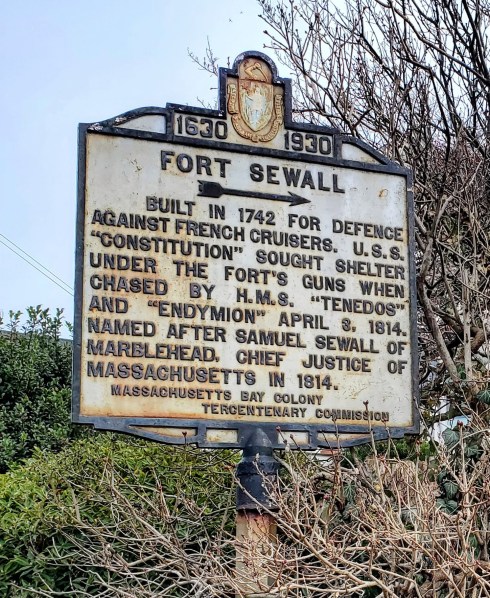
While at face value the inclusion of yet another long-neglected Salem historical resource, Fort Lee, looks like a good thing, I find it concerning. Why should Fort Lee be included in the interpretation of the faux Pioneer Village and not its very authentic (and far more important) neighboring fort on Winter Island, Fort Pickering? This is the guiding principle of the the 2003 study commissioned by the City and the Massachusetts Historic Commission, the Fort Lee and Fort Pickering Conditions Assessment, Cultural Resources Survey, and Maintenance and Restoration Plan: that the forts should be “restored, maintained and interpreted together [emphasis mine] as part of the Salem Neck and Winter Island landscape for enhanced public access.” To its credit, the City has begun a phased rehabilitation of Fort Pickering, but I see much less energy and far fewer resources committed to it than to the Pioneer Village project, which is perplexing given its authenticity and historical importance. Winter Island has served successively as a fishing village, a shipbuilding site, and in continuous military capacities from the very beginning of Salem’s settlement by Europeans to the mid-twentieth century.  The storied fortification which became known as Fort Pickering in 1799 was built on the foundation of the British Fort William, part of a massive effort by the new American government to fortify its eastern coastline beginning in 1794 under the direction of French emigré engineer Stephen Rochefontaine. Fort Pickering was manned, and rebuilt, on the occasions of every nineteenth-century conflict, and was especially busy during the Civil War. Another regional Rochefontaine fort, Fort Sewall in Marblehead, shines under the respectful stewardship of that town. Salem is so fortunate to have so much built history:  why can’t we focus our energies and resources on preserving and re-engaging with authentic sites, rather than creating new ones? (And could someone please find our SIX Massachusetts Tercentenary markers? Every other town in Massachusetts seems to have held on to theirs).

Talk about a site that can illustrate the BREADTH of Salem history: Winter Island was an early site for fishing and fish flakes (and even more substantial “warehouse” structures) as well as the location of Salem’s first fort William/Pickering. The Salem Frigate Essex (depicted by Joseph Howard) was built adjacent to the Fort in 1799, and Winter Island also served as the site of Salem’s “Execution Hill” in the later eighteenth and nineteenth century and of a Coast Guard air station from 1935-70. Members of the US Coast Guard Women’s Reserve, or SPARS, were stationed on the island during World War II. Rochefontaine’s 1794 plan and block house sketches and Frank Cousins’ photographs of the island and fort in the 1890s, Phillips Library of the Peabody Essex Museum. Marblehead’s Fort Sewall on the last day of December, 2021.


Salem Sustainability; or the Most Charming Memoir Ever

I came across a delightful short memoir quite by accident yesterday; it was so well-written and charming that I couldn’t stop thinking about it so I decided to write about it today to get it out of my head! It’s not about any BIG thing or event; in fact, it’s about a very little thing, what we might call an accessory today, and something we might not have thought much about at all before the pandemic: handkerchiefs in general, and “bundle handkerchiefs” in particular. “The Bundle Handkerchief ” was published in The New England Magazine in 1896 by Elisabeth Merritt Gosse, a Salem native and emerging newspaperwoman, who would go on to have a very successful career writing principally for the Boston Herald. It must have proved popular as it was issued as an illustrated pamphlet a few years later: I would love to get my hands on this! It’s such a simple story of how people wrapped up their purchases or possessions in the nineteenth-century, in handkerchief bundles of all cloths: gingham and calico sold at Mrs. Batchelder’s or Miss Ann Bray’s shops, the ‘finest white India silk” for ladies’ hats, lawn, linen or muslin for more intimate garments, Madras for new gowns as they made their way home from the dressmakers’, and “pale pink and blue gingham plaids” for shirts and spencers. Yet it is also revealing: of what people are doing and buying and wearing in very specific detail. l learned about all sorts of shops and customs of which I was previously completely unaware in its jam-packed three pages.

The bundle handkerchief as art: Alfred Denghausen, 1936, National Gallery of Art.

Apparently one could not even enter this world properly (or be introduced to it) without a bundle handkerchief! Is this where the stork with the bundled baby comes from? According to Elisabeth, No Salem infant, even without the requisite number of great-grandfathers and grandmothers, could be considered to have been properly introduced to society until it had dangled in a bundle handkerchief from a pair of steelyards, while its weight was recorded in the family Bible at the end of the family pedigree. She also included her own childhood memory of accompanying the family servants, armed with “two great bundle handkerchiefs of coarse blue and white checked gingham” to Mr. Hathaway’s bakery on Sunday mornings after church to retrieve the baked beans and brown bread which had been placed in his cavernous oven the day before. Salem women packed their soldiers’ trunks with prayer books from Mr. Wilde and medicine chests from Mr. (not Mrs.?) Pinkham, as well a selection of fine new bundle handkerchiefs, and three of these, of dark red silk, with the name embroidered in one corner, came home in one soldier’s trunk, brought by a guard of honor; for Salem gave the first of the Essex County heroes who laid down their lives for their country in the war of the Rebellion, as she did in the war of the Revolution. I wonder if she is referring to her own father here, Lt. Colonel Henry Merritt, who was killed at the Battle of New Bern in March of 1862.

Not blue and white, but the best I could do: a recipe card from the 1950s; Mr. Hathaway’s Bakery or the “Old Bakery” (now the Hooper Hathaway House on the campus of the House of the Seven Gables) in its original location at 21 Washington Street, Historic New England; Elisabeth Merritt Gosse in 1905, upon the occasion of the dedication of a boulder commemorating her father’s regiment near Salem Common.

Elisabeth Merritt Gosse recounts her last memory of a bundle handkerchief on the streets of Salem, wrapped around a book and carried by Mr. John Andrews in and out of the Salem Athenaeum, and observes that her title topic is as vivid a bit of color in Salem’s history as is Alice Flint’s silk hood, the frigate Essex, the North Bridge or even the House of the Seven Gables; and to speak of it calls up a long line of Salem’s sires and dames who took pride and pleasure and comfort in its use. [Another Salem memoirist, Harriet Bates or “Eleanor Putnam,” went even further: “The bundle handkerchief is as essential a figure in Salem history as the witches themselves.”] The bundle handkerchief’s time had passed in 1896, however, replaced by paper and string, prosaic, rustling, tearable, and to be quickly thrown aside and thrown away. This is not a good development in Elisabeth Merritt Gosse’s estimation, but as she died at the venerable age of 86 in 1936, we can at least be glad that she didn’t live long enough to see plastic.

Elisabeth Merritt Gosse was referencing the OLD Salem Athenaeum, now one of the Peabody Essex Museum’s empty buildings further up on Essex Street, but as I happened to be walking by the present one today, I snapped this photograph.


Venus Rising

As we enter/endure that season where hordes of tourists come to the Witch City for ghost tours, I’d like to celebrate some dynamic local history initiatives: over the past five years or so, there’s been a virtual Renaissance of African-American history, and consequently we know much more about how some REAL people lived and worked in Salem. Charlotte Forten, our city’s first African-American public school teacher, remains the focus of continuing commemoration at her alma mater, Salem State University, and is now the namesake of a relatively new city park. Her hosts in Salem, the Remond Family of Hamilton Hall, also have a park named after them, and a variety of real and digital resources documenting their entrepreneurial and advocacy activities is available at both the Hall and its website. Hamilton Hall was also the site of an exhibition on African-American enfranchisement by Salem United, Inc. this summer (soon to be on view at the Lynn Museum). The Salem Maritime National Historic Site has made a substantive commitment to regional African-American history in its recent interpretive initiatives, which include a general “History of Slavery in Salem” walking tour as well as more focused “Pathways in Freedom” and “Business of Slavery” digital tours.

The West India Goods Store, one of the “stops” on the “Business of Slavery” tour of the Salem Maritime National Historic Site.

This is all very exciting; such cross-institutional initiatives almost compensate for Salem’s lack of a historical museum, at least in reference to this one aspect of the city’s history. With so much focus on African-History in general, and in the immediate pre- and post-emancipation periods in particular, discoveries will doubtless be forthcoming. Another initiative is both a literal and metaphorical expression of this rising interest in African-American history: the restoration of several graves long neglected in the Howard Street Cemetery. The graves of Prince Farmer and his wife Mary, Samuel Payne, and Venus Chew have been lifted up and repaired, so that the lives of these three distinguished Salem African-American residents are once again marked. This important work was a pro bono, close-to-the-heart project of the two gravestone conservators who make up Epoch Preservation, Rachel Meyer and Joshua Gerloff. As far as I know, the only thing that the Farmers, Mr. Payne, and Mrs. Chew have in common besides their final (segregated) resting place is the fact that they all died in the 1850s. Farmer and Payne were both respected businessmen and by all accounts quite wealthy; Chew died in the Salem Almshouse at the very end of 1852, despite a life of hard work. She was the victim of marital misfortune, despite her very public attempts to defend herself and her property. Venus Thomas Chew was born in nearby Lynn to Peter Thomas, “a free Negro man” and Lavinia/Lucretia Trevet, “a mulatto girl,” in 1779 (The Marblehead Museum has a wonderful history of her famous tavern-keeping sister and brother-in-law here). She married Henry Chew, a mariner, in 1801 and they had at least three children before they separated, by her account, in 1819. They never lived together again, but remained married and thus entangled: this was problematic for Venus as she was clearly the most consistent wage earner. She “declared her independence” in September of 1841 but lost a legal case brought on my her husband’s creditors’ attempts to empty her bank account a year later. She wouldn’t be free of Henry until his death in 1848, and over the next few years her moves from Lemon to Dearborn Street and finally to the Salem Almshouse indicate that she was never completely free.

Notices in the Salem Gazette, 28 September 1841; the segregated listing in the Salem Directory, 1842; “Caleb M. Ames vs. Henry Chew & Trustee, November 1842, in Reports of Cases Argued and Determined by the Supreme Judicial Court in Massachusetts, ed. Theron Metcalf, Volume V (1858); Salem houses associated with Venus: 198 North Street, built for Henry Chew and apparently financed by Venus, 15 Dearborn St. and 18 Lemon Street; Massachusetts Report of the Commissioners of Alien Passengers and Foreign Paupers (1852; I have no idea why Venus was considered “Alien” or “Foreign”).

I went over to see Rachel and Josh of Epoch Preservation and a few other history-minded people on this rainy afternoon for a toast to Venus, and the Farmers, and Samuel Payne (“once a slave, but the last 17 years a resident of Salem. He was an industrious, honest man, and by strict attention to business had acquired a good estate, and a full share of the confidence of the citizens of Salem” in the words of his touching obituary) upon the completion of the restoration of their graves. We toasted with Joe Froggers, the famous molasses, rum and seawater cookie invented by Venus’s sister Lucretia for visitors to the Marblehead tavern which she and her husband Joseph Brown operated for many years. Cheers to these hardworking people that came before us, as well as to the historians, educators, preservationists and restorers whose hard work sustains their memory and memorials.

Venus T. Chew, Died December 31, 1852, Aged 73. Josh Gerloff and Rachel Meyer stand behind their work. Joe Froggers (made by Josh!)


Hudson River Valley Highlights

I’m just back from almost two weeks staying at my brother’s house in Rhinebeck, New York, right in the middle of the Hudson River Valley. I’ve seen a lot, and have many beautiful photographs to upload here, but I’m not quite sure how to curate them: no theme is emerging other than wow, there’s so much here. I’ve been to this region quite a bit over the past few decades, and I thought I knew it, but this longer stay has convinced me that I do not, really. You know I’m not really interested in nature (apart from its harnessing) so it’s not about the River for me, it’s about the houses and the towns, the built environment. Do I organize my hundreds of photos of structures and streetscapes by family (the Livingstons are everywhere), by chronology, by origin (Dutch vs. English), by size (the two cities of Kingston and Hudson on the west and eastern sides, surrounded by smaller towns and “hamlets” and the larger cities of Poughkeepsie and Tarrytown to the south), or by style? Mansions or private residences? Shops, or more particularly, shop windows (which seem to be curated here to a level we haven’t seen in Salem since the 1950s)? One theme which might work is that of stewardship, which I always think about when I’m in the midst of a region as architecturally and institutionally rich as this valley, but that will take some work and as I have officially entered the last week before classes that means I have SYLLABI looming: better stick to highlights!

Mansions and Cottages:

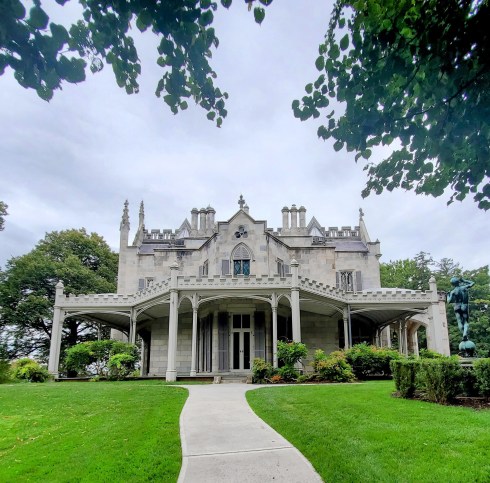
The stunning Lyndhurst Mansion in Tarrytown, designed by Alexander Jackson Davis for the Paulding and Merritt families over several decades beginning in 1838 and later acquired by Jay Gould, whose daughter left it to the National Trust for Historic Preservation; neighboring Sunnyside, the home of Washington Irving; Wilderstein in Rhinebeck and a detail from its stables; Montgomery Place and its stables, now the property of Bard College.


A Decayed Mansion with much potential: The Point, or Hoyt House, at the Mills Mansion/Staatsburg State Historic Site, Hyde Park.

There are several impressive structures on the vast riverfront acreage of the Staatsburg State Historic Site, including the Classically columned Mills Mansion, but I only had eyes for the Hoyt House on my hike. Designed by Calvert Vaux before his Central Park partnership with Olmsted, it just looks perfect, despite its decay (or maybe because of it?) The Calvert Vaux Preservation Alliance, of which my brother-in-law Brian is a director, is raising funds for the Hoyt House’s restoration and potential repurposing as a center of traditional craftsmanship training—talk about stewardship! I’m wondering if this cottage on the main road outside of the park is tied to the estate, as well as this adjacent entrance?


Alexander Jackson Davis’s furniture: almost everything is arched.

Chairs, beds, mirrors, even tables, so there is no “head” of the table: all at Lyndhurst.


Private residences: both vernacular and very high style—-all sorts of styles.

A Foxhollow Farm cottage, more contemporary board and batten, and two houses in Claverack to the north (I spent a lovely hour or so inside the white brick Hillstead, at the gracious invitation of Bruch Shostok and Craig Fitt); all sorts of restorations going on in Hudson; the lighthouse at the entrance to Kingston’s harbor.


And shopping! Mostly at Hudson, a bit at Kingston (Grounded) lured in by creative shop windows (which we need more of in Salem). History was in the windows too.