Category Archives: History

Face-based History

I am a longtime admirer of Simon Schama, as both historian and art historian, presenter and public intellectual. For me, his study of the Dutch Golden Age, The Embarrassment of Riches: An interpretation of Dutch culture in the Golden Age (1987) is a classic of cultural history, illustrating a masterful engagement of textual and material sources, almost Burckhardtian in its scope. I always have it close at hand. Even though Schama is not principally an English historian, I show bits and pieces of his History of Britain series in class, just because he is such a good communicator–and teacher. As any reader of this blog (or former student) knows, I’m always utilizing (I think of it as playing with, actually, as I am not trained) art in class, in large part due to Schama, even though I am far less knowledgeable and adept than he. Schama’s latest project focuses on British portraits in the National Portrait Gallery, probably my very favorite museum in the world: The Face of Britain is a multi-media history of Britain through its portraits, rather than a history of British portraits. Through an exhibition last year at the NPG, and an accompanying book and television series, Schama examines Britain’s relatively modern history (after all, the portrait is a Renaissance creation) through portraits of individuals which represent both precise historical moments and dynamic trends. A very representative, and compelling, vignette relates the creation of a famous (or infamous) portrait of Winston Churchill, commissioned for the Prime Minister’s 80th birthday by Parliament. There was quite a bit of push-and-pull between Churchill and the commissioned artist, Graham Sunderland, resulting in a portrait that is described by Schama as a “beautiful ruin” detested by the subject, the humiliation of the artist at its public unveiling in 1954, and its eventual  destruction by Lady Churchill or one of her delegates. All we have are studies and photographs of the painting that captured this particular historical moment.

NPG 5332; Winston Churchill by Graham Vivian Sutherland

Preparatory Study for Winston Churchill’s 1954 portrait by Graham Vivian Sunderland, National Portrait Gallery.

The making of Churchill’s portrait is a study in power dynamics, and Schama explores other kinds of relationships in his exhibition/presentation/narrative: “The Face of Power” is accompanied by “Faces of the People”, “The Face of Fame”, “The Look of Love”, and “The Face of the Mirror”. The essential relationship in all of these categories, however, is between the artist and the subject, and consequently it is a bit difficult to string along an entire collective history. I didn’t see the exhibition, but I heard from friends that it was confusing because of its conceptual-rather-than-chronological structure. I do have the book and I’ve seen several episodes of the series, and (once again) Schama’s superior communication skills do seem to carry us along, especially as we move among variant genres: “portable portraits”, miniatures, statues, engravings, photographs. I didn’t learn too much from his analysis of the Tudor and Stuart portraits–I’ve heard all that virgin and martyr stuff before–though I do appreciate the inclusion of Oliver Cromwell’s “warts and all” portrait and the “mourning portraits” Kenelm Digby commissioned of his beloved Venetia. I got a little lost in the later seventeenth century, but thought he made effective arguments for the representational value of portraits from the eighteenth century up through much of the twentieth, and I LOVED his “faces of the mirror”: I always though of self-portraits as being exclusively individualistic and not particularly dependent on context, but no longer! As is often the case with Schama, his transitions were subtle and his connections convincing, so in the end I found myself agreeing with his assertion that”portraits bring you into their company”.

Historical faces from Schama’s Face of Britain: Sir Francis Drake, whom Schama calls “the first genuine heroic famous Englishman”, principally because he is a “man of action”; Two very different portraits by William Hogarth: David Garrick as Richard III and the convicted murderess Sarah Malcolm in prison; Two earnest expressions of love by Thomas Gainsborough (for his daughters) and Dante Gabriel Rossetti (for Jane Morris, the wife of his William), and some amazing artists’ self-portraits, for which Schama provides plenty of context: Gerlach Flicke (cropped), an imprisoned sixteenth-century artist who painted the first English self-portrait so that his “dear friends….might have something by which to remember him after his death.”, Sir Joshua Reynolds, and William Orpen, “Ready to Start” fighing (?) in the Great War. Apparently Orpen later regretted his trivializing accouterments.

NPG 4032; Sir Francis Drake by Unknown artistSir Francis Drake by an unknown artist, c. 1580, ©National Portrait Gallery

british-faces-800_hogarth_davidgarrick_as_richardiii David Garrick as Richard III, William Hogarth, © Walker Art Gallery

british-faces-hogarth-sarah-malcolm-in-prison Sarah Malcolm by William Hogarth, Sarah Malcolm © Scottish National Gallery

british-faces-gainsborough-daughters-npgThe Painter’s Daughters chasing a Butterfly, Thomas Gainsborough ©National Gallery

Rossetti, Dante Gabriel, 1828-1882; Blue Silk Dress (Jane Morris)Blue Silk Dress (Jane Morris) by Dante Gabriel Rossetti, ©Society of Antiquaries of London

british-faces-gerlach_flicke_by_gerlach_flicke_crop Gerlach Flicke, ©National Portrait Gallery

British Faces Self-portrait_c.1747-9_by_Joshua_Reynolds_(2).jpgSir Joshua Reynolds, ©National Portrait Gallery

british-faces-498px-william_orpen-ready_to_start-1917 William Orpen, Ready to Start, ©Imperial War Museum


A Weekend Photographer

I discovered a digitized collection of over 2,000 photographic negatives by amateur photographer Robert L. Bracklow (1849-1919) at the New York Historical Society this past weekend and became lost in another world for several hours–hours which I probably could have used more productively, but I do not regret their “loss”. Bracklow’s photographs are primarily, though not entirely, of New York City and its vicinity in the 1890s and early twentieth century, and show a city in transition in which multi-story buildings were going up alongside wooden “garrets” and cows are still grazing by the side of the road. He captured all the monuments, and people visiting them on the weekends, like himself: his primary occupation was that of a stationer, and he went roving about on the weekends after he had closed his shop doors. Besides monuments, he loved churches, milestones, bridges, and people:  though Bracklow is often compared to Alfred Stieglitz, my own (parochial)  frame of reference is of course Salem’s Frank Cousins, who was clearly more transfixed by architecture than society. Not so Bracklow, who seems quite as determined to show the mix of people as of buildings in his time. Though Bracklow lived and shot primarily in New York, I found quite a few Massachusetts photographs in this digitized collection: lots of Great Barrington and Marblehead, several of Nantucket, Medford, and Salem. The New York Historical Society digital achive of his photographs is absolutely wonderful because you can zoom and see: a lone lady bicyclist pedaling over the Parker River Bridge in Newbury, Massachusetts, the parcels of a Marblehead housewife walking home from her shopping, crumbs on the shirt of a child at a tea party in Bensonhurst in 1898.

bracklow-balloon-harlem-river-boat-races-1900

bracklow-brunos-garrett

bracklow-greenwood-cemetery-brooklyn

bracklow-kaisers-ship-1902

bracklow-bensonhurst-1898

bracklow-nyhs

H:5 in. W:7 in.; Glass negatives; Negatives (photographic)

bracklow-door

bracklow-salem-monumentbracklow-bershires

bricklow-bridge-of-parker-river

bracklow-gregory-street-marblehead

bracklow-darling-street-marblehead

Photographs by Robert L. Bracklow from the collection of the New York Historical Society:  blowing up a balloon for the Harlem River boat race, 1900; Bruno’s Garret in Greenwich Village, entrance to Green-wood Cemetery in Brooklyn; a crowd greeting Kaiser Wilhelm’s yacht in New York, 1902; an afternoon tea party in Bensonhurst; milestones to New York and Boston; North Shore Massachusetts door; Leslie’s Retreat Monument in its original location on North Street in Salem, the Red Lion Inn (?), Stockbridge, Parker River Bridge, Newbury, Gregory and Darling Streets, Marblehead. All from the Robert L. Bracklow Collection at the New York Historical Society.


Time Wears Some Down

I tend to spend much of September in Salem’s cemeteries, running around the perimeters of Harmony Grove and Greenlawn in North Salem and walking slowly through the older cemeteries downtown reading the gravestones. The former will retain much of their serenity in October while the latter will be transformed into circuses, clogged with tourists and walking tours and trash. Salem’s oldest cemetery, the Old Burying Point on Charter Street, is particularly vulnerable given its age and proximity to the Janus-faced nexus of Salem Halloween tourism, the Witch Trials Memorial and the Salem Witch Village (or neighborhood or world or whatever it is called–a conglomeration of horrors) on Liberty Street. The city has contracted with a landscape designer who specializes in historic cemeteries to improve security, perimeter fencing, entrance accessibility, and circulation, and while I welcome these improvements, I doubt that they will address what I see as the central problem facing this sacred space: the lack of respect shown by too many of its visitors. Even on the relatively calm mid-week September day on which I took these pictures, I saw a group of people sitting on a cenotaph merrily eating, drinking, texting and smoking, and such scenarios will be the norm a month from now.

past-sign

Yet even if we closed the gates of the Old Burying Point to all but the descendants of those within (which would be my preference: I will stay out too!) time would still takes its toll. This point was really driven home for me when I compared the pictures that I took the other day to an assortment taken by photographer/author/preservationist/entrepreneur Frank Cousins between 1890 and 1910, preserved in a sample book for his art company in the collection of Historic New England. I can’t do a precise “past and present” comparison for every marker as I was pressed for time and couldn’t find several of the gravestones that Cousins captured (they might be there, but they’ve lost their inscription) and variant stones seemed to have captured his interest and mine. Yet it is readily apparent that even those gravestones that have stood the test of time are now surrounded by a very different world than the Salem of a century ago.

past-lindalls-2016

past-lindalls-cousins-hne

past-timothy-lindall

past-timothy-lindall-cousins-hne

past-lindall-children-2016-charter-street

The various graves of the Lindall family look pretty good in 2016 (on top, in color–such as it is) compared to Cousins’ photographs from c. 1900; I don’t think we can get wooden buildings back, but I far prefer the wooden fence to the present chain link one.

past-jm-crowninshield-2016

past-jmcrowninshield-cousins-hne

John and Mary Crowninshield’s gravestones do look a little worse for wear in 2016 but are still standing. I could not find all of the Crowninshield graves captured by Cousins, but below are those of Captains John and Clifford Crowninshield today and a century or so ago. All of the Crowninshields lie in the shadow of the Witch Village or whatever it is called.

crowninshield-collage

clifford-crowninshield-collage

Besides those of the Lindalls and the Crowninshields, Cousins captured the gravestones of the famous (Samuel McIntire, Nathanael Mather, Mary Corey) and the not-so-famous Shattucks, Marstons, Cromwells, and Hollingsworths. He was clearly drawn to the graves of the very young and the very old, as we all are, and those stones which were the better for wear and still bore detailed artistic flourishes. I was after much of the same, but somehow we only “shared” the Lindalls and the Crowninshields; I think I’ll go back and uncover some more comparisons when I have a bit more time.

charter-street-cousins-gathman-hne

charter-street-mansfield-cousins-hne

charter-street-shattock-cousins-hne

past-cousins-higgonson-hne

Some of my favorite of Cousins Charter Street photographs: the sad triple grave of the Gat(h)man children and the elusive one of Retire Shattuck–I easily found Mary Higginson but missed John. The rehabilitated gravestone of Elizabeth Millett illustrates the work that is yet to be done on many stones in the Old Burying Point, while Elizabeth Wellcome’s slightly-chipped and -leaning one has always been a particular favorite of mine for some reason.

charter-street-higginson-2016

charter-street-elizabeth-millett-gravestone

charter-street-wellcome


The Shots heard round the World

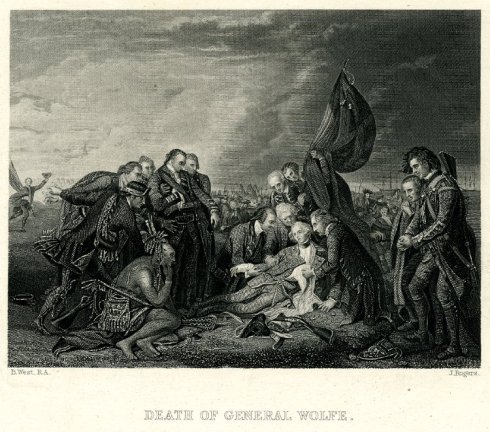
No, not that one, the (three) ones that came years before, which killed Major-General James Wolfe on this day at the decisive Seven Years’ War Battle of Quebec in 1759, a death that was disseminated around the world through the iconic 1770 painting by Benjamin West. The painting and its reproductions, in oil, print, tole, pottery and caricature, became a powerful symbol of the emerging British Empire, even though it was rather ironically the creation of an American-born artist. West broke with tradition by depicting the fallen hero in contemporary uniform rather than classical dress, thus intensifying the identification of his contemporaries, yet still portrayed an eternal, Christ-like figure. The painting was a sensation when it was first exhibited, and for quite a few years thereafter.

west-death-of-general-wolfe-1770

Benjamin West, Death of General West, 1770National Gallery of Canada.

I’m hardly the first historian to pontificate on the importance of this painting: I’m leaning pretty heavily on the analysis of Simon Schama (albeit in “historical novella” form in Dead Certainties:  Unwarranted Speculations, 1991) and Linda Colley, more straightforwardly in her magisterial Britons. Forging the Nation, 1707-1837 (1992). Colley calls the painting a “splendid fraud” in that none of the onlookers were even there, most particularly the pensive Native American, who was of course fighting on the other side in what is referred to as the “French and Indian War” over here. Still, Colley observes that “The Death of Wolfe started a vogue for paintings of members of the British officer class defying the world, or directing it, or dying in battle at the moment of victory.”  I think this “vogue” was probably due as much to the prints of the painting as the painting itself (most after William Woollett’s engraving), because they were everywhere, in constant circulation  up until at least 1820 as far as I can tell: through the American and Napoleonic wars, when Britain needed its heroes. I suppose it was only the cult of Nelson that diminished that of Wolfe, somewhat.

death-of-general-wolfe-1776

death-of-general-wolfe-1820

death-of-general-wolfe-john-rogers-1830

west-tray-northeast-auctions

west-pitchers-christies

wolfe-gillray

Print made by William Woollett, 1776; Etching for John Young’s  ‘A Catalogue of Pictures at Grosvenor House’, 1820; Print by John Rogers , 1830, all Collection of the British Museum; Tole Tray, Northeast Auctions; Creamware Jugs, Christies Auctions; and The Death of the Great Wolf, a satire on the passing of the Treason and Sedition Bills, in 1795, James Gillray, British Museum.


Hildegarde Hawthorne Hits Salem

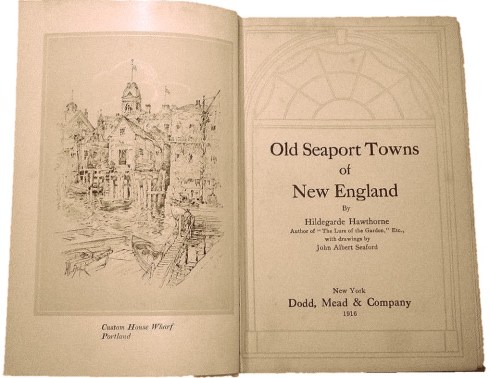
Nathaniel Hawthorne’s granddaughter Hildegarde (1871-1952), a prolific author of ghost stories, garden books, biographies and travel narratives as well as an ardent feminist and suffragist, returned to her ancestral city the year after its great fire (which she mistakenly dates to 1913 rather than 1914) so that she might gather material for her forthcoming book, Old Seaport Towns of New England. With “Sister” in tow, she disembarks into a bustling city which she clearly does not find as charming as Newburyport to the north or Newport to the south. The “insistent present” is bothersome in Salem, and she feels much closer to the spirit of her illustrious grandfather when she looks at the “tenements” of Union Street than the new House of the Seven Gables, “which used to belong to some relatives of ours”. She does, of course, love Chestnut Street.

hh-old-seaport-towns-of-ne

hh-chestnut-street

hh-old-seaport-towns-beverly-bridge-salem-side

Chestnut Street and the Beverly Bridge, Salem Side, by John Albert Seaford, from Old Seaport Towns of New England (1916)

And there’s lots more to see obviously, BUT (it seems like there is a but hanging over every sentence) new Salem or invented Salem seems to be intruding on old Salem too much:  You can easily spend a couple of days looking up the houses where famous men were born in this solid old city (for a feminist, she doesn’t seem to care about the house of famous Salem women). They seem to have had had an extraordinary hankering for the place. Not but what Salem must have been a particularly beautiful place in the days when these notable births were most common. It is now, in many spots, though it has lost much of its looks with advancing age.  For, oddly enough,as it becomes older it becomes younger, and the youth is not an improvement. After two days in town, Hildegarde left Salem at sunset, over the Beverly Bridge, vaguely disturbed by the conflicting impressions of her noisy, commercial present, that will not let you be, and the obstinate power of her past, equally insistent. It seems to me as if these last lines could have been written in 2016 as easily as 1916.

hh-collage

hh-1916

Two of Hildegarde’s other titles; Hildegarde, second from left, at the New York Womens’ Suffrage Parade, 1913, ©Paul Thompson, Getty Images.


Craftsman Confidence

As part of my recent immersion in early nineteenth-century design trends, I browsed through digital volumes of The Craftsman over its 1901-1916 run, every issue readily accessible at the University of Wisconsin’s wonderful Digital Library of the Decorative Arts and Material Culture. This was not a difficult task, as Stickley’s magazine is so interesting: such a heady mix of practicality, philosophy, and politics! How can you not enjoy a magazine with article titles like “Was Jesus a Carpenter?”, “The Century of Ugliness” (which was of course the 19th century from their point of view–when craftsmanship was compromised by industrialization), and “A Plea for True Democracy in the Domestic Architecture of America”?  In the end though, I came away feeling sad, as the editors and authors were so very hopeful for their new century, and their hopes were not fulfilled–the most anachronistic aspect of the magazine is its strident optimism. Everything can be reformed and everything is “civic”: not just education and urban planning, but also architecture and horticulture, even clothing. Birds are just as essential as bookcases, as the magazine espouses an integrated doctrine of conservation, craftsmanship, and community. The persistent quest for everything that is simple and “true” does get a bit pedantic as time goes on, even though I would like to live in their well-crafted and orderly world much more than in our disposable and disorderly one! But as soon as I saw Kaiser Wilhelm II depicted in a rather romantic fashion by the “new” German artist Arthur Kampf my browsing grew increasingly melancholy: I knew that the twentieth century would obliterate all opportunities for “Craftsman World”, and transform all those hand-crafted bungalows into cookie-cutter ranches.

crafstman1

craftsman-mark

craftsman06newyuoft_0530-entrance

stickley-house-1908

craftsman-living-room-c1901

craftsman11newyuoft_0302-dresses

craftsman-city-planning-1904

craftsman-collage

craftsman-roland-park-c1903

craftsman-cover-1914

craftsman-portrait-of-kaiser-arthur-kampf

Images from The Craftsman, 1901-1916, including the first cover and Stickley’s device, “Als Ik Kan” underneath a joiner’s compass, borrowed from Jan Van Eyck (Flemish for “All that I can do”), a Craftsman door and two-family house, “affording an opportunity for economy of construction without loss of architectural beauty”, living room, dresses “designed for comfort with a purpose in their ornamentation”, hexagonal urban planning, bookcases, urban villages, 1914 cover, and the foreboding Kaiser.


An Urban Village in Salem

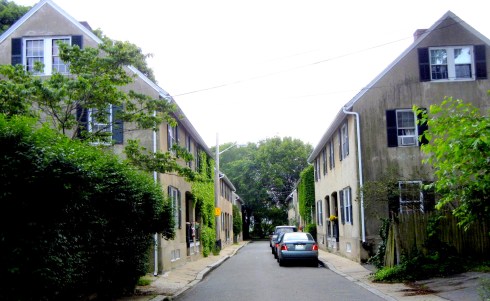
In preparation for the little talk I’m going to be giving about a post-fire neighborhood in Salem next weekend, I’ve been reading up on turn-of-the-century urban planning, design and construction trends. I’m much more comfortable in the Tudor realm than that of the Tudor Revival, but through my amateurish yet persistent pursuit of information about Salem’s rebuilding after 1914 fire, role in the Colonial Revival movement, and the early preservation movement I have been able to develop a fair amount of familiarity with the primary and secondary sources. Plus, I have several friends who are real architectural historians who are also happy to help–as well as very helpful commentators here.  I’ve written about this particular neighborhood, Orne Square, before, but I approached it again with an open mind, so I could glean a few more details about its origins, and a lot more context.

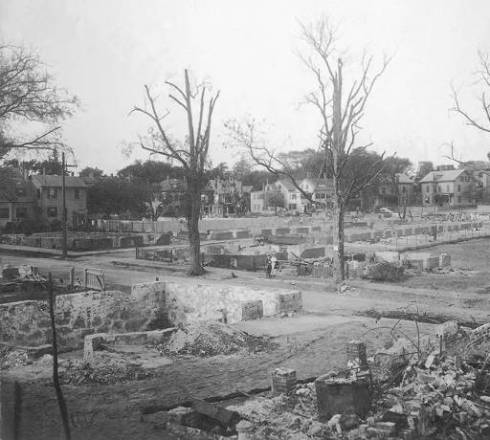
Orne Square Ruins

orne-square-1916

Orne Square in the summers of 1914 and 2014.

When I last considered Orne Square, I assumed that it was a very scaled-down, Americanized, and urban (or suburban) example of the Garden City Movement initiated by Ebenezer Howard’s To-morrow: a Peaceful Path to Real Reform (1898) and Garden Cities of To-morrow (1902) and conceived and implemented by the Boston architectural firm of Kilham & Hopkins, who were very connected and very involved in Salem’s rebuilding according to progressive principles that were both aesthetic and economic. By 1914, Kilham & Hopkins had completed the majority of their work on the new Boston neighborhood of Woodbourne in Jamaica Plain, clearly inspired by one of the most conspicuous English Garden City “company towns”, Bournville in Birmingham, which Walter Kilham had visited himself, finding it “architecturally charming, but fearfully paternalistic as only the English can be”. They would go on to build the Atlantic Heights neighborhood in Portsmouth, New Hampshire, and workers’ housing in Lowell for the Massachusetts Homestead Commission. In between, they designed and constructed a variety of buildings for the devastated Naumkeag Steam Cotton Company in Salem, including housing for its workers, and a neighborhood of affordable single-family and duplex brick cottages in North Salem. They were the likely architects of Orne Square, so everyone said, but I could never find confirming evidence, and somehow the style, the material, the client, and the overall commission just didn’t seem to point to the extremely busy Kilham & Hopkins firm. Salem was awash with architects in 1914-1918 (I have a working list of 63, and I’m sure there were more), many equipped with the MIT-credentials and social connections of Walter Kilham and James Hopkins. The owner of the Orne Square property, the private Phillips Trust, didn’t seem quite as taken with the Kilham & Hopkins as the public Salem Rebuilding Trust: the former had already hired the renown local architect William G. Rantoul to rebuild a three-family structure on the site of its Warren Street “tontine” block. The Orne Square commission went to an architect who was not local (yet), but who had several strong Salem ties: Ambrose Walker, then of Brookline, who had previously shared a Boston office and practice with his MIT classmate Ernest Machado (who died tragically young in 1907) and presently did so with A.G. Richardson, another Salem architect who was then occupied with rebuilding wasted Fairfield Street with brick Colonial Revival structures.

Bournville Village Trust

Bourneville Model Village

Kilham & Hopkins

Urban village Rantoul Architectural Forum 1917 vol. 26

Michael Reilly’s Bournville Village poster ( MS 1536 Box 59, reproduced with kind permission of the Bournville Village Trust, Library of Birmingham), and the Village itself, built by Cadbury as a model village for its factory and workers in Birmingham; Kilham & Hopkins plans for the Massachusetts Homestead Commission and a “low-rent” brick two-family house commissioned by the Salem Rebuilding Commission, 1915, Architectural Forum, Volume 28 and Phillip Library, Peabody Essex Museum; William G. Rantoul’s newly-completed Warren Street buildings, Architectural Forum, Volume 26.

I was going to save Walker for my talk next week but his identity seems to have leaked out so I might as well make the big reveal here! I have no idea why it was such a big secret for so long anyway: I found the building permit as well as notices in several trade journals pretty easily. I’ve chased down a few of his other commissions as well and while there does seem to be considerable variation in the styles of architects of this era, they do tend to favor certain materials, and Walker nearly always built in the distinctive Portland cement you see so perfectly illustrated by Orne Square. No brick for him, and wood was not a recommended building material in fire-anxious Salem at the time. I’m not entirely sure why Orne Square did not become an acclaimed development at the time of its completion–or after–when the two great propagandists of Salem architecture, Mary Harrod Northend and Frank Cousins, wrote about the resurgence of the Colonial in Salem after the great fire. I suspect it was not Colonial enough for these revivalists! Northend at least references Walker’s work (but does not name him) in her influential article for the September 1920 issue of The House Beautiful, Worthwhile Homes built in Salem since the Conflagration of 1914″: There is a grouping of some twenty stucco houses designed for moderate rentals in Orne Square which should not be omitted. The houses are artistic and comfortable, and the development worthy of being copied in any small city. Indeed, about a decade after the completion of Orne Square we do see the distinct design of one of its “2 1/2 story stucco duplexes” appearing in several (I’ve found seven–from Hamilton, Ohio to Santa Cruz, California) regional newspapers across the country, generally accompanying Walker’s text about the affordability and durability of duplex living and masonry construction. As the Portland Cement Company proclaimed in its contemporary advertising, “This is the age of cement”. There very well may be more Orne Squares out there.

Orne Square 1926

The word that pops out the most for me in Mary Harrod Northend’s description of Orne Square above is “artistic”: I’m very familiar with her work, and she uses that word rarely. I think she recognized the craftsmanship of these houses, but their more streamlined style was a bit beyond her comfort zone. Rantoul’s and Richardson’s brick houses with their colonial trim looked familiar, while Walker’s artistic houses appeared a bit different, even foreign. So that brings me to back to the Garden City movement, and Walker’s inspiration. I’m not going to go into great detail here, because I want to save something for my talk, but he was of a generation of architects that was definitely influenced by the goals of the Garden City, but was also exposed to its limitations, especially in America, which was never going to see wholly-planned cities, only neighborhoods within existing ones: urban villages like Woodbourne in Boston, the Connecticut Mills Village in Danielson, CT designed by Alfred Bossom, the Westinghouse Village in South Philadelphia, and John Nolen’s Urban Park Gardens in Wilmington, Delaware, all constructed contemporaneously with Orne Square.

Urban Village Danielson CT CT Mills Alfred Bossom architect AABN 1919

Urban VillageWestinghouse Village Philadelphia 1919 Clarence Wilson Brazer arch

Urban Village Union Park Gardens Wilmington Nolen Cornell

Urban Village Shakespeare Frank Chouteau Brown Architectural Year Book

Connecticut Mills Village, Danielson, CT, Westinghouse Village, Philadelphia, The American Architect, 1919; Union Park Gardens, Wilmington, Delaware, John Nolen papers, Division of Rare and Manuscript Collections, Cornell University Library. And one that didn’t get built:  Frank Chouteau Brown’s plans for a “Shakespeare Village in the Fens” of Boston, from the Boston Architectural College’s Current architecture: published in connection with a joint exhibition held in Boston, November 1916.

It is also important to note that Walker did not come from Salem or the North Shore, so he wouldn’t have been so subject to the dictates of its weighty architectural tradition. He became a Salem architect after his marriage to Machado’s younger sister Juanita in 1923, moving into the family home on Carpenter Street, becoming a trustee of the House of the Seven Gables, becoming the fire-proofing expert for several local organizations, and writing a scholarly paper on Samuel McIntire. But before that he was living in Brookline, not far from what I think of as one of the earliest urban villages, the Cottage Farm neighborhood, practicing in Boston, and immersed in a community made up of his very accomplished and worldly family, his fellow MIT graduates, and his colleagues–an artistic village of sorts.(Though no doubt he was also catching the train to Salem regularly, as by several accounts his courtship of Juanita occurred over two decades).

Appendices: Mr. and Mrs. Ambrose Walker in the 1930s; Walker’s drawings from the MIT Summer School, 1895, “The Georgian Period”, ed. William Roch Ware.

walkers-1930s

walker-drawings


Conflagration Commemoration

Across the Atlantic, the year-long commemoration of the 350th anniversary of the Great London Fire of 1666 is peaking this weekend, today actually, with a contained conflagration: a 400-foot wooden replica of the seventeenth-century city will go up in flames on the Thames at 8:30 pm tonight. This is only one spectacular event amidst many creative ventures  organized by the arts production company Artichoke, which seeks to”transform people’s lives and change the world through extraordinary art” along with other institutional purveyors. The Artichoke events include illuminations, projections, lectures, interactive performances, pub crawls, a “fire food market” and “fire garden”, all offered under the umbrella of “London’s Burning”, while London’s more traditional institutions are offering a variety of thematic exhibitions and displays. It’s a very complete commemoration, befitting a transformative event in London’s–and Britain’s–history.

Fire of London St Pauls

Fire of London model Flames projected onto the dome of St. Paul’s Cathedral, the symbol of post-Fire London. Photograph: Chris J. Ratcliffe/Getty Images;  the David Best-designed wooden model to be set on fire tonight @artichoketrust.

Fire has played such a huge role in London’s history–not only in the seventeenth century, but also in the nineteenth and twentieth centuries, when another Great Fire of 1834 leveled much of Westminster and the Blitz destroyed much of the central City. The commemoration of tragedy in general, and fires in particular, must necessarily focus on loss and devastation but also on rebuilding–and how the process of rebuilding reflects on the particular society that is engaged in it. I think an incandescent commemoration of 1666 is appropriate because it will illuminate the loss at least as much as the rebuilding–which has always been the focus in remembrance of this particular Great Fire: Wren’s London. We don’t even know how many people died over those three burning days: we have precise knowledge of property damage but a woeful lack of comprehension about the human toll. When the Fire burnt itself out late in the day on September 5 it had consumed 13,200 houses, 87 churches, and St. Paul’s Cathedral and left up to 200,000 people homeless, but how many people?  Who knows: anywhere from hundreds to thousands (doubtless including anonymous souls who had survived the preceding plague year), yet we still seem to repeat the ridiculous number of only six verified deaths. Then as now, it seems that we can only begin to process the enormity of destruction in a visual and structural way.

Griffier I, Jan, c.1645-1718; The Great Fire of London, 1666

Fire of London print BM Griffier

Fire of London print BM after Griffier2 BM

The paintings of Dutch artist Jan Griffier I (c. 1645-1718), who came to London just after the Great Fire, seem to be particularly influential depictions: his view of the burning of Ludgate (Museum of London Collection) was reproduced in scores of prints over the next century and a half (Trustees of the British Museum).


Clarissa Lawrence of Salem

The intertwined histories of Salem’s African-American community and Abolitionist movement in the mid-nineteenth century are often referenced and represented by the work of two strong women, Charlotte Forten Grimké (1837-1914) and Sarah Parker Remond (1824-1894), both born into families that were free, prosperous, and ardent advocates of abolition. Charlotte was a Philadelphia girl who came north to receive an integrated education in Salem: she graduated from the Higginson and Salem Normal Schools and became the first African-American to be hired to teach white students in a Salem public school when she accepted an appointment at the Epes School on Aborn Street. While in Salem she lived with the Remonds and became an active member of the Salem Female Anti-Slavery Society, and thereafter her continued advocacy for abolition was expressed primarily through her writing and her teaching, especially during her experience as a teacher of formerly enslaved children on the Union-occupied Sea Islands of South Carolina during the Civil War. Sarah Remond was a Salem native who followed in her parents’ and brother Charles’ footsteps in her dedication to the cause of abolition: she gave her first public speech for the cause when she was a teenager and was appointed a traveling lecturer for the American Anti-Slavery Society when she was twenty. In late 1858 she sailed for Britain to expose the horrors of slavery to a country which had close economic ties to the South, and delivered 45 lectures in the next few years, all of which attracted considerable crowds and press coverage–both abroad in the United States. Sarah never returned to Salem: after her citizenship status was questioned by the United States government upon her departure for Paris, she decided, in effect, to renounce it: she remained in Britain for several years, lecturing and taking classes at the Bedford College for Women, and then left for Italy after the Civil War.There she remained for the rest of her life, completing her medical degree, marrying, and entertaining family and friends from home.

There’s a lot more to say, and a lot more has been said, about both Charlette Forten Grimké and Sarah Parker Remond, but I’m interested in another African-American woman from Salem today: older, much lesser-known, but also an educator and an abolitionist: Clarissa Lawrence, also known as Chloe Minns, or “Mrs. Minns”. Her origins are obscure: we hear of her only in the Reverend William Bentley’s chatty diary when she is hired to run Salem’s first black public school in 1807. A “mulattoe” woman who could read but not write at the time of her appointment, Bentley is increasingly impressed with her as time goes by: every time he visits the “African School” on “Roast Meat Hill” he notes its “good order”. After he and Salem’s treasurer conducted a tour of all of Salem’s public schools in 1809 he observed that “In south Salem we found 40 children not provided with the best instruction. The African School by Mrs. Minns, 30 blacks, was better kept & several blacks repeated their hymns with great ease and propriety.” After the Reverend officiated at Mrs. Minns’ marriage to Schuyler Lawrence (her third, his second) in 1817 he commented that she “has acquitted herself with great honour, as to her manners & as to her instructions” and opined that the Lawrences were “the first grade of Africans in all our New England towns”. They settled on High Street, 8 High Street to be precise, where his seemingly-successful chimney-sweeping business was also located. She continued to teach (until 1823) and also held leadership positions in both the Salem Female Anti-Slavery Society and the Colored Female Religious and Moral Society of Salem. She cast off “Chloe Minns” (a name given to her in slavery?) and became Clarissa Lawrence, or Mrs. Lawrence. Like Charlotte Forten, she combined the causes of free education for blacks and abolition into an engaging appeal, and (two years after Forten was born in Philadelphia) traveled to that city to address the third national convention of the Women’s Anti-Slavery Society, asking her mostly white audience to “place yourselves, dear friends, in our stead”, and observing that “We meet the monster prejudice everywhere….We cannot elevate ourselves….We want light; we ask it, and it is denied us, Why are we thus treated? Prejudice is the cause.”

And that’s all I know about Clarissa Lawrence, which is just not enough. Compared to the well-charted lives of Forten and Remond, hers is relatively marker-less, especially her early life. The divergent circumstances of birth, wealth, and family created different paths for these three women, but the existence of slavery led them to a common place. I am writing about Clarissa today because I unexpectedly came upon a fruit of her labors yesterday, a beautiful sampler produced by one of her students in the collection of Colonial Williamsburg. Sarrah Ann Pollard’s sampler, produced at the “Clarrisa Lawrence School” in 1818, bears the inscription: virtue the [the] chief beauty of the ornament mind the nob/lest virtue of the female kind beauty without virtu[e] is [no value]. And now I’m wondering if I’ve even spelled “Clarissa” Lawrence’s name correctly, the way she would have wanted it.

Clarissa Lawrence School Sampler CWC

Clarrisa Lawrence School Sampler detail CWC

High StreetFramed Sampler by Sarrah [Sarah] Ann Pollard, 1818, Salem, Massachusetts. Collections of Colonial Williamsburg. 8 High Street, Salem: the former home of Mr. and Mrs. Schuyler Lawrence.


The Lollipop Cemetery

Such an undignified name for such a solemn place: the Shaker cemetery in Harvard, Massachusetts, one remnant of the industrious community of Shaker non-genealogical families that resided in this beautiful Massachusetts town from 1769 until the First World War. But that’s what people call it. I had a hankering to see it the other day, and so I drove to Harvard and asked for directions, because it’s a bit off the beaten path (I never use my phone for navigational purposes on a road trip; that would defeat the whole point for me–it’s either wander or inquire): oh, the Lollipop Cemetery? Just drive towards Ayer and take a right on South Shaker Road. And so I did and there it was.

Shaker Cemetery Sign

Shaker Cemetery Stone

Shaker Cemetery markers crop

Shaker Cemetery Markers

The gate was locked, and I didn’t want to trespass on this sacred ground, but I think you can comprehend the lollipop characterization of these cast iron markers, which replaced the original stones from 1879. Here is a close-up of an individual marker from a wonderful site where you can research both the cemetery and its inhabitants, as well as a rather haunting photograph from Clara Endicott Sears’ Gleanings from Old Shaker Journals (1916). The Harvard Shaker community closed down in the following year, and the cemetery was deeded to the town of Harvard in 1945.

Shaker Marker

Shaker Cemetery gleaningsfromold00sear_0375

Boston patrician (with Salem roots) Clara Endicott Sears (1863-1960) became devoted to preserving the memory and material of the Harvard Shakers as their numbers dwindled to single digits. She had already established one of America’s first outdoor museums adjacent to her summer home on Prospect Hill a few miles down the road after she realized that a farmhouse on her property had been the site of Bronson Alcott’s short-lived Transcendentalist experiment when the few remaining Shakers in Harvard began selling their buildings.Clara bought the original 1794 office building and moved it to her hilltop museum, uniting Transcendentalist and Shaker visions (and later those of Native Americans and Hudson River Valley artists). Following this path, I drove over to the Fruitlands Museum, passing a few more Shaker structures along the way.

Shaker Old Stone Barn

Shaker Building Harvard Ruins of the Old Stone Barn and the South Family Building, Harvard Shaker Village.

The interpreters at Fruitlands emphasized “community” as the theme tying Transcendentalists and Shakers together rather than any Utopian dream, which seems appropriate to me, especially as the latter were entrepreneurial workers and the former were idealistic intellectuals. The relocated Shaker office is a testament to the aesthetic and industrious pursuits of the brothers and sisters; I came away overwhelmed by the sheer drive of young seedsman Elisha Myrick, who left the Harvard community, like many of his brethren, around the time of the Civil War. I just felt sorry for the Alcott children, who had to endure a cold and hungry 6 months in the farmhouse just down the road.

Shaker Boxes

Shaker Ads

Shaker Cloak

Shaker Industry

Fruitlands Farmhouse

Fruitlands Fruit

At Fruitlands: Shaker artistry and industry, the Alcott Farmhouse, and artist-in-residence Carolyn Wirth’s 3D take on Shaker gift drawings, installed in a grape arbor.

Driving out past the town common, I was waylaid by some beautiful houses: Harvard is really gorgeous, and calm. I drove back to Salem thinking (not for the first time) that perhaps it was a little too busy (and loud!). I hope I’m not turning into my great-great-great? grandfather, who sold everything (including a beautiful Tudor house), and left his family and friends in England for America, and the Shaker community of New Lebanon, New York.

Harvard Tavern

Harvard Colonial House

Harvard Brick House

Just a few Harvard houses: this first one was once a tavern, I presume.