Category Archives: History

The War on Paper

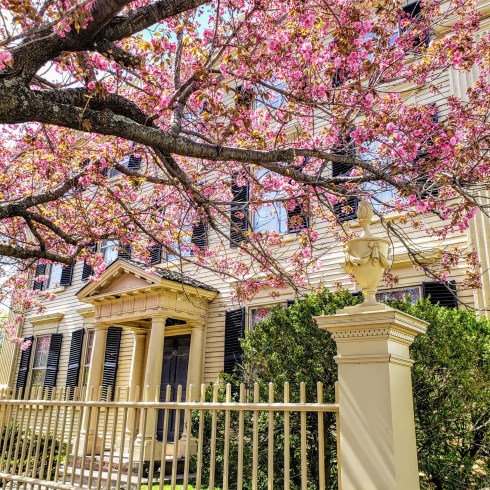
I spend a lot of time in cemeteries all year long (well perhaps not in the depths of winter) but in the weeks leading up to Memorial Day that time intensifies: late May is characterized by that heady mix of beautiful blooms and remembrance. Salem’s two larger cemeteries, Greenlawn and Harmony Grove, are nineteenth-century “garden cemeteries” which are beautiful places to wander and to remember, as they contain graves of soldiers who fought and died in the Civil War, the Spanish-American War, World Wars One and Two, Korea and Vietnam. The two Salem men who were killed in Afghanistan, James Ayube and Benjamin Mejia, are buried in these cemeteries as well: the former at Harmony Grove and the latter at Greenlawn. In the center of town, Salem’s older cemeteries, at Charter, Broad and Howard Streets, contain the graves of Revolutionary War veterans, as well as those who fought in earlier colonial conflicts, and the Civil War. This is one of the more important aspects of living in an old settlement: you can feel the weight of history.

20190524_124718

Harmony Grove is the cemetery where you feel the weight of the Civil War the most, or the “War to Preserve the Union” as its northern combatants called it (because that is what it was). Greenlawn has a G.A.R monument and many graves of Civil War soldiers, but there is something about Harmony Grove that feels more connected to that era. There is a central circle commemorating the young Salem men that died during the war, and survivors’ graves are interspersed throughout the cemetery: the grave of Luis Emilio, the Captain of the Mass. 54th is there. He survived the assault on Fort Wagner in South Carolina in 1863 and lived to tell the tale, but the grave of William P. Fabens, who died there the following year, is also at Harmony Grove.

20190524_124907

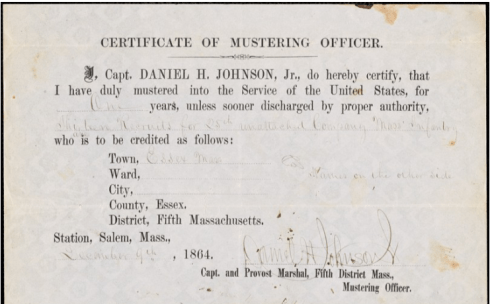
Stones can only tell you so much: if you want to want to know more, you need paper: the sources of the Civil War are plentiful and accessible in general but for Salem in particular, sparse, because of the removal of the Phillips Library.  With its present pledge to digitize more of its collections, this situation might change, but for now we are dependent on other repositories for glimpses of Salem’s Civil War history. Given Salem’s role as a regional center in northeastern Massachusetts, I was able to piece together a paper trail through two state digital databases, the New York Heritage and Digital Commonwealth, and a few other sources: this trail does lead us to the battlefield (or camp nearby) but is more evocative of the war at home. Salem emerges as a busy place of mobilization and recruitment, where young men from all over Essex County were mustered into service and dispatched to the major regional training camp in Lynnfield. At the beginning of the war, this is a process of enthusiastic volunteerism, but as it wears on it’s all about bounties and quotas. Massachusetts Adjutant-General William Schouler cited his own correspondence in his two-volume History of Massachusetts in the Civil War (1868) including this representative instruction to an official in Newburyport: Recruit every man you can; take him to the mustering officer in Salem and take a receipt for him. After he is mustered into United States service, you shall receive two dollars for each man. The officer will furnish transportation to Lynnfield. Work, work: for we want men badly. The correspondence between Daniel Johnson, the mustering officer and Provost Marshal in Salem who was responsible for recruiting men from Essex County in the last 18 months of the war and officials in the small town of Essex illustrates the intensifying local effort to meet quotas established by the state and federal governments.

MD Poster

MD Poster 2

MD POster 3

Civil War logistics 2

Civil War logistics 5

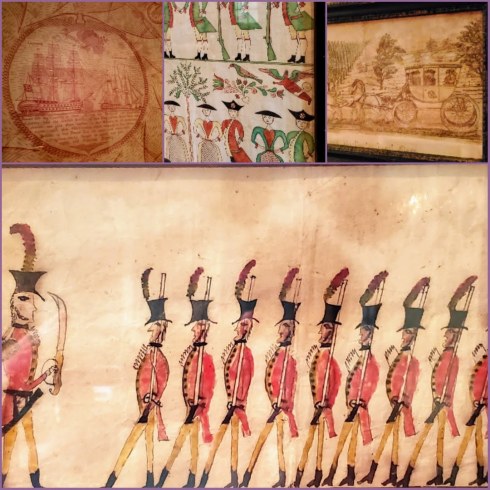
Civil War logistics DCRecruiting posters from 1861-1863, New York Historical Society via New York Heritage; Town of Essex Civil War records, 1864 via Digital Commonwealth.

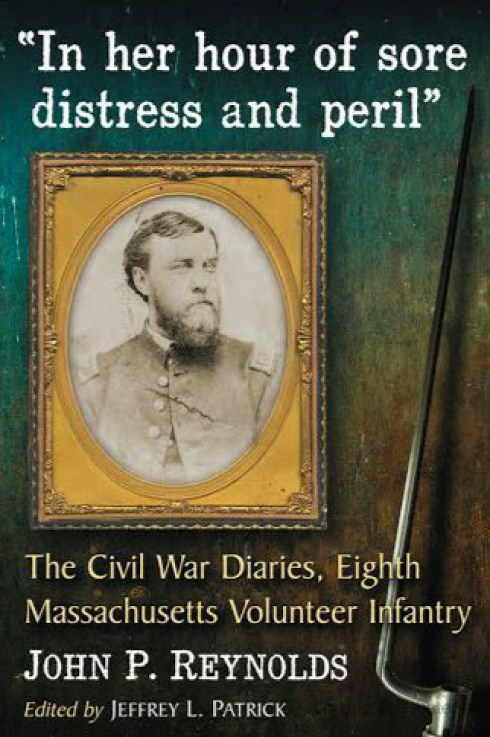
Official records are illuminating yet necessarily focused on logistics; more intimate perspectives, bringing us closer to the camp or battlefield, can be found in diaries and journals. Two Salem soldiers recorded and projected their personal perspectives during and after the war: John Perkins Reynolds and Herbert Valentine. Reynolds (a grandson of Elijah Sanderson who was briefly detained by the British on the even of the battles of Lexington and Concord!) kept a diary of his service in the opening months of the war with the Salem Zouaves (at the Clements Library at the University of Michigan, and available here in print),  and also documented  his reminiscences of his time with the Massachusetts 19th (at the Massachusetts Historical Society). Valentine’s journals, scrapbooks, and visual impressions of the war are also in several repositories, including the Wilson Library at the University of North Carolina at Chapel Hill, the Z. Smith Reynolds Library at Wake Forest University, the Phillips Library, and the National Archives, which has digitized his watercolors of wartime scenes.
CIvil War Diary

Civil War Valentine 1

Civil War Valentine 2Valentine’s Virginia vignettes, 1863-64, National Archives.

These are not impressions that would have been available to contemporaries, but I think people who lived during the war would have have been exposed to its images and texts every day: posters, newspapers, the daily mail. A sea of Civil War envelopes survives, emblazoned with all sorts of colorful messages: surely this must be a fraction of what was produced and disseminated. According to its finding aid (which is online), the Phillips Library has 17 boxes of Civil War envelopes! Wow—-those will make quite a splash when they come online. My very favorite example (about which I wrote a whole blog post) depicting President Lincoln as the “Union Alchemist” was printed by Salem printers G.M. Whipple and A.A. Smith: I hope that there are more examples of their clever imagery in that Rowley vault.

Civil War Envelope - C-O-53 Library Co of Philadelphia Union Alchemist

Civil War Envelope 2

Civil War Envelope 3Library Company of Philadelphia and Richard Frajola.

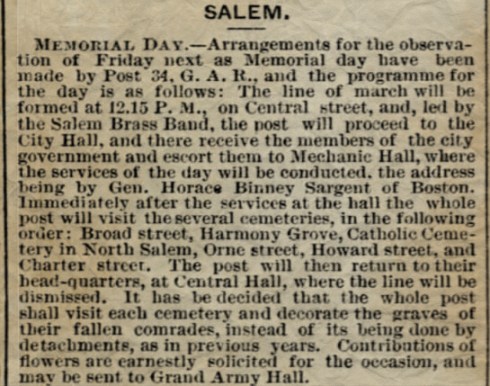
Newspaper accounts constituted a daily drumbeat and are thus too plenteous to consider here, but I did want to chart the beginnings of remembrance for this Memorial Day, so I looked at newspapers from the later 1860s and early 1870s—or so was my goal; I dug in and went quite a bit later. For the most part, the Salem story follows the national (or at least northeastern) pattern: in 1868 the first Commander-in-Chief of the Grand Army of the Republic declared May 30 to be Memorial Day and the Salem G.A.R obeyed his orders to the letter. I saw very few references to “Decoration Day”; Memorial Day seems to be have been the preferred designation right from the start. While local officials were invited to participate in the proceedings, the entire commemoration was a G.A.R affair until the early decades of the twentieth century. The only concerns expressed about the increasingly-ingrained “holiday” came right at its beginning and much later: an anonymous daughter of Civil War casualty expressed her concerns in 1870 that the proceedings were too commercialized, and certain members of the G.A.R leadership were profiting from supplying (see the C.H. Weber advertisement below), and much later the G.A.R itself expressed its concerns that a city-licensed circus was being allowed to operate on Memorial Day (see? protesting city-sanctioned circuses is a time-honored Salem tradition).

Memorial Day Salem_Register_1870-05-30_2

Memorial Day BG Mary 26 1873

Memorial day 1923 BG May 12

Memorial Day 30 May 1944 BGThe evolution of Memorial Day: C.H. Webber outfits participants for the occasion, Salem Register, May 19, 1870; Boston Globe May 1873, 1923, and 1944: the last GAR members in Massachusetts, including Thomas A. Corson of Salem, who died later that year at age 103.


Looking for Daniel Bancroft

If you walk down the streets of Salem looking at house plaques bearing the date of construction and first owner, you will quickly notice that a fair number of them will read “housewright”. There seem to have been so many housewrights in Golden-Age Salem around the turn of the nineteenth century, but only one architect of note: Samuel McIntire, of course. “Architect” is a rather fluid term until the later nineteenth century when the occupation was professionalized, but I’m wondering if there were any other designers, rather than merely builders, of structures in Salem before that time. One candidate is a colleague of McIntire’s, often described as his “chief assistant” or builder, a man named Daniel Bancroft (1746-1818). We have an absolutely glowing epitaph for Bancroft from the Reverend William Bentley, following his death from typhus in 1818 at the age of 72: “the most able Architect we had. We gave more to the genius of Macintire, as a Carver, but as a practical man in every part of Carpentry in house building, I have never known Mr. B’s superior.” [Diary, IV, 6] High praise indeed, although Bentley seems to be citing Bancroft’s craftsmanship rather than his design skills, and praising McIntire for the very same reason. In any case, Bancroft is a bit elusive: not only do you have to go through McIntire to get to him, but there is also considerable confusion between Daniel Bancroft the Elder (McIntire’s Daniel) and his son, Daniel Bancroft Jr., who was also a housewright. The “Daniel Bancroft House” on River Street, for example, was the home (and presumably the work) of the younger Bancroft. Around the corner on Lynn Street—perhaps #3—was his father’s house and workshop.

20190521_102707

20190521_102652

Bancroft July 1796Salem Gazette, July 1796.

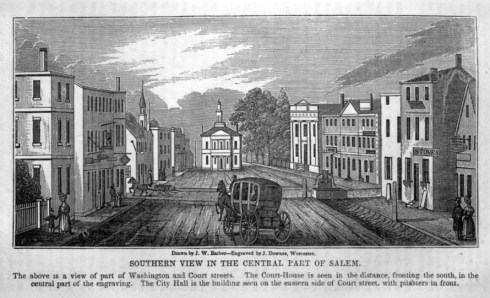
The earliest “commission” I could find for Bancroft is for the construction of a new church or meeting house in 1776-77 for the Third Congregational Church, later (and now) called the Tabernacle Church, as the church which replaced the colonial construction was inspired by London’s Metropolitan Tabernacle. The Tabernacle’s records have been digitized by the Congregational Library, and among them are payments to Bancroft, specifically in terms of days of labor. Bancroft exceeds mere workman status thirteen years later in an article in the March 1790 issue of Massachusetts Magazine about the Salem meeting/courthouse at the head of Washington Street, which states that its plan “was designed by the ingenious Mr. Samuel McIntire and executed by that able architect, Mr. Daniel Bancroft.” Clearly the word is used to refer to the builder, or executor, of McIntire’s vision, and I guess we can conclude that Bancroft was just that. But he built the most elaborate buildings in the Salem of his day: not just the Tabernacle and the courthouse, but also the Assembly House and the short-lived mansion of Elias Hasket Derby, which stood on the present site of Old Town Hall for only fifteen years. And likely much more.

Bancrofts Tabernacle Church.

Bancroft Tabernacle

Bancroft Court House

Bancroft Felt Courthouse

Bancroft salem-barber

20190521_103252

lost-mansion-old-shipmasters-of-salemThe Tabernacle Church of 1777-1854, from Samuel Worcester’s Memorial of the Old and New Tabernacle (1855); payments to Daniel Bancroft in the Tabernacle Church administrative records at the Congregational Library; Images of the McIntire courthouse from Massachusetts Magazine, George Washington Felt @ Peabody Essex Museum, and J.W. Barber. Drawing of the Derby Mansion from Charles E. Trow, Old Shipmasters of Salem (1905).

I’m sure that there is more evidence, material and textual, of Bancroft’s work and life; I can feel that there is a lot more to his story. If I had the time, I would: consult the McIntire papers at the Phillips Library in Rowley, explore Bancroft in records of the Symonds family of Salem, into which he married, and ascertain his possible connection (through McIntire, or alone) to the very Salemesque Thomas Symonds House in his native Reading. There is also his service in the 6th Massachusetts Regiment during the Revolutionary War to consider. For now, though, he remains an elusive figure: I couldn’t even find his gravestone in the Broad Street Cemetery where it is purported to be! There is a stone with a similar shape, but its inscription is illegible, as if symbolizing Bancroft’s ghostly presence in Salem.

20190521_124030


Cracking Open the Treasure Chest

There are two notable developments regarding the Phillips Library of the Peabody Essex Museum (PEM), the major archival source of Salem’s history, so (fair warning) I am returning to that troublesome topic. I don’t think I’ve written about the Library and its collections since the very beginning of the semester, when I made my first trip up to Rowley: out of sight, out of mind has been one of my major concerns about the relocation of this venerable collection to this rather detached location, and that’s pretty much been the case for me. The Library has regular open hours up there, the staff is very helpful, there are many discoveries to be made, but while I’m sure it is an invaluable repository for the curators of the Museum and specialized researchers, it’s hard to see how it could develop into any sort of a community resource, despite the nature of many of its collections. The PEM (or I should say its leadership to date) has never acknowledged the historical-society-origins of its amalgamated Library, so I’m sure that’s fine with them, but they have taken several strident steps towards open access in recent weeks with the hiring of a new Head Librarian and the announcement of a digitization initiative which will roll out in several stages. Following up on their partnership with the Congregational Library, which has made some important manuscript collections accessible, there are now some very interesting printed materials available in the Internet Archive, with lots more to come, apparently.

PEM atlasmaritime1700mort_0060There is a facsimile edition, but how amazing to see the original 1693 maritime atlas of Pierre Mortier, the “most expensive sea-atlas ever published in Amsterdam in the seventeenth century” according to the eminent Dutch cartographical historian Cornelis Koeman. Stunning plates of beautiful European ships: here is a “Tartane de Pesche”.

This is wonderful: certainly the PEM should be commended for cracking open the treasure chest that is the Phillips Library but I do want to emphasize that this “opening” has been a long time coming and is as much due to outside pressures as inside initiatives. Thanks to all the people who are keeping track of these things in Salem (and to digitization), I have in my (FAT) Phillips Library file a collection of published articles in which a succession of PEM representatives made confusing claims about the museum’s progress towards making its holdings more accessible. In response to a major push-back by scholars and librarians in 2004 after Library hours and staff were reduced dramatically, the PEM indicated that increased internet offerings would compensate for the restricted access. Then-acting “Library Administrator” John R. Grimes made the egalitarian argument that “many of the people interested—or potentially interested—in historical documents are not professional researchers, but students and laypeople with regular jobs, for whom the new digitization technology and the Internet proved access to knowledge they would otherwise never see” (Northeast Regional Library Newsletter, June 2004). A decade later, Phillips Library Librarian Emeritus Sidney Berger published an update on the progress of digitization in the Winter 2014 issue of Antiques & Fine Art magazinestating that in an effort to bring the PEM’s material to a worldwide audience, during the last two years, PEM’s Phillips Library, with the assistance of a team of cataloguers, has gone from having 9 percent of its holdings to more than 90 percent digitally accessible; financial gifts from donors have made this possible. The team has undertaken a retrospective conversion of 175,000 old cataloging records into the preferred Library of Congress system and catalogued another 75,000 previously unprocessed materials. The retrospective conversion connects PEM’s vast library holdings to researchers near and far. One of the particularly gratifying aspects of this project has been to make 50,000 singular, one-of-a-kind documents that only exist in PEM’s Phillips Library Collection available online. We could all see the online catalog, a momentous achievement certainly, but where were the “50,000 singular, one-of-a-kind documents”? No one could find them, and there was also confusion among the general public about the distinction between “records” and “holdings”: both can refer to catalog entries as well as the documents themselves. I think the long-term claims and confusion left PEM in a bit of a vulnerable position when they finally announced that the Phillips Library would not be returning to Salem, because it was apparent that there was no compensatory commitment to digitization. When pressed at the dramatic public forum on January 11, 2018, CEO Dan Monroe would only say that digitization was “expensive”.

PEM DMMr. Monroe at the 1/11/18 public forum at PEM.

So that is why the recent announcements are so welcome. Digitization goals are clearly stated. Mr. Monroe is departing, to be succeeded by Brian Kennedy, the director of the Toledo Art Museum, an institution that seems to have all of its collections online. The newly-hired head librarian, Dan Lipcan, has a great track record of digitization at the Watson Library at the Met (and, if this blog post about the devastating losses at Brazil’s Museu Nacional is any indication, a higher degree of sensitivity about the importance of material heritage to a locale than I have discerned from most representatives of the PEM). The chief of collections, John Childs, has been a pretty steady advocate for more digitization throughout, so I’m assuming that he is behind the initiatives that have already been put into place. The materials “deposited” in the Internet Archive seem very well-curated and seemingly representative of the Phillips Library’s diverse collection: local history, maritime history, natural history, fashion (not a strength of past collecting, but definitely a present and future emphasis), all about China, and more.

PEM Pickering

PEM journaloftravels1794saun_0005

PEM hamiltonhallerec0000fabe_0001

Essex Institute Annual Report 1988

PEM derbywharfsalemm1973dobr_0001

PEM Hats

PEM lebontondapresgu1192barb_0025

PEM horticulturalreg1112unse_0009

PEM Chinese Junks 1920

It’s very interesting to see the expansion vision that never happened on the front and back covers of the Essex Institute’s Annual Report from 1988, and I really want to dive into the Historic Structure Report for Derby Wharf from 1973, but I’ve also got to admit that I love George Barbier’s beautiful illustrations in Le bon ton d’aprèsguerre (the lady in the Poiret dress avec arrow above) and who can resist a book titled The Romance of Men’s Hats? But what I’m really looking forward to, along with many people, is the promised digitization of photographer Frank Cousins’ large body of work, encompassing images of Salem from c. 1890-1920. Apparently these are coming soon, and after that could we please see some scans from all those papers of Salem families? Almy, Butler & Robson, Crowinshield, Fabens, Lee, Loring, Peabody, Peirce-Nichols, Saltonstall, Waters……..my colleagues and I made a list if anyone’s interested.


Step it up, Salem

Nothing helps to define the distinguishing characteristics of where you live better than travel. I’ve been traveling quite a bit over the past year, near and far, in the US and abroad, but generally to places which are identified as tourist destinations, like Salem. I’m always happy to return home, where I am more appreciative of Salem’s many advantages and resources, but also its lost opportunities, for lack of a better phrase. There are quite a few places that make do with with a lot less than Salem has: they might or might not have streets of historic architecture (though most of the places I visit do), they might not have a “marketable historic event,” they might not have a harbor, they might not have 100 restaurants, but they do have: 1) historical societies and/or museums that provide free exhibits and walking tours for the public; 2) museums that are actually museums–nonprofit institutions with collections and curators; 3) attractive and informative signage; and 4) a sense of pride expressed by effective stewardship of public properties—historical and otherwise. I think Salem could do a lot better; I think we need to step it up in these four areas in particular. I’m not sure how to do that, however, as I’m not really sure who is in charge of Salem’s tourism planning and administration. Free enterprise seems to reign over the city’s tourism, with private institutions taking primary responsibility for selling our city’s heritage, with a few very notable exceptions like the Salem Maritime National Historic Site and the House of the Seven Gables. There should be some role for our city government, but I’m not sure if that role has been defined or exists, so I’m going to make my key points in the form of questions and just cast them out there into the unknown.

Why can’t we ditch the Red Line? I’ve written a whole post about this and my feelings have not changed, so I’m not going to belabor the point, but the Red Line–as one of the few truly public history initiatives visible in the city—makes Salem look regressive (I’m sure it must be based on Boston’s Freedom Trail, which dates to 1951! Come on, times have changed in historical interpretation! Where is our app?) exclusive (there is no African-American history on the Red Line; at least Boston’s Freedom Trail intersects with its Black Heritage Trail. Salem has no Black Heritage Trail and no markers on black heritage sites), and exploitative (because it’s really all about shops and witch “museums” obviously). Plus it just looks bad. We can and should do a lot better: the foundation is already laid with some great tours produced by Salem Maritime and Essex Heritage  (here and here), among others. We just need to consolidate, repackage and go digital.

20190506_143128

20190506_142906Is the Red Line going to take us across North Street to the beautiful Peirce-Nichols House? Of course not, sharp left to the Witch House, after we’ve just been to the Witch Dungeon Museum.

Why can’t we transform this beautiful Greek Revival courthouse which is currently empty into the Salem History Museum and Visitor Center?  There is a nice display of placards providing an overview of Salem’s history called the Salem Museum at Old Town Hall and a Visitors Center with much more regular hours run by Salem Maritime in the drill shed of the former Salem Armory, but I think we need to consolidate these two services into one building and this former courthouse happens to be empty and in the possession of the Salem Redevelopment Authority (SRA). I’m sure the SRA wants to develop it–and its adjacent courthouse next door–but this would be a great spot for Salem to really own its history. It’s right across from the train station and its parking lot. Salem needs permanent and professional exhibitions of its entire history, including the Witch Trials, which has always been its biggest draw. Doesn’t Salem Maritime have its own story to tell? Why does it bear the primary responsibility for visitor orientation in Salem? We know that the Peabody Essex Museum is not interested in historical interpretation, but they might be persuaded to loan some things, as would the Salem State Archives (I think!) which has been collecting quite a bit of local history over the past few years. 

20190511_124916Two empty courthouses downtown: can’t ONE play a key public role?

Why can the city of Salem regulate tour guides but not “museums”? Most historical interpretation in Salem is offered by private tour companies and private “museums” which are really not museums at all: they offer presentations and dioramas rather than collections and context. (This is not just my opinion! Check out reviews for the Salem Witch Dungeon Museum, the Witch History Museum, and the Salem Witch Museum on Yelp or TripAdvisor: even the people that like these places say “this is not what you would think of as a museum.”) The City of Salem licenses tour guides, but anyone and everyone can open a museum. This seems like an inconsistent public policy regarding historical interpretation to me. The other issue with the “museums” and haunted houses is their seasonality: they can be absolutely deadening if situated in a central location, as is the case with the juxtaposition of the Witch History Museum, Count Orlock’s Nightmare Gallery and the delightful Witch Mansion or whatever it is called along central Essex Street. This is Salem’s main street and you can hear a pin drop on a Friday night as these places are shut up tight; I think the last two were open only in October even during the day–but as you will notice, the Red Line runs right by.

pixlr-2

20190508_153716Thank goodness for Wicked Good Books and the Hotel Salem, otherwise there’s not a lot going on on the Essex Street pedestrian mall, day or night. 

Why can’t we have consistent, attractive, and informative signage? And why do these private “museums” get to stick their signs on all over town on public utility poles?

20190511_140534

20190506_143549

20190506_143528

20190506_143339

Look at these signs! Clearly the owners of the Salem Witch Museum and Witch Dungeon Museum can just place signs wherever they like. I’m assuming the numbers on this last sign refer to the Red Line and (obviously) the Salem Trolley tour, another private purveyor of history in Salem. I think we need some contrast here, so here’s just one of a succession of well-designed signs I spotted around North Adams last weekend.

20190504_081421

While I’m on the subject of signs, I would be remiss if I didn’t commend the City of Salem for putting up some lovely neighborhood and park signs—which they have—but the information presented on these signs has to be correct. I’m particularly concerned about the sign for the relatively new Remond Park adjacent to the Beverly Bridge. This is a memorial to the Remond family, a very successful free black family in mid-nineteenth-century Salem whose members advocated for school desegregation, abolition and myriad other social justice issues while operating several successful businesses. It’s great that they have a park! It’s great that this park is one of only two Salem sites on Tufts University’s acclaimed African American trail project. But the sign has the wrong information: Salem had a vibrant African-American population in the nineteenth century downtown; there was not “a large population of African Americans” who lived in this rather remote section of Bridge Street Neck. As if the location of this park wasn’t off the beaten path (Red Line) enough, Salem’s African-American population is marginalized geographically by this sign, just as they are marginalized (or omitted) from Salem’s history.

20190511_132408

20190511_132347Bridge Street Neck was not “home to a large population of African Americans” in the 19th century: just check the city directories!

Why can’t we protect Salem’s sacred sites? Salem’s downtown cemeteries, especially the Old Burying Point or Charter Street Cemetery, are besieged during October: why can’t the gates simply be shut? I have seen terrible things in Charter Street: many tourists don’t seem to realize that it is a real cemetery rather than some sort of stage set. The City of Salem has an obligation to protect this sacred site, and it could do so by simply locking its gates. Salem’s Quaker Cemetery on Essex Street is always locked up; why can’t Charter Street be locked up for the month of October? This is a question that people have been asking for years and there is never any answer.

20190506_160646

20190508_152704


Wonders of Winterthur

I am still processing Winterthur, so this is a rather premature post, but I wanted to get my first impressions and thoughts out there and sometimes posting is processing! It was just so wonderful, in so many ways, especially as my friends and I toured its many period rooms in the company of Wendy A. Cooper, Curator Emerita of Furniture and conservator Christine Thomson. If the majesty of the rooms and their furnishings was not enough, the commentary of these two brilliant women on style, detail, condition, context, and provenance provided a soundtrack of sorts which enhanced the whole experience. And we got to go where more scheduled tours could not–which is always fun: if we did not make it through Winterthur’s 175 rooms, we came pretty close, and by the time of the closing bell we were on the top floor. While Ms. Cooper’s specialty is furniture, she seemed to have a mastery of every object in every room, as well as the history of Winterthur itself, so the takeaway was a very personal, even intimate, view of both the museum, its collections, and its founder, Henry (Harry) Francis du Pont (1880-1969). During our tour, I was so focused on absorbing every little detail that I didn’t really process, but afterwards, and all this week, I kept comparing Winterthur to another famous house museum, across the pond: Sir John Soane’s Museum. I needed context, I needed a comparison, and while I know that Winterthur is comprised of parts of many different houses and inspired more by the tradition of installing period rooms that started right here in Salem with George Francis Dow’s exhibits at the Essex Institute and Soane’s (much smaller) house is uniquely his place and collection, and fixed at a more exact point in time, the two houses seem both stuffed and the stuff of very personal passions for collecting: materialistic rather than “scientific” wunderkammers.

20190427_135800

the_south_drawing_room_derry_moorePort Royal Parlor at Winterthur and South Drawing Room at Sir John Soane’s Museum, photograph by Derry More.

The personal was my window into Winterthur: somehow stories of Mr. du Pont entertaining antique dealers over dinner and then proceeding to invite them to help rearrange the furniture reminded me of the more eccentric Mr. Soane. As I did when I first visited the London museum, I really felt the stamp of Mr. du Pont on Winterthur: period rooms can be rather cold, detached places (as they are literally detached), but Winterthur felt warm. The big, showy parlors and dining rooms of the main floors less so than the upper stories, but still, altogether an inviting installation—impressive for a museum of such scale.

20190427_174024

20190427_172437

20190427_153703

20190427_154512

20190427_154601

20190427_154448

20190427_154426

20190427_153526-1

20190427_133830

20190427_145051So many rooms—and stuff—for eating and drinking, of course, but dining rooms can be very revealing in their details. After the famous Chinese Parlor are several shots of the Du Pont Dining Room, with the Derby family’s green knives and knife boxes (+ McIntire chairs and Needham secretary, and adjacent candlestick closet. I can’t remember the name of the second, simple dining room, which is one of my favorite Winterthur rooms, but the photograph just above is of Queen Anne Dining Room, which really represents Mr. du Pont’s creative abilities (as well as his collecting efforts).

Some more observations and thoughts not yet fully developed, impressions: you really have to put your New England preferences aside and pay tribute to Philadelphia and New York furniture when you visit Winterthur (particularly the former, wow), but Mr. du Pont seems to have been just as passionate a collector of American (or should I say eastern American) folk art as high-style furniture. I knew I could get pictures of the grand rooms from the Winterthur website (plus they have a great digital database) so I took pictures of lots of little things that caught my eye (see some below). How many eagles are there in Winterthur? They seemed to be everywhere. And tea tables! Apparently Mr. du Pont’s collections started with pink transferware and he continued to assemble pottery collections with great conviction: there are several rooms devoted entirely to a variety of wares, even spatterware. And yes, parochial person that I am, I did seek out Salem items, which were not hard to find: there’s a whole room dedicated to McIntire, and other pieces scattered around. In just one room, of painted furniture pretty high up, Ms. Cooper casually pointed out a lovely silk chimneypiece embroidered by Sarah Derby Gardner and a Silsbee chair. The Du Pont Dining Room (above) featured not only knives from the Derby family, but also some McIntire side chairs, and an amazing secretary/bookcase made by Nehemiah Adams. In his own suite of rooms, Mr. du Pont worked on another Salem secretary, with a Nathaniel Gould chest of drawers nearby. An entire room is wallpapered with a mural painted by Michel Felice Corné for the Lindall-Barnard-Andrews House at 393 Essex Street in Salem.

Winterthur Secretery best

20190427_153224-1

20190427_163422

20190427_165224

20190427_152226

Winterthur eagle

20190427_133515

pixlr-1

Winterthur Tea Collage

20190427_132758

20190427_161302

20190427_161025

20190427_164308

20190427_164321

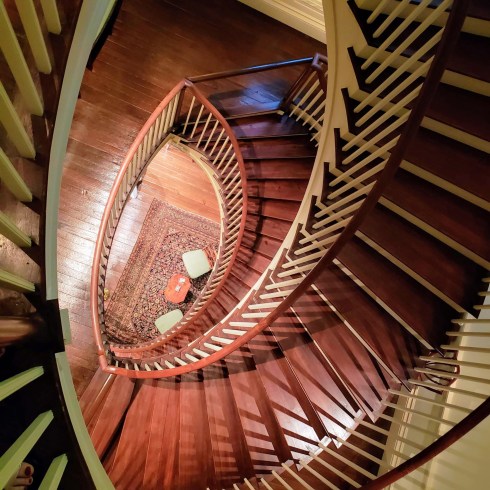
20190427_160227The Montmorenci stair, taken from a North Carolina house, replaced the “baronial” staircase which Mr. du Pont’s father installed. Folk objects and images, just a few tea tables, and just one china room. Several Salem items: the chimneypiece embroidered by Sarah Derby Gardner, a Silsbee chair, Mr. du Pont’s secretary (and bed), and the Corné mural from the Lindall-Barnard-Andrews House.

I could go on and on and on, but I’m going to wrap it up with just a few more of my favorite things/rooms, in no particular order. I really loved the William and Mary Parlor, pretty much every image of George Washington (and there were many), the detail on an otherwise simple chest of drawers, two pastels by John Singleton Copley of himself and his wife (and the amazing high-style parlor which they overlook), a very early billiards table, and an elegant curved settee for which Mr. du Pont built a wall. And just to bring in a touch of a real wunderkammer, a wonderful little anatomical plate.

20190427_142749

20190427_142843

20190427_162201

20190427_131347-1

20190427_162240

20190427_140726

20190427_140431

20190427_155945

20190427_170140

20190427_142043


The Friendship Returns

Yesterday the reproduction East Indiaman Friendship of Salem returned to Salem Harbor after an absence of nearly three years after she was hauled-out in the summer of 2016 for what proved to be substantial repairs. Everyone was very excited, and when I finally made it over there towards the end of the day, the resident ranger told me that 400 people had come out to greet her, despite the dreary weather. It’s nice to have some history, even of the reproduction variety, return to Salem. I’m also struck, yet again, by how maritime history unites and illuminates, as opposed to the divisive and exploitative aspects of Halloween “happenings”. The arrival of the Friendship was a bit “exuberant”, we shall say, as it actually hit the pier alongside the Pedrick Store House, and apparently it’s going to take many months for her to achieve her fully-rigged glory (“there’s a lot of work to do”, said my ranger, in the midst of sails and ropes in the Store House, with a view of her masts out the window), but no matter, our ship has come in.

20190422_162641

20190422_162925

20190422_161952

20190422_162308

20190422_162403

20190422_162830

Many ships named Friendship have returned to Salem Harbor over the years, as there was a succession of seven so-named ships in operation during the first half of the nineteenth century. I believe that our 21st-century Friendship was modeled on the ship built by Enos Briggs in 1797 which recorded fifteen long voyages before its capture as a prize ship by the British at the outset of the War of 1812 precisely because there is an extant model of this ship in the Peabody Essex Museum, but my colleague Dane Morrison, maritime historian extraordinaire, tells me that this Friendship was also the “perfect” East Indiaman.

Friendship Model PEM

friendship1 1917 Essex Institute

bridgman-friendship-bow-view-sketch-1921p

Model of the 1797 ship Friendship, c. 1804, Thomas Russell and Mr. Odell, Peabody Essex Museum; the Friendship in the Essex Institute’s Old-time Ships of Salem, 1917, and a bow view by Lewis Bridgman on the title page of John Robinson’s Marine Room of the Peabody Museum of Salem, 1921.

I envy Dr. Morrison his research because it’s fun to read the letters sent home from captains of the Friendship (and I presume other vessels as well), which were published in the newspaper: they are their era’s foreign correspondents! Captain William Storer gives us the first European accounts of the assassination of the Russian Tsar Paul I in 1801 in a letter from Hamburg dated only a few weeks after the crime was committed: thus putting an end to Paul. From Palermo, Captain Williams informs his owners that the Mediterranean markets are “gutted” due to the onset of the Napoleonic wars several years later. In 1811, the year before the Friendship was captured by the British, we can read about its entry into the Russian port of Archangel after the ice had finally melted in late Spring. The “market for imports was [still] uncommonly dull” and one wonders why the ship was not in warmer and more profitable waters in East Asia, but ultimately Archangel would be this Friendship’s last port as a free ship.

Friendship Paul 1801

Friendship 1807

Archangel

Letter from Capt. William Storer published in the Impartial Register, June, 1801 and portrait of Tsar Paul I (1754-1801) by Vladimir Borovikovsky; Letter from Captain Williams published in the Salem Gazette and painting of Palermo Harbor in the later eighteenth century by Luigi di Pietro; Letter from Archangel, June 7, 1811, Essex Register, and the port on the White Sea, 1829 map by Wilhelm Ernst August Schlieben, David Rumsey Map Collection.


Red Roofs

Patriots Day 2019 was not a very enjoyable day. It was certainly not as dreadful as Patriots Day 2013, but still a frightful day. I woke up to thunder, looked out at the dreary rain, made the decision not to drive to Lexington so I could walk the Battle Road as is my custom, did some errands, and then turned on the radio to hear the Marathon results and instead heard “Notre Dame is burning”.  And that was the story for the rest of the day: listening, watching (big mistake but I could not look away), and (towards the end of the day) drinking. I admire all historical architecture, but Gothic cathedrals are more than mere buildings: they symbolize the aspirations and abilities of an era and a civilization. Very early in my teaching career, I essentially turned my medieval survey into an “Age of Cathedrals” course, and I still teach through and around and with these monuments. At first reference that might sound like an approach that is simplistic and old-fashioned, but for me the cathedral has always been both a symbol and a conduit, connecting one to all the layers of medieval history, not just religious, but social, economic, political, cultural, and of course technological. Cathedrals can open up minds too: especially the minds of college students who are predisposed to think of the Middle Ages as merely “dark”,  and “backward”. It’s impossible to look at a cathedral and not be impressed by its creators, or maintain a presentist perspective.

aptopix-france-notre-dame-fire-20190415155934-12400800AP Photo by Thibault Camus

As the day wore on, I realized I was getting upset as much by the commentary and coverage as by the incessant fire. There was a lot of speculation, and little confirmation, and of course we could see the fire burning and burning and burning. So I turned everything off and went to bed. The next day, the fire had finally been stopped and Notre Dame was still standing: its roof and spire were gone but the bulk of its early Gothic expanse and vaulting, its bell towers, and even its trio of rose windows had been saved. I welcome the full report on the fire’s causes and damage because there is still a lot of contradictory information out there, but I learned a lot from a few select Twitter threads that found their way into my feed, mostly through architectural historians: about the protocol followed by the Parisian firefighters, put in place after the last time Notre Dame was ravaged during the French Revolution and sustained through two world wars, about the oak trees planted at Versailles after the last restoration of Notre Dame’s roof 160 years ago, and about the human chain created to rescue its treasures, with a fire-fighting chaplain serving as the essential link.  The combination of a still-standing Notre Dame, human heroism, and the resolute statement of President Macron reassured me quite a bit (French cathedrals have been owned by the state since 1905), but more than anything I am hopeful because of history: cathedrals were built over generations, in fits and starts, many sustained fire damage as well as human assaults but survived and were rebuilt. There are several precedents for the restoration of Notre Dame, but I think the most inspirational examples must be Reims Cathedral, which sustained devastating damage during World War I, and the Cathedral of St. Peter and St. Paul in Nantes, which was bombed heavily during World War II and severely damaged by a fire in 1972.

Cathedral CollageThe Cathedrals of Reims and Nantes in their present glorious condition. Photographs by Nicolas Janberg for Structurae.

The restoration of Reims, the most royal of French cathedrals, was an epic achievement. It sustained intense shelling by German forces outside of the city in September of 1914, setting fire to the wood scaffolding that was in place, and then the cathedral’s oak roof, which caved into the nave below. Reims lay in a state of semi-ruin for the rest of the war, and was bombed again in 1917 and 1918, thus attaining its status as a “martyred cathedral”. I inherited a book from my great aunt by the American illustrator George Wharton Edwards titled Vanished Halls & Cathedrals of France which was published at the height of the war. Reims is on the cover and inside, looking beautiful in his pre-war paintings, but the text reads like a eulogy: the catastrophe is so unbelievable that one cannot realize it…….Reims can never be restored to what it was before the bombardment. Let it rest thus….a sacred ruin—the scarred, pierced heart of France. He goes on a bit later: Let it remain….the living, standing record of an infamous crime. Consumed by fire, soaked in blood, Reims, which crowned and sheltered a hundred kings, has passed. Deleta est Carthago.

Vanished Halls

Edwards Collage

Vanished Halls Reims_Cathedral_burning_during_World_War_I

Vanished Halls Reims PC

The burning of Reims Cathedral after the severe bombardment by the Germans, 17-24 September 1914Edwards’ book and paintings; two 1914 postcards; Charles W. Wyllie, The Burning of Reims Cathedral after the Severe Bombardment of the Germans, 17-24 September 1914. From The Sphere, 7 December 1914.

Edwards would not get his wish. Reims would be restored after the war (with a good deal of American money) and it served as the site of the signing of the peace treaty which ended the second World War in Europe in May of 1945. Only a year before, and more than 300 miles to the east, the city and cathedral of Nantes sustained significant damage from Allied bombing in June of 1944, but the more serious threat to the latter was the fire that broke out in January of 1972 related to ongoing restoration on the roof. Indeed, the post-war restoration was barely completed by that time according to most accounts, but the “resuscitation” following the fire was shorter, and detailed in a wonderful short video you can view here. President Macron’s five-year plan is perhaps ambitious, but not impossible: it’s been done before.

1211872-musee-des-sapeurs-pompiers-de-loire-atlantique-fonds-hervio

[The Angel of the Resurrection on the Roof of Notre-Dame, Paris]Nantes Cathedral in flames on the night of January 28, 1972, Museum of firefighters Loire-Atlantique. Hervio Fund; Charles Nègre, Angel of Resurrection at Notre Dame, 1853, Getty Museum.


A Cabinetmaker is Captured

Even though a Salem company of militia men did not make it to Lexington and Concord in time to participate in the battles that commenced the Revolutionary War (I still can’t figure out what Timothy Pickering was doing on that day), there are still some important connections and contributions to note on this Patriots Day, including the publication of one of its most essential primary sources, the coffin-embellished broadside Bloody Butchery of the British Troops: or, The Runaway Fight of the Regulars, by Salem printer Ezekiel Russell. Russell documents the death of Salem’s one casualty of the day, Benjamin Pierce, but a source from years later established another important connection: Elias Phinney’s History of the Battle of Lexington, on the Morning of the 19th of April, 1775, published for the occasion of the 50th anniversary of the battles in 1825. Phinney took oral histories from participants who were still alive, published in the form of sworn affidavits in the book’s appendix, and the very first account was that of Elijah Sanderson, who was at the end of a long career as one of Salem’s most successful cabinetmakers. Sanderson’s testimony was given just weeks before his death in early 1825, and published not only in Phinney’s account but also in the regional newspapers that year, when historical consciousness of the importance of the Battles of Lexington and Concord seems quite well-developed.

Sanderson Phinney

Sanderson Essex Register Essex Register

Elijah Sanderson and his younger brother Jacob were among the most prolific and consequential cabinetmakers of Salem, who spread the city’s craftsmanship and style far beyond New England through an expansive export trade in alliance with their partner Josiah Austin and several prominent merchants and shipowners.  Through their collaborative business, and with half-shares in several Salem ships themselves, they sent cargoes of furniture to the Southern seaports, the West Indies, Africa, and India in a series of voyages that are well-documented in the Phillips Library and have been analyzed by scholars Mabel M. Swan, Thomas Hamilton Ornsbee, and more recently, Dean Lahikainen. Their success was clearly tied to Salem, but in 1775 the Sanderson brothers were living in Lexington, in the home of their elder brother Samuel, when Elijah found himself swept up in the events of April 18 and 19, for a time even finding himself in the captive company of Paul Revere! I love his testimony because it rings true in its lack of heroism and drama: it must be true because it is recounted in such a detailed yet mundane manner! The Sanderson house was on the main road from Boston, and relatively late on the evening of the 18th Elijah noted the passing of a party of British officers “all dressed in blue wrappers”. He decided to discern what was up, so made his way to John Buckman’s tavern where an older gentleman encouraged him to “ascertain the object” of these officers, so he did so, on a borrowed horse in the company of two other comrades. There was general concern that the British were after John Hancock and John Adams, who had been “boarding some time at Parson Clark’s”. Elijah’s party was stopped by nine British officers a few miles down the road in Lincoln, and they were detained and examined, along with two other “prisoners”, a one-handed pedlar named Allen and Col. Paul Revere. After “as many question as a Yankee could” ask, the entire party mounted and made their way to Lexington, where the British officer named Loring observed “The bell’s a ringing, and the town’s alarmed, and you’re all dead men” but let them go, after cutting the bridle and girth of Elijah’s horse. We hear no more of Revere, but Elijah made his way to the tavern in Lexington and there promptly fell asleep! Yes, he fell asleep in the middle of the opening act of the American Revolution.

Buckman-Tavern-1

Sanderson Lexington The taproom of the Buckman Tavern, where Elijah Sanderson fell asleep by the fire; early 19th century view of the Battle of Lexington, New York Public Library Digital  Collections.

Well not for long: Elijah awoke to the sound of drums and ran out to Lexington Common where he fell in, without a gun, but then stepped out “reflecting I was of no use” to become the perfect eyewitness bystander of the Battle of Lexington. He heard the British commander say “Fire” and then all was smoke and fire. After the British left for Concord, Elijah ran home to get his gun,, but it was gone (his brother took it) and so he returned to the center of town to “see to the dead”. A few hours later he witnessed the retreat of the British from Concord, firing houses as they made their way back to Boston. He ends his testimony with two statements that he clearly wanted to get on the record: 1) he spoke with one casualty of the day several days prior: a certain Jonas Parker who “expressed his determination never to run from before the British troops” and; 2) his wayward musket was still in his possession, and his brother “told me he fired at the British with it” on that fateful day. What a life this man led: his experience in Lexington, combined with his brilliant Salem career, could provide the basis for an absolutely amazing book. Reading between the lines of the Sanderson scholars, I’m guessing it was the younger brother, Jacob, who was the better craftsman and workshop manager, while Elijah was the traveling dealer and supercargo, with the responsibility of selling their wares up and down several coasts. Jacob died in 1810, and Elijah carried on through a series of less profitable (or at less amenable if the legal notices are any indication) partnerships. Lexington pops up in each and every obituary notice of this memorable man.

Sanderson Label Winterthur

Sanderson Collage

20190413_120059

20190413_120006

20190413_120122

20190413_120224

Sanderson Salem Observer Feb 19 1825

“E & J Sanderson” label on a Salem-made pembroke table, Winterthur collections; Sanderson pieces from the New England Historic Genealogical Society, Christie’s Auctions, and the State Department; The Elijah & Jacob Sanderson House on Federal Street, 1783 (a very rare— I think—back-to-back double house which received Historic Salem Inc.’s first plaque!); just one Sanderson obituary.


Fabricating Revere’s Ride

Because of his entrepreneurial engravings, his silverwork, portraits of him and by him, his storied ride, and his boundless brand, Paul Revere as always been the most material of our Founding Fathers: he didn’t just act, he produced, and after his legendary life was over he continued to be a focus and force of production. As we head into (a rather early) Patriots Day weekend, I am thinking about Revere, mostly in reference to Grant Wood’s 1931 painting The Midnight Ride of Paul Revere, which supposedly aims to highlight the mythology overwhelming the event from the publication of Longfellow’s 1863 poem. The painting is so very accessible, however, that I fear that it simply reinforces Revere’s singular ride, or it has just become an aesthetic object: Wood himself transformed the image into a textile design (in which the rider gets lost in the landscape) for the Association of American Artists, and now you can even buy laminated placemats of it on Etsy! Revere the Midnight Rider was featured in a design by Anton Refregier in another “Pioneer Pathways” design, issued in several colorways by Riverdale Fabrics in 1952. A few decades earlier, Walter Mitschke also included Paul Revere’s ride in drawings for his “Early America” series of textile designs produced by R. Mallinson and Company.

Revere Wood

Reveres Ride of Paul Revere Textile

Revere the Rider Pioneer Pathways

Revere Red

Reveres Ride Mallinson

Grant Wood, The Midnight Ride of Paul Revere, 1931, Metropolitan Museum of Art. Textile designs by Grant Wood and Anton Refregier for the Association of American Artists, produced by Riverdale Fabrics as part of the “Pioneer Pathways” series, 1952, Cooper Hewitt Museum; Walter Mitschke’s drawings for the Mallinson Company, 1927, Museum of Fine Arts, Boston. 

Obviously Paul Revere’s Ride is larger than the man himself in terms of its myriad representations in text, image, and fabric, but I think the most effective displays are those that were created close to home: Robert Reid’s 1904 mural in the State House, the iconic statue of Cyrus Dallin, the Paul Revere pottery produced by the Saturday Evening Girls Club, all those calendars issued by another institution with a founding- father-affiliation, the John Hancock Life Insurance Company. For a more updated presentation of the route rather than the ride, there is an exhibition of drawings by artist and illustrator Fred Lynch on view now at the Scottish Rite Masonic Museum & Library in Lexington (which used to be called the National Heritage Museum) titled “Paul Revere’s Ride Revisited”.

Massachusetts-State-House-Mural-Paul-Reveres-Ride-Boston-MA-2016-09-26

pp-caproni-and-brother-painted-cast-plaster-relief-panel-paul-reveres-ride (1)

Reveres Ride Tile MFA

Revere Calendars

Robert Reid mural in the Massachusetts State House, 1904, Caproni Brothers plaster bas-relief sculpture, Skinner Auctions, Tile by Paul Revere Pottery of the Saturday Evening Girls Club, 1917 (decorated by Sara Galner), Museum of Fine Arts, Boston; 1889 & 1903 calendars by the John Hancock Life Insurance Company, Historic New England.


Salem 1897

Salem 1897: William McKinley was President of the United States, Roger Wolcott was Governor of Massachusetts, and the Salem Evening News published an Illustrated History of Salem and its Environs, which includes photographs of many mustachioed men, their residences and places of business, and some of the city’s more notable public landmarks. Despite its title, it’s not really a guide to historic Salem (although there is a little narrative history of the city from its founding) but rather a visual “state of the city” in that very year, from a decidedly commercial point of view. Sometimes it is interesting to just swoop in and look at the lay of the land of a particular place and time, so that’s what I’m doing today. I don’t believe that there is a single featured woman in the entire publication: one would think the city was made up of white men except for sights of women and children in the distance: waiting for a train or the beach. And while we see many exterior views of factories—particularly tanneries—we don’t get to peer inside and see any work being done, by men or women.  Even with these limitations, it’s an interesting book, especially for one (such as myself) who is interested in built history: it allows us to see Lafayette Street before the Fire, a very busy Bridge Street, and many lost churches—and the engraved illustrations are particularly nice.

Salem 1897 Cover

Salem 1897 Courthouses

Salem 1897 Derby

Salem 1897 Jail

Lost Churches

Salem 1897 Illustrated_History_of_Salem_and_Environs_1897_0032 Y

Salem 1897 Mercantile National Bank 225 Essex @ 225 Essex Street.

It’s always interesting to see anachronistic trades and businesses in publications such as this as well: anything to do with horses, all those tanneries and factories, lead works, house movers (moving houses rather than the contents of houses): there were two in Salem!  This was a city full of houses of worship and work, many stores, and many banks–and not so many restaurants. The usual public institutions are featured as well: I think we’ve all seen enough old photographs of the Salem Public Library, the Essex Institute and Peabody Museum, various schools, and our famous, beloved Gothic fortress of a train station, so I have foregone those images in favor of less-broadcast ones here. Salem appears to have been thriving in 1897, though somewhat sparsely-populated in this (re)presentation—except for all those mustachioed men!

Salem 1897 37 Bridge Street

Salem 1897 Parker

Salem 1897 Store

Salem 1897 Almys

Salem 1897 Storage

Salem 1897 Lynch on Skerry

Salem 1897 Forest River

Salem 1897 Illustrated_History_of_Salem_and_Environs_1897_0129

Salem 1897 Fairmount Street

Salem 1897 Gorman

Just a few of the businessmen featured: Messers Almy, Bigelow, Washburn & the three Vaughn brothers.

Mustache Men