Category Archives: Art

The Lollipop Cemetery

Such an undignified name for such a solemn place: the Shaker cemetery in Harvard, Massachusetts, one remnant of the industrious community of Shaker non-genealogical families that resided in this beautiful Massachusetts town from 1769 until the First World War. But that’s what people call it. I had a hankering to see it the other day, and so I drove to Harvard and asked for directions, because it’s a bit off the beaten path (I never use my phone for navigational purposes on a road trip; that would defeat the whole point for me–it’s either wander or inquire): oh, the Lollipop Cemetery? Just drive towards Ayer and take a right on South Shaker Road. And so I did and there it was.

Shaker Cemetery Sign

Shaker Cemetery Stone

Shaker Cemetery markers crop

Shaker Cemetery Markers

The gate was locked, and I didn’t want to trespass on this sacred ground, but I think you can comprehend the lollipop characterization of these cast iron markers, which replaced the original stones from 1879. Here is a close-up of an individual marker from a wonderful site where you can research both the cemetery and its inhabitants, as well as a rather haunting photograph from Clara Endicott Sears’ Gleanings from Old Shaker Journals (1916). The Harvard Shaker community closed down in the following year, and the cemetery was deeded to the town of Harvard in 1945.

Shaker Marker

Shaker Cemetery gleaningsfromold00sear_0375

Boston patrician (with Salem roots) Clara Endicott Sears (1863-1960) became devoted to preserving the memory and material of the Harvard Shakers as their numbers dwindled to single digits. She had already established one of America’s first outdoor museums adjacent to her summer home on Prospect Hill a few miles down the road after she realized that a farmhouse on her property had been the site of Bronson Alcott’s short-lived Transcendentalist experiment when the few remaining Shakers in Harvard began selling their buildings.Clara bought the original 1794 office building and moved it to her hilltop museum, uniting Transcendentalist and Shaker visions (and later those of Native Americans and Hudson River Valley artists). Following this path, I drove over to the Fruitlands Museum, passing a few more Shaker structures along the way.

Shaker Old Stone Barn

Shaker Building Harvard Ruins of the Old Stone Barn and the South Family Building, Harvard Shaker Village.

The interpreters at Fruitlands emphasized “community” as the theme tying Transcendentalists and Shakers together rather than any Utopian dream, which seems appropriate to me, especially as the latter were entrepreneurial workers and the former were idealistic intellectuals. The relocated Shaker office is a testament to the aesthetic and industrious pursuits of the brothers and sisters; I came away overwhelmed by the sheer drive of young seedsman Elisha Myrick, who left the Harvard community, like many of his brethren, around the time of the Civil War. I just felt sorry for the Alcott children, who had to endure a cold and hungry 6 months in the farmhouse just down the road.

Shaker Boxes

Shaker Ads

Shaker Cloak

Shaker Industry

Fruitlands Farmhouse

Fruitlands Fruit

At Fruitlands: Shaker artistry and industry, the Alcott Farmhouse, and artist-in-residence Carolyn Wirth’s 3D take on Shaker gift drawings, installed in a grape arbor.

Driving out past the town common, I was waylaid by some beautiful houses: Harvard is really gorgeous, and calm. I drove back to Salem thinking (not for the first time) that perhaps it was a little too busy (and loud!). I hope I’m not turning into my great-great-great? grandfather, who sold everything (including a beautiful Tudor house), and left his family and friends in England for America, and the Shaker community of New Lebanon, New York.

Harvard Tavern

Harvard Colonial House

Harvard Brick House

Just a few Harvard houses: this first one was once a tavern, I presume.


Preparing to Paint

Is there anything more engaging than an artist’s sketchbook? Or even a notebook with a few sketches in it? I suppose the end product doesn’t have to be visual, it’s the insight into that conception/creation/ working it out process that I’m interested in, but imagery tends to be far more accessible, of course. I use Leonardo’s notebooks extensively in my Renaissance, Scientific Revolution, and early modern courses, and students are immediately engaged, entranced even, far more than they are when I show them the finished product. It’s interesting to see the wanderings of a very fertile mind in his case, what inspired him and what he also had to work out: perspective, motion, hands. Most of Leonardo’s sketches never made it onto canvas; once a particular challenge was overcome he moved on to the next one, but the sketchbooks of more (focused, disciplined, on-task???? it’s hard to compare Leonardo negatively to anyone) artists illustrate the progress from page to paint: those of Claude Monet immediately comes to mind. But again, it doesn’t have to be about images. The sketchbooks of  Massachusetts artist Alvan Fisher (1792-1863), a pioneer in American landscape, genre, and “view” paintings, gives us insights into his preparation for one of the first views of Salem from “Gallows Hill”, a scene that would be imitated time and time again over the course of the nineteenth century. Fisher jotted down notes about the Salem Witch Trials in his sketchbook, indicating that his inspiration for the Salem painting was not just the view he saw before him, but the events that brought him to this particular place.

Fisher View of Salem from Gallows Hill

Fisher Sketchbook no 5 1824

Alvan Fisher’s View of Salem from Gallows Hill (1818), Collection of the Peabody Essex Museum, Salem, and Sketchbook no. 5, containing notes about the Salem Witch Trials, Museum of Fine Arts, Boston. With the recent validation of Proctor’s Ledge below rather than Gallows Hill above as the 1692 execution site, it occurs to me that the inspiration for this famous “view” is based on a falsehood! Indeed, I think that the figures in the foreground are sitting on THE ledge. But clearly a perspective from that point would not be as revealing of the city below.

From what I can see, most of the sketches in Fisher’s notebooks in the Museum of Fine Arts contain more conventional preparatory sketches: houses, hills, streams, animals. Creatures, particularly creatures in motion and even more particularly birds, seem to captivate artists for centuries, from Leonardo to Salem’s most famous artist, Frank Benson. Browsing around sketchbooks which have been digitized (especially those included in this archived exhibition at the Smithsonian’s Archives of American Art), I can’t tell which is more captivating to me: individual sketches or the entire sketchbook, the works themselves or the works in progress. 

Fisher Notebook 1

Benson Sketchbook 1882

Bird Collage

Sketchbook Rockport

Sketchbook Porter

Page from Alvan Fisher’s Sketchbook no. 1, Museum of Fine Arts, Boston; Autographed sketch by Frank Benson, 1882, Skinner Auctions; Leonardo’s sketches from the Codex on the Flight of Birds and one of Benson’s bird sketches, Northeast Auctions; Covers of sketchbooks of Harrison Cady (1943) and Fairfield Porter  (1950) from the Archives of American Art.


The Two Mrs. Fenollosas

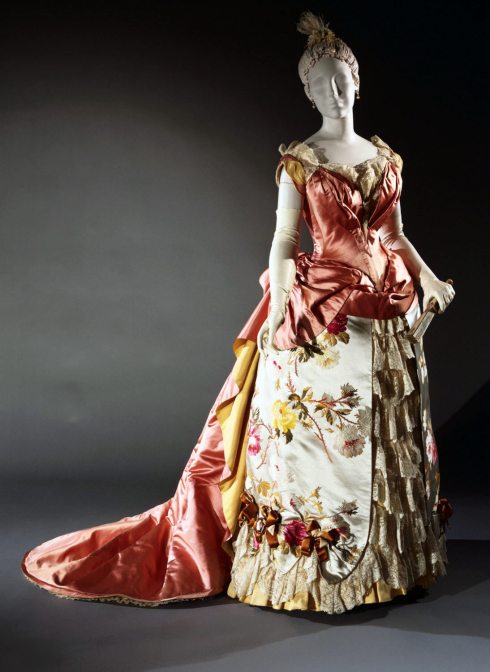
I came across a dress so beautiful the other day that I started thinking about its owner/wearer, Elizabeth Goodhue Millett Fenollosa, wife of the famous “Orientalist” and cultural ambassador Ernest Fenollosa, who happened to grow up in the house right next door to mine here in Salem. Actually “Lizzie” Fenollosa, who was also Salem-born and -raised, was Fenollosa’s first wife, who accompanied him to Japan, where he was eventually appointed Director of the Imperial Museum in Tokyo in 1888. Here is the Worth dress, which the curators of the Philadelphia Museum of Art believe might have been worn for her presentation at the Imperial Court coincidentally with her husband’s appointment. [Correction: please see comment below; Mr. Fenollosa was a professor of philosophy at Tokyo University and a curator at the Imperial Museum, but not its director.]

Fenollosa Dress

Women’s Evening Dress: Bodice and Skirt. Designed by Charles Frederick Worth, English (active Paris), 1825 – 1895. Worn by Mrs. Ernest Fenollosa, c. 1886-1887, Philadelphia Museum of Art. Gift of Mr. and Mrs. Owen Biddle, 1978.

I had never seen this stunning dress before but I was not surprised to see it in the collection of the Philadelphia museum, as the Fenollosas’ daughter Brenda was married into the prominent Biddle family of that city in 1913. Her son Owen Biddle and his wife donated the gown (along with another) to the museum, and she herself donated a lovely Meiji scroll from her father’s collection (and in his memory) in 1941. I was surprised to see another Fenollosa-related item in the museum’s collection, however: a photograph of her father’s second wife, Mary McNeil Fenollosa, by the photographer Eva Watson-Schütze, dated 1905. Obviously this item was not donated by the Biddle family, for the Fenollosa divorce was scandalous its day. I have no idea what Brenda’s feelings were, but her mother named Mary as a co-respondent in the 1895 proceedings.

Fenellosa Mary

Portrait of a Woman in Japanese Dress (Wife of Ernest Fenollosa), Eva Watson-Schütze, 1905. Philadelphia Museum of Art, 1905. Gift of Harvey S. Shipley Miller and J. Randall Plummer, 2004.

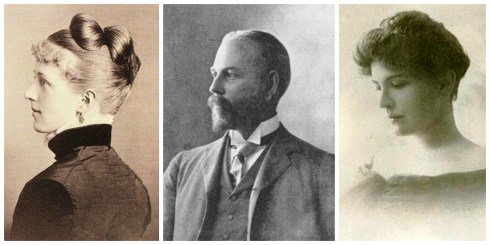
Ernest and Lizzie Fenollosa were childhood sweethearts in Salem; they were married right after his graduation from Harvard and then set off together for Japan, where he took up a position at the Imperial University at Tokyo and became fully immersed in traditional Japanese culture, eventually rising to his post at the Imperial Museum. He converted to Buddhism, but they did not appear to lead an ascetic lifestyle, if their house, their many western visitors (and her dress!) are any indication. During their time in Japan, Fenollosa also acquired a huge collection of traditional Japanese art, which he sold to Boston physician and philanthropist Charles Goddard Weld with the condition that it eventually be donated to the Museum of Fine Arts, Boston, where it now constitutes the Fenollosa-Weld Collection. The Fenollosas returned to Massachusetts in 1890, where he was appointed curator of the Department of Oriental Art at the MFA and organized several high-profile exhibitions. After he took up with Mary McNeil Scott, a twice-married southern secretary at the Museum, both his marriage and his curatorial career were over–although he continued in his scholarly activities. Lizzie and Brenda remained in the Boston area, but Ernest and Mary took off after their marriage: to New York, back to Japan (she had spent time there too, which explains much of their instant connection), to Mobile, Alabama (her hometown), and to London, where he died of a heart attack in 1908.

Fenollosa CollageElizabeth Goodhue Millett Fenollosa, Ernest Fenellosa, Mary McNeil Scott Fenollosa.

The two Mrs. Fenollosas were very different women bound together by one man, as well as their experiences in Japan, I suppose. Elizabeth Fenollosa seems to have been a private woman, although by all accounts she was a gracious hostess and certain details about her divorce did leak out to the papers…..Mary Fenollosa was much more public, writing popular novels under the pseudonym Sidney McCall, poems under her own name, and serving as an advocate for her husband’s work after his death. Truth Dexter, her first and most popular novel, tells the story of a southern wife (the title character) whose marriage is endangered by a brazen Boston socialite! That was too much for Lizzie, who told the New York Times that her intellectual ex-husband must have collaborated on the book as it contained too many little-known details of their lives together. I think that book, plus the fact that she’s a Salem girl, puts me on Team Lizzie, but both women certainly lived colorful lives that took them far from their places of origin.

Fenollosa House Buffum Street

Fenollosa House Japan Harvard Houghton

From Salem to Tokyo: Elizabeth Fenollosa’s childhood home on Buffum Street in Salem, and the Tokyo home she shared with Ernest, Fenollosa Papers, Houghton Library, Harvard University.


Felines in Frames

In GREAT anticipation of my visit to the Worcester Art Museum in order to see their big summer show, Meow: A CatInspired Exhibition (featuring cats-in-residence!) I have curated my own little digital exhibition, as I have a very large (digital) folder full of cat paintings.I could feature fifty paintings here, but I have restricted myself to seven, ok maybe nine. In chronological order, with commentary:

girl-with-garland_large

Cats HenryWriothesley

Hans Süss von Kulmbach (German, Kulmbach ca. 14801522 Nuremberg), Girl Making a Garland, c. 1508, Metropolitan Museum of Art, New York; John de Critz, the “Tower” Portrait of Henry Wriothesley, 3rd Earl of Southampton, imprisoned following the Essex Rebellion in 1601 with his cat Trixie. Buccleauch Collection, Boughton House.

Here we have enclosed portraits of remembrance and appeal: Southampton wants to get out of the Tower, and ultimately King James will release him. Cats are not pets in the pre-modern era, so typically they are depicted in the background, disassociated from humans and being cats: eyeing something to eat, chasing something, lying about. But here we have some very close-up, still, companion cats: unusual. The Southampton portrait and the significance of the cat has been dissected many, many times: my favorite analysis is here.

van Hoogstraten, Samuel, 1627-1678; A View through a House

(c) National Trust, Fenton House; Supplied by The Public Catalogue Foundation

A Sleeping Cat circa 1796-7 by Joseph Mallord William Turner 1775-1851

The nineteenth century is the golden age of cat paintings: cats move into the foreground, and even displace dogs in domestic settings (I think; but I could be biased). Certainly the American folk artists of the first half of the century loved cats–they are nearly omnipresent in the works of Zedidiah Belknap and Joseph H. Davis. Not only are they a fixture in the home, but also a subject of serious scrutiny, even preoccupation: so many Steinlen cats. I’m finishing up with another artist’s cat, featured in Eric Ravilious’s study of Edward Bawden in his Studio, from 1930. This is not the most aesthetically pleasing depiction of a cat, perhaps, but as every cat owner (companion? host? feeder?) knows, it is a very characteristic one.

Save

Save

Save

Save


A Breech-less Brute

The students in my Elizabethan class had quite a lot to say about Marcus Gheerhaerts’ 1594 portrait of Captain Thomas Lee yesterday: it is indeed a provocative portrait and he was indeed a provocative man. A poor relation of Sir Henry Lee, the Queen’s Champion and Master of the Armouries, Thomas’s career is characterized by his long “service” in Ireland, from the mid 1570s until the late 1590s, after which he was implicated in the Essex Rebellion of 1601 and executed for treason. In his pursuit of the conquest of Ireland and his own personal gain, Captain Lee murdered, blinded, stole, and conspired. When he was not “serving”, he engaged in highway robbery and was imprisoned for debt. He was not a happy outlaw, however, and the Gheerhaerts portrait, along with his two essays, A brief declaration of the government of Ireland  (1594) and The discovery and recovery of Ireland with the author’s apology (1599), are attempts to repair his reputation. Too little too late–though his arrest and execution at Tyburn in February of 1601 were consequences of his involvement in the Essex plot rather than any of his actions in Ireland, which were supposedly on behalf of the Queen.

Captain_Thomas_Lee_by_Marcus_Gheeraerts Portrait of Captain Thomas Lee by Marcus Gheeraerts II, 1594, Tate Britain.

Well of course this personal history does not explain why Captain Lee is not wearing pants (or breeches, or hose). Clearly that is the defining feature of this portrait, commonly known as “the man with the bare legs”. There’s something vaguely classical about the painting, with its pastoral background and Latin inscription on the right: Facere et pati Fortia, “To act and suffer bravely”, a quotation from Livy’s history of the Roman commander Caius Mucius Scaevola, who defeated Etruscan rebels by penetrating their camp and living among them, so he could know the enemy. He was recognized for his bravery and rewarded handsomely by the Roman government for his efforts and thus represented a useful example for Lee, who perhaps saw himself as performing a similar service for the Queen among the “wild” Irish. Despite its fanciful fabric, Lee’s outfit is actually a bit more pragmatic: he is fully-armed and wears some semblance of the “uniform” of an Irish foot-soldier, or “wood-kerne”, bare-legged to better accommodate the boggy terrain of the Emerald Isle. So Lee is presenting himself as Irish: he has “gone native” in the (sacrificial) service of the Queen. The true measure of his claimed “sacrifice” can only be grasped through a realization of just how “wilde”, barbaric, and brutal the English perceived and presented the Irish to be: John Derrick’s Image of Irelande (1581) is a good source for this, as is a book by another man who was constantly currying favor with the Queen, Edmund Spenser’s thoroughly racist View of the Present State of Ireland (c. 1596).

Lee Discovery Folger

1024px-The_Image_of_Irelande_-_plate01

Lee’s discoverye and recoverye of Ireland with the authors apologie, ca. 1600. Folger Shakespeare Library: John Derrick, The Image of Irelande, with a Discoverie of Woodkarne, 1581, Edinburgh University Library.

Save

Save

Save

Save

Save


Illustrations of the Improv’d Garden

I discovered the prolific British illustrator Clare Melinsky just recently, and apparently too late to obtain the examples of her work that I covet the most: illustrations based on several eighteenth-century gardening manuals by clergyman John Laurence, including: The Clergy-Man’s Recreation: Shewing the Pleasure and Profit of the Art of Gardening, The Gentleman’s Recreation: Or the Second Part of the Art of Gardening Improved, and (an apparent pseudonym) Charles Evelyn, The Lady’s Recreation: Or, the Art of Gardening Farther Improv’d (bound together in variant editions, 1717-1719, along with The Fruit-Garden Kalendar: Or, a Summary of the Art of Managing the Fruit-Garden). These are wonderful little practical books, and Melinsky’s clean linocut prints look like they are culled from the texts: they are period perfection and absolutely charming. Melinsky’s portfolio includes everything from The Witches of Salem: A Documentary Narrative (London: Folio Society, 1982) to the covers of the Bloomsbury boxed set of hardback “signature editions” of Harry Potter, and lots of flora and folktales and Shakespeare in between. Everything looks lovely, and I look forward to enjoying more of her work as time goes by but right now I’m pretty fixated on the unattainable “improv’d garden”  images–though her similar Robert Burns postcards might just suffice.

Melinsky Cards Collage

Melinsky Cards Collage Garden

Melinsky Collage

Melinsky Kew Gardens

Laurence Gardening Improvd Front

Melinsky Witch Linocut

Clare Melinsky’s Linocut “Gardening Improv’d” cards, along with a more “modern” illustration of Kew Gardens and a witch (just because) from here and here; Frontispiece ilustrations to Laurence’s Gardening Improv’d parts II and III, 1719.

Save

Save


Illustrations of Interest

There are several illustrations included in upcoming auctions that are of interest to me: some Salem things, and a few images which just appeal to me, period. First up is a little pamphlet by one of my representatives of Colonial Revival Salem, Mary Saltonstall Parker, who I wrote about more extensively here. She is known for her embroidery, her poetry and her prose, all of which evoked “Olde Salem” in a personal and heartfelt way. I can just imagine her and her contemporaries, including Frank Cousins and Mary Harrod Northend, working creatively and fervently to document all that was Salem (quite apart from the Witch Trials) in that heady decade of the 1890s. Mrs. Parker published little books continually through that decade, including one I do not have, Salem Scrap Book, with illustrations by S.E.C. Oliver, or Sarah E. Oliver, whom I presume is either the daughter or granddaughter of former Salem Mayor Henry Kemble Oliver, whose portrait is in the book. Miss Oliver’s illustrations are new to me so I’m going to search out for some more, because they look…..interesting. I also like how the content seems to be critiquing the two pillars of Salem tourism in the 1890s: Hawthorne and witches (now only one pillar stands): How Hawthorne would his face have hated, Burnt into cups, or silver-plated!…..We’ll let the poor old witches rest.

Salem Scrap Book

Salem Scrap Book 2

Swann Auction Galleries has a great auction of illustrated books coming up next week which includes several lots which caught my eye. I’ve always wanted a copy of Howard Pyle’s Book of the American Spirit, which includes images of several scenes of Salem “history”, including the previously-published young reputed witch on her way to the gallows and the iconic A Wolf had Not Been Seen in Salem for Thirty Years.  And speaking of Hawthorne, a 1918 English First Edition of Tanglewood Tales with illustrations by Edmund Dulac is also included in this Swann auction, as are more Dulac illustrations of famous and not-so-famous fables and fairy tales, the focus of this collection.

Pyle Dulcibel Spirit

Pyle Wolfe Salem

Hawthorne Dulac

Edmund-Dulac-Book-Tanglewood-Tales-First-Edition-1918-endpaper

Dulac Fables and Tales

Illustrations by Howard Pyle and Edmund Dulac from the upcoming Swann auction of the Salinas Collection of Fine Illustrated and Plate Books.

Save

Save

Save

Save


A Pair of Pears

I had a pear-oriented day yesterday. I was trying to work on the syllabus for my upcoming graduate course on Elizabethan England as well as the three-semester schedule for our department’s course offerings. Both are rather tedious tasks so I was taking regular breaks and roaming (both digitally and literally) away for bouts of time. I always like to have an “inspirational image” on my syllabi, and under the pretense of looking for one I spent hours examining Elizabethan portraits. Hours. Who is this, where are they, what are they holding, why are they dressed that way? Then I would feel guilty and go back to the syllabus and the schedule. Then I would take another break and go outside and see what’s popped up in my garden, ride my bike, play with my cats, and come inside and scope out lots in upcoming auctions, between loads of laundry and stabs at my syllabus and schedule. So you see the rhythm of my day, and by the end of this day of searching for Elizabethan images and secreting away from my schedule I ended up fixated on a pair of pears (or two pairs of pears really).

800px-Three_Young_Girls_by_Follower_of_William_Larkin

Pears by Sultan Skinner Auctions

Anonymous follow of William Larkin, Three Young Girls, c. 1620, Berger Collection, Denver Art Museum; Donald Sultan, Pears screenprint from Fruit, Flowers and a Fish, 1989-91, published by Parasol Press, Ltd., New York, Skinner Auctions.

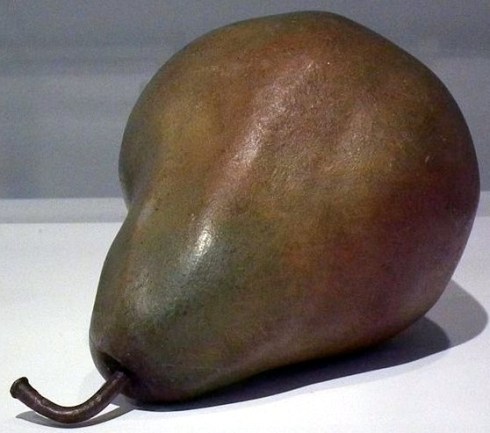
The painting of the three girls is not even Elizabethan–it dates from a bit later. But look at these girls, so beautiful and so ready, but for what? To greet an eminent visitor? To assume command of the household upon the death of their mother? The ripe fruit held by the older two might represent their maturity (and fecundity) while the younger girl is still “playing” with dolls–is this one a representation of Queen Elizabeth? I’m quite preoccupied with this painting: apparently lots of research remains to be done on both its projection(s) and its painter. Sultan’s pears appeal to me aesthetically, though I don’t have any questions about them (such is my reaction to much modern art). In their craftsmanship and detail they do, however, remind me of a very famous Salem pear: Samuel McIntire’s carving of an exemplar pear grown in Ipswich first captured by his contemporary, artist Michele Felice Corné.

Pear Carving McIntire PEM

Pear model by Samuel McIntire, 1802-1811, after a painting by Michele Felice Corné, Peabody Essex Museum, Salem.

I don’t feel like I have to draw Salem connections to every topic I write about here, but sometimes I can’t help it! Salem actually plays a very big role in pomological history as it prospered at a time when pears were much, much, much more important than mere apples, or any other tree fruit. More generally, Salem’s horticultural history is another example of its heritage that gets completely overshadowed by the giant Witch Trials. From Governor Endecott’s pear tree, planted around 1630 and still standing in nearby Danvers (then Salem–read a very complete history here), to the nearly as old and much commented-upon orange pear tree on the Hardy Street property of Captain William Allen, to the popular colonial pear cider, or “perry” made from Salem fruit, to Nathaniel Hawthorne’s grandfather Robert Manning’s vast “Pomological Garden” in North Salem, it is very evident that pears were popular, and perceived as representative of both Salem’s productivity and longevity. In a report on the Horticultural Exhibition held at the Essex Institute in 1850, the Horticultural Review and Botantical Magazine noted that this Salem must be a wonderful place for longevity. While we are boasting of our pears that begin to bear on bushes, three or four years old, these Salemites claim nearly as many centuries for some of theirs.

Pear Tree Danvers PC

Pears Buffum 1877

1910 postcard of the Endecott Pear Tree, Danvers; a pair of Buffum pears, one of the hundreds of varieties grown at Robert Manning’s “Pomological Garden” on Dearborn Street in the mid-19th century, from D.M. Dewey’s The nurseryman’s pocket specimen book : colored from nature : fruits, flowers, ornamental trees, shrubs, roses, &c (1872).

P.S. I did finish the syllabus, but not the schedule.


What to do with my Stereoviews?

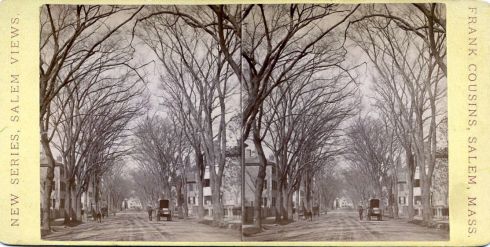
I’ve been a collector of sorts for much of my life but I never collected historic photographic images until I started this blog: I quickly realized their power to tell stories and provide context in this, our digital age. So I started buying some Salem images, mostly stereoviews, which were produced in vast quantities in the later nineteenth century. There were about six or seven major publishers of stereoviews here in Salem at that time, but I’ve focused almost all my collecting efforts on images associated with Frank Cousins, as either photographer or publisher. I just completed my collection of his sentimental “Salem in 1876” views, encompassing nearly every corner of central Salem. Now I’ve got a (shoe) box of stereoviews and I’m not quite sure what to do with them.

Stereoviews

Stereoviews 2

Steroview Chestnut Street Cousins

Frank Cousins published views taken both up and down Chestnut Street and all over the city, documenting “Salem in 1876”.

Stereoviews are relatively easy to acquire, especially of a city like Salem which has been selling its image, in one way or another, for quite some time. They turn up online very frequently and I always find them at the larger flea markets and paper shows. My collection is pretty focused on Cousins, but it also has a few views that I have never seen anywhere else, including a great (though completely unattributed and undated) view of Front Street from Washington Street and a rather unusual (forested!) view of the South Church that stood across Chestnut Street from my house for nearly a century. This McIntire masterpiece burned down in 1803: I’m trying to gather as many images of it so I can glean its impact from every possible perspective. My verdant view is contrasted with a more typical image of the church, from the best source for digitized stereoviews: the Robert N. Dennis Collection of Stereoscopic Views at the New York Public Library (where you can make “stereogranimators”).

Stereoview Front Street Salem

Stereoview Second Church Tilton

Stereo South Church Salem NYPL

(Stereo)view of Front Street, ?date, ?photographer); the South Church on Chestnut by Peabody & Tilton, c. 1875 and Guy & Brothers, c. 1884, Dennis Collection, New York Public Library.

Obviously I have a predilection for streetscapes but I like some (not all; some are creepy) of the more intimate, “up close and personal” stereoviews too. I’ve seen quite a few of people just standing outside their houses, being captured for posterity. A double dose of daily life. I love this image of a Salem Willows summer cottage with its residents, all ready for summer. This is not mine, unfortunately, but from another great source of stereoviews: the Center for Lowell History at the University of Massachusetts at Lowell Libraries.

Stereoview Juniper Point UMASS Lowell SP

“View at Juniper Point, Salem Neck, Mass.”, n.d., Center for Lowell History at the University of Massachusetts Lowell Libraries (the original Willows cottages were built for Lowell residents who wanted to summer on the coast).

So again, what to do with those stereoviews that I do possess? Ultimately I will leave them all to the Salem State University Library’s Archives and Special Collections, because what Salem needs is a Center for Salem History there, as the Peabody Essex Museum ceased its historical-society function long ago. But in the meantime, I’d like to find a more clever and creative way to preserve and display them. I’d like to get them out of the box! I guess I could frame them in some interesting combinations and create a gallery wall, but that’s about the extent of my creativity. Brass floating frames? Display them with a special “twinscope” at hand like this cool exhibit from just last year, Syracuse in 3-D (1860-1910)? I’m open to suggestions, because I do think there is something very engaging–both aesthetically and historically– about images in multiples. As evidence, I give you this beautiful invitation to the Pickering House’s annual garden party by Salem artist Racket Shreve, paired with Cousins’ stereoview, of course.

OLYMPUS DIGITAL CAMERA

Stereo Pickering

Stereoview Pickering House Cousins 1876

Scene from the interactive “Syracuse in 3-D” exhibit by Colleen Woolpert (+ more here); Racket Shreve’s quatre-Pickering House invitation; Frank Cousins’ “Salem in 1876” stereoview of the Pickering House.


Playing Card Personas

I love the look of playing cards: the traditional suits, their predecessors (roses, crowns, rings, bells, leaves, hares, acorns…I could go on), and their endless variations and adaptations over the centuries. It is one thing to transform a card into something else entirely, or replace the familiar figures with new entities, scenes or characters (events of the English Civil War, generals during the American Civil War, the non-standard Kings and Queens of every European country, the “dedicated decks” of Salem’s own Parker Brothers), but quite another to bequeath personality to the stiff standardized Kings and Queens of the traditional deck. That artistic feat is impressive to me: so I fell for one of Felix Blommestijn’s cards a few years back, and a collage of Elmo Hood caught my eye immediately when it came across my Instagram feed last week. Now I see that his playing card creations have gone viral over the past few years, but they were quite a discovery for me.The collages are very dear, the prints affordable but apparently sold out everywhere, and I can see why: Hood’s kings, queens and jacks are immediately recognizable, but they are also active (or reactive). Quite the card trick!

Elmo Hood Broken Queen 2014

Elmo Hood Queen and King

Elmo Hood PlayingCard Print

elmo hood jack queen king

Elmo Hood Two Kings

Elmo Hood Love is Rare

Elmo Hood Jack and King

@Elmo Hood collages and prints: “Broken Queen”, “Queen of Hearts/Suicide King”, “Loyal”;  “Most Young Kings get their Heads cut off”; “Diamond Heist”; “Cards were Harmed in the Making of this Art”.  More here and here.