I have several odd phobias including busts: I can’t stand to look at a sculpted portrait busts. They look like severed heads to me—even if they are beautiful. And many are: particularly classical ones, also Renaissance and Baroque ones, but after that I think we should have just left that genre to past masters. My distaste for these disembodied sculptures is a perennial problem because I’m a historian, so I often find myself in rare book libraries, which always feature busts. I just sit myself down as far as I can get away from them, and then get down to business. I think my dislike of busts is very consistent, so much so that when the art historian daughter of a colleague brought two busts by Salem’s iconic master woodcarver/architect Samuel McIntire, the namesake of my neighborhood, to my attention, my reaction was not: wow! but instead oh no. Here they are: busts of John Winthrop, the first governor of Massachusetts Bay, and Voltaire, both commissioned by the Reverend William Bentley in 1798-99 and later donated to the American Antiquarian Society.

Maybe I could be in the presence of Voltaire (right) for a few moments, but that John Winthrop bust is simply frightening! You only have the profile above: here he is, face forward: really scary, even in a lovely watercolor of the actual bust made by Joseph Goldberg for the Index of American Art in the 1930s. We are separated by several degrees, but I’m still afraid.

I did not feel very good about disliking, even fearing, something made by McIntire, who is revered here in Salem of course, until I read the entry in William Bentley’s diary on the day that he received the commissioned work: MacIntire returned to me my Winthrop. I cannot say that he has expressed in the bust anything that agrees with the Governor. So he didn’t like it either! Nevertheless, he accepted it and paid McIntire his $8.00 fee. But it’s not McIntire, it’s me: even the works of the greatest sculptor of that era, Jean Antoine Houdon, are off-putting to me. Houdon’s Voltaire? Horrifying–much more so than McIntire’s. I will say that the famous Houdon bust of Washington seems less alarming to me, although this multi-perspective video creeps me out.

Even the most handsome Salemite, Nathaniel Hawthorne, as carved by the most gifted sculptor of his generation, Daniel Chester French, is scary. Granted French chose to depict Hawthorne later in life rather than in his splendid youth, but still: sad and scary. Quite conversely, a bust that was crafted to repel, Gian Lorenzo Bernini’s Anima Damnata (1619), I find far less threatening: one expects a Damned Soul to be scary, but not Nathaniel Hawthorne or John Winthrop.


 Portholes and eyes at the PEM.


 Just a few items from Ocean Liners, which also includes some amazing ship models of which I don’t seem to be able to take a good photograph. Stanley Spencer’s Shipbuilders on the Clyde: Riveters (1941) is amazing! The panel from the Titanic’s sister ship Olympic is displayed in full majesty, altar-style, in the midst of renderings from other pre-World War I ships–this was an era in which the interiors were certainly not streamlined. I never knew there was Titanic “recreation diorama” for tourists just a couple of years after the disaster! This Fred Spear Enlist poster from 1915, showing victims of the Lusitania sinking, really stopped me in my tracks–the last image is from the Library of Congress.

 My favorite posters from It’s Alive, on either side of some very atmospheric wallpaper.
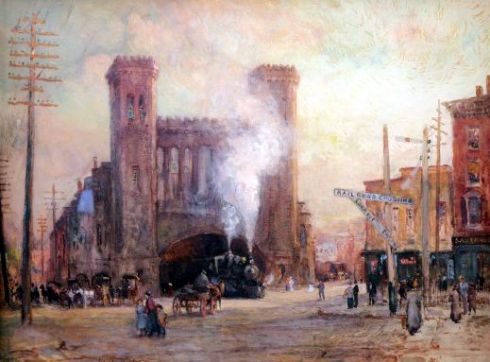




 19th Century Reverse-Painted Ship Silhouette on Glass Maple Frame, circa 1840, Trinity Antiques & Interiors,
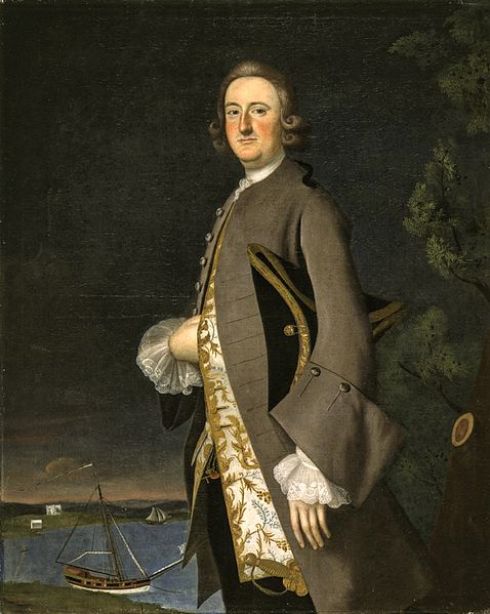
 Michele Felice Corné’s Perseverance Wrecked (1805), and a portrait of Captain Richard Wheatland by the Chinese artist

 H.M.S.
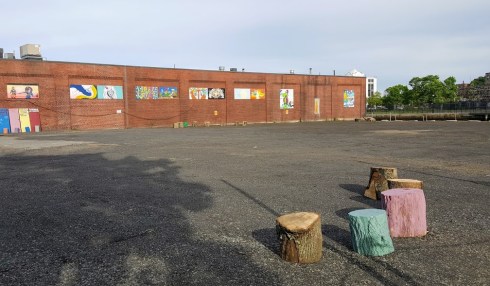
 The lot today and on the 1897 Salem Atlas, marked by the old lightbulb. It was R.C. Manning & Company’s coal and lumber yard then, and it served in a similar capacity well before and after. Below: the process of placemaking.


 Monopoly in the Park in San Jose (You can see more images at Anna Fox’s
 Street Monopoly by Bored, via


 Canadian artist An Te Liu’s


 Capture of Major John Andre by John Paulding, David Williams and Issac Vanwart, New York: Sowle and Shaw, 1845, Library of Congress; The Capture of Major André, Thomas Sully, 1812,
 Holyoke Family Coat of Arms, late eighteenth century, attributed to Samuel Blyth, Northeast


 Robert Lawson, The March of Progress, 1928.