
We know her instantly when we see her: from her famous John Singer Sargent portrait painted 20 years later: she is Ellen Peabody Endicott, the Grande Dame of Salem, Boston, and Washington society, standing right behind the bride at the first presidential White House wedding of Grover Cleveland and Frances Folsom on June 2, 1886. As the wife of Cleveland’s Secretary of War, William Crowninshield Endicott, she was invited to the intimate “stand-up” wedding, along with all the other cabinet ministers and their wives and so appeared in national newspaper stories over the next few weeks: her face is strong and clear-cut. One would say it was the typical Boston face. Mrs. Endicott looks like the high-bred New England woman of long descent. She wore a red pompom in her handsome gray hair at the president’s wedding. Mrs. Endicott is her husband’s first cousin. Both are descendants of the Putnam family.


 The President’s wedding from Harper’s Weekly, June 12, 1886 via the Library of Congress. Mrs. Endicott is on the extreme left above.
Yes, that’s correct: Ellen Peabody Endicott was an Endicott both my birth and by marriage, and a perfect example of how early Salem families, and slightly “newer” merchant families, liked to stick together. She was the granddaughter of Joseph Peabody, one of Salem’s richest golden-age merchants if not the richest, and was born (in 1833) and raised in two beautiful houses: 29 Washington Square on the Common (now the Bertram Home) and the summer house in Danvers, which the Endicotts later referred to simply as “the farm” (now Glen Magna, owned by the Danvers Historical Society). About a decade after her marriage to William Crowninshield Endicott in 1859 they established their primary Salem residence at the venerable Georgian mansion on Essex Street now known as the Cabot-Low-Endicott House: this house became quite notable due to Mr. Endicott’s rather spectacular career (Chief Justice of the Massachusetts Supreme Court, Secretary of War in the Cleveland administration) and their daughter’s spectacular marriage to the British politician Joseph Chamberlain. The Endicotts moved into a Boston brownstone mansion on Marlborough Street following his retirement, but still spent all of their summers in Danvers.
 Mrs. Endicott’s houses: clockwise, Washington Square and Essex Street, Salem; 163 Marlborough Street, the Farm (Glen Magna).
Mrs. Endicott is a perfect example of yet another theme that has been emerging from these #salemsuffragesaturday posts: the difficulty of piecing together women’s lives when you only get references through an association—usually a husband. In Mrs. Endicott’s case, we hear about her because of her husband’s cabinet position and also because her daughter married the notable British politician Joseph Chamberlain in 1888: the transatlantic marriage was big news on both sides of the ocean and the bride’s parents are always characterized as old Yankees, Boston Brahmins, Puritan and/or Codfish aristocracy in all the stories (you can read all about the “Puritan Princess” here). There was also interest in the new Mrs. Cleveland, and on the several occasions when she traveled to Massachusetts, Mrs. Endicott was sent to meet and accompany her: consequently we get to hear about what both women wore in considerable detail.

But later in life, after her husband’s death in 1900, we begin to see Ellen Peabody Endicott for herself: in terms of her accomplishments and quite literally. She oversaw (with the help of her son, William Crowninshield, Jr., and her son-in-law Joseph Chamberlain) considerable improvements to the house and garden at the Danvers estate, including the installation of the beautiful McIntire summer house which was originally built for Elias Haskett Derby’s farm on Andover Street a few miles away in what is now Peabody. And then there are the two amazing portraits by John Singer Sargent: in oil and charcoal. The latter is very appropriately in the collection of the Peabody Essex Museum, and was included in the Sargent exhibition at the Morgan Library and Museum just last year.


 William Crowninshield’s death in May of 1901 was a national headline; Ellen Peabody Endicott (Mrs. William Crowninshield Endicott), 1901 by John Singer Sargent, National Gallery of Art: Gift of Louise Thoron Endicott in memory of Mr. and Mrs. William Crowninshield Endicott; Portrait of Ellen Peabody Endicott, 1905, John Singer Sargent, Peabody Essex Museum: Gift of Mrs. William Hartley Carnegie, 1957.
Appendix: Painting Ellen’s Portrait! The Sargent oil portrait in situ in Karin Jurick’s painting “Sitting Idly By”: you can see more of her work here.


 Boston Post 13 February 1903




 Fidelia Bridges (1834-1923) by Oliver Ingraham Lay, 1872, Smithsonian: Bridges is probably the first and most successful Salem woman artist, though she traveled widely and lived in Connecticut for most of her professional life.

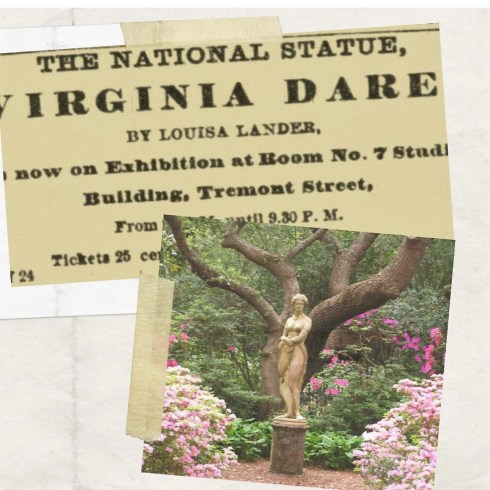 Mary E. Williams, illustrations from The Hours of Raphael in Outline – Together with the Ceiling of the Hall Where They Were Originally Painted (Little, Brown, 1891); Just some of Mary and Abigail Williams’ works shown in the 1875 Essex Institute Exhibition; Virginia Dare in the Elizabethan Gardens & notice in the Boston Post, January 24, 1865.


 Betty Ring’s two-volume Girlhood Embroidery; Salem samplers by Susannah Saunders (Sothebys) and Elizabeth Crowinshield (Doyles); Jenny Brooks Co. advertisements from 1913, and Mary Saltonstall Parker’s cover embroidery for House Beautiful, October 1916.
 Sarah Symonds in her studio, Phillips MSS 0.202, Papers of Sarah Symonds, 1912-21.

 ©Julie Shaw Lutts, The Vote.
 Samantha is currently wearing an ensemble by local artist Jacob Belair, which I think is lovely on its own but also because it covers part of her up! I wish it extended to her unfortunate pedestal. I’m not in Salem now, so I asked my stepson ©Allen Seger to take the photos of Samantha in crochet.

 The Boston Women’s Memorial by Meredith Bergmann; photographs from her
 Model and Mock-up of the first and final monument to the Women’s Rights Pioneers by Sculptor Meredith Bergmann, to be unveiled in Central Park on August 26, 2020.


 The Knoxville and Nashville Suffrage statues—both by Tennessee sculptor Alan LeQuire—and the unveiling of seven statues of prominent Virginia women last fall: former Virginia First Lady Susan Allen points to a statue of Elizabeth Keckley, dressmaker for Mary Todd Lincoln, and suffragist Adele Clark among the crowds (Bob Brown/ Richmond Times-Dispatch).
 The Anthony-Stanton-Bloomer statue (1998) by Ted Aub in Seneca Falls; Ira Srole’s “Let’s Have Tea” (2009) in Rochester.
 Office of the Architect of the Capitol.


 The MEN: pro-veil John Endicott and anti-veil John Cotton.
 The WOMEN: what were they wearing? Well, these are English women rather than Salem women but they are contemporary and this first portrait is one of my very FAVORITES: an anonymous painter and subject, it it titled “A Puritan Lady”, 1638, Berwick Museum & Art Gallery. I think it was back to the “steeple-crowned hat”, if they ever took them off! You tend to see veils for particular occasions and times of life: the second portrait is of Jane Trevor, Lady Myddleton as a WIDOW, so she is wearing a mourning veil. National Trust, Chirk Castle, c. 1670.


 Boston Sunday Post, February 3, 1918 & Boston Sunday Globe, April 7, 1918.
 The standard war-time recipe for grape “catchup”, sometimes called catsup and later ketchup: it evolves into a relish over the twentieth century, but earlier in the century there were many different types of catchups: cranberry, mushroom, any fruit or vegetable really, and it was recommended that such sauces be served with roasts. I bet Mrs. Gibney had a more economical recipe for her grape catchup as 2 pounds of sugar would have been very dear in 1918.
 We just discovered that Hamilton Hall served as a Surgical Dressings center for the Salem Red Cross in the summer of 1918, so Mrs. Gibney might have worked there—my attempt at a ghost sign for the Hall!






