
Residents of Salem have long noticed that our city’s Halloween festivities are not confined to October, hence “Septoberween,” a phrase I’ve heard once or twice. It’s been crowded for some time though—all summer, late spring—people are coming for a general goth spookiness, I think, rather than just for Halloween. Of course, none of it is connected to Salem, or the Salem witch trials, because they were not witches but try telling that to a bridal party wearing little witch hats in July. I’m not sure what’s going to happen to Salem’s dark tourism, but it does seem as if something needs to change in its overall management (I’ve given up on messaging). Whatever happens, if anything at all, will be the result of a top-down decision rather than any impetus from mere residents. After last Halloween season, when weekend crowds of a million people pushed around downtown, I decided that I had experienced my last Salem October: my husband and I are packing up the cats and moving to Maine for a month. Fortunately we have a big family house in York Harbor, which my parents generally vacate for a cozier condo nearby, so I’m going home. I think this is a good solution for my Halloween angst, but we’ll see: I’ll still be commuting to Salem several times a week! Since I’m getting out of town, I thought I would push up my annual little advice to visitors post a bit, especially as I’ve received a lot of email queries over the summer. This is hardly an exhaustive list: if you want that I suggest Destination Salem (truly the master list of events and a very dynamic site, but skip the “History” sections which are dreadful), or Things To Do in Salem or the dedicated Haunted Happenings site. I am no booster, as regular readers of this blog know, so the most important assertion I can make here is that there is only one museum in Salem, the Peabody Essex Museum (PEM), and the best advice I can give is to avoid all the other venues calling themselves museums if you are seeking authentic objects and/or professional curation based on the most recent scholarship. If you are coming to Salem because you want to learn about the Salem Witch Trials, the PEM offers a lot, but not the whole story: that’s not its mission. However, in the past five years or so, the PEM has really engaged with the Trials, and this year is offering an exhibition entitled The Salem Witch Trials. Recovering Justice. I popped in yesterday and found it very accessible and continuous with its previous exhibitions’ focus on authentic documents and objects.


Given the focus is on recovering justice, I think it would have been nice to exhibit some of the restitution requests (+transcriptions) submitted by victims and victims’ families that are referenced above: these statements by those related to the “Sufferers in the time of the Witchcraft” are very compelling and can amplify the judicial tragedy. The struggle to clear the names of those who were not included in the 1711 Reversal of Attainder could have been given more attention as well—it extended all the way up the 21st century! The exhibition does include the most recent attempt at restitution: the successful campaign of North Andover middle-school students to exonerate Elizabeth Johnson, who confessed to practicing witchcraft and was condemned to death but obtained a reprieve but no reversal. Similar heroic efforts happened in the 1950s when Ann Pudeator “and certain other persons” were legally exonerated, and again in 2001 when those “certain other persons” were named in a formal resolution. The Recovering Justice exhibit invites its onlookers to dig deeper in both primary and secondary sources, and also to visit other galleries in the PEM: the month of October gets its own “chapter” in Salem Stories and related objects and images can also be found in On this Ground: Being and Belonging in America.


News clippings from exoneration efforts in the past (which also offer interesting insights into the commercialization of the Witch Trials in Salem), further reading in the Recovering Justice exhibition (including my colleague Tad Baker’s definitive book), October in Salem Stories and portrait of Witch Trial judge Samuel Sewall by John Smibert, 1733, in On this Ground gallery.


Krystina Yeager explaining Puritan theology and disdain of counter-magic in the courtyard of the First Church and the horrors of the Salem gaol in 1692 in a rather less inspirational spot: clearly tour guides have to be conjurers! Our ending point at the Witch Trials Memorial overlooked by the 17th Century Pickman House, which is now the Welcome Center for both the Memorial and the adjoining Charter Street Cemetery.
And speaking of authenticity, as I have throughout this post, I really can’t recommend the adjoining sites overseen by the Charter Street Cemetery Welcome Center enough, and its establishment was a City initiative, in collaboration with the PEM. A decade ago, both the Witch Trials Memorial and the adjoining Charter Street Cemetery, otherwise known as the “Old Burying Ground,” were being completely overrun by tourists: the walls of the former and graves of the latter were actually endangered by abuse. I don’t even like to think or write about it, if you want to “go” there, read this post, which I typed with my hands shaking. The City stepped up, restored the cemetery and opened an orientation center in the adjoining Samuel Pickman House owned by PEM. Welcome Center staff monitor both the cemetery and the Memorial, and every time I go there, even last Septoberween, there is an air of respect and stewardship for these sacred places. I saw Amber Shannon, another Salem State History grad who works at the Welcome Center, on my way out, keeping her eyes on both the cemetery and the Memorial and clearly steeling herself for the crowds to come. I think everyone in Salem was doing that, this first weekend in September.


Amber Shannon of the Charter Street Cemetery Welcome Center and Rory Raven of Salem on Foot Tours, the first Sunday in September, (relative) calm before the storm. I haven’t been fortunate enough to take one of Rory’s tours, but when I heard him speak at an event he made an impression, and so when some family members visited a couple of years ago I signed them right up. They raved, and so I would certainly recommend his tour as well, especially if you’re interested in a more general tour of Salem and not just the Witch Trials. As I’ve been ranting about here for years now, there’s so much more to Salem!

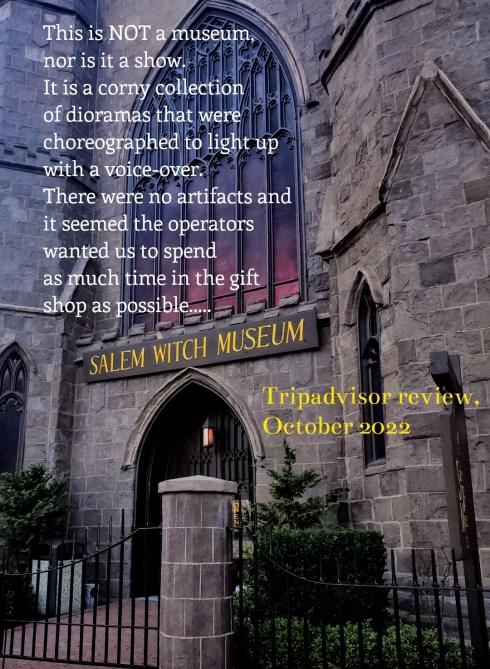


 So, much of this seems fine, certainly the themes are great (more on them below), and the criteria professional. I’m having some difficulty envisioning the logistics of the vetting process, but will leave that to the experts. What does concern me, however, is the disassociation of “site” and “building” as referenced in #3 on. As you see in my graphic above, the Salem Witch Museum, the most profitable of the for-profits, is referred to as the former East Church, which is presumably how it made the cut. Why the East Church is deemed “historic” is beyond me, aside from its imposing Gothic Revival style: certainly it is no more historic than the nearby houses of ultra-philanthropist George Peabody and Supreme Court Justice Joseph Story, or the birthplace of the illustrious Benson brothers across the Common. When I asked why and how the Salem Witch Dungeon Museum, also located in a former church (built by the Christian Scientists and not the East Church parishioners), was included on the trail, I got this response from the Executive Director of Destination Salem: The Witch Dungeon Museum and Lynde Street are the site of early fortifications. English settlers knew that their presence in Salem immersed them in a web of global conflicts. Fearing reprisals from the indigenous people they were displacing and attacks from other colonial powers, the colony of Massachusetts erected a fort near this spot in 1629. Samuel Sharpe came from London with cannons to assume command of the militia. The first fort was probably made of tall wooden palisades, with extensions jutting out to prevent flanking. In the following decades, further fortifications were built along the Salem coast and a palisade was built along the western end of town. The early, feared attacks never happened. The East Church built a chapel on Lynde Street in 1897 and The Witch Dungeon Museum opened in the building in 1979. Visitors can watch a live-action reenactment of a witch trial and tour a recreation of the grim prison where the accused were kept. So basically: because a long-gone fort was once on the site of the Salem Witch Dungeon Museum, it qualifies for the trail? I don’t think I need to spend too long discussing the implications of this “standard.” In a city as old as Salem, every structure downtown was built on the site of something else: there are layers and layers and layers. The Witch Dungeon Museum’s storefront sister “museum” on venerable Essex Street, the Salem Witch History Museum, could claim that it sits on the site of Salem’s first printing house or any number of historic structures and thus qualify for the new Heritage Trail. Perhaps the cumulative criteria above could mitigate against this, but it does not appear to have done so with the Salem Witch Dungeon Museum: I think we need to be honest about where we are leading people—and why.
 Mannequin City: mid-20th century interpretive “technology” reigns in Salem’s for-profit witch “museums” which have no incentive to innovate, as the City delivers visitors right to their doors; Witch Dungeon Museum hanging mannequins.


 Salem tourism brochures from the 1950s through the 1980s: not until the last decade was the Heritage Trail restricted to downtown and the “story” increasingly restricted to witches. Love the sentiment of “traveling through history in Salem.”
 Higginson Square, 1893, Nelson Dionne History Collection, Salem State Archives and Special Collections. A big flatiron to highlight Asheville’s Flatiron building. It begs the question: no Parker Brothers site for Salem’s new Heritage Trail?




 Winter Street

 On Washington Square East.


 Salem Maritime National Historic Site and the Salem Arts Association.


 From the Brookhouse Home to the PEM’s row of historic houses on Essex Street. Memorial stone in the Brookwood garden: Miss Amy Nurse, RN, an Army Nurse (1916-2013).


 Charter, Front & upper Essex Streets.


 Anchor from the Queen Anne’s Revenge, whose wreck was discovered in 1996. The Queen Anne’s Revenge
 A REAL Anchor.






