Tag Archives: Witch City

“Salem is not a Theme Park”

You hear my title phrase all the time in Salem now, with increasing frequency. It’s a way to acknowledge the fact that residents of Salem have to (or want to): go to work, drive to their appointments, take their kids to school, walk along the sidewalk or sit on their front stoops in the prolonged Halloween season of September and October (and a bit of November, and…….) when a million people shuffle around our very small city taking pictures of each other. Most people say it out of frustration. I’ve heard this expression from members of our City government as well, no doubt to also express frustration but at the time time, as coverage for doing nothing to ease it. Because the (other) official party line is that no one can do anything about it; the tourists just come and we have to do everything possible to accomodate them. We couldn’t possibly be asking them to come, in any way, because that would indicate a deliberate campaign to exploit an historic tragedy. Nope, they just come, we can’t stop them, and Salem is a real city, not a theme park, and if it exhibits theme park characteristics in response to the demands of the crowd, it’s the tourists’ fault and not ours! I understand the desire to point out that Salem is not a theme park, but at the same time, it looks like one to me, during this time of year, and increasingly all year long. And there’s a bit of protesting too much that it isn’t one going on here.

Here’s my argument for.

Some definitions of a “theme park”:

Oxford English Dictionary (my holy grail): an amusement park designed or organized around a unifying idea or subject.

Merriam-Webster: an amusement park in which the structures and settings are based on a central theme.

Cambridge Dictionary: a large permanent area for public entertainment, with entertaining activities and big machines to ride on or play games or restaurants, etc., sometimes all connected with a single subject.

Collins: theme park is a large outdoor area where people pay to go to enjoy themselves. All the different activities in a theme park are usually based on a particular idea or theme.

This last definition could undermine my assertion, as people do not pay an admission fee to enter Salem—but they certainly pay in all sort of other ways. Still, it makes the point that a theme park is generally seen as a private enterprise, and I think that’s a big part of the “Salem is not a theme park” refrain. It’s not Disney. But I’m still going to beg to differ. And certainly no one can argue that Salem does not have a central, unifying theme! I could show you tons of pictures of a packed Essex Street which would look very theme-parkish, but I really feel that the City looks most like a designated entertainment zone—or even a movie set– early in the morning when no one is about. Right in the center of it all is Samantha, the Bewitched statue, surveying her domain.

It was a slow burn, but once the Hocus Pocus fan base reached critical mass, that gloss was added to Salem’s veneer as key scenes were shot here. During the week before Halloween, the Peabody Essex Museum dresses up the Ropes Mansion as “Allison’s House,” which you can see above, along with the City’s new bollards installed to protect picture-takers and tour groups. This scene definitely reinforces the “Salem as set” impression! Across town, Salem Common is transformed into a marketplace, food court, and carnival site at this time of year, and you can’t get more theme park than that–a large outdoor area where people pay to go to enjoy themselves.

And then there’s the coordinated messaging/marketing. Don’t get me wrong, it is necessary: people need to know which roads are closed and encouraged to take the train. But it looks and feels commercial rather than civic. Look at this first photo–posted by the Salem Police Department, whose badge bears the image of a witch on a broomstick. Just below, a post from the City’s official travel and tourism agency, Destination Salem: I’m sure this cookie is delicious (the Chocolate Pantry on Derby Street features wonderful treats all year long), but would it be front and center if it didn’t bear the City’s offical witch brand? The “unifying” or “central” focus is the defining characteristic of a theme park and you just can’t miss it in Salem. I completely understand the sentiments of frustrated Salem residents—-I think I actually uttered these same words myself to a squad of felt witch hat ladies who were just standing in the middle of my street obliviously when I was trying to pull out of my driveway, nearly late for class. But I think the City should own it; after all, it is no mean feat to transform a city into a theme park.


“A Country by Itself”

A mayoral task force commission has been meeting for the past few months, called to contextualize charges that Salem’s City Seal is demeaning to Asian Americans and explicity rascist. The image in question depicts an apparent native of Sumatra’s westernmost province of Aceh in the foreground, with a pepper plant alongside and (an apparent) Salem ship in the background: a rare 19th century acknowledgement that a western society’s (Salem) prosperity was tied to its trade with the East. I posted about this issue back in the fall of last year, when my stance was generally supportive of the 1839 seal but open to a community dialogue. I’m doing so again because I’ve watched (there is no other way to “participate” besides a form you can send in) four of the Task Force’s meetings and after looking at images of the Sumatran figure presented alongside Sambo images as “proof” of racism and hearing an assertion that the seal is the equivalent of the Confederate flag I am convinced that this is not a serious inquiry. The Task Force has scheduled a listening session for July 14 and one member who is a Salem native and expert in Indonesia’s history and culture has yet to make an appearance so perhaps things will get a bit more substantive but I don’t have high hopes at this point. That a tradition of such longstanding should be given such short shrift is unfortunate—actually more than unfortunate, unsettling.

Salem’s City Seal was adopted as the insignia of the City in March 1839, and it was a rather “flexible” image for the next fifty years or so: the central figure even changed from a man to a woman!  In 1888, artist Ross Turner was commissed to paint the orginal seal (bottom left) and it was pretty much standardized after that. For the 1926 Tercentenary of the founding of Salem, the City produced Seal medals (bottom right). There has been no attempt by the Task Force as of yet to place this image—or its evolution—in any historical context; the assumption seems to be that the existence of an 1839 rendering of an Acehnese Native is without question objectionable and the best way to modify the Seal is simply to remove said Native and have a lovely Sumatran scene sans person. The City motto, “Divitis Indiae usque ad ultimum sinum” – “To the farthest port of the rich East” – never changed and doesn’t appear to bother the Task Commission. It has inspired a number of artistic creations: the piece below is quilted fabric but I’ve seen the same in tile and as a painting and print.

I really don’t want to watch these meetings anymore.; I come away from them feeling quite sad. I know why Salem people are troubled by the prospect of an altered seal because I’ve heard from some: for some civic service or upon retirement fathers and mothers and brothers and sisters received a seal from the Mayor of the moment as a photograph was taken and a memory made. It’s not so personal for me, but I do have a somewhat-related memory from around the time I first moved to Salem. I was still in graduate school, working on my dissertation, and I used the purchase of my first house and the move as a rationale to procrastinate as much as possible from working on it: I had four new (old) fireplaces and suddenly it was really important to deck them out with andirons and everything—even though it was June! So I drove around the North Shore, poking around every antique shop that I came upon. In Essex (most definitely the antique capital of the North Shore) I got into a really nice discussion with a man who told me (I’m paraphrasing from memory here) that in its heyday Salem was so prosperous and Salem ships so numerous that all of its trading partners in the East Indies thought it was “a country unto itself.” To them, Salem was the United States or the United States was Salem. I was looking at maps in his shop (because of course I had to have antique maps all over my new walls) and he said something like—and there’s a map somewhere, with Salem depicted as the United States. Well, for the next decade or so, I was looking for that map. I thought it would look something like this:

Well maybe a less strident SALEM but you get the point. Of course I never found this map, because it never existed! Once I started reading about Salem history (which was pretty much when I started this blog) I soon realized that my antique dealer had it wrong or I had it wrong: but the perception behind the nonexistent map was very, very real. It is expressed generally in all the maritime histories of the nineteenth century, as well as texts that probe the cultural history of America’s encounters with the East. Samuel Eliot Morison gives the most detailed description in his Maritime History of Massachusetts: While Boston ships followed Magellan westward around the Horn, Salem sent her vessels eastward to the Dutch East Indies, Manila, both coasts of Africa and the smaller islands of the Pacific, and so thoroughly did they pre-empt this trade that as late as 1833 Po Adam, the wealthiest merchant of Quallah Battoo ‘‘believed Salem to be a country by itself, and one of the richest and most important sections of the globe.” I’m not sure Po Adam was the wealthiest merchant of Quallah Battoo (Kuala Batu), the major pepper port in Aceh, but he was a well-known friend of the American traders who disembarked there, warning Captain Charles Endicott of the impending attack on his ship Friendship in 1831 which resulted in the retaliatory attack by the U.S. Naval Frigate Potomac in the following year. In his account, Endicott called him “my old and tried friend” and captains for the ships owned in part or whole by Salem’s largest pepper trader, Joseph Peabody, expressed the same sentiments. Trade is always about human relationships, for better or for worse, and I think that’s why Joseph Peabody’s son George, the Salem alderman who is universally credited with the conception and depiction of the Salem Seal in 1839, placed a person in the center of it. And when that figure is stripped from Salem’s seal, inevitably it seems at this point, all we will have left is a commodity (like a Witch here in the Witch City).

Drawing of Po Adam from James Duncan Phillips, Pepper and Pirates, 1949; George Peabody by John Singer Sargent, Museum of Fine Arts, Boston. 


When Salem was Pretty

The Salem visual vibe is darker now, and focused firmly on “Gothic” rather than Federal or Colonial, but the Witch City used to be pretty. I wrote the chapter on the Colonial Revival in our forthcoming book Salem’s Centuries. New Perspectives on the History of an Old American City (for which we have our cover, and a production schedule, and a publication date coming soon!), spotlighting four Salem “influencers” who emphasized the city’s beauty and craftsmanship through various cultural initiatives: Mary Harrod Northend, Frank Cousins, George Francis Dow and Caroline Emmerton.  They were so successful that Salem coasted into a period of being known primarily for its architectural and aesthetic heritage that lasted well into the 1960s, an image that was sustained by the Essex Institute’s house museums and the very public battle over urban renewal. A succession of commercial and graphic artists celebrated Salem through their accessible imagery, and we see Salem grouped with Colonial Williamsburg, Historic Deerfield, Sturbridge Village, Mystic Seaport, and other traditional heritage destinations. In today’s competitive tourism realm Salem has pulled ahead of (or moved behind?) that pack by emphasizing horror over beauty, Gothic over Federal, and darkness over light. At least that’s the projection I see in so many shop windows and on so many websites, but I think I better do some more searching in the real world. There are also many AI images of a Salem that doesn’t even exist, a concocted Victorian-Gothic world with black cats and cute witches, but also church spires! Fantasy Salem is even more idealistic than what came before, depictions in color and black and white of well-manicured car-free streets and stately houses, a “city of treasures” according to Katharine Butler Hathaway.

Some of my favorite images of Salem from the 1920s to the 1960s: Felicie Waldo Howell’s “Spring on Chestnut Street” + various houses; shelter magazines LOVED Salem in the 1920s; Rudolph Ruzicka made several Salem prints; interior vignettes from House & Garden, June 1939;Chestnut Street scenes from Philip Kappel and Samuel Chamberlain; LOVE these notecards from Nantucket artist Ruth Haviland Sutton; the “Silent Traveler,” Chiang Yee’s view of the Custom House.


History is Gray

For the past month or so, I’ve been considering the case of the Salem City Seal and various reactions to it. In the past, before last month, I’ve probably thought about the seal for 5 minutes; over the last month, I’ve been thinking about it for many hours—too many, certainly. If you haven’t read my previous posts, here is what happened, succinctly: several members of the Salem community complained that the seal, with its depiction of a Sumatran man, pepper plants, and Salem ship, was stereoptypical and insulting to Asian-Americans. Their condern and complaint was brought to the city’s Race Equity Commission, which had deliberations over the summer and concluded that “damage had been done” and the seal should be redesigned. The Race Equity Commission reported this finding to a subcommittee of the Salem City Council which concurred (I think), but somewhere in the process someone stepped in and suggested a public task force to add some transparency and public comment to what had heretofore been quite a closed process—I think at best 40 people knew that our circa 1839 seal was deemed suspect in a city of over 40,000.  And this is what the City Council finally voted on: the creation of a task force which will sit for 18 months and hear public testimony and garner historical perspectives. So that’s where we are and I think that’s a good place, in theory. In practice, I have my concerns, because I’m just not sure those in positions of authority have the capacity to grasp historical perspectives, frankly. In the Salem of my experience, every single public history issue has been black and white, villains vs. heroes, the powerful and the powerless, with an overcast of green, for money. Nothing is nuanced, multi-causal, two-dimensional, or gray, and that’s a problem, because most of history is gray. Salem has been without a professional historical society for a long time, and it shows.


Salem Stereotypes: Seal and Patch

My first concern about how this whole process will play out relates to stereotypes. The original accusation against the seal was that it represents a generic “oriental” stereotype. I can understand that, at face value. But before I gave the seal much thought, I always thought it was really cool for its cosmopolitan character, depicting a ship over there rather than in Salem Harbor. So I sent a note to our city councillors asking them to consider the very global nature of this very early civic symbol. About half wrote back, all but one branding the seal’s figure a stereotype. This got my dander up as it indicated a general closed-mindedness before we had even delved into the matter, and of course I couldn’t help but think about the certain stereotype which is everywhere in the Witch City. Wasn’t this a hypocritical position on the part of our Councilors, given that there is a crone-like character with a pointy hat riding on a broomstick on all of our police cars? And you know, people died who were not witches. (Edit: a city councillor informed that the City Council does not approve “mascots,” only the seal, so the omnipresent witch is not under their jurisdiction—I have to say that it’s not particularly uplifting to know that the Salem schools would choose the witch as their “mascot”).  No matter—there’s really no questioning this particular stereotype, and no constituency for its removal. The historical record regarding the intended depiction of the city seal’s character is pretty clear: he was supposed to be from the specific part of Sumatra (Aceh) which grew the pepper which was so sought after by Salem ship captains and merchants. He did look vaguely Asian to me except for the hat—the hat was a little different and a little distinctive and I thought I had seen it before. And then I remembered: Theodor de Bry, a Dutch engraver and publisher who specialized in depicting and disseminating images of “new” people as Europe intensified its voyages of expansion and conquest in the early modern era. Below is a 1599 engraving by de Bry’s son, and an image from nearly three centuries later of a group of Aceh men during the brutal Aceh War with the Dutch. Same hat, right? But again, it doesn’t matter:even if Salem’s seal features a unique provincial figure and not a general stereotype, if people label it as the latter it becomes one. There’s only so much history can do.

J.T. de Bry, Inhabitants of Sumatra, 1599, Bartele Gallery; Aceh envoys seeking British support against the Dutch in the Aceh War, 1873, Bridgman Images.


The “enormous condescension of posterity”.

George Peabody, Salem alderman and son of Joseph Peabody, one of the city’s wealthiest merchants, chaired the committee that designed the seal following the adoption of a new city charter in 1836. As a Sumatra trader himself, Peabody had familiarity with Aceh and its people, but again, I’m not sure this really matters. As expressed by public opinion, it seems to me that those for a complete redesign of the seal and against are rather equally divided, but last week a long column was published in the Salem News which condemned support of the Sumatran image as “toxic nostalgia.” It’s a well-written piece, so it commanded my attention, as did its almost-complete ahistorical argument: it’s an excellent example of labor historian E.P. Thompson’s famous quote, “the enormous condescention of posterity.” According to the author, “regardless of what the seal was meant to celebrate, it must be acknowledged that George Peabody was a product of his times and that the seal he designed reflects a lot of the imagery that came to be associated with western notions of superiority over eastern peoples.” Coincidental with the adoption of the seal in 1839 was the beginning of the shameful Opium Wars instigated by Great Britain upon a weak China, and as “some American merchants (including no doubt some from Salem) did engage in the Opium Trade and benefitted from the British actions in China” we should reject the seal on the basis of this connection? Are we also to reject the East Asian collections of the Peabody Essex Museum, all the Federal Salem houses built with fortunes made by pepper and spices, and the navigational expertise of Nathaniel Bowditch, whose miraculous return from Sumatra in 1803 made The New Practical American Navigator authoritative? Are we to reject anybody who had anything to say in 1839 and just wallow around in the progressive present? If so, it’s going to be a bit difficult to learn from the past. George Peabody’s time seems far less toxic to me than later in the nineteenth and twentieth centuries, when the Chinese Exclusion Act of 1882 and its extensions unleashed a cascade of anti-Asian vitriol in the United States, and we should all note that one of Salem’s most famous native sons, Joseph Hodge Choate, argued against the Act before the Supreme Court in 1893.


History is not cherry-picking.

Proponents of the seal tend to talk about “history-erasing” and its critics focus overwhelmingly on the violence which characterized the trade with Sumatra, which led to two US interventions after American ships were attacked by Malay pirates. Indeed, it’s not a pretty picture, but history seldom is. It is certainly not true that it was a one-way trade imposed upon the Acehnese: American ships brought a lot of silver over there. I’ve been reading as much scholarship as possible since this seal business began, and last week Anthony Guidone, an assistant professor at Radford University in Virginia, forwarded me his dissertion, “The Empire’s City: a Global History of Salem, Massachusetts, 1783-1820” (George Mason, 2023). It’s a detailed interdisciplinary study: I hope it gets published soon so everyone can read it. Guidone gives us the complete picture of Salem’s first global age: the black and the white, and lots of gray. Trade with Asia brought great wealth to Salem but also intensified its connections with slavery and the plantation economy in the Caribbean. But at the same time, it also benefitted a much wider slice of Salem’s population than I had realized, including African Americans and women, and facilitated the creation of a diverse community of sailors (he makes great use of the Salem Crew Lists 1799-1879 at the Mystic Seaport Museum, a great resource). In summary, Salem’s trade with Asia impacted “nearly all aspects of life in the town, changing Salem’s economy, politics, race relations, material culture, civic identity, and historical memory.” Whew! Even though the dissertation ends in 1820, Guidone expands it a bit further to discuss Salem’s anniversary moments in the next decades and the adoption of the city seal. He sees the commemorative focus on commerce by newish institutions such as the East India Marine Society and the Essex Historical Society as evidence of the desire to “construct a narrative that posed an alternative to the town’s witch-hunting past” even as (or because of ???) encroaching commercial decline. I agree completely: members of these institutions tended to identify the witch trials as a “stain” rather than an opportunity and waved no witch flags. How backward they were!

I’ve got to admit, Paul Revere’s first Massachusetts seal from 1775 is my favorite, even though its central figure cuts a rather simplistic figure.

The Troublesome Girls

A few weeks ago, a social media post popped up on my feeds from Destination Salem, our city’s official tourism office, featuring two young women dressed in garish costumes with giggly grins. They were/are wannabe “girl historians” (actually not historians at all) visiting Salem to promote their current podcast series, a comedy on the Salem Witch Trials. I was taken aback; you see and hear all sorts of exploitative expressions about 1692 in Salem, but seldom from “official” parties, which tend to walk a finer line. I reposted, along with a statement about how absolutely funny the witch trials were, and the next day the post disappeared. I had captured a screen shot, however, and here it is.

I was kind of angry when I captured the screen shot, but over the following week I just forgot about it. I really didn’t want to invest much time into something that seemed kind of silly. I tried to listen to the “girls,” but all I can say is: there are many great history podcasts, a lot of great podcasts by real historians who happen to be women, and several great podcasts on the Salem witch trials, and their podcast falls into none of those categories. But it’s not about them, really; it’s about Salem, because Destination Salem represents the City, and by extension, its residents. The photograph above kept dwelling in the back of my mind (rent-free!) and after a while I realized that it was conjuring up memories of another photograph, or series of photographs. There was a huge spread in Life magazine in September of 1949 on Marian Starkey’s groundbreaking new book, The Devil in Massachusetts: a Modern Enquiry into the Salem Witch Trials, which featured very evocative photographs of Salem sites and the “Salem girls” by photographer Nina Leen. Now these photos were dress-up promotion, just like the photo of the “girl historians” above, but what a difference! The subtlety and poignancy and starkness represent respect of a tragedy, rather than the craven commercialization of a “comedy”. The promotion of an insignificant podcast seems so small, pathetic actually, when compared with a multi-page spread in a national periodical, so much so that the event itself seems reduced in significance. Funny how that happened.

Nina Leen photographs, Life Magazine, September 1949.


Salem in the Press, 2023 Halloween Edition

Since I’ve been living outside of Salem for the past month, only coming in for classes and shooting right back to Maine on my (not-so) secret routes, I followed the press coverage on seasonal tourism a bit more closely than in years past. I set up a google alert and got notifications nearly every day. There are always a lot of what I would call obligatory articles about Salem at this time of year focusing on crowds and traffic but it struck me that in this particularly year the coverage was a bit more negative, though as you know, I’m not a Haunted Happenings fan, so I could have been reading what I wanted to read. I will be the first to admit extreme bias in this realm, but I tried to read every article which came my way several times, and there was definitely an underlying tension in several, between the “success” of Salem’s tourism and its costs, whether they were traffic, trash, or exorbitant short-term rentals. For me, the tone seemed to be set in late August, when the Salem Witch Museum was identified by as the #2 tourist trap in the entire world by USA Today: this generated more stories in the regional press, concluding with the recent “visit” of the Boston Globe to the “Museum.” This article is not especially probing in its exploration of either a for or against position on the attraction’s rating, and gives a rather blase tourist the last word: “you have to expect it to be a tourist trap. It’s Salem in October. Isn’t that kind of the whole point?” Indeed.  The Globe featured a stronger, more focused article in mid-October on the skyrocketing prices of Salem airbnbs, which was no surprise to anyone who lives in Salem. They’re everywhere, even though municipal regulations attempted to limit their number a few years back. The article quoted Mayor Dominick Pangallo as asserting that there are “250 t0 300 airbnbs” in Salem, while the rental website listed considerably more units in October.

Of course the victims of 1692 were NOT witches, but Airbnb puts a special focus on “haunted” or themed Salem rentals in October, like this one featuring a “100% that witch” bedroom./Airbnb

This year’s offering from the Washington Post is longer than the Globe pieces, but nevertheless manages to say very little. I don’t understand its title, “Salem bet big on spooky season. Now witch girlies are everywhere,” nor do I discern anything close to a theme or thesis. It’s all over the place with lots of quotes from locals, including my colleague, the president of our preservation organization, and several Salem shopkeepers. But none of the quotes seem to have much context, including one which made me see red after (apparently) confining twentieth-century Salem to the simplistic characterization of a “horrible factory town.” This is the tourist industry’s party line: witchcraft tourism saved Salem. After a summer of reading and writing about the past century for our book, I just can’t stand to hear it anymore–it erases the hopes, dreams, activities and achievements of generations. It’s a falsehood, but also a quote out of context according those who offered this characterization. So now I’m wondering what it, and the entire article, means. I can tell that my colleague is presenting an argument here—about the balance of history and entertainment, the need to discern the authentic from the fake, and tourism’s toll on Salem’s residents, but his quotes are so strung out that I couldn’t quite grasp it–and I know him! And then there are the captions, like the one for the photo below: “people dress up in Salem in late October.”  Wow, really? I have news for you, Washington Post, people dress up in Salem in late July.

Washington Post

The Wall Street Journal’s Salem story, “Living in the Middle of Halloween Central is Not Wicked Fun,” is much tighter and much better. And as you can tell from its title, more negative with its focus on the experience of residents. It’s far more historical in its analysis of how Salem evolved from shame to exploitation in its attitude to the trials, with one Salem tour guide furnishing a very interesting anecdote about Southern slaveholders taunting Salem abolitionists for “burning their grandmothers” and yet another referencing Joey Buttafuoco and Amy Fisher (the spectrum of Salem tour guides never ceases to amaze). And then there is the suggestion of a Florida (of course) tourist, who wants to see “a life-size wooden replica of the gallows where they hung the witches,” in order to “give a real sence of how intense it must have been.” A wary Salem social worker worries that “we’re commercializing a tragedy” and yes, her use of the word “we’re” is spot on: Salem’s exploitative and ever-encroaching tourism not only impacts but also reflects upon all of its residents. The WSJ article was my pick of the litter until a late-season entry appeared on my screen just two days ago: “Salem’s Unholy Bargain” by Lex Pryor, a writer for the sports and popular culture website The Ringer. A BRILLIANT writer: just read this one paragraph, and you’ll be hooked, like me:

It is awesome, financially beneficial, and out of control. In Salem, Halloween is a monthslong beast with an unquenchable appetite. It gobbles late-summer weekends and the first-of-winter snows. There are people who welcome it and people who flee it, but everyone feels it. And though by lineage this creation is at best rarely theirs, by geography and the inalterable stain of days gone by, they are full inheritors of its weight. Because of history—its burdens and allure—a community is held in a periodical and self-imposed state of bedlam. Look beyond the hoopla and you’ll see in Salem a storm, age-old as it is modern, that manages to unmask the knotty, innermost contents of the place and the folks who frequent it.

And one more: a brilliant quip involving bratwursts: the morbid nature of Salem’s appeal isn’t that uncommon among travel destinations. Millions visit the Colosseum every year. Same with Hiroshima and Nagasaki. I have never been to Auschwitz, but I am wholly certain that someone is selling something like bratwursts somewhere nearby. Salem is Salem because, unlike those sites, in Salem a plurality of people come for the bratwursts. They arrive in spite of the history, and they have no shame in this.

THEY COME FOR THE BRATWURSTS! And we can’t get away.

Well I could keep quoting this brilliant piece, but you can read it for yourself: you should read it for yourself if you’re interested in what Salem has become. I was going to conclude with the New York Times’ Salem article for this year but it is quite literally so small by comparison with Mr. Pryor’s piece in its focus on the plague of nip bottles on the streets of Salem that I think I’ll just leave you with the link.

NOVEMBER 1!!!


It Happened in Town House Square

I didn’t expect to be posting on Salem for a while as I’m on my way to Maine to escape the Halloween Hordes (haven’t quite broken away yet!) but I’m in the midst of writing the last chapter for Salem’s Centuries and I thought posting would help. It’s why I started this blog in the first place, so long ago, to indulge my curiosity about Salem’s lost history and free up my writing from its academic constraints! This last chapter is on the long history of Salem’s center, Town House Square, and I’m just kind of enraptured with everything that happened there, but also haven’t figured out the meaning of it all. I’m trying to use the chapter to summarize the book Salem’s Centuries and also Salem’s centuries by using the Square as kind of a “stage” (at least that’s the word I’m using now). So this will be kind of a sketchy post as it is a work in progress and I welcome all comments and corrections.

I’m happy with my opening paragraph:

A crowd filled Town House Square on a sunny day in June of 2005, cheering and jeering the unveiling of a bronze statue of the actress Elizabeth Montgomery in character as Samantha Stevens of the television series Bewitched. The rationale for the statue was the filming of a few episodes of the series in Salem in 1970, commencing a successful intensification of witchcraft-focused tourism in the view of those who cheered, while less-enthusiastic attendees noted the impropriety of installing a fictitious witch within view of the sites where the victims of 1692 were accused and tried. The Reverend Jeffrey Barz-Snell, 31st pastor of the First Church of Salem, which stood across the street for centuries, was among those who had urged the Salem Redevelopment Authority to reject the statue weeks before“in due deference to our history”and its location: “we must object to this statue being sponsored by the city of Salem, less than twenty yards away from site where we committed, arguably, one of the worst…..crimes in the history of this city.” This argument was countered by the majority opinion, expressed succinctly by Salem City Councilor Thomas Furey: “Salem is the Witch City. I think we all need to lighten up, take a breath, and let Salem have fun.” This moment in time and place is representative of the continuous significance of a small parcel of land, more of an intersection than a square, over Salem’s centuries. The crowd, the expression of civic identity, representations of church, state and commerce: all have had their role to play in Town House Square.

Then I go back to the seventeenth century and start with the English settlement of Salem from 1626, including a brief discussion of how the topography shaped the town and its center at the intersections of its two main thoroughfares, later called Essex and Washington Streets. This became known as Town House Square in the 18th century, and that’s still its place-name, although I wonder how many Salem residents (much less tourists) know it as such today. Then it’s all about meeting houses—-four on the same site: it really took a lot of time to figure out all that building history. First there was a small meeting house built in 1634 which was long thought to be the small building you can see in the rear of Plummer Hall on the Peabody Essex Museum’s campus, a larger though still quite simple structure built around 1670, the first “churchly” meeting house with a belfry, built in 1718, and finally the present building (1826) which long served as the Daniel Low & Co. store after the First Church departed to its present building further along Essex Street. Salem’s meeting houses are confusing, both before and after the First Church splits up into successor congregations: East, North, South and Tabernacle. Thank goodness I don’t have to go into the theological and factional disputes: I’m sticking to Town House Square.

So, once I set the stage, action will begin: here’s what happened in Town House Square, with an emphasis on the public. Obviously lots of other things happened in this vicinity over 400 years but why do some leave a mark or record and others not? And do the happenings in the Square reveal its public nature and role? Just questions I’m asking myself as I am writing.

  1. Lots of Quaker resistance: holding their own meetings right next to the First Church/Meeting House, wearing their hats into the latter, and then in 1662, Quaker Deborah Buffum Wilson, accompanied by her mother and half-sister, walked “naked for a sign” down Washington Street in imitation of an Old Testament episode (Isaiah 20.2-3) and in denunciation of the spiritual “nudity” of those who condemned them. Yes, a NAKED QUAKER walked down Washington Street. This resistance was met with an equal (or larger) measure of persecution, especially by the William Hathorne, who lived right on the Square.
  2. Anti-Royalist protests: by the same William Hathorne, who as Major of the Salem Militia, assembled his armed soldiers in Town House Square for his impassioned speech against the Royal Commissioners present in Massachusetts in 1664, after which he himself was summoned to England on the charge of refusing to submit to royal authority.
  3. The Salem Witch Trials: also happened in Town House Square once the judicial proceedings moved from Salem Village to Salem Town. Close quarters! Judge John Hathorne, son of William, lived right there, as did the Reverend Nicholas Noyes, and victim Bridget Bishop. The combined courthouse/schoolhouse at the northern end of the Square, made of the framing of the 1634 meeting house, separated the properties of Noyes and Bishop, and High Sheriff George Corwin resided at the southern end of the Square.
  4. Salem’s first July 4th: came before the Revolution! There was a huge party at the Town House (sometimes called the provincial Court House, sometimes even the State House—think of the old State House in Boston) to celebrate Sir William Pepperrell, the hero of the Siege of Louisbourg, in 1746. The cannons surounding the Town House were fired after every toast, and there were many.
  5. Big Town Meeting Protests: against British taxation, commencing with the Stamp Act (1765), at the Town House. (But less than 20 years earlier they were celebrating the hero of a war they were not willing to pay for–just a British historian’s perspective.)
  6. Salem’s “Tea Party”: a crate of tea from Boston is seized and burned in Town House Square on October 4, 1774, “in the presence of several hundred spectators.”
  7. Last meeting of the Massachusetts Provincial Assembly: against the orders of Governor Thomas Gage, electing delegates to the new Provincial Congress which met in Concord on October 7, 1774.
  8. Colonel Alexander Leslie and his regiment passed through Town House Square on their way to the North River to recover rumored cannon, and back again on their retreat, February 1775.
  9. Presidential Parades: George Washinton in 1789, and Theodore Roosevelt in 1912.
  10. Salem’s “big digs”: the first railroad tunnel built in 1839, and rebuilt in the later 1950s.
  11. Nathaniel Hawthorne’s romanticized view of colonial history set against Town House Square in two stories: A Rill from the Town Pump and Endicott and the Red Cross.
  12. Town House Square Transportation Hub: trains, trolleys, and later, buses.
  13. Daniel Low & Co. established in the former fourth meeting house of the First Church, 1867. A mail order innovator, the store also issued a catalog which projected both Salem and Town House Square to the entire country.
  14. War Bond Rallies: the Square was the center of  “community chest” and war bond events during both World War I and World War II, including one which featured  fake Germans attacking during the former!
  15. Restaurant action: I think this can take me from the second half of the twentieth century into the twenty-first, from the long-running Gerber’s “Little Town Hall” restaurant through various fast-food experiments to today.
  16. And then came Samantha……back where I started. I don’t really believe in historical objectivity, but I know that I can’t even try to write about that awful statue in a balanced way, so I better close with a reprise of Reverend Barz-Snell’s and Councillor Furey’s statements.

John Smibert’s portrait of Sir William Pepperrell, Peabody Essex Museum; the “Salem Tea Party” of October 4, 1774; there are great historic placques in Town House Square but I don’t think the tourists are really interested. Where can I Get a Car?, 1894; The Story of a Store, 1926. Boy, what a devolution of opponents: from King George to Burger King. Town House Square today, or yesterday: it’s Samantha’s neighborhood.


Bewitched, Bothered and Bewildered

Love that song, although I never realized its lyrics were so risque (“horizontally speaking”)! The title is how I feel living in Salem most of the time now, especially bewildered. I don’t understand why our local government is trying to impose out-of-scale and ugly buildings on this beautiful city, relentlessly. I don’t understand why the city’s roads and sidewalks are maintained so poorly. I don’t understand anything about our tourism industry: its management, messaging and particularly the economic impact it has on our city, which seems shrouded in mystery. I don’t understand why everything in this city is named “witch” when the victims of 1692 were not witches. I don’t understand why two tattoo shops are located right next to each other on Essex Street and two pirate “museums” are located right across from each other on Derby Street. I could go on and on and on. I came here for the architecture decades ago, and I’m really out of it when it comes to all the rest: the bones, the black, the business of selling all things spooky. I’m so alienated that I have become increasingly detached from Salem, to the extent that my husband and I and the cats are moving up to Maine for the month of October. I’m not going for good, however (at least not yet) and I also have an academic-esque interest in figuring out what’s going on: unlike me, it’s clear that many, many people love to come to Salem in the fall and increasingly throughout the year. What are they looking for? Last week was interesting because I took a deep dive into social media to answer that question, intentionally and non-intentionally! The non-intentional dive when I posted a picture of the back of my house on a really nice facebook group called Our Old House. It was a beautful day, and we painted the back of the house this summer so it was looking good! I’ve been following this group for a while because the people on it are so appreciative and lovely: everyone loves their own old house and everyone else’s old houses! No facebook rudeness at all. You can learn a lot too: people share their restoration experiences and knowledge. Our house is such a mish-mash in back that I thought everyone would enjoy seeing the different additions: and they certainly did! Nearly 7000 likes and comments, with a serious thread of people expressing their praise of both my house and Salem: I love Salem, You’re so lucky to live in Salem, We go to Salem every Halloween, I really want to go to Salem (it was funny to read these comments as I was literally packing my bags for our departure next week).

How and when my Salem house was built.

So that was interesting, and even more informative was my dive into one of the many Salem tourist groups on facebook: I picked Things to do in Salem, but there are many others. A couple of weeks ago, USA Today named the Salem Witch Museum the second biggest tourist trap in the world, and I was interested in reading some reactions to that. I found a solid defense of this attraction, based mostly on nostalgia: apparently its interpretation and presentation is so dated that it has become “historical” itself. There’s this relatively new defense of Salem attractions, that they are not and should not be Disney-esque, which is offered up with complete unawareness that it was the Salem Witch Museum that started us down that path. Most people also seemed to believe that the Salem Witch “Museum” presented a straightforward and accurate account of the Trials in a historical and global context and did not want to hear otherwise. I disagree, but this was no place to have a discussion: there is no place in Salem to have such a discussion. The type of information that people are seeking in these groups is perhaps 90% non-historical: how to get to Salem, how long to stay here, where to park, where to eat, the best attractions for kids, all about Hocus Pocus, and whether or not certain attractions are “worth it”? When “history” is referenced, I’m not sure what the meaning is, actually—just a kind of general historical environment or atmosphere? Other forums may yield different results, but I don’t discern a great deal of historical curiosity, and even less interest in architecture (though just like my fellow old house owners, everyone is very excited and enthusiastic). So it seems like the biggest thing I don’t get about Salem is the attraction! Ah well, to each his own, best to retreat to Maine and my academic pursuits. I did take a nice long walk around Salem last weekend so I’ll leave you with some pictures (and annotations) of not-quite calm before the storm. There’s quite a bit of ironwork below as that was my orginal pursuit, but it kind of got crowded out.

First up in my neighborhood, I wanted to showcase these two houses whose owners have invested in a lot of work! Kudos to them! Both are on Chestnut. As you can see, the first house has a way to go, but its very impressive entrance was just re-attached. It’s such a great house, with an amazing garden. Nathaniel Hawthorne lived briefly in the blue house. A rare Salem front garden on Essex—and this house has been thoroughly renovated as well. Besides the Witch House and the House of the Seven Gables, the only historic house that Salem tourists seem interested in these days is the Ropes House, because it was featured in Hocus Pocus of course. The Ropes Garden is consequently very crowded in the fall, but I caught it during a relatively calm time: more ropes in the Ropes Garden than ever before. This gate on Federal Court started off my iron hunt–I’m obsessed with it.


Downtown is quite a vibrant shopping scene with more than occasional bones and bats, and porta-potties, of course. There are some very well curated shops amidst the general kitsch, particularly Diehl Marcus & Co. (great ironwork and a Bulfinch building to boot) and Emporium 32 (in the old Custom House) on Central Street, and I’m so impressed that the owner of the new Silly Bunny and enduring Wicked Good Books (on different blocks of Essex Street) has declined to carry Bill O’ Reilly’s Killing Witches that I’m going to go in and buy a big bundle of books before I leave for Maine. The Peabody Essex Museum has opened a pop-up shop called the Bat Box to highlight its current bats exhibition: it’s a cute shop featuring the works of some local makers, but (once again) I don’t understand the attraction of coasters featuring a famous murder any more than I do witch souvenirs in the location of a series of famous judicial murders of accused witches.


Ghosts might trump witches this year eveywhere but Salem, of course. The ironwork at the Peabody Essex’s Gardner-Pingree House (which is never open) is simply astounding! A very busy Common, as the annual Food Truck Festival was underway, but once you get into the realm of Salem Maritime along Derby Street, not so busy. I still haven’t been in the Derby House even though it has been open this summer. The last photo just above is to remind me that I want to plant that particular variety of clematis next year!


I finished up my walk on Charter Street, where the Witch Trial Memorial and Burying Ground is located. As soon as I entered the latter, I was confronted by these strange mannequins, propped up right against the Cemetery’s gate and stones! So Salem: the juxtaposition of the sacred and the tacky, remembrance and exploitation, enduring and ephemeral.


Tips for Salem “Septoberween”

Residents of Salem have long noticed that our city’s Halloween festivities are not confined to October, hence “Septoberween,” a phrase I’ve heard once or twice. It’s been crowded for some time though—all summer, late spring—people are coming for a general goth spookiness, I think, rather than just for Halloween. Of course, none of it is connected to Salem, or the Salem witch trials, because they were not witches but try telling that to a bridal party wearing little witch hats in July. I’m not sure what’s going to happen to Salem’s dark tourism, but it does seem as if something needs to change in its overall management (I’ve given up on messaging). Whatever happens, if anything at all, will be the result of a top-down decision rather than any impetus from mere residents. After last Halloween season, when weekend crowds of a million people pushed around downtown, I decided that I had experienced my last Salem October: my husband and I are packing up the cats and moving to Maine for a month. Fortunately we have a big family house in York Harbor, which my parents generally vacate for a cozier condo nearby, so I’m going home. I think this is a good solution for my Halloween angst, but we’ll see: I’ll still be commuting to Salem several times a week! Since I’m getting out of town, I thought I would push up my annual little advice to visitors post a bit, especially as I’ve received a lot of email queries over the summer. This is hardly an exhaustive list: if you want that I suggest Destination Salem  (truly the master list of events and a very dynamic site, but skip the “History” sections which are dreadful), or Things To Do in Salem or the dedicated Haunted Happenings site. I am no booster, as regular readers of this blog know, so the most important assertion I can make here is that there is only one museum in Salem, the Peabody Essex Museum (PEM), and the best advice I can give is to avoid all the other venues calling themselves museums if you are seeking authentic objects and/or professional curation based on the most recent scholarship. If you are coming to Salem because you want to learn about the Salem Witch Trials, the PEM offers a lot, but not the whole story: that’s not its mission. However, in the past five years or so, the PEM has really engaged with the Trials, and this year is offering an exhibition entitled The Salem Witch Trials. Recovering Justice. I popped in yesterday and found it very accessible and continuous with its previous exhibitions’ focus on authentic documents and objects.

Given the focus is on recovering justice, I think it would have been nice to exhibit some of the restitution requests (+transcriptions) submitted by victims and victims’ families that are referenced above: these statements by those related to the “Sufferers in the time of the Witchcraft” are very compelling and can amplify the judicial tragedy. The struggle to clear the names of those who were not included in the 1711 Reversal of Attainder could have been given more attention as well—it extended all the way up the 21st century! The exhibition does include the most recent attempt at restitution: the successful campaign of North Andover middle-school students to exonerate Elizabeth Johnson, who confessed to practicing witchcraft and was condemned to death but obtained a reprieve but no reversal. Similar heroic efforts happened in the 1950s when Ann Pudeator “and certain other persons” were legally exonerated, and again in 2001 when those “certain other persons” were named in a formal resolution. The Recovering Justice exhibit invites its onlookers to dig deeper in both primary and secondary sources, and also to visit other galleries in the PEM: the month of October gets its own “chapter” in Salem Stories and related objects and images can also be found in On this Ground: Being and Belonging in America.

News clippings from exoneration efforts in the past (which also offer interesting insights into the commercialization of the Witch Trials in Salem), further reading in the Recovering Justice exhibition (including my colleague Tad Baker’s definitive book), October in Salem Stories and portrait of Witch Trial judge Samuel Sewall by John Smibert, 1733, in On this Ground gallery.

The PEM has a Trials “collection focus” page on its website with FAQs and also offers an audio self-guided “Salem Witch Trials Walk,” but if you want a more personal and narrative experience, you might want to take a walking tour, of which Salem has many. The quality spectrum seems very wide: you could take a tour with someone who has studied early American history for years and has the credentials to prove it, or you could be led around by someone who (literally) just got off the bus. I get asked for recommendations quite often and I am hesitant to offer any, because I just haven’t taken many tours. I am curious about a couple of things, however, and I’ve been working on a longer piece on Salem tourism for a while (now interrupted by the Salem’s Centuries project) so I intend to take more tours in the future. Having just watched them, I’m particularly interested in how tour guides use the physical space of Salem, where so few structures tied to the Trials exist, and also in what kind of context is presented: local, regional, Anglo, global? When you read reviews on Tripadvisor or Google, tourists often comment on authenticity (“all we saw were parking lots”: a paraphrase of a common complaint) or lack thereof: I’m curious how guides compensate for/use the relatively modern streetscape of Salem (the PEM must have noticed the authenticity issue too, as it has used that word in all press materials relating to its exhibitions). So with these questions in mind, I did take a walking tour this past weekend, with Krystina Yeager, a student in the Salem State MA program who was in my Renaissance grad course last spring. Krystina operates a tour called the Historian’s Guide to Salem and produces a podcast as well, and I chose her tour because I was impressed with her work in class but also thought her perspective on the Salem trials might be similar to mine, as she has been more focused on English witchcraft. We set off on a hot Sunday afternoon at a vigorous pace of walking and talking, and I was really glad that the tour group wasn’t too big–maybe 12 or so when the city allows groups of 40. If you’re a mere pedestrian on the streets of Salem you literally cannot get out of the way of such big groups. Krystina had me at the very beginning of her tour when she uttered the name “Martin Luther” as the Reformation is undeniably the biggest factor in instigating and intensifying fears and accusations of witchcraft in early modern Europe. She presented a comparative context throughout while still focusing on the very personal stories and suffering of each and every victim of 1692. It was a very source-based tour: standing before a parking lot and the new building on the site of the former Salem jail, she described conditions within using the detailed restitution requests I referenced above. So that’s how you rise above the parking lot—with some pretty vivid testimony! Krystina explained the Protestant demonization of magic, the power vacuum that gave rise to the odd legal “system” put in place during the Trials, and the character of Giles Corey as close as we could get to the site of his torture–and much more. We wound up at the Salem Witch Trials Memorial downtown, a site that seems both authentic and modern at the same time and certainly an appropriate place to end the story of the “Sufferers in the time of the Witchcraft.” I was exhausted! This tour seemed to echo the whirlwind pace of the Trials themselves over the months of 1692 in its intensity, and I recommend it enthusiastically.

Krystina Yeager explaining Puritan theology and disdain of counter-magic in the courtyard of the First Church and the horrors of the Salem gaol in 1692 in a rather less inspirational spot: clearly tour guides have to be conjurers! Our ending point at the Witch Trials Memorial overlooked by the 17th Century Pickman House, which is now the Welcome Center for both the Memorial and the adjoining Charter Street Cemetery.

And speaking of authenticity, as I have throughout this post, I really can’t recommend the adjoining sites overseen by the Charter Street Cemetery Welcome Center enough, and its establishment was a City initiative, in collaboration with the PEM. A decade ago, both the Witch Trials Memorial and the adjoining Charter Street Cemetery, otherwise known as the “Old Burying Ground,” were being completely overrun by tourists: the walls of the former and graves of the latter were actually endangered by abuse. I don’t even like to think or write about it, if you want to “go” there, read this post, which I typed with my hands shaking. The City stepped up, restored the cemetery and opened an orientation center in the adjoining Samuel Pickman House owned by PEM. Welcome Center staff monitor both the cemetery and the Memorial, and every time I go there, even last Septoberween, there is an air of respect and stewardship for these sacred places. I saw Amber Shannon, another Salem State History grad who works at the Welcome Center, on my way out, keeping her eyes on both the cemetery and the Memorial and clearly steeling herself for the crowds to come. I think everyone in Salem was doing that, this first weekend in September.

Amber Shannon of the Charter Street Cemetery Welcome Center and Rory Raven of Salem on Foot Toursthe first Sunday in September, (relative) calm before the storm. I haven’t been fortunate enough to take one of Rory’s tours, but when I heard him speak at an event he made an impression, and so when some family members visited a couple of years ago I signed them right up. They raved, and so I would certainly recommend his tour as well, especially if you’re interested in a more general tour of Salem and not just the Witch Trials. As I’ve been ranting about here for years now, there’s so much more to Salem!


The Aesthetics of Ancestry

I’m still simmering with anger and frustration over Salem’s “new” “Heritage” trail, confined to the downtown, anchored by commercial establishments presenting the sad tale of 1692 with pathetic mannequins which inspire laughter rather than learning, marked by a line of yellow paint applied in an egalitarian manner to both new concrete and old brick. All of my original objections are still standing, but they’ve had almost a year to fester. I’ve lost faith in so many people and institutions: city councillors, various public officials, even fellow historians and organizations which I thought were committed to the preservation and presentation of Salem’s rich heritage. I don’t see any understanding of what heritage tourism is in the realm of official or quasi-official Salem, much less any desire to follow its path. Indeed I wonder what heritage means to the people who have put together this heritage trail.

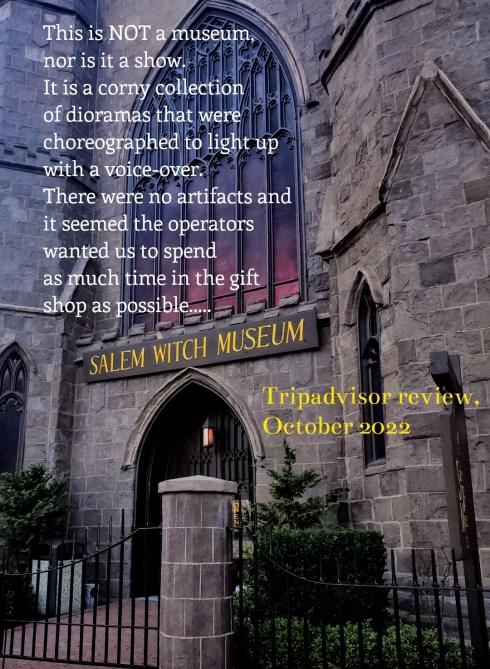
The words in the graphics above illustrate my concerns: a recent review of one of the two commercial institutions featured on the trail, the Salem Witch Museum, and some definitions of heritage by the Center for Heritage & Society at the University of Massachusetts, Amherst. I find the review to be very representative of those that the Salem Witch Museum has received, but of course, I am biased. There are certainly much better reviews, and there are also those which are substantive indictments: you can read them for yourself at the Tripadvisor site. But even many of the good reviews point out the dated nature of the presentation, the fact that the attraction is not a “Museum,” and its blatant commercialism. What is fascinating to me is that these reviews go back years (the Salem Witch Museum recently celebrated its 40th anniversary) and they are very repetitive, yet still the people keep coming and the dated dioramas endure: this is the most successful business in Salem, I believe, certainly the most successful attraction. There’s no attempt to update or improve the presentation, and why should there be? The people keep coming. But what does this institution have to do with Salem heritage and why does it have to be on the Salem Heritage Trail? The Witch Trials are certainly part of Salem’s heritage, though not, I would argue, as large a part as the City of Salem presents them to be—but that argument is certainly a lost cause! But is a dated diorama how we want to acknowlege this tragedy? Is there anything public or in any way reflective of the inclusion of the Salem Witch Museum on on the Salem Heritage Trail? The Salem Witch Museum will continue to be successful, no doubt, regardless of its inclusion on the Heritage Trail, so why can’t this one trail represent a more public and thoughtful presentation of Salem’s heritage in the fullest sense of the word? (I will never get an answer to this question)

I am not a tourism naysayer; I simply respect the past and want both Salem’s visitors and residents to experience its heritage in a layered and an engaging way. As I am writing this, I am looking up Chestnut Street as the Salem Trolley is making its way down, and I’m glad to see it. At least the tourists on board are exposed to more of Salem’s material heritage. It remains absolutely mystifying to me why the Salem Heritage Trail would not include the city’s oldest and largest Historic District, home to the Pickering House, the Phillips House, Hamilton Hall, the Salem Athenaeum, the Ropes Mansion, the Quaker Burying Ground, and streets of beautifully-preserved houses. There are no shops or restaurants or witch “attractions” over here: could that be the answer? Unfortunately the selection of paint in general, and that striking shade of yellow paint in particular, made the exclusion of residential historic districts a foregone conclusion: I know that most of my neighbors would welcome more walking tourists, but I doubt that many of them would like to see that yellow line run in front of their houses. The trolley is running past houses associated with a trio of brothers from a famous Salem family, the Bensons, and I’m wondering if the tourists on board are hearing anything about them, because I think their lives and works are representative of several important strands of Salem’s heritage. I’m sure Frank Weston Benson (residing at 14 Chestnut, 1862-1951) is getting a mention, as he was a pretty famous artist in his day, producing accessible paintings in a light-filled American Impressionist style as well as a succession of distinctive etchings primarily focused on wildfowl. His younger brother Henry (1866-1942) lived around the corner on Hamilton Street and served two terms as Salem’s mayor as well as the president of Salem’s largest business, the Naumkeag Steam Cotton Company. But I think it’s the brother between them, John Prentiss Benson (1865-1947), who is more evocative of an enduring Salem heritage, even though he seldom lived here in his adulthood (though he did design the massive and fantastic Colonial Revival mansion at 30 Chestnut Street).

A 1943 self-portrait by John Prentiss Benson and photograph of his younger self in Salem; Captain Samuel Benson of Salem as depicted by his grandson, John Prentiss Benson and Benson’s copy of “Reaper of Salem, S. Benson, Master, painted originally by Antoine Roux. All of the images and much of the text from this point on is taken from a lovely book entitled The Artistic Legacy of John Prentiss Benson, which was edited and published by the husband of Benson’s granddaughter in 2003. It’s really fabulous–with lots of family pictures and anecdotes.

I’ve never really appreciated maritime art, but I saw a painting that I really liked last week and looked at the signature: John P. Benson! I thought he was an architect by profession and an artist by hobby, but I was wrong: he had two careers, first architecture, then painting. This one painting took me down a rabbit hole of John P. Benson paintings, and I found some really lovely Salem ones, inspired by his birthplace and his heritage, primarily his descent from Captain Samuel Benson, of Reaper fame. All three Benson brothers plus their siblings grew up in an Italianate house which once faced the Common, on a site which is now the parking lot of the Hawthorne Hotel. Frank’s predisposition towards an artistic career was evident pretty early, as was John’s, but apparently there could only be one artist in the family so their father steered the latter towards the more practical architecture. He went to Paris for training, and returned to a job at the prestigious New York architectural firm McKim, Mead & White before setting up his own partnership. By all accounts, Benson had a successful architectural practice focused on the greater New York area, while living in Plainfield, New Jersey and later Flushing, New York with his wife Bessie and their four children. He retired from architecture in his later 50s and began painting full-time, primarily in his studio at a house called Willowbank in Kittery, Maine. He was prolific, and even though he had not lived in his native city since his departure for Paris, a notable number of his paintings are of Salem ships and harbor scenes.

Ship Eliza of Salem, Salem Coal Wharf, and Derby Wharf, John Prentiss Benson.

I particularly like a series of paintings which Benson produced as murals for his son Philip’s Cohasset home, entitled Salem Harbor memories. I trust that they still survive and I wish they could be on public view, because they are a perfect illustration of a family’s heritage and the endurance of a city’s heritage: it’s so interesting that these images were in the home of a man (Philip) who was not born in Salem, who never lived in Salem, but still saw Salem as part of his heritage. I’m not a fan of the witch trials vs. maritime history either/or debate as I believe that Salem’s heritage is both plus MUCH more but these maritime views are so poignant, especially in their invocation of memories which we can “enjoy, regret, and learn from” at the same time. Believe me, I know that the Benson brothers cannot compete with the suffering mannequins of the Salem Witch and Witch Dungeon Museums of the Heritage Trail. I think there are some other Chestnut Street stories that might be able to do so, but that’s not my point or my concern. If this trail was called the “Tourism Trail” or the “Witch City Trail,” I would have no concerns. But it isn’t: it’s called the Heritage Trail. So I ask my fellow Salem residents: does it represent your heritage?

A Memory of Salem Harbor, in Cohasset.