Tag Archives: urban planning

Samuel Chamberlain’s Salem

The Phillips Library of the Peabody Essex Museum, steward of so much of Salem’s printed, written and visual history amongst its many collections, has recently digitized over 5000 images from the “Samuel V. Chamberlain Collection of Photographic Negatives, 1928-1971″ and they are available and searchable at the Digital Commonwealth. Combined with the Frank Cousins images which the Phillips made available several years ago, there is now a very strong visual record of Salem’s architecture and streetscapes in the first half of the twentieth century, or at least some of Salem’s buildings and streets as neither Cousins or Chamberlain were particularly interested in “working Salem”. Cousins was a bit more of a documentarian than Chamberlain, especially as his era (roughly 1890-1920) encompassed the Great Salem Fire of 1914. Chamberlain was a man of the world, a gourmand, and an artist: his Salem photographs encompass only one part of his work, but an important part as he lived in nearby Marblehead for many years so developed quite an intimate knowledge of the city. I’ve always been struck by his perspectives, but I thought that I’d seen most of his Salem shots as he published so many books of photography of New England scenes in general and of Salem structures in particular, including Historic Salem in Four Seasons (1938), Salem Interiors (1950), and A Stroll through Historic Salem (1969). But I was wrong: there are discoveries to be made among the 1600+ Salem images included in the Phillips Library’s Chamberlain negative collection at Digital Commonwealth. The vast majority of these photographs are of the McIntire Historic District in the 1930s, 1940s, and 1950s, but I can see different details and angles in Chamberlain’s images of these perennially-showcased streets and structures—and lots of wonderful TREES.

New perspectives of old streets: and the interior of the depot!

These are images which struck me as “new” for one reason or another, although the first photograph is just the view of Chestnut Street from my window, over a half-century ago, and everything looks pretty much the same! Look at all the amazing elms: on the other end of Chestnut, on Essex, at the intersection of Federal and Washington Streets. A great photograph of the Lindall-Barnard-Andrews house (c. 1740; 3rd from top) and its amazing fence before some serious mistreatment in the later 20th century. Interesting views of Lynn Street, the Salem Maritime National Historic Site with trees, St. Nicholas Russian Orthodox Church and the Post Office and Washington Street before it became Riley Plaza (What is the white house on Norman?) One of my favorite little buildings on upper Essex Street was a bookstore! The Thomas Sanders house on Summer Street (2nd from bottom) looks much the same, but I want Mr. Chamberlain to turn around: what is behind him? And finally, a rare shot of the interior of the Boston & Maine train depot—rare in general but also for Chamberlain who preferred more timeless and aesthetic perspectives.

Change: Chamberlain was more interested in timelessness and continuity than change, but he couldn’t help but document some changes in Salem over the span of his work, from the 1930s through the 1960s. He was far more interested in urban survival than urban renewal, however: this was a man that sketched French chateaux amidst the destruction of World War I.

Two views of the London Coffeehouse or Red’s Sandwich Shop on Central Street; Nathaniel Hawthorne’s birthplace in its original location and from Hardy Street; The Curwen House rounds the corner from Essex to North Streets; 8 Chestnut Street very hemmed in by the second Second Church; which burned down in 1950, The Richard Derby House also very hemmed in; Charter Street before urban renewal; the cupola from the Pickman-Derby-Rogers House on Washington Street on the grounds of Essex Institute, now gone; the entrance to what Chamberlain called “the Italian Church,” St. Mary’s, built in 1925 and closed by the Archdiocese of Boston in 2003.

A few interiors: Chamberlain’s interior images are lavish and full of architectural and decorative detail; I’ve only included a few shots here but what a resource! All the PEM houses are here, and many Chestnut Street interiors, as well as views of interiors of both public and private homes which are seldom seen. His Salem Interiors has been a favorite book of mine since I was a teenage, and this Phillips/Digital Commonwealth collection includes many shots which are not included in that publication so I’ll going back quite a bit.

Pictorial paper in the Sanders house on Summer Street (see exterior above); much to see in the Northey house parlors, but ships on mouldings—how Salem can you get? Amazing fireplace in the East India House on Essex Street.

Chestnut Street Days! Who knew Chamberlain was such a great photographer of people? Certainly not me. Probably the most charming Salem photos in the Phillips Chamberlain collection are his portraits of Salem residents in colonial dress for the Chestnut Street Days which were held on at least 5 occasions from 1926 to 1976. I think that the photos below are from the 1947 and 1952 Chestnut Street Days, but I’m not entirely sure about the former date. These are wonderful photos of happy people, men, women and lots of children, smiling at the man behind the camera, Samuel Chamberlain. Just delightful. I’m going to post more on these in the future, but I’ve really got to do some oral histories first.

Chestnut Street Day, c. 1947-52. Not a great photograph to close out this wonderful collection, but is this the great man himself? Plus, the dog.


Gilded Age Salem

Let me be very clear: Salem is NOT a Gilded Age town. In reference to the new series from Julian Fellowes, Salem is the two Old Money sisters in the stuffy house, not the nouveau riche couple across the street in the bright and shiny Beaux-Arts building. In fact, there are no Beaux-Arts buildings in Salem, which was so Old Money that its dominant Gilded Age style was Colonial Revival, expressed characteristically through renovation rather than new construction. But I wanted to produce a Gilded Age post for Salem for two reasons: 1) despite the mixed reviews, I really like the new HBO series (though I think it should have a more nuanced title than The Gilded Age) and; 2) this time period (I’m going with 1870-1900, though I made one exception) provides me with an opportunity to address a big myth about Salem history, chiefly that it was all over for the city’s economy by 1820 or so. That’s just not true: I see a lot of prosperity and vitality in Salem’s economy in the later nineteenth century, and I think the buildings I have chosen to illustrate its own spin on the Gilded Age prove it. My choices were inspired by shots from the series premiere, although I must say that some of the cgi exterior views (in which everything is so CLEAN) contrasted sharply with those of more textured interiors). But before I get to the new, let me reassert and illustrate my claim that (re-) gilding the lily that was the Federal style was the Salem Gilded style, as we can see so clearly in architect Arthur Little’s 1885 plans for the George Emmerton House on Essex Street.

 Arthur Little and Herbert W.C. Browne architectural collection, Historic New England

Along Essex Street, which is undoubtedly Salem’s most dynamic street, there are also several prominent later-nineteenth-buildings that testify to the vibrancy of that age, but I want to start with a very showy building on parallel Chestnut Street which I think might be Salem’s ultimate Gilded Age construction: the Wheatland-Phillips House, built in 1896 for Mrs. Stephen G. Wheatland following the design of architect John B. Benson. At a glance, this imposing house fits right in with its Federal neighbors, but there is no restraint of scale or detail: it seems very “gilded” to me! Now on to Essex: even though it was built prior to the Civil War and Gilded Age, I’m still including the Bertram Mansion, built in 1855 for philanthropist John Bertram and donated by his family to the City for use as the Salem Public Library in 1887. This building really impressed contemporaries when it was built: I am always looking for signs of a nascent historical preservationist consciousness in the nineteenth century, and I found absolutely no trace of that sentiment in contemporary newspaper accounts of its construction, despite that fact that several “ancient” houses were swept away to make way for this “ornament” to the City of Salem. There are other candidates for such novel ornamentation on Essex Street, but none more than the Putnam-Balch House built in 1872, which once served as the headquarters for the American Legion in Salem.

I have no doubt that Salem had some really grand Gilded Age mansions on Lafayette Street, which was very much the new street of that era. But these structures were swept away by the Great Salem Fire of 1914. I don’t have photographs of all of them, but the Cassino Mansion at 192-194 Lafayette had to be among the most impressive, and it was gone in a day, an afternoon (A Cassino descendant gave me the photograph below, which I cherish!) Probably the grandest survivor on Lafayette is the Gove House built in 1888, the home of patent-medicine millionairess Lydia Pinkham’s very philanthropic daughter, Aroline Gove. The Pinkham story/connection is perfectly gilded.

Back in the center of town and heading north, I think I’m going to add the George C. Shreve House at 95 Federal Street and the James Dugan House on Dearborn Street, both built in 1872, to my list, as Italianate is as close as we’re going to get to Beaux-Arts in Salem. I love the situation of the Dugan House: it’s very grand.

Salem probably has more commercial or institutional architecture that approaches a Gilded Age style than residential: there are blocks on Essex and Washington streets downtown that evoke that era, still and fortunately, even though uninspired contemporary buildings are encroaching. The Superior Court Building on Federal Street (shown from Bridge, below) is an incredible structure inside and out, positively soaring and charming at the same time. It represents an era of unlimited opportunity and decoration quite well, but in typical Salem style, is an extensive 1887-91 renovation of an earlier Renaissance Revival building.


Sidney Perley’s Houses

Sidney Perley (1858-1928) exemplified that exhausting mix of endeavors—historical, genealogical, archaeological, architectural, legal, literary—which in his time was represented by the occupational identity of an “antiquarian.” It was a title he proudly bore, and one which had primarily positive associations a century ago. Now it is itself an antiquated term and I don’t know any historian who would refer to themselves as such. I’ve read pretty much everything Perley wrote about Salem, including the multi-volume History of Salem he published just before he died, and while I wish his work had a bit more context and interpretation, I still value it and think of him as a historian, primarily because he was so very focused on making early public documents public. His meticulous research and publication of probate records, deeds, and town documents was service-oriented; he was very much a public historian in his own time. And more than that: there is a famous dual characterization/division of historians by the French historian Emmanuel Le Roy Ladurie, who observed that they fell into one of two camps, either that of truffle hunters, “their noses buried in the details,” or of “parachutists, hanging high in the air and looking for general patterns in the countryside far below them.” Perley was the ultimate truffle hunter, and I’m grateful for all of the detailed information he dug out for me. Because he was trained as a lawyer, Perley’s publications on local history are overwhelmingly based on deed research, and this focus made him somewhat of an architectural historian as well: he sought to portray the built environment, not just land grants and transfers. His wonderful little series of “Parts of Salem in 1700” (and other Essex County towns too), first published in the periodical Essex Antiquarian and/or the Historical Collections of the Essex Institute and later incorporated in the the History of Salem, always included charming illustrations of houses, both on his hand-drawn maps and in the text. Now while I trust Sidney Perley completely in his dates for the construction, transfer, and demolition of these houses, sometimes I think he displays a little artistic license in their depiction. But maybe not: I’m just not sure.

The Essex Antiquarian Volume III (1899).

I’m not sure because sometimes he is a bit vague about the sources for his house illustrations. I would say that I have complete confidence in the depictions of about three-quarters of his illustrations: they were still standing in his time, or had been recently demolished, or had been sketched or photographed before demolition. But with some houses, he is relying on the memory of an anonymous elderly gentleman who gazed at the house early in his life, or on an undated sketch by an anonymous artist found in the depths of the Essex Institute. I’m always interested in the early days of historic preservation, or the first stirrings of some kind of preservation consciousness, so the depictions of these first period houses by Perley and his fellow antiquarians are just fascinating to me: their visions created houses that are still showcased in Salem, most notably the House of the Seven Gables and the Witch (Jonathan Corwin) House. Their visions shaped our visions of the seventeenth century. I like to imagine Perley’s houses still standing, and the best way to do that is to map them: my progress in the acquisition of digital mapping skills stopped as soon as I got my book contract in the summer of 2020, and as I am now working on another book it will stay stalled for a while, but I can cut and paste with the best of them! I am using Jonathan Saunder’s 1820 map of Salem from the Boston Public Library as the background for an evolving Perley map here, but later maps, with more crowded streets, really make these structures stand out too: they must have been so very conspicuous in Perley’s time. I find it interesting that in Europe, very old and very modern structures can coexist, side by side, but we seldom see that in America.

Jonathan P[eele?] Saunders / Engraved by Annin & Smith, Plan of the TOWN OF SALEM IN THE Commonwealth of Massachusetts from actual Surveys made in the years 1796 & 1804; with the improvements and alterations since that period as Surveyed by Jonathan P. Saunders. Boston, 1820. Proceeding clockwise rather haphazardly from the Epes House, on the corner of the present-day Church and Washington Streets, to the Lewis Hunt House, which was photographed before its demolition.


The MacCarter and Bishop Houses: the latter burned down in the 1860s but was fortunately sketched a few years before.


Some survivors in this bunch! The John Day House survived until Frank Cousins could photograph it in the 1890s (Phillips Library, Peabody Essex Museum), I’m not sure if Perley’s “John Beckett” house on Becket Court is the “Retire Becket” House on the House of the Seven Gables’ campus? Half of the Christopher Babbidge house survives to this day, though it moved to the parking lot of the 20th century building which replaced it.


MIT and Salem: little details and big plans

I knew that students in the pioneering professional architectural program at the Massachusetts Institute of Technology came to Salem to measure and draw interior and exterior details of notable Salem houses in the 1890s and after, but I did not know that the “Salem as laboratory” role extended well into the twentieth century for both architecture and urban planning students at MIT: recently I browsed through an archive of MIT Masters’ theses and saw several Salem studies among them as graduate students considered the waterfront, how to integrate historic and modern architecture (a perennial problem), public art, and the logistics of tourism, among other spatial topics. These were interesting to read as we seldom have debates about public spaces in Salem that are intellectual or contextual or even public: projects are simply announced and implemented. The most interesting thesis for me was one of the oldest, entitled “A new Peabody Museum for Salem, Massachusetts,” written by M.Arch candidate Donald H. Panushka in 1951. The thesis of Mr. Panushka’s thesis was that the Peabody Museum of Salem, especially its beautiful East India Marine Hall, was both detached from the waterfront and crowded in by commercial development on Essex Street, so that it should be removed to the Derby Wharf campus of the Salem Maritime National Historic Site (SMNHS). As you can on his map below, several other waterfront sites were considered, but ultimately he chose the large lot adjacent to the wharf in what was solely an academic exercise: I don’t think Mr. Panushka even consulted the SMNHS, but he did include some striking photographs and renderings to make his case. So it’s an interesting “what if” scenario, visually presented. I’m not sure the mid-century buildings placed alongside the relocated Hall would have weathered well, but knowing what we know about the development of Witch City in the later twentieth and twenty-first centuries, it’s tempting to think about how a more robust interpretation of Salem’s maritime heritage might have countered that trend—-and we could have had a ship decades before the Friendship. But again, it was all academic.

The first generations of architectural students at MIT were a bit more focused on architectural practice than planning: several “summer schools” in the 1890s produced measured drawings of Salem houses that were published in the the American Architect and Building News and later the successive volume of the Georgian Period published by William Rotch Ware. Details, details: including those of several Salem houses which, unfortunately, no longer exist in a material sense as well as those which fortunately do.


Envisioning Salem, 1962

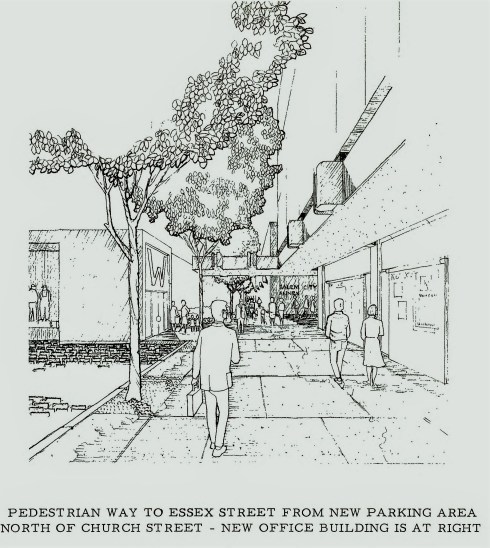
Salem is currently in the midst of implementing another urban renewal plan under the supervision of the Salem Redevelopment Authority (SRA), the board that was created by the city’s first urban renewal plan in the 1960s. The story of the implementation of that plan is a pretty established narrative: over-ambitious SRA orders destruction of much of downtown and advocates for the construction of a highway into central Salem to increase access for shoppers lured away by the North Shore Shopping Center in Peabody until concerned citizens’ protests and the New York Times architectural critic Ada Louise Huxtable’s extremely influential article brought national attention to the imminent destruction of Old Salem, shifting “renewal” towards redevelopment and preservation. Well, obviously I’m simplifying a much more complex process with many players: I’m starting to go through some of the sources which documented this process so I can understand it a bit better. I thought I would start with the early 1960s vision, as expressed by a series of reports issued by Blair and Stein Associates of Providence, RI, a planning firm hired by the City. Blair and Stein supposedly produced seven reports for the Salem Planning Board: I have found only three so far and the “Central Business District” report the most interesting: Salem, Massachusetts : central business district / prepared by Blair and Stein Associates in cooperation with the Salem Planning Board and the Massachusetts Department of Commerce (1962).

This study and its recommendations was not as focused on “tear it all down” as I expected: there are definitely recommendations for clearances, but also for preservation. Blair & Stein believed that the North Shore shopper, who is always referred to as “she,” could be lured back to downtown Salem if “blight” was cleared away and access improved. There are many references to urban blight, which was perceived as both decay and the reign of “inappropriate” facades and signs: after those were removed the state and fate of the stripped building should be considered. Because the emphasis is on renewing Salem’s shopping district above all, parking is very important, as is the overall design of pedestrian avenues around the downtown. Thus they gave us a pedestrian mall on Essex Street, Salem’s main street, but also on secondary routes leading into it. Salem would become an outdoor mall, with a mix of old restored buildings and new complementary structures: complementary not “imitative,” which is what I think most people would like to see now. It’s just annoying when advocates of sub-standard new construction accuse anyone who argues for higher standards of trying to turn Salem into a faux Federal city: I like the language below emphasizing scale, texture, character and “spirit” of new construction and did not expect to find it in a document of this nature and vintage.

Interesting spelling of “aesthetic” but these are goals I wish we were shooting for now!

Apart from the concerns about blight, parking and aesthetics, the major difference between this plan and the current one relates to housing: Blair and Stein envisioned a distinct shopping and cultural district and did not advocate for the expansion of residential buildings downtown, while that is a major planning goal at present. While they referenced tourism, they clearly saw it through a regional focus rather than a national one, and they don’t even mention Halloween. Salem would be a city of day trippers and day shoppers, returned to regional hub status.

Deed restrictions prevented all that planned Front Street parking, and inspired Artists’ Row, here pictured in 1978, Salem State University Archives and Special Collections.

The schematic sketches are just that, clean and orderly, and now I am seeking the specifics of how this rather vague plan turned into the scary plan of action recorded in the Boston Regional Office of HUD several years later: The Heritage Plaza East project advanced from the planning stage to the execution stage in February 1968. About 40 structures in the area will be rehabilitated, 140 will be razed, and 75 families will be relocated in the process of clearing the area. CLEARED OUT. The records of the SRA, which for some reason are deposited in the Phillips Library, will certainly shed light on the “progress” from planning to execution.

Appendix:  Historic Salem, Inc. has prepared a “Citizens Guide to the Downtown Renewal Plan” for those who wish to engage with its implementation, available here.


Mansard Mania!

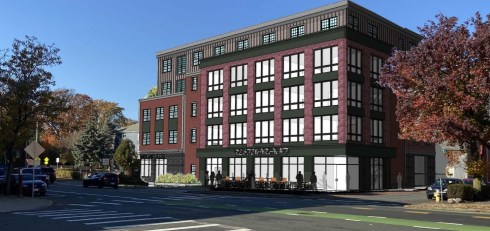
So the developers of a large lot on Norman Street, a major artery in Salem which connects the downtown to one of the city’s major residential/historic districts and also serves as a primary gateway, have come up with their third schematic rendering for the site. We first saw a rather brutalist box, then an industrial-esque box, and now we have a mansard box. I wrote about their challenge here, and despite my lack of enthusiasm for their projections, I do believe that they have a very challenging site: Norman Street was once an absolutely charming street of residences and shops of diverse style and size, but it was ravaged by a perfect storm of an unleashing of all the infrastructural forces of the twentieth century. This is the design that will be presented to the Salem Redevelopment Authority this week:

Proposed design for 38 Norman Street, Salem.

This is a site that is not only very conspicuous, but also situated directly between two historic streets: Crombie and Chestnut (where I live), so both scale and historical context are issues for consideration. Frankly, based on its judgements over the past year or so, I don’t think the Salem Redevelopment Authority (SRA) is particularly concerned about either of those criteria, but the developers met virtually with several neighborhood groups and I’m sure they were notified of such concerns. So I think this mansard addition must be in response to these meetings, although I’m at a loss to explain how that particular roofing style fits into the streetscape. While it is known for its Federal architecture, Salem actually has some great mansard-roofed buildings, but they are overwhelmingly residential rather than commercial or institutional, and none are in the immediate vicinity of this lot. The original Salem Normal School building on Broad Street is the only mansard-roofed institutional building that comes to mind. I really, really hope that these developers were not inspired by the ghastly River Rock residences on Boston Street, but why wouldn’t they be? This project was approved, and thus serves as a practical precedent for aspiring Salem developers.

River Rock Residences.

Whatever the inspiration, this new rendering gave me an excuse to read all about mansard roofs, past and present. There was a lot to read: people really have a lot to say about mansard roofs, not so much the original early modern examples or even those revival mansard roofs from the third quarter of the nineteenth-century, but the “neo-mansard” trend of the 1960s and 1970s. There are blogs and opinion pieces galore explaining that phenomenon from a range of perspectives—but generally more horrified, sarcastic, and whimsical than complimentary. The original mansard was a tax-dodge tactic: in the seventeenth century French houses were appraised according to the number of floors below the roofline, and the mansard style thus enabled the addition of a non-taxable floor (I suspect space is the primary motive of the “historical” addition to the Norman Street proposed development as well.) The Second Empire of Napoleon III and the Hausmannization of Paris inspired the second wave of mansard mania, which swept across the United States in the 1860s and 1870s, despite the fact that wooden “French” roofs were blamed for turning the Great Boston Fire of 1872 into a conflagration: Henry Ward Beecher even called mansard roofs “conflagration caps.” I’m wondering if this is the reason I can’t find many larger mansard-roofed building in Salem.

I couldn’t find any mansard-roofed commercial buildings among the Frank Cousins’ photographs from the Phillips Library via Digital Commonwealth, but Salem has lots of cute mansard cottages from the post-Civil War era.

As you can tell from the detailed photos of the mansard roofs above, it’s all about the details: most modern mansard-roofed buildings lose something in the translation because they don’t attend to those details. A great example is the Hotel Commonwealth in Boston, built in the early 2000s to liven up Kenmore Square and link it to the Back Bay through its Second Empire style. The Boston Redevelopment Authority approved the renderings, but “when workers took the shroud off [in 2002] ….. officials and neighbors were aghast. To save money, the elegant building depicted in renderings had been replaced with one featuring a plastic-looking facade and garish two-dimensional window bays seemingly lifted off a B-movie set.” [Boston Globe, 27 October, 2014: “Framing the Proposal”] The developers were ordered to overhaul the building’s exterior before it even opened, and replaced the building’s value-engineered (and apparently bright yellow?) fiberglass panels with precast stone, as well as all “cosmetic” features, to the tune of $5 million. Even though I was right here in Salem, I don’t remember this episode at all, so I read about it in the Globe: both letters and articles typically used the words hideous and disastrous in reference to the Hotel, and one piece was entitled “Yellow Alert.”

Hotel Commonwealth rendering, Boston University, and in 2015, Boston Herald photo by Angela Rowlings.

That’s quite a spectacular rendering above and obviously the more humble proposed design of 38 Norman Street doesn’t set itself up for failure quite so conspicuously, but Salem appears to have developed a propensity for plastic so I’m wary, even still. The Hotel Commonwealth seems to be in the midst—or at the end?—of a third wave of mansard mania that was noted by the eminent architectural critic Ada Louise Huxtable, otherwise known as the “woman who saved Salem” due to her exposure of Salem’s cataclysmic urban renewal plan to a national audience in the 1960s. A decade later, she wrote about “Mansard Mania” in the New York Times, and was not complimentary: all is fake tops and false nostalgia, regardless of use, size or scale. I think she was referring to structures like those featured in all the “neo-mansard” blogs, an example of which is below, but still I wonder: why do we need mansard-style roofs or prairie-style roofs? Why can’t we have Salem roofs?

1970s mansard-roofed structure from The Neomansard: “trying to embrace the style without irony.” Just a great site.


Let’s Restore (Some Semblance of) Norman Street

Norman Street was and is an important thoroughfare in Salem, one of the major connections from the major route north to the center of the city, and ultimately the harbor. The street was charming in the eighteenth and nineteenth centuries, with substantial houses lining its brick sidewalks and TREES. Two of my favorite Salem Georgians were on Norman, the Jonathan Mansfield House and the Benjamin Cox House: details of the former show up in all sorts of early American architecture books in the first few decades of the twentieth century.

Norman Street in the later nineteenth century (1880s-1890s), Phillips Library, Peabody 

Norman Street was essentially annihilated in the twentieth century: its charming houses demolished and replaced by generic business boxes, its width expanded for automobiles, its trees left to die. I can’t think of a street in Salem so utterly transformed. Its bleakness is all the more apparent by the fact that it’s basically an extension of mansion-lined Chestnut Street, so the contrast is striking: I sigh with relief when I pass over Summer Street and everything gets greener and more friendly. All the twentieth-century forces aligned to kill this street: a big public works project (the Post Office), the car, of course, and the worst architectural eras of the century, the 1930s and the 1970s-1980s. There are three crosswalks, but cars whip around the corner onto Norman so you have to be a rather audacious pedestrian to think about using them. The street is so bleak it can only be improved, but the one vacant lot now set for redevelopment is in a particularly conspicuous spot: on a corner, between two historic districts, and between a residential district and the beginning of the commercial downtown: this project has the potential to CONNECT so many constituent parts of Salem, and restore some structure (and dignity) to Norman Street at the same time. I have high hopes and great expectations, and I really hope the permitting boards of Salem do too.

So let me show you the current lot and the prospective building: I am taking these photos from the presentation that the developers (Kinvarra Capital) and Architects (Balance Architects) gave to a neighborhood group last week, before they go before the Salem Redevelopment Authority (SRA) next week. This presentation was very thorough in its consideration of all of the challenges and context of this site, I thought. You can see the whole thing for yourself here. Let me say that I don’t have really strong objections to this building: compared to recent construction in Salem, and to what defines Norman Street at present, it’s an improvement. But I think it could be better. And I REALLY think that it should prompt a city-wide discussion about design rather than just a neighborhood discussion about parking.

Existing conditions looking north (top) and east (bottom): Chestnut Street is right behind you in this second photo. The city has decided to put a roundabout at this busy intersection, but they haven’t really committed and it’s too small a space, so everyone just drives over that yellow circle.

Same vantage points as above with the rendering of the new building. The bottom image also show the recently-approved “suburban” addition to the adjacent Georgian house by the Salem Redevelopment Authority (SRA), the same board that has jurisdiction over new Norman Street building.

So you see, a challenging site. I don’t envy the architects: should they take their contextual cues from the adjacent 1980s plaza, or the Georgian with its (insert adjective; I have no words) addition, or the 1930s Holyoke building across the street or the Federal and Italianate buildings which open Chestnut Street? You know me, I’m a traditionalist and a historian: I’d like to restore something of what was Norman Street in its glory days, perhaps along the lines of the Julia Row in New Orleans, without the wrought iron. But you can’t really recreate that: it would look cheap with today’s materials, and it wouldn’t fit in with the twentieth-century buildings of Norman Street. It’s not the entire composition but rather the depth of façade and detail I’m after, and in this case I was particularly attracted to the parapet end wall: if integrated into a new building on Norman, it could match the one at 2-4 Chestnut Street, establishing continuity and connection.

Julia Row, New Orleans; Chestnut and Norman Streets in the 1880s, Salem Picturesque, State Library of Massachusetts.

The New Orleans building is also too big, as is the proposed Norman Street building. What you don’t see in these photographs is the Crombie Street Historic District tucked away in back, with smaller-scaled buildings than any of the other adjacent structures. I looked at some recent developments in Boston, New York, and Philadelphia in which new construction was integrated into existing historic neighborhoods and came up with a few favorites in terms of scale and also texture, which is missing in most of the new construction I see. The first is in Bay Village in Boston, a small historic neighborhood tucked away in the midst of downtown Boston. The scale and detail of of Piedmont Park Square is nice: it fits right into its quaint neighborhood on the storied site of the Cocoanut Grove, where a tragic fire occurred in 1942. The building “stitches” together townhouses—what could be more connective than that?

Piedmont Park Square in Boston’s Bay Village by Studio Luz Architects.

As I searched for semblances of things I’d like to see in this important new building, I was motivated by scale, detail, texture, integration, contextuality, and some sense of the past: the proposed rendering reads “industrial” to me, and Norman Street was never industrial, so I don’t understand the reference. I don’t think I found what I was looking for, but I really like the integration achieved by a recent infill development in the Bedford-Stuyvesant neighborhood of Brooklyn, below. Tucked in between an early 20th century mansion on the site of its fire-ravaged garage and a row of 19th-century townhouses, this structure fits in but still makes a statement with its variegated façade and roofline and so much texture! This seems like an even more difficult challenge than Norman Street. I like it, but my husband-the-architect does not and neither, apparently, do its neighbors. All architecture is paradoxical, but urban architecture particularly so: it is so very public, yet the public has so little power to influence what is built.

Renderings of 375 Stuyvesant Street, Brooklyn by DXA Studio


Renaissance and Reign of Terror

1904 was a big year in Salem’s commemorative history: it was the centennial of Nathaniel Hawthorne’s birth, and his birthplace received both regional and national attention. This was squarely in the midst of the time when Witch City and Hawthorne/Colonial City were duking it out to see which one would define Salem’s identify going forward: the former won, of course. Hawthorne was born on July 4, so in the midsummer there were lots of stories on Salem in the Boston papers, with a notable focus on material culture: his houses, other storied Salem houses, Salem gardens, Salem streets. As Hawthorne was so often focused on the past, so too was his commemoration.

Homes and Gardens in Salem, Boston Daily Globe, July-August 1904.

Salem was also featured in a book on American architecture published in 1904: American Renaissance. A Review of Domestic Architecture by Joy Wheeler Dow, Architect. This first caught my attention because I assumed “Joy” was a woman architect, but it turns out that Joseph Wheeler Dow preferred to be called Joy. He was a prolific writer and critic around this time, publishing in several “shelter” periodicals, and had a very forthright style. I like opinionated authors, and even though Dow was very snobby, concerned when anyone who lacked a Harvard education was in any position of authority and using the term “Anglo-Saxon” a bit too much for my taste, he’s still fun to read. His concept of the material “Renaissance” was strictly Victorian but he detested Victorian architecture: his division of American architecture centered on a Renaissance of craftsmanship and style in the colonial and first half of the nineteenth century and a “Reign of Terror” thereafter in which too much money and fashion (as opposed to style) created objectionable buildings. He loved Salem and placed its building firmly in the era and style of the American Renaissance.

Dow’s captions are great, so I included a few of them above: if you want atmosphere and plenty of it, go to Salem! (exclamation point mine, as that is how he writes). We’re so fortunate to have all of the houses above still standing, and they still provide a wonderful context and atmosphere. I don’t share Dow’s opinion of Victorian architecture, either residential or commercial, and I think buildings from that era—and after—add context and atmosphere as well. If I were to divide Salem’s built environment into periods I would have a long “Renaissance” era extending up to the twentieth century, perhaps even to the Great Salem Fire of 1914, then a rebuilding/accommodating the car era (not sure what I’d name it) and the “Reign of Terror” would begin in 2000 or so: we are clearly in a Reign of Terror now. It’s hard to characterize all of Salem’s new buildings: several appear to have tried for some context in the details but ended up as plastic pastiche, others could have been built everywhere and anywhere. I can’t explain the first building below, Salem’s new Hampton Inn: I really have no words. I’m not really sure what to think about the Brix, a new condominium development built on the site of the former District Courthouse: it’s a big boxy building but its downtown location can support that, even as the transition to a side street, Church Street, is rather abrupt. I guess it’s just the roofline that bothers me: why the overhanging eaves? This is the third or fourth new Salem building with similar roofs: has there been some secret pact to transform Salem into an exemplar of a revived Prairie Style? Maybe that’s the new “atmosphere” we’re going for but it seems odd given Salem’s illustrious architectural past. Away from the downtown, but not too far, are the new Halstead Apartments, which manage to represent a shadow of Salem’s vibrant industrial past in a rather reassuring, even atmospheric, way.

Salem’s new multi-colored Hampton Inn (+apartments) and multi-style River Rock development on Goodhue/Boston Streets; The new Brix condominium building on Washington and Church Streets; the Halstead Apartments on Flint Street.


Digging Up Derby Square

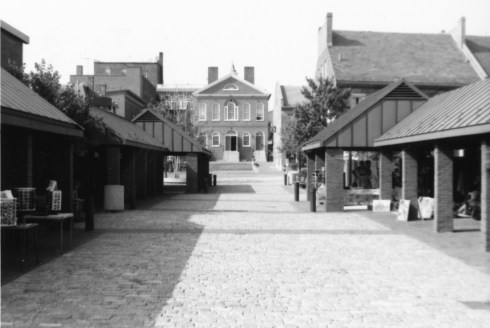
I was researching Salem’s struggle with/against urban renewal in the 1960s when I came across a massive collection of photographs from the career collection of Edmund Bacon, the famous Philadelphia city planner who is sometimes referred to as representing a “third way” between Robert Moses and Jane Jacobs. I honestly don’t know if Bacon was a critic or a fan of urban renewal: his work looks a little plaza-centric to me. Apparently he captured urban renewal funds for the rehabilitation of Society Hill in Philadelphia, however, and that is certainly to his credit. The landscape architect who worked on Society Hill was another Philadelphian, John F. Collins, and when Bacon was brought in to consult on Salem’s redevelopment after some (not all) of the planned destruction through “renewal” was thwarted, he recommended Collins to implement the new Heritage Plaza East Plan in the 1970s. Collins’ efforts reshaped downtown Salem over the decade, and you can read (and see) more about them here. But back to Bacon (father of Kevin, by the way): after his retirement he turned all of his papers and photographs over to the Fisher Fine Arts Library of the University of Pennsylvania, which is currently digitizing and crowdsource-cataloguing them through a project called the Ed Bacon Photo Project: the photographs are an amazing window into twentieth-century urban planning, and include several scenes of Salem’s little Dig.

During and after: Derby Square is such an important center for downtown Salem, although I wish the City was as dedicated to the maintenance of all the hardscape features incorporated by Collins as Philadelphia has been with Society Hill. The Cultural Landscape Foundation notes that “Collins’ details–richly patterned brick sidewalks and walls, granite curbs and backless benches, alleys, street trees, site-specific light standards and bollards – combined with small courtyards and pocket parks peppered throughout the 120-acre neighborhood, unite the unique blend of historic and modern buildings and landscape features.” The space has served as the site of grocers’ and farmers’ markets for decades–until last year when Covid mandated another location with more space for social distancing: I hope it can return this year. And on quite another note, I’m sure everyone will be thrilled to hear that one of Salem’s key businesses, Vampfangs®, is expanding into Derby Square with “Maison Vampyre,” an “elegant and uniquely themed private space, located in the heart of Salem at One Derby Square. Guests are invited to experience personal or group psychic readings from members of the local Vampire community.”


Seven Women of Salem: the Preservationists

I’ve been rather depressed about the state of historic preservation in Salem: after a strong commitment in response to full scale urban renewal in the 1960s and early 1970s we seem to be awash in a sea of vinyl siding and shed dormers. I’m not sure what happened exactly, although rising property values and the corresponding desire of developers to cram as many units as possible into old structures, thereby transforming their architectural profile beyond all recognition, likely has something to do with it. But history always brings perspective, and in recognition of both this Centennial anniversary of women’s suffrage, my own #SalemSuffrageSaturday series, and the Preservation Month of May, I am focusing on seven women who really made an impact on the recognition, and preservation, of Salem’s material heritage. These women faced far greater obstacles than I am seeing now, and they should be celebrated. This post is partly repetitive, as I’ve featured several of these women before, but there are some new heroines as well, at least new to me.

In chronological order:

Caroline Emmerton (1866-1942): the founder of the House of the Seven Gables Settlement Association, and a founding member of the Society for the Preservation of New England Antiquities (now Historic New England). Much has been written about Caroline Emmerton (especially as she was a rather mysterious woman), so I don’t have too much to add here, but she deserves recognition not only for reconstructing and creating the House of the Seven Gables and its campus, but also reorienting Salem’s—and the nation’s—appreciation of its first-period past. The House of the Seven Gables, and Emmerton’s vision of her native city, remains a strong counterweight to the commercial cacophony of Witch City. Emmerton seems like a rather “creative” preservationist to me, but certainly an influential one!

Emmerton Collage (2)Caroline O. Emmerton, The Chronicles of Three Old Houses, 1935

Louise du Pont Crowninshield (1877-1958): As a du Pont, Mrs. Crowninshield was not from Salem, nor did she ever live here (although she summered in Marblehead), but she has to be included on any list of preservationists for her key efforts towards the preservation and interpretation of several Salem sites, including the Derby House of the Salem Maritime National Historic Site and the Peabody Essex Museum’s Crowninshield-Bentley and Peirce-Nichols houses. She was also a board member of SPNEA, as well as of the Essex Institute and Peabody Museum in Salem, and a founding trustee of the National Trust for Historic Preservation. You can read more about Louise in this post, in which I appeal to a potential successor to to emerge in contemporary Salem!

louise-du-pont-crowninshield1Louise duPont Crowninshield (center) surrounded by the ladies of the Kenmore Association in Virginia, one of her first preservation projects, Hagley Museum & Library.
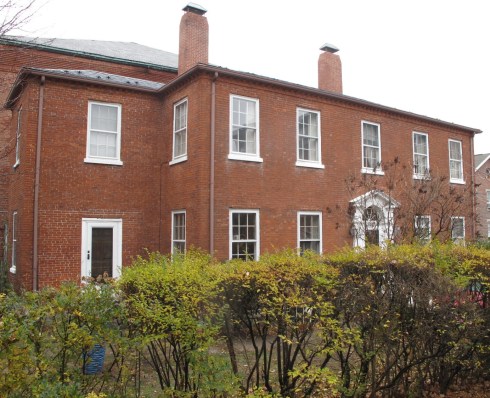
Bessie E. Munroe (?-1975): Mrs. Munroe waited out urban renewal in Salem in her lovely Federal home on Ash Street, with demolition ongoing all around her. She was a widow in her 80s when the Salem Development Authority began implementing its 1965 urban renewal plan, which called for the demolition of 145 out of 177 buildings downtown, including her house! She was compelled to sell to the SRA in 1970, but fortunately the agency agreed to her life tenancy because of her age and health. And then a new Salem Redevelopment Authority emerged, more intent on preservation than demolition: at the time of Bessie’s death in 1975, her house—the last historic residence standing, facing a parking lot—was saved and sold to a preservation architect. It is now on the National Register.

IMG_20200518_091858_799

SAL_2431 (2)Seeing red (demolition) in 1965; 7 Ash Street, the Bessie Munroe House, today.

Ada Louise Huxtable (1921-2013): Another woman who never lived in Salem (but long summered in nearby Marblehead like Louise duPont Crowninshield) yet had a tremendous effect on the city’s material heritage largely through her passionate indictments of the 1965 urban renewal plan (see above) published in the New York Times from 1965. Sometimes I think crediting her exclusively for the demise of this plan minimized all the efforts towards that aim by preservationists here in Salem, but still, there’s no denying her powerful impact, as she occupied a strong position of power as the architectural critic for the Times. Ms. Huxtable was not a strict preservationist, but she believed that it could be a useful tool against generic, thoughtless development with no historical or aesthetic merit: sterilized nonplaces. She kept watch on Salem through its new redevelopment and credited its mix of old and new in later articles and her 1986 anthology Goodbye History, Hello Hamburger. In praising Salem for “renewing it right” she also asserted that “Salem’s results promise to be a stunning rebuke to every community that has ever thought the only way to revitalization lay through….mutilation of what was often a unique identity for shoddy-slick, newly jerrybuilt anonymity.” Every day I wonder what Ms. Huxtable would think of Salem’s newest buildings.

Ada 1965 NYTAda Louise Huxtable’s condemnation of Salem’s 1965 Urban Renewal Plan in October of that year, the first of several pieces published in the New York Times.

Elizabeth K. Reardon Frothingham (1923-1983): A Salem native descended from several notable Salem families, “Libby” Reardon was a passionate afficionado and student of early American architecture who went on to become a professional preservationist, shepherding Historic Salem Inc. though its most turbulent era and writing several detailed inventories for the City of Salem. All of her records, unfortunately, were donated to the PEM’s Phillips Library and therefore moved from the city to which she was so dedicated: you can read more about that here. Given the pandemic, I haven’t been able to access her records or reports up there, but newspaper accounts testify both to her discovery (as a mere “housewife”) of two camouflaged Salem first-period houses, the Gedney and Samuel Pickman (pictured in the Huxtable article above, as well as below) Houses, as well as to her steadfast defense of Salem’s material heritage in the 1960s and 1970s. She was a real preservation heroine, gone too soon: I can only imagine what she might have achieved in the 1980s or 1990s—or now!

Reardon Collage1965! What a year that must have been—-Salem’s preservationists had to have been functioning 24/7.

And speaking of gone too soon, I wanted to take this opportunity to recognize two women who were clearly effective administrators of their respective institutions as well as contributors to the preservation of Salem’s material heritage: Anne Farnam (1940-91) of the Essex Institute and Cynthia Pollack (1932-1992) of the Salem Maritime National Historic Site. Ms. Farnam served as Curator at the Institute from 1975 to 1983 and as its President from 1984 until 1991, while Ms. Pollack served as Superintendent of SMNHS from 1983 to 1992. I have no idea what their personal relationship was like, but they were clearly colleagues not only in advancing the missions of their institutions but also the stature of Salem as a heritage destination. Both were active in the Salem Project, the forerunner of the Essex National Heritage Area, and both worked towards a more layered and contextual interpretation of Salem’s history. When you study their careers, you can see how interpretation and preservation are integrated and complementary: as the chief administrator of an institution charged with the stewardship of eight historic houses, Ms. Farnam was by necessity a preservationist, but she also initiated the 1977 exhibition on “Dr. Bentley’s Salem: Diary of a Town” which seemed to have seamlessly merged textual and material history (I never saw it, but I do have the companion volume of the Essex Institute Historical Collections). Likewise, Ms. Pollack deserves high praise for her dedication to the restoration of Salem’s historic wharves, but at the same time worked to enhance Salem Maritime’s interpretive reach: as the tribute sign at the Visitors Center’s Cynthia Pollack Theater reads: There were stories to be told, and she wanted visitors to see, touch, smell, and feel the maritime spirit that the site embodies. We all have a lot to live up to, I think.

Women Preservationists CollageA Boston Globe (glowing) review for Ms. Farnam’s exhibition, Dr. Bentley’s Salem. Diary of a Town in 1977 and 1992 photograph of Ms. Pollack.