I worked all summer long on my chapters for Salem’s Centuries and a few other projects, researching and writing, researching and writing, researching and writing. Once I’m on the trail, I’m a pretty steady worker, but I do take breaks: I’ve learned from other writing projects that you have to pause to let your mind absorb and process information. Sometimes the break might be at night when you’re asleep—I got into the habit of leaving a notebook by my bedside when I was writing my dissertation and when I woke up in the morning sometimes I would see notations inside that I didn’t even remember writing! That must have been one of the benefits of a younger mind because it didn’t happen this summer, when all my breaks were conscious. Every time I went up to the Phillips Library in Rowley, I would dutifully call up boring municipal records but also collections which contained old photographs of Salem. I’d pore over them a bit and photograph them for later perusal, and by the end of the summer I had quite a collection. The Phillips has digitized two of its largest collections of Salem photographs: the Frank Cousins and Samuel Chamberlain collections, but there remain many seldom-seen images within collections. Fortunately there are great finding aids to locate such images, but also some very miscellaneous collections which yielded surprises, at least for me! I loved schoolteacher Grace Hood’s shots of the Salem and Massachusetts celebrations in 1926-1930 (PHA 67; including some completely new-to-me views of the opening day of Pioneer Village in 1930) and an unknown photographer’s depictions of a very gritty Salem encased in a large composite collection entitled Photographs of interiors and exteriors of Salem, Mass., circa 1890-1950 (PHA 151). And there’s much more.

 Phillips Library PHA 67 & 151.
My favorite collection was the first one I accessed, back in May: a treasure trove of images contained in the scrapbooks of Francis Henry Lee of 14 Chestnut Street, mostly from the 1880s (Phillips Library MSS 128). Lee was the son-in-law of the woman who lived in my house, and a committed architectural antiquarian focused on documenting the history of every house on Chestnut and adjoining streets. He did not rely on hearsay, but sent queries to anyone who ever lived in the neighborhood, and his scrapbooks are filled with detailed responses, some written on black-trimmed stationery indicating that their authors were in mourning. I was familiar with his articles in the Historical Collections of the Essex Institute, but surprised to find his research materials accompanied by so many wonderful photographs.
Some of my favorites: (I filtered those that were really hazy or damaged).

 Chestnut, Summer & Norman Streets from two perspectives. I’ll never get over how wonderful Norman Street was!


 Riding and looking north on Summer Street, and then south (Samuel McIntire’s house is on the extreme left of the last photograph).
 Broad Street, looking west.

 Cambridge Street, looking north and south.
 Work on Bott’s Court.
 Hamilton Street, looking north.


 Chestnut Street Houses—what’s going on with that figure at the third-floor level of the third photo above, which I think is #26?
 Warren Street, looking towards the “Turnpike” (Highland Avenue).
There were several photographs which were especially exciting to see among the Lee papers, including those which show the magnificent formal garden in the rear of the Cabot-Endicott-Low House on Essex Street, which extended to Chestnut before no. 30 Chestnut was built in 1896. This garden was quite famous: it was prominently featured in many horticultural publications and was by all accounts quite the tourist attraction, especially in the spring. A 1904 Boston Globe article on “Beautiful Old Gardens of Salem” reports that for many years the tulip bed was the greatest feature of this garden, and each spring, when these flowers were in perfection, and upper portion of the high fence on Chestnut was removed to enable the public to view the exhibit.
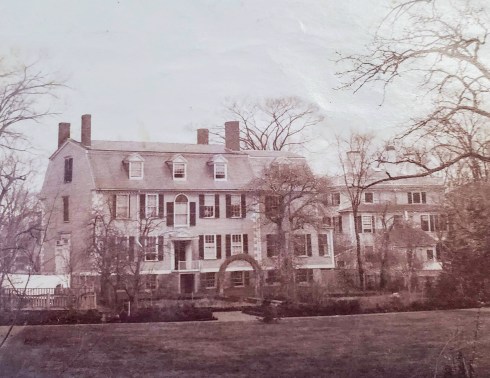


Even more exciting than this lost garden were two photographs of my own house that I had never seen before, including one sans the apartment that was added on in phases between 1890-1910. Our house is the right side of a double house built in 1827: both sides were identifical until the 1850s, when one of our owners expanded the house considerably in back and altered the interior to look more fashionable at the time—round mouldings rather than square ones! The big entrance alteration reflects the changes inside, but I did not know that this guy also put new mouldings over the windows, and disdained shutters as too colonial, I guess. Several owners later, there was a sequential addition on the side of the house: first as an office for a very well-know opthamologist who lived here, and then bedrooms were built above: this is our present-day 7 1/2, a really cute apartment with the best views of Chestnut Street. I assumed that it covered up windows which were on the side of our house, but it looks like there were none. As you can see from all of the other photos of the street, Chestnut was driveway-less in the nineteenth-century: the larger houses had carriage access on Warren or Essex: the property of our house actually wrapped around Hamilton Hall next door and so our carriage house—long- demolished—accessed Cambridge Street.






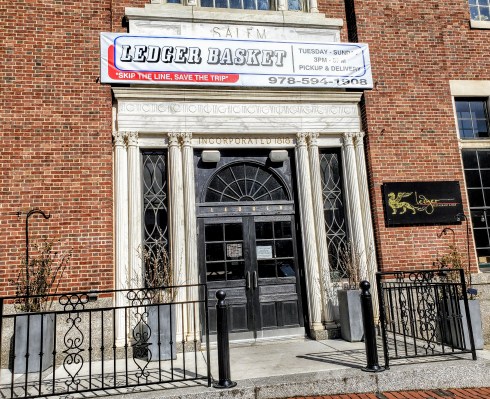


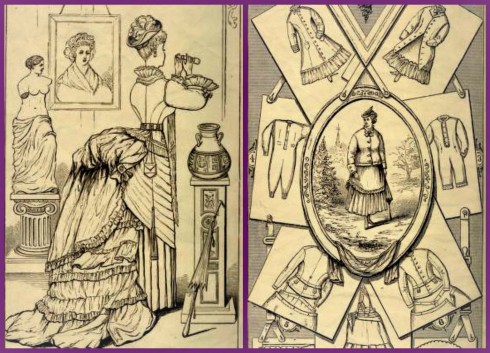


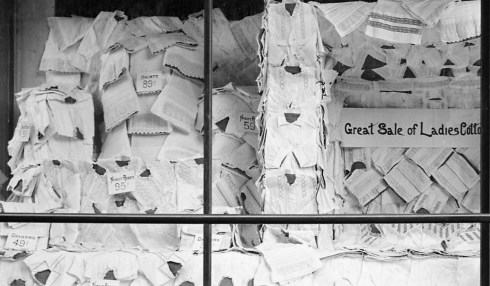


 N.C. Wyeth’s Peace, Prosperity, and Progress (1923) in one of the atriums of the new Peabody Essex Museum; the anchor returned in September, and in yesterday’s speech Dr. Kennedy also pledged to engage in some Halloween programming—-“Here’s people, Go get them, they are right there”. Now that should be interesting!


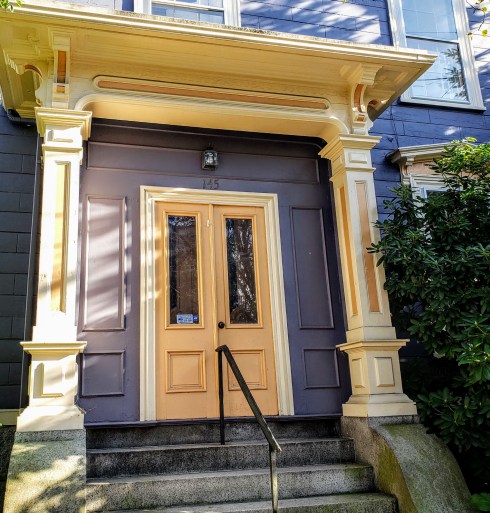

 Another reason to praise PEM: the beautiful restoration of the Daniel Bray House on Brown Street: it doesn’t have its new/old door yet as you can see–and I’m not sure if it will be painted this light orange color.


 Dark Brown/Red is a classic Salem combination.

 Turquoise is the current it-color, I think.


 T
T


 The John P. Felt House on Federal Court past and present: despite a rough last half-century or so, the house is still standing in good form, lacking only its widow’s walk and shutters.
 Barton Square has been pretty much annihilated.
 Change and continuity on Bott’s Court: old house on the left, newer (both 1890s) houses on the right. Cousins is showing us the demolition of the former house on the right with his preservationist eye.
 Kimball Court present and past: Cousins is showing us the birthplace of Nathaniel Bowditch below: this house is in the top right corner above. In front of it today is a house that was brought over from Church Street during urban renewal in the 1960s when that street was wiped out.
 18 Lynde Street: this appears to be the same house, with major doorway changes.
 The house on Mall Street where Nathaniel Hawthorne wrote the Scarlet Letter: there was an addition attached to the house at some point in the 1980s or thereabouts.
 134 Bridge Street: As a major entrance corridor–then and now—Bridge Street has impacted by car traffic pretty dramatically over the twentieth century; Cousins portrays a sleepier street with some great houses, many of which are still standing—hopefully the progressive sweep of vinyl along this street will stop soon.
 17 Pickman Street seems to have acquired a more distinguished entrance; this was the former Mack Industrial School (Cousins’ caption reads “Hack” incorrectly).
 Great view of lower Daniels Street–leading down to Salem Harbor–and the house built for Captain Nathaniel Silsbee (Senior) in 1783. You can’t tell because of the trees, but the roofline of this house has been much altered, along with its entrance.
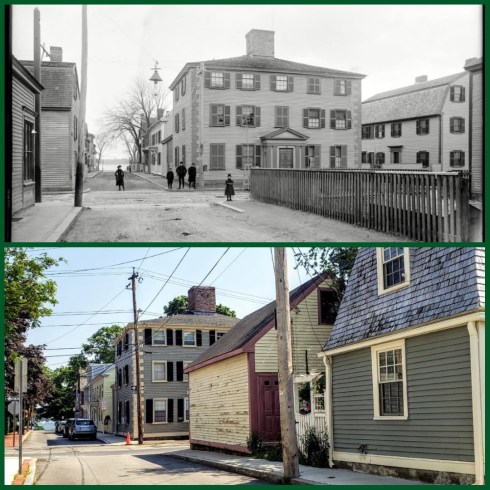 Hardy Street, 1890s and today: with the “mansion house” of Captain Edward Allen still standing proudly on Derby Street though somewhat obstructed by this particular view. You can read a very comprehensive history of this house
 The Frank Cousins “Team”/ Employees’