Tag Archives: Shopping

Salem Lots

Several years ago, Bonhams Auctions held an auction of items from the Caren Archive, the largest private collection of American documents from the colonial era to the present. It was an extremely profitable event for all concerned, and so now there is a second sale coming up, and this one features several notable Salem items. The April 11 “Treasures from the Caren Archives II: How History Unfolds” auction comprises a wide variety of paper lots, among them one of the earliest English reports on the Salem Witch Trials, a 1777 financial document in which the Widow Sarah Putnam agreed to finance the Salem privateer Pluto during the American Revolution,  the “preliminaries of peace” negotiations that brought the Revolution to a close as reported by the Salem Gazette, Andrew Jackson’s 1834 State of the Union address, also reported in the Gazette, and a list of the Salem donors who contributed to William Henry Harrison’s successful presidential campaign in 1840.There’s also a great mezzotint image of Major-General Israel “Old Put” Putnam made in 1775 by Salem printer Joseph Hiller, based on a painting by Benjamin Blyth–very similar to the portrait of John Hancock this very pair produced in that same year.

Selling Salem 1693

Selling Salem Putnam 1795

Salem Gazette 1783 Preliminaries of Peace

Salem Gazette 1834

Selling Salem 1840

Salem Lots from the upcoming Bonhams Auction of items from the Caren Archive: Memoirs of the Present State of Europe, or the Monthly Account of Occurrences Ecclesiastical, Civil and Military. Vol II. No 1 [-12]. London: printed for Robert Clavel and Jonathan Robinson and Samuel Crouch, 1692-93;  BLYTH, BENJAMIN. 1746-1786. The Honble Israel Putnam Esqr. Major General of the United Forces of America. Salem, [MA]: printed by Joseph Hiller, [1775]; Salem Gazettes from 1783 and 1834; A handwritten list of 47 Whig subscribers offering to contribute funds to the campaign of William Henry Harrison, Salem, June 1840.

The two items that interest me the most are the 1693 London periodical and (oddly enough), the list of William Henry Harrison campaign donors. 1693 is very late in the history of the European Witch Hunt, and you would expect English reactions to the Salem trials to run along the lines of those backward, superstitious colonials, but this correspondent is not quite so condemnatory. He does however express the emerging enlightened mentality : In my opinion a Rational person, who is not Convinced of the Matter by his own Eyes, ought to suspend his judgment and to remain in a kind of Skepticism, until Experience shall receive farther illustrations from Experience. The Harrison document is interesting not because of the 47 names of Salem men listed (familiar prominent names) but because it sheds light on campaign finances in the mid-nineteenth century: the money went not to the production of hand-bills or newspaper advertising, but to defray the expenses of the Whig celebrations of the Fourth of July ensuing in addition to the cost of the collations…..” . Firecrackers and food (and drink), no doubt.


Little British Books

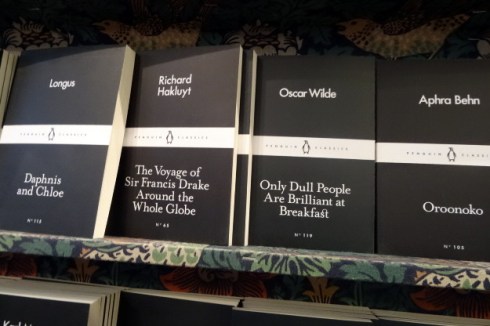
I have a particular predilection for small decorative books published in collectible series, which British publishers are particularly good at producing. I have posted about two of my favorite series before, Britain in Pictures and King Penguins, and on this recent trip I encountered some more! The very traditional and well-stocked Daunt Books, which in addition to selling books has its own imprint, had several series on display in their main store on Marylebone High Street in London, and Waterstones (now managed by James Daunt) had a beautiful display of the new Penguin Monarchs series AND two big bookcases full of classic Penguins. The British love their Penguins, and who can blame them?

Daunt Books London

Daunt Books

Daunt Books Display 2

Candlewick Press Collage

Daunt Books Display

All sorts of books at Daunt including pamphlets: the Candlewick Press “Poetry Pamphlets” are marketed with the pitch phrase “instead of a card”; the “Little Black Classics” were issued in a series of 80 volumes last year to commemorate Penguin’s 80th anniversary.

Penguins Orange

Penguins Blue

Penguin Monarchs

Penguin Monarch Charles II.

Over at Waterstones on Gower Street, there were vintage paperback Penguins in orange and blue, and the new Penguins monarchs series, “ short, fresh, expert accounts of England’s rulers in a collectible format” with commissioned covers. I want all 45 of them (44 kings and queens + Oliver Cromwell, of course).


Londonopolis

I have returned from my whirlwind tour of London, which is itself a whirlwind, continuing and even intensifying the dynamic expansion (up and out) that I witnessed the last time I was over there, with no cessation in sight! There’s nothing new about this: the metropolis (Londinopolis, according to the title of James Howell’s 1647 survey Londinopolis an historicall discourse or perlustration of the city of London, the imperial chamber, and chief emporium of Great Britain: whereunto is added another of the city of Westminster, with the courts of justice, antiquities, and new buildings thereunto belonging) emerged in the later sixteenth century and just kept growing all the way up to the twentieth century, when wars stopped and then resuscitated its regular redevelopment. London remains the “chief emporium” of Great Britain, but also of the world. It was difficult to take a picture anywhere in the city without capturing a crane in the background: construction zones abound in every district. And even where there are no cranes there are constant contrasts between old and new–some quite shocking–and some more subtle. But London remains an amalgamation of neighborhoods, and I do wonder what its citizens think of the relentless development pressure. You hear complaints of “blackened” Belgravia, where wealthy foreigners have purchased flats in which they will never live, and “iceberg houses” with hugely built-out basements below ground, but what looks like folly architecture to me seems okay to Londoners. I purchased a book by Rowan Moore, the architecture critic for the Observer, to give some insights into London’s 21st-century building boom during the long flight home, but Slow Burn City was more about anecdotal building than perceptions of planning, for the most part.

I did complete my planned itinerary (including Botticelli Reimagined at the Victoria & Albert, which was ok, but from my perspective presented in backwards order; the Pepys exhibition at the National Maritime Museum, which adhered to its one man’s life and times format without fail, and the AMAZING sixteenth-century Sutton House in Hackney, which will get its own post), and took students to Hampton Court, Westminster, Greenwich, and the Tower of London. The rest of the time I spent in the east end–in Spitalfields and Shoreditch– exploring bustling neighborhoods that I didn’t know very well, inspired by the wonderful blog Spitalfields Life and steadfastly avoiding the Salem-like Jack the Ripper Museum, which was supposed to be about the lives of the female victims (and working-class women in general) but is somehow not. Spitalfields is surrounded by modern buildings but its core is eighteenth-century, and it has been a long-time refuge for immigrants: French Huguenots in the seventeenth and eighteenth centuries, Irish and Jews in the nineteenth, and Bangladeshi today. It is home to the Old Spitalfields Market, which is probably the best market in London, a city of great markets. I fell hard for an architect there, and I don’t mean my husband (who came along): one sight of Nicholas Hawksmoor’s Christ Church, Spitalfields and I was a goner–so he’s going to get his own post too.

Some of my favorite places and photographs: more focused posts to follow all week.

London Staple Inn

London Staple

London Liberty

London Busts

Real Tudor and Faux Tudor: Two of my favorite buildings in London: the Staple Inn in Holborn and Liberty of London; busts from Liberty, the National Maritime Museum in Greenwich, and the Victoria & Albert Museum.

London Trooping

London Tower View

London 483

London Tower

London Graffiti Collage

London V and A courtyard

London Greenwich.jpg

Troops trooping near Buckingham Palace; In the Tower yard; armour in the White Tower; “graffiti” on window frames in the Tower and at Hampton Court Palace; The view from the White Tower–fortress against modernity! In the garden at the Victoria & Albert; the view south across the Thames from the Royal Observatory, Greenwich.

London St Pancras

Pancras todayLondon Marleybone 2

London Marylebone

London Placques

The amazing St Pancras train station and adjoining hotel, saved from demolition by Poet Laureate John Betjeman, whose statue is prominently situated inside; Marylebone streets; a few blue placques.

London 455

London Spitalfields

London bags Spitalfields

IMG_20160313_215701[1]

IMG_20160320_155918[1].jpg

London Fournier

Very Vibrant Spitalfields: Nicholas Hawksmoor’s STUNNING Christ Church, Spitalfields (completed 1729) with which I am OBSESSED; the view from the Church: old and new buildings encasing the market; a few items from the market (thanks Carol!), the beautiful Fournier Street; an effigy of London Mayor Boris Johnson (or Donald Trump)?


Miss Brooks Embellishes

I am featuring yet another new-to-me Salem artist today, Mary Mason Brooks (1860-1915), who worked primarily in watercolors over her career. Mary’s biography is spare: the obituary in the 1915 American Art Directory consists of only two brief lines: a painter in water colors, died September 20, 1915. She was born in Salem, Mass, studied in Rome and Paris; exhibited in New York and Boston, her home being in the latter city. I can fill in these lines a bit: she was born into an old and well-connected Salem family, grew up on Lafayette Street, and her father was the long-time Secretary of the Essex Institute who also published quite a few antiquarian pieces over his long career. After her training in Europe, Mary returned to Salem briefly and maintained a studio and school in the famous “Studio” at #2 Chestnut Street among her fellow Salem artists, but she was off to Boston and Jamestown, Rhode Island by her early 30s. She had both family and friends in Jamestown, located right over the bridge (then ferry!) from Newport, where an artists’ colony was emerging and where she eventually died, “suddenly”, at age 55. That’s about it for the written record on Mary Mason Brooks: her works are going to have to embellish her character for us. And there are many: it is apparent that Miss Brooks was no dilettante, but rather a professional, working artist. Most are watercolors: some European scenes, lots of flowers and trees, several structures, the occasional (appropriate for a Salem girl) ship. But the most charming–and in many ways most revealing–work of Miss Brooks that I could find is a book illustrated by her after its publication: a one-off edition of Eleanor Putnam’s Old Salem (1886 & 1899). This charming little book is a collection of previous-published Atlantic Monthly articles written by Harriet Leonora Vose Bates, who preferred to use the pseudonym of her ancestor Eleanor Putnam, published posthumously in two editions. It is basically a series of reminiscences about the stuff of old Salem—shops, schools, homes and things–which Miss Brooks illustrates in her special edition.

Miss Brooks Embellishes Old Salem

Miss Brooks Embellishes Old Salem Collage2

Miss Brooks Embellishes Old Salem Collage

I think it’s pretty gutsy to illustrate a book after its publication, and after its author’s death! And to sign your name right there on the title page! Miss Brooks probably thought her special edition would never see the light of day, but it made its way on to ebay, of all places, a century after her own death. I like the marginalia, which transforms a charming but mere book into something else entirely, but I also feel that I should present some of the artist’s more formal works which were represent her public oeuvre. They testify to a life well-lived, if short, in some beautiful places.

Mary Mason Brooks Salem Schooner

Brooks Garden Poppies

Brooks 3 Viewsp

Mary Mason Brooks watercolor Weston Historical Society

Watercolors by Mary Mason Brooks: Lumber Schooner; Garden of Poppies, Isles of Shoals; Three European Views, Skinner Auctions; and my favorite, a watercolor of the pool at Haleiwa, the Horace Sears Estate in Weston, Massachusetts, Weston Historical Society.


Anglo-Americana at Auction

There’s quite a bit of buzz here in Salem about a particular lot in an upcoming “Printed and Manuscript Americana” auction at Swann Auction Galleries: #84, a hitherto unknown edition of the Bay Psalm Book with Salem connections. It caught my attention a few weeks ago because of its importance in printing history, but of course the headlines here in Salem are all about its connections to the Witch Trials of 1692: it was owned by one of the judges, Jonathan Corwin and his wife Elizabeth, and later passed into the family of one of the trial’s victims, John Proctor. His descendants have held on to the book (which they apparently called “the witch book”) for over a century and are now parting with it. I wonder if its estimate of $30,000-$40,000 is due to its bibliographic importance or its ties to Salem? 

Anglo Americanap

I think it’s the former but I could be wrong. Two years ago, a copy of the first edition (1640) owned by the Old South Church in Boston set a new world record for a printed book at a Sotheby’s New York auction when it sold for $14, 165.000. The estimate for this newly-discovered seventh edition might be low.

No doubt the Bay Psalm Book will be the star, but several other items in this auction caught my attention: a first edition of one of the most important–if not the most important–early histories of English exploration, Richard Hakluyt’s Principall Navigations, Voiages and Discoveries of the English Nation (1589), a really neat anthology of shipwrecks and maritime disasters titled God’s Wonders in the Great Deep, or, a Token for Mariners (I am very slowly writing a book on wonder in early modern England and I had not thought of it in this way before–as deliverance from disaster), an engraving of a sketch made by British spy Major John André on the morning of his execution illustrating his voyage to meet Benedict Arnold (I’ve always had a thing for André), and last but not least, the expansive diary of a young Vermont woman named Elizabeth Houghton, including recollections from 1820 to 1836 and an AMAZING vernacular drawing of two women dressed in WILD “regency” dresses. Quite a treasure trove, this Anglo– Americana auction.

Anglo American Hakluytp

Anglo Americana Wonderp

Andre on the Hudson

Diary Dressesp

Lots from Swann Auction Galleries Printed and Manuscript Americana Auction, February 4, 2016: #84, an unknown 7th edition of the Bay Psalm Book; #152, a first edition of Hakluyt’s Principall Navigations; #177, God’s Wonders in the Great Deep (1731);#29, an engraving of Major André’s last drawing; and #270, Elizabeth Houghton’s Diary.


Animal Adaptations

I don’t think I will ever tire of anthropomorphic animals, no matter how old I get. This weekend, to mark National Handwriting Day (not really, but any excuse to shop), I purchased a print of a letter-writing fox from the Litus Gallery, and then went back for more. The very dynamic discussion in response to my Samantha statue post last week referenced the word “whimsical” several times, so I wanted to reorient myself to that word and sense and to me, these works are most definitely whimsical, fanciful, even dreamy. But beyond the aesthetics, many of the Litus images (as alluded to by their titles) are also referential: the title of my fox is “Michael Drayton writing the Second Part of the ‘Poly-Olbion’, Fleet Street, 1617 and I also purchased a print of a clerk-like cat titled “John Selden leaving Hare Court, Inner Temple, August, 1614.” I don’t think that either the poet or the jurist was painted in these situations, but other examples of the Gallery’s work are based directly on particular paintings. I thought it would be interesting to match up the originals with the adaptations. The differences are not hard to discern!

Fox Writing Letters

Animal Adaptations Collage 1

Animal Adaption Collage 2

PicMonkey Collage 3

PicMonkey Collage 4 Rembrandt

Animal Adaptation Collage 6 Blake

Animal Adaptations Collage 5

Weighing the Fruits after Jan Vermeer’s ‘Woman Holding a Balance’; Johannes Vermeer, Woman Holding a Balance, 1664, National Gallery of Art, Washington, D.C./ The Turnip Spinner (After Chardin’s ‘Gabriel Godefroy watching a top spin’/ Jean-Siméon, Portrait of the Son of M. Godefroy, Jeweler, Watching a Top Spin, c. 1735, The Louvre/ The Eight Lives of Mr. Tybalt (after Nicolaes Eliaszoon’s ‘Portrait of Nicolaes Tulp’; Nicolaes Eliaszoon Pickenoy, Portrait of Nicolaes Tulp, 1633, Stedelijk Museum, Amsterdam/The Book-Keeper (after Rembrandt’s ‘Young Man at His Desk,’); Rembrandt, Scholar at his Desk, 1631, Hermitage Museum/ I want, I want, after William Blake; William Blake, “I want, I want” from For Children: the Gates of Paradise (1793)/ Il Ladro di Fragola (after Jean Baptiste Chardin’s ‘Basket with Wild Strawberries’; Jean Baptiste-Simeon Chardin, Basket with Wild Strawberries, 1731.

All Animal Adaptations available at the Litus Gallery.


What I Want Now: King Penguins

Today I have an entry in my very occasional series of What I Want Now: things I am craving at this very minute. Generally these things fall into two categories: items that I have just discovered and want instantly and items that I have known about for a while but suddenly must have. Today I am thinking about collectible “King Penguin” books, an illustrated hardcover series that Penguin published between 1939 and 1959, including 76 titles. I have four and now want more. These are slim volumes with striking covers: like another series which I admire and collect, Britain in Pictures, it was the aesthetic quality of these books that first captured my attention rather than their content. They look great on a shelf, and in multiples, so I really need more, now. I bought my four volumes in a brick-and-mortar store that is no more, so I think I’ll have to expand my collection from online sources but I’m a bit hesitant as condition is everything with these books: not only do they have beautiful covers, they have lovely spines, and this is the part of the book that gets the most wear and tear. Yet despite my trepidation, I will press on, and if anyone out there reading this wants to help, I have Crown Jewels, Elizabethan Miniatures, Some British Moths, and Flowers of Marsh and Stream in my possession and really want Animals in Staffordshire Pottery, the two (edible and poisonous) mushroom books, both of which have amazing covers, A Book of Toys (with toy penguins on the cover), Spiders, The Bayeux Tapestry, The English Tradition in Design, A Book of Scripts, Tulipomania, and just for the season, Compliments of the Season.

King Penguin Elizabeth Miniatures

King Penguin Flowers Marsh and Stream

King Penguin Mushrooms Covers

King Penguin Toys Cover

King Penguin Spiders Cover

King Penguin Scripts Cover

King Penguin Ballet Illustration

King Penguin Military Uniforms Illustration

King Penguin Tulipomania Cover

King Penguin Compliments Cover

King Penguin titles I have and want, and illustrations from Janet Leeper’s English Ballet and James Laver’s British Military Uniforms. The best source for learning all about collectible Penguin titles is here. Oh, and this one too, please: for $92, I assume its spine its perfect.

King Penguin Life Cover


Small Business Salem

After a beautiful warm Thanksgiving week it was rather depressing to wake up to a cold, dark, and rainy Small Business Saturday here in Salem. We were playing football in what seemed like 70-degree weather yesterday up in Maine! I’m a big advocate of shopping local and small, not just during the Holidays but all year round. I think small business owners are absolutely heroic, particularly retailers in this internet age. The day before Thanksgiving I found myself with lots of errands to do and lots of things to buy, even though I wasn’t even cooking: off I went to the tailor, the newest French bakery, the wine store, and the cheese shop, all on foot. I’m sure I could have saved myself time and money if I had just driven to Vinnin Square (where all the big stores are), but I wouldn’t have learned that the tailor’s mother-in-law grew up in the same French town as one of the purveyor of macaroons, I wouldn’t have been able to wish several friends Happy Thanksgiving, and I wouldn’t have garnered any praise for my recent letter-to-the-editor protesting Haunted Happenings’ toll on our ancient cemeteries. Today I went out in the rain just to see who was out and about: I prefer to do my own Christmas shopping just a few days before Christmas in a single day (or maybe two) with a long lunch break.

Salem Small Business 020

Salem Small Business 022

Caramel Macaroons

Salem Small Business 032

Salem Small Business 047

Salem Small Business 042

Salem Small Business 050

Salem Small Business 052

A very random sampling of Salem wares on Small Business Saturday: vintage Christmas ornaments (including those of a political nature) at Witch City Consignment; macaroons at Caramel; fish prints at Joes Fresh Fish Prints at Pickering Wharf, a selection of teas at the Jolie Tea Company, the new tea shop/room across from the Hawthorne Hotel, rainy window and manly items at The Marble Faun.

There were people downtown, so hopefully all of Salem’s merchants had good day. In the 20 years that I’ve lived here, the retail scene has definitely improved (particularly retailers of food and beverages) but it still looks a bit challenging to me. There are many visual and literary reminders of the “golden days” before the construction of the Northshore Mall in nearby Peabody when Essex Street was clearly bustling year round, and neither its transformation into a pedestrian mall in the 1970s or the commencement of Haunted Happenings in the 1980s has been able to bring back that dynamic customer base. It’s a different commercial era for sure, but if we want a vibrant downtown offering more than witch kitsch it’s our obligation to get out there and consume: it’s a Salem tradition.

Salem Bakery

Filene's 1856 Pavilion

Filene's 1880s

I just discovered several new archives of Salem photographs which really focus on business, so here’s some historical perspective and inspiration. Above: delivery carriages for Hyman B. Miller’s Bakery on May Street in 1913–these buildings would all be wiped out by the Salem Fire in the next year, but Miller rebuilt his business (Collections of the American Jewish Historical Society). Below, the original Salem Filene’s in 1856 and 1881: this is a business which grew to become one of the biggest regional American department stores in the twentieth century (AJHS Collections and Archives of the Credit Union National Association, Inc.).


To Market, to Market

A few weeks ago I accompanied several friends up to Pettengill Farm in Salisbury, Massachusets for the holiday version of their occasional Vintage Bazaars. It was a bit early for a “holiday” market for me, but this was a juried affair, packed with vintage items, crafts made from salvaged materials, botanicals and art, so it was well worth the trip, and I delayed looking at, much less posting, the pictures until just this morning. With a healthy respect for a calm Thanksgiving, I do feel the urge to start getting the house ready for the season now. Christmas shopping for other people I will leave to later: everything I bought at this bazaar (a rather random assortment of a handmade mouse, typographic magnets, and a painting of a lime for my 1970s china cabinet/bar) was either for myself or my house (which clearly I think of as an entity separate from myself). This weekend, Salem’s flourishing farmers’ market evolves into the Winter Market, and then we are off……..

Market 17

Market

Market 18

Market 4

Market 2

Market 5

Market 6

Market 8

Market Collage

Market 13

Market 14

Market 15

Market 16

Market 19

Market 20

Market in Salem Winter

Some offerings from Pettengill Farm’s Holiday Vintage Bazaar earlier this month, and the poster for this weekend’s Salem Winter Market. Another Salem holiday market next month.


Tumbling Blocks

It’s an old, old pattern, utilized in ancient Greece and Rome and maybe before, revived in the Renaissance, Baroque, and Victorian eras. Actually “tumbling blocks”, also known as rhombille tiling, reverse cubes, or cubework, probably never went away. It’s got to be one of the most popular–and most effective–optical illusions used in tile and textile design–both in the past and the present. I’ve always loved this pattern, and after I saw it on some chairs in one of the bedrooms in the newly-restored Joshua Ward House, soon to open as The Merchant, I started thinking about it and looking for it and it was suddenly everywhere. I always knew it was ancient, but my first introduction to tumbling blocks came via an amazing and influential eighteenth-century pattern book,  John Carwitham’s Floor-decorations of Various Kinds, Both in Plano & Perspective: Adapted to the Ornamenting of Halls, Rooms, Summerhouses (1739). Carwitham’s 24 plates, including several three-dimensional patterns “compos’d of three different kinds of marble, as white, black and dove-coloured, which are so disposed of, that in the dark of an Evening they both appear as if they consisted of a number of long cubes, lying with angles upward, forming of ridges, like the roofs of houses…..”, were apparently very influential on both sides of the Atlantic. I wouldn’t be surprised if Joshua Ward’s beautiful Mansion House, built less than 50 years later, did not feature some surface in the tumbling blocks pattern, so it seemed very appropriate to see it reappear on a pair of modern slipper chairs in 2015.

Tumbling Blocks Pompeii House of the Faun

Tumbling Blocks Carwitham 1739

Tumbling Blocks Firescreen V and A

Tumbling Blacks Quilt crop NMAH

Tumbling Blocks Tunbridge Ware Box

Optical Illusion Below Getty

Tumbling Blocks Bowl Jayson

Tumbling blocks

Merchant Salem

Tumbling Blocks:  House of the Faun at Pompeii; plate for John Carwitham’s Floor-Decorations of Various Kinds (1739); Victorian firescreen, c. 1865-1875, Victoria and Albert Museum Collections; Connecticut Child’s Quilt, c. 1860-1880, National Museum of American History; Tunbridge Ware Tea Caddy, c. 1860, available here; floor of the Getty Villa; bowl at Jason Home; Anthropologie Diamond Interlockrugs; guest room corner at The Merchant, Salem.