Tag Archives: Shopping

Time for Salem Switchel

July was pretty hot; August will likely be cooler, but I still think it’s time to revive an old summer drink here in Salem called switchel. A colonial “ade” made of ginger, vinegar, and a sweetening agent, switchel has enjoyed a revival over the last few years, and is currently being produced in such variant hipster havens as Vermont and Brooklyn. In older texts, it’s often referred to as “haymaker’s punch”, implying agrarian origins, but I’ve also found plenty of references to switchel in maritime and military sources. There’s a famous reference to it in the account of one of the major naval battles of the War of 1812, between the USS Constitution and the HMS Guerriere off the coast of Nova Scotia. Anticipating a great victory, the Guerriere Captain James Dacres ordered his cooks to “prepare the switchel” for the soon-to-be captured Americans. After Old Ironsides prevailed, this phrase was incorporated into a mocking/patriotic American sailors’ song: When prisoners we’ve made them, With switchel we will treat them; We’ll welcome them with Yankee Doodle Dandy, O. It’s definitely one of the first American beverages. There’s a very nice reference to Salem switchel in the memoirs of Boston Brahmin Robert C. Winthrop, who marched up to Salem on a hot summer’s day in 1822 in the company of the Boston Light Infantry to camp out on the Common:a wisp of straw for our bed, and a bit of thin bunting above our heads, through which we could see the sentinel stars keeping their watch in the sky, more vigilant than any sentinels we could station, were our only and all-sufficient accommodations; and a little molasses and water and ginger–a switchel I think it was called–was our best drink. Elizabeth Hall’s Practical American Cookery and Domestic Economy (1857) contains the basic recipe (mix half a gallon of molasses, one quart of vinegar, 2 ounces of powdered ginger with five gallons of water, boil and cool to make a beverage that is not only “very pleasant”  but also “highly invigorating and healthful”) but it is clearly suitable for all sorts of substitutions and additions: the modern Vermont versions contains maple.

Switchel Vitick's

Salem is a major foodie town today, with countless restaurants and bars, a distillery, a cider taproom, a brand new beer brewery, beer hall & garden, and a whole bunch of clever and crafty people: surely someone could produce and market a special Salem Switchel drawing on our city’s past and present? A Salem variety should no doubt feature molasses, but I think rum would also be an appropriate (and appealing) ingredient. And I have the perfect containers for inspiration: these are beautiful vintage bottles produced for S.B. Winn & Son, producers of ginger ale and other beverages, and Eldredge’s Lagers, all made in Salem over a century ago.

bottles 3


bottles 6

Salem Bottle

Winns Ginger Ale Ad


Yellow Houses of Nahant

When I met my husband he was living in Nahant, a “land-tied island” (two actually) to the south, between Salem and Boston. It’s one of the smallest towns (if not the smallest) in Massachusetts, a single square mile in size with less than 4000 inhabitants. I spent quite a bit of time there while we were dating, and when we decided to get married there was a bit of a tussle which Salem (and I) won. I think this was the right decision for us as a couple, and certainly for his architectural practice, but I do wonder occasionally what our lives would be like if we decided to live in Nahant rather than Salem. And of course, I picked out all of my (our) potential residences during the time I spent there–something I do in pretty much every town in which I spend more than a few hours. The other day while I was driving by the causeway that leads out to “the island” I decided to revisit these houses. Nahant has some amazing coastal properties, but only one is on my list–all the others are on or just off the main road that runs through the center of the town. It was only when I returned home and looked at all the pictures that I realized all of my favorite Nahant houses are yellow.

Nahant PO

I always loved the Nahant Post Office…..below, “my” houses: the first one overlooks Egg Rock (which never seems to stay in the same place!) and is very difficult to photograph so you’re not really seeing its entirety or its details. The rest are easier to capture…even the long double Whitney house, once an inn and tavern, which is the oldest structure in Nahant. The last house–a Gothic Revival cottage near the library–is my very favorite: if my future husband had owned it we probably have wound up in Nahant!

Nahant 3

Nahant 5

Nahant Egg Rock

Nahant 7

Nahant 9

Nahant 11

Nahant 10

Nahant 1

Save

Save

Save

Save

Save


Color Full Days

A very full weekend in more ways than one: eating, drinking, shopping, gardening, sailing, events all around me. The weather has been nothing short of perfect: sunny in the low to mid-80s without a trace of humidity. We will pay later if we don’t get some rain, but at this point green still reigns, with lots of other colors competing–a veritable rainbow for Pride parade weekend, which was also Cancer Walk weekend and the occasion of countless outdoor activities. I spent much of Saturday at a large outdoor market up in Salisbury and Sunday afternoon sailing with friends, and in between I managed to do tons of yard and deck work (still cleaning up after chimney, roof, and carpentry projects–I think I’ll be picking up shavings of shingles all summer long, maybe for years) effortlessly just because it was so beautiful outside. This Monday morning, I’m sunburned and sore, which are always signs of a good Summer weekend.

The Last Weekend in June, 2016: at the Vintage Bazaar at Pettengill Farm, Salisbury, Massachusetts:

Color 7

Color 6

Color Collage

Color 8

Color 10

Color 4

Pettengill Door

Back in Salem, more colorful than usual:

Salem Door Essex Street

Color 11

Color 16

Color 17

Color 18

One color to avoid while in Salem is RED: the newly-painted red line does NOT take you to historical sites but rather to sites like the Witch Dungeon Museum on Lynde Street, which occupies neither the structure or the location of the original Salem Gaol. Do you think the Red Line is there for the (also newly-painted and looking great) Rufus Choate and Mary Harrod Northend Houses next door? It is not.

Color 12

Color 14

Color 15

Back to more pleasant sites and colors: a beautiful Sunday afternoon sail (with another sailboat passing by VERY closely!), and sunset at the Willows.

Color 19

Color 24

Color 25 Cocktail Cove

Color 26

Color 3

Save


Illustrations of the Improv’d Garden

I discovered the prolific British illustrator Clare Melinsky just recently, and apparently too late to obtain the examples of her work that I covet the most: illustrations based on several eighteenth-century gardening manuals by clergyman John Laurence, including: The Clergy-Man’s Recreation: Shewing the Pleasure and Profit of the Art of Gardening, The Gentleman’s Recreation: Or the Second Part of the Art of Gardening Improved, and (an apparent pseudonym) Charles Evelyn, The Lady’s Recreation: Or, the Art of Gardening Farther Improv’d (bound together in variant editions, 1717-1719, along with The Fruit-Garden Kalendar: Or, a Summary of the Art of Managing the Fruit-Garden). These are wonderful little practical books, and Melinsky’s clean linocut prints look like they are culled from the texts: they are period perfection and absolutely charming. Melinsky’s portfolio includes everything from The Witches of Salem: A Documentary Narrative (London: Folio Society, 1982) to the covers of the Bloomsbury boxed set of hardback “signature editions” of Harry Potter, and lots of flora and folktales and Shakespeare in between. Everything looks lovely, and I look forward to enjoying more of her work as time goes by but right now I’m pretty fixated on the unattainable “improv’d garden”  images–though her similar Robert Burns postcards might just suffice.

Melinsky Cards Collage

Melinsky Cards Collage Garden

Melinsky Collage

Melinsky Kew Gardens

Laurence Gardening Improvd Front

Melinsky Witch Linocut

Clare Melinsky’s Linocut “Gardening Improv’d” cards, along with a more “modern” illustration of Kew Gardens and a witch (just because) from here and here; Frontispiece ilustrations to Laurence’s Gardening Improv’d parts II and III, 1719.

Save

Save


Illustrations of Interest

There are several illustrations included in upcoming auctions that are of interest to me: some Salem things, and a few images which just appeal to me, period. First up is a little pamphlet by one of my representatives of Colonial Revival Salem, Mary Saltonstall Parker, who I wrote about more extensively here. She is known for her embroidery, her poetry and her prose, all of which evoked “Olde Salem” in a personal and heartfelt way. I can just imagine her and her contemporaries, including Frank Cousins and Mary Harrod Northend, working creatively and fervently to document all that was Salem (quite apart from the Witch Trials) in that heady decade of the 1890s. Mrs. Parker published little books continually through that decade, including one I do not have, Salem Scrap Book, with illustrations by S.E.C. Oliver, or Sarah E. Oliver, whom I presume is either the daughter or granddaughter of former Salem Mayor Henry Kemble Oliver, whose portrait is in the book. Miss Oliver’s illustrations are new to me so I’m going to search out for some more, because they look…..interesting. I also like how the content seems to be critiquing the two pillars of Salem tourism in the 1890s: Hawthorne and witches (now only one pillar stands): How Hawthorne would his face have hated, Burnt into cups, or silver-plated!…..We’ll let the poor old witches rest.

Salem Scrap Book

Salem Scrap Book 2

Swann Auction Galleries has a great auction of illustrated books coming up next week which includes several lots which caught my eye. I’ve always wanted a copy of Howard Pyle’s Book of the American Spirit, which includes images of several scenes of Salem “history”, including the previously-published young reputed witch on her way to the gallows and the iconic A Wolf had Not Been Seen in Salem for Thirty Years.  And speaking of Hawthorne, a 1918 English First Edition of Tanglewood Tales with illustrations by Edmund Dulac is also included in this Swann auction, as are more Dulac illustrations of famous and not-so-famous fables and fairy tales, the focus of this collection.

Pyle Dulcibel Spirit

Pyle Wolfe Salem

Hawthorne Dulac

Edmund-Dulac-Book-Tanglewood-Tales-First-Edition-1918-endpaper

Dulac Fables and Tales

Illustrations by Howard Pyle and Edmund Dulac from the upcoming Swann auction of the Salinas Collection of Fine Illustrated and Plate Books.

Save

Save

Save

Save


Grads and Hangtags

A very busy day yesterday, with Salem State’s commencement in the morning and the commencement of the Derby Square Flea salvage Art Market in the afternoon. There is very little to tie these two events together besides my attendance (and that of a few other people) but at the end of the day I was left with a lasting impression not only of commencement but also of creativity, on the part of both graduates and vendors! I’m going to spare you all of my graduation pictures but I wanted to showcase just a few of the extremely creative mortarboards on display at the morning graduation ceremony–I’ve really seen the practice of embellishing mortarboards explode over the last few years and this year it seemed like there were more than ever: the usual glitter and flowers and family names but also more inventive and inspirational projections (or recollections?) Below are two creations of new History grads, who I am very partial to of course, but it seemed to me that each and every discipline was well represented by this trend.

Commencement

Commencement 3

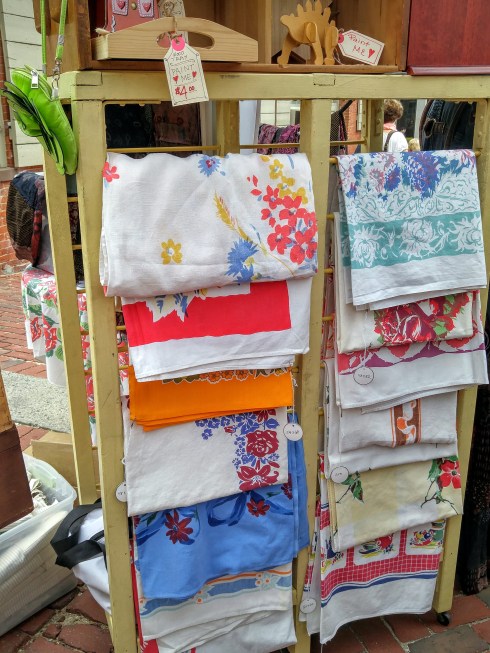
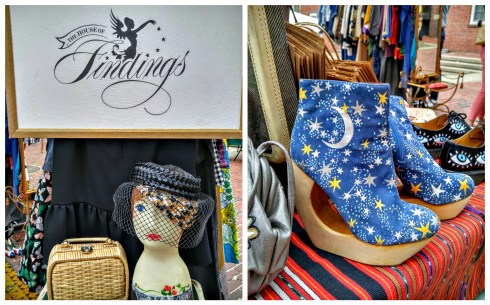
And on to the market…..which was obviously a huge success. Great vendors–lots of vintage collectibles and clothing, art, and up-cycled creations. It seemed to me that there was a lot of quality vintage hardware and textiles–the latter cleaned and pressed to perfection. I was a bit bleary from the morning’s festivities so was not really the purposeful picker that I generally am at these venues, but I did buy a very nice painting and marshaled all of my remaining strength to take some pictures. I’m sure that I will be back to form for the next market: on June 18.

Commencement 5

Commencement Collage

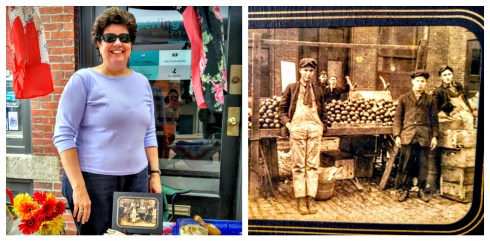
Here we have a proud vendor standing in the very same spot that her grandfather (on the right) had his stall when Derby Square was a food market!

Commencement 6

Commencement 17

Commencement 8

Commencement 10

Commencement 9

Commencement Collage 2

Very eclectic offerings.

Commencement 14

Commencement 18

The cars were not for sale but the books were–WHEN KNIGHTHOOD WAS IN FLOWER! The pioneering tale of romantic Tudorism: I would have picked this up, but I already have four or five copies, I think.


To Market, to Market

This coming weekend several friends of mine, three ladies who are clever and creative and fierce hunter-gatherers all, are launching a new endeavor, the Derby Square FLEA Salvage ART Market, a monthly pop-up venue featuring equally creative vendors of art, vintage and salvaged goods in both original and up-cycled form. The Market will be held every third Saturday from May through September in Salem’s venerable marketplace, Derby Square. For this first Market, there will be 23 vendors, all displaying their wares under perfect white tents, along with music and classic cars, befitting May’s launching theme of rev your engines. If you visit their wonderful website, you will see that each monthly market has its own theme, including July’s bicentennial in recognition of the anniversary of the Derby family’s donation to Salem of the land previously occupied by their majestic Bulfinch mansion (with the proviso that it remain commercial space). So this Market, like the weekly Farmer’s Market and all the enterprises along the adjacent Salem Marketplace across Front Street, honors the city’s past and present.

Derby Square Market Poster

Derby Square Poster

Derby Square Banner Sepia

Derby Square FSA is an invitation-only venture: these ladies have been “shopping” for their vendors for a year! There will be no witch kitsch in Derby Square on these summer Saturdays: think Brimfield rather than Haunted Happenings. Their vendors are listed on the website and the Market’s Facebook page, and I picked out a few representative items for a preview. I was happy to hear that my friend and neighbor Racket Shreve, a noted marine artist, will be selling cards and prints on Saturday, from the back of his 1962 Willys Jeep (most appropriately).Derby Square Market Collage

Derby Square Ashley Procopio Jewelry Packaging

Shreve Studio wall

Vintage handkerchiefs from Verve Design, Globe light from House of Champigny, Chair by 8 by Design (before it got a great seat), Soap from My Sweet Soap, Jewelry maker Ashley Procopio’s perfect packaging, Racket Shreve’s studio.

Like so many events and organizations in Salem (excluding all the witchcraft profiteers, of course), Derby Square FSA is a labor of love for the city and all it has to offer. Of course its organizers (who are again, full disclosure, my friends) are operating an enterprise, but they are also offering a service and a resource. Again, let me direct you to the amazing website which offers up a wealth of information not only about the Market but also about Salem: it should be bookmarked by visitors and residents alike. I’ll let them speak for themselves as they explain their vision for the transformation of Derby Square, the “heart of the city”, into a: a vital marketplace which showcases and connects what Salem is known for around the world–art and beautiful old things in a vintage American city.

Derby Square 1855 Harpers

Derby Square Market PC 1910

Derby Square Salem

Derby Square: 1855 (from Harper’s New Monthly Magazine), circa 1910, and this past weekend.

Derby Square FLEA salvage ART, a monthly pop-up market. Third Saturdays 10-5, May-September, Derby Square, Salem, Massachusetts, commencing MAY21!

http://www.derbysquarefleasalvageart.com/


What Would Jane Think?

My guilty pleasure-reward for making it through this particular semester is indulgence in a few Austen-esque books: Curtis Sittenfeld’s Eligible and Among the Janeites: A Journey through the World of Jane Austen Fandom by Deborah Yaffe. Eligible updates Pride and Prejudice by removing the story of Elizabeth and Darcy and their plot-driving families to the suburbs of Cincinnati, where they encounter complications brought on not only by their pride, prejudice, and genteel poverty, but also by a range of modern challenges (and opportunities): everything from artificial insemination to anorexia to a reality television wedding extravaganza. I think I got most of the updating, although I’m not quite sure of the significance of the spider infestation in the Bennet Tudor (Revival). Eligible is the fourth adaptation of HarperCollins’ Austen Project, which has commissioned contemporary authors to “reimagine” six Austen novels: I’ve also read Joanna Trollope’s Sense and Sensibility and am looking forward to the reimagined Persuasion, my favorite Austen. The Austen Project apparently aims not only to update but also to upgrade the usual Austen fan fiction genre, which has produced countless titles since Colin Firth/Darcy emerged from the Pemberley lake in the iconic 1995 BBC miniseries.

Austen Project Collage

Austen Stack

Austens Folio Society stack

British covers of Trolloppe’s Sense and Sensibility and Sittenfeld’s Eligible; my stack of real and inspired Austens; my favorite recent editions, from the Folio Society.

I’m not quite sure that I represent the target audience for all these Austen adaptations, even though I was right there, holding my breath, when Elizabeth encountered a damp Colin/Darcy striding from the lake. I’m probably too old or too traditional or both: while I got Clueless and Bridget Jones’s Diary, I didn’t really understand the point of Pride and Prejudice and Zombies in either text or film form. But I am really interested in the culture–and the economy–of “Janeitism” because it seems like a very vibrant one, offering up many new and varied products every year. I haven’t started Yaffe’s Among the Janeites yet (I’ve been too busy with Eligible) but I’m hoping it will give me lots of insights into this world. You would think that the word “Janeite” is a new one, but actually it goes all the way back to the first big revival of her works, following the publication of her nephew’s Memoir of Jane Austen in 1869, which inspired the appearance of several illustrated and introduced editions in the 1890s. From then on, it wasn’t quite the Austenworld that we live in now, but she was regularly in print (you can see a nice succession of Pride and Prejudice covers here) and occasionally on the screen. Austen adaptations have clearly surpassed those mediums in the twenty-first century, and I can’t help but wonder, what would Jane think?

Austenland

Death Comes to Pemberley

Austen Love & Friendship

balbusso_pp_1 Pride and Prejudice

Stills from Austenland (2013), which was not very good, Death Comes to Pemberley (2015), which was quite good, and a film opening this week, Love & Friendship, based on Austen’s posthumously-published epistolary novel, Lady Susan; Jane thinking, illustration from the 2013 Folio Society edition of Pride and Prejudice by the Anna and Elena Balbusso.


Searching for a Spring Wine

May–my favorite month of the year, representing the end of the school year, high time for gardening, that perfect shade of soft spring green, my anniversary, and a kind of wistful merriment which is actually more academic than experiential–because I’m generally too busy in May to engage in such merriment. But I always feel like the need to find a celebratory drink to toast to the spring, and the summer to follow. The traditional beverage is May Wine (Maiwein), which I have made on several occasions: a sweet white wine infused with sweet woodruff and a few other additions. My sweet woodruff has yet to really appear, much less bloom, so I don’t think that’s going to work this year. So I went backwards in time and beverage books looking for something new/old, beginning with George Edwin Roberts’ Cups and their Customs (1863), which has a fantastic title page but not much else.

Spring Wine Cups and Their Customs

Then I went way back to the sixteenth century and a favorite “receipt” book, Thomas Dawson’s The Good Huswife’s Jewell (parts one and two): here there are medicinal waters but nothing to accompany May merriment. In the Elizabethan age, that would be left to a host of imported wines, I think: malmsey, sack, claret, canary, brandy. Heavy, sweet wines which are not appropriate for Spring in any case. Jump forward to the mid-seventeenth century and a trio of popular “celebrity” cookbooks featuring the recipes of Charles I’s exiled and widowed Queen Henrietta Maria, ostensibly penned by her personal chef: The Queens Closet Opened. Being Incomparable Secrets in Physick, Chyrurgery, Preserving, Candying, and Cookery, A Queen’s Delight; or, the Art of Preserving, Candying and Cookery, and The Compleat Cook, all first appearing in 1655. I looked through a later, lovely digitized edition of A Queen’s Delight at the Beinecke Library at Yale and found several fruity “country wines”: raspberry looks good, “water of time for the passion of the heart” interesting.

Queens Delight Yale Bodleian Cover

Queens Delight Yale Bodleain

Queens Delight Yale Bodleain 2

Queens Delight 5 Yale

Over the course of the seventeenth century, Englishmen (and women too, I assume) were realizing that their dependence on imported foreign wines was not in their personal or national interests and searching for domestic substitutes. A succession of tracts appeared encouraging the planting of orchards and providing recipes for cider, perry, and a host of fruit wines. One of the most influential of these publications was John Worlidge’s Vinetum Britannicum: Or, a Treatise of Cider, and Such other Wines and Drinks that are extracted from all manner of Fruits Growing in this Kingdom (1676). As its title page illustration suggests, this is a rather practical publication: I really don’t have the inclination to make cider but perhaps I could buy some and doctor it up?

Spring Wine Folger

Worlidge

So that idea brought me to one of my favorite modern books:  Amy Stewart’s The Drunken Botanist. The Plants that create the World’s Great Drinks. Two of Stewart’s recipes could be candidates for my “toast to spring” drink: cider cup, an adapted version of medieval dépense made by combining hard cider with fruits and ginger beer (or ale), and Kir Normand, in which crème de cassis is mixed with cider. Or I could just pick up one of Salem’s own Far from the Tree ‘s seasonal ciders and leave it at that!

Drunken Botanist

Cider Collage

Buy Local; or Why invent the Wheel?


Playing Card Personas

I love the look of playing cards: the traditional suits, their predecessors (roses, crowns, rings, bells, leaves, hares, acorns…I could go on), and their endless variations and adaptations over the centuries. It is one thing to transform a card into something else entirely, or replace the familiar figures with new entities, scenes or characters (events of the English Civil War, generals during the American Civil War, the non-standard Kings and Queens of every European country, the “dedicated decks” of Salem’s own Parker Brothers), but quite another to bequeath personality to the stiff standardized Kings and Queens of the traditional deck. That artistic feat is impressive to me: so I fell for one of Felix Blommestijn’s cards a few years back, and a collage of Elmo Hood caught my eye immediately when it came across my Instagram feed last week. Now I see that his playing card creations have gone viral over the past few years, but they were quite a discovery for me.The collages are very dear, the prints affordable but apparently sold out everywhere, and I can see why: Hood’s kings, queens and jacks are immediately recognizable, but they are also active (or reactive). Quite the card trick!

Elmo Hood Broken Queen 2014

Elmo Hood Queen and King

Elmo Hood PlayingCard Print

elmo hood jack queen king

Elmo Hood Two Kings

Elmo Hood Love is Rare

Elmo Hood Jack and King

@Elmo Hood collages and prints: “Broken Queen”, “Queen of Hearts/Suicide King”, “Loyal”;  “Most Young Kings get their Heads cut off”; “Diamond Heist”; “Cards were Harmed in the Making of this Art”.  More here and here.