Tag Archives: road trips

Where Angels Once Tread

We were so fortunate to be the recipients of an invitation to visit the vacation home of (very) close Salem neighbors and friends this weekend, and now we know why they’re always leaving town. Their house is located in Dublin, New Hampshire, overlooking the lake and at the foot of majestic Mount Monadnock—-which drew genteel and monied urbanites and scenery-seeking artists to its midst like a magnet in the later nineteenth and early twentieth centuries, creating a summer colony which shaped Dublin to a great degree, both in terms of its materiality and its vitality (not to mention the preservation of vast acreage). Our friends’ house was built by one of the founders of this colony: Miss Mary Amory Green, a great-granddaughter of John Singleton Copley, who became so taken with local artist and instructor Abbott Handerson Thayer (1849-1921) that she offered to build him a cottage/studio on her property. He took her up on her offer, and because he was apparently as enticing an instructor as he was an artist, a succession of artistic pilgrimages to Dublin ensued. So here we were staying in the house that began it all, itself a beautiful creation, both enhanced by and reflective of its setting.

Monadnock House Best

Monadnock House Best Entrance Fernlea, early morning: designed by Russell Sturgis for Miss Mary Amory Greene, 1882-1883.

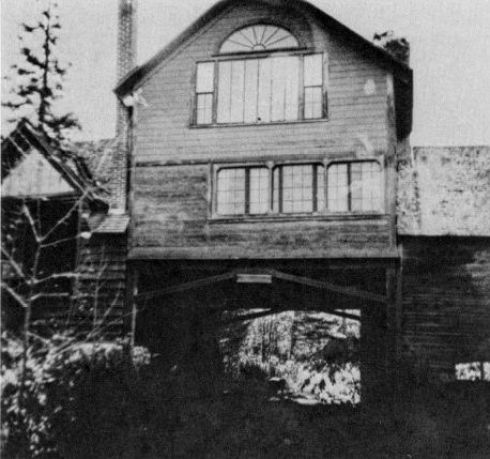
Unfortunately (for posterity but probably not for my friends), Thayer’s cottage was demolished around 1935. I began searching for images of it the moment I returned home, and as you can see below, it was more of a complex than a cottage as Thayer had some rather eccentric and austere ideas about living–and especially sleeping. Living in the age of that great “white plague”, tuberculosis, and losing his first wife to the dreaded disease, he came to believe that heat was a vehicle of its transition, a belief that his physician father apparently encouraged. The house that Miss Greene built for him was a summer house with no “conveniences”, and no alterations were made when he and his family took up year-round residence in 1901. Fires in the central house were allowed, but everyone had to retreat to open-air “sleeping huts” at the end of the day as Thayer believed that sleeping in the open, and in close communion with nature, was a particularly effective preventative against tuberculosis.

Monadnock Thayer

Monadnock Thayer Studio

downloadThe Thayer cottage complex and studio, and Gladys Thayer (Abbott’s daughter) in her sleeping hut, circa 1900. Nancy Douglas Bowditch and Brush Family papers, circa 1860-1985, Archives of American Art, Smithsonian Institution: cited in Susan Hobbs, “Nature into Art: the Landscapes of Abbott Handerson Thayer”, The Journal of American Art 14 (Summer 1982): 4-55.

And in this setting Thayer painted nature, portraits, and angels, who were not historical or theological figures but rather the characteristically-angelic women who crossed his path and touched his heart: all-the-more magnetic because of their humanity, and the wings that he gave them. You’ve got to be impressed by an artist who gave us both angels and camouflage!

Monadnock Dublin Pond Thayer Smithsonian

Monadnock 15

Thayer Angel 1903 MFA Abbott Handerson Thayer, Dublin Pond, New Hampshire, 1894, Smithsonian American Art Museum (painted as a gift for Stanford White); my early-morning view across from Fernlea; An Angel, 1903, Museum of Fine Arts, Boston.

I’ve got to leave Thayer territory and move on to Dublin at large: there are so many houses, so many stories, and I’m not even going to touch on the natural assets of the area. Probably one of the most famous public intellectuals and authors of the day (on a par with Mark Twain who also spent one summer in Dublin–is there anywhere Twain did not vacation?) was Thomas Wentworth Higginson from Cambridge, the so-called “Dean of Literary Boston” who built his Dublin cottage, the adorably-named “Glimpsewood” just down the Lake road from Fernlea in 1890. It’s now for sale. According to a very detailed 1899 article titled “Old Times and New in Dublin, New Hampshire (The New England Magazine, Volume 20) by George Willis Cooke, the colony was “complete” by about 1900, after several decades of steady cottage-building, although I think we should probably extend that up to World War One.

Monadnock glimpsewood collage

Monadnock cottages

Monadnock1

Monadnock 7

Monadnock 10

Monadnock 9

Monadnock 8

Monadnock 2

Monadnock 14

Monadnock Salem

“New” Shingle-style cottages, including a little gatehouse leading us up to the ruins of Pompelia, with its views of lake and mountain (torched by vandals in 1979), Our Lady of the Snows (1904), and a very charming boathouse; the “old” Eli Morse farmhouse, 1822, and the very new (1916) Colonial Revival “Skyfield” in nearby Harrisville, designed by Lois Lilley Howe, the founder of Boston’s first all-female architectural firm. This house apparently has several Salem mantels in it, and I need to determine from which house they were pulled.

The key to understanding Dublin is that it developed as one of several Gilded-Age alternatives to Newport: almost an anti-Newport. The “Old Times and New” article is very clear about this: the “summer resort” aims and methods have not found manifestation [in Dublin]. Almost exclusively the persons who have purchased and built in the town have sought a summer home for rest and recreation; they have not wished for society or fashion; and the life has been kept natural and simple. While there is a kindly interchange of social courtesies on the part of summer residents, any display of fashion or wealth has been discarded to a large degree and many interests bring persons together in a simple and unconventional manner. To keep to the ways of nature in yards, walks, roads and fields has been accepted as desirable; and an unwritten law has been adopted, that nature is to be interfered with as little as possible. Newport was shiny, marble grandeur for grandeur’s sake; Dublin was soft, shingled elegance for art’s (or nature’s) sake. I can completely relate to this aesthetic, having grown up in another anti-Newport, York Harbor, Maine, in a shingled summer cottage that was not quite winterized: I’m even wondering if my own father might have been exposed to the Thayer regimen!

A Harrisville appendix: driving to the town next door (in my host’s ’56 Morgan) and there we are in another archetypal New England setting: the small mill town, perfectly preserved.

Monadnock 6

Harrisville collage


White Album NH

While the storm was churning down south, and politicking-before-the-primary was happening in Salem, we escaped north to New Hampshire for the weekend, where I “shopped” for a vacation house and my husband decidedly did not. He humored me, however, and let me stop at every single house that caught my eye to take a photograph, probably because none of these houses was actually for sale. When I scrolled through these photographs last night I realized that each and every one of these houses was white, including the Quaker meetinghouse we found after crossing a covered bridge (about the only image that’s going to break up the non-palette below) and the Shaker meetinghouse we stopped at on our way home. We spent Saturday night at the Highland House in Tamworth, which was built in the 1790s by a Salem mariner, merchant and tanner named George Dodge (1750-1821), who was clearly trying to escape busy Salem too! He was lured back to the city by his father’s will in 1808: the elder Captain George Dodge left his son a considerable fortune of $282,000 plus the responsibility of running his various businesses in Salem. I’m not sure George Jr. made it back to New Hampshire for any extended length of time, and when he died in 1821 he left his “considerable” Tamworth properties to the First Congregational Society.

White NH

White Interior

White Latch

Highland House on a misty (frosty?) Sunday morning, and a few interior details…..below: its neighbors, and a bit further afield in the foothills of the White Mountains.

White NH 3

White NH flowers

White NH2

White NH Hill House

White NH Chartreuse

White NH mountain

White NH Bridge

White NH hill house 2

White NH perfection 2

Charming Wonalancet Union Chapel below…Friends’ Meeting House in Sandwich and Shaker Meeting House at Canterbury Shaker Village, where we stopped on the way home. I do believe that I’ll be dreaming of this last hilltop house, with its eyebrow windows, until my dying day!

White NH Church

White Collage

White NH perfection


Destination Tamworth

Even though I previously, and unjustly, relegated New Hampshire to the status of “drive-through” state, it doesn’t mean that I never stopped in its midst. I brake for historical markers, and I’m pretty certain that New Hampshire has more markers than all of the other New England states combined—and not just to dead white men like Mr. Webster below. All sorts of events, institutions and individuals are memorialized by green road-side Bicentennial markers: combined with the historical societies which seem to be located in nearly every New Hampshire town, they are a testament to a state that takes its history seriously. This earnest presentation is refreshing, frankly, especially when contrasted with Salem’s more cynical commercialization of just one aspect of its more varied past: history for history’s sake rather than for profit. Driving northwesterly across the state to the Lakes Region, I wanted to stop at each and every historical society, but I was pressed for time: I did stop at many markers.

NH Marker Webster

Many people are drawn to New Hampshire for its mountains and lakes, but these attractions are secondary to me: if you’ve spent any time at all on this blog you will have noticed my preference for the built landscape! So even though I had a prominent lakes/mountain destination last weekend, I became much more fixated on a town nestled between the two: Tamworth, established in 1766. Tamworth has everything: a picture-perfect town center, a pedigreed summer theater (the Barnstormers), a museum dedicated to life and work of  two country doctors (The Remick Country Doctor Museum & Farm) a presidential (Grover Cleveland) summer house, a babbling brook (the Swift River), a farm-to-table restaurant and grocer (The Lyceum), a general store (the Other Store), an amazing foundational edifice named Ordination Rock, a shiny-new distillery (Tamworth Distilling), and an inn (Highland House) built by a Salem sea captain! I’d love to have a summer house here (if I can convince my husband that it is possible to live more than a half-mile from the ocean and still be happy, a big if).

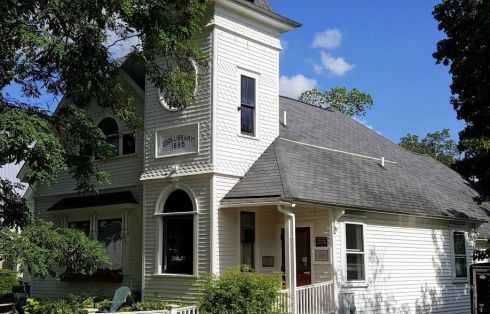
Tamworth Library

Tamworth House

Tamworth House 3

Tamworth Sign

Tamworth Barnstormers

Tamworth Poster Barnstormers

Tamworth Remick Museum

Tamworth Remick Barns

Tamworth Remick House

Tamworth Livestock

Tamworth Cow

Tamworth Brook

Tamworth Lyceum

Tamworth Poster

Tamworth Concert

Tamworth Distilling

Tamworth Brandy Sights & happenings of Tamworth: the Library, Barnstormers Theater, Remick Museum +Buildings+”Inhabitants”, Tamworth Lyceum, Sunday concert, Tamworth Distilling & Mercantile.

Given its heritage, of course Tamworth also has a historical society, recently re-christened (as you can see below) the Tamworth History Center. We found it open and bustling, with volunteers within eager to tell us about the town and the Center, which features revolving exhibits in its two ground-floor rooms: currently the early history of the Barnstormers is on, along with a very comprehensive genealogical exhibition on one of Tamworth’s prominent families. There is a dual preservation/presentation mission at present: focused continually on the town’s heritage as well as on the ongoing restoration of the Center’s c. 1830 headquarters. I enjoyed the exhibits immensely, but became a bit distracted by the untouched-for-decades attractions of the house’s central hallway! When restoration is complete, the house will not feature the traditional period rooms; instead it will serve as a forum, or center, for “the many stories that have made Tamworth unique, from 1766 onwards”. I want to hear more.

Tamworth History Center

Tamworth collage

Tamworth Exhibit

Tamworth HC

Tamworth HC2 Inside the evolving Tamworth History Center above; another visual presentation of Tamworth’s past—and present.

Tamworth PC


Red, White & Blue in the Newburys

I visited a friend up in Groveland yesterday and drove home in a very indirect way, east along Route 113 and south along Route 1A: I could have been home in a half hour or so but instead my return trip took several hours, because I had to stop and look at houses, of course. Much of my drive was through the Newburys: West Newbury, Newburyport, and just Newbury. These are all beautiful towns: Newburyport is the most bustling, and justly celebrated for its colonial and Federal architecture, but I’ve always been equally impressed by West Newbury, which is characterized by a line of beautiful classic colonials–interspersed with the occasional First Period house—all perfectly preserved. They’re all on Route 113, the main route between Newburyport and Haverhill and beyond–once obviously a country road running parallel to the Merrimack River but now pretty busy. There’s no sidewalk, so you have to look for spots to pull over and then walk alongside traffic until you reach the object of your adoration. Normally I don’t have time to do this, but yesterday I took the time.

Newbury Colors 9

Newbury Colors 10

Newbury Colors 12

Newbury Colors 8

Houses on the West Newbury Training Field (+ World War I Memorial): two down, an amazing First Period house (which is actually light green).

Newbury Colors 7

Newbury Colors 11

Newbury Colors 5

Newbury Colors 4

Newbury COlors 3

Newbury Colors

Newbury Colors 2

Newburyport, all ready for the Fourth.


The Lollipop Cemetery

Such an undignified name for such a solemn place: the Shaker cemetery in Harvard, Massachusetts, one remnant of the industrious community of Shaker non-genealogical families that resided in this beautiful Massachusetts town from 1769 until the First World War. But that’s what people call it. I had a hankering to see it the other day, and so I drove to Harvard and asked for directions, because it’s a bit off the beaten path (I never use my phone for navigational purposes on a road trip; that would defeat the whole point for me–it’s either wander or inquire): oh, the Lollipop Cemetery? Just drive towards Ayer and take a right on South Shaker Road. And so I did and there it was.

Shaker Cemetery Sign

Shaker Cemetery Stone

Shaker Cemetery markers crop

Shaker Cemetery Markers

The gate was locked, and I didn’t want to trespass on this sacred ground, but I think you can comprehend the lollipop characterization of these cast iron markers, which replaced the original stones from 1879. Here is a close-up of an individual marker from a wonderful site where you can research both the cemetery and its inhabitants, as well as a rather haunting photograph from Clara Endicott Sears’ Gleanings from Old Shaker Journals (1916). The Harvard Shaker community closed down in the following year, and the cemetery was deeded to the town of Harvard in 1945.

Shaker Marker

Shaker Cemetery gleaningsfromold00sear_0375

Boston patrician (with Salem roots) Clara Endicott Sears (1863-1960) became devoted to preserving the memory and material of the Harvard Shakers as their numbers dwindled to single digits. She had already established one of America’s first outdoor museums adjacent to her summer home on Prospect Hill a few miles down the road after she realized that a farmhouse on her property had been the site of Bronson Alcott’s short-lived Transcendentalist experiment when the few remaining Shakers in Harvard began selling their buildings.Clara bought the original 1794 office building and moved it to her hilltop museum, uniting Transcendentalist and Shaker visions (and later those of Native Americans and Hudson River Valley artists). Following this path, I drove over to the Fruitlands Museum, passing a few more Shaker structures along the way.

Shaker Old Stone Barn

Shaker Building Harvard Ruins of the Old Stone Barn and the South Family Building, Harvard Shaker Village.

The interpreters at Fruitlands emphasized “community” as the theme tying Transcendentalists and Shakers together rather than any Utopian dream, which seems appropriate to me, especially as the latter were entrepreneurial workers and the former were idealistic intellectuals. The relocated Shaker office is a testament to the aesthetic and industrious pursuits of the brothers and sisters; I came away overwhelmed by the sheer drive of young seedsman Elisha Myrick, who left the Harvard community, like many of his brethren, around the time of the Civil War. I just felt sorry for the Alcott children, who had to endure a cold and hungry 6 months in the farmhouse just down the road.

Shaker Boxes

Shaker Ads

Shaker Cloak

Shaker Industry

Fruitlands Farmhouse

Fruitlands Fruit

At Fruitlands: Shaker artistry and industry, the Alcott Farmhouse, and artist-in-residence Carolyn Wirth’s 3D take on Shaker gift drawings, installed in a grape arbor.

Driving out past the town common, I was waylaid by some beautiful houses: Harvard is really gorgeous, and calm. I drove back to Salem thinking (not for the first time) that perhaps it was a little too busy (and loud!). I hope I’m not turning into my great-great-great? grandfather, who sold everything (including a beautiful Tudor house), and left his family and friends in England for America, and the Shaker community of New Lebanon, New York.

Harvard Tavern

Harvard Colonial House

Harvard Brick House

Just a few Harvard houses: this first one was once a tavern, I presume.


Road Trip, Part One

My husband is preoccupied with a kayak fishing tournament, my house is being painted, and my street (finally–the last time was in the early 1970s by all accounts!) is being paved:  it was time to get out of town.  So off I went yesterday, on a circular tour of New Hampshire, Vermont, (a bit of) New York and Western Massachusetts.  That’s the thing about New England:  it is small, and you can cover a lot of ground–even when you only travel on routes marked “A” and stop at every historical marker, as is my inclination. I drove leisurely towards my childhood home of Strafford, Vermont, perhaps the most picturesque village on the planet, and then poked around central Vermont for a bit.

Strafford Meeting House, built 1799 with additions of belfry and tower in 1832.  As a child, I lived in the shadow of this amazing building, described in a 1959 HABS report as “a well-preserved, severe, wooden structure on an imposing site”.  Severe indeed.  Often mistaken as a church, it has served in a secular function for most of its life, and I remember:  rummages sales, plays, and of course town meetings.

The Meeting House yesterday and in a 1959 HABS photograph, Library of Congress, along with a 1964 cover of Vermont Life (my little brother and I were actually on a cover about 10 years later, but I can’t find it!)

My childhood memory of Thetford, next to Strafford, is of a town of brick houses.  It did not disappoint, although there were some non-brick houses too.  These two neighboring houses were perfect, and perfectly situated on lovely grounds.

The corn is high in central Vermont::

The Cornish-Windsor Covered Bridge, linking the New Hampshire town of Cornish and the Vermont town of Windsor, is one of the longest covered bridges in the United States.  It was built in 1866 and substantially rebuilt in the 1980s. Also in Windsor (actually I guess the bridge is actually in Cornish) is the Old Constitution House, where the constitution of the Vermont Republic was signed in 1777 , in effect until Vermont was admitted to the US as the fourteenth state in 1791.

On to Woodstock, where I spent the night. You could spend several days in Woodstock:  there are shops, restaurants, the Billings Farm & Museum,the Marsh-Billings-Rockefeller National Historic Park, and countless amazing houses.  It is yet another one of those achingly beautiful towns in Vermont, but also a busy and obviously wealthy one.  It’s a “shire town”, or county seat, to use the term we use in the rest of New England. Vermont is always a little bit different, perhaps because of its brief republican experiment.

Woodstock:  houses, another bridge, and a case of vintage tins in FH Gillingham & Sons General Store.