Tag Archives: Renaissance

Flemish Renaissance Revival

I thought I had my architectural revival styles straight–Greek, Gothic, Colonial–but somehow I never accounted for the different varieties of Renaissance revival styles until yesterday, when, in my continuous search for double-parlor inspiration, I came across a beautiful photograph of the interior of a Flemish Renaissance Revival house in a New York Times article about upcoming house and garden tours across the country. This parlor took my breath away, and also took me back, to the Flemish (Northern) Renaissance, of course.

Flemish Renaissance Revival

720px-Rogier_van_der_Weyden_-_Seven_Sacraments_Altarpiece_-_WGA25602

The parlor of a 1903 Flemish Renaissance Revival House in Park Slope, Brooklyn, one of several houses open to the public during the upcoming Park Slope Civic Council Tour, and Rogier van der Weyden’s triptych, the Seven Sacraments Altarpiece, c. 1445-50, Royal Museum of Fine Arts, Antwerp.

I don’t know why this style is such a surprise to me: there were several Renaissances, so it only makes sense that there would be several Renaissance Revival styles. The Renaissance itself was a revival of sorts; revivals are eternal. I immediately set off on a walk around Salem to see if I could find buildings of similar inspiration here, but to no avail:  this is not a Salem style, perhaps not even a New England one–though I do think there are brownstones in the Back Bay of Boston that feature the distinct roofline. A digital search will have to do for now, but I look forward to future forays. I would expect that this style would flourish in New York, but my preliminary search for more examples of the Flemish Renaissance Revival seems to indicate its particular popularity in the Midwest:  surely the Pabst Mansion in Milwaukee, built in 1892 is an exemplar.

Flemish Renaissance Revival Pabst Mansion 1892

Flemish Renaissance Vanderslice Hall 1895-96 Kansas City Art Institute

Flemish Renaissance Parkside West Philadelphia

Flemish Renaissance NYC

Flemish Renaissance Revival houses in America: the Pabst Mansion in Milwaukee, Vanderslice Hall in Kansas City (1895-96), built for the Meyer family and now the Kansas City Art Institute, rowhouses in the Parkside neighborhood, West Philadelphia, and at 13-15 South William Street, Manhattan.

Bruges Getty Images

in-bruges-poster1The inspiration:  the beautiful, storybook city of Bruges (Getty Images), and I’m throwing in the great 2008 film here too, just because I also think it’s converging on CLASSIC, the basis for any revival.


Two Tudors

It is been an EXHAUSTING week living in the present; I’m retreating to the past. To my favorite period and my academic specialty:  the Tudor era. Before they were as fashionable as they are now due to an explosion of cultural depictions in the last decade or so, I set my sight on this dynasty. This is a big day in Tudor history as it marks the death of its founder, Henry VII, and the accession of his (second) son, the much-more notorious Henry VIII. These were very different men, very different kings, very different Tudors.

NPG D34139; King Henry VII; King Henry VIII; King Edward VI after Unknown artist

King Henry VII of England (r. 1485-1509) & King Henry VIII of England (r. 1509-1547); 1677 print, National Portrait Gallery, London.

I’ve always preferred the father to the son.  Henry VII was a reluctant warrior-turned king: disciplined (physically reinforced by his slender physique), a bit defensive, definitely wary, prudent, calculating, somewhat severe, on the job. He was determined to bring order, stability, and prosperity to England after the tumultuous Wars of the Roses, and equally intent on liberating the Crown from parliamentary and noble interference. These two policies had both positive and negative consequences:  increased industry and trade, a more centralized administration, an “isolationist” foreign policy which shifted England away from the Continent, the Court of Star Chamber, revenue collection that ventured into the realm of “avarice” according to the Tudor historian Polydore Vergil. It could just be the so-called “Tudor myth”, but England seems dark and divided at the commencement of Henry VII’s reign and more illuminated and integrated at its end. And then came Henry VIII.

Tudors BL Arundel 66 1490 Henry VII

Tudor Henry MIchael Sittow 1500

693px-HenryVIIdeathbed

(c) Bristol Museum and Art Gallery; Supplied by The Public Catalogue Foundation

Henry VII in life, death, and after:  British Library MS Arundel 66, c. 1490; portrait by Estonian court painter Michael Sittow, c. 1505, National Portrait Gallery, London; deathbed scene by Sir Thomas Wriothesley, BL MS Additional 45131; the avarice label sticks: Thomas Edwin Mostyn’s 1919 painting, King Henry VII Fining the Citizens of Bristol Because Their Wives Were So Finely Dressed, 1490, Bristol Museum and Art Gallery.

Henry VIII is of course a more iconic figure than Henry VII, more so because of his personal life and portraits than his policies. As momentous as it was, the English Reformation cannot trump the six wives in the public mind, although scholars are not so similarly focused. I drag my students through the “Tudor revolution in government” (a point of continuity between the two Henrys) and the Reformation, but I know we’ve also got to cover the wives: Anne Boleyn, in particular seems to have become an object of singular obsession for this particular generation. And when I show them pictures of the young Henry, they gasp, so fixed in their mind are the Hans Holbein images and their derivations. Because of the emphasis on the personal, Henry VIII seems to have emerged as a more human figure than his father, warts and all. He is portrayed and perceived as both pious and gregarious, educated and arbitrary, charming and tyrannical. Everyone seems to agree that he was self-indulgent and wasteful, lacking his father’s discipline in all matters, but somehow compensating for this weakness by his larger-than-life personality. He does indeed get bigger and bigger in his contemporary portrayals, and ultimately this magnitude extends to his historical image. Henry VIII’s ability to project his image transcended that of his father–he had more at stake and more tools at his disposal–but there is no getting around the fact that Henry VII was the first Tudor.

Tudors Henry VIII 1540 NPG

NPG 157; King Henry VIII after Hans Holbein the Younger

Tudors Great Bible 1538 BL Henry VIII

Tudors Henry and Barber Surgeons 1541 Hunterian

(c) DACS; Supplied by The Public Catalogue Foundation

Henry VIII through the ages: at about 30, in a c. 1520 portrait by an anonymous artist, and in a c. 1536 portrait after Hans Holbein, National Portrait Gallery, London; Henry handing down the word of God in the frontspiece to the “Great Bible” of 1538, British Library, and among (above!) the Barber-Surgeons of London in 1541, Hunterian Museum, Glasgow; a rather romantic image of a key moment in the “King’s Great Matter”:  Henry VIII and Catherine of Aragon before Papal Legates at Blackfriars, 1529 by Frank O. Salisbury, 1910, Palace of Westminster Collection.


Characterizing the Continents

In my ongoing quest for anthropomorphic representations of just about everything, I have been assembling emblematic representations of the continents, or at least some of the continents: personifications of Antarctica and Australia remain elusive as the allegorical “Four Continents” became established in Europe in the early modern era. From the commencement of their global expansion in the sixteenth century to the dawn of the nineteenth, Europeans consistently crafted a vision of a primarily feminine, and therefore subordinate, world in their service. The sole exception to this perspective is offered by William Blake’s 1796 engraving Europe Supported by Africa and America, in which Europe is literally being propped up by the other continents, all still represented by women. This is a very modern view presented by the abolitionist Blake, and a rare contemporary acknowledgement that Europe’s prosperity was built on the backs of the “Dark Continent” and the “New World”. Much more representative of this era is the 1755 drawing of the four continents paying tribute to Britannia, a perfect piece of propaganda for the expanding British Empire. Yet this image departs from the traditional feminine portrayal of the continents by depicting the princely Europe and the turbaned Asia as male, and I think the kneeling Africa as well. The bare-breasted American Indian is stereotypically standard. More than a century earlier, these same four continents are bringing their gifts to the Louis XIII, the King of France, and this time is it Asia on bended knee.

Blake 1796

Britannia and Four Continents Anthony Walker 1755 BM

Louis XIII and the Four Continents

William Blake, Europe Supported by Africa and America, 1796, Victoria & Albert Museum, London; Anthony Walker, Britannia Receiving the Tribute of the Four Continents, 1755, British Museum, London; Title page to Les Estats Empires Royaumes et Principaites du Monde by Crispijn de Passe the Younger, 1635, British Museum, London.

Whenever or wherever Europa appears, she is always dressed (with the exception of the Blake print), in contrast to her continental counterparts, whose nakedness can convey their lack of civilization and/or morality. While the “Four Continents” allegorical tradition commences in the sixteenth century, I think the seventeenth-century images are the most vivid, and definitely the most Eurocentric in their attitude. The title page to Samuel Clarke’s Geographical Description of all the Countries in the Known World (1657) illustrates an inkling of this attitude, but I think the most flagrant examples are the prints published by John Stafford between 1625 and 1635, with accompanying verse by George Withers depicting the cannibalistic America, the chained Africa, and the faithless Asia. As you can imagine, these are particularly powerful images for teaching:  students are shocked into engagement.

Four Continent Gaywood

Four Continents America Stafford 1630

Africa

Four Continents Asia Stafford

Title page to Samuel Clarke’s A Geographical Description.., London: T. Newberry, 1657; John Stafford engravings, 1625-35, British Museum, London.

While I was searching through the sold lots archives of Northeast Auctions for some Salem items (a rather indulgent and time-consuming habit of mine) I came across some emblem mezzotints of Europe and Africa produced in London in 1800 but owned by a Salem family, so apparently admiration of the triumphant and bountiful Europa (as indicated by her ever-present cornucopia) extended over to the New World as well–even in the early years after the Revolution.

Emblem of Europe

“An Emblem of Europe” mezzotint, A. Testi, London, 1800, one of a pair sold at Northeast Auctions, 2009.


Seeing Triple

Two things turned my attention to triple portraits: a student essay on Renaissance portraiture as an expression of humanism, and the anniversary (today) of King Charles I’s accession to the thrones of England and Scotland in 1625. I was inspired to look (again) at one of my favorite portraits of the Stuart king, the one and only victim of regicide at the close of the English Civil Wars, and to explore the origins of the subgenre of triple portraiture, yet another Renaissance invention. The famous Van Dyck portrait of Charles, painted in 1635 as a study for a marble bust by Lorenzo Bernini, was both influenced by an earlier composition and influential to a future one:  Lorenzo Lotto’s Triple Portrait of a Jeweler, the first triple portrait, was in the King’s collection at the time, and across the Channel, Cardinal Richelieu, l’eminence grise, was inspired to have his own triple portrait painted shortly thereafter.

anthony-van-dyck-triple-portrait-of-king-charles-i

Triple Portrait Lorenzo Lotto

731px-Philippe_de_Champaigne_-_Triple_Portrait_of_Richelieu_-_WGA4724

Anthony Van Dyck, “Charles I in Three Positions” (1635), Royal Collection, London; Lorenzo Lotto, “Triple Portrait of a Jeweler” (c. 1530), Kunsthistorisches Museum, Vienna; Philippe de Champaigne and studio: “Triple Portrait of Cardinal de Richelieu” (1642), National Gallery of Art, London.

It is interesting that Lotto’s portrait is of an anonymous jeweler, or goldsmith, rather than a “great” man like King Charles or Cardinal Richelieu. It is also more realistic and less impressionistic, and Lotto’s quest for the absolute essence of the jeweler (one perspective is not enough) ultimately gives him more dignity than either the King or the Cardinal, in my opinion. Or it might just be that I know much more about those two!

There is another sixteenth-century triple portrait that I want to include here even thought it’s a bit different–in several ways. It is not like the others in that it is a portrait of three different people, rather than just one person in different “positions” (to use the language of the day), although the artist is definitely playing up their similarity. And appearances are very deceiving in this collective portrait:  these profiles do not belong to women, but rather to rather fancifully-dressed (and -tressed) men:  the “favorites” of French King Henry III (1551-1589).

Triple Profile POrtrait of the Minions of Henry III
“Triple Profile Portrait” (c. 1570). Attributed to Lucas de Heere (Ghent, Belgium, ca. 1534–ca. 1584), Milwaukee Museum of Art.

The triple portrait technique has been used intermittently in the succeeding centuries, to depict both single and collective subjects:  the Van Dyck portrait, in particular, has been copied and adapted numerous times, most recently by Hip Hop artist Kehinde Wiley–it really has a life of its own. Norman Rockwell rendered his own self-portrait in triplicate, and also that of Lyndon B. Johnson. Andy Warhol liked the multiple portrait, of course, though went for mere duplication rather than divergent profiles. And to return to royal portraiture (at least another kind of royalty): there were official triple portraits made of both Prince Charles (for the occasion of his 60th birthday) and Princess Diana (in 1987). The latter portrait hangs at Cardiff City Hall in Wales, and was apparently hastily (and temporarily) removed upon the occasion of a visit by Charles and his present wife, Camilla, the Duchess of Cornwall, in 2005. Just to avoid an awkward “encounter” of sorts.

Triple Elvis Warhol
Diana Princess of Wales
Andy Warhol, “Triple Elvis” (1963), Fisher Collection, San Francisco Museum of Modern Art; the portrait painter John Merton (who died just last month) with his triple portrait of Diana, Princess of Wales in 1987. Photo: UPPA/PHOTOSHOT.

Green with Envy

I have posted about green quite a bit on this blog:  green cards, green men, green rooms, the green fairy, my favorite shade of green. Yet it’s St. Patrick’s Day, so I’ve got to come up with something green–why not the emotion associated with the emerald hue? Shakespeare was specifically referring to jealousy with Othello’s “green-eyed monster” line, but jealousy is just a subset of the more all-encompassing envy, one of the seven deadly sins and the one conspicuous for its complete lack of pleasure: it leads not to material wealth or power or drunkenness, but only to a festering illness in which one literally eats their heart out. This self-inflicted sickness–described as a form of moral rotting–could be one source of the sin’s connection with the color green, as could its association with snakes, either alone or in the form of an allegorical Medusa-like character, but emerald (or chartreuse) envy seems to be more of a modern conception than a medieval one.

Envy 2008 by Michael Craig-Martin born 1941

Michael Craig-Martin, Envy (from the Seven Deadly Sins series), 2008.  Tate Modern, London.

Medieval manuscripts illustrate envy (invidia) in several ways:  on the iconic “Tree of Vices”, accompanied by a demon and its “sprouts” (detraction, treachery, treason, homicide, conniving, pleasure in the suffering of others–what we would call Schadenfreude–resentment, jealousy) and as a woman looking at something or someone with daggers (sometimes literally). Pride is always the root of the tree–the root all the vices– but envy is just one branch up from the fall of Man. Pride, represented by a King-like character riding a lion, and Envy, a sword-bearing woman riding a wolf, are closely associated in the fifteenth-century edition of penitential psalms below, and Envy reveals her jealous nature in a fourteenth-century Roman de la Rose. Green is not her color, yet.

L0029366 Tree of Seven Vices

Envy and Pride 2

Roy19BXIII_royal_ms_19_b_xiii_f006v_detail2 Envy1

The Apocalypse of St. John, c. 1420-30, Wellcome Library, London; British Library MS Yates Thompson 3, c. 1440-1450, and MS Royal 19BXIII, the Roman de la Rose of Guillaume de Lorris and Jean de Meun, c. 1320-1340.

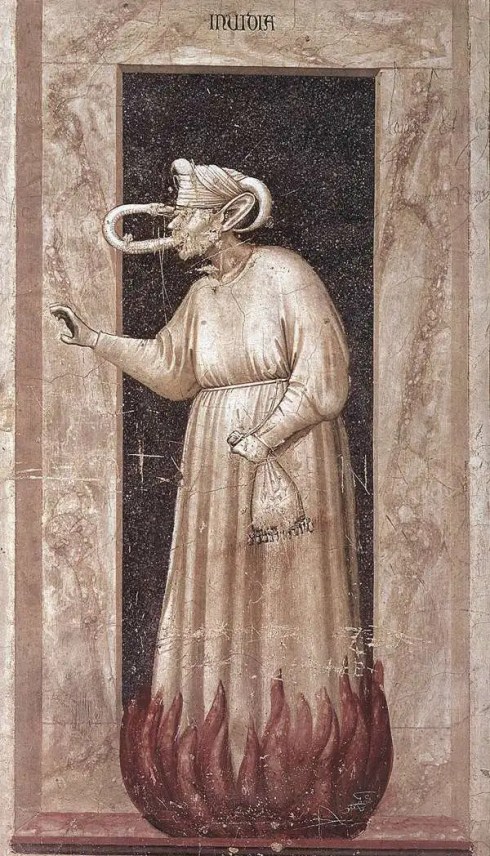
Beginning with Giotto, the Renaissance shifted Envy decisively towards jealousy and generally portrayed her as an aged woman, tearing at her heart and/or eating an apple to illustrate her complete capitulation to temptation, often grotesque and emaciated, clearly suffering and sometimes chained, almost always with snakes. There’s a rather striking similarity between the depictions of Envy and witches in the sixteenth and seventeenth centuries, before the conception of envy in particular and the seven deadly sins in general become secularized. A notable exception is Hieronymus Bosch’s famous table painting, The Seven Deadly Sins and the Four Last Things, which depicts envy with an illustration of a local proverb about two dogs with one bone seldom reaching agreement. Still no green.
Envy Giotto Arena Chapel 1306

Envy George Pencz

Envy Bosch detail

Giotto di Bondone, Envy panel from the Arena Chapel, 1306; Print by George Pencz, 1541, British Museum; Hieronymus Bosch, The Seven Deadly Sins and the Four Last Things detail, c. 1485.

Looking through allegorical images of envy from the seventeenth and eighteenth centuries, I still don’t see much green, but then again, prints predominate. Lots of snakes are in appearance, which is appropriate for a St. Patrick’s Day post as the cleansing of Ireland of snakes is part of St. Patrick’s mythology. At least the connection between women and this most miserable sin is broken, as envy appears in the form of both sexes and then only as a green snake.

Envy 17th century

Envy Snake 1796

Print by John Goddard, c. 1640, British Museum; “Envy” (perhaps a caricature of the Earl of Abingdon), Anonymous, 1796, British Museum.

Envy is depicted in all sorts of ways by modern artists and illustrators, though the aged-lady-turning-green (grotesque)-with envy certainly comes back with a vengeance! I don’t usually see things exclusively through the prism of gender, but it’s really interesting to me how this most self-destructive of sins is so often associated with women. In two twentieth-century Seven Deadly Sins series, the Belgian artist James Sensor envisions a christening in which the young mother (interestingly dressed in green) is looked on with envy by everyone around her, but by the middle-aged woman to her right with particular vehemence, and Paul Cadmus’s Envy definitely harkens back to the Renaissance. As before, envy does not make for a pretty picture; I think I prefer alternative associations for the color green!

Ensor Envy 1904

Envy Paul Cadums

James Ensor, L’Envie, from the 1904 portfolio The Deadly Sins, Art Institute of Chicago; Paul Cadmus, The Seven Deadly Sins:  Envy, 1947, Metropolitan Museum of Art, New York.



Retreating Popes

It’s been interesting to see scores of religious commentators draw comparisons to Pope Benedict XVI’s resignation (effective later today) and that of the next-to-last Pope to resign, the briefly-reigning St. Celestine V, who served for five months in 1294. Celestine’s renunciation is indeed a much better comparison than that of Gregory XII, whose 1415 abdication was coerced by the power politics of the Western Schism, for a number of reasons. Even though the two popes are separated by the centuries and their records of service to the Church, they might have been of like mind in their mutual desire to retreat from the very worldly powers and obligations of their office.

Harley 1340, f.3

Celestine V:  British Library MS Harley 1340, attributed to Joachim of Fiore, mid-fifteenth century.

In his statement of renunciation, Benedict expressed his desire “to also devotedly serve the Holy Church of God in the future through a life dedicated to prayer”, which was also the stated goal of his predecessor, who went further:  “I Celestine V, moved by valid reasons, that is, by humility, by desire of a better life, by a troubled conscience, troubles of body, a lack of knowledge, personal shortcomings, and so that I may proceed to a life of greater humility, voluntarily and without compunction give up the papacy and renounce its position and dignity, burdens and honors, with full freedom”.

These men were roughly the same (advanced) age, so I am certain that “troubles of body” have a lot to do with both of their abdications.  And they were both reluctant Popes, Celestine even more so than Benedict.  The so-called “hermit-Pope” was the founder of an order of friars that bore his pontifical name, and he was more comfortable in their company than in Rome.  While the reactions to Pope Benedict’s resignation strike me as largely positive, this was not the case with Celestine’s:  he was labeled cowardly, a characterization that was reinforced by Dante’s Inferno, which refers to the shade of him who in his cowardice made the great refusal. Dante’s anger derives from his hatred of Celestine’s successor, Boniface VIII, who many believed manipulated “the great refusal”.

Celestine V-cropped

The Liber Sextus:  Sextus decretalium liber a Bonifacio viii in concilio Lugdunensi editus (Venice: Luca Antonio Giunta, 1514), Courtesy Lillian Goldman Library, Yale Law School. Boniface’s foxy fox is pulling the papal tiara off Celestine’s head, while the holy dove flies above the latter’s head.

Among his contemporaries, there were those who also admired Celestine’s retreat from the world, and he was canonized in 1313 for his piety. During the Schism and after, when the Church was perceived as being corrupt and over-worldly,Celestine and his renunciation were increasingly depicted in a more positive light, both by theologians and artists, who depicted the resigned Pope as the very image of humility, in the plain grey robes of his order with the papal tiara in his hand (or on the ground) rather than on his head.

Celestine without tiara

Saint Celestine V Renouncing the Papacy, after Mattia Preti Fragonard MET

St. Celestine, the hermit-Pope; Jean Honoré Fragonard, Saint Celestine V Renouncing the Papacy after Mattia Preti, 1761. Metropolitan Museum of Art.

Beyond the label Popes who quit, there are a few more connections between Celestine V and Benedict XVI.  After the devastating L’Aquila earthquake in 2009, the present (just) Pope visited the Abruzzo region, from where Celestine hails and where he is venerated as a saint. The purpose of Benedict’s visit was clearly to comfort the inhabitants of the region in the wake of the quake, but while he was there he also made a point of visiting sites associated with Celestine, including his tomb (miraculously intact in the midst of the severely-damaged Basilica Santa Maria di Collemaggio in Aquila), where he left his inaugural pallium (a vestment, or “stole of honor” and symbol of papal authority), apparently a gesture of great significance. A year later, to mark the 800th anniversary of Celestine’s birth, Pope Benedict visited his reliquary at nearby Sulmona Cathedral, towards the end of his proclaimed “Celestine Year”. This is reverential treatment of a retreated Pope, by one who is now retreating himself.

Benedict XVI

Benedict XVI and Celestine V, 2009.  Associated Press/Boston Herald.


In the Bedroom

I’ve been spending a lot of time this past week looking at two pictures of bedrooms: we’ve been examining the justly-famous Arnolfini Portrait in two of my classes, and then I came across a painting of a mysterious bedchamber by an anonymous artist when I was (of course) searching for something else entirely:  what’s going on here? Actually, what’s going on in both paintings? Bedroom scenes are pretty provocative.

Red Bedchamber 1700 V and A

Arnolfini double portrait van Eyck 1434 National Gallery London

Scene in a Bedchamber, Unknown Artist, c. 1700, Victoria & Albert Museum; The Arnolfini Portrait, Jan van Eyck, 1434, National Gallery, London.

I’ve got very little information on this first painting, so it invites speculation and many return visits. We have a well-appointed bedchamber in which something has happened: is the person in the doorway looking at the remains of the night before?  A chair has been overturned, a little dog is running towards the door with a slipper in his mouth, wallpaper in peeling off the wall, cards are on the dressing table. Some sort of wild card party in which someone lost his/her shirt, or at least a slipper? I’m not sure if anyone is actually in the bed; we can’t quite see in there. I’ve got too much information on the Arnolfini portrait but it remains somewhat enigmatic:  ostensibly it is a double portrait of  Giovanni di Nicolao Arnolfini and his wife, but at what stage in their relationship/lives?  Is this a betrothal portrait, a wedding portrait, or perhaps a memento mori?  Does the woman’s apparently-expectant appearance represent fertility (along with the symbols in the room) or is it just a fashion statement?  Like the painting above, we have a rather flagrant display of wealth here:  Arnolfini was a member of a wealthy Italian merchant family living in Bruges and he looks the part. And who are those figures in the doorway, reflected very cleverly in the convex mirror?  We have a dog and slippers here too!

Scenes of curtain lectures purport to give us a little bit more information about what’s going on behind those bedclothes, but they are really just commentaries on nagging housewives. From its first use in the seventeenth century, the phrase referred to those moments after the curtains had been drawn and the wife would berate her (poor) husband with all the pent-up demands of the day, until he (mercifully) fell asleep.

STC 13312, title page and frontispiece

Curtain Lecture 1

Two Curtain Lectures:  Thomas Heywood. A curtaine lecture. London, 1637 (STC 13312); Richard Newton print, London, 1794, British Museum.

Rather less compelling, but still interesting to me because they are both so staged, are two Salem bedroom views published by Detroit Publishing Company in the first decade of the twentieth century:  one is a “New England Bedroom c. 1800” and the other is “Clifford’s Bedroom” in the House of the Seven Gables.  I’m not sure where the first one actually was, but the Essex Institute retains the copyright, so I assume it is one of George Dow’s period rooms (the first in the country). I love the fancy chairs in Clifford’s room at the Gables, and the portrait:  Abraham Lincoln? These two cards much have had a huge print run, as I see them everywhere.

Bedroom at Essex Institute Salem 1907

Bedroom at House of Seven Gables Salem

Back across the Atlantic, to a painting that was produced around the same time as these postcards.  Again, this image has captured my curiosity as I can’t figure out what is going on between these three people in the bedroom.  And that bed and their shoes! Like the painting at the beginning of the post, I think a creative person could conceive a complete sketch–perhaps even an entire novel–around just this one scene. Or just a funny caption.

Bedroom Lendecke

Two Men and a Woman in a Bedroom, Otto Friedrich Carl Lendecke, 1918, Metropolitan Museum of Art, New York.


Love, Illuminated

I’m not really the romantic type, but even I can appreciate Pierre Sala’s “Le Petit Livre d’Amour”, the little book of love that French poet Pierre Sala presented to his future wife Marguerite Bullioud in the early sixteenth century. For me, the combination of illuminated miniatures and Sala’s verse are a testament to both personal and courtly love, for Sala was that ideal Renaissance Man, an accomplished courtier to three French kings.  But he was also a rather whimsical poet, and the images (énigmes attributed to the mysterious “Master of the Chronique scandaleuse”) are so completely charming that one cannot help being……….charmed. A look at this little book is the perfect way to start off what has become Valentine’s Day week.

Sala declares himself right at the beginning, when he gives his strawberry-like heart to Marguerite, or drops his heart in a marguerite flower, a rather more exotic example of our own marguerite daisies. Then it’s games and desperation, as he is parted from the object of his affection. The most captivating miniature is of a pair of maidens capturing hearts, literally:  hearts that can easily fly away!

Love Sala 1 Marguerite

Love Sala 2 Blind Man's Bluff

Love Sala 3 Tree

Sala Petite Livre Winged Hearts

British Library MS Stowe 955.

Sala’s book is one of several iconic manuscripts (including da Vinci’s notebooks and Beowulf) recently digitized by the British Library:  you can find out more about these treasures here, and additional information and images of the “Petite Livre” here.  The book was presented (and still is) in its own wooden carrying case, covered with tooled, painted and gilded leather, with the letters “P” and “M” prominently displayed, of course.  At the end, there is a stunning portrait of Sala, in which he even looks like the ultimate Renaissance man!  It was painted by his fellow courtier, the royal painter and limner Jean Perréal, who, according to the British Library catalogue notes, was also supposed to paint in Sala’s face in the book’s first heart-dropping image.  Somehow that never happened, which makes the book even more charming in its imperfection.

Pierre Sala Portrait

British Library MS Stowe 955, folio 17:  Pierre Sala (1457-1529).

P.S. There is an apparently-beautiful facsimile of The Little Book of Love out there in limited quantities (for you Romantic types out there) but I wasn’t able to find a copy that was either available or for less than $6500.


Royal Entries (and Exits)

The thought of Richard III’s re-interment ceremony got me thinking about the royal festivals of the early modern era, when every coronation, wedding, procession, visitation or funeral was projected to peers and the public via the new medium of print. The festival books that record (or make up) these events are great examples of “official history”, or propaganda. If it was logistically impossible for the “new” monarchs of the sixteenth and seventeenth century to project absolute authority, they could at least project magnificence, even, as in the case of Richard’s vanquisher, Henry VII, and his granddaughter Elizabeth I, in death.

Royal Entry Death of Henry VII

elizafuneral

The Death of Henry VII in 1509 at Richmond Palace,  British Library  MS Additional 45131,f.54; Funeral procession of Elizabeth I, 1603, British Library MS. Add. 35 324, fol.37v.

But these solemn displays were nothing compared to the elaborate events that occurred on the Continent, which were recorded in both lavish manuscript books and well as more spare printed texts. The British Library has digitized much of its collection of festival books, and assembled a comprehensive site where you can access over 250 texts in addition to links to other collections and scholarly context and analysis. In these texts, you can read about, and see, all sorts of amazing events staged to mark the “joyful entries” of Renaissance monarchs:  processions (with detailed lists of participants), tournaments, masques and other theatrical performances, ballets, water spectacles, fireworks, and all sorts of temporary architectural and/or mechanical constructions. The effort and expensive that went into these festivities is all the more impressive (and of course, seemingly wasteful) because the moments are so fleeting. A great example of flagrant-display-for-very-little-purpose was the meeting of Kings Henry VIII of England and Francis I of France near Calais in June of 1520, which became known as the Field of Cloth of Gold because of the profligate use of gold for the pavilion tents and presentation clothing of the participants. The two kings achieved very little (besides a wrestling match in which Francis bested Henry), but they put on a great show.

British Library-G.1209.(3)_c3499_02_0006_01
Royal Entry MS Augustus III, 18 Gold 1520
Royal Entry BL Cotton Augustus III f 19 framed
Field of Cloth of Gold Richard Doyle framed
A printed account of the Field of Cloth of Gold, and two illustrations of the Pavilion tents, British Library MS Cotton Augustus III, folios 18-19; Punch caricaturist Richard Doyle’s cartoon of the wrestling match between Francis I and Henry VIII, Victoria & Albert Museum, London.

For both aesthetic and pedagogical reasons (and because it provokes shock and awe among my students), my favorite festival book is a beautifully illustrated account of the promenade into Antwerp of François,the Duke of Alencon and Anjou, in 1582.  This elaborately-staged “joyous entry” was in fact an attempted conquest by the heir to the French throne (and Elizabeth’s serious suitor) in disguise, and the Duke barely escaped with his life. But what does that matter?  There was an elephant in the parade!

British Library- C.22.c.12 c1742_11_0280+001
British Library- C.22.c.12 c1748_02_0280+036
British Library- C.22.c.12 c1748_04_0280+044
British Library- C.22.c.12 c1748_01_0280+023
British Library- C.22.c.12 c1749_02_0280+055
Title page and Scenes from La ioyeuse [et] magnifique entrée de monseigneur Francoys, fils de France, et frere unicque du roy, par la grace de dieu, duc de Brabant, d’Anjou, Alencon, Berri, [et]c. en sa tres-renomée ville d’Anvers (Antwerp, 1582), British Library.


Rest for Richard

Now that it has been confirmed that the skeletal remains found underneath a parking lot in Leicester, England are indeed those of the last Plantagenet king, Richard III, at last he can be laid to rest in a place and manner befitting a king. His advocates, the Riccardians, have been uncharacteristically divided in the past few months over the burial:  should Richard have a grand state funeral and be laid to rest in Westminster Cathedral, or remain in Leicester, or be interred at York Minster, which he himself might have desired?  I took note of more than one newspaper British headline that read Bones of Contention, but in the end Leicester won out, so Richard’s bones will not have to travel very far.

I’ve already posted about Richard and the discovery of his bones, so today I have some rather random thoughts about reactions to their verification. My first thought upon hearing the news was for Josephine Tey, who wrote the 1951 historical detective novel (one of the first of its genre?) Daughter of Time about a twentieth-century detective’s efforts to untangle the Tudor mythology of Richard’s life and death. This little book definitely sparked my own interest in history when I first read it in my teens, and I’ve seen it have the same effect on countless students and friends. Though the recovery of Richard’s remains sheds little light on his life deeds and misdeeds, he is forever linked with historical curiosity for me.

Richard Daughter of Time

The cover of the first edition of Josephine Tey’s Daughter of Time, 1951.

And that really is the key point. Curiosity, and engagement, are fostered by uncertainty about the past more so than any presentation of supposedly well-established “facts”.  It’s been so exciting to see historians, scientists, and the general public engage with each other over the discovery of the remains of a long-dead king, and a short-lived and unpopular one at that. This engagement might not be palpable here in the United States (where I heard a succession of broadcasters take great pains to point out that this was Richard III, not Richard the Lionheart) but it sure was coming over loud and clear on my Twitter feed (along with a lot of bad jokes:  a hearse, a hearse, my kingdom for a hearse!).

The other thing I have noticed (watching from afar) is the very personal, even intimate, nature of this entire revealing. The Riccardians have always taken Richard’s demonization very personally, so that is no surprise, but the sight of his curved spine (but no withered arm!) and cleaved skull is a verification not only of his existence, but his suffering. On the other hand, I found the images of the facial reconstruction released yesterday a little off-putting, though it’s interesting to read comments of how handsome he was:  not a monster, after all.

Richard Buckley and Richard III

Richards Skeleton and Jo Appleby Bioarcheology

Richards Spine

Richard III facial reconstruction

NPG 148; King Richard III by Unknown artist

Scenes from the big reveal:  University of Leicester archeologists Richard Buckley and Jo Appleby discussing the archeological and DNA evidence, Richard’s curved spine, the results of scoliosis, the facial reconstruction, and a late 16th century portrait of Richard III, Getty Images & the National Portrait Gallery London.

And so now Richard will be laid to rest (again).  I’m sure there will be a lot more discussion about the ceremony for his re-interment (will the Royal Family attend?), but it sounds like David Monteith, the Canon Chancellor of Leicester Cathedral, has already given this a great deal of thought:  he announced that an ecumenical service of remembrance is being planned for our time, as the King had most certainly received a proper Christian burial in his.

Leicester Cathedral

Cathedral and Guildhall, Leicester.

