Tag Archives: Renaissance

Intricate Insects

There are beetles in my garden and some West Nile-carrying mosquitoes in Salem: I’ve got bugs on the brain. On a more pleasurable note, the Getty Museum has expanded access to thousands of its digitized images through its new Open Content Initiative. Another treasure trove to explore (and eat up time)! One of the most precious manuscripts in the world is in the Getty collection, the Mira Calligraphiae Monumenta, or Model Book of Calligraphy, the collaboration of two late Renaissance artists who never met! In this first age of printing, when it was feared that the skill and beauty of writing would soon be lost, Holy Roman Emperor Ferdinand I commissioned his court scribe, George Bocskay, to produce the Model Book; 30 years later, his grandson Rudolf II instructed his court artist, Joris Hoefnagel, to illustrate it. And thus the beautiful little (6+ inches by 4+ inches) was created, over the period from about 1561 to 1591.

Bugs About Hoefnagel Getty

Bugs About Hoefnagel 2 Getty

Hoefnagel (1542-1601) worked in every medium and all over Europe: though generally classified as a Netherlandish artist he also spent time in England and really flourished in central Europe at the courts of two major royal patron-collectors, Albert V, the Duke of Bavaria, and Rudolph II, who was in the process of assembling the largest Kunst- and Wunderkammer (“Cabinets” or collections of art and natural wonders) of the era. While in Munich, he completed his three encyclopedic collections of  zoological and botanical miniatures, Animalia Aqvatilia et Cochiliate (Aqva), Animalia Volatilia et Amphibia (Aier), and Animalia Rationalia et Insecta, between 1575 and 1580. These images are amazing blends of art and science, and while the animals are compelling (especially the hairy people–more in a later post), the insects almost jump off their pages!

D13029.jpg

E11250.jpg

Insects Hoefnagel 2

E11363.jpg

Joris Hoefnagel’s insect miniatures, watercolor and gouache on vellum, 1575-1580, National Gallery of Art, Washington.

Is Hoefnagel’s inspiration primarily artistic or scientific? Sometimes it’s hard to tell, really. He is a transitional artist in so many ways–transitioning between the Renaissance and the Scientific Revolution, between manuscript culture and print culture, between the medieval miniature and the early modern still life with his precise eye for detail. But at the same time he is merging all these things rather than evolving from one to another. At about the same time that he was engaged in his “collaboration” with Bockskay, Hoefnagel was part of another artistic partnership, this time with his son, the teenaged Jacob Hofsnaegel, whose collection of printed botanical and entomological engravings, Archetypa Studiaque Patris (1592)  was inspired by his father’s early allegorical drawings and accompanying verse. You can see more of the younger Hoefnagel’s images here and here, as well as at the British Museum.

Hoefnagel Allegory of Winter Louvre

Hoefnagel Insects and the Head of a Wind God

Hoefnagel Archetypa frontspiece

Hoefnagel Archetypa 2 BM

Hoefnagel Archetypa 3 BM

Joris Hoefnagel, Allegory of Winter, c. 1589 (The Louvre, Paris); and Insects and the Head of the Wind God, c.  1590-1600 (Metropolitan Museum of Art, New York); Jacob Hoefnagel, frontspiece and plates from Archetypa Studiaque Patris Georgi (Joris) Holfnaegeli, 1592 (British Museum, London).

Below: Art and nature, father and son, INSECTS:  Allegory on Life and Death, Prague, 1598: Figure and landscape within oval drawn by Jacob Hoefnagel, surrounding flora, fauna and bugs, by Joris Hoefnagel, Metropolitan Museum of Art, New York.

Hoefnagel Allegory of Life and Death Met


Poison Vessels

News of the discovery of a late medieval poison ring in eastern Europe has intrigued me; I know that “poison rings” (alternatively called “pillbox rings” with built-in receptacles) were popular in the Renaissance and after, but very few of them actually served to contain or convey poison–more likely the held articles of remembrance. But this Bulgarian bronze ring, with its little channel, looks like the real thing! It instantly reminded me of one of my favorite (also late medieval) woodcut illustrations of a woman poisoning her husband–through a much larger pipeline–and set me off on a hunt for more man-made vessels for poison, besides the proverbial poison arrow.

poison-ring-2.jpg1377181665

poison-ring-1.jpg1377181844

Poison 1481

Book of Wisdom of the Ancient Sages, 1481; The Illustrated Bartsch. Vol. 83, German Book Illustration before 1500: Anonymous Artists, 14811482.

Well of course the most obvious vessel is a cup:  whether medieval depictions of Socrates drinking his hemlock or later prints of supposed royal assassinations, the poison is generally conveyed in a cup, or, more seriously, a chalice, as in Shakespeare’s This evenhanded justice Commends thingredients of our poisoned chalice (Macbeth). Somehow a chalice is more reverent, and at the same time menacing, than a mere cup. John Foxe’s Protestant martyrology, Actes and Monuments of these Latter and Perillous Days, Touching Matters of the Church (1563) shows King John being poisoned by English monks offering his majesty a chalice of wassail, of all things. The chalice and the mortar and pestle become the two most “medieval” vessels associated with poison, as in the line from Danny Kaye’s Court Jester (1955): the pellet with the poison’s in the vessel with the pestle; the chalice from the palace has the brew that is true!

Poison Cup Socrates

Poison Cup BM

Poison Cup MET

National Library of the Netherlands MS RMMW, 10 A 11 (c. 1475), John Foxe, Acts and Monuments  (1563); NYPL Digital Gallery.

Another English monarch who was threatened with assassination by poison (and other means) was Elizabeth I: a Jesuit-inspired French plot involving a poisoned saddle is illustrated in George Carleton’s Thankful Remembrance (1627). This might or might not be the basis of the purely fictional poisoned dress scene in the 1998 film Elizabeth. In any case, it was foiled.

Poison Saddle BM

George Carleton, A Thankful Remembrance of God’s Mercy, 1627.

Things seem to get more straightforward in the modern age, when poison was contained in boldly labeled and brightly colored apothecary bottles, dispensed collectively in war and from planes, self-induced through various addictive substances, and trivialized by mid-century modern “name your poison” bar sets. But obviously the most effective poisons would have no vessel at all.

Poison Sign

Name Your Poison Glasses Etsy


Imperial Ermine

In the midst of a royal-birth-dominated media week I found myself in my graduate class, interpreting two iconic Renaissance portraits with ermines in them. And thus a post was provoked. How did this little weasel get associated with royalty, pretentious nobility, and the academic and clerical hierarchy? The answer lies in the (rare) white fur of this beast (more scientifically know as the stoat, or short-tailed weasel) as well as the emblems incorporated into what became a distinct ermine design: for no animal has the “ermine” black and white coat, it is a heraldic invention.

Ermine Leonardo

1585_elizabeth_ermine_portr

Leonardo da Vinci, Lady with an Ermine (Cecilia Gallerani, the mistress of Ludovico Sforza, the Duke of Milan), 1489-90, The Czartoryski Museum and Library, Krakow; Nicholas Hilliard, The Ermine Portrait of Queen Elizabeth, 1585, Hatfield House.

Leonardo has a real ermine in his portrait of a woman who is presumed to be Cecilia Gallerani, the mistress of his powerful patron Ludovico Sforza, the Duke of Milan–whose heraldic emblem was an ermine. But the little creature on Elizabeth’s arm, wearing a crown collar, is an artistic creation based on the ermine pattern, in which the distinctive black tips of the animal’s (several animals actually) tail is stitched onto the fur, sometimes cut into distinct heraldic shapes. I think you can see this most clearly in the portrait below, in which a sixteen-century German merchant’s wife is wearing very distinct ermine sleeves (and a lot of jewelry) with her family crest in the corner.

ermine Cologne portrait

Bathel Bruyn the Younger, Portrait of Woman of the Slosgin Family of Cologne, 1557, The Metropolitan Museum of Art, New York.

As eminent (and wealthy) as she might have been, this woman is not a Queen–or even the mistress of a Duke: it seems like anyone can wear ermine in the sixteenth century, at least outside of England. The black-and-white (or white-and-black) patterned “fur” had become a device of conspicuous consumption and social mobility, because of its long-held associations with majesty, wealth, and a Christ-like “purity bought with his own death”, in which it was said that the ermine would give himself up to the approaching hunter, so not to sully his pure white winter coat (not quite sure why this was royal). The sheer expense of  ermine is most likely the ultimate source of its desire and association with the wealthy and privileged: the stoat’s coat is pure white only in winter, and then there are all those little black tails. I do think ermine maintains its exclusive association with royalty longer in England than on the Continent, but I could be wrong.

Ermine Bedford Hours

Ermine George I

Ermine sign for Crown Inn 1750 V and A

Ermines

Ermine in various incarnations, through the ages: The Duke of Bedford prays before St. George in his ermine-lined robe, c 1423, the Bedford Hours, 1423  (Additional Ms. 18850 ), British Library, Mezzotint of King George I by John Smith, 1715, British Museum; Drawing for a sign for the Crown Inn, c. 1750, Victoria & Albert Museum, London; The Stout wearing his summer and winter coats, Prang & Co., 1878, New York Public Library Digital Gallery.  

Appendix:  as a stark contrast to Leonardo’s portrait, I could not resist adding this Ermine with a Lady portrait” by Ellen Paquette!

Ermine with a Lady


Ideal Cities

Salem is a boom town/construction zone right now with big projects ongoing, or about to begin, all over town: a large housing project on the site of the demolished St. Joseph’s Church on Lafayette Street and two more on the outskirts of town, a new “Gateway” center on one of the major entrance corridors, a new parking garage for the train station, more expansion for the Peabody Essex Museum and my own university, a huge (and great) power plant demolition/reconstruction project, and, of course, infrastructure work, a constant activity in a city as old as Salem. There is so much going on that the city has put up a separate website just to handle information about these projects.

Boom Town

I am glad that Salem is doing so well in terms of development, and I believe that most of these projects will benefit the city tremendously. But not all. Certainly the Mayor’s office and city government facilitated these proposals, and are doing a good job overseeing the process of their implementation. However, I can’t help thinking that much of this development is compartmentalized and not part of a plan, that our city is reacting to proposals rather than seeking them out, vision in hand and mind.  Too often a proposal skates by the various boards, simply because it’s better than what is there now. As is my general inclination, I can’t help but compare past and present, and as I’m teaching a summer-long graduate class on the Renaissance, a time when urban planning became an art (like everything else) that is my past. Ideals were very important to Renaissance society, for both human development and urban development. The rediscovery of Vitruvius’s Ten Books of Architecture in 1414, the desire to build structures on a human scale. and the influence of mathematics combined to create an ideal vision for Renaissance cities, exemplified by three panels produced in the 1480s, all called The Ideal City.

Boom Town Ideal City Walters

IdealCityUrbino

cittc3a0_ideale_di_berlino_2

Ideal Cities in Baltimore, Urbino & Berlin museums: Fra Carnevale, Walters Art Museum; Piero della Francesca or Leon Battista Alberti ?, Galleria Nazionale delle Marche, Urbino; Gemaldegalerie, Berlin.

It’s really not fair to hold up these panels as standards because they were, in fact, idealized rather built cities:  “windows into a better world”. Yet the ideal, the plan, the desire to live in a better world, still has merit. I know we lost the sense of human scale and aesthetic detail in the twentieth century, but we can still seek better and more beautiful buildings, that assimilate easily into their material landscape. Perhaps it’s not the lack of planning but the actual architecture that is troubling me. This is certainly the case with one project: a proposed $45 million complex that would include a possible hotel, residences and retail stores to be built on a downtown block that definitely needs some help–this would be an easy case of it’s better than what’s there now so the expectations, and the standards, will be low. The renderings for the project reveal a (cheap) brick and glass multistory building which is a mirror image of the “Tavern on the Square” structure affixed to the old Salem News building across the way:  both are more suited for the suburban corporate office parks found along Route 128, Boston’s inner beltway, than a historic port city like Salem.  Both buildings, like several structures built in Salem in the past few years, are not only grace-less but also place-less: they have no relation to our city’s built environment and are also, quite frankly, boring. Can’t we do better?

Boom Town Dodge St

Boom Town Waltham Corporate Center

“Mill Hill” proposal conceptual rendering for Salem & the Waltham Corporate Center along Route 128.


Thunder Month

In his annual almanac, the seventeenth-century astrologer John Gadbury calls July the Thunder Month, [when] it was customary at Malmsbury-Abbey, to ring the great bell call’d St. Adam’s Bell, to drive away the THUNDER AND LIGHTNING. If the last week of June is any indication of things to come, his characterization will prove correct for July 2013. We’ve had rain pretty much every day over the past week, and it is raining again today. A bit of thunder and lightning, but nothing too dramatic…yet.*** It’s quite humid so the feeling is more tropical than New England, but the garden is thriving.

Gadbury_John-Ephemeris_or_A_diary_astronomical-Wing-A1775-1392_48-p1

July NYPD

John Gadbury, Ephemeris, or a Diary Astronomical, Astrological and Meteorological for the Year of our Lord 1696; a Strobridge Lithograph Company calendar for July 1901, which could also work for July 2013, New York Public Library Digital Gallery.

Other texts from the sixteenth and seventeenth centuries–astrological, agricultural, and “medical”–predict: if the first of July be rainy weather, ’twill rain more or less for four weeks together, which wouldn’t bother me at all. They also offer the following prescriptions for July:  don’t eat “strong”, substantive or spicy foods, nor any “muddy” fish, green fruits, or beets, drink but a little wine, eat sage and rue on a bit of bread every morning, and take as much “verjuyce” as possible, as it cools and refreshes the body (and the mind). Verjuice is a juice made of crushed and strained sour (unripe, green) grapes or apples mixed with a variety of herbs, and it appears to be experiencing a bit of a comeback at the moment, so maybe my early modern experts were right.

maggie_beers_verjuice__73302_zoom

***Tornado watch later in the day: very unusual for New England.


Merchant Princesses

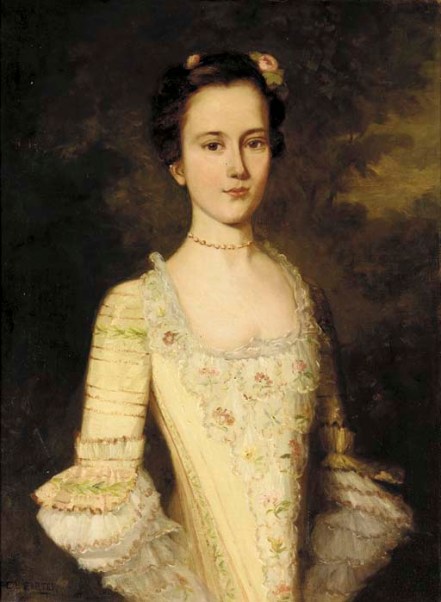
I recently found another Salem painting in the Christie’s Auctions archive that captured my attention and fancy: “Portrait possibly of a Girl of the Derby Family” by C.L. Carter, early nineteenth century (she actually looks more eighteenth-century to me). She’s a lovely girl, but I think she entranced me not only because of her Salem connection, but because she reminds me of another “merchant princess” from long ago and far away: Bia Medici, the illegitimate daughter of Cosimo I de’ Medici, as envisioned by Bronzino.  I say “envisioned” because while the portrait of the Salem girl captured the fullness of life (I think), the Bronzino portrait is a memorial image of the recently deceased girl. In life and death and in these paintings, both girls represent the privileged positions their respective families held in two mercantile oligarchies, centuries and an ocean apart.

Merchant Princess CL Carter Christies

Merchant Princesses  Bronzino

C.L. Carter, Portrait Possibly of a Girl of the Derby Family, Christie‘s; Angelo Bronzino, Untitled, known as Portrait of Bia Medici, Daughter of Cosimo I or Portrait of Bia, illegitimate daughter of Cosimo I de’ Medici, Uffizi Gallery, Florence.

Bronzino’s Medici princess has become iconic I think; I use her in my Renaissance classes to illustrate contemporary themes of family, death and remembrance, and Medici power and the students are always very taken with her, perhaps because of the angelic quality Bronzino (working from a death mask) gave her. Joseph Cornell was apparently taken with her as well, as she is the featured image of his 1948 collage sculpture that was part of the Navigating the Imagination exhibition originating at the Smithsonian American Art Museum and shown here in Salem at the Peabody Essex Museum. Another artist who seems to have been inspired by the portraits of these and other merchant princesses is the Australian photographer Bill Gekas, who has posed his very alive 5-year-old daughter in a series of  “reimagined” scenes, with adorable, and engaging, results.

Merchant Princess Cornell

Merchant's Daughter

Joseph Cornell, Untitled (Medici Princess), c. 1948, Private Collection; Bill Gekas, The Merchant’s Daughter, © Bill Gekas.


Joan for the Ages

Today marks the day of Joan of Arc’s execution at the hands of the Rouen Inquisition under the thumb of the English occupiers of France in 1431, and consequently her Feast Day, as of 1920. She was accused of a myriad of charges, but ultimately it was her conviction as a relapsed heretic that led to her death by burning at the stake, as well as the desire of the English to demonize such an inspirational figure in the closing stages of the Hundred Years’ War. There are many interesting things about Joan’s life and death, but one of the most compelling aspects of her image is its timelessness, which is discussed at length (and in many manifestations) in two great books: a collection of essays edited by Dominique Goy-Blanquet entitled Joan of Arc, a Saint for All Reasons: Studies in Myth and Politics (2003) and Nora Heimann’s Joan of Arc in French Art and Culture (1700-1855): From Satire to Sanctity (2005).

Jehanne La Pucelle, the “Maid of Orleans” was famous in her own time and immediately after her death. I love the poem by her contemporary Christine de Pisan, directed to the French king but really all about Joan:

And you, the King of France, King Charles,
The seventh of that noble name,
Who fought a mighty war before
Good fortune came at all to you:
Do, now, observe your dignity Exalted by the Maid, who bent
Your enemies beneath your flag
In record time (that’s something new!)

That’s something new! It sounds so modern, but I guess Joan was pretty modern in the fifteenth century, which might account for some of her timelessness thereafter. She resurfaces pretty predictably in times of conflict: the French Wars of Religion in the sixteenth century, the French Revolution in the eighteenth century, World Wars I & II in the twentieth century. All of her cultural depictions could fill a museum, or an encyclopedia, but certainly she is transformed into a nineteenth-century romantic heroine by Friedrich Schiller’s 1801 play, The Maid of Orleans.  She was embraced by the Suffrage movements on both side of the Atlantic in the early twentieth century, and she remains a feminist hero(ine) in our own time. Joan’s eternal image can be seen in depictions from a succession of centuries, beginning with the late fifteenth-century manuscript poem Les Vigiles du roi Charles VII by Martial d’Auvergne (Paris, BnF, département des Manuscrits, Français 5054) and proceeding into the last century.

Le_siège_de_Paris_en_1429_par_Jeanne_d'Arc_-_Martial

Joan of Arc 16th c. 1505 ms

The Maid of Orleans in Les Vigiles du Roi Charles VII, later 15th century, and riding into battle in Les Vies des femmes célèbres by Antoine Du Four, about 1505, Dobrée Museum, Nantes, France.

Joan of Arc Gaultier 1612 BM

Joan of Arc 1542 Fuller Holy State

Joan of Arc in print in the seventeenth century:  prints by Leonard Gaultier (1612) and William Marshall (1642), British Museum.

I’m skipping over the eighteenth century, when the imagery associated with Voltaire’s scandalous poem La Pucelle d’Orléans reduces Joan to a sexual object; you would think the Enlightenment would be a great time for the Maid as a victim of the Inquisition, but it isn’t. It’s in the following centuries that she really gains power as both an iconic and historical (with the release of the trial records in the 1840s) figure, tying into the emerging nationalist and feminist movements (sometimes at the same time).

Joan of Arc 1815

Joan Harpers 19th

Joan of Arc France Lillian Tennant Lancaster c. 1910

Joan of Arc 1913

Joan of Arc 1917 LC

Joan of Arc Posters

Satirical print of the support for Napoleon among French “Amazonian” women, who rally around a statue of Joan, Jean Baptiste Genty, 1815, British Museum; Edward Penfield cover for Harper’s, April 1895, New York Public Library Digital Gallery; Lillian Lancaster [Tennant] Map of France as Joan of Arc (or vice-versa), 1910, Garwood & Voight; Progam Cover for the 1913 Woman Suffrage Procession, Washington, D.C., Library of Congress; Joan of Arc They are Calling You (a “weeping” France) sheet music, 1917, Library of Congress; U.S. war posters from the First and Second World Wars, Library of Congress.


Band of Brothers

Because I’ve been rather engrossed in the Hundred Years War this past few weeks as I prepped for my summer graduate course on late medieval and Renaissance Europe, I’ve been thinking more about the Battle of Agincourt than, say, D-Day. And so for this Memorial Day weekend, a moment of remembrance and reflection, I thought I’d look at Shakespeare’s famous “band of brothers”/St. Crispin’s Day speech, with which King Harry rallies the troops just before battle in Henry V. “Band of brothers” is a familiar phrase to us now, because of Olivier and Branagh and Spielberg, but did it always have resonance? What did it mean when an actor first uttered these lines in 1599 or 1600, and after?  From this day to the ending of the world, But we in it shall be remember’d; We few, we happy few, we BAND OF BROTHERS; For he to-day that sheds his blood with me Shall be my brother; be he ne’er so vile; This day shall gentle his condition. And gentlemen in England now a-bed Shall think themselves accursed they were not here, And hold their manhoods cheap whiles any speaks That fought with us upon Saint Crispin day.

STC 22289, front endleaf 3v- A1r, t.p.

Band of Brothers Lambeth Palace Library

Title page of first printed version of Henry V, Folger Shakespeare Library; Agincourt illumination, Lambeth Palace Library.

Of course Henry did not really utter these lines; Shakespeare wrote them for his late Elizabethan audience, tapping into their burgeoning nationalism in the decade after the defeat of the Spanish Armada, while Spain was still a very real threat. So when England was threatened again, do these words reappear? The Napoleonic Wars immediately come to mind, when an even more glorious national hero than King Henry V–Admiral Nelson–used the “band of brothers” analogy on several occasions, most notably in reference to the great victory against the French fleet at the Battle of the Nile in 1798. While Nelson was referring to the ship captains under his command, the phrase took on a more egalitarian and nationalistic meaning in the celebratory aftermath.

Band of Brothers Battle of the Nile

Band of Brothers BM

Contemporary prints of the “Glorious Battle of the Nile” and Admiral Nelson and his band of brothers, British Museum.

At about the same time the Battle of the Nile was waging on the other side of the world, Philadelphia statesman Joseph Hopkinson was penning a poem that later became the lyrics to the so-called first American national anthem, Hail, Columbia. Hopkinson’s’ chorus proclaimed:  Firm, united, let us be, Rallying around our liberty, As a Band of Brothers joined, Peace and safety we shall find. My brief search through the sheet music collection of the Library of Congress gave me the impression that this song was far more popular in the nineteenth century than the Star Spangled Banner, which eventually became the national anthem in 1931. Before, during, and particularly after the Civil War, the phrase “band of brothers” was used in speeches and published materials in both the North and the South, cementing its American usage.

Band of Brothers Hail Columbia 1798

Band of Brothers Memorial Day Card 1909

The Favorite New Federal Song, Adapted to the Presidents March, Library of Congress Music Division; 1909 Memorial Day souvenir card.

Back in Britain, the phrase was still Shakespearean, and most definitely one inspiration for Winston Churchill’s famous “the few” speech given in 1940 in the midst of the Battle of Britain, when Britain was most definitely standing alone: Never in the field of human conflict was so much owed by so many to so few. I would expect (but didn’t really have enough time to confirm) that the band of brothers theme was used to emphasize the bond between British troops and their allies, both in the Commonwealth and outside, as the “we’re in this together” message is artfully employed in wartime propaganda.

Band of Brothers together William Little 1941

Band of Brothers Back to the Wall

Two examples of British wartime propaganda from the great exhibit at the UK National Archives, The Art of War:  “Together” by William Little, 1940 & “Back against the Wall” by Illingworth, 1941.

It’s no accident that Sir Laurence Olivier chose to produce a stylized film version of Henry V during the war, indeed, the project was partially funded by the British government and originally dedicated to the “Commandos and Airborne Troops of Great Britain the spirit of whose ancestors it has been humbly attempted to recapture”.  And there is the direct connection between Shakespeare’s romanticized war and an all too real one. I do recall the inclusion of Shakespeare’s words in Spielberg’s and Hanks’ Band of Brothers (as well as Stephen Ambrose book on which it is based), but it doesn’t matter; by this point in time,  the title says it all.

olivier-henry-v

A fifteenth-century manuscript brought to life/film:  the recently-restored Henry V (1944).


Fashion and Art, centuries apart

One big fashion and art exhibition closes this month while another opens: at the Metropolitan Museum of Art in New York, Impressionism, Fashion and Modernity closes on May 27 while across the Atlantic, In Fine Style: the Art of Tudor and Stuart Fashion just opened at the Queen’s Gallery at Buckingham Palace in London. I had hoped to see both exhibitions, but will probably end up of seeing neither; for some reason I thought the Met show was up all summer. Oh well, I have been perusing the catalog of the former and I’m already familiar with most of the paintings in the latter, and I have some general comparative observations, which would almost certainly either be reinforced or refuted if I saw the actual shows.

First observation: the early modern era was a much better time for MEN’s fashion. Tudor and Stuart men got to dress up in fabulous, colorful clothing for all sorts of occasions, and they had ARMOUR.  There is no comparison for the Belle Epoque. One of the galleries in the Met show is entitled “Frock Coats and Fashion: the Urban Male”, but these stockbrokers are clearly no match for the enigmatic sixteenth-century man in red or King Charles I.

Art and Fashion Degas

Art and Fashion Red  Art and Fashion Charles I

Edgar Degas, Portraits at the Stock Exchange, 1879, Musée d’OrsayParis; Portrait of a Man in Red, German/Netherlandish School, c. 1530-50, Royal Collection © Her Majesty Queen Elizabeth II; Daniel Mytens, Portrait of H.M. King Charles I, 1628, Royal Collection© Her Majesty Queen Elizabeth II.

Second observation: black-and-white is classic. No matter what the occasion, black-and-white attire is timeless and striking. The Met exhibition has a gallery of black dresses and white dresses, also completely classic, but what I notice looking at both eras is the eternal elegance of the two non-colors together. Below we have two very different scenes:  seventeenth-century mourners and a lady of leisure on a sunny late nineteenth-century afternoon, united by their attire.

664px-Anthony_van_Dyck_-_Thomas_Killigrew_and_( )_William,_Lord_Croft_-_WGA07416

Art and Fashion Black and White

Sir Anthony van Dyck,Thomas Killigrew and (?) William, Lord Croft, 1638; Royal Collection © Her Majesty Queen Elizabeth II; Albert Bartholomé, In the Conservatory (Madame Bartholomé),1881; “Summer Day Dress Worn by Mademe Bartholomé in the PaintingIn the Conservatory”,1880, which is described as cotton printed with PURPLE dots and stripes but it reads black to me–a good illustration of why I should have seen this exhibition in person!

Third observation: texture = luxury+artistry. This is where the art and the fashion really meet. In both exhibitions, the fabrics are absolutely luxurious, and the artists’ ability to depict their textures is absolutely amazing. Obviously the Met exhibition, which places garments adjacent to paintings (as in the example above) illustrates this artistry in a really compelling way, but the artists of the Tudor-Stuart era, who are depicting royalty and nobility, are also compelled to inject that luxurious texture into their subjects’ portraits, as illustration of their exalted status.

Art and Fashion Tissot

Art and Fashion Leyly

Glistening fabrics from both eras: James Tissot,Evening (The Ball),detail, 1878; Sir Peter Lely, Frances Teresa Stuart, Duchess of Richmond, c.1662, Royal Collection© Her Majesty Queen Elizabeth II.

Fourth observation: it’s all in the details. Both exhibitions feature “little” things that are incredibly important: trims, jewelry, undergarments, patterns. Whether the sixteenth-century ruff or the nineteenth-century corset, details are important to these societies–and these artists. You would think that the details would be more important in the early modern portraits than the nineteenth-century en plein air paintings, but that is not the case. The details are always important.

404437 crop

Art and Fashion

Details of Marcus Gheeradts the Younger’s (attributed) Anne of Denmark, 1614, Royal Collection © Her Majesty Queen Elizabeth II, and Ckaude Monet’s Camille, 1866, as banners for their respective exhibitions.


Mother Shipton

Rather contrarily, my offering for Mother’s Day weekend is not a warm, loving, and lovely caregiver but a prophesying crone:  Mother Shipton, who most likely never existed.  Supposedly born in the first years of the new Tudor dynasty in a Yorkshire cave (the product of  a union between a poor wretch named Agatha and the Devil), Ursula Southeil or “Mother Shipton” rose to fame in the mid-seventeenth century, long after her supposed death. Just before the English Civil War, a time of high anxiety indeed, a series of Mother Shipton pamphlets suddenly appeared, containing predictions of things that, for the most part, had already happened, along with dire warnings of war and destruction.

Mother Shipton 1642p

Mother Shipton 1642 part 3p

The first prophecy on the second 1642 pamphlet is typical Mother Shipton: Joane Waller should live to heare of Wars within this Kingdome but not to see them. The Civil War broke out in the same year of as the tract was published, but of course Waller had died the year before. A similar assertion regarding Henry VIII’s chief minister, Cardinal Wolsey, that he would see York but never get there, was one of Mother Shipton’s most famous “predictions”.  Her published prophecies continued through the Civil War (closely tied to current events) and after, and she joined the ranks of such legendary magicians as Merlin.

Mother Shipton 1648p

Mother Shipton 1661p

Shipton Prophecies from 1648 & 1661

In the later seventeenth century, Mother Shipton’s biography and predictions were embellished rather vastly by a series of publications entitled The Life and Death of Mother Shipton, and her story was adapted for entertainment purposes, thus cementing her now-legendary character. The transition from ominous witch-soothsayer to stock character is emblematic of the emergence of a collective rationalist mentality in the seventeenth century, with a corresponding decline in belief in magic and “wonder”, now assuming its more modern meaning.

Mother Shipton 1677p

Mother Shipton Life and Death

Mother Shipton play 1670p

And that would probably be the end of Mother Shipton, consigned to a relatively minor character in the long history of sibyls and soothsayers, if she was not resurrected in the Victorian era. It’s always the Victorians! Charles Dickens first referenced her in a 1856 story, and then the entrepreneurial bookseller Charles Hindley published a new set of rhymed and timely prophecies that were supposedly based on a newly-discovered manuscript in the British Museum (he later confessed to making them up). Now Mother Shipton was predicting railroads, ships made of iron, wireless communication and all sorts of industrial innovations, as well as the ominous warning that the world then to an end shall come/ In Eighteen Hundred and Eighty-One, which was changed to 1991 in early-twentieth-century reprints. By that time, she had evolved yet again, into a fairy-tale character and (later) a tourist attraction.

Mother Shipton 1800 BM

PicMonkey Collage

Mother Shipton's Cave Yorkshire

Charles Townley print of Mother Shipton and her familiar, 1800, British Museum, Linley Sanbourne and W. Heath Robinson illustrations of Mother Shipton on her broomstick for Charles Kingsley’s The Water-Babies. A Fairy Tale for a Land-Baby (1888 & 1915); the entrance to Mother Shipton’s Cave in Knaresborough, “England’s Oldest Tourist Attraction” (shades of Salem!).