
Tag Archives: Photography

Hawthorne’s Homes and Haunts

In the later nineteenth century there emerged a particular genre of topical nonfiction writing which focused on literary “shrines”, and Nathaniel Hawthorne received lots of attention from its practitioners. There were several periodical articles and books published with variant titles in the “Homes and Haunts of Hawthorne” realm, exploring the role of environment on his works with varying degrees of depth. As he was a native son, obviously Salem plays a central role in these analyses, generally as an urban and conversely puritanical place from which he wanted to escape to Concord and pastoral points west. No doubt all these authors were inspired by Hawthorne himself, not just his works but also his (quite self-conscious) words, written in 1840 about a garret room in his uncle’s house on Herbert Street where he spent quite a bit of time: Here I sit in my old accustomed chamber, where I used to sit in days gone by….Here I have written many tales–many that have been burned to ashes, many, doubtless, that deserved the same fate….If ever I should have a biographer, he ought to make mention of this chamber in my memoirs, because so much of my lonely youth was wasted here, and here my mind and character were formed.  All of the Hawthorne biographers did indeed make their way to the stark Herbert Street house (which Hawthorne later described as “Castle Dismal”) and it is interesting to see its comparative depictions. Winfield S. Nevins calls it a “severely plain”, common, though tidy, tenement house in his 1894 article in The New England Magazine, while Helen Archibald Clarke goes much more negative in her 1926 book, Hawthorne’s Country: It is now a tenement house, into which one does not care to intrude farther than the yard, so untidy that no amount of enthusiasm for shrines can blind one to it. When asking the way to the house, one is apt to be met by the reply: ‘I cannot speak English’. It is a comfort to remember that in Hawthorne’s day the district was not so closely built up [YES IT WAS],and was at least quiet and clean, and that however unlovely the lines of the house, the beach and boundless ocean were not far off.  Well, you can tell that she is going to prefer Concord to Salem!

Hawthorne Collage

Sepia drawings of Hawthorne’s birthplace, then on Union Street, now on the campus of the House of the Seven Gables, and the adjacent rear window of 10 Herbert Street from  W.B. Closson’s Homes and Haunts of the Poets, a series of etchings issued by Prang in 1886, and a photograph of the same buildings from Winfield S. Nevins’ “Homes and Haunts of Hawthorne” from New England Magazine (15) 1894.

Both authors include lots of illustrations in their works, including drawings, prints and photographs, but Nevins wants to portray a past Salem for the most part, devoid of people, while Clarke lets us see some 1926 inhabitants in the Witch City: children are prominently placed on Gallows Hill, even though it is not exactly clear what this site has to do with Hawthorne. The time span between the two texts affords us to see the restoration (or creation) of the House of the Seven Gables, never the home of Hawthorne but perpetually his most conspicuous Salem “haunt”.
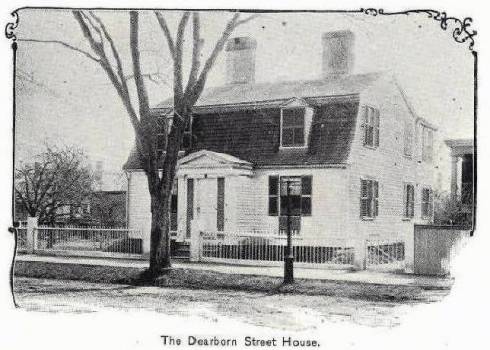
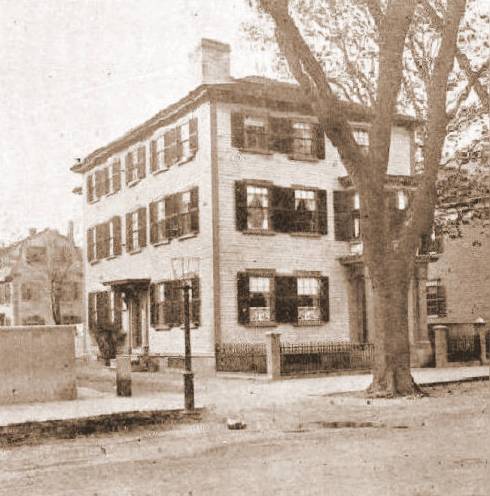
Homes and Haunts Dearborn

Hawthorne Homes and Haunts Chestnut

Hawthorne Houses Mall Street

Hawthorne Homes and Haunts Custom House Clarke

Hawthorne Homes and Haunts Main

hawthornescountr00claruoft_0133p

Gables collage

Hawthorne Homes and Haunts Gables2

Photographs of Hawthorne’s Dearborn and Chestnut Street residences, along with the Turner-Ingersoll House before its transformation into the House of the Seven Gables (on the left above) from Winfield S. Nevins’ 1894 article, “The Homes and Haunts of Hawthorne”; photographs of the Mall Street house, the Customs House, a view towards Washington Square, the “Sockets” of Gallows Hill, and the House of the Seven Gables from Helen Archibald Clarke’s Hawthorne’s Country (1926).


Ever in Transition

The tensions between public and private interests, commercial and residential concerns, and historic preservation and economic growth are nothing new to Salem, which has always been a dynamic city proud of its past and poised for the future. Some eras are more dynamic than others, however, and I think we’re in a particularly dynamic period now, but any city or town or settlement is always in transition, of course. When I hunt for historic photographs I’m always on the lookout for the mix of “ancient” and “modern”, residential and industrial, small-scale and larger, dirt roads and railroad tracks. My very favorite visual chronicler of Salem, Frank Cousins, who was himself living through a very dynamic age, was clearly attracted to that mix as well, as one of the photographs that he submitted as part of Salem’s exhibition at the 1893 Columbian Exposition was that of a divided Derby Street doorway labelled “modern” and “colonial” (A subtle distinction for our modern eyes).

In Transition Cousins 1892 Columbian Exposition

Frank Cousins photograph of a Derby Street doorway, c. 1892, courtesy of Duke University’s digital Urban Landscape collection.

More illustrative of the city in transition, as opposed to a co-joined household, are the many pictures of Town House Square that date from the 1880s to about 1910. There you see predominantly brick multi-story commercial buildings, but if you look closer, there are still some surviving wooden residential structures (although they are probably serving a multitude of uses). For several years, I have had in my possession a stereoview of a building labeled “Ward-Goldthwaite & Co. Salem” which I thought might be one of these structures, only to realize that I had made a rookie historian’s mistake (not questioning a label): the Ward-Goldthwaite Company was located in Chicago, not Salem (even though it was published by the Moulton firm of Salem). Nevertheless, it’s a great image of a city in transition: you know that house isn’t going to last long.

In Transition Cousins Town House Square 1892 LOC

In Transition 1906 LOC

Stereoview Ward Golthwaite Co Salem

Town House Square at the intersection of Essex and Washington Streets, Salem, (Library of Congress) and a stereoview of the Ward Goldthwaite & Company in Chicago published by J.W. and J.S. Moulton of Salem as part of their “American Views” series.

The idea of zoning starts to catch on in Salem after 1900, and it was definitely accelerated by the Great Salem Fire of 1914. But before this momentous event, factories and residences co-existed in close proximity in the Point, Blubber Hollow and even the more residential North Salem, where the large Locke Regulator Company bordered the North River and a line of colonial houses on North Street. Some of the houses are still there, serving mixed uses as they did a century ago, while the Locke factory has been replaced by a junkyard and a car wash. The streets along Salem Harbor have always been among the most densely settled in Salem, but the 1903 photograph seems to show structures which are primarily residential–I’m not sure of the precise vantage point, but I’m assuming these buildings were all swept away by the Fire. The last photograph, from the PEM’s Phillips Library, shows fire bystanders watching the conflagration on Lafayette Street from the roof of a building on Highland Avenue: a view of mixed-used zoning with the new High School, the factory, and residences all in close proximity to one another. Highland Avenue became a preferred location for commercial development over the twentieth century, but as this photograph indicates, residences were built along it as well–and a few older structures, drastically transformed–still stand among the big box stores.

In Transition North Bridge 1890s

Salem 1903 Locomotive's Journal

phillipslibrarycollections.pem.org

Looking north along North Street from the old bridge, 1890s, Boston Public Library; A Perspective on Salem Harbor, 1903, Brotherhood of Locomotive Engineers Monthly Journal, September 1903; Watching the Great Salem Fire from Highland Avenue, 1914, Phillips Library, Peabody Essex Museum


The Wayfaring Chapel

To stick with cinema for just a bit, I’ve always believed that those in Salem who favor the maritime over the witchcraft in terms of tourism focus are handicapped a bit because Salem was not a whaling port like New Bedford. Merchants are simply not as dashing and courageous as whalers; there is no Hawthornian equivalent of Moby Dick. When I think of the latter, I must admit that images from the 1956 film come to mind much more quickly and vividly than detailed passages from the 1851 book, and the very first image that comes to mind is the passionate preaching of Father Mapple (Orson Welles) from that amazing pulpit shaped like the bow of a ship in a seamen’s chapel, or Bethel, packed with mariners. Both the preacher and the place were based on reality; in the case of the former, the “Mariner’s Preacher” of the Boston Bethel, Edward Thompson Taylor, and the Bethel was based on that of New Bedford, which is still standing (its original pulpit was not the elaborate one depicted in the film, but a similar one constructed to satisfy the tourists who made their way to New Bedford in increasing numbers due to the popularity of the film–a version of Salem’s Samantha statue).

Bethel

Bethel Collage

Orson Welles in John Huston’s Moby Dick (1956); The New Bedford Bethel or “Whaleman’s Chapel”, exterior and interior.

Like nearly every seaport of a certain size, Salem had a Seamen’s Bethel too, but it was a wandering one. It clearly existed in the early part of the nineteenth century (there is an extant sign, and several references to a chapel at the head of Phillips Wharf), but was reincarnated later on. The French Catholic parish, St. Joseph’s, purchased an old Bethel on Herbert Street in 1873, and then it turns up in two locations on Turner Street: first right on the water in the House of the Seven Gables’ front yard, and then alongside it on the street. A large bequest by Captain Henry Barr funded the construction of this later building in 1890-91, but a decade later newspapers across the country were commenting on Salem’s fading maritime glory, testified to by the fact there were simply not enough sailors in Salem to attend services in this new Bethel; consequently the YMCA took over the building in 1911. By the 1920s it was moved to another location on Turner Street to accommodate the expanding House of Seven Gables Settlement Association, and by the 1930s it was gone. The last picture of the Bethel below, taken by the Boston-based architectural photographer Leon Abdalian in 1929, was probably more notable for the blimp than the Bethel at the time!

Seamen's Bethel Salem on Water

Bethel on Turner

The Salem Seamen’s Bethel, 1914 and 1929, Boston Public Library.


The Most Poignant Epitaph Ever

The Old Burying Point is a sacred site best visited in the winter, or the summer, or the spring, or anytime other than October when costume-clad tourists are not draped over the graves taking pictures of each other. I prefer winter, because the very gnarly trees are bare, and nothing other than these same trees competes with the graves themselves. I was walking by the other day, thinking about the very recent death of a young scholar whom I knew, when I remembered a famous epitaph on a seventeenth-century grave of another young scholar: Nathanael Mather, son of Increase, and brother of Cotton. Nathanael died in Salem in 1688 at aged 19 and his grave is located on the western perimeter of the cemetery, just behind the Peabody/”Grimshawe” house. I went through the gate, turned right, and there he was, there it was, the most poignant epitaph ever.

Epitaph 026

Epitaph 030

An Aged person/ that had seen but Nineteen Winters in the World.

An Aged person that had seen but Nineteen Winters in the World is a sentiment that is immediately and universally affective, and timeless: as moving now as it was when it was inscribed in 1688 (or later? see below). There are testimonies to these words that date back to the early nineteenth century; no doubt there are far more that I am aware of. Hawthorne incorporated a similar epitaph into his first novel Fanshawe for the title character (one imagines him sneaking out back before or after he visited his future wife Sophia at the Grimshawe house) and Lovecraft referenced it a century later. In between, my favorite photographer Frank Cousins gave it pride of place in a portfolio of Salem images which he marketed nationally.

Epitaph Cousins 1890s 2p

Epitaph Cousins 1890sp

The Grave in the 1890s

And what of Nathanael, the inspiration for this memorable epitaph? By all accounts he was a young man feverish with the desire to learn, both for his own sake and as way to know and glorify God, and this “fever” ultimately killed him. His “unusual industry” drove him to enter Harvard University at age 12, and during his time there he mastered Latin, Greek, and Hebrew and wrote several books. His “pious education” continued after his graduation, and he followed a disciplined regime of constant study and prayer which rendered him a virtual shut-in. Real fevers set in, and “distemper”, and ultimately he was sent to Salem as a patient of Dr. John Swinnerton, at whose home he eventually died. His elder brother Cotton Mather, who apparently “closed his dying eyes” wrote later that it may be truly written on his Grave, Study kill’d him. In his Diary, Samuel Sewall recounts visiting Nathaneal at Dr. Swinnerton’s and, quite perplexingly, an alternative epitaph: the Ashes of a hard Student, a good Scholar, and a great Christian, which is also asserted in Cotton Mather’s Magnalia Christi Americana. So now we have an epitaph mystery: are both Sewall and Mather mistaken, or do we have an instance of an “enlightened” epitaph substitution at some later date?

Epitaph 038


Scraps of Salem History

Moving on from rocks to paper today, as it is time for a more ephemeral and less serious topic. I am by no means a serious collector, but I seek out and purchase ephemera pretty consistently, generally but not exclusively Salem items. Things have to appeal to me both aesthetically and historically, and I love unusual fonts and illustrations as well as things that are architectural or zoological. I have several folders of stuff, but certainly not boxes. Trade cards continue to be an ephemeral favorite, but I seem to be buying a lot of programs lately, as well as various “visitors’ guides” to Salem: these serve as my guide to the city’s changing identity over time. Is the emphasis on Witch City or “Old Salem” or the China Trade or the city of Hawthorne? Somehow it doesn’t seem possible for Salem to be all of these things simultaneously for the authors and editors of the guides in my collection, but the programs of the various historical “pageants” that occurred over the period from 1890 to 1930 reflect a more comprehensive (though wildly historically incorrect) approach. One of my favorite recent purchases is the program for a concert/pageant sponsored by Salem’s G.A.R. Post in 1895 entitled Historic Salem Illustrated. Representing Epochs in the History of Salem from the Time of its Settlement up to the Present Year with really cool illustrations of each “epoch” (“Indian”, Colonial, Revolutionary, Commercial, “Patriotic” (basically the Civil War), and “the Present or Electric Period”) by George Elmer Browne (1871-1946) who later emerged as an important Cape Ann/Provincetown artist. The historical vignettes, set to music, include “Chief Naumkeag welcoming the Puritans”, a tableau of Colonial punishments, and “The Blue and Gray of 1895”. What better way to tap into this particular historical perspective?

Salem Scraps GAR Programp

So here is a random sampling of some recent additions to my ephemera files, along with some things I haven’t featured before and some notes about why I like these scraps of paper and what I have learned from them, starting with some items I chose completely for their aesthetic qualities, and more particularly, their fonts: even though Salem: its Representative Businessmen and Points of Interest is from the “Electric Age” (1893) and the menu from the Calico Tea House (in the Hawthorne Hotel) is from the Atomic Age (1953) they have a similar aesthetic quality. On the menu in 1953: “Witch House Chicken”, “Derby Wharf Scrod”, and “Seven Gables Salad”. Still in the realm of color, a few trade cards from the first decade of the twentieth century (I think): the first is a very unusual view of the Custom House, and the second features cute rabbits. And how can you beat insects and architecture! A program for an Essex Institute “Social Evening” in 1868 at Hamilton Hall which featured all these creatures viewed under a microscope with musical interludes (LOVE this snail), followed by a program for the annual meeting of the members of the Salem Club in 1914 and a ticket (multiplied) to the 1952 Chestnut Street Day house tour which was held sporadically from the 1920s to the 1970s (it would be great to revive this event).

Salem Scraps in color

Salem Scrap 1910s PC Custom House

Salem Scraps TC Burnett

Program Final

Salem Scraps Snail

Salem Club 1914

Salem Scraps CSD 1952

It’s a lot easier to find things that our intended for an external audience–advertising and tourism pieces basically–than the entomological item above, or the G.A.R. or Salem Club programs. Salem really crafted and disseminated its image from at least the 1890s on and so there is a sea of promotional materials out there: brochures for walking, trolley and automobile tours, little pamphlets of photographic “glimpses” of Old Salem (besides postcards of which there are oceans). Witch City is nothing new, but it was definitely less all-encompassing a century ago, or fifty years ago, or at any time before the 1980s. One thing that you definitely notice when you look over older promotional materials is a consistent emphasis on Revolutionary Salem that is absent now. If you want to be a specialist collector, you could form a collection out of paper items created for the 1926 Salem Tercentenary alone, and at its center would be the Highlights in the History of Salem pamphlet published by the Salem Evening News, which has the perfect title for an ephemeral history.

Salem Scraps 1896

Picture2

Picture1

Salem Scraps 1926


Losing our Way?

One of the latest looming commercial developments in Salem is a proposal for a new showroom facility by the F.W. Webb Company, a large distributor of plumbing and HVAC parts, on an abandoned lot adjacent to its large brick building on Bridge Street. The lot was long occupied by the Universal Steel and Trading Company, which stored and processed scrap metal on the site, creating a contaminated cauldron from which they simply walked away, leaving the City to clean up the mess. Once the site was cleaned up–a process that took several years–the City put the parcel up for sale, and F.W. Webb was the only bidder. The public process by which the City divests itself of the site and the Webb proposal is reviewed by various city boards commenced last week, and consequently both the big picture and the little details are starting to emerge. Regarding the former, the jury’s still out for me–of course the proposed new building appears blandly “modern” and appears to have no connection to the existing Webb building–but this section of Bridge Street is not distinguished by structures of great architectural integrity. Where the terraced gardens of Federal Street houses once sloped down to the North River used car lots have more recently and characteristically occupied a filled-in Bridge Street, so you can argue that anything is an improvement. There are two “details” that do concern me at this point in the process, however: 1) the not-so-veiled threat inherent in the F.W. Webb proposal documents: this new building will allow us to remain in Salem and; 2) the loss of venerable public “way”called Beckford Way. This public path once accessed the riverfront but is now a trail to nowhere; nevertheless, it is still public property and will cease to be if the Webb proposal is approved.

Path 009

Webb Building

Path 001

Beckford Way

Bridge Street 2016 MA Boating and Fishing Access

NOW: The current Webb building on Bridge Street and the adjacent lot, now cleaned and paved, on which the company wants to build a new showroom building; rendering of the proposed new building and Beckford Way alongside the lot. A current map of Salem, with no Beckford Way.

I looked into the history of Salem’s public ways a bit, primarily by examining maps of the city in 1820, 1851, 1903 and 1916 in the Norman B. Leventhal collection at the Boston Public Library. It was an interesting exercise, through which you could clearly see the disappearance and/or transformation of myriad ways, courts, and even streets by projects that were both public and private. The nineteenth century privileged the train while the twentieth century was all about the car; the pedestrian lacked advocacy in both centuries. Sewall Street, once lined with houses, became a parking lot for the YMCA and adjacent developments; Liberty Street was absorbed by the Peabody Essex Museum just a decade ago. Now all of Salem’s “ways” exist only in condominium developments built out on Highland Avenue: they’re not even really part of the city.

Salem 1820 BPL

Bridge Street Before LC HABS

THEN: Jonathan Saunders map of Salem, 1820, clearly indicating Beckford Street’s access to the North River, Boston Public Library Leventhal Map Center; a map of the terraced gardens of Federal Street (a bit further west from the Webb property) before the River was filled in for the railroad and Bridge Street extension, HABS, Library of Congress.


The Mysterious Miss Hodges

For some time, I’ve been curious about a pair of beautiful daguerreotypes by the esteemed Boston photography studio of Albert Sands Southworth and Josiah Johnson Hawes (1843-1863) featuring a lovely young woman identified only as “Miss Hodges of Salem”. All of the Southworth and Hawes photographic portraits are riveting, but these are particularly so: they are large, whole-plate images, they were insured by the partner photographers, and both were retained by members of the Hawes family long after the dissolution of the partnership. The description for the daguerreotype in the collection of the Metropolitan Museum reads: The Boston partnership of Southworth and Hawes produced the finest portrait daguerreotypes in America for a clientele that included leading political, intellectual, and artistic figures. Nothing is known today about Miss Hodges, but Southworth and Hawes made two costly whole-plate portraits of her for their studio collection, suggesting that she was sufficiently well-known – or sufficiently photogenic – to warrant displaying her likeness in the front-room public gallery.

Miss Hodges MFA

Miss Hodges MET

Miss Hodges of Salem, c. 1850: (1) Museum of Fine Arts, Boston (gift of Edward Southworth Hawes in memory of his father Josiah Johnson Hawes); (2) Metropolitan Museum of Art (gift of I. N. Phelps Stokes, Edward S. Hawes, Alice Mary Hawes, and Marion Augusta Hawes, 1937).

So which was it: well-known or photogenic? Well I’m not entirely sure, because Miss Hodges is somewhat mysterious, but I think it is the latter. I think “Miss Hodges of Salem” was Sarah Ellen Hodges, born in 1823 to Joseph Hodges and his wife Elizabeth Shipman Hodges, both of old Salem families. There are a couple of other candidates, but Sarah is my best bet. If she is indeed our Miss Hodges, she never married, and lived with family members and then alone in a boarding house on Bridge Street in Salem from 1883 until her death in 1895. The extended Hodges family was old and prosperous, with a succession of Salem sea captains dating back to the seventeenth century, but Joseph Hodges seems to have been a bit of a black sheep and I think money might have been a problem. His family of seven, including Sarah and her four siblings, moved around every few years according to the Salem city directories: from one old family home to another on lower Essex Street. And then there is this very curious entry in the Genealogical Record of the Hodges Family of New England, Ending December 31, 1894 by Almon D. Hodges (1896):

Joseph Hodges is said to have been so small at birth that he was put into a silver tankard and the cover shut; but he grew to be a very large man, like most of his race. When Gen. Washington visited Salem, Oct. 29, 1789, the babe Joseph (then 13 days old) was held up at the window to see him. Joseph Hodges was a shipmaster in his younger days, but retired early from active business. He met his death through an accident. He was walking on the railroad bridge at the northern end of the tunnel when a train of cars came on the bridge behind him. He was large and heavy and unable to escape by running, so he crouched at the side of the track, but was knocked to the flats below and died a few minutes after he was taken up.

Early retirement? Hit by a train? By sheer coincidence (?) his wife died by accident on the railroad, near the northern end of the tunnel twenty years later, according to Sidney Perley’s History of Salem (Volume III). Have these two railroad deaths–both at the northern end of the tunnel– been confused? I hope so! In any case, there are other hints that the Hodges were at most a tragic family, or at least one that did not adjust very well to Salem’s nineteenth-century transition from commerce to industry. Sarah was the only one who didn’t marry or get out of Salem, and I have no insights into what she might have done with her life. She and her siblings inherited a mere half of a house among them after their mother’s death in 1883, which they quickly sold, and then she appears to have lived alone until her death. The daguerreotypes might have been one of the highlights of her life, if indeed they depict her.

Millard Fillmore Southworth and Hawes

A Daguerreotype of President Millard Fillmore taken at just about the same time as those of Miss Hodges. It is about half the size of hers, and sold for over $10,000 at a 2005 Skinner auction.


Looking Forward to………

New Year’s Day is for taking down the Christmas Tree, lying around recovering from the night before, and making lists of things to do and see for the New Year. I have quite literally been in bed since Christmas with the most dreadful flu/cold I’ve ever had, so I’m still too weak to take down my tree and I spent last night sleeping (blissfully, for the first time in a week) so there is no need to recover from excessive food and/or drink. So I’m all about looking forward today…and taking baby steps out of bed. Like every New Year, I have lots of personal hopes and goals for this year, some of which (hopefully the majority) will be attained and some of which will not, but this is a less soul-seaching list of happenings I’d simply like to see in the coming year. After this past week, this relatively passive agenda is about all I can manage!

1 &2. Dutch Treats. Class Distinctions: Dutch Painting in the Age of Rembrandt and Vermeer (Museum of Fine Arts, Boston, through January 18) and Asia in Amsterdam: The Culture of Luxury in the Golden Age (Peabody Essex Museum, February 27-June 5).

The MFA show is consistently described as “groundbreaking” and I’ve been meaning to see it for months, but now I only have a few weeks to attain this goal! I am imagining that it would be somewhat complementary with the upcoming PEM exhibition: two sides of the Dutch Golden Age. But regardless of themes, it’s always a treat to see assemblages of Dutch art from this amazing era.

Berckheyde Baker MFA Exhibition

Asia in Amsterdam PEM Exhibition

Job Berckheyde, The Baker, about 1681, Worcester Art Museum, from the Class Distinctions exhibition, MFA, Boston; Jan van der Heyden. Room Corner with Rarities, 1712, Szépmûvészeti Múzeum, Budapest, from the Asia in Amsterdam exhibition, Rijkmuseum and Peabody Essex Museum, Salem. Look at that Armadillo!

3. Shades of Blue. Cyanotypes: Photography‘s Blue Period (Worcester Art Museum, January 16-April 24).

This is the first major exhibition of cyanotypes, photographs made with a technique invented by John Herschel in 1842 which involves treating paper with an iron-salt solution under the sun, producing a distinctive Prussian blue tonality. Cyanotypes were very popular in the nineteenth century, but the genre survives today and the exhibition encompasses both past and present.

Cyanotypes

Anna Atkins cyanotype from the Worcester Art Museum’s upcoming exhibition, Cyanotypes: Photography’s Blue Period.

4. Surreal Prints. Beyond Bosch: The Afterlife of a Renaissance Master in Print ( Harvard Art Museums University Research Galleries, January 23-May 8).

This exhibit was organized by curators at the St. Louis Art Museum and incorporates several Harvard prints of Bosch, who is always fascinating. And more so than paintings, prints are a window into whatever age produces them, and I’m always looking for Renaissance perspectives.

Bosch Patience

Hieronymus Bosch, “Patience” print, from the St. Louis/Harvard exhibition, Beyond Bosch.

5. Beyond Botticelli. Botticelli Reimagined (Victoria and Albert Museum, March 5- July 3).

I’m going to be in London in March, and while much of my time will be in the streets and with students, I’m going to break away for a few exhibitions, including Botticelli Reimagined at the Victoria and Albert Museum. I’m just as fascinated by the impact of the past on the present–particularly the “enduring impact” of creative forces that are both individual and “traditional”–as I am in the past, period, so this is right up my alley.

Botticelli Reimagined

Venus, after Botticelli, 2008 by Yin Xin, part of the Botticelli Reimagined exhibition at the Victoria and Albert Museum, London.


6-10. I’m running out of energy so I’m simply going to list my last four “must-see” events without too much elaboration or illustration–follow the link for more information.
6. 350th Anniversary of the Great London Fire. I hope to be in London in the summer too, and am looking for some fire commemoration events–so far, I’ve got the Museum of London’s Fire, Fire! exhibition on my list.
7. First Folio Tour. 2016 is also a big anniversary in the world of Shakespeare as it marks the 400th anniversary of The Bard’s death. There are lots of commemorative events on both sides of the Atlantic, including a 50-state tour of the First Folio of his printed plays: see the Folger Library site for details.
8. Great Gardens. I am absolutely determined to take advantage of the Garden Conservancy’s Open Days program this year, in which special private gardens are open to the public on specified days. I never get the schedule and only find about openings when it’s too late to take advantage. Not this year.
9. Recovered Art. As I indicated in my recent book list post, I find art thefts endlessly fascinating. I don’t know if the pilfered paintings from the Isabella Stewart Gardner museum will ever be recovered, but six N.C. Wyeth paintings stolen from Maine have been returned and are the focus of a fall exhibition at the Portland Museum of Art:  The Great N.C. Wyeth Caper.

10. Christmas in Newport. I miss the apparently-stunning Christmas decorations in the mansions of Newport every year and am determined to see them next (this) year!

Appendix:  The Huffington Post mapped out the year in exhibitions as well, so if you’re more of a modern art aficionado, check out their list.

Hats off to Saint Catherine

There is a holiday more feminine than Thanksgiving and it is today: the feast day of St. Catherine of Alexandria, whose hagiography established her as the patron saint of philosophers and students in the Middle Ages, and of unmarried women and milliners in the modern era. An interesting evolution from the spiritual to the secular, like many medieval saints, with librarians and all penitents in need representing the transitional beneficiaries. According to her Legend, Catherine was a lovely young woman of noble birth in the early fourth century who converted to Christianity following a vision. She caught the eye of the Emperor Maxentius (r. 306-312) and her refusal to marry him resulted in her martyrdom: after she shattered the first instrument of her torture and execution, a spiked wheel, with a mere touch, she was put to the sword and beheaded. Catherine is seldom seen without these attributes as reminders of the strength of her faith, but there is also a genre of Renaissance depictions which show her rising above them and vanquishing the evil emperor.

Saint Catherine Pacher

Saint Catherine withe the Defeated Emperor

Friedrich Pacher, Saint Catherine of Alexandria, 15th-16th century, deYoung/Legion of Honor Museums, San Francisco; Master of the Legend of Saint Lucy, Saint Catherine of Alexandria, with the Defeated Emperor (c. 1482), Philadelphia Museum of Art.

I’m not sure of the precise transition, but at some point in the later eighteenth or nineteenth centuries, Catherine evolved in a patron saint for spinsters, or more precisely unmarried women over the age of 25. This was particularly a French development, and young women began to commemorate the day by praying to Saint Catherine for a husband, donning hats specially made for the occasion, and sending notes and cards to each other as a form of comfort and companionship. The emphasis on hats led to another evolution of Catherine’s patronage, and she became associated more specifically with unmarried women who worked in the fashion and millinery trades of Paris, where large “Catherinette” celebrations occurred on this day in the 1920s and 1930s, a “tradition” that was revived after World War II and apparently continues to this day. As would only be fitting for the women who worked in these creative industries, the hats worn by the Catherinettes were often (but not always) confined to Catherine’s colors of yellow (for faith) and green (for wisdom), but also exemplified unlimited forms of structure, substance and style. And still do.

Catherinets Paris Flammarion

Catherinettes 1950s

Catherinettes Etsy

Catherinette PC

Catherinette Paris 2013

Catherinettes in the 1930s (from Ernest Flammarion’s Paris (1931)) and 1950s; a modern print of vintage Catherinettes; a St. Catherine’s Day card from the 1940s, and a Chanel Catherinette creation, 2013.


The Town Dyer’s House

My interest in Salem’s historic architecture has been narrowed down over the past few years that I’ve been writing this blog: while I still appreciate most of our city’s older (let’s be generous and say pre-World War II) structures, I’ve become increasingly fascinated with its oldest buildings in general and those that were demolished in particular. I’ve developed a somewhat peculiar fascination with “lost” houses, a demolition expert of sorts!  I’m constantly wondering why some houses are deemed too important to be swept away and others were leveled with little comment. My focus in this post is a house that was almost as famous a “Witch House” as the actual “Witch House” that still stands at the turn of the last century, yet it was demolished with little or no opposition that I could detect. The Samuel Shattuck House, built by 1680 just a few steps away from the Jonathan Corwin/”Witch House” on Essex Street, actually had a more direct tie to the Trials that the latter: the accusations and testimony of its occupants, a dyer named Samuel Shattuck and his wife Sarah, led directly to the conviction and execution of the first victim of 1692: Bridget Bishop. This poor widow, not quite as notorious as depicted by a succession of historians who confused her with the tavern-keeping Sarah Bishop, nonetheless had several encounters with the Shattucks, bringing them oddly-sized scraps of lace for dyeing–perhaps for a poppet? The affliction of their son convinced them that she was up to some mischief, and so they testified with considerable detail and vehemence, even though these encounters had occurred twelve years previously. Bridget Bishop was executed on June 10, 1692, despite her consistent affirmations of innocence.

Jump forward two hundred years later, when the Bicentennial of the Trials was stirring up a cauldron of commemorative and commercial products: witch spoons, postcards and plates. Contemporary Salem guidebooks typically featured several Trial-related sites at this time:  the Witch House, supposedly the site of interrogations, Gallows Hill, the site of the executions, and the Shattuck House, a “scene of the crime” as well as the source of allegations. My major window into the world of lost Salem houses, photographer Frank Cousins, marketed his print of the “olde” Shattuck House with the label it was through evidence of the Shattucks that Bridget Bishop was convicted as a witch.

Cousins Shattuck House DUKE

Shattuck House and Gallows Hill

Shattuck House Salem BPL

Frank Cousins photograph of the Shattuck House, 315-317 Essex Street, in the 1890s and the same photograph in The Visitors’ Guide to Salem, Essex Institute, 1895; another late nineteenth-century view, Boston Public Library.

It was so notable in 1895, and 1897, and 1900, but by the end of 1902 it was gone, demolished to expose to view only the two huge chimneys….showing the clam shell clay in which the brick was laid before the days of stone and mortar according to the brief notice in the Boston Evening Transcript on October 30, 1902. No notice at all that I could find in the Salem papers! And so despite its Witch Trial connections, the Shattuck House passed quietly in the night (like the Hunt House, the Parkman House, and the Ruck House before it), only to be replaced by an indistinct Colonial Revival structure that served in a variety of capacities (Gainsborough’s Photography Studio when I came to town) before it succumbed to condo-izaton.

Shattuck House Salem

Boston Evening Transcript clip, October 30, 1902; sketches of the Shattuck House from Nooks and corners of the New England Coast by Samuel Adams Drake (1905) and The Romance of Old York by Herbert Milton Sylvester (1909).

