
Six weeks into the struggle to convince the leadership of the Peabody Essex Museum to return its Phillips Library to Salem, I find myself with lost faith and many learned lessons. The phrase “broken trust” has been applied to the PEM’s actions many times over these past weeks, but that is too legal a concept for me: I prefer to think in terms of faith, encouraged by Victor Hugo’s lovely observation that A library implies an act of faith which generations, still in darkness hid, sign in their night in witness of the dawn. Under the guise of preservation and with a consistent disdain for accessibility and accountability, the PEM leadership broke faith with the community of Salem, and now I have lost faith in them. I’m trying to separate the leadership from everyone else who works at this large Museum, in effect the Museum itself from the policy regarding the Library and its collections, but that’s tough to do when such an all-encompassing feeling as faith is in play. Working on it.
 The interior of the East India Marine Hall past and present, and before the installation of the PEM’s newest exhibition, Play Time.
I’ve learned many lessons over these past weeks but I think the most important one is about prejudging in general and my own prejudices in particular. I’ve been concerned about the commodification of history in Salem for quite some time (as regular readers are all too aware!) and assumed that this trend was driven exclusively by the many tour guides in town, who were presumably more concerned with #tourismmatters than heritage. Now I know that that predisposition is largely incorrect, as I have seen and heard tour guides take earnest and public stances in support of the return of the Phillips while established heritage institutions have stood silently on the sidelines, taking no position and choosing not to exercise their more considerable influence. I remain impressed, and heartened, by the power of history to unite a broad spectrum of people, although at the same time I realize that history, or the perception of one’s history, is also intensely personal.

 The Collections of the Essex Institute in the Phillips Library Reading Room, 1980, and the library collections reinstalled, 2008, Rizvi Architects.
I’ve been having difficulty separating the personal from the professional in my reaction to the PEM’s policy towards the Phillips ever since the “announcement” was made—actually I don’t even think I can get past the “announcement”, or lack thereof! But I better try, because obviously no apologies will be forthcoming; instead PEM CEO Dan Monroe offered only the assertion that there was an expectation by a number of people that we had a responsibility to consult with them about what would be done with the Phillips collection…an expectation we didn’t particularly share or understand in last week’s Boston Globe article. I certainly wasn’t expecting a consultation, but an announcement might have been nice, especially as the PEM’s last official word on the Phillips was that it would be returning to Salem in……..2013.
Thank goodness, when confronted with such adversity, healthy instincts of self-preservation begin to take over, and so I’ve started to privilege the professional over the personal in my considerations. When I look at the situation from the former perspective it is clear to me that I don’t need the Phillips Library in Salem or even in Rowley. I have a car, a Ph.D., and a flexible schedule so I can probably gain access to the new warehouse library during one of the 12 hours a week or so that it will be open (well maybe not, after my running commentary over these past weeks) if I want to. In any case, I’m an English historian, fortunate to be equipped with academic databases and dependant on repositories that have made the accessibility of their collections a priority. Local history is just a lark for me, right? Unfortunately, private priorities only work for a while: when I start thinking about all those records relating to Salem people, places and institutions, and all those Salem donors, I find myself right back in the realm of public history.
Actually, I do have three presentations coming up this year on the intersection of the Colonial Revival and historic preservation movements here in Salem—all of which were scheduled just before the temporary Phillips facility closed down on September 1, ostensibly so that materials could be readied for the big move to Rowley (which was not, of course, announced at that time). I was looking forward to using the library’s collections intensively for the first time in my career, an opportunity that will sadly not come to pass. I’ll have to make do, and I will make do, with the help of other institutions that have made their materials more accessible and lots of secondary sources, but I fear I will only be scratching the surface of this Salem story without the Phillips sources.


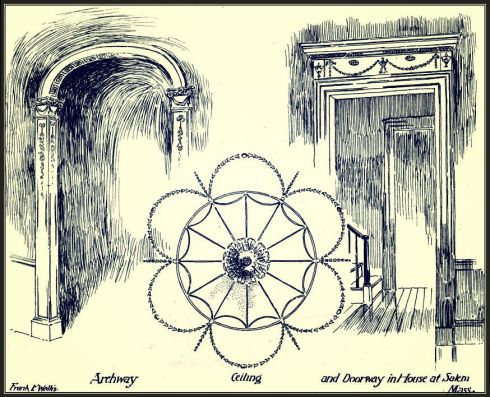
 And I really fear I’ll be too reliant on the detailed-yet-romantic work of Maine-born architect Frank E. Wallis, whose reverence for Salem is all too apparent! Plates from Frank E. Wallis, Old Colonial Architecture and Furniture. Boston: George H. Polley & Co. Publishers, 1887.


 Mr. Monroe at the PEM forum last night.
 The shuttered Phillips Library.


 Flyer for the 1/11 forum, position letter of newly-revived “Friends of Salem’s Phillips Library”(which is so new that it is homeless but I think it is going to wind up
  One of my very favorite photographs from the Phillips collections that I’ve found while DREDGING every and all online sources this month: from the anniversary of the Children’s Friends & Family Services, Inc. (Phillips MSS 447), 1839-2003, which began life as the Salem Seamen’s Orphan Society and has 54 boxes of records on deposit in the Phillips.


 British soldier Leonard Knight and the bullet-ridden


 Vermeer’s Art/Allegory of Painting, Kunsthistorisches Museum: featuring Clio, the Muse of History.
  Moving the Ropes Mansion back a few feet in the 1890s.
 Library of Congress.
 Childe Hassam,
  A panel of mayors, including Kim Driscoll of Salem, at the Massachusetts 400 Forum in 2016.


 Just two Salem institutions whose records are preserved in the Phillips Library, and the Essex Institute in its heyday.


 The Gedney House on High Street, soon after its discovery by Elizabeth Reardon and restoration by Historic New England, and an excerpt from Julie Arrison-Bishop’s article “A Witness to Four Centuries in Salem”, Historic New England Summer 2015; 1965 Boston Globe article on Elizabeth’s discovery of the Samuel Pickman House (hiding under a mansard roof), and the Pickman House today, with the Peabody Essex Museum in the background.






