Tag Archives: Phillips Library

Where’s the Fire (Engine)?

Exactly one hundred years ago in Salem, people were flocking to the Essex Institute to see a piece of Salem history that had recently been returned to their fair city: a Georgian fire-fighting engine, by all contemporary accounts the oldest in America. Here we see a complete reversal of the situation we find ourselves in now, with the Essex Institute’s successor, the Peabody Essex Museum, shipping out the city’s material history rather advocating for its return—and showcasing it. The Union hand-tub engine was imported from Great Britain by one of Salem’s first private fire-fighting companies, the Union Fire Club, established in 1748. In the following year the company placed its order for one of Richard Newsham’s recently-patented “water engines for the quenching and extinguishing of fires”, and it arrived in Salem in 1750.

Fire Engine Colonial WilliamsburgA Newsham Engine of similar vintage @Colonial Williamsburg.

The Union was in service for quite some time as far as I can tell, but by the middle of the nineteenth century both its technology and its company was obsolete: steam and public fire-fighting departments were replacing hand-tubs and clubs. On a ceremonial visit to Philadelphia in the summer of 1866, a few remaining members of the then Union and Naumkeag Fire Club gifted their hosts, the William Penn Hose Company, with the Union. This provoked a “great hue and a cry” at home in Salem, but the old engine was not returned until 1917: and right into the Essex Institute it went. (I am wondering if Salem’s experience of conflagration in 1914 inspired the City of Brotherly Love to return the Union as a sympathetic gesture, but cannot find any confirmation of this theory).

Fire 1865

Fire Union 1866 Collage

Fire PhotoRobert Newall photograph of the William Penn Hose Company in Philadelphia with their steam engines, 1865, The Library Company; Harper’s Weekly photograph of the Union, “the oldest fire-engine in the United States” in 1866; a photograph of the Union in an article announcing its return to Salem in The American City, January 1918.

You can easily discern how important the threat of fire and the organization of fire-fighting was in the eighteenth and early nineteenth centuries by browsing through the online catalog of the Phillips Library, where the papers of the Union and Naumkeag Club are held, along with its predecessor club, the Union and Essex, and myriad other fire clubs: the Active, Alert and Amity clubs, Engine #9, the Enterprise Club, the Franklin Hook & Ladder No. 1, the Friend Engine Company, the Old Fire Club, the Social Club, the Reliance Hose Company, and the Relief Fire Club, among others. I do appreciate the PEM’s digitized library catalog, although it does not quite compensate for the lack of digitized items, or their removal from Salem. However, as I have been meeting and talking to people who have much longer associations with the PEM’s predecessors and the Phillips Library than I do, I am increasingly aware that they are missing objects as much as texts, and those objects are difficult to locate, both on the web and in reality. In the company of the “world-class” museums it claims to be, the Peabody Essex does not seem to be committed to comparative open access, to either its texts or its objects. Several years ago, one could search through a “collection gateway” that seemed to yield access to a good part of the PEM collections (it can still be accessed here but appears to be functional only in accessing items from the Native American collection), now we can only see selected “highlights”. Try comparing the collections portals of say, the Museum of Fine Arts in Boston, or the Metropolitan Museum of Art, or even the Worcester Art Museum, with that of the Peabody Essex Museum: and see how little you will yield. I wouldn’t know where to find the Union online: the Phillips Library finding aid description states that both it and an oil painting entitled The Union Hand-Tub by W.B. Eaton are in the PEM collections, but they are both absolutely unattainable in both digital and actual forms: a regression, certainly, from 1918.

Fire brochure

Fire 1970s

firebucket_fpoThe Union and some fire buckets were featured prominently in a 1978 Essex Institute booklet: Museum Collections of the Essex Institute by Huldah Smith Payson, and fortunately for us, one of those very same buckets is one of the PEM’s online highlights of its American art collection.


Simon Bradstreet’s Body

Lately I’ve become a bit fixated on Simon Bradstreet, the last governor of the Massachusetts Bay Colony, primarily because of the spectacular Salem house in which he lived—and died. So much so that when I realized the anniversary of his death date (in 1697) was yesterday, I ran over to look at his grave in Salem’s oldest cemetery, the Old Burying Point. But when I got there, I realized that it wasn’t there: there’s a cenotaph, but no grave and no body. Where is it? No one really seems to know!

Bradstreet Negative DC

There are clues to the whereabouts of Simon Bradstreet’s body in the Phillips Library, and also, of course, in the graveyard. The most serious inquiry was initiated by Robert Rantoul, a Mayor of Salem, President of the Essex Institute, and someone who addressed many issues of his time and before, and published in an 1892 article in the Salem Press and Genealogical RecordThere is a strong tone of righteousness in this piece, which begins with the statement that Bradstreet’s tomb is now, be the title good or bad, in possession of parties alien to the Bradstreet line, and has been so held for a century, and the representatives of these claimants not unnaturally object to all interference with their long-established rights of possession. I have to admit I did not know that cemetery plots, including those that had been “occupied”, were actually sold like any other piece of property, but that is what seems to have happened: Rantoul lays out all of the historical facts which testify to Bradstreet’s burial on Charter Street, and then presents the surprising revelation that in 1798 the tomb seems to have changed hands according to a bill of sale endorsed by Colonel Benjamin Bickman which states that Major John Hathorne and Captain Samuel Ingersoll bou’t of Benjamin Pickman….a tomb in the burying point (so called)….formerly the Property of Governor Bradstreet. Jump forward a century, to Rantoul’s time and a major investigation carried out by a special committee comprised of members of the Salem City Council and Essex Institute along with “health officers, accomplished antiquarians, and local historians”, which did not seem to be able to locate the remains of Governor Bradstreet. Rantoul leaves us with the mystery, but also some intriguing details: members of the Hathorne family had protested the disturbance of their tomb, and one contemporary observer commented that an ancestor of Nathaniel Hawthorne having taken possession, with no further scruple cleaned out the tomb, throwing the remains of the old Governor and his family into a hole not far away”. And there we are–but where is Bradstreet?

Bradstreet Tomb 2

Bradstreet Tomb3The Bradstreet Tomb today and in its original location in the 1890s (photograph by Frank Cousins @ Digital Commonwealth). Cotton Mather’s epitaph for Bradstreet seems particularly apt: “Here lies New England’s Father! Woe the day! How mingles mightiest dust with meaner clay!”


Uncovering a Shipwreck

Our recent nor’easter uncovered a skeletal shipwreck on Short Sands Beach in my hometown of York, Maine, and I dispatched my parents to take pictures almost as soon as the skies cleared, knowing that our mercurial weather could result in its resubmergence at any time. This particular shipwreck has actually appeared several times over the last fifty years or so, but this time it attracted a lot of attention, both locally and nationally. Many of the stories referred to it as the remains of a “revolutionary era” ship, but the most recent report, based on empirical mapping and sampling by an archaeologist for the Maine Historic Preservation Commission and past research, indicates that the ship might have been a pre-revolutionary “pinky” sloop named the Industry, which ran aground in York with a southbound cargo of lumber in October or November of 1769. The source for this information is a retired York police officer named Barry Higgins, who became curious about the shipwreck after its appearance in the 1980s. And where did Mr. Higgins go to research this wreck? Why the Phillips Library of course, which was/is not only the major repository of local and family history in our city and region, but also of maritime history. At that time, it was open and accessible, and Mr. Higgins found the reference to the Industry in the journal of York notary public Daniel Moulton: for which we can all see a description in the digitized catalog, but not much more than that.

Shipwreck long beach

Shipwreck SS2

Shipwreck SS4

Shipwreck SS3The Short Sands Shipwreck last week.

First impressions are of the remains of a relatively small ship, yet the national reports immediately went naval: the Washington Post consulted with a Naval History and Heritage Command official who consulted a database of 2,500 shipwrecks but was unable to find any records indicating it was an American sloop. But Mr. Higgins knew just where to go thirty years ago, to Salem’s Phillips Library, a well-known repository of maritime history. All of these records are now removed from their natural foundation, en route to Rowley (or perhaps already there in their boxes), and hopefully the state of Maine will have enough sway to gain access so that the identity of this slippery sloop can be verified, again and once and for all.

Shipwreck gone2

Shipwreck gone The Short Sands Shipwreck yesterday–gone but not forgotten.

SHipwreck last


Salem Women’s Lives in the Phillips Library

As they are now, Salem women were really, really busy in the near and more-distant past, and the records in the Phillips Library are a testament to both the range and intensity of their activities. At this moment, the PEM is highlighting all of the powerful women whose work and lives are featured in their 2018 slate of exhibitions, including Georgia O’Keeffe, artist and facilitator Angela Washco, photographer Sally Mann, and a succession of Qing Dynasty empresses of China. In her post, Lydia Gordon writes about “multiple feminisms” and observes that to operate in feminist modes is not just advocating for women’s issues, but rather to take on the human issues within social, cultural, economic and political arenas of our lives. To be a feminist is to be human. I couldn’t agree more, and while it is wonderful to have all these exhibitions on view here in Salem, once again I am struck by the burying of the local past by an institution which is focused primarily on the more global present. For the collections of the PEM’s Phillips Library are full of women tak[ing]on the human issues within [the] social, cultural, economic, and political arenas of [their] lives, and I’m afraid we’re never going to hear their stories–or see their faces.

Woman Pierce PEMThe lovely Catherine Johnson Pierce, who we do get to see in Salem: anonymous American artist, c. 1828-29, Peabody Essex Museum.

So many activist “Republican Mothers” in nineteenth-century Salem! Here’s just a sampling of women’s association papers in the Phillips Library: the Salem Female Charitable Society Records (1801-2001; MSS 359—still active today!), the Dorcas Society of Salem (1811-1875; MSS 113), The Seamen’s Widow and Orphan Association (1833-1960; Acc. 2011.008); the Salem Female Anti-Slavery Records, 1834-1866; MSS 34—fortunately digitized by the Congregational Library and Archives), the Salem Female Employment Society (1861-1875; MSS 113) and the Salem Thought and Work Club (1891-1974), headed by the famed author and activist Kate Tannatt Woods, who deserves her own archive. In her 1977 article in the Essex Institute Historical Collections, then-curator Anne Farnam outlined the workings of the Salem Female Charitable Society early in the nineteenth century, and also reads between the lines to illustrate what can be gleaned from the more opaque entries, such as the vote of the SFCS on September 2, 1801 from the first published list of subscribers of the society. Mrs. West was in the process of a bitter divorce, and one would like to have heard that discussion. As the century progresses, Salem women’s organizations continue to serve as charity stewards, and widen their social scope to include abolition, temperance, education and immigration.

Women PEM SFCS

WOMEN PEM collage A published sermon for the Salem Female Charitable Society, 1815; and records of the Salem Female Anti-Slavery Society as digitized by the Congregational Library & Archives.

And then there are so many stories of individual women in the Phillips: far too many to include an exhaustive list here. One could: follow a Salem sea captain’s wife along as she accompanies her husband around the world in 1837-38 (Log 405), reconstruct several long-distance marriages by delving into the correspondence between captain’s wives who stayed in Salem and their roving husbands, perceive how several Salem women, from different stations in life, assessed the world around them and their own lives during short and long stretches of time in the nineteenth and early twentieth centuries through their diaries; appreciate the contributions of the extraordinary women of the Remond family (MSS 271), assess the interesting lives and careers of the “Misses Williams” of Salem, two spinster sisters who made, taught, collected and sold art in Salem, and traveled to Italy and elsewhere recording their observations and purchasing items for resale back in their Salem studio/gallery (MSS 253); read cookbooks annotated with notes and suggested variations (MSS 483); examine the unsuccessful restoration of the Qing Dynasty in China from the perspective of three missionaries present at the time (MSS 0.650), learn so much more about the lives and work of so many accomplished Salem women, including Sophia and Rose Hawthorne (MSS 69), educator Elizabeth Palmer Peabody (MSS 474), author, illustrator and educator Lydia Very (MSS 83), authors Kate Tannatt Woods and Mary Harrod Northend (Fam. Mss 1119 and MSS 0.016) and artist and entrepreneur Sarah Symonds (MSS 0.016).

Women PEM Collage 3

Photograph of Waters family members, undated, MSS 92 Volume 4

Women PEM Williams Sisters Studio

Women PEM Very


Women PEM Woods

Cookbook

Synchronicity Sarah Symonds

Studies of the intersection of maritime and gender histories have been trending for some time–but where do the rich collections of the Phillips Library fit in? Women of the Waters Family–all dressed up and ready to go where? (Phillips MH 12); The Studio of the Misses Williams of Salem (Phillips Library photograph from Jacqueline Marie Musacchio’s “The Misses Williams in Salem and Rome: Women Making and Marketing Art and Antiquities.” In The Art of the Deal: Dealers and the Art Market on Both Sides of the Atlantic, 18601940, ed. Lynn Catterson, 59-8 (2017)An illustration by Lydia Very, who bequeathed her Federal Street house to the Essex Institute (MSS 83); Kate Tannatt Woods, Out and About (1882); What Salem Dames Coked, the cookbook published by the Esther C. Mack (another amazing woman) Industrial School in 1910, 1920, and 1933 and reprinted by Applewood Books; The “Colonial Studio” of Sarah Symonds on Brown Street, in a building now owned by the Peabody Essex Museum.

As I think about these Salem women on this particular day, in the midst of this particular Women’s History Month, I am dismayed and disheartened when I should be inspired. The sources for women’s history in the Phillips Library are so rich that I have no doubt that they will be discovered and dispersed by a succession of scholars, as many have already (and the digitized catalog and finding aids will facilitate that process), but the prospects for public presentation and engagement seem bleak. As the Phillips collections take up residence in an inaccessible factory, with no obvious digitization plan in place or apparent institutional interest in historical interpretation, it is difficult to see how the people of Salem—or visitors to our “historic city”– will be able to face its history in any meaningful way, like the little girl below.

CurryPhotoTwo-year-old Parker Curry facing Michelle Obama’s portrait by Amy Sherald: a photograph taken by museum visitor Ben Hines which went viral last week, Washington Post.


Arthur Miller in Salem

So this is where we are with the Phillips Library relocation, for lack of a better term: the Peabody Essex Museum, having made the reluctant admission that the collections will not be returning to Salem in December (after informing several parties this fact in the late spring of 2017), has agreed to keep the historic reading room in Salem open, but that’s about it: what will actually be in there is unspecified, except perhaps for volumes of the Historical Collections of the Essex Institute, a venerable journal that the PEM did away with almost as soon as it had absorbed the latter. There have been two pieces in the Boston Globe, and several meetings of both the Salem Historical Commission and the Mayor’s “Working Group”, which are charged with dealing with both the exterior and interior aspects of this PEM problem. Meanwhile, the Phillips collections are en route to the 1980s toy factory off Route One in Rowley, far removed from the context of their creation, and inaccessible by public transportation.

Books-on-Shelves-870x490 I am assuming that these are Phillips materials, from the website of Smith +St. John, a “real estate and development management” company that has been fulfilling a variety of functions for the PEM, including: “Administrative leadership – when the director of the Phillips Library retired in October 2014, Smith + St. John principal Gregor Smith was asked to serve as interim director while the Museum conducted a national search to fill the position with the right rare book scholar”. Unusual to have a real estate developer serve as director of a research library, no?

Throughout these 2+ months, I have never heard one admission from a PEM representative that what they were doing was in any way detrimental to Salem, the very crucible of their collections, despite the fact that they are always lauding themselves as the country’s oldest continuously operating museum based on the 1799 founding of the East India Marine Society of Salem. They remain very publicly and exclusively focused on the priority of preservation, but I see no acknowledgement that the Phillips is both a library and an archive: with public records therein, as well as materials that people will come specifically to Salem to see. There’s no better way to illustrate the symbiotic relationship between place and exploration than the example of one of the Phillips’ Library’s most famous researchers, Arthur Miller, who wrote about his trip to Salem for Crucible material and inspiration in several essays as well as his 1987 autobiography Timebends. He was drawn to Salem in the spring of 1952, but found it to be “a sidetracked town…with abandoned factories and vacant stores” according to his 1996 recollections in the New Yorker. No one wanted to talk about the trials then; it was the archives that first made the story come alive for him, the trial transcripts which he read in the “gloomy courthouse” and then other texts in a repository he identifies alternatively as the “museum” or the “historical society”: the Phillips Library.

archival collage 2

Salem's Museum NYT 1953 Feb 8.JPG

In his 1953 New York Times article “Journey to the Crucible”, Miller recalls a “silent” library/museum, in which an old man, looking like a retired professor, is reading a document. Two middle-aged couples come in from their automobile outside and ask to see the pins: the pins the spirits stuck the children with. The pins are in the courthouse, they are told. They look about at the books, the faded fragments of paper that once meant Proctor must hang tomorrow, paper that came through the farmhouse door in the hands of a friend who had a half-determined, half-ashamed look in his eyes. The tourists pass the books, the exhibits and no hint of danger reaches them from the quaint relics. I have a desire to tell them the significance of those relics. It is the desire to write. That’s a pretty good description of intellectual/creative inspiration! And he goes on, taking it outside, into the streets of Salem: the stroll down Essex Street I remember, and the empty spaces between the parking meters, the dark storefronts…but further down a lighted store, and noise. I take a look: a candy store. A mob of girls and boys in their teens running in and out, ganging around on the vacant street, a jalopy pulls up with two wet-haired boys, and a whispered consultation with a girl on the running boards; she runs into the store, comes out with a friend, and off they go into the night, the proud raccoon tail straightening from the radiator cap. And suddenly, from around a corner, two girls hopping with a broomstick between their legs, and general laughter going up at the specific joke. A broomstick. And riding it. And I remember the girls of Salem, the only Salem there ever was for me—the 1692 Salem–and how they purged their sins by embracing God and pointing out His enemies in the town. Salem girls. No researcher is going to find such archival ambiance, and such an illuminating juxtaposition between past and present, in the midst of an industrial development in Rowley. Arthur Miller returned to Salem in late 1991 for the announcement of the planned memorial for the Tercentenary in the coming year, expressing concern about the commercialization of the Trials (which “trivializes the agony of the victims”) but also appreciation for its historical resources. And with the removal of the latter, we are increasingly defenseless against the former.


Topsy-Turvy

I find myself these days full of feelings of dissent and resistance but looking for more whimsical ways to express the same, as you can’t be strident all the time. It’s boring, and exhausting. So a flashing reference caught my attention, to a dinner party in Baltimore in February of 1777 attended by two of the most strident people in history: John and Samuel Adams of Massachusetts. The next day, John noted in his diary [II, 434]: Last evening I supped with my friends, Dr. Rush and Mr. Sargeant, at Mrs. Page’s, over the bridge. The two Colonel Lees, Dr. Wisherspoon, Mr. Adams, Mr. Gerry, Dr. Brownson, made the company. They have a fashion, in this town, of reversing the picture of King George III in such families as have it. One of these topsy-turvy kings was hung up in the room where we supped, and under it were written these lines, by Mr. Throop, as we are told: Behold the man, who had it in his power/ To make a kingdom tremble and adore, Intoxicate with folly. See his head Placed where the meanest of his subjects tread. Like Lucier, the giddy tyrant fell; He lifts his heal to Heaven, but points his head to Hell.

George III

King George III by Nathaniel Dance-Holland, National Trust, Uppark

Well I like this “fashion”, and can certainly think of one or two people I’d like to turn upside down at the moment. I’m sure we all can. Apologies to my British friends: I couldn’t find an image of a Baltimore dining room with a topsy-turvy portrait of King George, so I simply turned him upside down myself. But we must note that like so many of their revolutionary sensibilities, the new Americans were simply following a British example: in this case the “world turned upside down” sentiments of the English Revolution in the previous century. The leader of that revolution, Oliver Cromwell, was himself turned upside down when an Indian monarchist of the Victorian era purchased his portrait and displayed it topsy-turvy in a delayed protest of the regicide: the Inverness Museum and Art Gallery followed suit when it acquired the portrait, and Tate Britain when it exhibited it. Another topsy-turvy ruler is Philip V of Spain, whose portrait is traditionally upended in the Almodí Museum in Xàtiva, in retribution for the burning of the city at the close of the War of the Spanish Succession.

Topsy Turvy Tate cromwell_for_web_0

Robert Walker (in the style of), Inverness Museum and Art Gallery

Topsy Turvy King 2

The first Bourbon King of Spain, Philip V.

Later in the eighteenth century and into the nineteenth, the upside-down, topsy-turvy motif was mostly used in a satirical or critical way, the point having been established: “it is monstrous that the feet should direct the head” (in the words of my favorite queen, Elizabeth I, to make up for turning George III upside down) or something’s not right here. There was also a two-sides-of-the-same-coin message in some topsy-turvy images, as well as a general sense of we’re being tossed about/PLAYED. That’s how I feel.

topsy turvy collage

TOpsy Turvy Economy 1979 Jean-Michel Folon Smithsonian NPGTopsy-turvy “Talons” Kaiser Wilhelm I and Emperor Napoleon III, 1878, Victoria & Albert Museum; the Topsy-turvy Economy, 1978, Jean Michel Folon, Smithsonian/National Portrait Gallery.


Home, Hearth & History

I’m really looking forward to an upcoming exhibition at the Concord Museum: Fresh Goods: Shopping for Goods in a New England Town, 1750-1900, offered as part of a state-wide MASS Fashion collaborative project which will include a fall exhibition at the Massachusetts Historical Society guest-curated by my Salem State colleague Kimberly AlexanderFashioning the New England Family. I thought I had fashion fatigue, because there have been so many clothing-based exhibitions over the past few years, but these exhibitions look a bit different to me—there’s something more active and engaging about the words shopping and furnishing. Instead of just being wowed by the artifacts, we can learn how and why they came to be created and acquired, processes that involved not just cultural considerations, but also economic and social factors. If I were a curator, I think I would like to create a similar exhibition focusing on home furnishings, because that could offer up insights into so many crafts, industries, and distributors—especially over the nineteenth century as households were affected increasingly by market forces. Recapturing and representing colonial “hearths and homes” and “daily life” were Colonial Revival preoccupations over a century ago; I think we could do with a refresh–and an expanded chronological focus.

Home Furnishings BA 1869

373 Essex Street Joseph Ropes©Boston Athenaeum and Phillips Library, Timothy Ropes Papers (MSS 365).

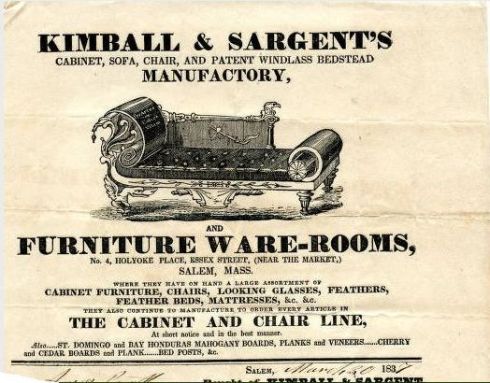
I imagine there are two approaches to researching the history of household furnishing: presume by utilizing prescriptive materials like trade catalogs and books on contemporary home decoration, or establish through receipts, diaries, and accounts. There are certainly lots of collections of the former, at the Smithsonian, here, and the Winterthur Library, to name just a few sources. Individual household accounts are more decentralized, of course, and for Salem we would be quite dependant on the collections of the Phillips Library: the marvelous hand-drawn sketch by Joseph Ropes of his bedroom at 373 Essex Street above was included in a blog post published by the library which is no longer available, but I was so taken with it I snipped it right up, fortunately. Imagine researching the furnishing of just this one room: that odd stove, so many chairs, the textiles on the bedspread and chair? Wherever they end up, and hopefully digitized, all those family papers in the Phillips have such a wealth of information within—capable of tracing the history of decades of the China Trade and a single year in the material life of one Salem household. But until they see the light of day, we have some other sources: the Winterthur Library’s digital collection of ephemera will not enable me to source Joseph Ropes’ room, but it can give us a few glimpses into Salem’s material past.

Home Furnishings 1801

Liverpool War NA 2

Home Furnishing Waters

Waters

Home Furnishings 4

Home Furnishings 2

Printed_bill 1862

Home Furnishings 3

Home Funishings

A crate of Liverpool Ware for Mr. Nathaniel Burnham (?), 1801; perhaps a pattern such as this (Northeast Auctions)? Andirons and a Kettle for Captain John Waters and the Captain himself (Northeast Auctions); furniture for another Mr. Waters, 1861; 14 yards of black silk for Mr. Goodhue; pillow and furniture manufacturers in the 1880s, Winterthur Library.


We Need Louise!

If you haven’t noticed, I’ve become a bit obsessed with the prospect of an exiled and extracted Phillips Library; even though I’m living through it, it’s still difficult for me to grasp how this could happen to a city with as rich a heritage as Salem—-to any community really. I just don’t understand how or why the Trustees of the Peabody Essex Museum could acquiesce to such a radical policy, but then again, I don’t have many insights into the role(s) of contemporary trustees: I am governed more by characterizations from the past than present examples. I can suppress thoughts of Salem losing nearly all of its material history for a day or two, but then they come raging back: in dreams (or nightmares), first thoughts upon waking, and last thoughts at the end of the day. Lately I’ve found myself conjuring up people from the past and asking (myself–not them!) what they would think or do in this situation: Dr. Henry Wheatland, who devoted his life to the Essex Institute by all accounts, or James Duncan Phillips, the great Salem historian after which the Library is named. These men would not be happy, and they would make their unhappiness known, no doubt. But I think this particular crisis calls for another Essex Institute trustee from the more recent past: the pioneering preservationist Louise du Pont Crowninshield (1877-1958). I just know she would never let this happen.

Louise 1900 wedding

Francis & Louise du Pont Crowninshield and bridesmaids (+dog) on their wedding day, 1900 (Hagley Museum & Library)

Louise was a Gilded-Age princess: the heiress to the du Pont industrial fortune, raised at Winterthur, and married to Boston Brahmin (with Salem roots) Francis Boardman Crowninshield in 1900. She mixed in all the right circles but was obviously not content to just play and party: like her brother Henry, she was an energetic student and collector of early American material culture, and this passion brought her into the early preservationist movement. After restoring her family’s original homestead, Eleutherian Mills, she became involved with the rebuilding and restoration of two historic Virginia properties related to George Washington: Wakefield, his birthplace, and Kenmore, the Fredericksburg plantation that was home to his sister and her family. Crowninshield then worked her way up the east coast, participating in a succession of preservation initiatives, including Independence Hall in Philadelphia and several Massachusetts properties: Gore Place in Waltham, the Lee Mansion in Marblehead (where she and her husband summered at a beautiful estate on Peaches Point), the Wayside Inn in Sudbury, the Mission House in Stockbridge, and two Essex Institute houses: Peirce-Nichols and Gardner-Pingree. Her interest and investment in another Salem house, the Derby House, was integral to the establishment of the Salem National Historic Site as the first national historic site in the NPS. She was one of the founding trustees of the National Trust for Historic Preservation in 1949 and is the namesake of its most prestigious award.

louise-du-pont-crowninshield1

Louise du Pont Crowninshield in the center of the “Kenmore Ladies”, 1930s.

Louise du Pont Crowninshield was a powerful woman: so powerful that the substantial contributions she made towards the restoration of the Gardner-Pingree house in the 1930s entitled her to dictate (apparently–I’m relying on written hearsay here) that no mention be made of her relative-by-marriage’s key role in the savage murder of Captain Thomas White in the house in 1830 when it was opened for tours a century later, and to place furniture in the Derby House that was perhaps a bit “old” for its period. But her capital and connections were utilized overwhelmingly for the public good rather than vanity or recognition. She was committed: to her belief that Americans will be better for having around them some visible remains of their past, as well as to the importance of place in general and Salem in particular. She served on the boards of both the Essex Institute and Peabody Museum, and as President of the Salem Maritime Trust as well. If Mrs. Crowninshield was alive today I have no doubt that she would spare no expense of her cultural capital (telling her Marblehead neighbors and fellow trustees: we are not going to do this to Salem), and perhaps also her capital, to ensure that the Phillips Library was returned to Salem, adjacent to the buildings in which she invested so much of herself, and which bear her name. We need her now.

Louise Collage

CB

CB2

Helen Comstock’s influential 1958 coffee-table book 100 Most Beautiful Rooms in America was a veritable memorial to Louise du Pont Crowninshield in the year of her death, with pictures of Winterthur, Kenmore, and (above), a Peirce-Nichols bedroom, the Crowninshield Memorial bedroom in the Gardner-Pingree House, and the Lee Mansion parlor. A true memorial is the Crowninshield-Bentley house, which was removed to the Essex Institute campus from its original location further along Essex Street and restored by subscription in 1959-60 in tribute to Mrs. Crowninshield. (Love these historic house pamphlets published by the Essex Institute in 1976-78—scoop them up if you can find them).

P.S. And of course there are Crowninshield papers in the Phillips Library deposited by Mrs. Crowninshield, as well as other purchased and donated in her memory.


Samuel Chamberlain’s Salem I: Winter

Two notable architectural photographers of the twentieth century turned their lenses on Salem again and again: Frank Cousins (1851-1925) and Samuel Chamberlain (1895-1975). These men represent a continuum for me: Chamberlain picked up where Cousins left off: with a gap of about ten or fifteen years while the former was more focused on the Old World than the New, and on etching rather than photography. It’s a very interesting exercise to consider their views of the same structure side by side: this is one way that I’ve been teaching myself about photography. Chamberlain has much more of a trained eye–having studied both architecture at MIT and etching in France–but both seem as concerned with documentation as illustration to me. I’m impressed with the range of activities and entrepreneurship of both men–although clearly Chamberlain was more worldly, by choice and circumstance. Born in Iowa and raised in Washington State, Chamberlain’s time at MIT was interrupted by World War I and service as an ambulance driver in France, where he became entranced with the buildings around him and “decided he would prefer to record the picturesque rather than design it” according to 1975 obituary in The New York Times. He recorded picturesque architecture in France, England and America with his etchings, prints and photographs in over 40 published books and countless magazine pieces, as well as the first-ever engagement calendars featuring New England scenes.

Chamberlain collage Two perspectives on the Peirce-Nichols House:  Cousins and Chamberlain.

I grew up with Samuel Chamberlain books and when I moved to Salem I bought more: his vista included all of New England (and beyond) but as he lived in nearby Marblehead, he had ample opportunity to photograph Salem over a 30+ year period from the 1930s through the 1960s. Like Cousins before him, Chamberlain resolutely avoided all the “dull” parts of the city (anything industrial or utilitarian, Victorian or 20th century), and stuck to the historic districts for the most part, where he photographed both interiors and exteriors. I can’t get enough of the first of his three Salem-specific titles, Historic Salem in Four Seasons: A Camera Impression (1938), Salem Interiors: Two Centuries of New England Taste and Decoration (1950), and A Stroll through Historic Salem (1969) because of its rich rotogravure reproductions, which render pre-war Salem in very rich hues. I’m going to offer up some seasonal highlights of Samuel Chamberlain’s Salem this year, starting with winter, which he believed was the time of “Salem’s most beautiful moments…when few visitors see it”.

Chamberlain 1

Chamberlain 7

Chamberlain 8

Chamberlain 9

Chamberlain 11

Chamberlain 10

Chamberlain Federal

Chamberlain 5

Chamberlain 3

Chamberlain 4Essex Street, Church Street, the rear of the Andrew Safford House, the Retire Becket House, the Derby House, Federal and Chestnut Streets from Samuel Chamberlain’s Historic Salem in Four Seasons (1938). Both Chamberlain and Cousins deposited materials in the Phillips Library, which has been removed from Salem by the Peabody Essex Museum. 


The Digitization Dilemma

From my perspective, there are two digitization dilemmas inherent in the Peabody Essex Museum’s plan to relocate the Phillips Library outside of Salem, where it was created over a period of 200+ years. The first is my own dilemma: if the PEM had actually made digitization an institutional priority, I certainly would have much less of a leg to stand on (or no leg at all) in my argument that the Library should remain in Salem. The second is theirs: if they had engaged in digitization equal to that of their peer institutions across the country and globe, or even comparable, their relocation–especially as it comes with promises of increased access– would be more palatable. One thing that the public debate over the relocation has made crystal clear is the fact that despite some confusing messaging, the PEM has actually only digitized the catalog of the Phillips collections, and a few additional items, pictured below.

Digital collageCompare the PEM’s online holdings to those of an institution with similar historical materials, the Massachusetts Historical Society, or another regional institution, the Boston Athenaeum.

This scant list is not completely representative of Phillips materials online: in partnership, the PEM has enabled more of its collection to be accessible, chiefly with the Congregational Library & Archives and Adam Matthew, a British-based digital publisher of primary source databases for teaching and research. Where there is a partner, there is a way. The materials at the Congregational Library site, including witch trial records digitized previously by the University of Virginia and other records digitized as part of a Digitizing Hidden Collections grant from the Council on Library and Information Resources, are open access, but the materials at Adam Matthew are solidly behind a paywall. This is really unfortunate, because these are truly important Salem sources which constitute part of Adam Matthew’s China, America, and the Pacific database and the entirety of its module on Meiji Japan. 

Digital database AM

Digital Japan

Both are wonderful thematic databases, expertly curated, and likely very dear—I wasn’t able to obtain exact pricing information. We don’t have these Adam Matthew products at Salem State, but I was able to get trial access to both databases for the month of January and I dove in. It’s wonderful to have so many Morse materials assembled in one place: Morse was an extraordinary intellectual and person, by all accounts: a naturalist, ethnologist, and director of one of the PEM’s foundation institutions, the Peabody Museum of Science, from 1880 until his death in Salem in 1925. (There’s a wonderful story of Morse’s young colleagues running through and around the Great Salem Fire of 1914 to their mentor’s house on Linden Street, only to find Morse ensconced in his living room, calmly playing a flute). Meiji Japan includes materials drawn from the Phillips’ 55 boxes of Morse papers, including Morse’s famous Japan diaries, correspondence (including letters to and from his colleague Ernest Fenollosa, the Salem-born Japanese Imperial Minister of Fine Arts, whose childhood home is right next door to ours), scrapbooks, and scholarly works. There is a note in the Phillips catalog that This digital resource is available to researchers on Phillips Library computers so I guess we can all troop up to Rowley to see the works of this long-time Salem resident, or perhaps there will be a desktop in Plummer Hall.

Digital Morse

Thomas PerkinsThe very interesting house of Edward Sylvester Morse on Linden Street in Salem; the Account Book of the Thomas Perkins of Salem (pictured above from the Essex Institute’s Old-Time Ships of Salem1922) is included in Adam Matthew’s China, America, and Pacific database.

Morse is amazing, but I found the China, America, and the Pacific collection captivating, as its sources have been even less accessible and are extremely relevant to, and illustrative of, historiographical trends in world history. My trial is rapidly coming to an end with this database, but we have one at the Salem State University Library for the next month or so, so you can go and see for yourself. Records of several major Salem merchants, including Benjamin Shreve, Samuel Barton, Joseph Peabody, Benjamin Crowninshield, Joseph Bowditch, and Nathaniel Kinsman, are included, encompassing account and log books for myriad Salem ships, including Minerva, the first Salem ship to circumnavigate the globe, Canton, New Hazard, China, Comet, Catherine, Bengal, Mount Vernon, and more. These materials don’t just record trade, they decipher relationships for us, as in the account book of the Minerva’s 1809 voyage to Canton, in which “the captain and his clerk have added detailed remarks about the Canton System and the Hong Kong merchants who they met”. This particular Adam Matthew “product” would be wonderful for my students, and I wish SSU could purchase it, but funds are limited and demands great for all library materials at my public university, just as they are at all public institutions. It seems more than a bit ironic then, that so many of the Phillips materials (including the Tucker, Kinsman, Barton, Shreve, Bowditch and Peabody papers) which are included in the China, America, and the Pacific database were, in fact, processed with public funds from either the National Endowment of the Humanities or the National Historical Publications and Records Commission.

I want to be very precise in my presentation of facts as PEM CEO Mr. Dan Monroe has recently complained that those of us who have “virulently criticized” the removal of the Phillips Library from Salem have been “constantly presenting false information to the public”: the PEM has licensed historical materials donated by Salem families and processed with Federal funds to a commercial academic database, and if I want my Salem students to be able to access these materials (after our trial run is over) we will have to pay for the privilege.