Tag Archives: Maine

Most Endangered 2013

My affection for history was fostered by places and buildings; it’s very material. And while I appreciate and am often awed by nature, I find the built landscape more accessible–and instructive. I’ve been an ardent preservationist since my teens, and am just passionate (geeky) enough to actually anticipate the release of the National Trust for Historic Preservation’s annual Most Endangered Places list every year. Yesterday brought the big announcement of this year’s list, which includes two New England properties with which I am familiar and nine more which I’m eager to see (most of them anyway, before they disappear). I have helped to create similar lists for our local preservation organization, Historic Salem, Inc., and if our deliberations are any indication, this list is the result of an intensive process:  you have to choose places that are threatened but are not too far gone, that possess the potential for recovery, there are always political factors involved, and historical and/or cultural significance has to be readily apparent. I’m sure the National Trust also has to take into account regional representation, as their Most Endangered Places are generally spread all over the U.S. map.

New England Most Endangered Places: Gay Head Lighthouse, Martha’s Vineyard, Massachusetts, and the Abyssinian Meeting House, Portland Maine.

Most Endangered

The Gay Head Light, Aquinnah, Martha’s Vineyard, Massachusetts, is threatened by erosion: it’s about 10 feet away from falling over the cliff. It’s wooden predecessor was faced with the same threat in 1844, and this brick structure, outfitted with a first-order Fresnel lens, dates from the 1850s.

OLYMPUS DIGITAL CAMERA

The Abyssinian Meeting House in Portland, Maine was built in 1828 to serve as a school and assembly house for Portland’s African-American community, and it also served as a stop on the Underground Railroad. It is the third oldest African-American meeting house in the country, which is amazing to me given its northern location. If you visit the Abyssinian Restoration Project website, you will see that an intensive preservation effort is ongoing; all they lack is resources.

Properties threatened by Development: The Village of Mariemont, Ohio, and the James River, Virginia.

Mariemont_619x350

The Village of Mariemont  in Ohio, a Tudor Revival planned community built in the 1920s, is threatened by highway construction. Of all the threats to historic structures, infrastructure development bothers me the most, because it is often short-sighted. Salem was faced with the threat of a road running down its historic center in the 1960s which was fortunately averted; I thought Urban Renewal had ended.

Most Endangered

The historic places that line its shores–Jamestown, Williamsburg, and a host of plantations–have given the James River the name “America’s Founding River”. Apparently “inappropriate development” threatens this region now. I’ll take the National Trust’s word on this, but I wish they were a bit more specific about the threat.

Most of the places on the list are quite modern, including Houston’s Astrodome, the Worldport at JFK Airport in New York, and several mid-twentieth-century buildings–all of which face demolition. By contrast, the oldest building on the list and one of the oldest buildings in North America, the San José Church (1523) in Old San Juan, Puerto Rico, is threatened by the deterioration that comes with time. The notes on its Historic American Buildings Survey record indicate that it was “in need of extensive repairs” in 1935, so you can imagine its condition now.

Endangered Historic P1341341

Church

Church 2

The Church of San José in Old San Juan, Puerto Rico, built by the Dominican Order in 1523. Black and white photographs from the Historic American Buildings Survey (1935), Library of Congress.


Red Christmas

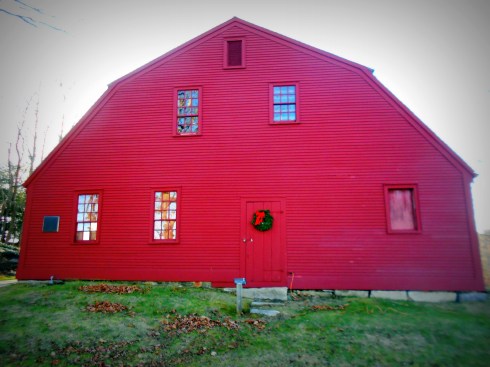
Even before I read a nice little article yesterday on how the holidays obtained their color themes, I was already planning to focus on red:  it’s been a dreary week and I needed a little cheering up. The red that we now associate with Christmas comes from an amalgamation of historical and cultural forces:  iconic images of St. Nicholas of Myra wearing red robes, holly berries and the apple props of medieval mystery plays, the Victorian poinsettia craze, the colorful depictions of Santa Claus by nineteenth-century cartoonist Thomas Nast, and the Coco-Cola Santa Claus of the early twentieth century. I’ve already covered Saint Nicholas in a lengthy post a week or so ago, so this perspective is going to be structural. Here are some of my favorite red houses, tastefully decorated for the season in typical understated New England fashion. I’m starting up north, in my hometown of York, Maine, where I happened to be last week before our weather turned dreadfully dreary, and then I’ll work my way home to Salem via Newburyport.

Two of the Historic House Museums of Old York:  the 1719 Old Gaol (Jail) and the 1754 Jefferds Tavern. As you can see, the gaol is situated on a little hill that overlooks York Village below. There is a large new barn-like structure attached to the tavern which I don‘t really care for (despite the fact that it is named after my wonderful high school guidance counselor) so I‘m showing a vantage point that excludes it.

treees 001

red Gaol 2

red gaol

treees 011

Heading south, I stopped in Newburyport–a city of white houses for the most part–and found two adorable colonial side–shingled houses on side streets in the south end.

red house Newburyport

treees 019

treees 021

Back in Salem, where there are not a lot of red houses, really. But there is venerable Red’s Sandwich Shop downtown, and the Manning house in North Salem, which was once in the midst of one of the most famous orchard nurseries in Massachusetts. This was the home of Nathaniel Hawthorne’s uncle, Robert Manning, a famous “pomologist” (an expert in the cultivation of fruit trees) and according to the sign, also a stagecoach agent–news to me. The last picture in this group is a rare red Greek Revival on Essex Street: you seldom see a house in this style painted red, as they are meant to mimic stone. From these pictures it appears we like our red houses with white trim in Salem.

Red's Sandwich Shop

red house North Salem

red Manning House

red greek revival

Finally, Nathaniel Hawthorne’s c. 1750 birthplace, moved to its present location adjacent to the House of the Seven Gables on the harbor in 1958 from downtown. A rather gnarly tree seems to be threatening it! And last but not least, a wonderful old (fishing?) shack on the other side of the Gables: a little worse for wear maybe, but still red and picturesque–it does seem to be crying out for a wreath at this time of year.

Red Hawthorne House

Red Hawthorne House rear

red shack


Iron Animals

It seemed like everywhere I went this (past) summer there were animals made of iron or some other metal.  Large or small, inside or out, they were in shops, parks, and museums.  So I snapped away, and here are some of my favorites, in chronological order of sighting.

All Summer long: horse sculpture by Deborah Butterfield in the atrium at the Peabody Essex Museum; in the midst of what used to be a Salem street.

Early July:  a stag and yet another noble horse at Smith-Zukas Antiques @ Wells Union Antique Center, Route One, Wells, Maine.

Late July:  a climbing tree frog by North Shore artist Chris Williams in Ipswich. 

Late August:  Big cats by Wendy Klemperer face off each other in Lenox.

Late August, again:  a tortoise and a hare in Copley Square, Boston.


High Summer Gardens

August is beyond peak time in New England gardens but there is still a lot of color out there:  primarily from phlox, phlox and more phlox. I’ve been taking pictures on my local travels and those below are from eastern Massachusetts, coastal New Hampshire, and southern Maine. The first group were taken during a visit to Fuller Gardens in North Hampton, New Hampshire. The garden was designed by landscape architect Arthur Shurcliff (of Colonial Williamsburg fame) for the 50th governor of Massachusetts, Alvan Fuller,  and his wife Viola, who maintained a summer seaside home in North Hampton, which is only about ten miles from the Massachusetts border. The house is no longer there, but its adjacent gardens are, laid out in a series of  “rooms” in the Colonial Revival fashion. Everything is so immaculately maintained, especially Mrs. Fuller’s beloved roses, that it is a treat to visit here in August when nearly every other garden I see (including my own) is looking a bit tired and overgrown.

Up the road a piece, some gardens and flowers in Portsmouth, New Hampshire:  Prescott Park in the afternoon and early evening, a vertical garden on a utility box, and the terraced garden across from the Moffat–Ladd House (1763) on Market Street.

Some very diverse images of plants and landscapes in southern Maine:  a coastal garden in Kittery Point, a checkerboard courtyard, a border, and my father’s cabbage, all in York.

Back home in Massachusetts, the colonial garden at the Parson Capen House in Topsfield, with its raised beds and very practical herbs and flowers, and my own Salem garden, which I think is a bit behind due to its sheltered location:  the bee balm is still reigning, the phlox (I have only the white, mildew-resistant David variety) is just starting to bloom, and the ferns are starting to sag:  August is not their month.


Clapboard Castles

I know that the great American photographer Walker Evans (1903-75) liked Greek Revival houses, factories, main streets, roadside advertising, picture postcards, and people from all walks of life, but I think he really, really liked hotels. In the vast Walker Evans Archive at the Metropolitan Museum of Art, there are many images of hotels, large and small, and I’ve recently come into possession of a Fortune Magazine article from August 1949 in which he photographs and writes about some of the most famous New England resort hotels of the last century. In “Summer North of Boston”, Evans refers to one of these grand hotels, the Poland Springs House in South Poland, Maine, as “the nation’s uttermost dream of secular grandeur, this clapboard castle, turreted, porticoed, balustraded, oriflammed”. And when you see the photographs of this sprawling hotel (erected in 1876 and destroyed by fire in 1975), you know just what he means.

Scan from “Summer North of Boston” by Walker Evans, Fortune Magazine, August 1949 and original photograph and c. 1910 postcard of the Polar Springs House from the Walker Evans Archive, Metropolitan Museum of Art; 1894 menu from the Polar Springs House, New York Public Library Digital Gallery.

I really wish I had seen this amazing building before it burned to the ground in what all the accounts describe as a “spectacular” fire–a fate that it shared with most of the grand hotels in Evans’ article.  His “north of Boston” encompasses a triangular region between the North Shore towns surrounding Salem in the south, Bar Harbor, Maine in the north, and the White Mountains of New Hampshire in the west. Within this area were the New Ocean House in Swampscott (1884-1969), Oceanside in Magnolia (a village of Gloucester, Massachusetts:  1876-1958), Wentworth-by-the-Sea in New Castle, New Hampshire (built in 1874 and still standing, though some people think its recent “restoration” was more of a reconstruction), the Samoset in Rockland, Maine (1902-1972), and the Mount Washington Hotel in Bretton Woods, New Hampshire (built in 1902 and still majestically and miraculously intact).

The New Ocean House, Oceanside, Wentworth-by-the-Sea, and the Samoset by Walker Evans, and the Mount Washington Hotel at the time of the 1944 Bretton Woods International Economic Conference by Alfred Steiglitz, Time Life Pictures/Getty Images.

Of all these American castles it is the Wentworth with which I had the closest connection:  I grew up nearby and actually attended my senior prom at what was then almost a relic.  The building experienced a conspicuous decline in the later 1980s and 1990s, becoming the focus of the national preservationist movement, before it was rescued and rebuilt after 2000.  It has lost its hyphens and become the Marriott Wentworth by the Sea.

The Wentworth in 2000 and today; the BEST book for the architecture and culture of the grand resort hotels of coastal New England:  Bryant Tolles’ Summer by the Seaside.  The Architecture of New England Coastal Resort Hotels, 1820-1950 (2008)


An Array of Elephants

I know that they’re trendy now and have been for some time, but I’ve been an elephant afficionado since I was a little girl, so I have many, many elephants that run the range from extreme tackiness to quite elegant.  I’ve had to edit my collection of elephants down rather dramatically to avoid their takeover of the house, so most of them are in boxes in the basement now (I could not, of course, get rid of them!)  I think that I should forgo future pachyderm purchases, unless they are of the ephemeral variety and don’t take up much room. Nevertheless, I am always looking…and several very different and unattainable elephants  have caught my eye over the past few weeks, renewing my appreciation for those in my own house at the same time.

Three great elephants: a “change packet” (a kind of ephemera I didn’t even know existed! nineteenth-century shopkeepers would give you your change back in these cute little paper packets, which provided them with another avenue for advertising) from the Graphics Arts Collection at the Princeton University Library, the mechanical elephant of the Machines of the Isle of Nantes, which can carry around up to 49 people for 45 minutes, and an elephant embroidered by Mary, Queen of Scots about 1570 from the collection of the Victoria & Alfred Museum in London.

I like this last embroidery panel because it indicates that the Queen had access to the first great Renaissance zoological work, Conrad Gessner’s Historiae Animalium (1551-1558).  Mary’s elephant clearly seems to be based on the image in Volume One of Gessner, and I like to think of the plotting Queen and her ladies leafing through the tome for inspiration.

Elephants in my house:  a few of my favorite elephants, still upstairs, beginning with the wallpaper in my first-floor powder room. I can’t remember what the maker or pattern is.

The little guy below is my very favorite elephant:  I have no idea what he is made of or how old he is. He was in a box with some other little elephants–all cast iron–which I bought for a $1.00, but he is not cast iron but rather a hard plaster-like material.

A recent purchase from an antiques shop in Maine:  this guy seems to be made of old college pennants.  I have no idea what to do with him, so he just sits on a chair in the guest bedroom.

A sixteenth-century book illustration:  I purchased it after it was already cut out, but I still feel guilty.

Moneypenny, one with the elephant garden seat.


Definitive Duels

Living right next to the Samuel McIntire-designed Hamilton Hall, a virtual memorial to Alexander Hamilton, I am always semi-conscious of the man, his life, and his death:  208 years ago today in a famous duel with Aaron Burr.  I wrote about the duel and its cultural impact in a post from last year, so for this particular anniversary I thought I would look at some of the more famous duels in Anglo-American history.

A romanticized view of the Burr-Hamilton duel, July 11, 1804, from an 1890 American history textbook.

I’m going to start with some early modern English duels and then work my way forward towards the nineteenth century and America.  Duels are interesting little events in European history because they represent the remnants of early medieval judicial combat, as well as a tradition that early modern kings were intent on ending in order to establish themselves as the ultimate defenders of the peace.  I’ve seen images from as early as the fourteenth century of kings “overseeing” duels between their noble subjects, thus projecting the message that the ritual had royal sanction. By the early modern era, one which witnessed a great expansion of royal authority, duels were made illegal and participants were subject to prosecution, especially if a death occurred.  A case in point was the duel fought between the Elizabethan playwright Ben Jonson and his actor colleague Gabriel Spencer on 22 September 1598 in the sprawling Hoxton Fields northwest of London.  Spencer was killed and Jonson was sentenced to hang for murder, but managed to escape this fate by pleading the ancient privilege of “benefit of clergy”.  Spencer’s death left no mark on Jonson, who went on to fame, fortune and celebrity as the recipient of lots of royal patronage.

Several decades later one of the most interesting men of his age, Sir Kenelm Digby (natural philosopher, cookbook author, courtier, swordfighting cavalier) killed a French nobleman who had insulted King Charles I in a 1641 Parisian duel from which he emerged unscathed.  Back home, the fact that he had defended the honor of the King of England did not mollify his fellow Englishmen, who remained affronted by his Catholicism on the eve of the English Civil War.

The romanticized image of the duel envisions a fight over a lady, but it seems to me that most duels were either about politics or petty insults.  One exception was the duel fought in 1668 between George Villiers, the 2nd Duke of Buckingham, and Francis Talbot, the 11th Earl of Shrewsbury, over Anna Maria Talbot, the Countess of Shrewsbury.  The Duke and the Countess were brazen lovers, and Talbot seems to have challenged Villiers to avenge his own honor more than that of his wife.  To no avail: he died from injuries sustained in the duel and his widow was promptly installed in Buckingham’s new country estate, Cliveden House.  The Duke’s career was not tarnished by this particular episode, but Samuel Pepys, the diarist of the age, did note that “this will make the world think that the king hath good councillors about him, when the Duke of Buckingham, the greatest man about him, is a fellow of no more sobriety than to fight about a whore.“

Anna Maria (Brudenell) Talbot, the Countess of Shrewsbury, 1670 by Sir Peter Lely, National Portrait Gallery, London.

The later eighteenth and early nineteenth centuries was a golden age of duels, fought for more petty reasons than previously. It is almost as if the professionalization of war led to the trivialization of duels.  Before I jump the pond, let’s briefly examine the “royal duel” fought between the Richard Lennox, the (future) Duke of Richmond and Governor General of British North America and Frederick, Duke of York, second son of King George III.  When royals get involved, dueling becomes “fashionable”, but compared to the seventeenth-century duels, this one does indeed seem a bit trivial:  the Duke of York was said to have made a passing remark about Lennox’s cowardly disposition, to which the latter took offense, and they met at Wimbledon Common with pistols on May 26, 1789. Lennox’s shot merely grazed the Duke’s hair, and the Duke refused to fire, and so the matter was settled.

I could go on and on with British duels in this period:  duels involving future and serving Prime Ministers, Cabinet members and Members of Parliament, peers, military officers, journalists, and even ladies!  But I’m going to leave duel-happy Britain and cross the Atlantic to put the Burr-Hamilton duel in a bit more historical perspective.  Just two years after Hamilton’s death, another scandalous duel had a very decisive end:  the future seventh President of the United States, Andrew Jackson, fatally wounded Charles Dickinson in Kentucky on May 30, 1806.  Not being an American historian with the ability to recognize reliable primary sources from those prone to exaggeration, I must say that there are a variety of confusing accounts about this duel.  Here is what I understand, but I may be wrong:  Dickinson slandered his Nashville neighbor Jackson, then a country lawyer, over a bet on a horse race and threw in a slur on his previously married wife.  Jackson (who was apparently involved in anywhere from 13 to over 100 duels over his lifetime, depending on the source) took offense and challenged Dickinson, who accepted the challenge. When they met on the field of a Kentucky border town (because dueling was illegal in Tennessee), Jackson let Dickinson fire first, and received a bullet that would shatter two ribs next to his heart and remain with him for the rest of his life.  The wounded Jackson then fired straight at Dickinson, and his pistol either misfired or stopped half-cocked (depending on the source), so he fired again, and effectively killed him. Besides the bullet, nothing about this event hindered Jackson in any way:  he went on to become the “hero of New Orleans” and the President of the United States.

An illustration from the fictional author Major Jack Downing’s Life of Andrew Jackson (Boston, 1834); General Andrew Jackson, The Hero, the Sage and the Patriot, N. Currier lithograph, 1835 (Library of Congress).

My last duel has a Salem connection via Nathaniel Hawthorne.  As part of the notable Bowdoin College class of  1825, Maine Congressman Jonathan Cilley formed friendships with classmates Henry Wadsworth Longfellow and  Hawthorne, and the latter would memorialize him after his death from immediate injuries sustained in a duel with Kentucky Congressman William Jordan Graves in 1838. The cause of the duel was, again, politics, and the contentious Democrat (Cilley)-Whig (Graves) rivalry at the time; Graves, who is always described as an experienced “marksman” in the historical record, was standing in for the Whig New York publisher James Webb, whom Cilley had labelled biased and corrupt.  Months after the duel, Hawthorne published an earnest memorial/obituary in which the honor of New England is put forward as the greater cause of Cilley’s death, anticipating the larger conflict in years to come.

An 1838 broadside ballad, courtesy of Special Collections & Archives, Bowdoin College Library.


Silver Substitute

I spent the latter part of the long July Fourth week with family in southern Maine, engaging in some leisurely antiquing along Route One.  Our first stop was one of my long-time favorite shops, R. Jorgensen Antiques in Wells, which is always a lovely place to visit:  amazing furniture, beautiful grounds, friendly owners.  Usually I’m exclusively focused on the big pieces at Jorgensens, particularly tables:  I really can’t imagine a better place to buy an antique dining table.  But while I was gazing longingly at a pedestal table that seats eight but could be magically transformed into a Pembroke table that you could push against the wall, my eye fell on several smaller items: a “silver” tea set that was really pottery in disguise.

I thought I was familiar with lustreware but apparently not.  Many of my pearlware pieces have copper lustre bands, and you see the pink lustreware everywhere, but I had never seen pieces completely dipped in silver or platinum glaze, in such an alchemical and egalitarian way.  Silver for everyone!  This particular tea set is Edwardian, but looking around I found items from the early nineteenth century onwards.  Here are some of my favorites, all dating from the decades immediately following the invention of the glazing process in Staffordshire around 1805:  two lead-glazed earthenware coffeepots with platinum lustre decoration from about 1810-1820, and a two-handed cup, two decorated jugs, and an urn from the same period and region.  I also checked out auction results for similar items over the past few years and found that they are surprising affordable: could there be a new collection in my future?

Silver lustreware from the collection of the Victoria & Albert Museum, London, with the exception of the last two pieces:  decorated jug at Appleby Antiques and urn at the Metropolitan Museum of Art, New York.


The World of Work Boxes

I was researching a post on painted “fancy chairs” from the Federal era and after when I got distracted by a great book and its subject matter: Betsy Krieg Salm’s Women’s Painted Furniture, 1790-1830 (University Press of New England, 2010) caught my eye in the library for numerous reasons (it’s a beautiful book, I love painted furniture, the era coincides with Salem’s golden age, so I knew I’d find some good stuff in it), but once I opened it I could not put it down. The result of three decades of research by the author (who is an ornamental artist herself), the book is art history, social history, education history, cultural history, world history all at the same time.

The subtitle, American Schoolgirl Art, is particularly appropriate as this book is about training, expectations, and influences as well as the motifs which decorate the furniture. I had never really considered the distinct genre of “schoolgirl art” and now I’m curious about its place in other eras and cultures. Lots of painted pieces are examined in Salm’s book, but my favorite by far are the work boxes produced by young women from relatively wealthy families, like Salem’s own Mary Derby Prince, the daughter of a Salem ship captain, with connections by blood and marriage to two of Salem’s most commercially aristocratic families, the Derbys and the Ropes. Another Salem box from the same era (and milieu) is that of Hannah Crowninshield, from the collection of the Peabody Essex Museum. Have I ever seen this before?  I don’t think so, but I could have walked right by it. I am familiar with samplers, of course, and the various types of wooden, decorated boxes produced for documents and other materials, but somehow I have never put the two together in the form of a work box, produced by young women as both an example of their work and for their work. Here are some of my favorites from the book:

Work Box by Ann Trask, Rowson Academy, Boston, circa 1810-20. Collection of Old Sturbridge Village.

Lid of Work Box by Hannah Bland, Massachusetts, circa 1810-30. Private Collection.

Detail of Lobstermen from Work Box of Fanny Barber, Gloucester, Massachusetts, 1821. Private Collection.

These boxes are so charming and so reflective of the environments in which these girls lived and worked, as well as the more general cultural influences to which they were exposed.  A little bit more context, for both American schoolgirl art and (transatlantic) work boxes in the first half of the nineteenth century:  a concise yet substantive article about the curriculum and culture at the Misses’ Martin’s School in Portland, Maine, and a few images of professionally-made work boxes from the British Empire. The first box is a particularly expensive example, with leather covering, silk lining, brass fittings, and custom-made sewing and needlework accessories, from the collection of the Victoria & Albert Museum in London.

Work Box, England, circa 1815. Collection of the Victoria & Albert Museum, London.

These last two “cottage” work boxes are both examples of Tunbridge ware, even though they were made in places thousands of miles apart:  southeast England and India. Tunbridge ware is the very intricate type of inlaid woodwork that emerged in the vicinity of Tunbridge Wells, Kent in the eighteenth century, characterized by the creation of mosaic patterns with different colored woods, and sometimes other materials. Tunbridge ware designs influenced American decoration and obviously Asian as well, as the second work box, made of wood veneered with ivory, was made in India around 1790-1800.

Tunbridge ware painted sewing box, early 19th century, Bleasdales Ltd.

Ivory-veneered Work Box, Vishakhapatnam, India, circa 1790-1800. Collection of the Victoria & Albert Museum, London.


Adapted Armories

I read an article yesterday in the current issues of Preservation magazine about adapted uses for armories that made me feel sad and regretful, sad because the Salem Armory was lost and regretful that I didn’t do more to save it. I wrote about the armory story in a previous post, along with other preservation losses in Salem, so I won’t bore you with the details now, but I was on the Redevelopment Authority during the early stages of the battle to save it and wish I could have done more.  The fire-ravaged armory was just such an eyesore, and the “demolition by neglect” policy of the Peabody Essex Museum, seemed to make its eventual demolition inevitable, a fait accompli.  But once a building of that stature is gone, the streetscape is never the same.

The Preservation article, by the wonderfully-named Margaret Shakespeare, focuses on two Portland armories on either ends of the country.  The Portland, Maine Armory has been turned into the  Portland Regency Hotel, while the Portland, Oregon armory has been transformed into a theater for the Portland Center Stage Company.  These building look amazing, but perhaps more importantly, their environment is lively:  so different from that part of Essex Street in Salem where our armory once stood.

The Portland (Maine) Regency Hotel in its first incarnation as the State of Maine Armory, and now.

The Portland, Oregon Armory exterior and interior mezzanine.

The Salem Armory was demolished  in 2000, leaving its rear drill shed reconstituted as a Visitor’s Center for the Salem Maritime National Historic site and an always-empty “Armory Park” in its wake.  In the intervening decade between then and now, both a new hotel (The Salem Waterfront) and a new theater company (The Salem Theatre Company) have come to town.