Tag Archives: Local Events

Getting Ready for the Fourth

Salem celebrates the Fourth of July in a big way, with a Horribles parade at Salem Willows in the morning and fireworks accompanied by an orchestra at Derby Wharf in the evening. The Fourth is not perhaps as big an extravaganza as it used to be a while ago when a huge bonfire of barrels ruled the day (or night) in our city, but it is still big. I walked around and saw everyone putting out their colors today, and past the rather sad-looking Friendship which is missing its masts and getting hauled out for repairs the day after the holiday. The money shot of Fourth of July photography is the fireworks against the rigging and sails of the Friendship, so this year Salem photographers are going to have to be very creative! I put my own bunting on the house and stocked the refrigerator: my only regret is that I failed to make the famous Fourth of July punch featured on Chestnut Days past and in the 1947 Hamilton Hall Cookbook: apparently it takes two months to “ripen” so two days will simply not do.

Fourth Home

Fourth 8 Chestnut

Fourth Chestnut

Fourth Essex

Fourth House Carlton St

Fourth House Williams Street

Fourth Derby Wharf

Fourth Collage HH

Fourth Windowboxes

Festooned for the Fourth on Chestnut, Essex, Carlton, Williams and Winter Streets in Salem, the mastless Friendship, and the 1947 recipe for Fourth of July punch–too late for this year but keep in mind for next.

Save

Save

Save


Color Full Days

A very full weekend in more ways than one: eating, drinking, shopping, gardening, sailing, events all around me. The weather has been nothing short of perfect: sunny in the low to mid-80s without a trace of humidity. We will pay later if we don’t get some rain, but at this point green still reigns, with lots of other colors competing–a veritable rainbow for Pride parade weekend, which was also Cancer Walk weekend and the occasion of countless outdoor activities. I spent much of Saturday at a large outdoor market up in Salisbury and Sunday afternoon sailing with friends, and in between I managed to do tons of yard and deck work (still cleaning up after chimney, roof, and carpentry projects–I think I’ll be picking up shavings of shingles all summer long, maybe for years) effortlessly just because it was so beautiful outside. This Monday morning, I’m sunburned and sore, which are always signs of a good Summer weekend.

The Last Weekend in June, 2016: at the Vintage Bazaar at Pettengill Farm, Salisbury, Massachusetts:

Color 7

Color 6

Color Collage

Color 8

Color 10

Color 4

Pettengill Door

Back in Salem, more colorful than usual:

Salem Door Essex Street

Color 11

Color 16

Color 17

Color 18

One color to avoid while in Salem is RED: the newly-painted red line does NOT take you to historical sites but rather to sites like the Witch Dungeon Museum on Lynde Street, which occupies neither the structure or the location of the original Salem Gaol. Do you think the Red Line is there for the (also newly-painted and looking great) Rufus Choate and Mary Harrod Northend Houses next door? It is not.

Color 12

Color 14

Color 15

Back to more pleasant sites and colors: a beautiful Sunday afternoon sail (with another sailboat passing by VERY closely!), and sunset at the Willows.

Color 19

Color 24

Color 25 Cocktail Cove

Color 26

Color 3

Save


Silken Skirts and Open Houses

On at least five occasions over the last century, residents of Chestnut Street opened their wardrobes and their houses, donning period clothing while giving house tours on a succession of “Chestnut Street Days” celebrating the apparel, architecture, and culture of Salem’s golden age. The first Chestnut Street was in 1926, organized to recognize Salem’s Tercentenary, and the last was sometime in the 1970s: I’m not sure precisely when but I’m assuming it must have been around the Bicentennial? I’ve posted on these occasions before, but just the other day a very nice man sent me a photograph of the first Chestnut Street Day which I’d never seen before, so I thought I would do so again: we have lots of new residents on the street who are probably completely unaware of these happenings. I also delved into the press coverage a bit and was amazed by the number of headlines the 1939 and 1947 Chestnut Street Days generated: my title is derived from my favorite, “Heavy Silken Skirts Rustle Again at Salem’s Chestnut St.Day Preview”, from the May 27, 1947 edition of the Boston Globe.

Chestnut Street Day 1947 Boston Globep

This preview was followed up by no less than seven articles in the Globe over the next month, covering every little detail of the organization and occasion of the 1947 Chestnut Street Day:  Luncheon Waitresses Chosen for Chestnut Street Day in Salem (all Misses, for the luncheon at Hamilton Hall, the beneficiary of this particular Chestnut Street Day), Salem’s Beautiful Old Houses to be Open for Chestnut Street Day (30 that year!), It Took Two Months to Ripen the 4th of July Rum Punch in Salem (no aspect of the life of “Old-Time Sea Captains” was left uncovered by either the organizers of the Day or the press), and finally, on the eve of the big day:

Chestnut Street Day June 24 1947 Boston Globe Headline

There was definitely a big emphasis on the “garb”, for both men and women, some of which still resides on the street in storage at Hamilton Hall but most of which was sold a few years ago, as I recall. Historic New England also has some clothing in their collection–and films of Chestnut Street days–from the Phillips family. Every piece of evidence indicates that no detail was spared: clothing, food, furnishings carriages, games, house flags, flowers. These days were huge undertakings, apparently involving everyone of every age on the street: a real community effort and display of pride of place. Here are some images from a succession of Chestnut Street Days, beginning with the great family photo I just received and proceeding up to 1952. I don’t have any 1970s images: I wish someone would fill me in on that particular occasion and send photos!

Chestnut Street Days 1926 Trumball

Chestnut Street Day 1626 Tom Sanders

howell-painting-1926-chestnut-street-christies-2006-7200

Chestnut Street Day 1926: Family photograph courtesy of Jim Trumball;  Tom Sanders and his horses and carriage courtesy Martha Sanders; Felicie Ward Howell, “Salem’s 300th Anniversary, Chestnut Street, June, 1926”, Christie’s.

chestnut-street-days

Chestnut Streets Days 1939 carriage SSU

Chestnut Street Day 1939 Gibralter Lady SSU

1939: Flyer featuring Samuel Chamberlain’s “Springtime in Salem”; another carriage and team of horses; two ladies buying Salem’s famous Gibralters from Mrs. Mary E. Barker in period dress, Dionne Collections, Salem State University Archives and Special Collections.

Chestnut Street Day 1947 Press Coverage

Chestnut Street Day 1952 Ticket

1947 and 1952: One of MANY photographs and stories about the “famous” Chestnut Street Day in the Boston (and even New York) press, and a ticket to the 1952 Day, which featured 25 open houses.

Save

Save


A Galleon in Port

Our anniversary falls on Memorial Weekend so this past Friday we celebrated it with drinks and dinner in Newburyport, after which we walked around the foggy old town and came across a pirate ship, with a party on board. This was El Galeón, a Spanish reconstruction of a sixteenth-century galleon, which is apparently sailing up and down the eastern U.S. coast this summer. Somehow we didn’t know she was going to be in Newburyport, but there she was, and quite a sight to see. This is a ship from my period, so I was thrilled, and determined to make it back to see her in daylight. The weekend was busy, and so I didn’t manage this until late yesterday. In broad daylight El Galeón was still pretty impressive in its details, and bigger than I thought such a ship might be, but perhaps not quite as magical as she appeared on Friday: much less fog, no costumed party-goers on board, and I suppose alcohol might have colored my previous view a bit. But I had wanted to head north to Newbury and Newburyport anyway, to explore some Moses Little territory as a follow-up to my last post, and these towns are so packed with beautiful old houses they are always worth a trip, even on a busy holiday weekend.

Newbury cemetery

Newbury Short House Memorial Day Weekend

Newbury Short House Memorial Day Weekend2

Driving through Newbury, I always stop to admire the Knight-Short House (built c. 1723) with its brick sides.

Newburyport Galleon 4

Newburyport Galleon3

Newburyport Galleon2

Newburyport Galleon Night

Newburyport Galleon

Newburyport

El Galeón in port, day and night. Then I was off to see more houses.


Grads and Hangtags

A very busy day yesterday, with Salem State’s commencement in the morning and the commencement of the Derby Square Flea salvage Art Market in the afternoon. There is very little to tie these two events together besides my attendance (and that of a few other people) but at the end of the day I was left with a lasting impression not only of commencement but also of creativity, on the part of both graduates and vendors! I’m going to spare you all of my graduation pictures but I wanted to showcase just a few of the extremely creative mortarboards on display at the morning graduation ceremony–I’ve really seen the practice of embellishing mortarboards explode over the last few years and this year it seemed like there were more than ever: the usual glitter and flowers and family names but also more inventive and inspirational projections (or recollections?) Below are two creations of new History grads, who I am very partial to of course, but it seemed to me that each and every discipline was well represented by this trend.

Commencement

Commencement 3

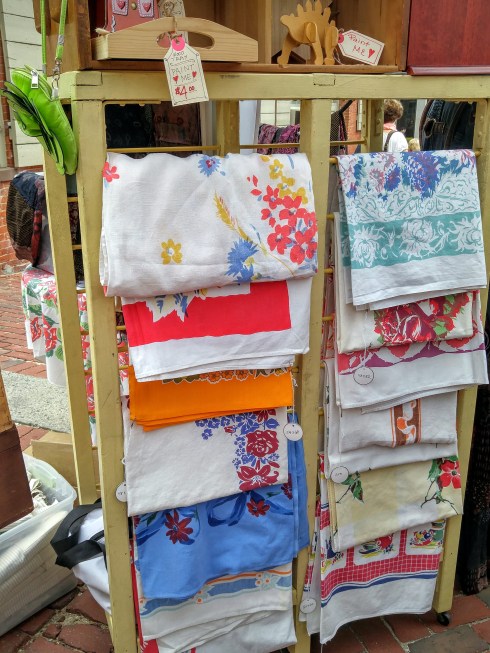
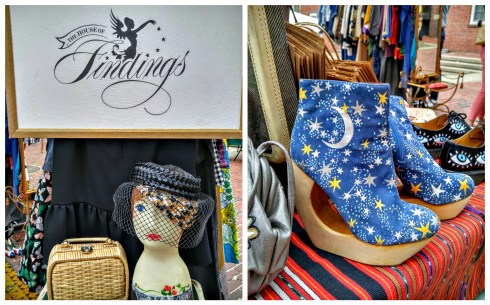
And on to the market…..which was obviously a huge success. Great vendors–lots of vintage collectibles and clothing, art, and up-cycled creations. It seemed to me that there was a lot of quality vintage hardware and textiles–the latter cleaned and pressed to perfection. I was a bit bleary from the morning’s festivities so was not really the purposeful picker that I generally am at these venues, but I did buy a very nice painting and marshaled all of my remaining strength to take some pictures. I’m sure that I will be back to form for the next market: on June 18.

Commencement 5

Commencement Collage

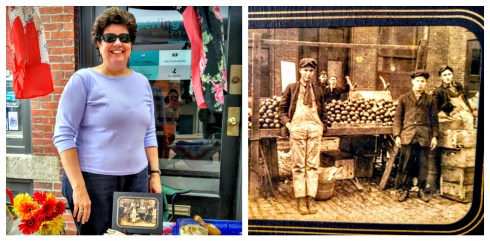
Here we have a proud vendor standing in the very same spot that her grandfather (on the right) had his stall when Derby Square was a food market!

Commencement 6

Commencement 17

Commencement 8

Commencement 10

Commencement 9

Commencement Collage 2

Very eclectic offerings.

Commencement 14

Commencement 18

The cars were not for sale but the books were–WHEN KNIGHTHOOD WAS IN FLOWER! The pioneering tale of romantic Tudorism: I would have picked this up, but I already have four or five copies, I think.


To Market, to Market

This coming weekend several friends of mine, three ladies who are clever and creative and fierce hunter-gatherers all, are launching a new endeavor, the Derby Square FLEA Salvage ART Market, a monthly pop-up venue featuring equally creative vendors of art, vintage and salvaged goods in both original and up-cycled form. The Market will be held every third Saturday from May through September in Salem’s venerable marketplace, Derby Square. For this first Market, there will be 23 vendors, all displaying their wares under perfect white tents, along with music and classic cars, befitting May’s launching theme of rev your engines. If you visit their wonderful website, you will see that each monthly market has its own theme, including July’s bicentennial in recognition of the anniversary of the Derby family’s donation to Salem of the land previously occupied by their majestic Bulfinch mansion (with the proviso that it remain commercial space). So this Market, like the weekly Farmer’s Market and all the enterprises along the adjacent Salem Marketplace across Front Street, honors the city’s past and present.

Derby Square Market Poster

Derby Square Poster

Derby Square Banner Sepia

Derby Square FSA is an invitation-only venture: these ladies have been “shopping” for their vendors for a year! There will be no witch kitsch in Derby Square on these summer Saturdays: think Brimfield rather than Haunted Happenings. Their vendors are listed on the website and the Market’s Facebook page, and I picked out a few representative items for a preview. I was happy to hear that my friend and neighbor Racket Shreve, a noted marine artist, will be selling cards and prints on Saturday, from the back of his 1962 Willys Jeep (most appropriately).Derby Square Market Collage

Derby Square Ashley Procopio Jewelry Packaging

Shreve Studio wall

Vintage handkerchiefs from Verve Design, Globe light from House of Champigny, Chair by 8 by Design (before it got a great seat), Soap from My Sweet Soap, Jewelry maker Ashley Procopio’s perfect packaging, Racket Shreve’s studio.

Like so many events and organizations in Salem (excluding all the witchcraft profiteers, of course), Derby Square FSA is a labor of love for the city and all it has to offer. Of course its organizers (who are again, full disclosure, my friends) are operating an enterprise, but they are also offering a service and a resource. Again, let me direct you to the amazing website which offers up a wealth of information not only about the Market but also about Salem: it should be bookmarked by visitors and residents alike. I’ll let them speak for themselves as they explain their vision for the transformation of Derby Square, the “heart of the city”, into a: a vital marketplace which showcases and connects what Salem is known for around the world–art and beautiful old things in a vintage American city.

Derby Square 1855 Harpers

Derby Square Market PC 1910

Derby Square Salem

Derby Square: 1855 (from Harper’s New Monthly Magazine), circa 1910, and this past weekend.

Derby Square FLEA salvage ART, a monthly pop-up market. Third Saturdays 10-5, May-September, Derby Square, Salem, Massachusetts, commencing MAY21!

http://www.derbysquarefleasalvageart.com/


What to do with my Stereoviews?

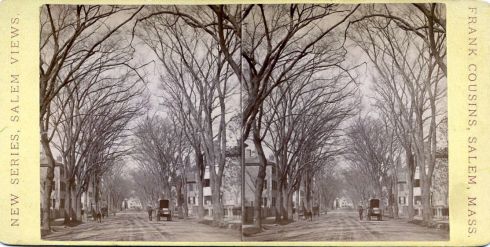
I’ve been a collector of sorts for much of my life but I never collected historic photographic images until I started this blog: I quickly realized their power to tell stories and provide context in this, our digital age. So I started buying some Salem images, mostly stereoviews, which were produced in vast quantities in the later nineteenth century. There were about six or seven major publishers of stereoviews here in Salem at that time, but I’ve focused almost all my collecting efforts on images associated with Frank Cousins, as either photographer or publisher. I just completed my collection of his sentimental “Salem in 1876” views, encompassing nearly every corner of central Salem. Now I’ve got a (shoe) box of stereoviews and I’m not quite sure what to do with them.

Stereoviews

Stereoviews 2

Steroview Chestnut Street Cousins

Frank Cousins published views taken both up and down Chestnut Street and all over the city, documenting “Salem in 1876”.

Stereoviews are relatively easy to acquire, especially of a city like Salem which has been selling its image, in one way or another, for quite some time. They turn up online very frequently and I always find them at the larger flea markets and paper shows. My collection is pretty focused on Cousins, but it also has a few views that I have never seen anywhere else, including a great (though completely unattributed and undated) view of Front Street from Washington Street and a rather unusual (forested!) view of the South Church that stood across Chestnut Street from my house for nearly a century. This McIntire masterpiece burned down in 1803: I’m trying to gather as many images of it so I can glean its impact from every possible perspective. My verdant view is contrasted with a more typical image of the church, from the best source for digitized stereoviews: the Robert N. Dennis Collection of Stereoscopic Views at the New York Public Library (where you can make “stereogranimators”).

Stereoview Front Street Salem

Stereoview Second Church Tilton

Stereo South Church Salem NYPL

(Stereo)view of Front Street, ?date, ?photographer); the South Church on Chestnut by Peabody & Tilton, c. 1875 and Guy & Brothers, c. 1884, Dennis Collection, New York Public Library.

Obviously I have a predilection for streetscapes but I like some (not all; some are creepy) of the more intimate, “up close and personal” stereoviews too. I’ve seen quite a few of people just standing outside their houses, being captured for posterity. A double dose of daily life. I love this image of a Salem Willows summer cottage with its residents, all ready for summer. This is not mine, unfortunately, but from another great source of stereoviews: the Center for Lowell History at the University of Massachusetts at Lowell Libraries.

Stereoview Juniper Point UMASS Lowell SP

“View at Juniper Point, Salem Neck, Mass.”, n.d., Center for Lowell History at the University of Massachusetts Lowell Libraries (the original Willows cottages were built for Lowell residents who wanted to summer on the coast).

So again, what to do with those stereoviews that I do possess? Ultimately I will leave them all to the Salem State University Library’s Archives and Special Collections, because what Salem needs is a Center for Salem History there, as the Peabody Essex Museum ceased its historical-society function long ago. But in the meantime, I’d like to find a more clever and creative way to preserve and display them. I’d like to get them out of the box! I guess I could frame them in some interesting combinations and create a gallery wall, but that’s about the extent of my creativity. Brass floating frames? Display them with a special “twinscope” at hand like this cool exhibit from just last year, Syracuse in 3-D (1860-1910)? I’m open to suggestions, because I do think there is something very engaging–both aesthetically and historically– about images in multiples. As evidence, I give you this beautiful invitation to the Pickering House’s annual garden party by Salem artist Racket Shreve, paired with Cousins’ stereoview, of course.

OLYMPUS DIGITAL CAMERA

Stereo Pickering

Stereoview Pickering House Cousins 1876

Scene from the interactive “Syracuse in 3-D” exhibit by Colleen Woolpert (+ more here); Racket Shreve’s quatre-Pickering House invitation; Frank Cousins’ “Salem in 1876” stereoview of the Pickering House.


Considering Caroline

The House of the Seven Gables is featuring a new exhibit on its founder, Caroline O. Emmerton (1866-1942) in commemoration of the sesquicentennial of her birth and as the rather mysterious Caroline has long intrigued me I took advantage of a preview invitation to check it out even before the official opening. Despite her fortunate birth into one of Salem’s wealthiest and most philanthropic families, her connections, and her achievements, Caroline is a bit enigmatic, and I was hoping that Caroline Emmerton. An Unbounded Vision would shed new light on her for me. It did, but my suspicion that Caroline can only really be known in context rather than strictly on her own was confirmed. The exhibit actually presents Caroline in several contexts and it is through these perspectives that we come to know her: the wealth, privileges, and sense of civic duty that came to her through her family, her interest in the emerging Settlement Movement, with its aims of aiding and assimilating (or “Americanizing”) the country’s expanding immigrant communities, and the corresponding Preservation Movement, which aimed to preserve the pre-industrial past in an era of dynamic change. You can definitely perceive how Salem shaped her. The exhibit appropriately emphasizes Caroline’s settlement activities over her preservation goals but you certainly get the sense that they are going to merge with the formation of the House of the Seven Gables Settlement Association in 1910.

Gables Exhibition

Gables 2

Gables 4.jpg

Gables Panels 2

Gables Panels

Gables 10

Caroline Emmerton: an Unbounded Vision, at the House of the Seven Gables through August 31: A young Caroline and a very famous photograph of her with children at the Settlement House c. 1920; Exhibition panels, which were also produced in Spanish (a 21st-century update on Caroline’s settlement goals).

Gables 13

Gables 3Gables Scrap Collage

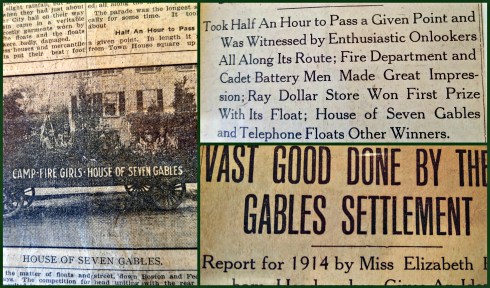
Context, context: the Gables in the Community. Great photograph of a Derby Street factory and worker, instructing neighborhood girls in the Settlement House kitchen; newspaper clippings from a Gables scrapbook.

So the context was definitely there but what about the personal Caroline? There was a sense of her in the exhibit, actually: a photograph of her home on Essex Street (with a wallpaper sample and a few household possessions), a range of photographs of her at different stages in her life, an original notepaper version of her (very ye Olde) tour for the Gables, and my favorite, the hand-written manuscript of her book Chronicle of Three Old Houses, which she published in 1935 for the 25th anniversary of the Gables. It was lovely to see these things, and also to talk with Irene Axelrod, the former Research Librarian of the Phillips Library of the Peabody Essex Museum, who knows more about Caroline than anyone else. I asked Irene where Caroline went to school, because in my experience institutions often offer up lots of evidence, and she said that Caroline was tutored at home and then probably went on the Grand Tour. So there goes that source. Irene told me that her research forayed into oral history, and she was able to interview some (quite old) people that actually knew Caroline. So that’s about as close as I’m going to get, I think: four degrees of separation?

Gables 12

Gables Emmerton Handwriting

LOVE this handwritten manuscript of Caroline’s Chronicles of Three Old Houses complete with little intextual illustrations! The companion book to the exhibition by David Moffat features a full-page view, along with lots of other illustrations from the Gables archives, sources, and more context.


Salem on Screen: East meets West

There is quite a long list of films set in Salem, but the list of films that were actually filmed here is impressive as well–and much more impactful. David O. Russell apparently loves Salem, as he filmed scenes from two movies here (American Hustle, Joy) even though their plots did not necessitate this location, tours of Hocus Pocus locations remain ridiculously popular, and though not a film, we’ve decided to dedicate a very prominent city square to Samantha from Bewitched (and TV Land), just because a few episodes were filmed here. The very first production filmed in Salem, however, traded on its commercial reputation rather than its connection to witchcraft: this was the 1923 silent film Java Head, which shot scenes on Derby Wharf, Salem Common, and Chestnut Street.

Filmed in Salem Java Head Lobby Poster

Java Head was based on the novel of the same name by Joseph Hergesheimer, about the scion of an old Salem family who meets a “Manchu princess” in China, marries her to prevent her imminent death, and brings her home to his Yankee family and the girl he left behind. Apparently this love triangle drives the movie, along with lots of cross-cultural conflicts, but I’m basing my plot summary on the novel (and the 1934 “talkie” remake, which replaced Salem with Bristol, England) as the film has not made it to You Tube (and may indeed be lost, along with 75% of all silent films that were produced–the Library of Congress has catalogued the film but there are “no holdings” in its archive). The interior and “Chinese” scenes of Java Head were filmed at a studio in New York, but Derby Wharf (or a nearby stand-in) and several Salem structures were used as locations. In his 1989 memoir Highlight and Shadows, cameraman Charles Galloway Clarke recalls that We loved the good people of Salem for they were friendly and helpful and did everything to make our stay there pleasurable. After finishing the scenes around the recreated dock, for this was a film about the China Trade during the sailing days of Salem, we returned to Astoria for the interior scenes. The title “character” of the film is actually a Federal mansion, exemplifying the fortunes to be made in the China trade. Contemporary sources hint that the Forrester-Peabody Mansion (later the Salem Club and later still the Bertram Home) “played” Java Head, but I think a far more likely suspect is the Devereux-Hoffman-Simpson House on Chestnut Street.There are a few more details and images here, but what I’d really like to see is the film!.

Filmed in Salem Java Head Poster

Filmed in Salem Java Head article

Filmed in Salem Leatrice Joy

Filmed in Salem Java Head 1923

Filmed in Salem Bertram Home

Filmed in Salem Devereux Hoffman Simpson House Chestnut Street

Lobby Card for Java Head (1923) and article from Picture Play from the same year, showing lead actress Leatrice Joy’s transition “from occidental to oriental”; after the transition-a Swedish poster for the film; a still from the film showing the Salem mansion “Java Head” which some sources identify as the Bertram House at 29 Washington Square (with flag, above), but I think it was definitely 26 Chestnut Street (just above).


Salem Film Fest 2016

CATS, architecture, the Renaissance (or pseudo-Renaissance)…all my favorite topics are featured in documentary films screening at this year’s Salem Film Fest, which opened last night with Curious Worlds: the Art & Imagination of [miniaturist] David Beck. The festival is now a Salem tradition, in its ninth year, and of course a welcome addition to the non-witchy/kitschy calendar. I usually go to one or two films, and regret not seeing more. Even though the slogan of the festival is Come to Salem, See the World, its organizers always include some local productions, so the entire experience has a “glocal” feel to it, which seems appropriate for our city, our time, and this particular medium. This evening we will see Concrete Love:  the Böhm Family, which purportedly “paints an intimate and pointed portrait of the complexity and inseparability of life, love, faith and architecture” through its examination of the life and work of German architect Gottfried Böhm, the patriarch of an architectural dynasty which includes his three sons. This weekend, I’ve got my eye on Projections of America, featuring 26 short propaganda films about America: the people produced for European audiences following the liberation of France in 1944, Kedi, all about the hundreds of thousands of cats that roam the streets of Istanbul, American Renaissance, a short on Renaissance-faire culture (I can’t miss this, as hopefully it will give me all sorts of insights into my students), and The Million Dollar Duck, (not to be confused with the 1971 Disney film of the same name) about the fierce competition among six artists to win the Federal Duck Stamp Contest, the only juried art competition sponsored by the U.S. government. I feel honor-bound to see this last movie, as one of Salem’s most illustrious artists, Frank Benson, was actually one of the competition’s first victors!

Salem Film Fest Concrete Love Poster

Salem Film Fest Poster_Projections_of_America

Salem Film Fest Kedi Still

Salem Film Fest Kedi Cat

Salem Film Fest AMERICANRENAISSANCE_web_1

Salem Film Fest Million Dollar Duck

Duck Stamp

German poster for Concrete Love: the Böhm Family; Projections of America poster;  character cats in Kedi; a “Renaissance” plague doctor in American Renaissance, poster for The Million Dollar Duck, and Frank Benson’s winning design from 1935.