Tag Archives: Literature

Hawthorne’s Salem Notebook

For a blog with Salem in its title, I have written relatively few posts about witches, or Hawthorne. Faithful followers will understand the former slight, but I haven’t really discussed my thoughts about Hawthorne here, I think. Essentially I am not a fan of the man or his works. He strikes me as very haughty and melancholy and over-dramatic and not subtle and there are particular aspects of his biography and character which I really don’t like, particularly his attitude towards race and any expression of social reform and his treatment of Salem sculptor Louise Lander in Rome. I don’t think his novels have aged well: just a brief comparison with a near-contemporary like Jane Austen will illustrate what I mean. Despite her smallish world, much smaller than that of Hawthorne, her works are classic and current because she understood people much better than he did. It’s no revelation that Hawthorne was a misanthrope, but it’s difficult to get past that, really, at least for me. In the last year or so, I have been trying to get closer to Hawthorne by reading his notebooks: they’re by my bedside in nice editions and I have been been dipping into them regularly. I started with the European notebooks (English, Italian) and then last month picked up the “lost” notebook, which he kept in Salem from 1835-1841. And now I find myself looking at him not altogether but a bit differently: he seems young, very impressionable, very curious, but still judgemental. True to form, young Nathaniel was not really social in any sense in the world—he even calls himself a recluse—but he is a good observer so he is a good source for Salem. This notebook was published by his widow Sophia in the 1860s in a highly-edited American version: most critics use the word bowdlerized. She took out all the interesting bits! More than a century later it was rediscovered, and published in a 1978 facsimile edition by the Pierpont Morgan Library, which has the original manuscript in its collection.

The entries in the notebooks are basically observations interspersed with story ideas. Hawthorne is always walking around Salem: in general (but not always) he prefers to walk away from the city center into nature, to the Willows and Winter Island, to North Salem, along the coastline. Sometimes something he sees will prompt a story idea but usually the story ideas are coming out of his head rather then his environment. He seems to be practicing describing settings, rather than people’s characters. Sophia took out his descriptions of a well-dressed drunken couple observed on a trip to Boston, and young ladies bathing at the Salem shore, but they are restored in the 1978 publication, and another (really great, but again somewhat detached) discourse on society is a great description of the celebration of July 4 (his birthday!) on Salem Common. I made a list of highlights, but you will surely have your own: the lost notebook, which is also Hawthorne’s Salem notebook, is a quick, engaging read.

On Nature: Hawthorne loves the shoreline and describes its features in great detail. He seems to relish “marine vegetables” in general of an olive color, with round, slender, snake-like stalks, four or five feet long, and a great leaf, twice as long, and nearly two feet broad; these are the herbage of the deep-sea. I had never heard of samphire, or mutton sauce, growing somewhat like asparagus; it is an excellent salad at this season, salt yet with an herb-like vivacity, and eating tender. A succession of cookbook authors agree: where have I been? It’s all over Juniper Point, along with jellyfish. Hawthorne also liked to observe farmland and farm animals, especially pigs, which surely are types of unmitigated sensuality; — some standing /^in/ the trough, in the midst of their own and others victuals; — some thrusting their noses deep into the filth; — some rubbing their hinder-ends against a post; — some huddled together, between sleeping and waking, breathing hard; — all wallowing in each other’s defilement; — a great boar -going /swaggering/ about, with lewd actions; — a big-bellied sow, waddling along, with her swag-paunch. He’s judgemental even of PIGS.

Samphire illustration by Mrs. Henry Perrin from British Flowering Plants (1914).

I would have like to have seen this, but the Bulfinch Almshouse/Hospital was demolished in 1954: The grass about the hospital is rank, being trodden, probably, by nobody but me. The representation of a vessel under sail, cut with a pen knife, on the corner of the house. I would have liked to have seen both the building and the vessel carving.

The Salem Almshouse and Hospital of Contagious Diseases built 1816, Frank Cousins glass lantern slide, Phillips Library, Peabody Essex Museum via Digital Commonwealth.

Looking glasses: Young Hawthorne clearly loved nature, but he was a materialist too, interested in and inspired by structures and objects. I found multiple reference to mirrors: To make one’s own reflection in a mirror the subject of a story. An old looking-glass—somebody finds out the secret of making all the images that have been reflected in it pass back again across its surface.

Wondrous Forces: Many of the story ideas which pop up in the notebook involve plots in which some sort of wondrous force drives the action. I like this one: a person to be writing a tale, and to find that it shapes itself against his intentions; that the characters act otherwise than he thought; that unforeseen events occur; and a catastrophe which he strives in vain to avert. It might shadow forth his own fate — he having made himself one of the personages. Hawthorne seems very interested in all forms of magic, particularly of the kind that alters forms, like alchemy. What I think was the Deliverance Parkman House (demolished just before Hawthorne began his notebook entries; he must have seen it) draws forth several alchemical connections: the house on the eastern corner of North & Essex streets (supposed to have been built about 1640) had, say sixty years later, a brick turret erected, wherein one of the ancestors of the present occupants used to practice alchemy. He was the operative; a scientific person in Boston the director. There have been other Alchemysts of old in this town — one who kept his fire burning seven weeks, and then lost the elixir by letting it go out.

Stereoview of a drawing of the Parkman House, New York Public Library Digital Gallery.

Macabre bits: Hawthorne’s interest in the dead and dying are pretty well-known and there are certainly lots of death references in the notebook: one story idea involves a young couple [who] take up their residence in a retired street of a large town. One day, she summons several of the neighbors in, and shows them the dead body of her husband. That’s it! I wonder where he was going with that? He is of course enchanted with and by the Old Burying Ground on Charter Street where he encounters the grave of his witch-trial judge ancestor and the famous epitaph of Nathaniel Mather, “an aged person that had seen but nineteen winters in the world.” Hawthorne admits that he is quite considerably affected by these words, which he himself revealed to the world when I had away the grass from the half buried stone, and read the name.

July 4: Probably my favorite entry is Hawthorne’s depiction of a very festive Fourth in Salem in 1838. It was a “very hot, bright sunny day,” and the town was “much thronged”. On the Common were booths selling gingerbread &c. sugar-plums and confectionery, spruce-beer, lemonade. Spirits forbidden, but probably sold stealthily. On the top of one of the booths a monkey, with a tail two or three feet long. He is fastened by a cord, which, getting tangled with the flag over the booth, he takes hold and tries to free it. The object of much attention from the crowd, and played with by the boys, who toss up ginger bread to him. He goes on to describe more of the festivity, but he can’t help himself from commenting on the “plebianism” of the crowd!

True Crime via Wax Figures: A very festive July 4th/birthday for Hawthorne as he also attended an exhibition of wax figures which made quite an impression on him. Wax-figure displays had been happening in Salem from at least the 1790s: they were often patriotic or religious in theme, but this particular “statuary” consisted  almost wholly of murderers and their victims; — Gibbs and Wansley the Pirates; and the Dutch girl whom Gibbs kept and finally murdered. Gibbs and Wansly were admirably done, as natural as life; and many people, who had known Gibbs, would not, according to the showman, be convinced that this wax figure was not his skin stuffed. The two pirates were represented with halters round their necks, just ready to be turned off; and the sheriff behind them with his watch, waiting for the moment. The clothes, halters, and Gibbs’ hair, were authentic. E K. Avery and Cornell, the former a figure in black, leaning on the back of a chair, in the attitude of a clergyman about to pray; — an ugly devil, said to be a good likeness. Ellen Jewett and R. P. Robinson; — she dressed richly in extreme fashion, and very pretty; he awkward and stiff, it being difficult to stuff a figure to look like a gendeman. The showman seemed very proud of Ellen Jewett, and spoke of her somewhat as if this was figure was a real creature. Strang and Mrs. Whipple, who together murdered the husband of the latter. Lastly the Siamese Twins. The showman is careful to call his exhibition the “Statuary”; he walks to and fro before the figures, talking of the history of the persons, the moral lessons to be drawn therefrom, and especially the excellence of the wax- work. Gibbs and Wansley were notorious pirates, Ellen (Helen) Jewett was a Maine girl who became a prostitute in New York City and her murder in the spring of 1836 triggered sensationalist headlines for the rest of the year as R.P. Robinson was tried and acquitted of the crime. E.K. Avery was Ephraim Kingsbury Avery, a Rhode Island Methodist minister accused of murdering a factory worker in his congregation named Sarah Cornell whom he had impregnated: he too was aquitted and this was another sensational murder case involving a (very) lasped clergymen which perhaps inspired The Scarlet Letter. In yet another notorious case, Jesse Strang and Elsie Whipple conspired to murder the latter’s husband outside Albany in 1827: she was acquitted and he was executed. I guess “Siamese twins” refers to the conjoined Bunker twins from Thailand who were thrown in here for good sensationalistic measure.

Cornell Digital Collections.

Social Commentary: Hawthorne does not seem to be interested in the contentious causes of his time and place. Salem was characterized by dynamic temperance and abolition movements in the 1830s, and he makes no mention of them in his notebook except for another story idea, a sketch to be given of a modern reformer — a type of the extreme doctrines on the subject of slaves, cold-water, and all that. He goes about the streets haranguing most eloquently, and is on the point of making many converts, when his labors are suddenly interrupted by the appearance of a keeper of a mad-house, whence he has escaped.

While I enjoyed reading Hawthorne’s Salem journal more than the European ones, especially in this unadulterated form, I can’t say I like him anymore than I did before I delved in. I do admire his curiosity, his descriptive abilities, as well as his tendency to engage—-and often wrestle with—the past, even in his odd anti-humanistic way. When I read his proposal of a history of modes of punishment, ancient and modern I finally understood the rationale behind the Salem Museum of Torture! (just kidding; I doubt a Hawthorne connection). And while a statue on Hawthorne Boulevard and the House of the Seven Gables stand testament to Hawthorne today in Salem, there is also a wax representation, which seems appropriate, given his fascination with that genre.

I pinched this photo of Hawthorne’s wax figure at the Salem Wax Museum of Witches & Seafarers from the author J.W. Ocker’s website, Odd Things I’ve Seen. In “Wax City,” Ocker observes that Salem tells its history through wax museums, and I agree, although I would put quotations around the word “museums.” Ocker wrote the great book The Season With the Witch about his residency in Salem during Haunted Happenings in 2015, and since Salem’s tourism has escalated so much over the past decade, I think he should return for a sequel.


The Best Historical Series, Period.

A newish friend of mine was going in for knee surgery a few weeks ago, to be followed by a period of still convalescence. She was preparing by assembling a stack of bedside books and a playlist of videos to stream, and so we were discussing her choices. They were all titles that I would have chosen for myself, but something was missing, so I piped up: what about North and South? I braced myself for the typical reaction whenever I mention this series, which is the 1980s miniseries about the Civil War with Patrick Swayze? YOU like that, Donna? But my friend smiled broadly and said she loved that series too and proceeded to talk about THE North and South, the 2004 BBC series based on Elizabeth Gaskill’s popular novel. And then we were off: she was pleased that she had someone to talk about this amazing four-part series, as was I. While North and South has an enthusiastic following in the the UK even 20 years after its broadcast, I rarely run into someone who has even seen it here in the US. We ran through our favorite scenes and our mutual admiration for leading actor Richard Armitrage joyfully. North and South is THE best period miniseries, even better than than that universal favorite, the 1995 BBC Pride and Prejudice (Colin Firth emerging from the lake!) in my humble opinion.

Actually, North and South is often compared to Pride and Prejudice in terms of their storylines and characters: both are romances between two people from different places and backgrounds who form first impressions which serve as an obstacle to their seemingly-inevitable union. But North and South is set decades later in Great Britain, in the midst of the Industrial Revolution and the early days of unionization, so its leading characters Margaret Hale (Daniela Denby-Ashe) and John Thornton (Armitrage) are much more engaged in the world around them than Elizabeth and Darcy. Margaret is a displaced young woman who is always reaching out: she has spent her entire life in the beautiful village of Helstone in the south of England, the only child of the local vicar and his more retiring wife. Her father loses his comfortable position because of his spiritual differences with the Church of England (he seems to have become a Unitarian) and so the entire family is forced to move north to the stark and colorless industrial city of Milton, a stand-in for Gaskill’s Manchester. They have the perfect Tudor vicarage in the South, and are reduced to a somewhat shabby townhouse in the North, with the Revolution right outside their door. There is no escape.

Everything in the South is filtered sunlight, golden green and fuzzy; everything in the North is gray yet still vivid. But, Margaret is not one to pout: she walks around her new city in her flat brown frisbee hat every day. That hat, it’s like the symbol of the series! (actually there are several–brown, black, and another of some indeterminate drab color)  She meets new people, and Milton seems to aquire more color the longer she is there (that’s another thing—the cinematography in North and South is amazing; it doesn’t look dated at all; whereas Pride and Prejudice definitely wears its age). Margaret’s mother (played by the great Lesley Manville) is “delicate” and miserable; her father (Tim Piggott-Smith) is quite naive, so their daughter has to step up and be practical in securing them a home and this is how she encounters both a cotton factory and its owner, John Thornton, at the same time. Her first view (and ours) of Thornton is not positive: he is beating one of his workers who is smoking amidst all that cotton, which is literally floating around in the air. I can’t imagine anything more dangerous than smoking in a Victorian cotton mill so I immediately excused him, but Margaret does not. There are other factors that keep them apart throughout the four episodes: her class and his awareness of it, her ignorance of “northern” manners, her increasing interest and intervention in the working conditions of the mill workers after she befriends the Higgins family (Brendan Coyle of Downton Abbey and Anna Maxwell-Martin of Death at Pemberley) and his role as the BOSS. But all will give way, eventually.

There are a lot of losses: Margaret loses both of her parents and her good friend Bessy Higgins; John loses the mill. In between all these setbacks, the plot becomes more focused on their relationship but we’re still very aware that they live in a world of dynamic change. A scene at the Great Exhibition of 1851 is a good reminder of this change, but I also took it as as a bit of foreshadowing for national, regional, and personal unity. It takes a while to gauge Margaret’s feelings because she’s not sure of her feelings, but increasingly, John wears his heart on his sleeve: he proposes, is rebuffed, is convinced that his lack of gentility is the reason, yet still pines for her. Armitrage is just a cauldron: you can feel his energy, agitation, desire and disappointment. Even his walk is magnetic. To my American ear, he’s got the perfect Northern British accent, and his fiercely-proud mother (played by Sinéad Cusack) an even better one. When Margaret returns to the South, he stares at her departing carriage and wills her to look back, and then goes South himself, to her former home in Helstone where he snips a flower and puts it in his pocket (Zuzu’s petals!) He is not looking for her, he believes it is over but wants to wallow in his feelings in a very forthright way for a bit longer. Eventually Margaret finds her way North again (after rebuffing yet another marriage proposal and inheriting a fortune from her father’s friend), while John is on his southern indulgence tour. Their trains meet at the same stop, and we are treated to a glorious, very romantic, ending in the perfect Victorian setting: a train platform. It’s so perfect.

Off with her hat and northward!

I envy all first-time watchers!


Secret Staircases

Every old house has secrets, but every old house does not have deliberately-constructed secretive places for hiding or hidden means of conveyence: such spaces are special. Novelists love secret staircases, and historians do too: they are evidence of intent. Well, I think everyone is fascinated by secret spaces in general: I have been since I was a child and my mother told me all about priest holes in England and that was that. When I was older and in England I was determined to find as many as I could, armed with the books below. When I was older still, and looking at the house I now live in, its owners (who were also realtors) showed me its two secret spaces: a door hidden in the master bedroom closet that opens up into the in-law apartment next door and a tunnel in the basement that opens up under the street. There’s a big door, with a big lock, leading to some underground space! I always call it a tunnel but I’m not sure how far it goes under Chestnut Street: as soon as the previous owners opened up the door and I saw black I ran upstairs! Twenty years later, I still haven’t been in that space: it’s too scary. I can assure you, however, that my husband and every single contractor who has worked in this house has been in there—they all seem to think it’s some sort of large coal bin but of course the previous owners told me it was a stop on the Underground Railroad. I have a theory that it might have been a space to store rum, as the man who built my house was Salem’s biggest distiller and he lived right across the street, but I’ve yet to find proof. So all of this is just an introduction to say: I’m interested in secret spaces! (And I was a Nancy Drew fan too and the Hidden Staircase is my favorite.)

I think that the American equivalent of priest holes are secret staircases and one of the most important secret staircases in America is right here in Salem, at the House of the Seven Gables. For generations of children in our region and beyond, myself included, the first impression or memory of the Gables is undoubtedly of the secret staircase: every child (and many adults) that I have taken to the Gables has been struck by both the idea and the experience of the secret staircase. Its aura is very interesting because it is a twentieth-century installation rather than an original feature of this seventeenth-century house. The House of Gables Settlement Association’s founder, Caroline Osgood Emmerton, and her architect James Everett Chandler, were “inspired” by Nathaniel Hawthorne’s novel in their restoration of the house: and so it acquired four more gables, a rebuilt central chimney, a second-story overhang, and a cent shop as well as additional room for the companion settlement mission. I love the headline for this Boston Sunday Globe article from January 1910:  all is revealed!

The house also acquired a secret staircase, right alongside the new chimney, even though there is no secret staircase in The House of the Seven Gables. So why? There are several reasons. The house’s previous owner, Henry Upton, maintained that there had been a secret staircase and so Emmerton believed that she was putting something back that had been there before. She also believed, apparently, that the novel needed a secret staircase and so she was giving the house one: “For it seems to be that we feel the absence of the secret staircase in the story just as we feel the absence of a bit of a picture-puzzle that has been lost and has left an unfiled place in the picture.” [The Chronicles of Three Old Houses,1935]. This seems like a bit of a rationalization to me, so I’m wondering if she merely wanted a secret staircase in the house to increase its allure: such discoveries made headlines in those days and they still do.

Boston Evening Transcript 8.5.1911 (not the word “museumized”!); the era of secret staircases: that found in Governor Tilden’s Gramercy Park mansion made national headlines in 1905.

And once the secret staircase was there, it took on a life of its own. I’m working on an article on the Colonial Revival in Salem, and just read a wonderful study on interpretation at the House of the Seven Gables over the last century, based on a succession of scripts [Tami Christopher, “The House of the Seven Gables. A House Museum’s Adaptation to Changing Societal Expectations since 1910,” in Amy K. Levin, ed., Defining Memory: Local Museums and the Construction of History in America’s Changing Communities (2007); the chapter on the Gables in Colin Dickey’s Ghostland is great too.]. In the beginning, the staircase was explained in terms of smuggling/tax evasion or “a means of escape in witchcraft times.” Then there was a shift to the Underground Railroad, and finally an admission of its 20th century origins. The staircase has reflected historical interests, and historical inquiry over time, but it has also been a means to express simple (childhood) curiosity, and there’s nothing wrong with that.

Early twentieth-century postcard and the secret staircase in 1950 (National Geographic) and today (or recently).


A Salem Ghost Story

Even though I recognize no connection between Halloween in general and the Salem Witch Trials (because #theywerenotwitches) and for that reason don’t particularly care for Salem Halloweens, I do like the holiday itself, especially its All Hallows Eve foundations. I like ghosts too, and ghost stories, especially if they are crafted elegantly and not just made up by Salem tour guides. For these reasons, I am always looking for a good Salem ghost story and last week I found one! It’s a humorous ghost story rather than a scary tale, written by Brander Matthews (1859-1929), the very prolific and pioneering professor of dramatic literature at Columbia University. “The Rival Ghosts” was first published in Harper’s Magazine in 1884 and then in Matthews’ Tales of Fantasy and Fact in 1896. Its plot features a Salem house haunted by two ghosts who duke it out before they enter into a spectral marriage, bringing peace to both the house and its owner, a Mr. Eliphalet Duncan, on the eve of his own marriage. Eliphalet Duncan is a young New York lawyer, of Scotch and Yankee stock, as his father had come over from Scotland and married a girl from an old Salem family, dating back to the days of the Witch Trials of course. Both his parents died when Eliphalet was quite young, leaving him two legacies: a haunted Salem house and (eventually) a Scottish title. The Salem house is described as “little” and dates back to the seventeenth century, so I’m picturing it as either the Narbonne House or the John Ward House, both of which I gothicized a bit. The Crowninshield-Bentley House might be a bit late but I’ll throw it in there too: “The Rival Ghosts” is not illustrated in either of its editions, but it seems to be calling out for some imagery!

The Narbonne House of the Salem Maritime National Historic Site; John Ward and Crowninshield-Bently Houses, Peabody Essex Museum.
The Salem ghost never appears to the master of the house, but visitors would see and hear its presence on the second day of their stay, when it became determined to drive them away. So Eliphalet was a bit isolated in his little old Salem house, which became even more unwelcoming after he received word that his Scottish cousin had died, leaving him with the family title. Apparently the title came with a ghost, who was to attend his lord at all times and places, and so the Scottish Ghost was suddenly in Salem. Neither ghost was threatening to the new Lord Duncan, but they clearly hated each other, and caused quite a ruckus in his little house: wailing, rapping, throwing things, and playing a variety of musical instruments. He was determined to find out more about them in order to get rid of them, so that he might have peace and visitors in Salem. Towards that aim he invited an old friend to the house, a very brave friend with whom he had fought in the Civil War: his comrade left on day three of what was supposed to be a week’s stay, driven away by the the cacaphony of the rival ghosts. A very frustrated Eliphalet fled as well, to the White Mountains, accompanied by the personal Scottish Ghost and leaving the House Ghost in Salem: “spooks can’t quarrel when they are a hundred miles apart any more than men can,” our narrator observes.

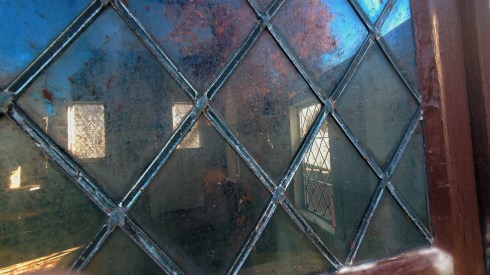
Window of Quaker Meeting House, Salem, Peabody Essex Museum.

On the top of Mount Washington (I guess the cog railway had been built), Eliphalet met the love of his life, the sister of a former classmate who was he immediately determined to marry: Miss Kitty Sutton. A long courtship and engagement ensued, during which he told her about the ghosts. She expressed great interest in his family house, but wanted it cleared of spectres, so Eliphalet returned to Salem on a mission. He pleaded with the ghosts to vacate and managed to enter into a dialogue with them, during which it was revealed that the House Ghost was a woman! She had been murdered by her husband back in seventeenth-century Salem and had lingered ever since. Eliphalet suggested a spectral marriage to give them all some domestic peace, but the ghosts protested that there was too much of an age difference (the House Ghost was about 200 years old, while the Scottish Ghost claimed to be 450 years old) before finally consenting. There followed a double wedding, of ghosts and humans, and off the former went, leaving the little old Salem house to the new Mr. and Mrs. (Lord and Lady) Duncan. While it’s not entirely clear how their marriage led the ghosts to vacate, it’s a nice ending to a charming tale, full of spirited negotiations! Another discovery this past week: the old house interiors paintings of the Russian-American artist Morris Kantor (1896-1974), painted in 1930-31 after a summer tour of visiting historic houses. Maybe it was just the timing of these twin discoveries, but they seem like perfect atmostpheric illustrations for “The Rival Ghosts,” particularly this first one: The Haunted House. 

Morris Kantor, The Haunted House (1930), Art Institute of Chicago; Still Life (1931), Artemis Gallery; Interior (1931), Smithsonian American Art Museum.


Dickinson Domicile

I drove “out west” to the recently-reopened Emily Dickinson Museum last week thinking it would just be a pleasant last road trip of the summer during which I would learn a bit more about the poet, take some photographs of her house and the surrounding Pioneer Valley, and then return home to dash off a quick post and then turn to my syllabus prep as the new semester starts TOMORROW. But that’s not how it worked out: I couldn’t dismiss Emily or the rest of the Dickinsons that quickly or easily. The “Homestead” was striking and the tour substantive, but I left with fewer pictures and more questions than I intended to have. Emily remains enigmatic, but I found myself more interested in her living conditions than her work: the physical space of the house and its surrounding land, which was much larger and more pastoral in her time, her dashing brother Austin and very close sister-in-law Susan next door, the constant companionship of her younger sister Lavinia, and what can only be called the LOOMING presence of her brother’s pushy mistress and the first editor of her work, Mabel Loomis Todd. Emily managed never to meet Mabel (which I find particularly impressive) but nevertheless she was there. It was just all too much for me, so I wondered how Emily persevered/flourished in such a space! So when I got home, I couldn’t possibly post before I read three books about Emily and her family, all when I should have been working on my syllabi! This beast was the best: I could not put it down for two days, an amazing work of scholarship.

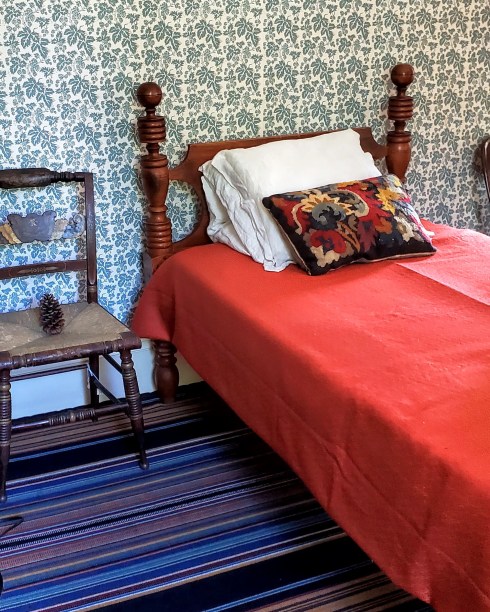
The Dickinson “Homestead,” members of the family, the library and conservatory. The Museum places pinecones on period seating which it does not want you to sit on, but also provides period seating in green!

So much LOVE and DEATH! Emily’s parents die–her mother after a long incapacitation in the bedroom next to Emily’s, and then her beloved young nephew. His father, her brother Austin, begins his passionate and long affair with Mabel, wife of a young Amherst College astronomer, and Emily has to pussyfoot around her own house, the Homestead, to get to her conservatory off the library while they are having liasons! Next door at the Evergreens, the social center of Amherst it seems, her very best friend and “sister over the hedge,” Sue Dickinson, is in distress over her husband’s open adultery. Emily herself commences a passionate-yet-platonic (I think?) relationship with an old friend of her father’s, Judge Otis Phillips Lord from SALEM. She refers to him as “My Lovely Salem” in her letters and he visited her often before his death in 1884. Emily died two years later and then Mabel the Mistress takes over, with the approval, at first, of Lavinia. The Poet is established, but conflict between all of the surviving insiders ensues, resulting in many Dickinson possessions and Emily’s papers going to Harvard. The recently-restored Homestead contains period copies of everything and so you really feel the Dickinson presence (or at least I did) but Harvard’s Houghton Library is the major Dickinson repository.

The amazingly colorful double parlor: somewhat subdued walls and brightly-patterned floors seems to be the theme. The lovely runner and second-floor landing floorcover by Thistle Hill Weavers; Emily’s bedroom and stand-in “desk”—a Federal work table. The real desk in the Dickinson Room at the Houghton Library.

But displaced possessions don’t matter, believe me, the house is THE HOUSE, and it is so colorful and full of texture, it feels alive! I loved it: the curation of the interiors seemed to echo the “meticulous care” Emily took with her own life. There are period pieces, both authentic and reproduction papers and textiles, and also some donations from the recently-concluded Dickinson series. The Homestead is a palimpest house: built in 1813 in a more austere Federal style, it was expanded and embellished by Emily’s father, and interpreted as her family house. I think I responded to it so much because it reminded me of my own house, built in 1827 and “italianaticized” in the 1850s, but my double parlor is nowhere near as colorful as Emily’s! You’ve got to go; you’ll have your own response, believe me.

A fragment of period wallpaper in Emily’s room, and an utilitarian white dress representative of what she preferred; her mother’s room next door, furnished with a bed from Dickinson the television series; the only surviving tree from the Dickinson era: an oak which survived the Hurricane of 1938. The Evergreens, Austin’s and Sue’s house, which is closed now but apparently still perfectly Italianate inside.


Decorating the “Little Room”

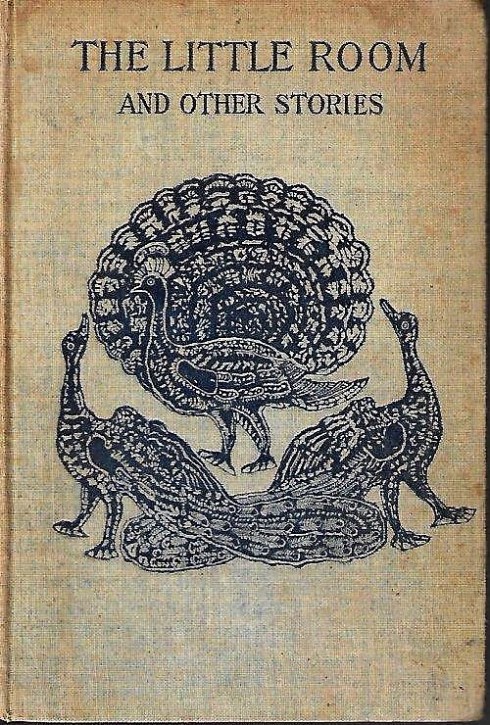
Happy June! I’m going to transition into a summer of lighter fare here: houses, gardens, non-academic books, events with people! In my contrary fashion, I’m going to start this transition with a spooky short story: one of the spookiest and shortest stories I’ve ever read. Madeline Yale Wynne’s “The Little Room” was first published in the August 1895 issue of Harper’s Magazine and then in The Little Room and Other Stories (1906). It’s a story about memories and perceptions, with a lot of ambiguity balanced by (in contrary fashion) very precise details, material details.

I’ll let you read it for yourself (it’s right here), but the basic problem is whether a certain space in an old Vermont farmhouse inhabited by two old maids was in fact a china cupboard or a “little room” complete with a green Dutch door exiting to the outside and a couch “covered with blue chintz—Indian chintz—some that had been brought over by an old Salem sea-captain as a ‘venture'” and given to one of the ladies when she was at school in Salem (yes, there is always a Salem connection). This chintz was described in more detail by those who saw the little room, and not the cupboard: it was “the regular blue stamped chintz, with the peacock figure on it. The head and body of the bird were in profile, while the tail was full front view behind it.” There were also hanging shelves with leather-bound books in the room, from which one bright red volume stood out, titled the Ladies’ Album, which “made a bright break between the other thicker books.” On the lowest shelf was a pink seashell, “lying on a mat of made of balls of red shaded worsted.” Not just a mat: a mat made of balls of red shaded worsted! Can we have any doubt that such a room, such a couch, such a shell, such a mat existed? Yes, we can. The room also contained several bright brass objects, a braided rag rug, and was wallpapered with “a beautiful flowered paper—roses and morning glories in a wreath on light blue ground.” How can this room not have existed? Wynne ensures that we will never know whether it did or not, but at least it can exist in some digital form with a bit of foraging and filtering.

The green Dutch door:

On the walls: I couldn’t find the wallpaper so precisely described by Wynne so I altered the color a bit from a 1960s floral paper on Etsy (which is the best place to find vintage wallpaper) and a watercolor possibly by John Hancock from the Carnegie Museum of Art (this is a lovely painting and I’ve really mucked it up with my filtering so make sure you see the original).

On the Settee: this first fabric looks very “stamped” but it’s really going to clash with my wallpaper, the second is softer but would still make for a very vibrant room!

On the Shelves: Wynne refers to hanging shelves very particularly, not a bookcase. I think of hanging shelves as more contemporary, but there are examples from the 18th and 19th century: the shelves below look appropriate to me, although with everything on them I think they would have to be bigger. These Waverly novels look weighty, but you can see how a slim red Ladies’ Album might pop out: perhaps it was Ladies Home Journal (which used red extravagantly) rather than Ladies Album? I’ve got lots of brass objects for this digital shelf/room (although maybe I should have polished them), and I stole the ultimate shell from my husband’s study. No mat though: I looked far and wide for a mat made of balls of shaded red worsted with no success, so the shell is sitting on a throw (but I used a “faded” filter). And finally, an amazing braided rag rug, which (hopefully) will pull this very interesting room together.

So that’s my “little room,” which was fun to put together. While this little story of a little room is an amusing diversion, it’s really not just about material stuff: it’s about the truth, and that awful scenario when two people, or three or four, or more, cannot decide or agree on what the truth is. This little story is a lot more timely now than when I first read it, maybe twenty years ago: then I think we all knew what the truth was.


Paper Houses

My manuscript is completed and has been dispatched to London, so last night I actually started reading a non-academic book, the first in a year or more. I didn’t last long, between the covers and between the sheets, because I’m tired, but it was novel. The book in question was almost-academic, so it was a good transition: Novel Houses by Christina Hardyment, featuring 20 “famous fictional dwellings,” including everything from Horace Walpole to Hogwarts. This morning I read it right through: a very pleasant read with great illustrations, so I thought I would showcase some of them here. Hardyment chose novels in which the plot is dominated by a structure, so much so that the latter is almost like a character: Walpole’s Castle of Otronto, Jane Austen’s Mansfield Park, Sir Walter Scott’s Waverly, Emily Bronte’s Wuthering Heights, Hawthorne’s House of the Seven Gables (of course, but is this a fictional house?), Charles Dickens’s Bleak House, Harriet Beecher Stowe’s Uncle Tom’s Cabin, Arthur Conan Doyle’s Sherlock Holmes, Henry James’s The Spoils of Poynton, John Galsworthy’s The Forsyte Saga, E.M. Forster’s Howards End, F. Scott Fitzgerald’s The Great Gatsby, Virginia Woolf’s Orlando & Vita Sackville West’s The Edwardians, Stella Gibbons’s Cold Comfort Farm, Daphne du Maurier’s Rebecca, Evelyn Waugh’s Brideshead Revisited, Dodie Smith’s I Capture the Castle, Mervyn Peake’s Gormenghast, J.R.R. Tolkien’s The Hobbit and Lord of the Rings, J.K. Rowling’s Harry Potter. 

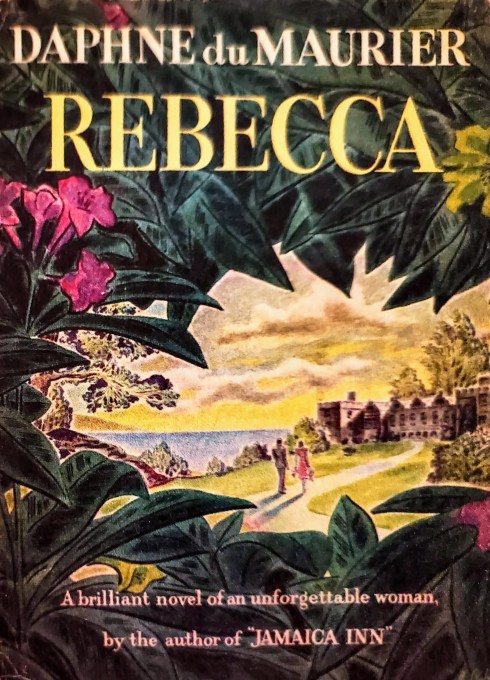
In no particular order: Walpole’s Strawberry Hill, Jane Austen’s ancestral home Chawton, inspiration for many of her novels, 1913 edition of The House of the Seven Gables, an advertisement for Uncle Tom’s Cabin, 1949 edition of I Capture the Castle, Knole, inspiration for Woolf’s Orlando, Galsworthy’s drawing of the fictional “Robin Hill” in The Forsyte Saga, the first edition of Rebecca, cool cover for Cold Comfort Farm, Hobbit houses, Beacon Towers on Long Island Sound, which might have inspired Gatsby’s mansion in West Egg.

Some chapters worked better than others for me in terms of inspirational houses: I haven’t read Peake or Conan Doyle, or The Spoils of Poynton. I think perhaps Manderley and Brideshead are the strongest house-characters. It’s difficult for me to think of the Gables as simply a fictional house, because it actually exists, but it bears remembering that it did not in Hawthorne’s time.

I would love to get some more suggestions for novels in which houses play a major role in the plot, not just the setting.


Lady Arbella

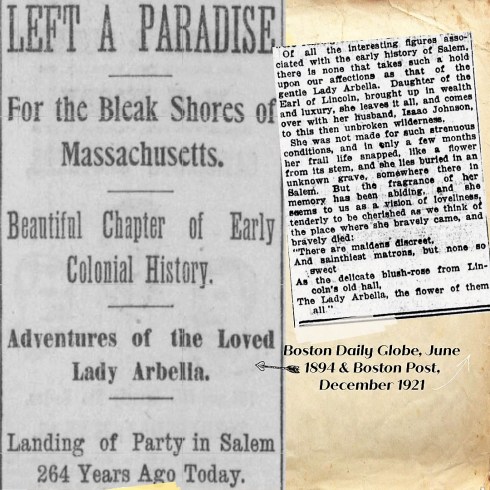
Certainly one of the most romanticized women in Salem’s history is Lady Arbella Johnson, who died here in the late summer of 1630, not long after she arrived on these shores in the flagstaff ship of the Winthrop fleet named after her, thus remaining ever young and beautiful. She was a Puritan martyr to Cotton Mather, “Coming from a paradise of plenty and pleasure in the family of a noble Earl into a wilderness of want, and unable to stem the tide of these many adversities of her outward condition, she died at Salem……and took New England on her way to heaven.” Her nobility is always noted: she was the daughter Thomas Fiennes-Clinton, the third Earl of Lincoln, and sister of Theophilus, the fourth earl. So there is a strong sense of sacrifice attached to her, as Mather’s assessment illustrates. Then there is her husband, Isaac Johnson, young, articulate, wealthy, committed to the cause, and apparently very much in love with the fair Arbella: he followed her to the grave a month later. They were both snuffed out before they could make their mark, leaving the field to their shipmates and fellow Lincolnshire Puritans: John Winthrop, Samuel Skelton, Anne Bradstreet, Simon Bradstreet.

Two prints by Moseley Isaac Danforth based on a painting by Charles Robert Leslie, 1837, British Museum and Pennsylvania Academy of the Arts. 

After Mather, I don’t think anyone really cared about Lady Arbella, until she was resurrected in the nineteenth century: of course Hawthorne had to write about her, as he was always mining Salem’s colonial past and her story was right up his alley. She is the tragic first owner of Grandfather’s Chair, which bore the Lincoln arms and in which she sat in the summer of 1630, “fading away, like a pale English flower, in the shadow of the forest” which her husband away in Boston and her growing realization that “none should be here but those who can struggle with the wild beasts and wild men, and can toil in the heat or cold, and can keep their hearts firm against all difficulties and dangers.” This new world was not for her. The less-deft Romantic author Lydia Sigourney went even further in the tragic direction with Arbella, who is plucked right out of the Lincoln castle, Tattershall (where she never lived) and set upon a difficult voyage towards an inevitable death.

Nathaniel Hawthorne, Grandfather’s Chair. A History for Youth, first published in Boston in 1840; Lydia Huntley Sigourney, Myrtis: With other etchings and sketchings. New York, 1846.

Lady Arbella remained a subject of interest after the Centennial: the Johnson’s short landing in Salem provided a tragic counterpart to the happier story of John and Priscilla Alden’s foothold on the South Shore. There is a particular emphasis in the later nineteenth-century stories on the graveless Arbella, a wandering ghost as she was buried in some unmarked “Potter’s Field” off present-day Bridge Street (near the present-day Arbella Street) in Salem: this angle makes her even more tragic, of course, and even more interesting. With the “recreation” of Pioneer Village and the Arbella for the Massachusetts Tercentenary of 1930, Lady Arbella gained a twentieth-century notoriety which is still (somewhat) alive today: the ship is no longer with us, but the Village is, though there are plans to move it to Salem Willows, perhaps in time for Salem’s 400th anniversary.

Postcards from the 1930s-1950s of the Arbella and what was originally called The Pioneer’s Village at the time, including a very healthy-looking Lady Arbella in front of “her” house.

Appendix:

Lady Arbella was one of eighteen children, and consequently her mother was considered an expert on childbirth: she was actually the first English woman author of an instructive book for women, The Countess of Lincoln’s Nursery, published in 1622. (I was just writing about this book for my book when I began this post!) A brother and two sisters also made it to the New World, and former Lincoln steward (and father of Anne Bradstreet) Thomas Dudley’s letter to Bridget, the Fourth Countess of Lincoln, remains an absolutely essential source for the early settlement of Massachusetts. The Sempringham-Salem connection consisted of multiple strands, and is best viewed in an Atlantic perspective, as this was the lived experience of both those who made the crossing, and those who stayed behind.

Appendix #2: I’m giving a lecture on ALL (or most) of my #SalemSuffrageSaturday ladies for the Pickering House tomorrow (September 20) at 5pm on Zoom: more details here.


Summer 2020 Reading List: What I Would Have Read

I’m a bit late with this summer reading list: it’s August! And this list is more intentional than actual, so I’m not going to be able to give informed commentary on most of these books. I planned to read all of them, but as soon as the end-of-semester responsibilities were over, intensive gardening began. And as soon as intensive spring gardening ceased, family trips were taken. And then I returned home and BOOM: big book contract! So the last month has been all about writing rather than reading. Yet I have heard from many of you that you like my book lists, so I thought I would offer up one: I did choose these carefully, and many of them are sitting by my bedside, but I usually pass out before I can pick one up! I didn’t even have time to go back and look at my previous book lists but I bet there is a trend of increasing interest in historical fiction over the years: I used to be pretty snobby about that genre, but after reading several titles which were researched meticulously and crafted beautifully—enabling one to really plunge into the world in question—I have changed my tune. I think there are a few of these on this list: you’ll have to forward your assessments, and after my own book is finished I will either return to these books—or I won’t!

So let’s start with fiction. I am dying to read James Meek’s To Calais, in Ordinary Time, which is set in England and France during the Hundred Years’ War and Black Death, and the publication date of Emma Donoghue’s 1918 book was moved up to Corona time. Talk about plunging into the past: I read Andrew Miller’s previous historical novel, Pure, last year and was definitely plunged into the world of an eighteenth-century engineer in Paris; Free is set in Scotland during the Napoleonic Wars, and I really want to go there. I always want to go to sixteenth-century England, even into the somber Shakespeare household following the death of Hamnet, from the plague, of course. Big jump in terms of both chronology and topics: I’ve been reading my way through Evelyn Waugh and his era over the years, and I loved these new covers so purchased them for my bedside stack (I purchased Martin Green’s Children of the Sun a few years ago for some context and insights into this era, but have read it only in snippets so far). And another favorite era in fiction and fact: the Daphne Du Maurier’s novel is from the 1940s, Nadine Akkerman’s scholarly book on female spies in the seventeenth century is much more recent.

Reading Pandemics

Reading Miller

Reading Hamnet

Reading Waugh collage

REading Untitled - 2020-08-03T132118.632

For the first time every, I think I have more fiction books than nonfiction—-probably because I’m all nonfiction all the time for by work: both writing and teaching. I don’t really have time to indulge my curiosity this year, but if I did, I would move Ivory Vikings by Nancy Marie Brown, about the medieval Lewis Chessmen, up to the top of my bedside stack: I’ve been curious about these guys forever. The other books are somewhat related to my book so I supposed I can categorize them as research: I’m writing about gardening and cooking right now, in my Chapter Three, so Floud’s and Dawson’s books are right by my side, offering some great insights and context supplementary to my primary sources. Newton is a little late for me, but I’ve got to read all about alchemy for my book as it creeps into several topics (medicine, beauty, even agriculture), so William R. Newman’s Newton the Alchemist will be illuminating, I’m sure.

Reading Chess

Reading Gardens

Reading Food

Reading Newton Collage


Elizabethan Exemplar

It’s been a long time since I featured one of my Renaissance crushes, but today is Sir Philip Sidney’s birthday so time to indulge. Sidney of course was a wonderful poet, but for me he is much more than that: he is the perfect Elizabethan Renaissance Man, multi-faceted, adept at both words and action, on the spot in all the key settings. He is one of those people whose lives can represent an age, albeit a rarefied experience. And he died young, on the battlefield, so that just makes him more: more elusive, more martyr-like, more crush-worthy. His notable contemporaries who lived longer had more layered lives in which both their attributes and their flaws were manifested, but Sidney seems flawless. His biographers note his proficiency in all the subjects in the studia humanitatis, but he himself asserted that one should aim for “well-doing, and not of well-knowing only” in The Defence of Poesy (published posthumously in 1595).

Sidney 2012-03-09-images-sidney_ma409_4_engraving The Sensational Sidney brothers as boys: Sir Philip and Sir Robert, from a painting by Mark Garrard at the Sidney’s ancestral home Penshurst Palace, Kent.

Sir Philip Sidney (1554-1586) was always connected: He was the eldest son of Sir Henry Sidney, the Lord Deputy of Ireland, the nephew of Queen Elizabeth’s favorite, Robert Dudley, and the godson of King Philip of Spain. I’m not sure he would have been happy about this latter affiliation given that he became a relatively strident Protestant later on, which was perhaps a flaw in Queen Elizabeth’s estimation as she preferred a more moderate public religious stance and must have been very annoyed when Sidney opposed her marriage to Francis, the Duke of Alençon and Anjou, in 1579 on religious grounds. His principled Protestantism is not a problem for me, however: it makes him look like less of a dilettante courtier. Sidney was educated at Oxford but left for a “Grand Tour” on the Continent before taking his degree: clearly he was ahead of his time as this custom did not become popular among the English aristocracy until a century later. He returned to England to the life of a courtier (when he pleased Elizabeth), patron and poet, but clearly longed for some kind of serious placement, which he eventually received in the form of various official diplomatic missions on the Continent. In between, he commenced writing his corpus of poetry, invested in overseas expeditions, and spent time at the estate of his beloved sister, Mary, the Countess of Pembroke, to whom he dedicated his most ambitious work, The Arcadia, and who established a reputation as both a literary patron and poet(ess) herself.

Sidney 1577 (3)_edited

pixlr_20191130100316782-1 Sir Philip Sidney, 1577-78, courtesy the Marquess of Bath, Longleat House; A trio of Sidney copied portraits from the sixteenth, eighteenth, and twentieth centuries: National Portrait Gallery, London; an 18th century copy, NPG, London, and a 20th century version attributed to Frederick Hawkesworth Sinclair, Pembroke College, Oxford University.

All of the Sidneys are so interwoven with Elizabeth, most conspicuously Philip and Mary’s mother Mary Dudley Sidney (also a writer!) who served and nursed the Queen during her smallpox seclusion, contracting the disease herself and marring her beauty permanently. There is a theme of sacrifice that connects mother to son: Philip accompanied his uncle the Earl of Leicester’s expedition to the Netherlands in 1586 to fight England’s now arch-enemy Spain, and reportedly urged Leicester to push harder, eventually falling on the battlefield himself at the Battle of Zutphen. He was shot in the thigh, but took 21 days to die—likely of gangrene. He then becomes larger than life, memorialized by an ostentatious public funeral (paid for by his father-in-law Francis Walsingham), elegies, biographies and posthumous portraits. He is forever young and bold in imagery, and ever eloquent in text.

Sidney 17th Knole_edited

screenshot_20191130-080116_chrome

screenshot_20191130-075953_chrome

screenshot_20191130-080224_chrome Sir Philip Sidney, early 17th century, National Trust @Knole; by John de Critz the Elder, c. 1620; by John de Critz the Elder, 17th century; by George Knapton, 1739.