Monthly Archives: January 2026

Frosty Salem

So I was going to bring you some photographs of Salem during yesterday’s snowstorm today, but that would have necessitated actually going out and walking around, and just a few steps from my backyard out onto Chestnut Street at midday were enough to convince me that I didn’t want to do that. So I have images of snowstorms past, mostly new discoveries, and most from the Peabody Essex Museum’s Phillips Library, which possesses the largest collection of famed photographers Frank Cousins and Samuel Chamberlain, as well as images by amateur photographers in family papers. True to their promises of several years ago, the Phillips librarians have been steadily digitizing their local collections and everytime I go their digital collections page I see new-to-me things. If you’re new to Salem photo-sleuthing, you can just start with their very accessible “Salem Streets” collection, culled from a variety of sources. And of course all the glass plate negatives of Frank Cousins were digitized quite a while ago, and can also be found at Digital Commonwealth. My title is from Cousins, who assembled several of his favorite images for an 1891 collage, which I imagine was hung in the window of his Bee-Hive shop that very winter. Then I’m going to double back and proceed in chronological order.

So let’s go back a decade into the 1880s, when we really start to see a lot of photographs of Salem streets and buildings, both commercially published and popping up in family papers. I’ll never forget opening up the volumes of the Francis Lee papers a few summers ago at the Phillips Library in Rowley and seeing all of these gorgeous photographs from the mid-1880s. The photos below are from the same time period—1884-86—and this first amazing one is taken from the vantage point of Lee’s house, 14 Chestnut Street. No filter! Isn’t this a striking image? This photo and those that follow are attributed to John Robinson, a Salem author and horticulturalist and trustee of pretty much every single civic institution in the city at the time. I wasn’t aware that he was a photographer as well; I don’t know if had commissioned these images for some future publication? The last one of this group is from the vantage point of his house on Summer Street, and so we have two striking views of Samuel McIntire’s South Church, which burned to the ground in 1903.

Chestnut Street winters, Salem Streets collection, Phillips Library, Peabody Essex Museum.

The 1890s: was Frank Cousins’ most productive decade as a photographer. He loved to photograph Chestnut Street too, but he branched out, all over the city, as his “Frosty Salem” poster illustrates. I love his winter shots because many of them include people, while his more formal architectural photographs decidedly do not.

Essex Street, the Common, Dearborn and Lafayette Streets,1890s, Frank Cousins Glass Plate Negative Collection, Phillips Library via Digital Commonwealth.

Also from the 1890s are several photographs by amateur photographers of an uprooted (Elm?) tree on Chestnut Street, with every possible angle captured!  I have looked in vain for more views of dealing with the snow, but this is as close as I could get. Closing out this decade are several beautiful photographs of the Pickering and Bartlett houses on Broad Street which are somehow connected to (taken by?) a certain Katherine A. Pond. I need to know more about her.

Chestnut and Broad Streets, 1890s, Phillips Library Digital Collections.

The 1920s: when I was looking for photos of Salem’s 1926 Tercentenary in various family albums at the Phillips, I came across the photos of the winter of 1924-25 in Francis Tuckerman Parker’s album. Again, these are not professional, and they are not digitized—I just took photos of the snapshots myself—so they not that great quality, but they are so interesting for what they show. The first image shows the intersection of Chestnut, Summer, and Norman Streets and on the extreme right is what I think is the last photograph of Samuel McIntire’s house before its demolition. The second, looking up Chestunt in the other direction, shows the church that replaced McIntire’s South Church, which was later demolished. Then we have a snow trolley on Essex, and a very messy intersection at the Essex and Summer.

Salem in the winter of 1924-25, Parker Family Photograph Album, Phillips Library.

1930s: the Phillips Library also possesses the huge negative collection of Samuel Chamberlain, a very important mid-century photographer of New England architecture and scenery, which is accessible at Digital Commonwealth. Chamberlain published Historic Salem in Four Seasons in 1938, so I assume these photos are from that time, but the collection encompasses his entire career. Pioneer Village, Salem’s outdoor living-history museum, was in its first decade, and Chamberlain photographed its buildings and landscape lavishly.

Pioneer Village by Samuel Chamberlain, Digital Commonwealth.

And finally, a street view of Broad Street in 1956 and an aerial view of Chestnut in 1972, both after the storms. The latter is included in a feature in Life magazine in that year, prompted by President Nixon’s visit to China. Eastern-oriented Salem seemed like a good place to examine American perspectives on Asia at that time; I don’t think that would be the first Salem association now.

Salem in 1956 and 1972: William F. Abbott collection at the Phillips Library and Life magazine, 1972.


Salem Ladies 1876

I think I’ve previewed the “anniversary year” for quite a few years on this blog in Januarys past, but this particular year is going to be so dominated by the 250th anniversary of the American Revolution (nationally) and Salem’s 400th anniversary (locally) that I decided not to. However, I don’t want to lose sight of the trees through the forest! I’ve always thought that the 1870s was an interesting decade for Salem women, and in 1876 in particular there were two women’s organizations which emerged that I think really represent the collective impact of women both within and outside their community at this time, and after. One organization, the Ladies Centennial Committee of Salem, had a very specific focus and is no longer with us, while the other, the Woman’s Friend Society, most certainly is: it is celebrating its 150th anniversary this very year. I thought I’d shine a spotlight on both. I had an opportunity to research the Ladies Centennial Committee’s efforts for my chapter on Salem and the Colonial Revival in Salem’s Centuries, and my general awareness turned to appreciation for both its organization and creative curation: its December 1875 Salem exhibition of “relics” from the past was broadcast across the nation. These objects were sent to the Centennial Exposition in Philadelphia along with many other Salem exhibits from the present, and because so few other Massachusetts towns and cities followed suit Salem really dominated the entire effort from the Bay State. The Ladies of Salem followed up with a Centennial Ball at Mechanics Hall, which added to Salem’s Centennial Fund coffers and enhanced its reputation as as steward of the Colonial past.

Centennial Commemoration in Salem: Exhibition and Ball, Mechanic Hall on Essex Street Salem and the Massachusetts Building in Philadelphia. Salem is the “Old City of Peace” and not yet Witch City.

The exhibition of antique articles was quite diverse, encompassing furniture, clothing, silver, portraits and paper from the past, but I think these women were more than casual antiquarians relying on their family and social connections for “relics” of Salem’s and America’s past. Mrs. Hagar, the committee chair, wasn’t even old-money North Shore: she was Mary Bradford McKim Hagar from New York State, the wife of Daniel Hagar, the principal of Salem Normal School. They received so much publicity, and often their Centennial efforts were paired with other pieces of “news” related to Salem women (see the first image above) which I think is really interesting. The membership of the committee included women—most prominently educator Kate Tannant Woods—who were as much or more interested in social reform as cultural curation. While she was serving on the Centennial Committee, Woods was instrumental in establishing the Moral Education Society of Salem, which eventually changed its named to the Woman’s Friend Society, after similarly-named societies in the area.

Right from its foundation, the Salem Woman’s Friend Society developed a mission that expanded far beyond the first “Needle Woman’s Friend Society” founded in Boston in 1847 “for the purpose of giving employment in needlework to poor women.” The Salem mission included a girl’s reading room, an employment bureau, and housing, after Salem’s most generous philanthropist, Captain John Bertram, offered them half of a stately Federal house on Elm Street for shelter purposes. In 1884, his daughter Jennie Emmerton, always referred to as “Salem’s richest woman” and long Salem’s largest individual taxpayer, deeded the house to the Society, which acquired the other half of the Joseph Fenno house in 1887 through private donations. There was also a focus on vocational education, but I’ll let the Society explain its expanding mission in its own words, with this great fundraising brochure from its deposited records at the Salem State Archives and Special Collections. (*note: these records are amazing! I had one student write a great paper about the employment bureau several years ago, but more studies could be sourced)

So many initiatives! Including the District (later Visiting) Nurse program, which would later be adminstered out of the House of the Seven Gables, founded by Jennie Emmerton’s daughter, Caroline Emmerton. All of this outreach was extraordinarily important in the historical context, when Salem’s immigrant population was increasing steadily and social and medical services were not yet in place. And now, more than a century later, such systems are well-established but the Woman’s Friend Society continues its important work in the housing sphere, where insufficiency prevails. This is also a Salem organization that knows and shares its history, and will be commemorating its 150th anniversary with several special events in the coming months, so watch this space.

Emmerton House/ Women’s Friend Society, 12 Elm Street, Salem, Massachusetts.


Minority Report

Provocative title, yes? It’s not mine. A very different presentation for me today: a very short post, with no pictures and very little analysis on my part. Basically I just want to offer you a link, to the Minority Report of the two historians appointed to the City Seal Task Force, whose contributions to the Official Report were so butchered and detached from documentation that they felt compelled to compose their own report and submit it to the Salem City Council for its review and consideration of an alteration to Salem’s official city seal since 1839. I’m not sure what’s going to happen here, but we all (including myself—five posts here!) got very swept up in this process. In general, the City Council seems to have a preference for very bland history, which offends no one and affirms some contemporary value, or very commodified history (all witches all the time everywhere), which many people find offensive but is rationalized according to its perceived monetary value, and nothing in between. Very little nuance is permitted, and of course history is all nuance and the City Seal discussion really had a lot of nuance, all of which is presented so well in this Minority Report. And that’s one reason I want to amplify it.

Download Report

The other reason why I wanted to share this report is that it is excellent in general as well as in nuance! It’s a detailed summary of a major sector of Salem’s maritime history during its so-called “golden age,” drawn from both traditional and new studies, with some great insights into cultural history and public history. It features an array of perspectives, from both the past and the present. Even if you’re not into the seal debate (which is understandable–I don’t know how it creeped up on me either) it’s well worth your time.

Now usually I would analyze and annotate this myself, but I said to myself (for once): I have said (written) enough! I certainly would be interested in your comments here, however (particularly because I haven’t had anyone to discuss this with), and I’ll be back with something new next week. I’m not sure when the City Council is going to take this issue up, but I’ll report back when they do.


Salem’s Centuries

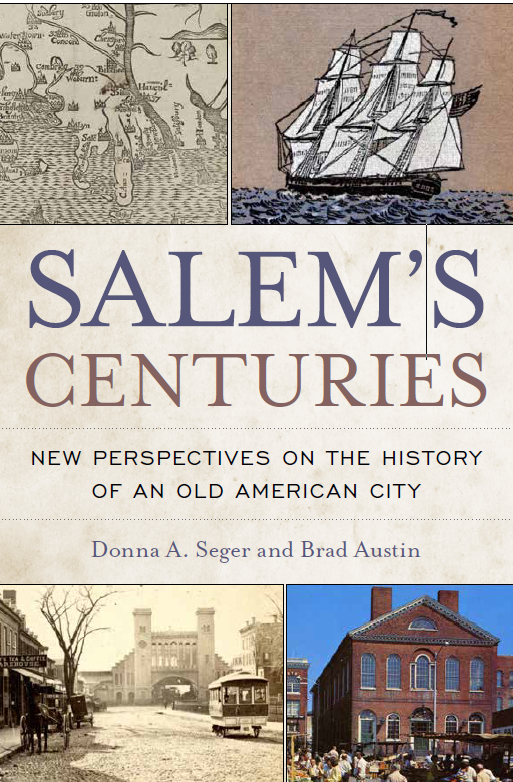
Yesterday I received three copies of Salem’s Centuries. New Perspectives on the History of an Old American City, and Tuesday is publication day, so I thought I’d provide an introductory post. The crucible of this book is definitely this blog, so I want to thank all of its followers, readers, and commenters: I truly am grateful for your support and inspiration! I can’t believe that I’ve been writing in this space for fifteen years: that’s a long time in internet years. It started out as just a vehicle to satisfy my own curiosity about Salem’s history and showcase Salem’s architecture, though I definitely thought I would move on to more worldly topics, despite its title. But the Salem posts were always the most popular, by far (except for anything to do with maps!) And so a more sustained focus on Salem led to the book, but a book is different than a blog. What I share here are mostly stories, but Salem’s Centuries is all about the history of this storied place.


I “posed” the books all over the house!

Salem is indeed a storied place. You (or I) can’t walk down the street without seeing a structure that conjures up some story or inspires the search for one. Stories are part of history, but history is more: layers, context, perspectives. After Covid and the publication of The Practical Renaissance I knew I wanted to write something about Salem for its 400th anniversary in 2026, but I wasn’t sure what—or howThe easiest thing to produce would be a compilation of the Salem stories I have posted here, but I wanted more and I thought Salem deserved more, and so the thought of a proper Salem history emerged. It was an intimidating thought for me, as Salem is an important American city and as I have asserted here time and time again, I am not an American historian. I think I’ve acquired some knowledge and expertise in Salem’s history over these fifteen years, but not enough to sustain a volume that attempts to cover 400 years. So I turned to my colleagues at Salem State, and the result is a collection of essays which explore Salem’s history from different scholarly perspectives across time but centered in place. The key moment in this turn was definitely that in which Brad Austin, our Department chair, 20th century American historian and experienced editor, agreed to be my co-editor. And the rest is history!

Here’s an overview of the book, which will be released everywhere on Tuesday and showcased in a series of events, beginning with a presentation (and hopefully discussion) at Hamilton Hall on January 25. Brad and I are incredibly grateful to the Peabody Essex Museum for centering its PEM Reads podcast on Salem’s Centuries throughout 2026. There’s a lot to discuss, but as both Brad and I realized as we finished this book, there’s also a lot more to learn about Salem’s vast history, so we hope that its reception encourages further research. And that’s exactly where you want to be at the end of a history project: stories end, history doesn’t.

The First Century (note: an innovative feature of our book is its division into full-length chapters and shorter, more focused “interludes” on people, places, and specific events. This was Brad’s idea.):

“Putting Salem on the Maps” is a grand display of historical and geographical context by Brad, and a perfect orientation for our place and book. My colleague Tad Baker has written the definititve history of the Salem Witch Trials, A Storm of Witchcraft, but he is also an archeaologist and historian of the indigenous peoples of New England, and his contributions to our book showcase both these fields of expertise. “The Dispossession of Wenepoykin” gives some much needed historical background of Salem’s “Indian Deed,” and “Gallows Hill’s Long Dark Shadow” is a first-hand account of the revelation of Proctor’s Ledge, a space below Gallows Hill, as the execution site of the victims of 1692, set in historiographical and contemporary contexts. My brief history of Hugh Peter, Salem’s fourth pastor and a regicide of King Charles I, enabled me to indulge in my own scholarly expertise for a bit, and Marilyn Howard’s depiction of John Higginson and his world is a rewrite of one of the best (no, the best) masters’ theses that I have read at Salem State. A magisterial chapter on “Salem and Slavery,” including both indigenous and African-American enslavement in Salem, by my award-winning colleague Bethany Jay, completes this century. Salem’s Centuries contains five pieces on African-American history, all set in larger contexts.

The Second Century: 

You would think that an eastern American city as venerable and consequential as Salem would have a published history of its myriad roles during the American Revolution, but no. Hans Schwartz, also a graduate student at Salem State who went on to get his Ph.D. at Clark University, has contributed a succinct yet comprehensive history of these roles in Chapter Four, with an emphasis on the social and economic changes brought about by the Revolution. Another one of our graduate students, Maria Pride, contributes some of her dissertation research on privateering in an interlude on Salem’s “hero among heroes,” Jonathan Haraden, with a little public history push by me. A strong theme of the book is Salem’s continuous “outward entrepreneurialism,” which Dane Morrison’s and Kimberly Alexander’s chapter on the rather tragic expatriate residency of the Kinsman family represents well. “Sabe and Rose” summarizes the collaborative research of Professor Jay and Salem Maritime National Historic Park Education Specialist Maryann Zujewski into the lives of the two people enslaved by Salem’s wealthy Derby family. The much-told story of Mary Spencer, “the Gibralter Woman” who (ironically) made and sold her famous hard candy with slave-made sugar while simultaneoulsy maintaining (and passing down) a fierce Abolitionist stance, gets the Austin treatment while I am able to indulge in a longer history of the man who inspired me to dig in, and dig in deeper, to Salem’s history: patriarch, entrepreneur and abolitonist John Remond.

The Third Century:

The Third Century opens with two studies of Salem and the Civil War by former Salem State graduate students Robert McMicken and Brian Valimont. McMicken contributes a general overview (like the Revolution, there isn’t one!) and Valimont a more focused piece on Captain Luis Emilio of the Massachusetts 54th. Here we have another Salem hero with no statue while a fictional witch reigns in Salem’s most historic square (at least Haraden has a plaque, even though it’s in the Korean barbecue restaurant which stands where his home once did). Our colleague Elizabeth Duclos-Orsello contributes a valuable overview of Salem’s Catholic parishes (Irish, French, Italian and Polish) with her chapter on “Immigrant Catholicisms” and we have another example of Salem’s many connections to Asia in Chapter Nine, “A Salem Scholar Abroad: the Worldview of Walter G. Whitman” by our department’s South Asian historian, Michele Louro, and the Dean of the Salem State Library, Elizabeth McKeigue. This chapter is based on Whitman’s writings and lantern slides of his time in Asia in the SSU Library’s Special Collections, and could definitely be the basis of a larger project. There are two focused studies on Salem Willows in this Century: mine on the evolution of Salem’s famed “Black Picnic” from the eighteenth century to the present, and Brad’s portrayal of the Willows as the “playground” of the North Shore. My chapter on four notable Salem representatives of the Colonial Revival movement definitely transitions well in the twentieth century, while my examination of the 1879 “School Suffrage” election is pretty focused on that one year.

The Fourth Century: 

We were slightly deferential to the nineteenth and twentieth centuries, as Salem historiography has been so focused on the witch trials and maritime history and felt that this last century has been a bit ignored. From a department perspective, we also have several acclaimed twentieth-century historians and wanted to showcase their work. Brad and I worked together on all the editing and introductions in Salem’s Centuries, but the one chapter we co-wrote is an overview Salem’s urban development over the twentieth century, beginning with the aftermath of the Great Salem Fire of 1914. This chapter enabled me to finally figure out Salem’s experience of urban renewal in the 1960s and 1970s! Avi Chomsky, an eminent Latin Americanist who also studies labor history and Hispanic communities here in the US, contributed two pieces to this century, one on the 1933 strike at Salem’s largest employer, the Naumkeag Steam Cotton Company, and another on Salem’s changing demographics in the later twentieth and twenty-first century. Brad worked with SSU archivist Susan Edwards on a chapter on Salem during World War II and with Professor Duclos-Orsello on the Salem State community during the lively 1960s: both pieces are based on SSU archival holdings, which we also wanted to showcase. Readers of this blog have read my rather struggling posts about Salem’s public history in its present “tourism era,” but our book contains two much more illuminating studies by public history professionals Margo Shea and Andrew Darien. Drew Darien, our former chair and now Associate Dean of the College of Arts and Sciences at SSU, presents an analysis of oral histories taken during and after a conference held on the occasion of the 325th anniversary of the Witch Trials back in 2017, which Professor Shea and her former graduate student Theresa Giard explore the lure and meaning of one of Salem’s most popular present attractions, ghost tours. Finally, we have an epilogue (by me, exploring or maybe the better word is summarizing 400 years of Salem history through the perspective of one place, Town House Square) and a coda, by our colleague in the English department, J.D. Scrimgeour, Salem’s very first Poet Laureate.

Salem’s Centuries. New Perspectives on the History of an Old American City. Temple University Press, 2026.